ConservationBytes.com

Conservation research … with bite
  • Home
  • About
    • Policy
  • Top 20
  • Cartoons
  • Classics
    • Pollination
  • Potential
  • Toothless
  • Australiana
    • Dingoes
  • CJA Bradshaw
    • Publications
    • Media appearances
    • Public speaking
    • Curriculum Vitae
  • Tips

Raise targets to prevent extinction

12 11 2009

I know I’ve blogged recently about this, but The Adelaidean did a nice little article that I thought I’d reproduce here. The source can be found here.

—
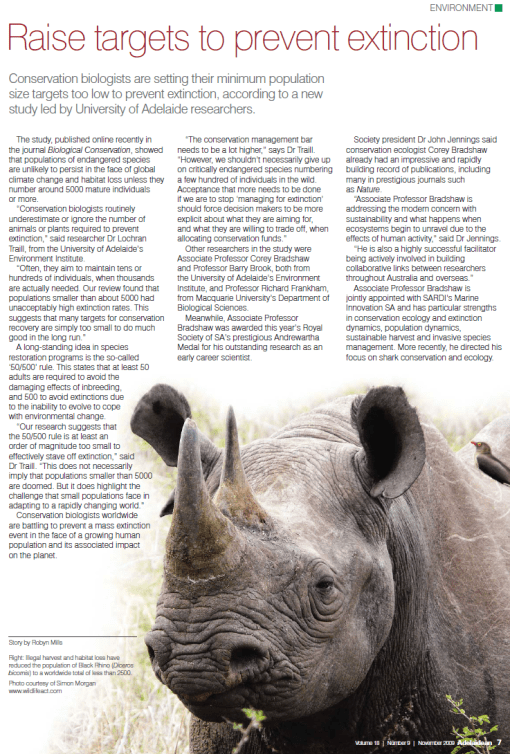
Adelaidean story Nov 2009

Share:

  • Share on Bluesky (Opens in new window) Bluesky
  • Share on Mastodon (Opens in new window) Mastodon
  • Share on LinkedIn (Opens in new window) LinkedIn
  • Share on Reddit (Opens in new window) Reddit
  • Share on Facebook (Opens in new window) Facebook
  • Share on Pinterest (Opens in new window) Pinterest
  • Share on Pocket (Opens in new window) Pocket
  • Share on Tumblr (Opens in new window) Tumblr
  • Share on Telegram (Opens in new window) Telegram
  • Share on WhatsApp (Opens in new window) WhatsApp
  • Email a link to a friend (Opens in new window) Email
  • Print (Opens in new window) Print
Like Loading...

Related

« Susceptibility of sharks, rays and chimaeras to global extinction Crap environmental reporting »


Actions

  • rss Comments RSS
  • trackback Trackback

Information

  • Date : Thu, 12 Nov 2009
  • Tags: biodiversity, conservation, minimum viable population, science
  • Categories : conservation, conservation biology, ecological triage, investment, living dead, management, minimum viable population, mvp, population viability analysis, PVA, Red List, threatened species

Leave a comment Cancel reply


The science of ... saving life

CJAB

CJAB

I am the Matthew Flinders Professor of Global Ecology at Flinders University.

View Full Profile →

Follow ConservationBytes.com on WordPress.com

Stats

  • 3,368,875 views
  • GitHub
  • Google
  • Bluesky
  • Mastodon
  • Facebook
  • LinkedIn
  • Instagram
  • SoundCloud

Top Posts

  • Our pets are predators
    Our pets are predators
  • The dingo is a true-blue, native Australian species
    The dingo is a true-blue, native Australian species
  • Killing (feral) cats quickly (and efficiently)
    Killing (feral) cats quickly (and efficiently)
  • How to write a scientific paper
    How to write a scientific paper
  • We're sorry, but 50/500 is still too few
    We're sorry, but 50/500 is still too few
  • Conservation quotes: Attenborough to Irwin
    Conservation quotes: Attenborough to Irwin
  • Rextinct: a new tool to estimate when a species went extinct
    Rextinct: a new tool to estimate when a species went extinct
  • Conservation hypocrisy
    Conservation hypocrisy
  • Conservation research rarely equals conservation
    Conservation research rarely equals conservation
  • Earth's second lung has emphysema
    Earth's second lung has emphysema
Nov 2009
M T W T F S S
 1
2345678
9101112131415
16171819202122
23242526272829
30  
« Oct   Dec »

RECENT POSTS

Our pets are predators

Our pets are predators

Those of us living with cats share our homes with an ancestral predator, one adapted for hunting and the frequent, exclusive consumption of meat. These instincts become fully activated outside the domestic environment, where cats pose a global threat to wildlife. Pets are family. We celebrate their arrival with the same joy as a grand…

CJAB's avatar by CJAB Wed, 21 Jan 2026Wed, 21 Jan 2026
Fear of humans

Fear of humans

Many animals avoid contact with people. In protected areas of the African savanna, mammals flee more intensely upon hearing human conversations than when they hear lions or sounds associated with hunting. This fear of humans affects how species use and move in their habitat. Throughout our lives, we interact with hundreds of wildlife species without…

CJAB's avatar by CJAB Thu, 28 Aug 2025Thu, 28 Aug 2025
A long life can be a disadvantage

A long life can be a disadvantage

Deep-sea sharks include some of the longest-lived vertebrates known. The record holder is the Greenland shark, with a recently estimated maximum age of nearly 400 years. Their slow life cycle makes them vulnerable to fisheries. Humans rarely live longer than 100 years. But many other animals and plants can live for several centuries or even millennia, particularly…

CJAB's avatar by CJAB Thu, 12 Jun 2025Sat, 14 Jun 2025

Links

    Log in


    Create a website or blog at WordPress.com
    • Comment
    • Reblog
    • Subscribe Subscribed
      • ConservationBytes.com
      • Join 2,777 other subscribers.
      • Already have a WordPress.com account? Log in now.
      • ConservationBytes.com
      • Subscribe Subscribed
      • Sign up
      • Log in
      • Copy shortlink
      • Report this content
      • View post in Reader
      • Manage subscriptions
      • Collapse this bar
     

    Loading Comments...
     

      %d


