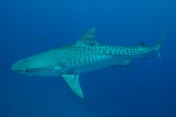
© R. Harcourt
Tue, 10 Nov 2009 16:05
© R. Harcourt
Quite some time ago my colleague and (now former) postdoctoral fellow, Iain Field, and I sat down to examine in gory detail the extent of the threat to global populations of sharks, rays and chimaeras (chondrichthyans). I don’t think we quite realised the mammoth task we had set ourselves. Several years and nearly a hundred pages later, we have finally achieved our goal.
Introducing the new paper in Advances in Marine Biology entitled Susceptibility of sharks, rays and chimaeras to global extinction by Iain Field, Mark Meekan, Rik Buckworth and Corey Bradshaw.
The paper covers the following topics:
- Niche breadth
- Age and growth
- Reproduction and survival
- Fishing
- Beach meshing
- Habitat loss
- Pollution and non-indigenous species
- Drivers of threat risk in chondrichthyans and teleosts
- Global distribution of threatened chondrichthyan taxa
- Ecological, life history and human-relationship attributes
- Threat risk analysis
- Relative threat risk of chondrichthyans and teleosts
- Ecosystem roles of predators
- Predator loss in the marine realm
- Ecosystem roles of chondrichthyans
- Role of fisheries in future chondrichthyan extinctions
- Climate change
- Extinction synergies
- Research needs
 As mentioned, quite a long analysis of the state of sharks worldwide. Bottom line? Well, as most of you might already know sharks aren’t doing too well worldwide, with around 52 % listed on the IUCN’s Red List of Threatened Species. This compares interestingly to bony fishes (teleosts) that, although having only 8 % of all species Red-Listed, are generally in higher-threat Red List categories. We found that body size (positively) and geographic range (negatively) correlated with threat risk in both groups, but Red-Listed bony fishes were still more likely to be categorised as threatened after controlling for these effects.
 In some ways this sort of goes against the notion that sharks are inherently more extinction-prone than other fish – a common motherhood statement seen at the beginning of almost all papers dealing with shark threats. What it does say though is that because sharks are on average larger and less fecund than your average fish, they tend to bounce back from declines more slowly, so they are more susceptible to rapid environmental change than your average fish. Guess what? We’re changing the environment pretty rapidly.
We also determined the spatial distribution of threat, and found that Red-Listed species are clustered mainly in (1) south-eastern South America; (2) western Europe and the Mediterranean; (3) western Africa; (4) South China Sea and South East Asia and (5) south-eastern Australia.
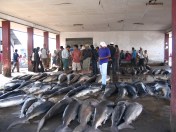
© W. White
Now, what are the implications for the loss of these species? As I’ve blogged recently, the reduction in predators in general can be a bad thing for ecosystems, and sharks are probably some of the best examples of ecosystem structural engineers we know (i.e., eating herbivores; ‘controlling’ prey densities, etc.). So, we should be worried when sharks start to disappear. One thing we also discovered is that we still have a rudimentary understanding of how climate change will affect sharks, the ways in which they structure ecosystems, and how they respond to coastal development. Suffice it to say though that generally speaking, things are not rosy if you’re a shark.
We end off with a recommendation we’ve been promoting elsewhere – we should be managing populations using the minimum viable population (MVP) size concept. Making sure that there are a lot of large, well-connected populations around will be the best insurance against extinction.


 I.C. Field, M.G. Meekan, R.C. Buckworth, & C.J.A. Bradshaw (2009). Susceptibility of Sharks, Rays and Chimaeras to Global Extinction Advances in Marine Biology, 56, 275-363 : 10.1016/S0065-2881(09)56004-X
Posted by CJAB
Categories: climate change, exploitation, extinction, fish, fisheries, harvest, illegal fishing, IUU fishing, management, marine protected area, minimum viable population, mvp, PVA, shark
Tags: biodiversity, conservation, marine, science, shark
Mobile Site | Full Site
Get a free blog at WordPress.com Theme: WordPress Mobile Edition by Alex King.
[…] make some species more vulnerable to extinction than others (see examples for legumes, amphibians, sharks & teleosts, and mammals), one of the main ones is species […]
LikeLike
By It’s not always best to be the big fish | ConservationBytes.com on Wed, 3 Feb 2016 at 20:30
[…] Indonesia is the world’s largest commercial fishing nation for sharks, but this is made worse by a lot of Chinese- and other nation-financed fishing in the region, […]
LikeLike
By Empty seas coming to a shore near you « ConservationBytes.com on Thu, 12 Jul 2012 at 20:45
[…] could assist in designing fishing lures that were less attractive to sharks, thus reducing unwanted bycatch. Well again, my same trepidation holds. I think if baits are used, the shark would use smell and […]
LikeLike
By Colour-blind sharks « ConservationBytes.com on Thu, 3 Feb 2011 at 10:50
Press release for this paper here
LikeLike
By CJAB on Tue, 17 Nov 2009 at 20:05
[…] This post was mentioned on Twitter by paulhjimerson, ConservationBytes. ConservationBytes said: Susceptibility of sharks to global extinction http://wp.me/phhT4-Nl New post on ConservationBytes.com @conservbytes […]
LikeLike
By Tweets that mention Susceptibility of sharks, rays and chimaeras to global extinction « ConservationBytes.com -- Topsy.com on Tue, 10 Nov 2009 at 16:09