Rare just tastes better

11 02 2009

I had written this a while ago for publication, but my timing was out and no one had room to publish it. So, I’m reproducing it here as an extension to a previous post (That looks rare – I’ll kill that one).

As the international market for luxury goods expands in value, extent and diversity of items (Nueno & Quelch 1998), the world’s burgeoning pool of already threatened species stands to worsen. Economic theory predicts that harvested species should eventually find refuge from over-exploitation because it simply becomes too costly to find the last remaining wild individuals (Koford & Tschoegl 1998). However, the self-reinforcing cycle of human greed (Brook & Sodhi 2006) can make rare species increasingly valuable to a few select consumers such that mounting financial incentives drive species to extinction (Courchamp et al. 2006). The economic and ecological arguments are compelling, but to date there has been little emphasis on how the phenomenon arises in the human thought process, nor how apparently irrational behaviour can persist. Gault and colleagues (2008) have addressed this gap in a paper published recently in Conservation Letters by examining consumer preferences for arguably one of the most stereotypical luxury food items, caviar from the 200-million-year-old sturgeon (Acipenser spp.).

Sturgeon (6 genera) populations worldwide are in trouble, with all but two of the 27 known species threatened with extinction (either Near Threatened, Vulnerable, Endangered or Critically Endangered) according to the International Union for Conservation of Nature and Natural Resources’ (IUCN) Red List of Threatened Species. Despite all 27 species also having strict international trade restrictions imposed by the Convention on International Trade in Endangered Species (CITES) (Gault et al. 2008), intense commercial pressure persists for 15 of these at an estimated global value exceeding US$200 million annually (Pikitch et al. 2005). The very existence of the industry itself and the luxury good it produces are therefore, at least for some regions, unlikely to endure over the next decade (Pala 2007). What drives such irrational behaviour and why can we not seem to prevent such coveted species from spiralling down the extinction vortex?

Gault and colleagues addressed this question specifically in an elegantly simple set of preference experiments targeting the very end-consumers of the caviar production line – French connoisseurs. Some particularly remarkable results were derived from presentations of identical caviar; 86 % of attendees of luxury receptions not only preferred falsely labelled ‘rarer’ Siberian caviar (A. baeri) after blind tasting experiments, they also scored what they believed was caviar from the rarer species as having a higher ‘gustative quality’. These high-brow results were compared to more modest consumers in French supermarkets, with similar conclusions. Not only were unsuspecting gourmands fooled into believing the experimental propaganda, subjects in both cases stated a preference for seemingly rarer caviar even prior to tasting.

The psycho-sociological implications of perceived rarity are disturbing themselves; but Gault and colleagues extended their results with a mathematical game theory model demonstrating how irrational choices drive just such a harvested species to extinction. The economic implications of attempting to curb exploitation as species become rarer when the irrationality of perceived rarity was taken into consideration were telling – there is no payoff in delaying exploitation as more and more consumers are capable of entering the market. In other words, the assumption that consumers apply a positive temporal discount rate to their payoff (Olson & Bailey 1981) is wrong, with the demographic corollary that total depletion of the resource ensues. The authors contend that such artificial value may drive the entire luxury goods market based mainly on the self-consciousness and social status of consumers able to afford these symbols of affluence.

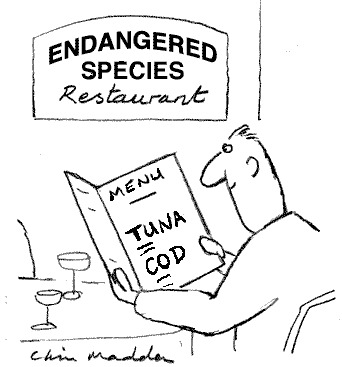
The poor record of species over-exploitation by humans arising from the Tragedy of the Commons (Hardin 1968) is compounded by this new information. This anthropogenic Allee effect (Courchamp et al. 2006) provides a novel example mechanism for how small populations are driven ever-downward because low densities ensure declining fitness. Many species may follow the same general rules, from bluefin tuna, Napoleon wrasse lips and shark fins, to reptile skins and Tibetan antelope woollen shawls. Gault and colleagues warn that as the human population continues to expand and more people enter the luxury-goods market, more wildlife species will succumb to this Allee effect-driven extinction vortex.

The authors suggest that a combination of consumer education and the encouragement of farmed substitute caviar will be more effective than potentially counter-productive trading bans that ultimately encourage illegal trade. However, the preference results suggest that education might not promote positive action given that reluctance of affluent consumers to self-limit. I believe that the way forward instead requires a combination of international trade bans, certification schemes for ‘sustainable’ goods that flood markets to increase supply and reduce price, better controls on point-of-origin labelling, and even state-controlled ‘warning’ systems to alert prospective consumers that they are enhancing the extinction risk of the very products they enjoy. A better architecture for trading schemes and market systems that embrace long-term persistence can surely counteract the irrationality of the human-induced destruction of global ecosystem services. We just need to put our minds and pocketbooks to the task.

CJA Bradshaw

Add to FacebookAdd to NewsvineAdd to DiggAdd to Del.icio.usAdd to StumbleuponAdd to RedditAdd to BlinklistAdd to Ma.gnoliaAdd to TechnoratiAdd to Furl


Man bites shark

7 01 2009

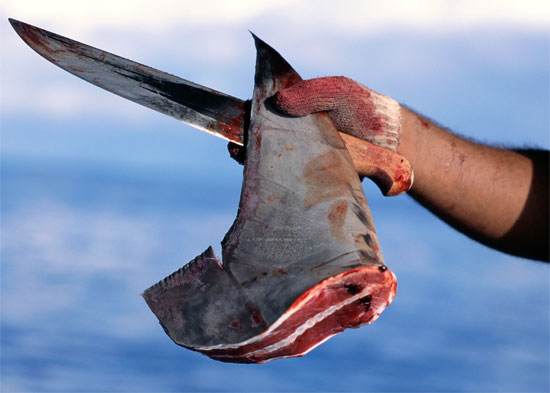
cut-shark-finYesterday I had a comment piece of the same title posted on the ABC‘s Unleashed site. I have permission to reproduce it here on ConservationBytes.com.

The silly season is upon us again, and I don’t mean the commercial frenzy, the bizarre fascination with a white-bearded man or a Middle-Eastern baby, the over-indulgence at the barbie or hangovers persisting several days into the New Year. I mean it’s the time of year when beach-goers, surfers, and municipal and state policy makers go a bit ga-ga over sharks.

There are few more polite pleasures than heading down to the beach during the holidays for a surf, quick dip or just a laze under the brolly. Some would argue it’s an inalienable Australian right and that anything getting in our way should be condemned to no less than severe retribution. Well, in the case of sharks, that’s exactly what’s happened.

Apart from a good number of adrenalin-addicted surfers and mad marine scientists, most people are scared shitless by the prospect of even seeing a shark near the beach, let alone being bitten or eaten by one. I won’t bore you with some ill-advised, pseudo-psycho-analytical rant about how it’s all the fault of some dodgy 1970s film featuring a hypertrophied American shark; the simple fact is that putative prey don’t relish the thought of becoming a predator’s dinner.

So, Australia is famous for its nearly 100-year-old pioneering attempt to protect marine bathers from shark attack by setting an elaborate array of shark nets around the country’s more frequented beaches. Great, you say? Well, it’s actually not that nice.

Between December 1990 and April 2005, nearly 3500 sharks and rays were caught in NSW beach nets alone, of which 72 per cent were found dead. Shark spearing was a favourite past-time in the 1960s and 1970s, with at least one high-profile species, the grey nurse shark, gaining the dubious classification of Critically Endangered as a result. Over-fishing of reef sharks has absolutely hammered two formerly common species in the Great Barrier Reef, the whitetip and grey reef sharks (See the Ongoing Collapse of Coral-Reef Shark Populations report). And illegal Indonesian fishing in northern Australia is slowly depleting many shark species in a wave of protein mining that has now penetrated the Australian Exclusive Economic Zone.

Despite the gloomy outlook for sharks, I’m happy to say today that we are a little more aware of their plight and are making baby steps toward addressing the problems. Australia has generally fared better in shark conservation than most other parts of the world, even though we still have a lot of educating to do at home. Over 50 per cent of all chondrichthyans (i.e., sharks, rays and chimaeras) are threatened worldwide, with some of the largest and most wide-ranging species being hardest hit, including white sharks. The most common threat is over-fishing, but this is largely seen by the lay person as of little import simply because of the persistent attitude that “the only good shark is a dead shark”.

The attitude is, however, based on a complete furphy. I’m sure many readers would have seen some statistics like the following before, but let’s go through the motions just to be clear. Dying from or even being injured by a shark is utterly negligible. Based on the International Shark Attack File data for Australia, there were 110 confirmed (unprovoked) shark attacks in Australian waters between 1990 and 2007, of which 19 were fatal. Using Australian Bureau of Statistics human population data over the same period, this equates to an average of 0.032 attacks and 0.006 fatalities per 100,000 people, with no apparent trend over the last two decades.

Now let’s contrast. I won’t patronise you with strange comparative statistics like the probability of being killed by a (provoked) vending machine or by being hit by a bus, they are both substantially greater, but I will relate these figures to water-based activities. Drowning statistics for Australia (1992-1997) show that there were around 1.44 deaths per 100,000 people per year, or approximately 0.95 if just marine-related drownings are considered. These values are 240 (158 for marine-only) times higher than those arising from shark attack.

It’s just plainly, and mathematically, ridiculous to be worried about being eaten by a shark when swimming in Australia, whether or not there’s a beach net in place. The effort made, money spent and anxiety arising from the illogical fear that a shark will consider your sunburnt flesh a tasty alternative to its fishier sustenance is not only regrettable, it’s an outright crime against marine biodiversity. Of course, if you see a big shark lurking around your favourite beach, I wouldn’t recommend swimming over and giving it a friendly pat on the dorsal fin, but I wouldn’t recommend screaming that the marine equivalent of the apocalypse has just arrived either.

You may not be fussed either way, but consider this – the massive reduction in sharks worldwide is having a cascading effect on many of the ocean’s complex marine ecosystems. Being largely carnivorous, sharks are the ecological equivalent of community planners. Without them, herbivorous or coral-eating fish can quickly get out of control and literally destroy the food web. A great example comes from the Gulf of Mexico where the serial depletion of 14 species of large sharks has caused an explosion of the smaller cownose ray that formerly was kept in check by its bigger and hungrier cousins. The result: commercially harvested scallops in the region have now collapsed because of the hordes of shellfish-eating rays.

The day you fail to find sharks cruising your favourite beach is the day you should really start to worry.

CJA Bradshaw

Add to FacebookAdd to NewsvineAdd to DiggAdd to Del.icio.usAdd to StumbleuponAdd to RedditAdd to BlinklistAdd to Ma.gnoliaAdd to TechnoratiAdd to Furl


Threatened species depend on protected areas

4 09 2008

One for the Potential list:

3932397_origA great new paper has just come out in Global Change Biology by Sarah Jackson and Kevin Gaston: Land use change and the dependence of national priority species on protected areas. In what is simultaneously frightening and ecouraging is the observation that of nearly 400 Biodiversity Action Plan (BAP) species considered either to be globally threatened or rapidly declining in the UK (i.e., > 50 % decline over 25 years), 55 % were largely restricted to statuatory protected areas in the UK. These areas cover about 11.5 % of Britain’s land surface.

What’s amazing about this is that without these reserves, these (hundreds) of species would already be extinct (or very close to it) – if this isn’t one of the strongest arguments for reserves, I don’t know what is. Not only are reserves essential for maintaining populations of threatened species, their spatial connectivity is also highly influential on persistence probability (future posts on fragmentation coming).

Much of the planet has now been modified to the point where any sort of species preservation will necessarily require large, expansive, contiguous networks of protected areas. Jackson & Gaston conclude:

Britain has undergone particularly extensive land transformation, reducing many originally much more widespread vegetation/habitat types to scattered fragments, few of which can be considered strictly natural (Rackham, 1986). A proportion of these fragments receive statutory protection and intensive management, increasing the likelihood that species of conservation concern are restricted to such areas. This circumstance is not unique to Britain, being found in many heavily developed regions including much of northwestern Europe, although it is not so extreme in many others. Britain may, thus, represent a possible future scenario for such regions. Under such circumstances, it is not unlikely that many species if they are not already restricted to protected areas will become so (e.g. species confined to tropical forest habitats following deforestation).

 Keeping things off limits from the burgeoning human population is therefore one of the major ways we can stem the tide of extinctions.

CJA Bradshaw

Add to FacebookAdd to NewsvineAdd to DiggAdd to Del.icio.usAdd to StumbleuponAdd to RedditAdd to BlinklistAdd to Ma.gnoliaAdd to TechnoratiAdd to Furl


Classics: Red List of Threatened Species

22 08 2008

‘Classics’ is a category of posts highlighting research that has made a real difference to biodiversity conservation. All posts in this category will be permanently displayed on the Classics page of ConservationBytes.com

3_en_redlist_rgb_sitoMace, G.M. & Lande, R. (1991). Assessing extinction threats: toward a re-evaluation of IUCN threatened species categories. Conservation Biology, 51, 148-157.

I was recently fortunate enough to have the chance to speak with Georgina Mace, current president of the Society for Conservation Biology, to ask her which was the defining paper behind the hugely influential IUCN Red List of Threatened Species. There is little doubt that the Red List has been one of the most influential conservation policy tools constructed. Used as the global standard for the assessment of threat (i.e., extinction risk) for now > 40000 species, the Red List is the main tool by which most people judge the status, extinction risk, and recovery potential of threatened species worldwide. Far from complete (e.g., it covers about 2 % of described species), the Red List is an evolving and improving assessment by the world’s best experts. It has become very much more than just a ‘list’.

Indeed, it is used often in the conservation ecology literature as a proxy for extinction risk (although see post on Minimum Viable Population size for some counter-arguments to that idea). We’ve used it that way ourselves in several recent papers (see below), and there are plenty of other examples. From extinction theory to policy implementation, Mace & Lande’s contribution to biodiversity conservation via the Red List was a major step forward.

See also:

CJA Bradshaw

Add to FacebookAdd to NewsvineAdd to DiggAdd to Del.icio.usAdd to StumbleuponAdd to RedditAdd to BlinklistAdd to Ma.gnoliaAdd to TechnoratiAdd to Furl