Reality check: coral restoration won’t save the world’s reefs

8 04 2025
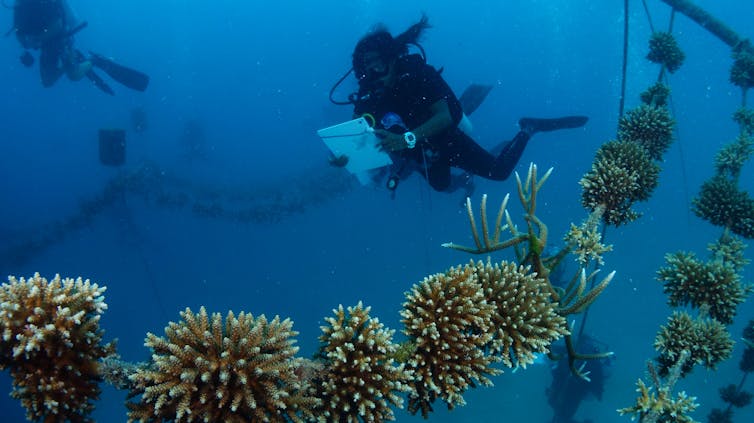
A coral ‘rope’ nursery in the Maldives. Luca Saponari/University of Milan, CC BY-ND

Corey J. A. Bradshaw, Flinders University; Clelia Mulà, The University of Western Australia, and Giovanni Strona, University of Helsinki


Coral reefs are much more than just a pretty place to visit. They are among the world’s richest ecosystems, hosting about a third of all marine species.

These reefs also directly benefit more than a billion people, providing livelihoods and food security, as well as protection from storms and coastal erosion.

Without coral reefs, the world would be a much poorer place. So when corals die or become damaged, many people try to restore them. But the enormity of the task is growing as the climate keeps warming.

In our new research, we examined the full extent of existing coral restoration projects worldwide. We looked at what drives their success or failure, and how much it would actually cost to restore what’s already been lost. Restoring the reefs we’ve already lost around the world could cost up to A$26 trillion.

Closeup of a bleached (white) coral in blue water
Bleached Acropora corals in the Maldives. Davide Seveso/University of Milan

Global losses

Sadly, coral reefs are suffering all over the world. Global warming and marine heatwaves are the main culprits. But overfishing and pollution make matters worse.

When sea temperatures climb above the seasonal average for sustained periods, corals can become bleached. They lose colour as they expel their symbiotic algae when stressed, revealing the white skeleton underneath. Severe bleaching can kill coral.

Read the rest of this entry »


Citizens meet coral gardening

12 10 2021

It is possible to cultivate corals in the sea like growing a nursery of trees to restore a burned forest. Cultivated corals grow faster than wild corals and can be outplanted to increase the healthy area of damaged reefs. Incorporated in projects of citizen science and ecotourism, this activity promotes environmental awareness about coral reefs, the marine ecosystem that is both the most biodiverse and the most threatened by global change.


When I finished by undergraduate studies in the 1980s, I met several top Spanish marine biologists to prospect my first job ever in academia. In all one-to-one interviews I had, I was asked what my interests were. And when I described that I wanted to study ways of modifying impacted marine ecosystems to restore their biodiversity, a well-known professor judged that my proposition was an inviable form of jardinería marina (marine gardening) ― those words made me feel embarrassed and have remained vivid in my professional imagination since. Neither the expert nor the young researcher knew at the time that we were actually talking about ecological restoration, a discipline that was being formalised exactly then by botanists in their pledge to recover pre-European conditions for North American grasslands (1).

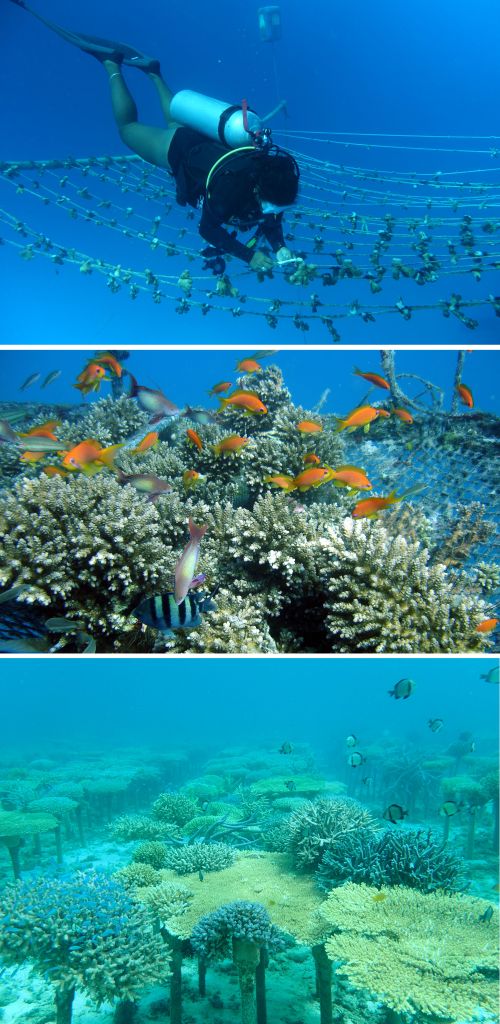
Aspects of coral gardening. The photos show (top) a diver scraping off (with the aid of a toothbrush) algae, sponges and parasites that compete for light and nutrients with the coral fragments under cultivation along suspended ropes (Cousin Island, Seychelles), (middle) coral outplantings in the Gulf of Eliat (Red Sea) hosting a diverse community of fish that clean off the biofouling for free (21), and (bottom) a donor colony farmed off Onna (Okinawa, Japan) (12). Photos courtesy of Luca Saponari (Cousin), Buki Rinkevich (Eliat) and Yoshimi Higa / Onna Village Fishery Cooperative.

Today, the term coral gardening encompasses the suite of methods to cultivate corals (tiny colonial jellyfish with an external skeleton and a carnivorous diet) and to outplant them into the wild to boost the growth of coral reefs following perturbations (2). In the face of the decline of coral reefs globally, due to the combination of climate change, pollution, and overfishing (3), this type of mariculture has gathered momentum in the last three decades and is currently being applied to more than 100 coral species in all the main reefs of our seas and oceans (4-6).

Read the rest of this entry »