A few weeks ago we published a paper that was in the works for a long time, so long in fact that one of my co-authors died before it was published online.
That co-author was none other than the legendary Paul Ehrlich of Stanford University, and of The Population Bomb fame (and infamy). More importantly, but often overlooked, Paul wrote more than 700 scientific articles and 30 books during his career.
Paul Ehrlich died on 13 March 2026 at the ripe old age of 93, exactly two weeks before our article appeared online. Paul had a good innings no doubt, but I wish he had survived long enough to see what might very well be his last co-authored paper.
I first met Paul back in the mid-2000s during a trip through San Francisco. I had organised to come chat with Professor Gretchen Daily at Stanford, and Paul came along for lunch. I remember vividly how we clicked almost immediately.
We clicked so well in fact, that we wrote a book together, co-authored several high-impact papers (e.g., ‘ghastly future‘), spent a month in Bellagio as Rockefeller Foundation writing residents, participated in various public and parliamentary presentations, and generally just got on like a house on fire. Paul and his wife Ann became like family, so much so that they were de facto grandparents to my daughter who grew up with them in near-annual contact.
This post isn’t about Paul per se, but I cannot ignore the profound influence Paul had on my career, my personality, and my life view. I miss him. I am therefore dedicating this paper and post to his memory. So long, and thanks for all the fish.
Back to the paper in question.
The paper (Global human population has surpassed Earth’s sustainable carrying capacity) has already been downloaded nearly 23,000 times since it was published less than a month ago. It has an Altmetric score of 543, and is currently the top-trending paper in Environmental Research Letters.
Nothing like writing about human population to get the punters engaged.

We show empirically that the Earth has already exceeded its ability to support the global human population sustainably, with dire implications for increasing pressure on food security, climate stability, and human wellbeing. However, slowing population growth and raising global awareness could still offer us some hope.
Our study shows that humans have pushed well beyond the planet’s long-term carrying capacity and that continued growth under current patterns of consumption will intensify environmental and social challenges for communities worldwide.
We examined more than two centuries of global population data and uncovered a major shift in human population dynamics that began in the mid-twentieth century. The trend reveals a clear biological signal that humanity is living far beyond what the Earth can support.
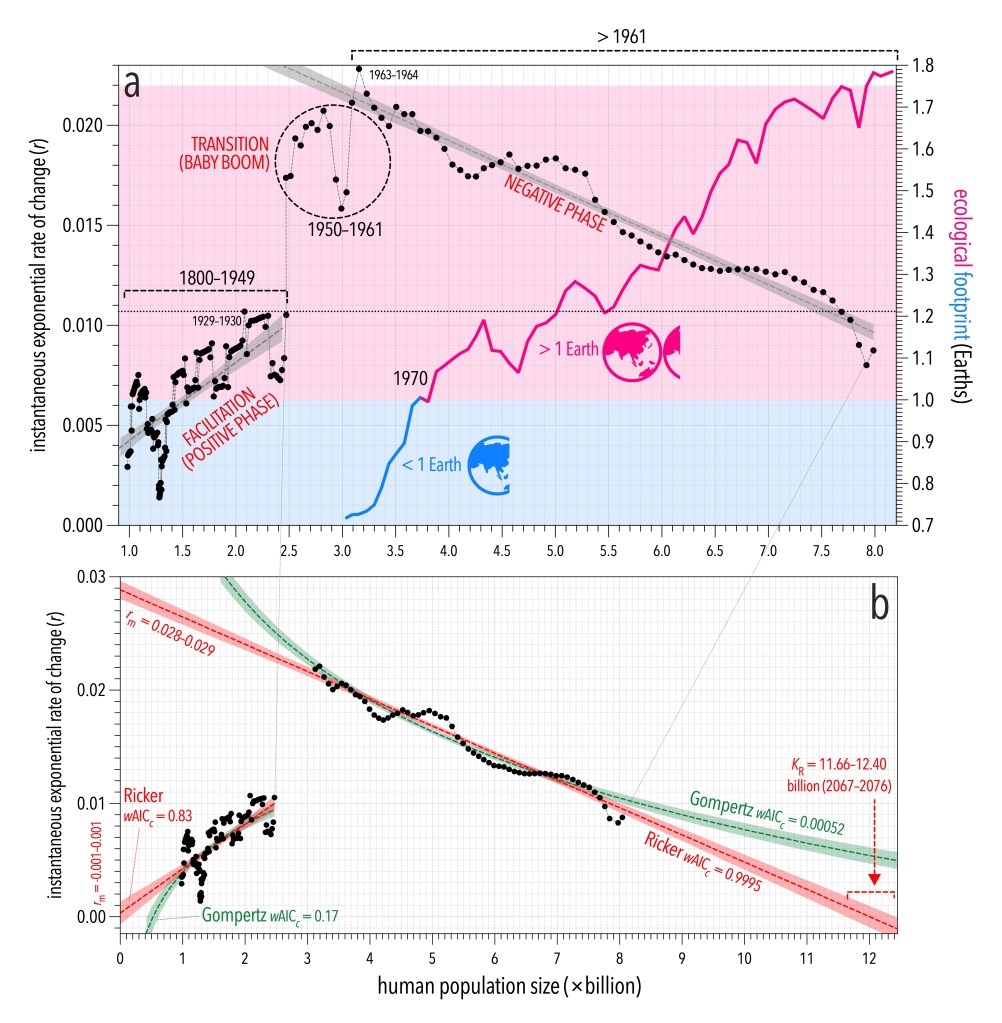
(a) Relationship between the instantaneous (annual) exponential rate of change (r = loge(Nt+1/Nt) and population size (N) at year t from 1800 to 2023. There is a positive relationship between r and Nt from 1800 to 1949, indicating facilitation. The dotted horizontal line intersecting 1929–1930 indicates the highest r observed during the facilitation phase (0.011). Following WWII through the 1950s, there was a period of transition toward high r, but no relationship with Nt, and then the establishment of a negative r ∼ Nt relationship from around 1961–1962 to the present. Also shown on the right y axis is the ecological footprint expressed in terms of number of Earth’s required to meet global human consumption — at 1 ‘Earth’, the global ecological footprint (ecological assets the global population requires to produce the natural resources it consumes and to absorb its wastes) equals the Earth’s biocapacity (productivity of ecological assets, including cropland, grazing land, forest land, fishing grounds, and built-up land). The global ecological footprint has exceeded the Earth’s biocapacity since 1970 (transition from blue to pink). (b) Ricker and Gompertz logistic relationships for the facilitation and negative phases (Akaike’s information criterion weights wAICc shown for each model for each phase) indicate most support for the Ricker model. Extending the fitted Ricker relationship between r and Nt to where r (y) = 0 indicates maximum (biophysical) global population size (KR = −intercept ÷ slope). Assuming no deviation from this expected relationship, KR = 11.66–12.40 billion people predicted to occur between 2065 and 2074. Red (Ricker) and green (Gompertz) shading around logistic fits indicate 95% confidence intervals.
We show that the Earth cannot keep up with the way in which we are using resources. It cannot support even today’s demand without major changes. We analysed global population data using ecological growth models to track how population size and growth rates have changed over time. We tested the direction of these trends and compared results across world regions. We also measured how population size has historically aligned with changes in climate, emissions, and the ecological footprint to understand how human numbers cause environmental stress.
Before the 1950s, global population growth actually sped up as human abundance increased. More people meant more innovation, more energy use, and more rapid technological development that supported further expansion.
However, this pattern broke down in the early 1960s when the global growth rate began to fall even as the population continued to rise. This shift marked the beginning of what we call ‘a negative demographic phase”, meaning that adding more people no longer translated into faster growth. When we examined this phase, we found the global population is likely to peak somewhere between 11.7 and 12.4 billion people by the late 2060s or 2070s if current trends hold.
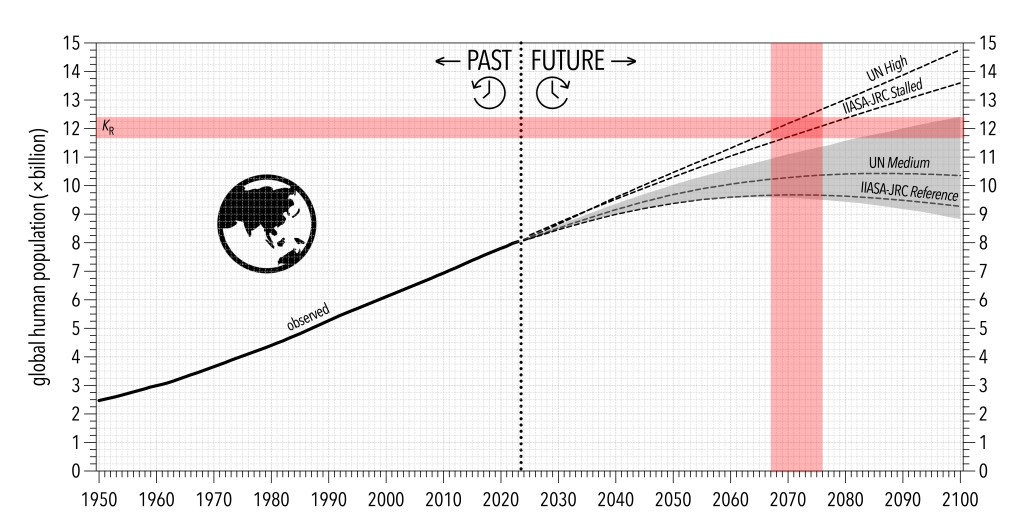
Past trajectory and future projections of the global human population from the most-plausible models of the United Nations (UN) and IIASA-JRC. Dotted black lines are the Medium and High scenarios from the UN, and the Reference and Stalled scenarios from the IIASA-JRC; grey-shaded area is the 95% confidence interval for the UN Probabilistic Population Projections. Red shading indicates the maximum human carrying capacity derived from the Ricker model (KR = 11.66–12.40) and timing (2067–2076).
This upper limit is dangerous and has only been possible to date because human societies have relied on fossil fuels and drained natural resources faster than nature can replace them. The truly sustainable population is much lower and closer to what the world supported in the mid-twentieth century. Our calculations show a sustainable global population closer to about 2.5 billion people if everyone were to live within ecological limits and comfortable, economically secure living standards.
The enormous gap between that sustainable number and today’s population of now 8.3 billion highlights the scale of global overconsumption. This overshoot has been hidden for decades by heavy reliance on fossil fuels, which boosted food production, energy supply, and industry, but also accelerated climate change and pollution.
Our analysis shows a strong link between increasing population size and rising global temperatures, larger ecological footprints, and higher carbon emissions during the negative phase. And total population size explained more variation in these environmental indicators than per-capita consumption. This highlights how both human numbers and consumption patterns jointly intensify environmental stress, meaning that humanity’s current path will push societies into deeper crises unless we make major changes.
The planet’s life support systems are already under strain and without rapid shifts in how we use energy, land, and food, billions of people will face increasing instability. Our study shows these limits are not theoretical but unfolding right now.
But we emphasise that our study does not predict sudden collapse, but instead offers a realistic assessment of the long-term pressures shaping humanity’s future. The consequences of overshooting Earth’s ‘biocapacity’ include stronger climate impacts, declining biodiversity, reduced food and water security, and widening inequality.
Society must therefore rethink how it uses land, water, energy, and materials if future generations are to live safe and stable lives. Smaller populations with lower consumption create better outcomes for both people and the planet, but the window to act is narrowing. Meaningful change is only achievable if nations work together.
We hope our findings encourage governments, organisations, and communities to plan for the long term, recognise Earth’s environmental limits, and focus on strategies that reduce consumption, stabilise population, and protect natural systems (but I doubt they will listen). The choices we make over the coming decades will determine the wellbeing of future generations and the resilience of the natural world that supports all life.
But I’m not holding my breath.
(I also thank my other fantastic co-authors: Melinda Judge, Dan Blumstein, Aisha Dasgupta, Mathis Wackernagel, Lewis Weeda, and Peter Le Souëf).






Leave a Reply