Primate conservation enhances human food availability

19 09 2008

This one from Mongabay.com – yet another reason to conserve species for human benefit…

© F. Möllers

© F. Möllers

Primate conservation may have the unintended benefit of enhancing food availability to humans, reports a study [Koné et al. 2008. Primate seed dispersal and its potential role in maintaining useful tree species in the Taï region, Côte-d’Ivoire: implications for the conservation of forest fragments. Tropical Conservation Science 1:293-306] led by African scientists.

The research, conducted in the Taï region of Côte-d’Ivoire, found that seven species of monkeys used about 75 species of plants as a source of fruit, of which 25 were also used by local human inhabitants for various purposes. Because monkeys are key seed dispersal agents, the results suggest that primate conservation may sustain the persistence of plant resources important for human livelihoods.

“The cost of losing monkeys extends beyond the loss of the animals themselves,” write the authors. “Indeed, the local extinction of frugivorous primates is predicted to have deleterious consequences for forest regeneration and/or tree species community composition.”

The authors, led by Inza Koné from the University of Cocody in Abidjan and the Taï Monkey Project, note that monkeys in the region are already experiencing “extreme hunting pressure” as a source of protein and as crop pests. Primates are also threatened by habitat loss caused by the conversion of forest for agriculture.

Koné and colleagues suggest measures to conserve monkeys will offer multiple benefits to the primates themselves as well as local communities.

“Results of this study suggest that maintaining populations of monkeys is important not only for forest regeneration, but also for human habitat use,” they continue. “The conservation of primate species is a critically important goal in itself; by working to ensure their protection in forest fragments, we protect indirectly the seed dispersal of important human resources in these fragments as well.”

“Protection of monkeys and seed dispersal systems outside protected areas is particularly relevant in this context, since it is in these areas… that primates are most at risk, and also where people are allowed to exploit forest plant resources.”

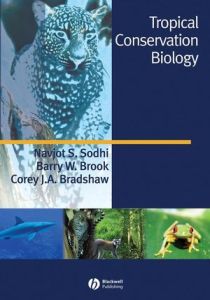


Tropical Conservation Biology

8 09 2008

An obvious personal plug – but I’m allowed to do that on my own blog ;-)

1405150734I’d like to introduce a (relatively) new textbook that my colleagues, Navjot Sodhi and Barry Brook, and I wrote and published last year with Blackwell (now Wiley-Blackwell) Scientific Publishing – Tropical Conservation Biology.

We’re rather proud of this book because it was a timely summary and assessment of the scientific evidence for the degree of devastation facing tropical biodiversity today and in the future. I’ve summarised some of the main issues in a previous post covering a paper we have ‘in press’ that was born of the text book, but obviously the book is a far more detailed account of the problems facing the tropics.

This introductory textbook examines diminishing terrestrial and aquatic habitats in the tropics, covering a broad range of topics including the fate of the coral reefs; the impact of agriculture, urbanisation, and logging on habitat depletion; and the effects of fire on plants and animal survival.

One of the highlights of the book is that each chapter (see below) Includes case studies and interviews with prominent conservation scientists to help situate key concepts in a real world context: Norman Myers (Chapter 1), Gretchen Daily (Chapter 2), William Laurance (Chapter 3), Mark Cochrane (Chapter 4), Daniel Simberloff (Chapter 5), Bruce Campbell (Chapter 6), Daniel Pauly (Chapter 7), Stephen Schneider (Chapter 8), Stuart Pimm (Chapter 9) and Peter Raven (Chapter 10). These biographies are followed by a brief set of questions and answers that focus on some of the most pertinent and pressing issues in tropical conservation biology today. It is our intention that readers of Tropical Conservation Biology will benefit from the knowledge and be inspired by the passion of these renowned conservation experts.

TABLE OF CONTENTS

  1. Chapter 1: Diminishing habitats in regions of high biodiversity. We report on the loss of tropical habitats across the tropics (e.g., deforestation rates). We also highlight the drivers of habitat loss such as human population expansion. Finally, we identify the areas in immediate need of conservation action by elucidating the concept of biodiversity hotspots. Read the rest of this entry »


Native forests reduce the risk of catastrophic floods

20 08 2008

A-Pakistan-Army-helicopte-004Each year extreme floods kill or displace hundreds of thousands of people and cause billions of dollars in damage to property. The consequences of floods are particularly catastrophic in developing countries generally lacking the infrastructure to deal adequately with above-average water levels.

For centuries it has been believed that native forest cover reduced the risk and severity of catastrophic flooding, but there has been strong scientific debate over the role of forests in flood mitigation.

Forest loss is currently estimated at 13 million hectares each year, with 6 million hectares of that being primary forest previously untouched by human activities. These primary forests are considered the most biologically diverse ecosystems on the planet, but this realisation has not halted their immense rate of loss.

Last year my colleagues and I published a paper entitled Global evidence that deforestation amplifies flood risk and severity in the developing world in Global Change Biology (highlighted in Nature and Faculty of 1000) that has finally provided tangible evidence that there is a strong link between deforestation and flood risk. Read the rest of this entry »


Tropical turmoil – a biodiversity tragedy in progress

18 08 2008

fragmentationWe recently published (online) a major review showing that the world is losing the battle over tropical habitat loss with potentially disastrous implications for biodiversity and human well-being.

Published online in the Ecological Society of America’s journal Frontiers in Ecology and the Environment, our review Tropical turmoil – a biodiversity crisis in progress concludes that we are “on a trajectory towards disaster” and calls for an immediate global, multi-pronged conservation approach to avert the worst outcomes.

Tropical forests support more than 60 % of all known species, but represent only about 7 % of the Earth’s land surface. But up to 15 million hectares of tropical rainforest are being lost every year and species are being lost at a rate of up to 10000 times higher than would happen randomly without humans present.

This is not just a tragedy for tropical biodiversity, this is a crisis that will directly affect human livelihoods. This is not just about losing tiny species found in the canopies of big rain forest trees few people will ever see, this is about a complete change in ecosystem services that directly benefit human life. Read the rest of this entry »