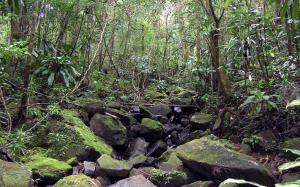
No end in sight for tropical deforestation

20 04 2009

Just a quick one while I wade through the swamp of overdue deadlines.
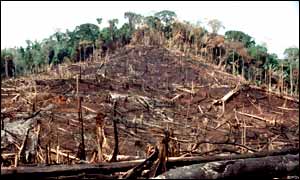
Despite years of conservation biologists telling the world about the woeful state of the world’s forests, the loss of essential ecosystem services and the biodiversity extinction crisis, it seems the message doesn’t really get out. I’m in a state of semi-shock about the following Reuters release on the potential deal to deforest 10 million hectares for agricultural expansion in the Republic of Congo. There isn’t a single mention of the deforestation aspects or what it will mean for the Congolese. Sure, turn your country (the last remaining large tracts of rainforest in Africa) into a paddock, and see how long your ‘food security’ lasts under climate change. From poor to destitute in a matter of decades.

South African farmers have been offered 10 million hectares of farm land to grow maize, soya beans as well as poultry and dairy farming in the Republic of Congo, South Africa’s main farmers union said on Wednesday.

The deal, which covers an area more than twice the size of Switzerland, could be one of the biggest such land agreements on the continent agreed by Congo’s government in an effort to improve food security, Theo de Jager, deputy president of Agriculture South Africa (AgriSA), told Reuters.

South Africa has one of the most developed agriculture sectors on the continent, and is Africa’s top maize producer and No.3 wheat grower.

“They’ve given us 10 million hectares, and that’s quite big when you consider that in South Africa we have about 6 million hectares of land that is arable,” De Jager told Reuters on the sidelines of an agriculture conference in Durban.

De Jager said the agreement — to be finalised in South Africa next month — would operate as a 99-year lease at no cost, with additional tax benefits.

“The offer which we got and we’ve agreed on paper, is a 99-year lease, of which the value would be zero and it’s not allowed to escalate over the 99 years. So it is free use for 99 years,” he said.

The Republic of the Congo’s population of around 4 million people is concentrated in the southwest, leaving the vast areas of tropical jungle in the north virtually uninhabited.

De Jager said some 1,300 South African farmers were keen to farm in the Congo Republic.

“We have two groups of farmers who are interested, one of farmers who want to leave South Africa and relocate entirely to farm over there and another of farmers who want to diversify their farming operations to the Congo,” he said.

“We’ve got guys wanting to get into poultry and dairy farming, as well as maize and soya bean production.”

TAX HOLIDAYS

“It is a tax holiday for the first five years and you’re also exempted from import tax on all your agricultural inputs and equipment,” he said.

“So you can import directly from the source and take all your profits out for the duration of this lease,” he said.

He said there was a government-to-government bilateral agreement on the promotion and protection of investments.

“There are also rules for disengagement, for example if they find oil or minerals on your farm they can move you off, but compensate you for the loss of income and they must give you land to the same value or more in a different area,” he said.

De Jager said food in Congo was expensive because the country lacks an established agriculture sector and most of its foodstuff is imported.

“On their side, (the Congo government) is promising the Congolese that they will be self-sufficient in food production in five years, and the way they want to do it is by importing, according to them, high technology farmers,” De Jager said.

South African farmers had also been invited to farm in Mozambique, Angola, Nigeria, Libya, Kenya, Democratic Republic of Congo, Malawi and Zambia, he said.


Some biodiversity with your coffee, Sir?

7 12 2008

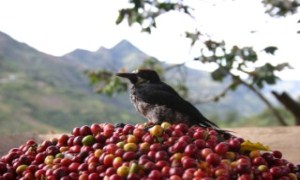
Bird on coffee cherriesI really like my coffee. I’m sure there are a few billion humans who claim likewise, but I think I could safely categorise myself as a coffee snob. I cannot even contemplate placing powdery crystals into a cup of hot water and calling it ‘coffee’, let alone imbibing the toxic concoction. I spend way too much money on very slow-roasted, dark, oily beans that have to be ground to the exact espresso consistency to use in my Bialetti cafettiera, and I’ll search high and low for the best coffee produced in any city in which I live or to where I travel (N.B. Still haven’t found what I call a ‘great’ coffee in the CBD of Adelaide – suggestions welcome). I really, really like good coffee.

What the hell does all this meandering preamble have to do with biodiversity conservation? I’m happy you asked. With environmentally conscious consumers now demanding some sort of ‘green’ certification for many products (e.g., no palm oil, carbon-neutral, fair trade, etc.), coffee has also been targeted as a good product to certify for harvest and production of lower environmental impact than has been done traditionally. Well, how do you measure ‘green-ness’ in a product? For coffee, there are some good ways.

A recent paper (and candidate for the Potential list) by Aaron Gove and colleagues published in Conservation Letters entitled Ethiopian coffee cultivation – implications for bird conservation and environmental certification demonstrates how the cultivation of this NATIVE Ethiopian plant (Coffea arabica) can enhance or restore the biological value of lowland agricultural areas. This species of ‘highland coffee’ is harvested from forests (where it evolved and now grows naturally) and from more intensive farmland. Interestingly, this species needs some shade to grow, so trees must generally be planted in the agricultural areas to allow this. Result? Gove and colleagues found that birds who otherwise wouldn’t be seen dead in the agricultural areas were attracted there by the maintenance and proliferation of the shade trees, thus reducing regional extinction risk for fragmented populations dependent on forest remnants. The flip side was that coffee cultivation in forest remnants reduced bird diversity because of the obvious trade-off between some native trees and intensive agricultural crops.

So, the next time you’re thinking of buying certified coffee, think of this – the cultivation of INDIGENOUS (did I say that loudly enough?) coffee species requiring shade promotes the proliferation of native forest trees to reduce the extinction risk of threatened birds. The number of boxes to tick on my coffee-snobbery list has just grown by two.

CJA Bradshaw

Add to FacebookAdd to NewsvineAdd to DiggAdd to Del.icio.usAdd to StumbleuponAdd to RedditAdd to BlinklistAdd to Ma.gnoliaAdd to TechnoratiAdd to Furl


Oil palm plantations destroying tropical biodiversity

18 09 2008

This one from MongaBay.com

Conversion of primary rainforest to an oil palm plantation results in a loss of more than 80 percent of species, reports a new comprehensive review of the impacts of growing palm oil production. The research is published in the journal Trends in Ecology and Evolution.

“By compiling scientific studies of birds, bats, ants and other species, we were able to show that on average, fewer than one-sixth of the species recorded in primary forest were found in oil palm,” said led author Emily Fitzherbert from the Zoological Society of London and University of East Anglia. “Degraded forest, and even alternative crops such as rubber and cocoa, supported higher numbers of species than oil palm plantations.”

The results confirm that oil palm plantations are a poor substitute for natural forests when it comes to conservation of biological diversity.

The study warns that burgeoning demand for palm oil for use in foods, household products, and biodiesel will continue to fuel expansion in the tropics. Because planters can subsidize operations by the initial logging for forest plots, it seems likely that forests will continue to fall for new plantations despite the availability of large tracts of degraded and abandoned land.

“There is enough non-forested land suitable for plantation development to allow large increases in production without large impacts on tropical forests, but as a result of political inertia, competing priorities and lack of capacity and understanding, not to mention high levels of demand for timber and palm oil from wealthy consumers, it is still often cheaper and easier to clear forests. Unless these conditions change quickly, the impacts of oil palm expansion on biodiversity will be substantial,” the authors conclude.

See also Koh & Wilcove. 2008. Is oil palm agriculture really destroying tropical biodiversity? Conservation Letters 1: 60-64

CJA Bradshaw