Have you ever done any research that relied to any degree on Indigenous Knowledges? How did you cite those Knowledges, if at all?
It’s probably time we rethink how we engage with Indigenous Knowledge systems.
In a new article published in BioScience, we — a large group of Indigenous and non-Indigenous scholars in Australia — call for a fundamental shift in how universities and scientists publish research that draws on Indigenous Knowledges (proper noun; the sum of the understandings, skills, and philosophies developed by Indigenous societies with long histories of interaction with and custodianship of their natural surroundings).
Therein we warn that current academic practices risk sidelining First Nations authority while benefiting from their expertise.
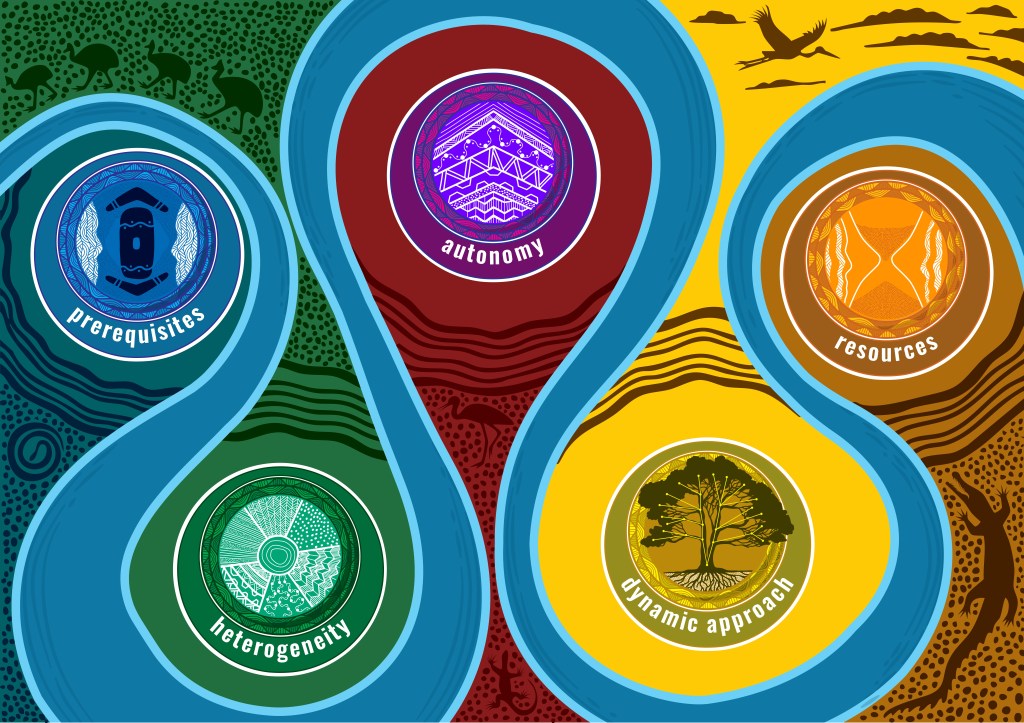
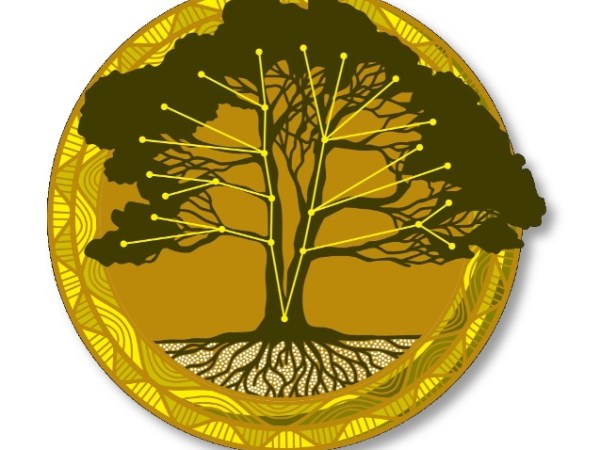
Infographic summarizing the main considerations for crediting and citing Indigenous Knowledges. prerequisites: traditional shield and two boomerangs to represent cultural and legal authority, and framing it with two faces to represent face-to-face conversations; heterogeneity: diversity of First Nations peoples with different patterned backgrounds; autonomy: arrow pointing upward represents First Nations peoples in decision-making position; dynamic approach: decision tree representing formal procedures (also see figure 2 ); fig tree representing staying grounded and being connected to Country; resources : hourglass represent time, also framed by faces. Commissioned original artwork by Tarquin Singleton, Yirrganydji Creative, Red Ochre Republic.
Without question, Indigenous groups must be treated as active partners in research publications — not just contributors acknowledged in footnotes or ‘personal communications’.
Governments, funding bodies, and other institutions increasingly emphasise Indigenous engagement, yet publication practices have failed to keep pace, leaving communities without real control over how their Knowledges are used, cited, or shared.
A few weeks ago we published a paper that was in the works for a long time, so long in fact that one of my co-authors died before it was published online.
Paul Ehrlich died on 13 March 2026 at the ripe old age of 93, exactly two weeks before our article appeared online. Paul had a good innings no doubt, but I wish he had survived long enough to see what might very well be his last co-authored paper.
I first met Paul back in the mid-2000s during a trip through San Francisco. I had organised to come chat with Professor Gretchen Daily at Stanford, and Paul came along for lunch. I remember vividly how we clicked almost immediately.
We clicked so well in fact, that we wrote a book together, co-authored several high-impact papers (e.g., ‘ghastly future‘), spent a month in Bellagio as Rockefeller Foundation writing residents, participated in various public and parliamentary presentations, and generally just got on like a house on fire. Paul and his wife Ann became like family, so much so that they were de facto grandparents to my daughter who grew up with them in near-annual contact.
This post isn’t about Paul per se, but I cannot ignore the profound influence Paul had on my career, my personality, and my life view. I miss him. I am therefore dedicating this paper and post to his memory. So long, and thanks for all the fish.
Nothing like writing about human population to get the punters engaged.
We show empirically that the Earth has already exceeded its ability to support the global human population sustainably, with dire implications for increasing pressure on food security, climate stability, and human wellbeing. However, slowing population growth and raising global awareness could still offer us some hope.
Our study shows that humans have pushed well beyond the planet’s long-term carrying capacity and that continued growth under current patterns of consumption will intensify environmental and social challenges for communities worldwide.
Using animals as sport symbols reflects the integration of biodiversity into cultural identity and the transmission of collective values. This raises the possibility that the economic muscle of the sport industry could translate its symbolic capital into tangible commitments to biodiversity conservation.
Those who have had the privilege of travelling in remote areas might have come across an unexpected scene: a football pitch in the middle of the Amazon rain forest or on the slopes of the Andes, a basketball court on the side of a Buddhist temple, or an ice hockey rink on a snow-ploughed lake in remote northern Canada.
Sport is a global industry that generates identity, belonging, education, and shared emotions for both athletes and their avid spectators (1). Sporting affinities now rival the sense of nationhood once shared by citizens during warfare (2).
Now in our heavily monetised world, sport clubs rely on their fans through tickets and merchandising, and indirectly through television rights and advertising. In this both emotional and commercial relationship, expressions such as being true to the badge reflect the central role of corporate symbols in building bonds between a club and its supporters (3).
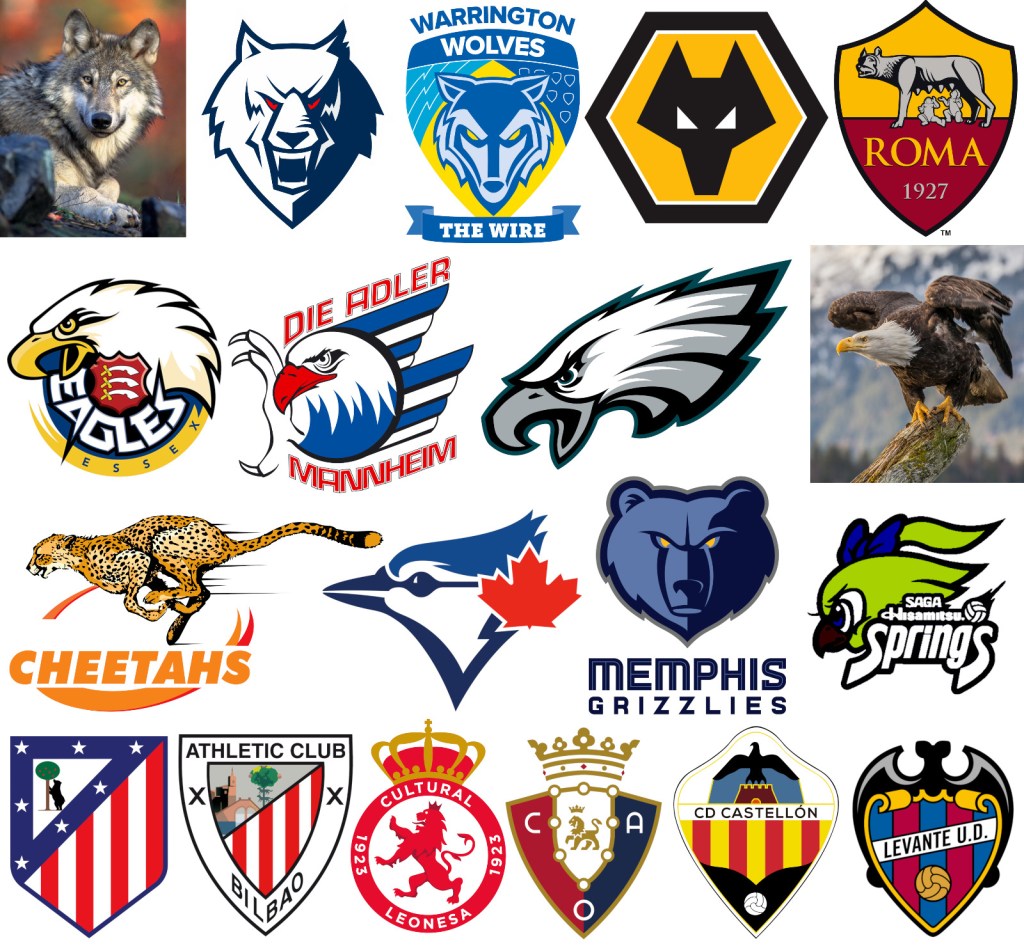
Sport club logos with animal iconography. Top row: examples of the grey wolf (Canis lupus) in Neftekhimik Nizhnekamsk (ice hockey, Russia), Warrington Wolves (rugby, England), Wolverhampton Wanderers (football, England), and Roma (football, Italy). Second row: bald eagle (Haliaeetus leucocephalus) in Essex Eagles (cricket, England), Adler Mannheim (handball, Germany), and Philadelphia Eagles (American football, USA). Third row: Free State Cheetahs (represented by the cheetah Acinonyx jubatus; rugby, South Africa), Toronto Blue Jays (blue jay Cyanocitta cristata; baseball, Canada), Memphis Grizzlies (grizzly bear Ursus arctos horribilis; basketball, USA) and Hisamitsu Springs (Japanese white-eye Zosterops japonicas; volleyball, Japan). Fourth row: six Spanish football clubs. Clubs featuring wolves and eagles are often associated with the symbolic qualities of these species (e.g., intelligence, prowess, fealty, bravery, strength). In football, animals reflect represent the history and heraldry of cities and regions, as seen in the crests of in Atlético de Madrid (brown bear Ursus arctos), AS Roma and Athletic Club (wolf), Cultural Deportiva Leonesa and Atlético Osasuna (lion Panthera leo), CD Castellón (raptor) and Levante UD (bat). Photos: Gary Kramer (wolf) and Andy Morffew (eagle).
In professional sport such as football, clubs increasingly function as brands (4) where even traditional logos are modified to enhance a team’s commercial value and strengthen audience loyalty (5). In this process, biodiversity becomes relevant because the iconography of many sport organisations incorporates representations of plants and animals.
Sport fauna
To quantify this phenomenon, Ugo Arbieu and collaborators analysed the presence of animals in club names, crests, and fan nicknames among 10 professional team sports across 50 countries (6). They found that 727 teams use 161 different animal species in their corporate imagery. Football and basketball lead in the number of species represented due to the large number of clubs worldwide, but American football, rugby and baseball display greater symbolic fauna diversity per club. Mammals and birds are the most common, particularly carnivores and raptors.
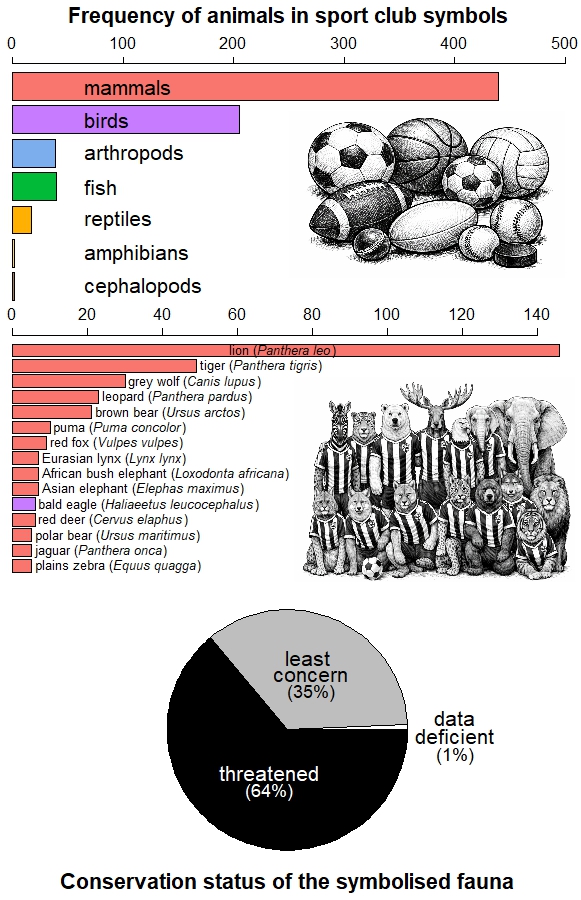
Animal symbols in club iconography (names, logos, fan nicknames) for the sports with the largest audiences (6): basketball, handball, baseball, cricket, football, American football, ice hockey and volleyball. The sample excludes 106 teams that use domesticated species as identity symbols, includes 163 men’s leagues and 67 women’s leagues, respectively, and the animal species depicted in the emblems of 48 teams could be identified. Horizontal bars above show the most represented animal groups (top panel), and the 15 species most frequently featured (middle panel). Bottom panel: percentage of symbols according to the IUCN’s conservation status of the species, where ‘threatened’ includes the categories Near Threatened, Endangered and Extinct. The trend indicates that sport clubs prefer to identify themselves with large mammal species that are threatened.
This pattern is not coincidental, for it reflects the historical bias of science and conservation towards large, charismatic vertebrates (7), but also the uneven availability of biological information and our social preferences for certain species (8). These preferences are even reflected in the animal emojis we share regularly on social media (9).
Arbieu’s study also revealed that clubs tend to favour images of threatened fauna (6), possibly due to their higher symbolic impact and media visibility (10). Moreover, although clubs in Europe and the Americas more often depict exotic animals, native species dominate in Africa, Asia, and Oceania (6). This suggests that the choice of an animal as an emblem is the product of not only aesthetic or symbolic criteria, but also of cultural roots and the historical relationship of societies with their local fauna.
Under the sea where there is little or no light, the foraging, communication, and orientation of whales and many other marine animals depend on sound. But increasing human activity has transformed the soundscape of seas and oceans. This change affects the behaviour of species and presents challenges in managing a problem of global scale.
Many like me feel uneasy when we hear a siren on the street. An ambulance, fire fighters, or the police can remind us of times when we or someone close to us suffered a heart attack, a fire, or a robbery. Animals can also associate sounds with risky situations they have experienced before, such as an attack from a predator, in their own lives or in the evolutionary history of their species.
For example, many types of whales are prey to killer whales (1) [watch predatory scenes here, here, here], and not only do they recognise the presence of their main predator by sound, but the vocalisations of some species have evolved to fall outside the killer whale’s hearing range (2). When faced with such a threatening sound, species must decide whether the risk of being hunted is great enough to justify interrupting essential activities such as feeding or mating (3). Interestingly, there are alarm signals that are so general in the animal kingdom, like a simple noise, that prey animals might react to them by spending time and energy to protect themselves, even when there is no real threat (4).
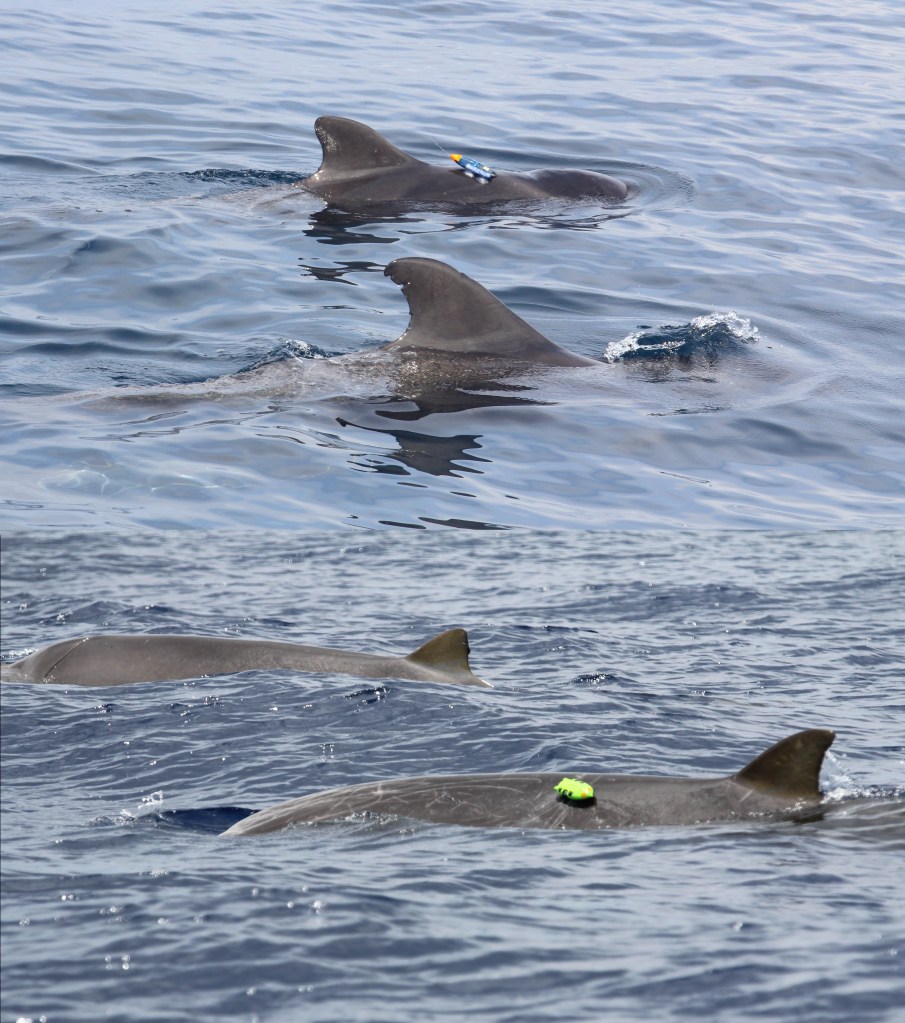
Tagging cetaceans off the Canary Islands to study their behaviour in relation to human and environmental disturbance. Above, 2 short-finned pilot whales (Globicephala macrorhynchus) in the southwest Tenerife, and below 2 Blainville’s beaked whales (Mesoplodon densirostris) in the Mar de las Calmas southwest of El Hierro. The back-mounted devices are DTAGs [read here, here and here]: they are attached by suction cups on top of which an encased electronic device records time series of environmental (depth, pressure, temperature, magnetic fields) and biological (e.g., swimming speed, heart rate, echolocation) variables. Watch videos of scientists deploying DTAGs on a range of cetacean species using a long stick here and here and drones here and here. Photos courtesy of O Marín Delgado (pilot whales) and C Yzoard (beaked whales); projects based at Universidad de La Laguna, Tenerife, Spain and led by N Aguilar de Soto [see stories here and here] (9, 26-29).
Naval sonar and killer whales
To examine this issue, Patrick Miller and his colleagues used underwater microphones to play recordings of killer whale sounds and ship sonar in the presence of 43 individuals from four cetacean species off the coasts of Norway and its Svalbard Archipelago (5): northern bottlenose whale (Hyperoodon ampullatus), humpback whale (Megaptera novaeangliae), long-finned pilot whale (Globicephala melas), and sperm whale (Physeter macrocephalus) [see press release for this research paper, listen to a podcast discussing findings]. During the experiment, each of the 43 individuals studied was fitted with a digital device attached to the skin using a suction cup. These devices recorded the animals’ movements and vocalisations. In total, the researchers collected 179 hours of baseline behaviour data in natural background noise, along with 7 hours of behavioural data in response to experimental playbacks of sonar [listen] and killer whale [listen] sounds.
Get Conservation Bytes by Email Enter your email address to receive new posts on conservation, biodiversity, and environmental science directly in your inbox. No need to visit the website regularly, and you can unsubscribe at any time.
Hulton Archive / Getty Images We warn readers that the content of this study is confronting and may be distressing. In April 1789, the first smallpox epidemic among Aboriginal people in the Sydney region began, just 16 months after Europeans arrived on the First Fleet. Little is known of the true scale of the epidemic,…
Just over two years ago I reported the ‘likely’ eradication of feral pigs from Australia’s third-largest (4,405 km2) island — Kangaroo Island. I indicated ‘likely’ because the program still required the proof-of-eradication phase to be completed before an official declaration could be made. Yesterday I had the immense honour to take part in the official…
Have you ever done any research that relied to any degree on Indigenous Knowledges? How did you cite those Knowledges, if at all? It’s probably time we rethink how we engage with Indigenous Knowledge systems. In a new article published in BioScience, we — a large group of Indigenous and non-Indigenous scholars in Australia —…