5000 piggies, 500 piggies, 100 piggies, … and there there was none

4 12 2024

The Black Summer bushfires of 2019–2020 that razed more than half of the landscape on Kangaroo Island in South Australia left an indelible mark on the island’s unique native biodiversity, which is still struggling to recover. 

Flinders Chase National Park on Kangaroo Island after the 2019-2020 Black Summer fires (credit: CJA Bradshaw)

However, one big bonus for the environment’s recovery is the likely eradication of feral pigs (Sus scrofa). Invasive feral pigs cause a wide range of environmental, economic and social damages. In Australia, feral pigs occupy about 40% of the mainland and offshore islands, with a total, yet highly uncertain, population size estimated in the millions

Feral pigs are recognised as a key threatening process under the Environment Protection and Biodiversity Conservation Act 1999, with impacts on at least 148 nationally threatened species and eight threatened ecological communities. They are a declared invasive species and the subject to control programs in all Australian jurisdictions.

Motion sensing cameras deployed during the eradication program capture feral pigs using their snouts to search for soil-borne food. This behaviour, called rooting, creates large areas of disturbed soil, killing native vegetation and spreading invasive weeds and pathogens (credit: PIRSA).

In a new article published in Ecosphere, a collaboration between PIRSA Biosecurity and the Global Ecology Laboratory at Flinders University analysed optimal strategies for culling feral pigs. 

Read the rest of this entry »


Better codes of practice for control of feral animals

24 02 2023

From time to time I turn my research hand to issues of invasive species control, for example, from manipulating pathogens to control rabbits, to island eradication of feral cats and pigs, to effective means to control feral deer.

Not only do invasive species cost well over $1.7 trillion (yes, that’s trillion, with 12 zeros) each year in terms of damage and control (a minimum of $25 billion per year in Australia alone), they are one of the main drivers of biodiversity loss globally. So, if you baulk at lethal forms of control of invasive species, you are simultaneously stating that you’re fine with the torture and death of millions (if not, billions) of native animals each year.

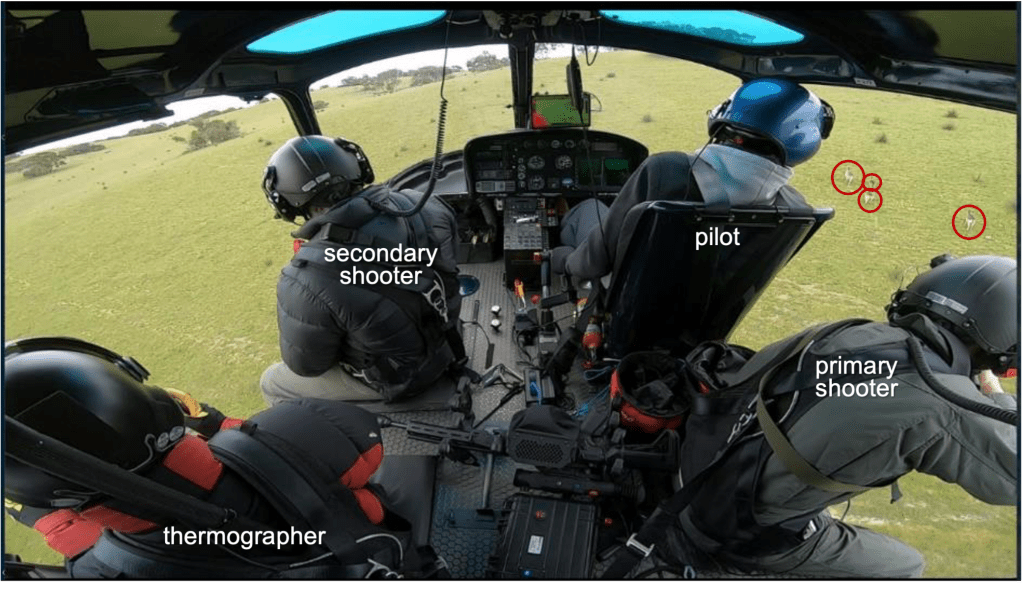
Thanks to the collaborative and evidence-driven foresight of my colleagues at PIRSA Biosecurity and Landscape Boards, I was recently involved in more research examining the most efficient, cost-effective, and humane ways to cull feral dear in South Australia. The resulting paper is now in review in NeoBiota, but we have also posted a pre-print of the article.

Feral deer are a real problem in Australia, and South Australia is no exception. With six species of feral deer in the country already (fallow Dama dama, red Cervus elaphus, hog Axis porcinus, chital A. axis), rusa C. timorensis, and sambar Rusa unicolor deer), fallow deer are the most abundant and widespread. These species are responsible for severe damage to native plants, competition with native animals, economic losses to primary industries (crops, pastures, horticulture, plantations), and human safety risks from vehicle collisions. Feral deer are also reservoirs and vectors of endemic animal diseases and have the potential to transmit exotic animal diseases such as foot-and-mouth. If left uncontrolled, within 30 years the economic impacts of feral deer could reach billions of dollars annually.

Read the rest of this entry »