Mega-meta-model manager

24 07 2010

As Barry Brook just mentioned over at BraveNewClimate.com, I’ll be travelling with him and several of our lab to Chicago tomorrow to work on some new aspects of linked climate, disease, meta-population, demographic and vegetation modelling. Barry has this to say, so I won’t bother re-inventing the wheel:

… working for a week with Dr Robert LacyProf Resit Akcakaya and collaborators, on integrating spatial-demographic ecological models with climate change forecasts, and implementing multi-species projections (with the aim of improving estimates of extinction risk and provide better ranking of management and adaptation options). This work builds on a major research theme at the global ecology lab, and consequently, a whole bunch of my team are going with me — Prof Corey Bradshaw (lab co-director), my postdocs Dr Damien FordhamDr Mike Watts and Dr Thomas Prowse and Corey’s and my ex-postdoc, Dr Clive McMahon. This builds on earlier work that Corey and I had been pursuing, which he described on ConservationBytes last year.

The ‘mega-meta-model manager’ part is a clever piece of control-centre software that integrates these disparate ecological, climate and disease dynamic inputs. Should be some good papers coming out of the work soon.

Of course, I’ll continue to blog over the coming week. I’m not looking forward to the 30-hour travel tomorrow to Chicago, but it should be fun and productive once I get there.

CJA Bradshaw

Add to FacebookAdd to DiggAdd to Del.icio.usAdd to StumbleuponAdd to RedditAdd to BlinklistAdd to TwitterAdd to TechnoratiAdd to Yahoo BuzzAdd to Newsvine


Australian Ecology Research Award

7 06 2010

I had the immense pleasure of receiving a telephone call a few weeks back from the Ecological Society of Australia telling me that I had been awarded the 2010 Australian Ecology Research Award (AERA). They’ve just announced it, so I’m now allowed to boast a bit on Conservation Bytes.

If you’re going to the 50th Anniversary ESA annual conference in Canberra this year ‘Sustaining Biodiversity – the next 50 years‘ (6-10 December), I’ll be giving the AERA Plenary Lecture then. Thanks to the ESA for my selection, the University of Adelaide (The Environment Institute & School of Earth and Environmental Sciences), the South Australian Research and Development Institute, and all my students, post-docs and collaborators for your support. Many thanks also to Prof. Bill Laurance for the nomination!

The AERA blurb from the ESA site follows: Read the rest of this entry »


How many species are there?

4 06 2010

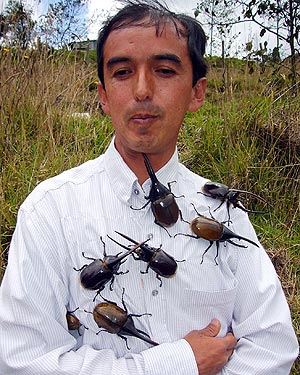
© japanprobe.com

An interesting research note just came out in the American Naturalist by Hamilton and colleagues entitled Quantifying uncertainty in estimation of tropical arthropod species richness. I retweeted a Science Daily twitter feed on this that had a terribly misleading opening line: “New calculations reveal that the number of species on Earth is likely to be in the order of several million rather than tens of millions“. This is, of course, absolute rubbish because the authors only looked at estimating tropical arthropod richness, not all species on Earth. The number of protists alone is probably > 4 million species, and there are an estimated > 1.5 fungi.

That whinge about crap reporting aside, this is what Hamilton and colleagues concluded:

  • using stochastic models, they predict medians of 3.7 million and 2.5 million tropical arthropod species globally
  • estimates of 30 million species or greater are predicted to have < 0.00001 probability
  • uncertainty in the proportion of canopy arthropod species that are beetles is the most influential parameter
  • in spite of 250 years of taxonomy and around 855000 species of arthropods already described, approximately 70 % await description

Interesting, but I didn’t give it much notice until New Scientist contacted me to get an assessment (their article will appear shortly). This is what I had to say: Read the rest of this entry »


Vodcast on killing for conservation

24 02 2010

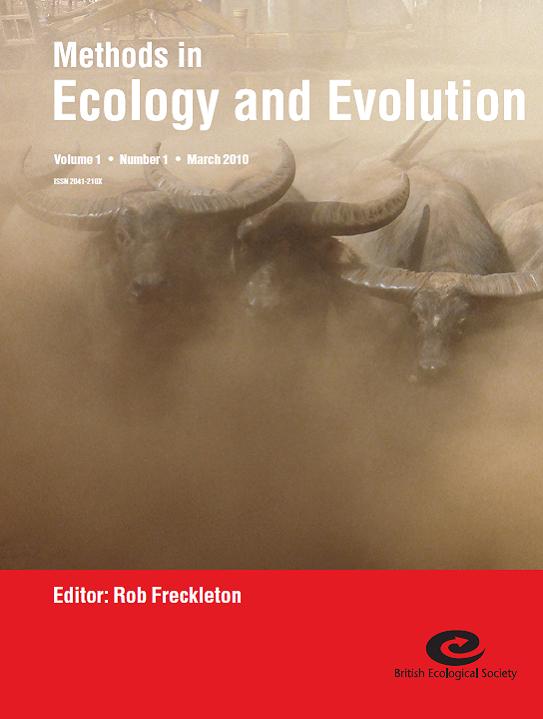
The inaugural issue of Methods in Ecology and Evolution came out today (see first issue editorial) and I am very pleased not only that our paper (Spatially explicit spreadsheet modelling for optimizing the efficiency of reducing invasive animal density) made it into the the paper line-up (see previous ConservationBytes.com post on the paper here), we also managed to score the journal’s cover image (buffalo image shown right: Asian swamp buffalo Bubalus bubalis introduced to Australia in the early 19th Century now populate much of the tropical north and cause severe environmental disturbances to savanna and wetland ecosystems. Despite a broad-scale cull of hundreds of thousands of free-ranging buffalo occurring in the 1980s and 1990s to eradicate brucellosis and tuberculosis, the population is recovering and continuing to threaten protected areas such as Kakadu National Park. A small wild harvest of several thousand buffalo occurs each year in Arnhem Land where mustering is aided by helicopters and on-ground vehicles. The buffalo pictured are housed in temporary holding pens and then shipped for live export. Photo credit: Jesse Northfield).

I also had the opportunity to chat with Journal Coordinator, Graziella Iossa, via Skype about the paper, and they have put up a YouTube vodcast of the interview itself. You can also check it out here.

Summary: Corey Bradshaw answers what is the main idea behind his work with co-authors, “Spatially explicit spreadsheet modelling for optimising the efficiency of reducing invasive animal density”. Further, he explains how their model advances methodology in ecology and evolution and finally shows how it could be applied by wildlife manager and practitioners with basic knowledge of computer models. Their Excel-spreadsheet ‘Spatio-Temporal Animal Reduction’ (S.T.A.R.) model is designed specifically to optimise the culling strategies for feral pigs, buffalo and horses in Kakadu National Park (northern Australia), but Corey explains how their aim was to make it easy enough for anyone to use and modify it so that it could be applied to any invasive species anywhere.

Congratulations to Editor-in-Chief Rob Freckleton, Graziella and the Associate Editors for a great first issue. Other titles include:

Keep them coming!

CJA Bradshaw

Add to FacebookAdd to DiggAdd to Del.icio.usAdd to StumbleuponAdd to RedditAdd to BlinklistAdd to TwitterAdd to TechnoratiAdd to Yahoo BuzzAdd to Newsvine


Wobbling to extinction

31 08 2009

crashI’ve been meaning to highlight for a while a paper that I’m finding more and more pertinent as a citation in my own work. The general theme is concerned with estimating extinction risk of a particular population, species (or even ecosystem), and more and more we’re finding that different drivers of population decline and eventual extinction often act synergistically to drive populations to that point of no return.

In other words, the whole is greater than the sum of its parts.

In other, other words, extinction risk is usually much higher than we generally appreciate.

This might seem at odds with my previous post about the tendency of the stochastic exponential growth model to over-estimate extinction risk using abundance time series, but it’s really more of a reflection of our under-appreciation of the complexity of the extinction process.

In the early days of ConservationBytes.com I highlighted a paper by Fagan & Holmes that described some of the few time series of population abundances right up until the point of extinction – the reason these datasets are so rare is because it gets bloody hard to find the last few individuals before extinction can be confirmed. Most recently, Melbourne & Hastings described in a paper entitled Extinction risk depends strongly on factors contributing to stochasticity published in Nature last year how an under-appreciated component of variation in abundance leads to under-estimation of extinction risk.

‘Demographic stochasticity’ is a fancy term for variation in the probability of births deaths at the individual level. Basically this means that there will be all sorts of complicating factors that move any individual in a population away from its expected (mean) probability of dying or reproducing. When taken as a mean over a lot of individuals, it has generally been assumed that demographic stochasticity is washed out by other forms of variation in mean (population-level) birth and death probability resulting from vagaries of the environmental context (e.g., droughts, fires, floods, etc.).

‘No, no, no’, say Melbourne & Hastings. Using some relatively simple laboratory experiments where environmental stochasticity was tightly controlled, they showed that demographic stochasticity dominated the overall variance and that environmental variation took a back seat. The upshot of all these experiments and mathematical models is that for most species of conservation concern (i.e., populations already reduced below to their minimum viable populations size), not factoring in the appropriate measures of demographic wobble means that most people are under-estimating extinction risk.

Bloody hell – we’ve been saying this for years; a few hundred individuals in any population is a ridiculous conservation target. People must instead focus on getting their favourite endangered species to number at least in the several thousands if the species is to have any hope of persisting (this is foreshadowing a paper we have coming out shortly in Biological Conservationstay tuned for a post thereupon).

Melbourne & Hastings have done a grand job in reminding us how truly susceptible small populations are to wobbling over the line and disappearing forever.

CJA Bradshaw

Add to FacebookAdd to NewsvineAdd to DiggAdd to Del.icio.usAdd to StumbleuponAdd to RedditAdd to BlinklistAdd to Ma.gnoliaAdd to TechnoratiAdd to Furl


Not-so-scary maths and extinction risk

27 08 2009
© P. Horn

© P. Horn

Population viability analysis (PVA) and its cousin, minimum viable population (MVP) size estimation, are two generic categories for mathematically assessing a population’s risk of extinction under particular environmental scenarios (e.g., harvest regimes, habitat loss, etc.) (a personal plug here, for a good overview of general techniques in mathematical conservation ecology, check out our new chapter entitled ‘The Conservation Biologist’s Toolbox…’ in Sodhi & Ehrlich‘s edited book Conservation Biology for All by Oxford University Press [due out later this year]). A long-standing technique used to estimate extinction risk when the only available data for a population are in the form of population counts (abundance estimates) is the stochastic exponential growth model (SEG). Surprisingly, this little beauty is relatively good at predicting risk even though it doesn’t account for density feedback, age structure, spatial complexity or demographic stochasticity.

So, how does it work? Well, it essentially calculates the mean and variance of the population growth rate, which is just the logarithm of the ratio of an abundance estimate in one year to the abundance estimate in the previous year. These two parameters are then resampled many times to estimate the probability that abundance drops below a certain small threshold (often set arbitrarily low to something like < 50 females, etc.).

It is simple (funny how maths can become so straightforward to some people when you couch them in words rather than mathematical symbols), and rather effective. This is why a lot of people use it to prescribe conservation management interventions. You don’t have to be a modeller to use it (check out Morris & Doak’s book Quantitative Conservation Biology for a good recipe-like description).

But (there’s always a but), a new paper just published online in Conservation Letters by Bruce Kendall entitled The diffusion approximation overestimates extinction risk for count-based PVA questions the robustness when the species of interest breeds seasonally. You see, the diffusion approximation (the method used to estimate that extinction risk described above) generally assumes continuous breeding (i.e., there are always some females producing offspring). Using some very clever mathematics, simulation and a bloody good presentation, Kendall shows quite clearly that the diffusion approximation SEG over-estimates extinction risk when this happens (and it happens frequently in nature). He also offers a new simulation method to get around the problem.

Who cares, apart from some geeky maths types (I include myself in that group)? Well, considering it’s used so frequently, is easy to apply and it has major implications for species threat listings (e.g., IUCN Red List), it’s important we estimate these things as correctly as we can. Kendall shows how several species have already been misclassified for threat risk based on the old technique.

So, once again mathematics has the spotlight. Thanks, Bruce, for demonstrating how sound mathematical science can pave the way for better conservation management.

CJA Bradshaw

Add to FacebookAdd to NewsvineAdd to DiggAdd to Del.icio.usAdd to StumbleuponAdd to RedditAdd to BlinklistAdd to Ma.gnoliaAdd to TechnoratiAdd to Furl