Cartoon guide to biodiversity loss

30 01 2009

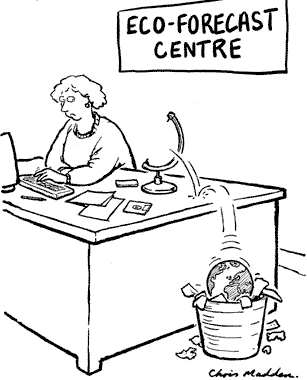
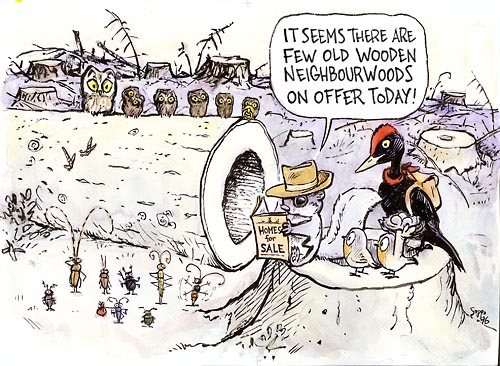
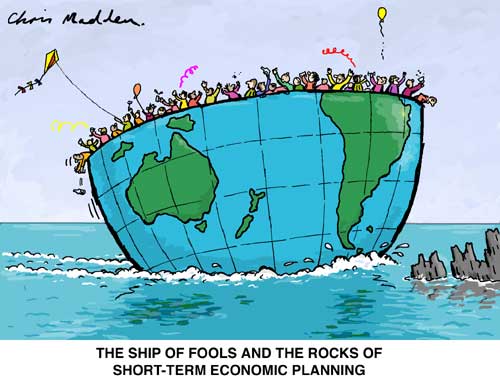
I’m taking Barry Brook‘s great idea on the Cartoon Guide to Global Warming Denial and applying it to biodiversity and habitat loss.

There are a lot of these sorts of things out there (amazing how we laugh at tragedy), so I will probably do subsequent posts as I find good candidates (suggestions welcome).

ucs-cartoonearthbin

CJA Bradshaw

Add to FacebookAdd to NewsvineAdd to DiggAdd to Del.icio.usAdd to StumbleuponAdd to RedditAdd to BlinklistAdd to Ma.gnoliaAdd to TechnoratiAdd to Furl


Classics: the Allee effect

22 12 2008

220px-Vortex_in_draining_bottle_of_waterAs humanity plunders its only home and continues destroying the very life that sustains our ‘success’, certain concepts in ecology, evolution and conservation biology are being examined in greater detail in an attempt to apply them to restoring at least some elements of our ravaged biodiversity.

One of these concepts has been largely overlooked in the last 30 years, but is making a conceptual comeback as the processes of extinction become better quantified. The so-called Allee effect can be broadly defined as a “…positive relationship between any component of individual fitness and either numbers or density of conspecifics” (Stephens et al. 1999, Oikos 87:185-190) and is attributed to Warder Clyde Allee, an American ecologist from the early half of the 20th century, although he himself did not coin the term. Odum referred to it as “Allee’s principle”, and over time, the concept morphed into what we now generally call ‘Allee effects’.

Nonetheless, I’m using Allee’s original 1931 book Animal Aggregations: A Study in General Sociology (University of Chicago Press) as the Classics citation here. In his book, Allee discussed the evidence for the effects of crowding on demographic and life history traits of populations, which he subsequently redefined as “inverse density dependence” (Allee 1941, American Naturalist 75:473-487).

What does all this have to do with conservation biology? Well, broadly speaking, when populations become small, many different processes may operate to make an individual’s average ‘fitness’ (measured in many ways, such as survival probability, reproductive rate, growth rate, et cetera) decline. The many and varied types of Allee effects can work together to drive populations even faster toward extinction than expected by chance alone because of self-reinforcing feedbacks (see also previous post on the small population paradigm). Thus, ignorance of potential Allee effects can bias everything from minimum viable population size estimates, restoration attempts and predictions of extinction risk.

A recent paper in the journal Trends in Ecology and Evolution by Berec and colleagues entitled Multiple Allee effects and population management gives a more specific breakdown of Allee effects in a series of definitions I reproduce here for your convenience:

Allee threshold: critical population size or density below which the per capita population growth rate becomes negative.

Anthropogenic Allee effect: mechanism relying on human activity, by which exploitation rates increase with decreasing population size or density: values associated with rarity of the exploited species exceed the costs of exploitation at small population sizes or low densities (see related post).

Component Allee effect: positive relationship between any measurable component of individual fitness and population size or density.

Demographic Allee effect: positive relationship between total individual fitness, usually quantified by the per capita population growth rate, and population size or density.

Dormant Allee effect: component Allee effect that either does not result in a demographic Allee effect or results in a weak Allee effect and which, if interacting with a strong Allee effect, causes the overall Allee threshold to be higher than the Allee threshold of the strong Allee effect alone.

Double dormancy: two component Allee effects, neither of which singly result in a demographic Allee effect, or result only in a weak Allee effect, which jointly produce an Allee threshold (i.e. the double Allee effect becomes strong).

Genetic Allee effect: genetic-level mechanism resulting in a positive relationship between any measurable fitness component and population size or density.

Human-induced Allee effect: any component Allee effect induced by a human activity.

Multiple Allee effects: any situation in which two or more component Allee effects work simultaneously in the same population.

Nonadditive Allee effects: multiple Allee effects that give rise to a demographic Allee effect with an Allee threshold greater or smaller than the algebraic sum of Allee thresholds owing to single Allee effects.

Predation-driven Allee effect: a general term for any component Allee effect in survival caused by one or multiple predators whereby the per capita predation-driven mortality rate of prey increases as prey numbers or density decline.

Strong Allee effect: demographic Allee effect with an Allee threshold.

Subadditive Allee effects: multiple Allee effects that give rise to a demographic Allee effect with an Allee threshold smaller than the algebraic sum of Allee thresholds owing to single Allee effects.

Superadditive Allee effects: multiple Allee effects that give rise to a demographic Allee effect with an Allee threshold greater than the algebraic sum of Allee thresholds owing to single Allee effects.

Weak Allee effect: demographic Allee effect without an Allee threshold.

For even more detail, I suggest you obtain the 2008 book by Courchamp and colleagues entitled Allee Effects in Ecology and Conservation (Oxford University Press).

CJA Bradshaw

Add to FacebookAdd to NewsvineAdd to DiggAdd to Del.icio.usAdd to StumbleuponAdd to RedditAdd to BlinklistAdd to Ma.gnoliaAdd to TechnoratiAdd to Furl

(Many thanks to Salvador Herrando-Pérez for his insight on terminology)


The extinction vortex

25 08 2008

One for the Potential list:

vortexFirst coined by Gilpin & Soulé in 1986, the extinction vortex is the term used to describe the process that declining populations undergo when”a mutual reinforcement occurs among biotic and abiotic processes that drives population size downward to extinction” (Brook, Sodhi & Bradshaw 2008).

Although several types of ‘vortices’ were labelled by Gilpin & Soulé, the concept was subsequently simplified by Caughley (1994) in his famous paper on the declining and small population paradigms, but only truly quantified for the first time by Fagan & Holmes (2006) in their Ecology Letters paper entitled Quantifying the extinction vortex.

Fagan and Holmes compiled a small time-series database of ten vertebrate species (two mammals, five birds, two reptiles and a fish) whose final extinction was witnessed via monitoring. They confirmed that the time to extinction scales to the logarithm of population size. In other words, as populations decline, the time elapsing before extinction occurs becomes rapidly (exponentially) smaller and smaller. They also found greater rates of population decline nearer to the time of extinction than earlier in the population’s history, confirming the expectation that genetic deterioration contributes to a general corrosion of individual performance (fitness). Finally, they found that the variability in abundance was also highest as populations approached extinction, irrespective of population size, thus demonstrating indirectly that random environmental fluctuations take over to cause the final extinction regardless of what caused the population to decline in the first place.

What does this mean for conservation efforts? It was fundamentally the first empirical demonstration that the theory of accelerating extinction proneness occurs as populations decline, meaning that all attempts must be made to ensure large population sizes if there is any chance of maintaining long-term persistence. This relates to the minimum viable population size concept that should underscore each and every recovery and target set or desired for any population in trouble or under conservation scrutiny.

CJA Bradshaw

Add to FacebookAdd to NewsvineAdd to DiggAdd to Del.icio.usAdd to StumbleuponAdd to RedditAdd to BlinklistAdd to Ma.gnoliaAdd to TechnoratiAdd to Furl


Classics: Declining and small population paradigms

23 08 2008

‘Classics’ is a category of posts highlighting research that has made a real difference to biodiversity conservation. All posts in this category will be permanently displayed on the Classics page of ConservationBytes.com

image0032Caughley, G. (1994). Directions in conservation biology. Journal of Animal Ecology, 63, 215-244.

Cited around 800 times according to Google Scholar, this classic paper demonstrated the essential difference between the two major paradigms dominating the discipline of conservation biology: (1) the ‘declining’ population paradigm, and the (2) ‘small’ population paradigm. The declining population paradigm is the identification and management of the processes that depress the demographic rate of a species and cause its populations to decline deterministically, whereas the small population paradigm is the study of the dynamics of small populations that have declined owing to some (deterministic) perturbation and which are more susceptible to extinction via chance (stochastic) events. Put simply, the forces that drive populations into decline aren’t necessarily those that drive the final nail into a species’ coffin – we must manage for both types of processes  simultaneously , and the synergies between them, if we want to reduce the likelihood of species going extinct.

CJA Bradshaw

Add to FacebookAdd to NewsvineAdd to DiggAdd to Del.icio.usAdd to StumbleuponAdd to RedditAdd to BlinklistAdd to Ma.gnoliaAdd to TechnoratiAdd to Furl


‘Conservation for the people’

11 07 2008

This, the title of Peter Kareiva and Michelle Marvier’s paper in Scientific American, embodies in some ways, what this website is all about. Certainly not the first researchers to conclude that people will only value biodiversity if it has direct implications for their own well-being (economic prosperity, health, longevity, etc.), Kareiva and Marvier’s paper nicely summarises, however, the extent to which conservation research MUST quantify these links. The corollary is that if we don’t, conservation research will pass into oblivion (along with the species we are attempting to protect from extinction). Nice paper, and certainly one to watch.

CJA Bradshaw

Add to FacebookAdd to NewsvineAdd to DiggAdd to Del.icio.usAdd to StumbleuponAdd to RedditAdd to BlinklistAdd to Ma.gnoliaAdd to TechnoratiAdd to Furl


Conservation Letters – a scientific journal with a difference?

5 07 2008

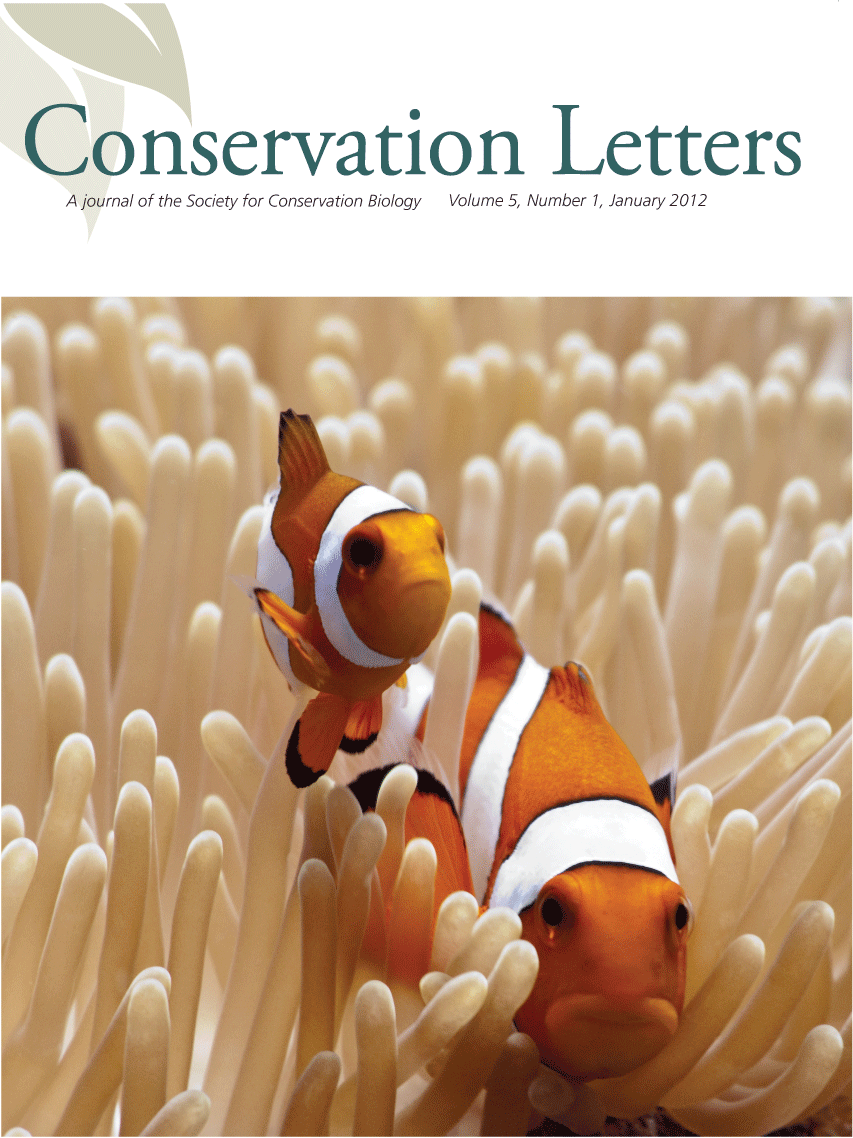
ConLetters-Jan12I’d like to introduce the latest scientific conservation journal – Conservation Letters (Wiley-Blackwell). If you are a publishing conservation scientist then you will have undoubtedly heard about this already. I must admit my biased opinion up front – I have the role of Senior Editor for the journal under the auspices of the venerable Editors-in-Chief, Professor Richard Cowling, Professor Hugh Possingham, Professor Bill Sutherland and Dr. Michael Mascia.

We’ve been doing conservation science now for well over 50 years, and there has been some fantastic, hard-hitting, brilliant research done. However, extinction rates continue to soar, habitat loss and fragmentation abound, bushmeat hunting and other forms of direct over-exploitation show no signs of slowing and invasive species are penetrating into the most ‘pristine’ habitats. To top it all off, climate change is exacerbating each and every one of these extinction drivers.

So what have we been doing wrong?

Clearly the best research is going unheeded – this is not to say that some progress has not been made, and I hope to highlight the best examples of the hardest-hitting research on this site – it simply means that we are losing the battle. Enter Conservation Letters – a journal designed to make conservation research more available to policy makers and managers to make true strides forward in biodiversity conservation. I’m not suggesting for a moment that other well-known, respected and established conservation journals have not done their job; without the research those journals publish we’d certainly be much worse off. However, we have recognised that our research isn’t affecting as many people as it should.

With Conservation Letters now well into its first year, I hope that we start to see some changes here, and I hope that the discipline will have a much greater net effect on slowing (and perhaps) reversing the extinction trends we observe today. Climate change is making this much more challenging, as well as the ever-increasing human population. Can we make better progress? – I certainly hope so.

CJA Bradshaw

Add to FacebookAdd to NewsvineAdd to DiggAdd to Del.icio.usAdd to StumbleuponAdd to RedditAdd to BlinklistAdd to Ma.gnoliaAdd to TechnoratiAdd to Furl