Unholy trinity of leakage, permanence and additionality

13 03 2012

I begin with the proverbial WTF? The title of this post sounds a little like the legalese accompanying a witchcraft trial, but it’s jargon that’s all the rage in the ‘trading-carbon-for-biodiversity’ circles.

I’m sure that most of my readers will have come across the term ‘REDD‘ (Reduced Emissions from Deforestation and forest Degradation), which is the clever idea of trading carbon credits to keep forests intact. As we know, living forests can suck up a lot of carbon from the atmosphere (remember your high school biology lesson on photosynthesis? Carbon dioxide in. Oxygen out), even though climate change is threatening this invaluable ecosystem service. So the idea of paying a nation (usual a developing country) to protect its forests in exchange for carbon pollution offsets can potentially save two birds with one feeder – reducing overall emissions by keeping the trees alive, and ensuring a lot of associated biodiversity gets caught up in the conservation process.

The problem with REDD though is that it’s a helluva thing to bank on given a few niggly problems essentially revolving around trust. Ah yes, the bugbear of any business transaction. As the carbon credit ‘buyer’ (the company/nation/individual who wishes to offset its carbon output by ‘buying’ the carbon uptake services provided by the intact forest), you’d want to make damn sure that all the money you spend to offset your carbon actually does just that, and that it doesn’t just end up in the hands of some corrupt official, or even worse, used to generate industry that results in even higher emissions! As the buyer, of course you want to entice investors to give you lots of money, and if you bugger up the transaction (by losing the resource you are providing), you’re not likely to have any more investors coming knocking on your door.

Enter the unholy trinity of leakage, permanence and additionality.

This horrible jargon essentially describes the REDD investment problem:

Read the rest of this entry »


Infinite planet theory

24 05 2011

Rob Dietz over at the Centre for the Advancement of the Steady State Economy (CASSE) just e-mailed me and suggested I reproduce a recent post of theirs on ConservationBytes.com. Rob has produced a cracker – very funny, but ‘reality’ usually is. Many thanks, Rob, for a fine piece of writing.

Few people have read the dense volumes published by the economist Milton Mountebank, but his work has affected you, me and every single person on the planet. Dr. Mountebank has revolutionized economic thought, and now he has been recognized for his singular efforts. Yesterday at a gala reception in Stockholm, Sweden, the chairman of Sveriges Riksbank, Peter Norborg, presented Dr. Mountebank with the Nobel Prize in Economics for his lifetime of work on infinite planet theory.

In his presentation of the award, Mr. Norborg stated, “Dr. Mountebank has demonstrated imagination and inventiveness beyond what the rational mind can comprehend.” Indeed, it is because of his theories that we all do what we do economically. Nations strive for continuous GDP growth and endless expansion of consumption thanks to infinite planet theory. Mr. Norborg went on to say, “All of our banks, including Sveriges Riksbank, owe him a huge debt. We finance economic expansion. Our actions and decisions would be morally suspect if we lived on a finite planet.”

In a light-hearted moment during the presentation, Mr. Norborg asserted that Dr. Mountebank had provided an even greater service to humanity by reducing stress on individuals. “Best of all,” he said, “is that we can extract, consume and digest resources guilt-free. Planetary constraints have been conquered. They have gone the way of the dodo, the Roman Empire and the world’s major fisheries.” Read the rest of this entry »


Resolving the Environmentalist’s Paradox

7 04 2011

Here’s an extremely thought-provoking guest post by Megan Evans, Research Assistant at the University of Queensland in Kerrie Wilson‘s lab. Megan did her Honours degree with Hugh Possingham and Kerrie, and has already published heaps from that and other work. I met Megan first in 2009 and have been extremely impressed with her insights, broad range of interests and knowledge, and her finely honed grasp of social media in science. Smarter than your average PhD student, without a doubt (and she has even done one yet). Take it away, Megan.

© T. Toles

Resolving the ‘Environmentalist’s Paradox’, and the role of ecologists in advancing economic thinking

Aldo Leopold famously described the curse of an ecological education as “to be the doctor who sees the marks of death in a community that believes itself well and does not want to be told otherwise”. Ecologists do have a tendency for making dire warnings for the future, but for anyone concerned about the myriad of problems currently facing the Earth – climate change, an ongoing wave of species extinctions and impending peak oil, phosphate, water , (everything?) crises – the continued ignorance or ridicule of such warnings can be a frustrating experience. Environmental degradation and ecological overshoot isn’t just about losing cute plants and animals, given the widespread acceptance that long-term human well-being ultimately rests on the ability for the Earth to supply us with ecosystem services.

In light of this doom and gloom, things were shaken up a bit late last year when an article1 published in Bioscience pointed out that in spite of declines in the majority of ecosystem services considered essential to human well-being by The Millenium Ecosystem Assessment (MA), aggregate human well-being (as measured by the Human Development Index) has risen continuously over the last 50 years. Ciara Raudsepp-Hearne and the co-authors of the study suggested that these conflicting trends presented an ‘environmentalist’s paradox’ of sorts – do we really depend on nature to the extent that ecologists have led everyone to believe? Read the rest of this entry »


Cartoon guide to biodiversity loss XI

22 03 2011

The latest six cartoons… (see full stock of previous ‘Cartoon guide to biodiversity loss’ compendia here).

Read the rest of this entry »


Classics: Tragedy of the Commons

28 02 2011

Although not a conservation biology paper per se, Hardin’s classic essay (Hardin, 1968) changed the way we think about managing natural resources that lack definitive ownership.

The thesis of the “tragedy of the commons” is that individuals are inherently selfish and usually place their own interests first in using commonly owned resources, thereby resulting in their depletion. Hardin used a hypothetical and simplified situation based on medieval land tenure in Europe (herders sharing a common parcel of land) on which each herder was entitled to graze his cattle. Each herder maximized his gains by putting additional cattle onto the land, even if the carrying capacity of the common was exceeded and overgrazing ensued. The herder, by making an “individually rational decision,” received all the benefits from his cattle, but could in the process deplete the common resource for the entire group. If all herders make such selfish decisions then the common will be depleted, jeopardizing the livelihoods of all.

Read the rest of this entry »


Biodiversity begins at home

20 01 2011

A few months ago I was involved in a panel discussion entitled ‘Biodiversity begins at home’ held at the Royal Institution of Australia in Adelaide and sponsored by the Don Dunstan Foundation.

The main thrust of the evening was to have both academic (me & Andy Lowe) and on-the-ground, local conservationists (Sarah Lance, Craig Gillespie and Matt Turner) talk about what people can do to stem the tide of biodiversity loss. The video is now available, so I thought I’d reproduce it here. We talked about a lot of issues (from global to local scale), so if you have a spare hour, you might get something out of this. I did, but it certainly wasn’t long enough to discuss such big issues.

Warning – this was supposed to be more of a discussion and less of a talkfest; unfortunately, many of the panel members seemed to forget this and instead dominated the session. We really needed 4 hours to do this properly (but then, who would have watched the video?).

Read the rest of this entry »


Unbounded economic growth destroying biodiversity

16 08 2010

…we can’t have more of everything instantaneously

…increasing takeover of the ecosystem is the necessary consequence of the physical growth of the macroeconomy

…consider telling the economist to go to hell

Herman Daly

© M. Leunig

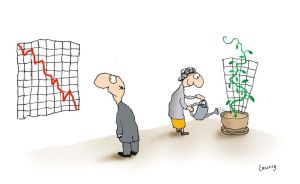
Last month I had the privilege of listening to Rob Dietz of the Centre for Advancement of the Steady State Economy (CASSE) when attending the 2010 International Congress for Conservation Biology. He introduced the CASSE and their mandate – to promote stable or mildly fluctuating levels in population and consumption of energy and materials. This is the steady-state economy.

I’ve hinted before that our essentially linear economy (natural resource exploitation -> transport -> manufacturer -> redistribution -> sale -> consumption/use -> disposal (discussed in a very easy-to-understand way in the Story of Stuff) is not sustainable in the long term because of the finite resource base of the planet (think trees, coal, oil, arable land). My colleagues and I have even shown analyses based on hard data demonstrating that total wealth is the ultimate driver of environmental degradation at the country scale.

So, it is my opinion (and a growing number of others‘) that we need a new way of measuring economic prosperity, or the world will enter a state of permanent financial crisis. The mantra of constant economic growth is simply unrealistic as our human populations continue to expand. This is a very simplistic statement and on the surface an apparently impossible goal; however, people who put together the CASSE believe it is achievable.

It is for this reason that I have been communicating with Rob Dietz and others at CASSE about reposting some of their excellent essays on ConservationBytes.com. Please feel free to comment here on the subject matter because the CASSE people will be monitoring. I hope we can expand the readership and support base, and eventually start to convince politicians that growth will eventually kill us and a good slice of the planet’s biodiversity.

So with that, here’s the first repost by Professor Herman Daly entitled “Opportunity Cost of Growth“: Read the rest of this entry »


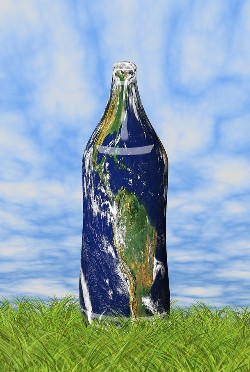
The planet is our bottle

22 05 2010

Professor Chris Thomas, conservation ecologist extraordinaire, tells it like it is. This might be a little basic for many ConservationBytes.com readers, but it’s the kind of pitch that might convince even the stupidest of yobs. I reproduce the Guardian article here in full.

Why do we care about nature, and can we actually quantify what the benefits are? This is what the UN’s The Economics of Ecosystems and Biodiversity (Teeb) project is all about, and the answer is remarkable. The natural world – biodiversity – provides us with food, materials and energy. We eat animals and plants; insects pollinate many of the foods we consume; microbes in the soil provide the nutrients the plants to grow; vegetation and soil biodiversity reduce flooding and release clean drinking water; vegetation soaks up a substantial proportion of the climate warming carbon dioxide gasses that we emit. The list goes on and on. Urban and rural citizens alike rely on these natural products and benefits.

The real cost of damaging nature, it turns out, is at least 10 times greater than the cost of maintaining the ecosystem as it is so that we can reap the associated benefits. To take an example close to the University of York where I work, the costs of flood defence construction and flood-related insurance claims in the Vale of York hugely outweigh the agricultural benefits of drainage ditches and overgrazing in the River Ouse catchment. Rather than treating nature as a pleasant luxury, Teeb argues that we should integrate the real costs and benefits within our decision-making. It should not be the preserve solely of environment and conservation ministries, but it should be at the core of the activities of finance departments. Teeb argues that we should get rid of subsidies that are environmentally damaging and reward beneficial activities that maintain natural ecosystems. This might be by including the costs of damage within the purchase price of products to encourage us to buy the least damaging items, and potentially by paying land owners and countries directly to maintain natural ecosystems. Farmers in the Ouse catchment have recently received payments for blocking their drainage ditches; and the perverse subsidies that rewarded farmers by the animal – resulting in over-grazing, trampling and erosion – have been removed. It can be done. Achieving this at a global scale is far more difficult. Read the rest of this entry »


Sick environment, sick people

30 10 2009

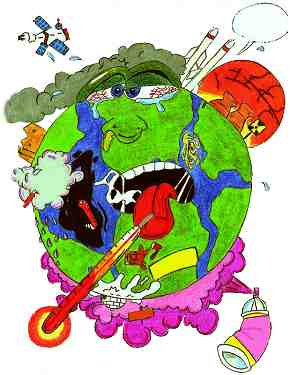
sickplanetA quick post to talk about a subject I’m more and more interested in – the direct link between environmental degradation (including biodiversity loss) and human health.

To many conservationists, people are the problem, and so they focus naturally on trying to maintain biodiversity in spite of human development and spread. Well, it’s 60+ years since we’ve been doing ‘conservation biology’ and biodiversity hasn’t been this badly off since the Cretaceous mass extinction event 146-64 million years ago. We now sit squarely within the geological era more and more commonly known as the ‘Anthropocene’, so if we don’t consider people as an integral part of any ecosystem, then we are guaranteed to fail biodiversity.

I haven’t posted in a week because I was in Shanghai attending the rather clumsily entitled “Thematic Reference Group (TRG) on Environment, Agriculture and Infectious Disease’, which is a part of the UNICEF/UNDP/World Bank/World Health Organization Special Programme for Research and Training in Tropical Diseases (TDR) (what a mouthful that is). What’s this all about and why is a conservation ecologist (i.e., me) taking part in the group?

It’s taken humanity a while to realise that what we do to the planet, we eventually end up doing to ourselves. The concept of ecosystem services1 demonstrates this rather well – our food, weather, wealth and well-being are all derived from healthy, functioning ecosystems. When we start to bugger up the inter-species relationships that define one element of an ecosystem, then we hurt ourselves. I’ve blogged about this topic a few times before with respect to flooding, pollination, disease emergence and carbon sequestration.

Our specific task though on the TRG is to define the links between environmental degradation, agriculture, poverty and infectious disease in humans. Turns out, there are quite a few examples of how we’re rapidly making ourselves more susceptible to killer infectious diseases simply by our modification of the landscape and seascape.

Some examples are required to illustrate the point. Schistosomiasis is a snail-borne fluke that infects millions worldwide, and it is on the rise again from expanding habitat of its host due to poor agricultural practices, bad hygiene, damming of large river systems and climate warming. Malaria too is on the rise, with greater and greater risk in the endemic areas of its mosquito hosts. Chagas (a triatomine bug-borne trypanosome) is also increasing in extent and risk. Some work I’m currently doing under the auspices of the TRG is also showing some rather frightening correlations between the degree of environmental degradation within a country and the incidence of infectious disease (e.g., HIV, malaria, TB), non-infectious disease (e.g., cancer, cardiovascular disease) and indices of life expectancy and child mortality.

I won’t bore you with more details of the group because we are still drafting a major World Health Organization report on the issues and research priorities. Suffice it to say that if we want to convince policy makers that resilient functioning ecosystems with healthy biodiversity are worth saving, we have to show them the link to infectious disease in humans, and how this perpetuates poverty, rights injustices, gender imbalances and ultimately, major conflicts. An absolute pragmatist would say that the value of keeping ecosystems intact for this reason alone makes good economic sense (treating disease is expensive, to say the least). A humanitarian would argue that saving human lives by keeping our ecosystems intact is a moral obligation. As a conservation biologist, I argue that biodiversity, human well-being and economies will all benefit if we get this right. But of course, we have a lot of work to do.

CJA Bradshaw

Add to FacebookAdd to NewsvineAdd to DiggAdd to Del.icio.usAdd to StumbleuponAdd to RedditAdd to BlinklistAdd to Ma.gnoliaAdd to TechnoratiAdd to Furl

1Although Bruce Wilcox (another of the TRG expert members), who I will be highlighting soon as a Conservation Scholar, challenges the notion of ecosystem services as a tradeable commodity and ‘service’ as defined. More on that topic soon.


Official Environment Institute video

11 06 2009

I’ve written about The University of Adelaide‘s new Environment Institute not too long ago (see post here), and now we’ve had the official launch. The people behind scenes have put together a great introductory video that we all witnessed for the first time last week. Happy to share it with ConservationBytes.com readers here.

Vodpod videos no longer available.

A couple of other excellent parts of this evening include the venerable Robyn Williams‘ speech (listen here), and our Director’s, Professor Mike Young, encouraging kick off (listen here).

I’ve very proud to be a part of this exciting initiative.

CJA Bradshaw


Tropical forests worth more standing

4 06 2009
© R. Butler

© R. Butler

Keeping with the oil palm theme…

A paper just published online in Conservation Letters by Venter and colleagues entitled Carbon payments as a safeguard for threatened tropical mammals gets my vote for the Potential list.

We’ve been saying it again and again and again… tropical forests, the biodiversity they harbour and the ecosystem services they provide are worth more to humanity than the potential timber they represent. Now we find they’re even worth more than cash crops (e.g., oil palm) planned to replace them.

A few years ago some very clever economists and environmental policy makers came up with the concept of ‘REDD’ (reducing carbon emissions from deforestation and forest degradation), which is basically as system “… to provide financial incentives for developing countries that voluntarily reduce national deforestation rates and associated carbon emissions below a reference level”. Compensation can occur either via grant funding or through a carbon-trading scheme in international markets.

Now, many cash-greedy corporations argue that REDD could in no way compete with the classic rip-it-down-and-plant-the-shit-out-of-it-with-a-cash-crop approach, but Venter and colleagues now show this argument to be a bit of a furphy.

The authors asses the financial feasibility of REDD in all planned oil palm plantations in Kalimantan – Indonesia’s part of the island of Borneo in South East Asia. Borneo is also the heart of the environmental devastation typical of the tropics. They conclude that REDD is in fact a rather financially competitive scheme if we can manage to obtain carbon prices of around US$10-33/tonne. In fact, even when carbon prices are as low as US$2/tonne (as they are roughly now on the voluntary market), REDD is still competitive for areas of high forest carbon content and lower agricultural potential.

But the main advantage isn’t just the positive cash argument – many endangered mammals (and there are 46 of them in Kalimantan) such as the South East Asian equivalent of the panda (the orang-utan – ‘equivalent’ in the media-hype and political sensitivity sense, not taxonomic, of course) and the Bornean elephant (yes, they have them) are currently found in areas planned for plantation. So saving the forest obviously saves these and countless other taxa that only exist on this highly endemic island. Finally, Venter and colleagues found that where emission reductions were cheapest, these are also areas with higher-than-average densities of endangered mammals, suggesting that REDD is a fantastic option to keep developing countries in the black without compromising their extensive species richness and endemism.

Brilliant. Now if we can just get the economists and pollies to agree on a REDD model that actually works.

CJA Bradshaw

Add to FacebookAdd to NewsvineAdd to DiggAdd to Del.icio.usAdd to StumbleuponAdd to RedditAdd to BlinklistAdd to Ma.gnoliaAdd to TechnoratiAdd to Furl


Celebrities actually doing something positive for conservation?

7 05 2009

When I first saw this on the BBC I thought to myself, “Well, just another toothless celebrity ego-stroke to make rich people feel better about the environmental mess we’re in” (well, I am a cynic by nature). I have blogged before on the general irrelevancy of celebrity conservation. But then I looked closer and saw that this was more than just an ‘awareness’ campaign (which alone is unlikely to change anything of substance). The good Prince of Wales and his mates/offspring have put forward The Prince’s Rainforest Project, which (thankfully) not only endeavours to raise awareness about the true value of rain forests, it actually proposes a mechanism to do so. It took a bit to find, but the 52-page report on the PRP website outlines from very sensible approaches. In essence, it all comes down to money (doesn’t everything?).

Their proposed plan to the United Nations Framework Convention on Climate Change (UNFCCC) details some of the following required changes:

  1. Payments to rain forest nations for not deforesting (establish transaction costs and setting short-term ‘conservation aid’ programmes)

  2. Multi-year service agreements (countries sign up for multi-year targets based on easily monitored performance indicators)

  3. Fund alternative, low-carbon economic development plans (fundamental shifts in development targets that explicitly avoid deforestation)

  4. Multi-stakeholder disbursement mechanisms (using funds equitably and minimising corruption)

  5. Tropical Forests Facility (a World Bank equivalent with the express purpose of organising, disbursing and monitoring anti-deforestation money flow)

  6. Country financing from public and private sources (funding initially derived from developed nations in form of ‘aid’)

  7. Rain forest bonds in private capital markets (value country-level ‘income’ as interest payments and incentives within a trade framework)

  8. Nations participate when ready (giving countries the option to advance at the pace dictated by internal politics and existing development rates)

  9. Accelerating long-term UNFCCC agreement on forests (transition to independence post-package)

  10. Global action to address drivers of deforestation (e.g., taxing/banning products grown on deforested land; ‘sustainability’ certification; consumer pressure; national procurement policies)

Now, I’m no economist, nor do I understand all the market nuances of the proposal, but it seems they are certainly on the right track. The value of tropical (well, ALL) forests to humanity are undeniable, and we’re currently in a state of crisis. Let’s hope the Prince and his mob can get the ball rolling.

For what it’s worth, here’s the video promoting the PRP. I could really care less what Harrison Ford and Pele have to say about this issue because I just don’t believe celebrities have any net effect on public behaviour (perceptions, yes, but not behaviour). But look beyond the superficiality and the cute computer-generated frog to the seriousness underneath. Despite my characteristically cynical tone, I give the PRP full support.

Vodpod videos no longer available.

more about “Rainforest film brings out stars“, posted with vodpod


CJA Bradshaw

Add to FacebookAdd to NewsvineAdd to DiggAdd to Del.icio.usAdd to StumbleuponAdd to RedditAdd to BlinklistAdd to Ma.gnoliaAdd to TechnoratiAdd to Furl


Band-aid approach to fix ecological and economic ruin

10 04 2009

An excellent article by Andrew Simms (policy director of the New Economics Foundation) posted by the BBC:

It is like having a Commission on Household Renovation agonise over which expensive designer wallpaper to use for papering over plaster cracks whilst ignoring the fact that the walls themselves are collapsing on subsiding foundations.

While most governments’ eyes are on the banking crisis, a much bigger issue – the environmental crisis – is passing them by, says Andrew Simms. In the Green Room this week, he argues that failure to organise a bailout for ecological debt will have dire consequences for humanity.

“Nature Doesn’t Do Bailouts!” said the banner strung across Bishopsgate in the City of London.

Civilisation’s biggest problem was outlined in five words over the entrance to the small, parallel reality of the peaceful climate camp. Their tents bloomed on the morning of 1 April faster than daisies in spring, and faster than the police could stop them.

Across the city, where the world’s most powerful people met simultaneously at the G20 summit, the same problem was almost completely ignored, meriting only a single, afterthought mention in a long communiqué.

World leaders dropped everything to tackle the financial debt crisis that spilled from collapsing banks.

Gripped by a panic so complete, there was no policy dogma too deeply engrained to be dug out and instantly discarded. We went from triumphant, finance-driven free market capitalism, to bank nationalisation and moving the decimal point on industry bailouts quicker than you can say sub-prime mortgage.

But the ecological debt crisis, which threatens much more than pension funds and car manufacturers, is left to languish.

It is like having a Commission on Household Renovation agonise over which expensive designer wallpaper to use for papering over plaster cracks whilst ignoring the fact that the walls themselves are collapsing on subsiding foundations.

Read the rest of this entry »


Our new Environment Institute: tackling environmental crises

9 12 2008

© T. Hampel

© T. Hampel

It’s official, the University of Adelaide has put in some major investment to get its environmental research specialists together to turns things into high gear. I’m privileged to be a part of the Institute, and I hopefully will be blogging about many of the exciting, topical and revolutionary research coming out this new ‘think tank’ (also, a ‘do tank’) over the coming years.

This report from AdelaideNow:

THE University of Adelaide will bring together experts in water management, climate change, economics, marine research, energy technology and ancient DNA to tackle Australia’s most pressing environmental challenges.

The new Environment Institute will be headed by water policy expert Mike Young who said Australia faced diabolical policy problems in relation to climate change and water resources.

“While climate change is the issue of greatest national importance, it is arguable that water is the issue of most interest to South Australia,” Professor Young said.

“The River Murray, our greatest ecological icon, is under terminal stress and we need to find alternative water sources.

“We should expect the adverse effects of climate change to first be expressed in water.”

Professor Young said research was needed to help reduce Australia’s carbon footprint, to restore and improve native habitats and restructure agricultural systems.

“Many of these issues have been dealt with in isolation in the past but this is no longer an option,” he said.

“All are linked and must be dealt with in a holistic and co-ordinated way.”

Also involved in the institute will be the university’s climate change expert Barry Brook and conservationist David Paton.

University vice-chancellor James McWha said all of the institute’s researchers had an outstanding track record and were internationally recognised in their fields.

“Collectively, they have been growing their research at a phenomenal rate over the past five years and they will play a critical role in building the state’s reputation as a global leader in environmental research,” Professor McWha said.


Loss of nature’s value makes bank crisis look ridiculous

13 10 2008

Thanks for pointing this one out, Tim (see ConsBlog.org). In the theme of demonstrating (how many different ways do we need to show this before it bloody well sinks in?) the value of ecosystem services currently being degraded by habitat loss, invasive species, over-exploitation and climate change, some people in power are starting to take notice.

All you investors, bankers, share brokers and buyers – beware! Without a large upheaval of the current economic system that promotes absolute consumption and growth in a finite and dwindling resource base, you will lose a lot more that the value of a few shares.

The global economy is losing more money from the disappearance of forests than through the current banking crisis, according to an EU-commissioned study.

It puts the annual cost of forest loss at between $2 trillion and $5 trillion… (read on)