Our new Environment Institute: tackling environmental crises

9 12 2008

© T. Hampel

© T. Hampel

It’s official, the University of Adelaide has put in some major investment to get its environmental research specialists together to turns things into high gear. I’m privileged to be a part of the Institute, and I hopefully will be blogging about many of the exciting, topical and revolutionary research coming out this new ‘think tank’ (also, a ‘do tank’) over the coming years.

This report from AdelaideNow:

THE University of Adelaide will bring together experts in water management, climate change, economics, marine research, energy technology and ancient DNA to tackle Australia’s most pressing environmental challenges.

The new Environment Institute will be headed by water policy expert Mike Young who said Australia faced diabolical policy problems in relation to climate change and water resources.

“While climate change is the issue of greatest national importance, it is arguable that water is the issue of most interest to South Australia,” Professor Young said.

“The River Murray, our greatest ecological icon, is under terminal stress and we need to find alternative water sources.

“We should expect the adverse effects of climate change to first be expressed in water.”

Professor Young said research was needed to help reduce Australia’s carbon footprint, to restore and improve native habitats and restructure agricultural systems.

“Many of these issues have been dealt with in isolation in the past but this is no longer an option,” he said.

“All are linked and must be dealt with in a holistic and co-ordinated way.”

Also involved in the institute will be the university’s climate change expert Barry Brook and conservationist David Paton.

University vice-chancellor James McWha said all of the institute’s researchers had an outstanding track record and were internationally recognised in their fields.

“Collectively, they have been growing their research at a phenomenal rate over the past five years and they will play a critical role in building the state’s reputation as a global leader in environmental research,” Professor McWha said.


Show me the (conservation) evidence

29 08 2008

Guest post from Professor William J. Sutherland, Miriam Rothschild Chair in Conservation Biology, Department of Zoology, University of Cambridge, Cambridge CB2 3EJ, United Kingdom:

We carry out research in conservation largely under the belief that this is making a difference to the planet. However, research (e.g., Sutherland et al. 2004) shows that little of this research is used in practice. There are many good reasons why practitioners only use a small fraction of the available science: most do not have access to the scientific search engines, they usually have very limited access to scientific journals and most importantly, they usually do not have the time or training to search the literature. Another important problem is that the most important source of information is the experience of practitioners, but this is rarely quantified or documented.
To help overcome these problems the website ConservationEvidence.com has been established. It has two main objectives: (1) providing a means for practitioners to document their experience through the online journal Conservation Evidence and (2) summarising the global literature including unpublished report and papers in languages other than English. Currently (August 2008), this has details of over 1200 interventions but the aim is to increase this to 10,000 interventions. The next stage, which is currently being worked on, is then to provide summaries of the consequences of different interventions.

The ambitious objective is to change the way in which global conservation practice is carried out so that practitioners have ready access to information on the effectiveness of interventions including the experience of other practitioners.

Add to FacebookAdd to NewsvineAdd to DiggAdd to Del.icio.usAdd to StumbleuponAdd to RedditAdd to BlinklistAdd to Ma.gnoliaAdd to TechnoratiAdd to Furl


Global warming and biodiversity extinction

14 08 2008

My colleague Barry Brook recently posted a discussion on the impacts of climate change on biodiversity extinction rates and patterns. A very good introduction to the subject.

CJA Bradshaw


‘Conservation for the people’

11 07 2008

This, the title of Peter Kareiva and Michelle Marvier’s paper in Scientific American, embodies in some ways, what this website is all about. Certainly not the first researchers to conclude that people will only value biodiversity if it has direct implications for their own well-being (economic prosperity, health, longevity, etc.), Kareiva and Marvier’s paper nicely summarises, however, the extent to which conservation research MUST quantify these links. The corollary is that if we don’t, conservation research will pass into oblivion (along with the species we are attempting to protect from extinction). Nice paper, and certainly one to watch.

CJA Bradshaw

Add to FacebookAdd to NewsvineAdd to DiggAdd to Del.icio.usAdd to StumbleuponAdd to RedditAdd to BlinklistAdd to Ma.gnoliaAdd to TechnoratiAdd to Furl


Conservation Letters – a scientific journal with a difference?

5 07 2008

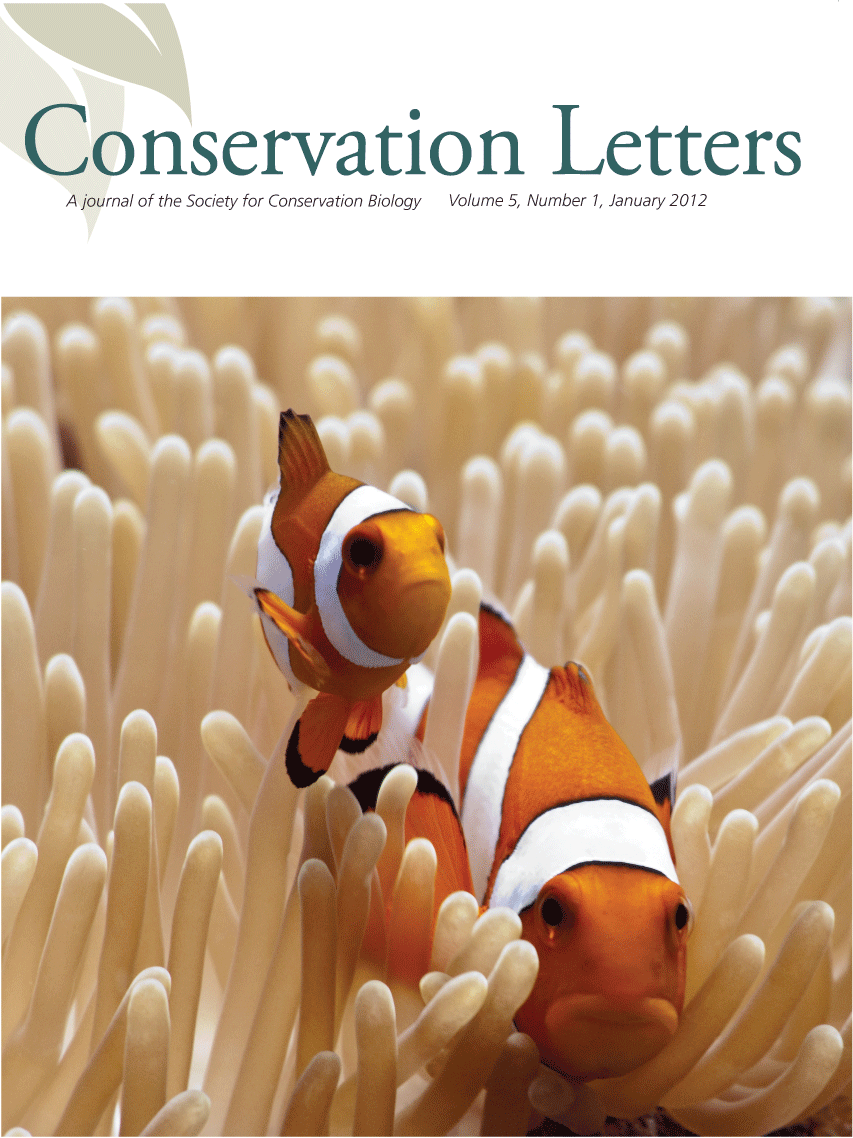
ConLetters-Jan12I’d like to introduce the latest scientific conservation journal – Conservation Letters (Wiley-Blackwell). If you are a publishing conservation scientist then you will have undoubtedly heard about this already. I must admit my biased opinion up front – I have the role of Senior Editor for the journal under the auspices of the venerable Editors-in-Chief, Professor Richard Cowling, Professor Hugh Possingham, Professor Bill Sutherland and Dr. Michael Mascia.

We’ve been doing conservation science now for well over 50 years, and there has been some fantastic, hard-hitting, brilliant research done. However, extinction rates continue to soar, habitat loss and fragmentation abound, bushmeat hunting and other forms of direct over-exploitation show no signs of slowing and invasive species are penetrating into the most ‘pristine’ habitats. To top it all off, climate change is exacerbating each and every one of these extinction drivers.

So what have we been doing wrong?

Clearly the best research is going unheeded – this is not to say that some progress has not been made, and I hope to highlight the best examples of the hardest-hitting research on this site – it simply means that we are losing the battle. Enter Conservation Letters – a journal designed to make conservation research more available to policy makers and managers to make true strides forward in biodiversity conservation. I’m not suggesting for a moment that other well-known, respected and established conservation journals have not done their job; without the research those journals publish we’d certainly be much worse off. However, we have recognised that our research isn’t affecting as many people as it should.

With Conservation Letters now well into its first year, I hope that we start to see some changes here, and I hope that the discipline will have a much greater net effect on slowing (and perhaps) reversing the extinction trends we observe today. Climate change is making this much more challenging, as well as the ever-increasing human population. Can we make better progress? – I certainly hope so.

CJA Bradshaw

Add to FacebookAdd to NewsvineAdd to DiggAdd to Del.icio.usAdd to StumbleuponAdd to RedditAdd to BlinklistAdd to Ma.gnoliaAdd to TechnoratiAdd to Furl


Conservation that bites

2 07 2008

This new website will post examples of conservation science with real-world impacts to policy that improves biodiversity outcomes. Stay tuned.

CJA Bradshaw