Perceptions on poverty: the rising Middle Class

16 03 2009

I’m being somewhat ‘lazy’ this week in that I have unfortunately less time to spend on pertinent blog posts than I’d like (lecturing, looming deadlines, that sort of thing). So, I start out this week’s posts with one of my favourite TED talks – Hans Rosling debunks myths about the developing world.

What’s the relevance to biodiversity conservation? I’ll admit, it may appear somewhat tangential, but there are a few important messages (both potentially good and bad):

1. POSSIBLE BENEFIT #1: The rising wealth in the developing world and associated reduction in family size may inevitably curb our human population growth rates;

2. POSSIBLE DISADVANTAGE #1: Rising wealth will necessarily mean more and more consumption, and as we know at least for tropical developing nations, resource consumption is killing biodiversity faster than anywhere else on the planet;

3. POSSIBLE DISADVANTAGE #2: As family wealth rises, so too do opportunities do opportunities for the Anthropogenic Allee effect (consuming rare species just because you can afford to do so);

4. POSSIBLE BENEFIT #2: Better health care associated with rising wealth and lower infant mortality might make education a higher priority, teaching more people about the necessity of safeguarding ecosystem services.

I’m not convinced the advantages will necessarily outweigh the disadvantages; regardless, Prof. Rosling’s amazing 20-minute presentation will both entertain and enlighten. I recommend it for a lunchtime sitting or that late-afternoon attention wain.

CJA Bradshaw

Vodpod videos no longer available.
more about “Hans Rosling shows the best stats you…“, posted with vodpod


Tropical Turmoil II

8 03 2009

In August last year I covered a paper my colleagues (Navjot Sodhi and Barry Brook) and I had in press in Frontiers in Ecology and the Environment entitled Tropical turmoil – a biodiversity tragedy in progress. The paper is now available in the March 2009 issue of the journal (click here to access). We were also fortunate enough to grab the front cover (shown here) and have a dedicated podcast that you can listen to by clicking here about the paper and its findings. I encourage ConservationBytes.com readers to have a listen if they’re interested in learning more about the woeful state of tropical biotas worldwide, and maybe some ways to rectify the problems. The intro to the podcast can be viewed by clicking here.

CJA Bradshaw


Cartoon guide to biodiversity loss III

24 02 2009

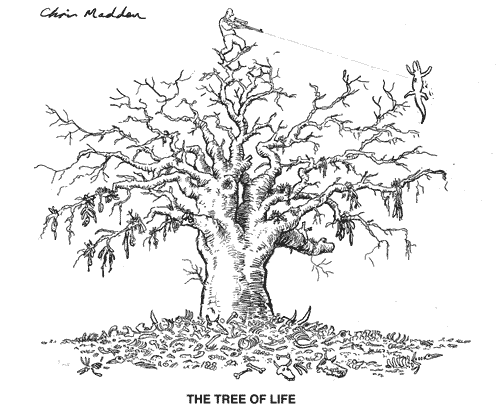
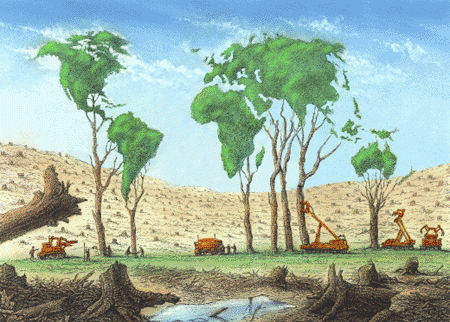
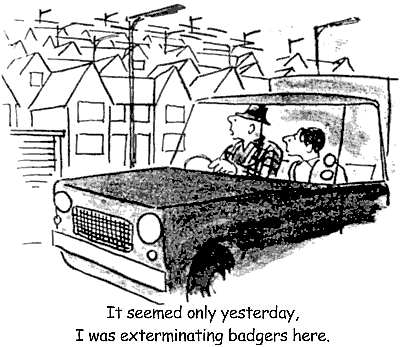
Some more (see previous ‘Cartoon Guide’ instalments I and II) comedic reminders of humanity’s environmental short-sightedness.

The Call of The Wild

CJA Bradshaw

Add to FacebookAdd to NewsvineAdd to DiggAdd to Del.icio.usAdd to StumbleuponAdd to RedditAdd to BlinklistAdd to Ma.gnoliaAdd to TechnoratiAdd to Furl


Who gives a rodent’s bum about conservation?

14 11 2008

I thought this might be an interesting thing to ponder for a Friday – where in the world do people appear most interested in issues to do with biodiversity conservation science?

Impossible Difficult question to answer, but the map of ConservationBytes.com viewers since August might reveal some interesting trends:

© ClustrMaps
© ClustrMaps

The above map shows our viewers’ locations since 19 August 2008 (to 19 November). The salient features are:

  1. Most viewers are from Europe (especially UK) and the USA. Not really a surprise here given the availability of internet, the number of people and average education level.
  2. Australia comes out next as a centre of activity – again, no surprise here given I’m from Australia and I feature many Australian issues.
  3. Almost nothing from China – the most populous country. I originally thought that the Chinese weren’t interested, but I have since discovered that the Great Firewall of China blocks all WordPress blogs (see blogs and posts on this issue). While there are ways around this, it isn’t easy for this vast body of internet surfers to see what I write. My recent trip there highlighted to me how much this country needs to pay attention to the issues raised in ConservationBytes.com (extensive pollution, huge human population and associated demand, GHG emissions, massive livestock industry, demand for oil palm, etc., etc., etc.).
  4. India was a bit of a surprise. Sure, second-highest human population, so a lot of potentially interested people. It also suggests that increasing internet access and a growing middle class are driving greater awareness and concern in conservation issues.
  5. Very little from Africa and South America. Internet access issues, education, awareness?
  6. Canadians – don’t care? They should.
  7. Russia & the Middle East – not sure why nothing much from these areas.

Of course, my little survey based on web hits from one tiny blog isn’t necessarily the most representative tool to gauge these issues, but it does allow me to pose some interesting hypotheses.

CJA Bradshaw

Add to FacebookAdd to NewsvineAdd to DiggAdd to Del.icio.usAdd to StumbleuponAdd to RedditAdd to BlinklistAdd to Ma.gnoliaAdd to TechnoratiAdd to Furl


Wake Up, Freak Out

9 10 2008
© Leo Murray

© Leo Murray

An excellent, short animated film about the perils of climate change and its implications for biodiversity (including humans). Highly recommended.

This really isn’t about polar bears any more. At this very moment, the fate of civilization itself hangs in the balance.

It turns out that the way we have been calculating the future impacts of climate change up to now has been missing a really important piece of the picture. It seems we are now dangerously close to the tipping point in the world’s climate system; this is the point of no return, after which truly catastrophic changes become inevitable.

Wake Up, Freak Out – then Get a Grip is a short, animated film about climate change by Leo Murray.


Tropical Conservation Biology

8 09 2008

An obvious personal plug – but I’m allowed to do that on my own blog ;-)

1405150734I’d like to introduce a (relatively) new textbook that my colleagues, Navjot Sodhi and Barry Brook, and I wrote and published last year with Blackwell (now Wiley-Blackwell) Scientific Publishing – Tropical Conservation Biology.

We’re rather proud of this book because it was a timely summary and assessment of the scientific evidence for the degree of devastation facing tropical biodiversity today and in the future. I’ve summarised some of the main issues in a previous post covering a paper we have ‘in press’ that was born of the text book, but obviously the book is a far more detailed account of the problems facing the tropics.

This introductory textbook examines diminishing terrestrial and aquatic habitats in the tropics, covering a broad range of topics including the fate of the coral reefs; the impact of agriculture, urbanisation, and logging on habitat depletion; and the effects of fire on plants and animal survival.

One of the highlights of the book is that each chapter (see below) Includes case studies and interviews with prominent conservation scientists to help situate key concepts in a real world context: Norman Myers (Chapter 1), Gretchen Daily (Chapter 2), William Laurance (Chapter 3), Mark Cochrane (Chapter 4), Daniel Simberloff (Chapter 5), Bruce Campbell (Chapter 6), Daniel Pauly (Chapter 7), Stephen Schneider (Chapter 8), Stuart Pimm (Chapter 9) and Peter Raven (Chapter 10). These biographies are followed by a brief set of questions and answers that focus on some of the most pertinent and pressing issues in tropical conservation biology today. It is our intention that readers of Tropical Conservation Biology will benefit from the knowledge and be inspired by the passion of these renowned conservation experts.

TABLE OF CONTENTS

  1. Chapter 1: Diminishing habitats in regions of high biodiversity. We report on the loss of tropical habitats across the tropics (e.g., deforestation rates). We also highlight the drivers of habitat loss such as human population expansion. Finally, we identify the areas in immediate need of conservation action by elucidating the concept of biodiversity hotspots. Read the rest of this entry »


Tropical turmoil – a biodiversity tragedy in progress

18 08 2008

fragmentationWe recently published (online) a major review showing that the world is losing the battle over tropical habitat loss with potentially disastrous implications for biodiversity and human well-being.

Published online in the Ecological Society of America’s journal Frontiers in Ecology and the Environment, our review Tropical turmoil – a biodiversity crisis in progress concludes that we are “on a trajectory towards disaster” and calls for an immediate global, multi-pronged conservation approach to avert the worst outcomes.

Tropical forests support more than 60 % of all known species, but represent only about 7 % of the Earth’s land surface. But up to 15 million hectares of tropical rainforest are being lost every year and species are being lost at a rate of up to 10000 times higher than would happen randomly without humans present.

This is not just a tragedy for tropical biodiversity, this is a crisis that will directly affect human livelihoods. This is not just about losing tiny species found in the canopies of big rain forest trees few people will ever see, this is about a complete change in ecosystem services that directly benefit human life. Read the rest of this entry »