Classics: Fragmentation

3 10 2008
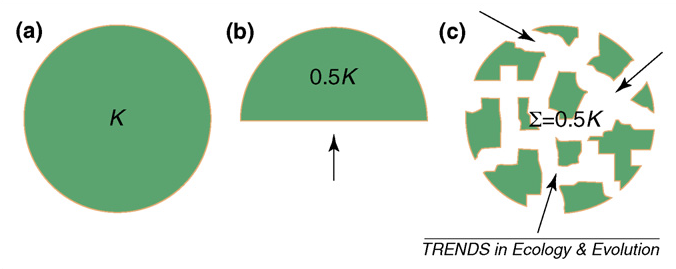
Figure 2 from Brook et al. (2008): Synergies among threatening processes relative to habitat loss and fragmentation. a) A large population within unmodified, contiguous habitat occupies all available niches so that long-term abundance fluctuates near full carrying capacity (K). b) When habitat is reduced (e.g. 50 % area loss), total abundance declines accordingly. c) However, this simple habitat-abundance relationship is complicated by the spatial configuration of habitat loss. In this example, all remaining fragmented subpopulations might fall below their minimum viable population (MVP) sizes even though total abundance is the same proportion of K as in panel B. As such, limited connectivity between subpopulations implies much greater extinction risk than that predicted for the same habitat loss in less fragmented landscapes. Further synergies (positive feedbacks among threatening processes; black arrows) might accompany high fragmentation, such as enhanced penetration of predators, invasive species or wildfire, micro-habitat edge effects, and reduced resistance to drought with climate change.

Figure 2 from Brook et al. (2008): Synergies among threatening processes relative to habitat loss and fragmentation. a) A large population within unmodified, contiguous habitat occupies all available niches so that long-term abundance fluctuates near full carrying capacity (K). b) When habitat is reduced (e.g., 50 % area loss), total abundance declines accordingly. c) However, this simple habitat-abundance relationship is complicated by the spatial configuration of habitat loss. In this example, all remaining fragmented subpopulations might fall below their minimum viable population (MVP) sizes even though total abundance is the same proportion of K as in panel B. As such, limited connectivity between subpopulations implies much greater extinction risk than that predicted for the same habitat loss in less fragmented landscapes. Further synergies (positive feedbacks among threatening processes; black arrows) might accompany high fragmentation, such as enhanced penetration of predators, invasive species or wildfire, micro-habitat edge effects, and reduced resistance to drought with climate change.

This is, perhaps, one of the most important concepts that the field of conservation biology has identified as a major driver of extinction. It may appear on the surface a rather simple notion that the more ‘habitat’ you remove, the fewer species (and individuals) there will be (see MacArthur & Wilson’s Classic contribution: The Theory of Island Biogeography), but it took us decades (yes, embarrassingly – decades) to work out that fragmentation is bad (very, very bad).

Habitat fragmentation occurs when a large expanse of a particular, broadly defined habitat ‘type’ is reduced to smaller patches that are isolated by surrounding, but different habitats. The surrounding habitat is typically defined a ‘matrix’, and in the case of forest fragmentation, generally means ‘degraded’ habitat (fewer native species, urban/rural/agricultural development, etc.).

Fragmentation is bad for many reasons: it (1) reduces patch area, (2) increases isolation among populations associated with fragments, and (3) creates ‘edges’ where unmodified habitat abuts matrix habitat. Each of these has dire implications for species, for we now know that (1) the smaller an area, the fewer individuals and species in can contain, (2) the more isolated a population, the less chance immigrants will ‘rescue’ it from catastrophes, and (3) edges allow the invasion of alien species, make the microclimate intolerable, increase access to bad humans and lead to cascading ecological events (e.g., fire penetration). Make no mistake, the more fragmented an environment, the worse will be the extinction rates of species therein.

What’s particularly sad about all this is that fragmentation was actually seen as a potentially GOOD thing by conservation biologists for many long years. The so-called SLOSS (Single Large or Several Small) debate pervaded the early days of conservation literature. The debate was basically the argument that several small reserves would provide more types of habitat juxtapositions and more different species complexes, making overall diversity (species richness) higher, than one large reserve. It was an interesting, if not deluded, intellectual debate because both sides presented some rather clever theoretical and empirical arguments. Part of the attraction of the ‘Several Small’ idea was that it was generally easier to find series of small habitat fragments to preserve than one giant no-go area.

However, we now know that the ‘Several Small’ idea is completely inferior because of the myriad synergistic effects of fragmentation. It actually took Bruce Wilcox and Dennis Murphy until 1985 to bring this to everyone’s attention in their classic paper The effects of fragmentation on extinction to show how silly the SLOSS debate really was. It wasn’t, however, until the mid- to late 1990s that people finally started to accept the idea that fragmentation really was one of the biggest conservation evils. Subsequent work (that I’ll showcase soon on ConservationBytes.com) finally put the nail in the SLOSS debate coffin, and indeed, we haven’t heard a whisper of it for over a decade.

For more general information, I invite you to read the third chapter in our book Tropical Conservation Biology entitled Broken homes: tropical biotas in fragmented landscapes, and our recent paper in Trends in Ecology and Evolution entitled Synergies among extinction drivers under global change.

CJA Bradshaw

Add to FacebookAdd to NewsvineAdd to DiggAdd to Del.icio.usAdd to StumbleuponAdd to RedditAdd to BlinklistAdd to Ma.gnoliaAdd to TechnoratiAdd to Furl


Oil palm plantations destroying tropical biodiversity

18 09 2008

This one from MongaBay.com

Conversion of primary rainforest to an oil palm plantation results in a loss of more than 80 percent of species, reports a new comprehensive review of the impacts of growing palm oil production. The research is published in the journal Trends in Ecology and Evolution.

“By compiling scientific studies of birds, bats, ants and other species, we were able to show that on average, fewer than one-sixth of the species recorded in primary forest were found in oil palm,” said led author Emily Fitzherbert from the Zoological Society of London and University of East Anglia. “Degraded forest, and even alternative crops such as rubber and cocoa, supported higher numbers of species than oil palm plantations.”

The results confirm that oil palm plantations are a poor substitute for natural forests when it comes to conservation of biological diversity.

The study warns that burgeoning demand for palm oil for use in foods, household products, and biodiesel will continue to fuel expansion in the tropics. Because planters can subsidize operations by the initial logging for forest plots, it seems likely that forests will continue to fall for new plantations despite the availability of large tracts of degraded and abandoned land.

“There is enough non-forested land suitable for plantation development to allow large increases in production without large impacts on tropical forests, but as a result of political inertia, competing priorities and lack of capacity and understanding, not to mention high levels of demand for timber and palm oil from wealthy consumers, it is still often cheaper and easier to clear forests. Unless these conditions change quickly, the impacts of oil palm expansion on biodiversity will be substantial,” the authors conclude.
See also Koh & Wilcove. 2008. Is oil palm agriculture really destroying tropical biodiversity? Conservation Letters 1: 60-64
CJA Bradshaw


Deforestation and disease

10 09 2008

Humans have such a short memory…

A recent theme in many of my posts is the concept of ecosystem services provided to us essentially free of charge, and their continued degradation due to the burgeoning human population, bad land management and excessive resource consumption. We are indeed degrading the very life-support system species assemblages provide us. I’ve previously posted a long list of ecosystem services that you can consult here, but this recent paper in BioScience highlights one that is probably largely overlooked – the role of forests in reducing the incidence of human disease.

In their article entitled Deforestation, mosquitoes, and Ancient Rome: lessons for today, Lara O’Sullivan and colleagues discuss the evidence from Ancient Rome that deforestation rapidly increased the prevalence of malarial diseases. They also go on to cite several examples from the modern world where deforestation appears to be linked to greater manifestation of diseases like malaria.

The evidence isn’t just linked to Africa and the Amazon, but the authors suggest that the incidence of mosquito-borne diseases in Australia such as Ross River fever may also be on the rise as forests are quickly degraded and destroyed.

In two previous posts (see here and here), I commented on the escalating biodiversity crisis in the tropics driven largely by habitat loss (i.e., deforestation) – add increasing human disease to the long list of negatives associated with degrading or disappearing ecosystem services such as increased frequency and severity of floods, reduced food provision, reduced availability of clean water, reduced pollination, etc. We MUST educate the masses with the increasing body of scientific evidence that our behaviour is self-defeating (see previous post on this issue).

Indeed, it’s no longer the days of the capitalists versus the ‘greenies’ – the rapid decline in the quality of human life and and our own survival is affecting all of us, including the wealthy. In fact, I would argue that environmentalism has fully developed as the principal rationale in conservation ecology, such that it has become much less of an esoteric struggle for maintaining all things beautiful (the capitalist viewpoint of the traditional ‘greeny’), to a science-driven means to maintain human life and prosperity. Can we afford to continue along this path? Definitely not. Only an idiot with the foresight of a slug could ignore our current trajectory – and that includes the millionaire sport heroes, actors, and entrepreneurs who have benefited directly from our collective resource exploits. If you give a shit about the quality of life you and your descendants will have in the very near future, do not ignore habitat loss any longer.

CJA Bradshaw

Add to FacebookAdd to NewsvineAdd to DiggAdd to Del.icio.usAdd to StumbleuponAdd to RedditAdd to BlinklistAdd to Ma.gnoliaAdd to TechnoratiAdd to Furl


Tropical Conservation Biology

8 09 2008

An obvious personal plug – but I’m allowed to do that on my own blog ;-)

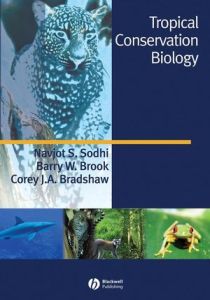
1405150734I’d like to introduce a (relatively) new textbook that my colleagues, Navjot Sodhi and Barry Brook, and I wrote and published last year with Blackwell (now Wiley-Blackwell) Scientific Publishing – Tropical Conservation Biology.

We’re rather proud of this book because it was a timely summary and assessment of the scientific evidence for the degree of devastation facing tropical biodiversity today and in the future. I’ve summarised some of the main issues in a previous post covering a paper we have ‘in press’ that was born of the text book, but obviously the book is a far more detailed account of the problems facing the tropics.

This introductory textbook examines diminishing terrestrial and aquatic habitats in the tropics, covering a broad range of topics including the fate of the coral reefs; the impact of agriculture, urbanisation, and logging on habitat depletion; and the effects of fire on plants and animal survival.

One of the highlights of the book is that each chapter (see below) Includes case studies and interviews with prominent conservation scientists to help situate key concepts in a real world context: Norman Myers (Chapter 1), Gretchen Daily (Chapter 2), William Laurance (Chapter 3), Mark Cochrane (Chapter 4), Daniel Simberloff (Chapter 5), Bruce Campbell (Chapter 6), Daniel Pauly (Chapter 7), Stephen Schneider (Chapter 8), Stuart Pimm (Chapter 9) and Peter Raven (Chapter 10). These biographies are followed by a brief set of questions and answers that focus on some of the most pertinent and pressing issues in tropical conservation biology today. It is our intention that readers of Tropical Conservation Biology will benefit from the knowledge and be inspired by the passion of these renowned conservation experts.

TABLE OF CONTENTS

  1. Chapter 1: Diminishing habitats in regions of high biodiversity. We report on the loss of tropical habitats across the tropics (e.g., deforestation rates). We also highlight the drivers of habitat loss such as human population expansion. Finally, we identify the areas in immediate need of conservation action by elucidating the concept of biodiversity hotspots. Read the rest of this entry »


Threatened species depend on protected areas

4 09 2008

One for the Potential list:

3932397_origA great new paper has just come out in Global Change Biology by Sarah Jackson and Kevin Gaston: Land use change and the dependence of national priority species on protected areas. In what is simultaneously frightening and ecouraging is the observation that of nearly 400 Biodiversity Action Plan (BAP) species considered either to be globally threatened or rapidly declining in the UK (i.e., > 50 % decline over 25 years), 55 % were largely restricted to statuatory protected areas in the UK. These areas cover about 11.5 % of Britain’s land surface.

What’s amazing about this is that without these reserves, these (hundreds) of species would already be extinct (or very close to it) – if this isn’t one of the strongest arguments for reserves, I don’t know what is. Not only are reserves essential for maintaining populations of threatened species, their spatial connectivity is also highly influential on persistence probability (future posts on fragmentation coming).

Much of the planet has now been modified to the point where any sort of species preservation will necessarily require large, expansive, contiguous networks of protected areas. Jackson & Gaston conclude:

Britain has undergone particularly extensive land transformation, reducing many originally much more widespread vegetation/habitat types to scattered fragments, few of which can be considered strictly natural (Rackham, 1986). A proportion of these fragments receive statutory protection and intensive management, increasing the likelihood that species of conservation concern are restricted to such areas. This circumstance is not unique to Britain, being found in many heavily developed regions including much of northwestern Europe, although it is not so extreme in many others. Britain may, thus, represent a possible future scenario for such regions. Under such circumstances, it is not unlikely that many species if they are not already restricted to protected areas will become so (e.g. species confined to tropical forest habitats following deforestation).

 Keeping things off limits from the burgeoning human population is therefore one of the major ways we can stem the tide of extinctions.

CJA Bradshaw

Add to FacebookAdd to NewsvineAdd to DiggAdd to Del.icio.usAdd to StumbleuponAdd to RedditAdd to BlinklistAdd to Ma.gnoliaAdd to TechnoratiAdd to Furl