Primate conservation enhances human food availability

19 09 2008

This one from Mongabay.com – yet another reason to conserve species for human benefit…

© F. Möllers

© F. Möllers

Primate conservation may have the unintended benefit of enhancing food availability to humans, reports a study [Koné et al. 2008. Primate seed dispersal and its potential role in maintaining useful tree species in the Taï region, Côte-d’Ivoire: implications for the conservation of forest fragments. Tropical Conservation Science 1:293-306] led by African scientists.

The research, conducted in the Taï region of Côte-d’Ivoire, found that seven species of monkeys used about 75 species of plants as a source of fruit, of which 25 were also used by local human inhabitants for various purposes. Because monkeys are key seed dispersal agents, the results suggest that primate conservation may sustain the persistence of plant resources important for human livelihoods.

“The cost of losing monkeys extends beyond the loss of the animals themselves,” write the authors. “Indeed, the local extinction of frugivorous primates is predicted to have deleterious consequences for forest regeneration and/or tree species community composition.”

The authors, led by Inza Koné from the University of Cocody in Abidjan and the Taï Monkey Project, note that monkeys in the region are already experiencing “extreme hunting pressure” as a source of protein and as crop pests. Primates are also threatened by habitat loss caused by the conversion of forest for agriculture.

Koné and colleagues suggest measures to conserve monkeys will offer multiple benefits to the primates themselves as well as local communities.

“Results of this study suggest that maintaining populations of monkeys is important not only for forest regeneration, but also for human habitat use,” they continue. “The conservation of primate species is a critically important goal in itself; by working to ensure their protection in forest fragments, we protect indirectly the seed dispersal of important human resources in these fragments as well.”

“Protection of monkeys and seed dispersal systems outside protected areas is particularly relevant in this context, since it is in these areas… that primates are most at risk, and also where people are allowed to exploit forest plant resources.”


Classics: Fishing down the web

17 09 2008

A Classic

Fishing_down_the_food_webDaniel Pauly and colleagues’ classic paper in Science, Fishing down marine food webs, is one that merits citation in ConservationBytes.com Classics section. The trend identified by Pauly and colleagues is fairly simple – data from the Food and Agriculture Organisation (FAO) of the United Nations revealed that the average trophic level (i.e., the position in the food web relative to autotrophs – primary producers such as phytoplankton) has declined by an overall average of 0.2 units. In this case, a trophic unit varied from 1 (phytoplankton) to 4.6 (e.g., snappers, family Lutjanidae). The trends varied by region and whether or not one takes certain overrepresented species into account, but the average decline was more or less consistent across the dataset.

What does all this reveal? Put simply, it means that fishing on a massive and global commercial scale has essentially removed many of the larger species to the point where it has become no longer economically viable to sustain a targeted fishery. This does not necessarily mean that these species have disappeared, but it does indicate a large drop in relative abundance (and thus, ease of capture) necessary to support an industry, with the corollary that highly reduced populations are now much more extinction-prone if they fall below their minimum viable population size. The corollary is that marine species we wouldn’t consider palatable for a dog 50 years ago are now considered top-quality market delicacies.

The paper did not go without critique – Caddy and colleagues argued that Pauly and colleagues oversimplified the case for marine fishes and misinterpreted some data; however, a subsequent paper by Pauly’s team published in 2005, Fishing down marine food web: it is far more pervasive than we thought, argued that the original paper didn’t go far enough, and that fisheries over-exploitation worldwide is much worse than originally reported. Indeed, there are certainly some high-profile examples to support the case (e.g., the Atlantic cod and Peruvian anchoveta fisheries collapses, to name a few).

What did this do for biodiversity conservation? I think it can be argued that this is one of the first big papers to identify that the over-fishing problem was global in extent and massive in magnitude, and that high-seas over-exploitation was stripping our seas of its bigger (generally slower-growing and more extinction-prone) species. I believe things have changed for the better, but we’re still a long way off. Fishing in international waters still operates without an international body to enforce regulation and document catch precisely, and the classic tragedy of the commons applies so well to fisheries that it should be one of the principal examples used to illustrate the concept. People tend to jump up and down about elephants, pandas and whales, but the reduction in fish worldwide is a biodiversity crisis in progress that has not attracted nearly enough attention. We need more papers like Pauly’s on this issue, as well as demonstrations of the loss of marine ecosystem function and services with the loss of species brought about by excessive fishing harvests. Only then can we expect the careless greed driving quick-profit high-seas fisheries to ease up enough to prevent extinctions on a massive scale.

CJA Bradshaw

Add to FacebookAdd to NewsvineAdd to DiggAdd to Del.icio.usAdd to StumbleuponAdd to RedditAdd to BlinklistAdd to Ma.gnoliaAdd to TechnoratiAdd to Furl


Tropical Conservation Biology

8 09 2008

An obvious personal plug – but I’m allowed to do that on my own blog ;-)

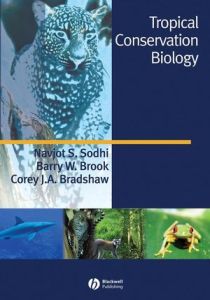
1405150734I’d like to introduce a (relatively) new textbook that my colleagues, Navjot Sodhi and Barry Brook, and I wrote and published last year with Blackwell (now Wiley-Blackwell) Scientific Publishing – Tropical Conservation Biology.

We’re rather proud of this book because it was a timely summary and assessment of the scientific evidence for the degree of devastation facing tropical biodiversity today and in the future. I’ve summarised some of the main issues in a previous post covering a paper we have ‘in press’ that was born of the text book, but obviously the book is a far more detailed account of the problems facing the tropics.

This introductory textbook examines diminishing terrestrial and aquatic habitats in the tropics, covering a broad range of topics including the fate of the coral reefs; the impact of agriculture, urbanisation, and logging on habitat depletion; and the effects of fire on plants and animal survival.

One of the highlights of the book is that each chapter (see below) Includes case studies and interviews with prominent conservation scientists to help situate key concepts in a real world context: Norman Myers (Chapter 1), Gretchen Daily (Chapter 2), William Laurance (Chapter 3), Mark Cochrane (Chapter 4), Daniel Simberloff (Chapter 5), Bruce Campbell (Chapter 6), Daniel Pauly (Chapter 7), Stephen Schneider (Chapter 8), Stuart Pimm (Chapter 9) and Peter Raven (Chapter 10). These biographies are followed by a brief set of questions and answers that focus on some of the most pertinent and pressing issues in tropical conservation biology today. It is our intention that readers of Tropical Conservation Biology will benefit from the knowledge and be inspired by the passion of these renowned conservation experts.

TABLE OF CONTENTS

  1. Chapter 1: Diminishing habitats in regions of high biodiversity. We report on the loss of tropical habitats across the tropics (e.g., deforestation rates). We also highlight the drivers of habitat loss such as human population expansion. Finally, we identify the areas in immediate need of conservation action by elucidating the concept of biodiversity hotspots. Read the rest of this entry »


Synergies among extinction drivers

24 08 2008

Hopefully one for the Potential list:

© J. Hance

Brook, BW, NS Sodhi, CJA Bradshaw. (2008) Synergies among extinction drivers under global change. Trends in Ecology and Evolution 23, 453-460

A review my colleagues, Barry Brook and Navjot Sodhi, and I have just published in Trends in Ecology and Evolution demonstrates how separate drivers of extinction (e.g., habitat loss, over-exploitation [hunting, fishing, etc.], climate change, invasive species, etc.) tend to work together to heighten the extinction probability of the species they affect more than the simple sum of the individual effects alone.

In what we termed ‘synergies’, the review compiles evidence from observational, experimental and meta-analytic research demonstrating the positive and self-reinforcing actions of multiple drivers of population decline and eventual extinction. Examples include experimental evidence that wild radishes experiencing inbreeding depression have lower fitness than expected from simple population reduction (Elam et al. 2007), inter-tidal polychaetes succumb to pollution effects much more so at low densities than when populations are abundant (Hollows et al. 2007), and habitat fragmentation, harvest and simulated climate warming increase rotifer extinction risk up to 50 times more than expected from the additive effects of the threatening processes (Mora et al. 2007).

We argued that conservation actions only targeting single drivers will more than likely be inadequate because of the cascading effects caused by unmanaged synergies. Climate change will also interact with and accelerate ongoing threats to biodiversity, so the importance of accounting for these interactions cannot be understated.

CJA Bradshaw

Add to FacebookAdd to NewsvineAdd to DiggAdd to Del.icio.usAdd to StumbleuponAdd to RedditAdd to BlinklistAdd to Ma.gnoliaAdd to TechnoratiAdd to Furl


More on ‘roos

8 08 2008
Couldn’t resist posting this. Brilliant. Copyright Cathy Wilcox and the Sydney Morning Herald (in reference to previous post).


Beef is bad; Skippy is better

7 08 2008

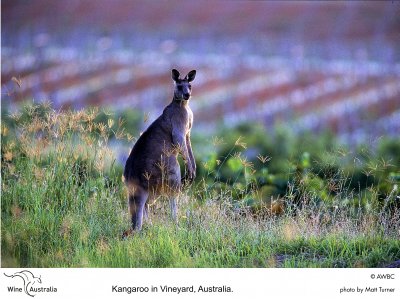
© AWBC

One for the ‘potential‘ list – George Wilson and Melanie Edwards of Australian Wildlife Services have just published a paper in the Early View section of Conservation Letters entitled Native wildlife on rangelands to minimize methane and produce lower-emission meat: kangaroos versus livestock.I am particularly moved by this one for several reasons: (1) it is one of the first really good policy pieces on why we should be eating more kangaroos and fewer sheep and cattle in Australia, (2) it moves past the ridiculous welfare issues that have prevented people from embracing kangaroo harvest in this country, (3) it provides an excellent model for reducing our reliance on non-native livestock for protein worldwide, (4) I love eating macropods (flavour, nutritional value, tenderness – see basic cooking instructions below), and (4) I was responsible for editing the manuscript for publication in Conservation Letters.

Hard-hoofed livestock pastoralism has been the economic backbone of Australia since Europeans first managed to scratch out a living on this harsh land. It has always been a bit of a battle raising largely European-adapted livestock (cattle, sheep, goats) on the driest inhabited continent in the world, but the innovative and persevering Australian cocky has managed to pull it off. However, such livestock pastoralism has been implicated in the extinction of at least 20 mammal species and threatens around 25 % of the plant species listed as endangered in Australia (Wilson & Edwards 2008). It’s also becoming more difficult to raise water-thirsty livestock as our rainfall dwindles with climate change.

Now as Wilson and Edwards point out, there are many carbon-related benefits for switching our protein dependency to kangaroos. Read the rest of this entry »


IUCN Chief Scientist & Asia

15 07 2008

I’m currently attending the Society for Conservation Biology‘s Annual Meeting in Chattanooga, Tennessee, USA and blogging on presentations I think are worth mentioning.

The first plenary talk was given by the IUCN’s Chief Scientist, Jeffrey McNeely, about the issues surrounding biodiversity conservation in Asia. Dr. McNeely gave an interesting background to the human cultural history and diversity of the region, followed by a brief exposé of the conservation issues there (habitat loss, over-exploitation, invasive species, etc). Overall, however, I was disappointed by his lack of emphasis on the magnitude of the conservation crisis Asia is undergoing. There was no mention of the perverse subsidies buffering unsustainable forestry and fishing, the corruption driving habitat loss and habitat degradation, or the massive problems driven by human over-population.

We recently published (currently online) a paper regarding the conservation crisis facing this (and similar regions) in the tropics Tropical turmoil – a biodiversity crisis in progress (see related post), and several of my colleagues have recently outlined just how badly biodiversity is faring in Asia (e.g., see Brook et al. 2003; Sodhi et al. 2004). While I was happy to see Dr. McNeely mention the need for more research on these issues, his statement that he had “depressed [us] with the problems” was a major understatement. He did not nearly go far enough to ‘depress’ his audience of conservation scientists. We are squarely within a crisis in the region, and if the Chief Scientist of the IUCN who has intimate knowledge of Asia is not singing that song loudly and clearly, I fear it will get far worse before we see any real positive change.
CJA Bradshaw


Conservation Letters – a scientific journal with a difference?

5 07 2008

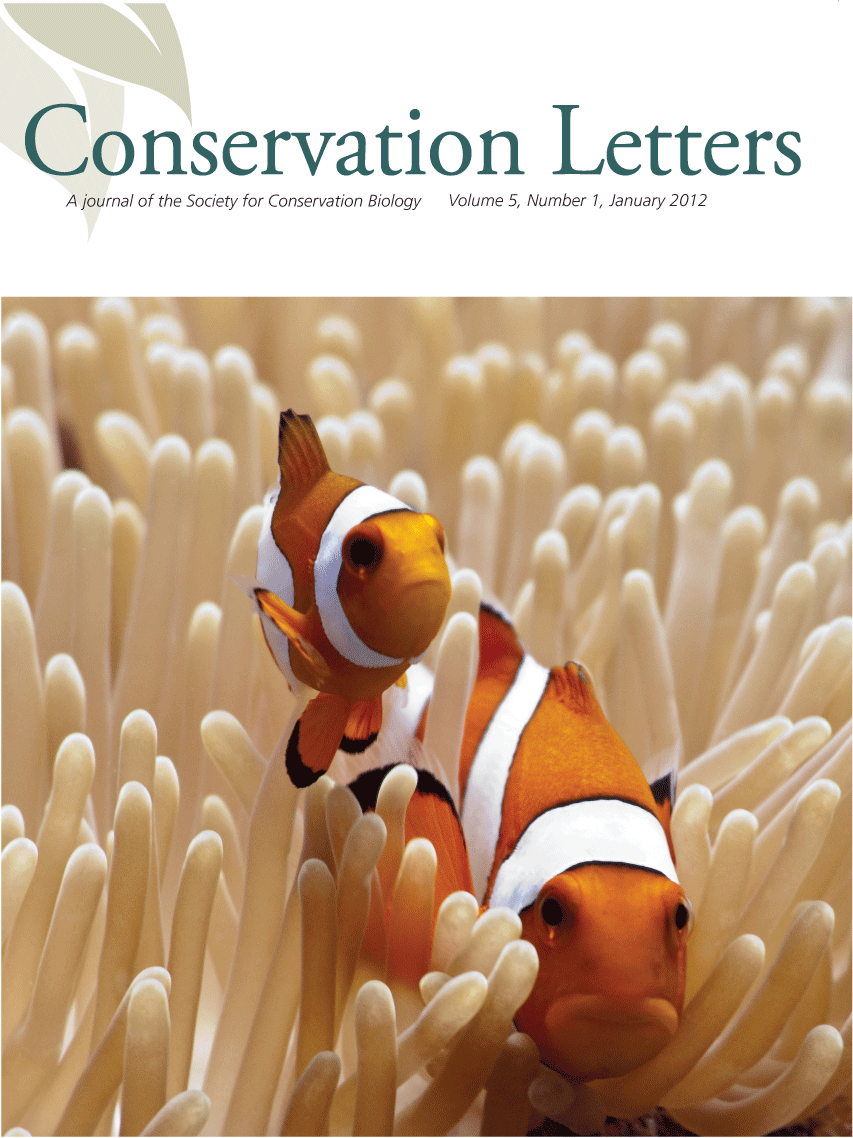
ConLetters-Jan12I’d like to introduce the latest scientific conservation journal – Conservation Letters (Wiley-Blackwell). If you are a publishing conservation scientist then you will have undoubtedly heard about this already. I must admit my biased opinion up front – I have the role of Senior Editor for the journal under the auspices of the venerable Editors-in-Chief, Professor Richard Cowling, Professor Hugh Possingham, Professor Bill Sutherland and Dr. Michael Mascia.

We’ve been doing conservation science now for well over 50 years, and there has been some fantastic, hard-hitting, brilliant research done. However, extinction rates continue to soar, habitat loss and fragmentation abound, bushmeat hunting and other forms of direct over-exploitation show no signs of slowing and invasive species are penetrating into the most ‘pristine’ habitats. To top it all off, climate change is exacerbating each and every one of these extinction drivers.

So what have we been doing wrong?

Clearly the best research is going unheeded – this is not to say that some progress has not been made, and I hope to highlight the best examples of the hardest-hitting research on this site – it simply means that we are losing the battle. Enter Conservation Letters – a journal designed to make conservation research more available to policy makers and managers to make true strides forward in biodiversity conservation. I’m not suggesting for a moment that other well-known, respected and established conservation journals have not done their job; without the research those journals publish we’d certainly be much worse off. However, we have recognised that our research isn’t affecting as many people as it should.

With Conservation Letters now well into its first year, I hope that we start to see some changes here, and I hope that the discipline will have a much greater net effect on slowing (and perhaps) reversing the extinction trends we observe today. Climate change is making this much more challenging, as well as the ever-increasing human population. Can we make better progress? – I certainly hope so.

CJA Bradshaw

Add to FacebookAdd to NewsvineAdd to DiggAdd to Del.icio.usAdd to StumbleuponAdd to RedditAdd to BlinklistAdd to Ma.gnoliaAdd to TechnoratiAdd to Furl