The biodiversity extinction numbers game

4 01 2010

© Ferahgo the Assassin

Not an easy task, measuring extinction. For the most part, we must use techniques to estimate extinction rates because, well, it’s just bloody difficult to observe when (and where) the last few individuals in a population finally kark it. Even Fagan & Holmes’ exhaustive search of extinction time series only came up with 12 populations – not really a lot to go on. It’s also nearly impossible to observe species going extinct if they haven’t even been identified yet (and yes, probably still the majority of the world’s species – mainly small, microscopic or subsurface species – have yet to be identified).

So conservation biologists do other things to get a handle on the rates, relying mainly on the species-area relationship (SAR), projecting from threatened species lists, modelling co-extinctions (if a ‘host’ species goes extinct, then its obligate symbiont must also) or projecting declining species distributions from climate envelope models.

But of course, these are all estimates and difficult to validate. Enter a nice little review article recently published online in Biodiversity and Conservation by Nigel Stork entitled Re-assessing current extinction rates which looks at the state of the art and how the predictions mesh with the empirical data. Suffice it to say, there is a mismatch.

Stork writes that the ‘average’ estimate of losing about 100 species per day has hardly any empirical support (not surprising); only about 1200 extinctions have been recorded in the last 400 years. So why is this the case?

As mentioned above, it’s difficult to observe true extinction because of the sampling issue (the rarer the individuals, the more difficult it is to find them). He does cite some other problems too – the ‘living dead‘ concept where species linger on for decades, perhaps longer, even though their essential habitat has been destroyed, forest regrowth buffering some species that would have otherwise been predicted to go extinct under SAR models, and differing extinction proneness among species (I’ve blogged on this before).

Of course, we could just all be just a pack of doomsday wankers vainly predicting the end of the world ;-)

Well, I think not – if anything, Stork concludes that it’s all probably worse than we currently predict because of extinction synergies (see previous post about this concept) and the mounting impact of rapid global climate change. If anything, the “100 species/day” estimate could look like a utopian ideal in a few hundred years. I do disagree with Stork on one issue though – he claims that deforestation isn’t probably as bad as we make it out. I’d say the opposite (see here, here & here) – we know so little of how tropical forests in particular function that I dare say we’ve only just started measuring the tip of the iceberg.

CJA Bradshaw

Add to FacebookAdd to NewsvineAdd to DiggAdd to Del.icio.usAdd to StumbleuponAdd to RedditAdd to BlinklistAdd to Ma.gnoliaAdd to TechnoratiAdd to Furl

This post was chosen as an Editor's Selection for ResearchBlogging.org

ResearchBlogging.orgStork, N. (2009). Re-assessing current extinction rates Biodiversity and Conservation DOI: 10.1007/s10531-009-9761-9
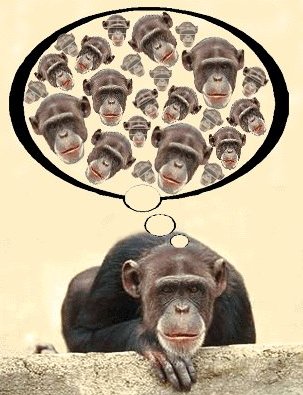


Cloning for conservation – stupid and wasteful

5 02 2009
© J. F. Jaramillo

© J. F. Jaramillo

I couldn’t have invented a better example of a Toothless conservation concept.

I just saw an article in the Independent (UK) about cloning for conservation that has rehashed the old idea yet again – while there was some interesting thoughts discussed, let’s just be clear just how stupidly inappropriate and wasteful the mere concept of cloning for biodiversity conservation really is.

1. Never mind the incredible inefficiency, the lack of success to date and the welfare issues of bringing something into existence only to suffer a short and likely painful life, the principal reason we should not even consider the technology from a conservation perspective (I have no problem considering it for other uses if developed responsibly) is that you are not addressing the real problem – mainly, the reason for extinction/endangerment in the first place. Even if you could address all the other problems (see below), if you’ve got no place to put these new individuals, the effort and money expended is an utter waste of time and money. Habitat loss is THE principal driver of extinction and endangerment. If we don’t stop and reverse this now, all other avenues are effectively closed. Cloning won’t create new forests or coral reefs, for example.

I may as well stop here, because all other arguments are minor in comparison to (1), but let’s continue just to show how many different layers of stupidity envelop this issue.

2. The loss of genetic diversity leading to inbreeding depression is a major issue that cloning cannot even begin to address. Without sufficient genetic variability, a population is almost certainly more susceptible to disease, reductions in fitness, weather extremes and over-exploitation. A paper published a few years ago by Spielman and colleagues (Most species are not driven to extinction before genetic factors impact them) showed convincingly that genetic diversity is lower in threatened than in comparable non-threatened species, and there is growing evidence on how serious Allee effects are in determining extinction risk. Populations need to number in the 1000s of genetically distinct individuals to have any chance of persisting. To postulate, even for a moment, that cloning can artificially recreate genetic diversity essential for population persistence is stupidly arrogant and irresponsible.

3. The cost. Cloning is an incredibly costly business – upwards of several millions of dollars for a single animal (see example here). Like the costs associated with most captive breeding programmes, this is a ridiculous waste of finite funds (all in the name of fabricated ‘conservation’). Think of what we could do with that money for real conservation and restoration efforts (buying conservation easements, securing rain forest property, habitat restoration, etc.). Even if we get the costs down over time, cloning will ALWAYS be more expensive than the equivalent investment in habitat restoration and protection. It’s wasteful and irresponsible to consider it otherwise.

So, if you ever read another painfully naïve article about the pros and cons of cloning endangered species, remember the above three points. I’m appalled that this continues to be taken seriously!

CJA Bradshaw

Add to FacebookAdd to NewsvineAdd to DiggAdd to Del.icio.usAdd to StumbleuponAdd to RedditAdd to BlinklistAdd to Ma.gnoliaAdd to TechnoratiAdd to Furl


Classics: Fragmentation

3 10 2008
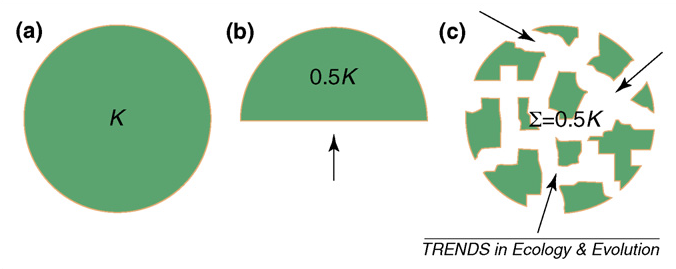
Figure 2 from Brook et al. (2008): Synergies among threatening processes relative to habitat loss and fragmentation. a) A large population within unmodified, contiguous habitat occupies all available niches so that long-term abundance fluctuates near full carrying capacity (K). b) When habitat is reduced (e.g. 50 % area loss), total abundance declines accordingly. c) However, this simple habitat-abundance relationship is complicated by the spatial configuration of habitat loss. In this example, all remaining fragmented subpopulations might fall below their minimum viable population (MVP) sizes even though total abundance is the same proportion of K as in panel B. As such, limited connectivity between subpopulations implies much greater extinction risk than that predicted for the same habitat loss in less fragmented landscapes. Further synergies (positive feedbacks among threatening processes; black arrows) might accompany high fragmentation, such as enhanced penetration of predators, invasive species or wildfire, micro-habitat edge effects, and reduced resistance to drought with climate change.

Figure 2 from Brook et al. (2008): Synergies among threatening processes relative to habitat loss and fragmentation. a) A large population within unmodified, contiguous habitat occupies all available niches so that long-term abundance fluctuates near full carrying capacity (K). b) When habitat is reduced (e.g., 50 % area loss), total abundance declines accordingly. c) However, this simple habitat-abundance relationship is complicated by the spatial configuration of habitat loss. In this example, all remaining fragmented subpopulations might fall below their minimum viable population (MVP) sizes even though total abundance is the same proportion of K as in panel B. As such, limited connectivity between subpopulations implies much greater extinction risk than that predicted for the same habitat loss in less fragmented landscapes. Further synergies (positive feedbacks among threatening processes; black arrows) might accompany high fragmentation, such as enhanced penetration of predators, invasive species or wildfire, micro-habitat edge effects, and reduced resistance to drought with climate change.

This is, perhaps, one of the most important concepts that the field of conservation biology has identified as a major driver of extinction. It may appear on the surface a rather simple notion that the more ‘habitat’ you remove, the fewer species (and individuals) there will be (see MacArthur & Wilson’s Classic contribution: The Theory of Island Biogeography), but it took us decades (yes, embarrassingly – decades) to work out that fragmentation is bad (very, very bad).

Habitat fragmentation occurs when a large expanse of a particular, broadly defined habitat ‘type’ is reduced to smaller patches that are isolated by surrounding, but different habitats. The surrounding habitat is typically defined a ‘matrix’, and in the case of forest fragmentation, generally means ‘degraded’ habitat (fewer native species, urban/rural/agricultural development, etc.).

Fragmentation is bad for many reasons: it (1) reduces patch area, (2) increases isolation among populations associated with fragments, and (3) creates ‘edges’ where unmodified habitat abuts matrix habitat. Each of these has dire implications for species, for we now know that (1) the smaller an area, the fewer individuals and species in can contain, (2) the more isolated a population, the less chance immigrants will ‘rescue’ it from catastrophes, and (3) edges allow the invasion of alien species, make the microclimate intolerable, increase access to bad humans and lead to cascading ecological events (e.g., fire penetration). Make no mistake, the more fragmented an environment, the worse will be the extinction rates of species therein.

What’s particularly sad about all this is that fragmentation was actually seen as a potentially GOOD thing by conservation biologists for many long years. The so-called SLOSS (Single Large or Several Small) debate pervaded the early days of conservation literature. The debate was basically the argument that several small reserves would provide more types of habitat juxtapositions and more different species complexes, making overall diversity (species richness) higher, than one large reserve. It was an interesting, if not deluded, intellectual debate because both sides presented some rather clever theoretical and empirical arguments. Part of the attraction of the ‘Several Small’ idea was that it was generally easier to find series of small habitat fragments to preserve than one giant no-go area.

However, we now know that the ‘Several Small’ idea is completely inferior because of the myriad synergistic effects of fragmentation. It actually took Bruce Wilcox and Dennis Murphy until 1985 to bring this to everyone’s attention in their classic paper The effects of fragmentation on extinction to show how silly the SLOSS debate really was. It wasn’t, however, until the mid- to late 1990s that people finally started to accept the idea that fragmentation really was one of the biggest conservation evils. Subsequent work (that I’ll showcase soon on ConservationBytes.com) finally put the nail in the SLOSS debate coffin, and indeed, we haven’t heard a whisper of it for over a decade.

For more general information, I invite you to read the third chapter in our book Tropical Conservation Biology entitled Broken homes: tropical biotas in fragmented landscapes, and our recent paper in Trends in Ecology and Evolution entitled Synergies among extinction drivers under global change.

CJA Bradshaw

Add to FacebookAdd to NewsvineAdd to DiggAdd to Del.icio.usAdd to StumbleuponAdd to RedditAdd to BlinklistAdd to Ma.gnoliaAdd to TechnoratiAdd to Furl


Classics: The Living Dead

30 08 2008

‘Classics’ is a category of posts highlighting research that has made a real difference to biodiversity conservation. All posts in this category will be permanently displayed on the Classics page of ConservationBytes.com

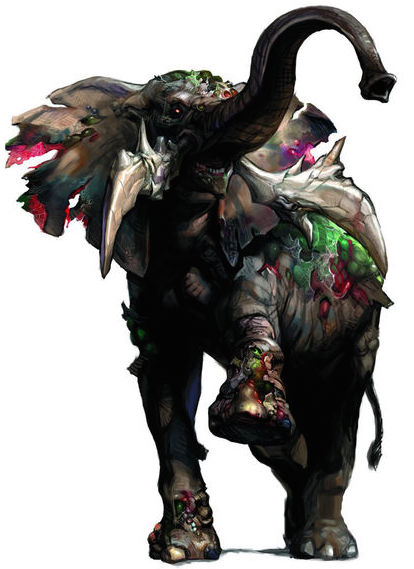
Zombie_ElephantTilman, D., May, R.M., Lehman, C.L., Nowak, M.A. (1994) Habitat destruction and the extinction debt. Nature 371, 65-66

In my opinion, this is truly a conservation classic because it shatters optimistic notions that extinction is something only rarely the consequence of human activities (see relevant post here). The concept of ‘extinction debt‘ is pretty simple – as habitats become increasingly fragmented, long-lived species that are reproductively isolated from conspecifics may take generations to die off (e.g., large trees in forest fragments). This gives rise to a higher number of species than would be otherwise expected for the size of the fragment, and the false impression that many species can persist in habitat patches that are too small to sustain minimum viable populations.

These ‘living dead‘ or ‘zombie‘ species are therefore committed to extinction regardless of whether habitat loss is arrested or reversed. Only by assisted dispersal and/or reproduction can such species survive (an extremely rare event).

Why has this been important? Well, neglecting the extinction debt is one reason why some people have over-estimated the value of fragmented and secondary forests in guarding species against extinction (see relevant example here for the tropics and Brook et al. 2006). It basically means that biological communities are much less resilient to fragmentation than would otherwise be expected given data on species presence collected shortly after the main habitat degradation or destruction event. To appreciate fully the extent of expected extinctions may take generations (e.g., hundreds of years) to come to light, giving us yet another tool in the quest to minimise habitat loss and fragmentation.

CJA Bradshaw

Add to FacebookAdd to NewsvineAdd to DiggAdd to Del.icio.usAdd to StumbleuponAdd to RedditAdd to BlinklistAdd to Ma.gnoliaAdd to TechnoratiAdd to Furl