Guilty until proven innocent

18 07 2013

precautionary principleThe precautionary principle – the idea that one should adopt an approach that minimises risk – is so ingrained in the mind of the conservation scientist that we often forget what it really means, or the reality of its implementation in management and policy. Indeed, it has been written about extensively in the peer-reviewed conservation literature for over 20 years at least (some examples here, here, here and here).

From a purely probabilistic viewpoint, the concept is flawlessly logical in most conservation questions. For example, if a particular by-catch of a threatened species is predicted [from a model] to result in a long-term rate of instantaneous population change (r) of -0.02 to 0.01 [uniform distribution], then even though that interval envelops r = 0, one can see that reducing the harvest rate a little more until the lower bound is greater than zero is a good idea to avoid potentially pushing down the population even more. In this way, our modelling results would recommend a policy that formally incorporates the uncertainty of our predictions without actually trying to make our classically black-and-white laws try to legislate uncertainty directly. Read the rest of this entry »




Ecology: the most important science of our times

12 07 2013

rocket-scienceThe title of this post is deliberately intended to be provocative, but stay with me – I do have an important point to make.

I’m sure most every scientist in almost any discipline feels that her or his particular knowledge quest is “the most important”. Admittedly, there are some branches of science that are more applied than others – I have yet to be convinced, for example, that string theory has an immediate human application, whereas medical science certainly does provide answers to useful questions regarding human health. But the passion for one’s own particular science discipline likely engenders a sort of tunnel vision about its intrinsic importance.

So it comes down to how one defines ‘important’. I’m not advocating in any way that application or practicality should be the only yardstick to ascertain importance. I think superficially impractical, ‘blue-skies’ theoretical endeavours are essential precursors to all so-called applied sciences. I’ll even go so far as to say that there is fundamentally no such thing as a completely unapplied science discipline or question. As I’ve said many times before, ‘science’ is a brick wall of evidence, where individual studies increase the strength of the wall to a point where we can call it a ‘theory’. Occasionally a study comes along and smashes the wall (paradigm shift), at which point we begin to build a new one. Read the rest of this entry »


The economy worse off since 1978

3 07 2013
eat money

Can’t eat money

I was only a little tacker in 1978, and as any little tacker, I was blissfully unaware that I had just lived through a world-changing event. Just like that blissfully ignorant child, most people have no idea how important that year was.

It was around that year that humanity exceeded the planet’s capacity to sustain itself in perpetuity1. As I’ve just discovered today, it was also the same year that the per-capita Genuine Progress Indicator (GPI) peaked.

Now for a little detour and disclaimer before I explain all that. I’m not an economist, but I have a dabbled with the odd economic concept and bolted-on economic sub-routine in a few models I’ve written. Some would argue that conservation (i.e., the quest and methods needed to conserve biowealth) is almost entirely an economic pursuit, for economics is the discipline that attempts to explain (and modify) human behaviour. I tend to agree insofar as we now know enough on the biological side regarding how species become threatened and go extinct, and what kind of things we need to do to avoid losing more of the life-support system provided by biodiversity. Being completely practical about it, one could even argue that the biology part of conservation biology is complete – we should all now re-train as economists. While that notion probably represents a little hyperbole, it does demonstrate that economics is an essential endeavour in the fight to conserve our home.

Almost everyone has heard of ‘GDP’ – the Gross Domestic Product – as an indicator of economic ‘performance’, although most people have little idea what it actually measures (I’m including businesspeople and politicians here). GDP is merely the sum of marketed economic activity, which is only one small facet of the economy. For example, growing a tomato and preparing a salad for your family with it is not included, yet buying a frozen meal in the supermarket is. Even an oil spill increases GDP via increased expenditures associated with clean-up and remediation, when clearly it is not a ‘good’ thing for the economy on the whole because of the lost opportunities it causes in other sectors. Read the rest of this entry »


Improving the Roundtable on Sustainable Palm Oil

23 11 2012

RSPO – don’t be guilty of this

Laurance & Pimm organise another excellent tropical conservation open-letter initiative. This follows our 2010 paper (Improving the performance of the Roundtable on Sustainable Oil Palm for nature conservation) in Conservation Biology.

Scientists Statement on the Roundtable on Sustainable Palm Oil’s Draft Revised Principles and Criteria for Public Consultation – November 2012

As leading scientists with prominent academic and research institutions around the world, we write to encourage the Roundtable on Sustainable Palm Oil (RSPO) to use this review of the RSPO Principles and Criteria as an opportunity to ensure that RSPO-certified sustainable palm oil is grown in a manner that protects tropical forests and the health of our planet. We applaud the RSPO for having strong social and environmental standards, but palm oil cannot be considered sustainable without also having greenhouse gas standards. Nor can it be considered sustainable if it drives species to extinction.

Tropical forests are critical ecosystems that must be conserved. They are home to millions of plant and animal species, are essential for local water-cycling, and store vast amounts of carbon. When they are cleared, biodiversity is lost and the carbon is released into the atmosphere as carbon dioxide, a greenhouse gas that drives climate change.

Moreover, tropical areas with peat soils store even larger amounts of carbon and when water is drained and the soils exposed, carbon is released into the atmosphere for several decades, driving climate changei. In addition, peat exposed to water in drainage canals may decay anaerobically, producing methane – a greenhouse more potent than carbon dioxide.

Palm oil production continues to increase in the tropics, and in some cases that production is directly driving tropical deforestation and the destruction of peatlandsii. Given the large carbon footprint and irreparable biodiversity loss such palm oil production cannot be considered sustainable. Read the rest of this entry »


The invisible hand of ecosystem services

4 08 2012

I’ve just spent nearly an entire week trying to get my head around ecosystem services (ES).

You’d think that would have been a given based on my experience, my research, my writings and the fact that I’ve just spent the last week with 400 ES specialists from around the world at the 5th international Ecosystem Services Partnership (ESP) Conference in Portland, Oregon, USA.

Well, prior to this week I thought I knew what ES were, but now I think I’m just a little more confused.

Of course, I’m not talking about the concept of ES or what they are (hell, I’ve written enough about them on this blog and in my papers); my problem is understanding how we as society end up valuing them in a practical, sensible and feasible way.

So I’m going to describe the ESP Conference as I saw it, and not necessarily in chronological order.

First up is the term ‘ecosystem services’ itself – horrible name, and something rammed home again after attending the conference. Most people on the planet that are not scientists (that would be nearly everyone) just might have the most tenuous and ethereal of grasps of ‘ecosystem’ in the first place, and I’d bet that 99 % of most undergraduate students couldn’t provide a comprehensive description. This is because ecosystems are mind-bogglingly, chaotically and awesomely complex. Just ask any ecosystem ecologist.

The second part of the term – services – is particularly offensive in its presumption and arrogance. It’s not like you ring up an ecosystem and get it to clean your carpets, or fill your water tank or gas cylinder. No, the natural world did not evolve to pamper humanity; we are merely part of it (and bloody efficient at modifying it, I might add).

So try to sell this ‘incredibly complex thingy’ that is ‘there to do some (intangible) shit for us’ to the public, policy makers and politicians, and you mostly get a dog’s regurgitated breakfast and some blank, slack-jawed stares. Read the rest of this entry »


Empty seas coming to a shore near you

12 07 2012

Last week I had the pleasure of entertaining some old friends and colleagues for a writing workshop in Adelaide (don’t worry – they all came from southern Australia locations, so no massive carbon footprints for overseas travel). I’m happy to report it was a productive (and epicurean) week, but that’s not really the point of today’s post.

One of those participants was long-time colleague, Dr. Rik Buckworth. Rik and I first met in Darwin back in the early 2000s when he was lead fisheries scientist for Northern Territory Fisheries; this collaboration and friendship blossomed into an ARC Linkage Project (with Dr. Mark Meekan of AIMS) on shark fisheries (see some of the scientific outputs from that here, here, here and here). Rik has since moved to CSIRO in Brisbane, but keeps a hand in NT fisheries’ affairs. Incidentally, Rik trained under one of the most well-known fisheries modellers in the world – Carl Walters – when he did his PhD at the University of British Columbia back in the early 1990s.

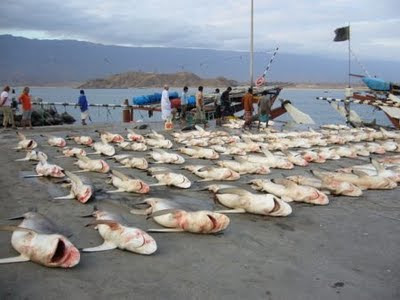
During our workshop, Rik pointed out a paper he had co-authored back in 2009 in Reviews in Fish Biology and Fisheries that had completely escaped my attention – it’s a frightening and apocalyptic view of the Australasian marine tropics that seems to confirm our predictions about northern Australia’s marine future. Just take a look at the following two figures from their paper (Elasmobranchs in southern Indonesian fisheries: the fisheries, the status of the stocks and management options): Read the rest of this entry »


Eat a feral a week

22 03 2012

© Y. Sugiura

Just a quick post this week about something I’ve been contemplating for a while.

What if every Australian pledged to eat a feral animal a week?

Yes, I know that it’s a bit out of the pitch, and I’m sure not everyone would do it. Nor would it be physically possible for one person to eat an entire camel, buffalo or deer in a week – but hopefully you get the picture.

Why propose this? Australia is quite over-run with feral animals. Some quick stats:

Now we have, of course, many other ferals (cats, rats, foxes, mice), but I don’t think too many people would want to eat them. I have personally eaten feral pigs, camels, buffalo, goats, and red, fallow and sambar deer, mostly from my own research trips or from friends who hunt. Read the rest of this entry »


Mucking around the edges

8 11 2011

Barry Brook over at BraveNewClimate.com beat me to the punch regarding our latest paper, so I better get off my arse and write my take on things.

This post is about a paper we’ve just had accepted and has come out online in Biological Conservation called Strange bedfellows? Techno-fixes to solve the big conservation issues in southern Asia – and it’s likely to piss off a few people, and hopefully motivate others.

We wrote the paper for a special issue of essays dedicated to the memory of our mate and colleague, Navjot Sodhi, who died earlier this year. The issue hasn’t been released yet, but we have managed to get our paper out well before.

Like Navjot, the paper is controversial. Also like Navjot, we hope it challenges a few minds and pushes a few boundaries. We, as conservation biologists, must accept the fact that we have largely failed – biodiversity is still being lost at an alarming rate despite decades and decades of good science, sound evidence-based policy recommendations and even some rescues of species on the ‘brink’. Huge consumption rates, a population of 7 billion humans and counting, carbon emissions exceeding all worst-case scenarios, and greater disparity of wealth distribution have all contributed to this poor performance.

So what else can we do? Read the rest of this entry »


How buggered are our hairy red cousins?

23 08 2011

Here’s a post from one of our lab’s post-doctoral fellows, Dr. Stephen Gregory. Stephen just got back from Borneo (jammy bastard), and will now regale you with his exploits.

© Danau Girang Field Centre

When asked to name a Bornean animal, I’ll bet the Bornean orangutan (Pongo pygmaeus) would top a public survey. This charismatic animal shares over 95 % of its genome with Homo sapiens, and so it’s little wonder that we find their infants so adorable and their popularity in the pet trade so deplorable.

Yet, I wonder how many people know that the biggest threat to our hairy red cousin is actually human eating and hygiene habits? Palm oil (oil extracted from the kernel of Elaeis spp.) is used in many foods – particularly snack foods – and hygiene products. It is our addiction to these convenient products that is destroying the orangutan’s habitat.

I’ve just returned from a trip to Sabah, the northernmost Malaysian state on Borneo, where I witnessed this distressing truth firsthand. I was meeting with the Sabah Wildlife Department, French NGO Hutan and staff at the Danau Girang Field Centre  to discuss early results from my Sabah orangutan project and seek their expert opinions. Read the rest of this entry »


Silence of the birds

2 05 2011

Yet another contribution from my PhD student, Salvador Herrando-Pérez (see his previous ConservationBytes.com posts on micro-evolution and pollination).

In the 1960s, Rachel Carson preoccupied (to put it mildly) the political and economic powers of the United States with the publication of her book, Silent Spring, an overwhelming essay highlighting the environmental impacts caused by the pesticide industry. Half a century later, the metaphor of that book – a spring devoid of bird song – stands in force as farmland birds keep declining worldwide at the mercy of agricultural practices insensitive to the ecosystem services biodiversity procures. The problem has been best studied in Europe where non-government organisations, such as the British Trust for Ornithology or the Sociedad Española de Ornitología, have been monitoring bird populations for decades, and the European Union has sumptuously financed research and management actions.

Sparrows are the commonest among common birds. Worldwide we see them wherever humans live, travel and take leisure, from mountains and beaches to stadiums and underground trains. These feathery dwarfs snick even through security checks and sliding doors at airports and shopping malls, and it is no one’s surprise to be overflown by one of them carrying a chip from the leftovers of a nearby food court. However, the deterioration of their populations has sown alarm among European politicians, society, and the scientific community. Read the rest of this entry »


Buzzing to the plate

4 04 2011

Here’s another contribution from my PhD student, Salvador Herrando-Pérez (see his previous ConservationBytes.com post on micro-evolution here).

Once upon a time at the produce section of a supermarket, a little girl confided to me that she had no idea that little plants could grow on carrots. This sympathetic scene portrays the split between the food we consume and the environments that produce it.

© Cordell

Mediterraneans love their cuisine. In fact, we are fairly proud of all our food. Yet how many of us associate a juicy tomato in our multicoloured salads, the smoothness of a escalibada (grilled veggies) bathed in virgin olive oil, the afternoon’s delicious expresso among friends and colleagues, or the last Christmas’ crunchy nougat shared with our beloved, with an insect that one given day pollinates a flower whose fertilized ovary will reach our dining room in the form of a sweet, infusion, fruit, sauce, soup or veggie.

Biodiversity fuels this relationship between insects and food. A study led by Alexandra Klein on highland coffee (Coffea arabica) from Sulawesi (Indonesia) demonstrates this concept well1. The German team showed that the amount of coffee beans produced in 24 agro-forestry sites increased with the number of bee species visiting the flowers (Fig. 1). Read the rest of this entry »


More to bees than queens and honey

11 02 2011

Another great guest post, this time from Tobias Smith, a PhD candidate at the University of Queensland’s School of Biological Sciences. Tobias is investigating bee community shifts across a fragmented tropical landscape in far north Queensland, aiming to identify landscape variation in community composition of two important rainforest pollinator groups, bees and flies. I met Tobias a few years ago as part of the Thiaki rainforest reforestation project for which he is doing baseline surveys of bees and flies.

I asked him a while ago to write a ‘primer’ on bees for ConservationBytes.com since so many people really don’t much about the taxon (I include myself in that group). He’s done a brilliant job – everything you wanted to know about bees but were afraid to ask (in 1000 words).

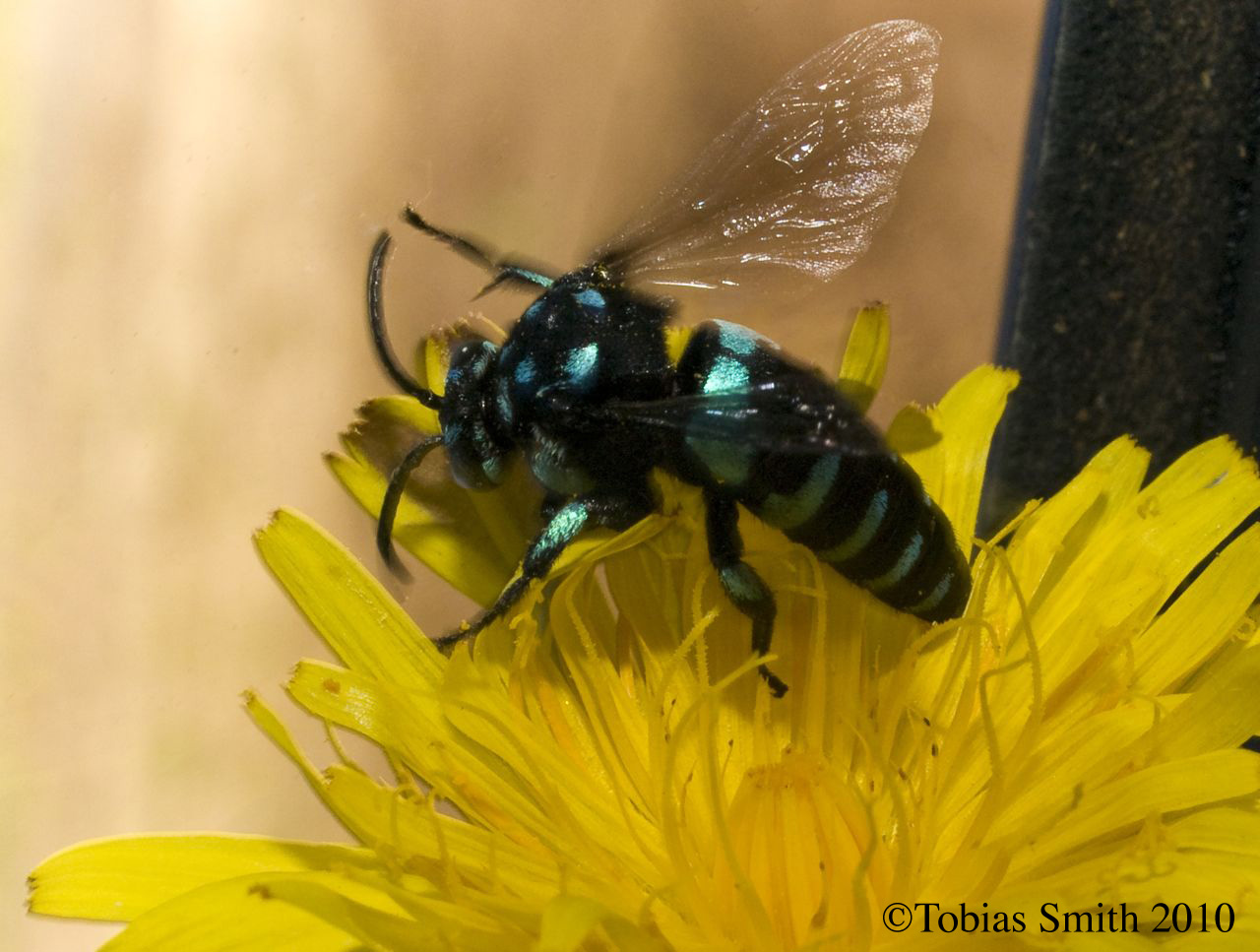
The frequently reported, gloomy news about bee declines is hard not to notice. Bees are in dire trouble around the world, and this trend has worrying implications for both ecosystems and human food production. As a result, popular media often reports on the plight of bees, regularly reciting the figure of one in three mouthfuls of food being dependent on the work of bees. While bees certainly are in major trouble, it can be easy to misinterpret statements often made in these kind of articles without a little general bee knowledge. So here are a few bee facts that, at the very least, we ecological representatives should be familiar with. This information should help give some perspective when interpreting bee news, and when engaging in exciting bee conversations at the shops.

There are approximately 20,000 bees species globally. Yet when most people think of bees they think of a single species, Apis mellifera, the western honey bee (introduced in most of its range, and also referred to as the European honeybee). This bee is certainly an important bee. It is managed as the usual pollinator of crops requiring biotic pollination, and it makes the honey we usually eat here in the developed world. Some say our domestication of this bee has been an important contributing factor in achieving the level of development that we humans have. There are however, about 19,999 other bee species out there, and most of them are very different to the western honeybee. Read the rest of this entry »


When weeds are wanted

31 01 2011

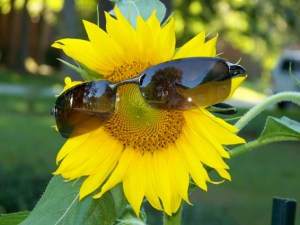
And in keeping with the topic of bees

© Flowergardengirl

I’ve just read a very, very cool paper in Ecology Letters about something I’ve wanted to do myself for some time. It’s a fairly specific piece of work, so it could easily be reproduced elsewhere with different species. My point though is that a hell of a lot more of these types of studies are required.

The study by Carvalheiro and colleagues entitled Natural and within-farmland biodiversity enhances crop productivity examined the role of weedy (ruderal) vegetation in supporting pollinator communities. Using sunflowers as a model crop, they showed rather convincingly how native vegetation patches interspersed amongst crop species can enhance a host of crop production measures, even when larger areas of natural habitats were far away from the crops themselves.

Based on a series of plot experiments, they tested four main hypotheses:

  1. The distance to natural habitat affects pollination visitor abundance and diversity.
  2. Plots surrounding or interspersed with ruderal vegetation affect pollinator abundance and diversity.
  3. The diversity of pollinators visiting sunflowers affects honeybee (the principal pollinators) behaviour.
  4. The diversity of pollinators affects sunflower production.

Read the rest of this entry »


History and future (of Australian ecology and society)

11 12 2010

I’ve just returned from a week-long conference in Canberra where the Ecological Society of Australia (of which I am a relatively new member) has just completed its impressive 50th anniversary conference. It was a long, but good week.

It’s almost a bit embarrassing that I’ve never attended an ESA1 conference before, but I think I waited for the right one. However, the main reason I attended was that I was fortunate to have received the ESA’s 3rd Australian Ecology Research Award (AERA), and the kick-back was a fully funded trip. My only reciprocation was to give a 40-minute plenary lecture – a small price to pay.

I entitled my talk ‘Heads in the desert sand: why Australians should wake up to the biodiversity crisis’, and I received a lot of good feedback. I talked about the global and Australian trends of biodiversity loss and associated ecosystem services, focussing the middle section on some of our work on feral animal ecology (see example). I then gave my views on the seriousness of our current situation and why some of the fastest losses of sensitive ecosystem services are happening right here, right now. I finished off with a section on how I think Australian ecologists could get more relevant and active in terms of research uptake by policy makers. I hope that the talk will be podcastable soon, so stay tuned.

But that was just ‘my’ bit. This post is more about a quick summary of the highlights and my overall impressions.

Read the rest of this entry »