Loss of nature’s value makes bank crisis look ridiculous

13 10 2008

Thanks for pointing this one out, Tim (see ConsBlog.org). In the theme of demonstrating (how many different ways do we need to show this before it bloody well sinks in?) the value of ecosystem services currently being degraded by habitat loss, invasive species, over-exploitation and climate change, some people in power are starting to take notice.

All you investors, bankers, share brokers and buyers – beware! Without a large upheaval of the current economic system that promotes absolute consumption and growth in a finite and dwindling resource base, you will lose a lot more that the value of a few shares.

The global economy is losing more money from the disappearance of forests than through the current banking crisis, according to an EU-commissioned study.

It puts the annual cost of forest loss at between $2 trillion and $5 trillion… (read on)


Poor media coverage promotes environmental apathy and untruths

11 10 2008

I just came across this excellent opinion piece by James Fahn on how climate change is covered by the media.

Poor countries’ media must tackle climate change

Paraphrasing briefly, the article laments the ill-equipped, uninformed and lowly stature of reporters covering climate change issues. The corollary is that simple junk, badly researched stances and plain untruths are rife throughout the media. For many, many examples of such plainly misinformed ‘journalism’ on climate change issues, just visit BraveNewClimate.com for a taste of the worst.

My comments on Fahn’s piece touch on several issues. First, it’s not just the ‘poor’ country that has problems with respect to ill-equipped reporters – the developed world (and Australia could easily be one of the leaders here) has some particulary terrible coverage of climate change impacts. Second, this problem extends to all environmental issues, not just climate change. Indeed, for some of the most important issues facing humanity today (loss of biodiversity and the ecosystem services they provide), should not the best people be put onto the job? Finally, whatever happened to journalism? Isn’t this supposed to be well-researched, cross-examining, hard-hitting and plain investigation into the affairs affecting everyday life? Instead, too many so-called ‘journalists’ are nothing more than blindly parrotting reporters who wouldn’t know what research was if it came up and bit them on the arse.

Addendum 16 October: I’ve added a little poll below directed toward Australian blog readers:

CJA Bradshaw

Add to FacebookAdd to NewsvineAdd to DiggAdd to Del.icio.usAdd to StumbleuponAdd to RedditAdd to BlinklistAdd to Ma.gnoliaAdd to TechnoratiAdd to Furl


Wake Up, Freak Out

9 10 2008
© Leo Murray

© Leo Murray

An excellent, short animated film about the perils of climate change and its implications for biodiversity (including humans). Highly recommended.

This really isn’t about polar bears any more. At this very moment, the fate of civilization itself hangs in the balance.

It turns out that the way we have been calculating the future impacts of climate change up to now has been missing a really important piece of the picture. It seems we are now dangerously close to the tipping point in the world’s climate system; this is the point of no return, after which truly catastrophic changes become inevitable.

Wake Up, Freak Out – then Get a Grip is a short, animated film about climate change by Leo Murray.


Potsdam Initiative: Economics of Ecosystems and Biodiversity

1 10 2008

moneygamiA recent report from the European Union with which I was marginally involved has been published online.

The meeting of the environment ministers of the G8 countries and upcoming industrialising countries took part in what has been dubbed the ‘Potsdam Initiative‘ have commissioned a series of reports on the ‘Economic significance of the global loss of biological diversity’.

I quote:

‘In a global study we will initiate the process of analysing the global economic benefit of biological diversity, the costs of the loss of biodiversity and the failure to take protective measures versus the costs of effective conservation.’

The first stage was the report was entitled ‘The Economics of Ecosystems & Biodiversity (TEEB)’. Mr Pavan Sukhdev, Managing Director and Head of Deutsche Bank’s Global Markets business in India, and a Founder-Director of the ‘Green Accounting for Indian States Project’, an initiative of the Green Indian States Trust (GIST) to set up an economic valuation and national accounting framework to measure sustainability for India, was recently appointed as the independent Study Leader.

The overall aims of the study are to evaluate the costs of the loss of biodiversity and the associated decline in ecosystem services, and to compare them with the costs of effective conservation and ‘sustainable’ use. The overall aim is to increase awareness of the value of biodiversity and ecosystem services to facilitate the development of cost-effective policy responses to the problem.

The interim report is available here, and the final report will be published shortly on the dedicated website here. The title of the final report of the first phase is THE ECONOMICS OF ECOSYSTEMS AND BIODIVERSITY: SCOPING THE SCIENCE.

I was involved specifically in Section 4.13 ‘Regulation of Natural Hazards’ which are defined ‘as infrequent natural phenomena that – during a relatively short period of time – pose a high level of threat to [human] life, health or property. These include seismic events (volcanic eruptions, earthquakes, tsunamis), extreme weather events (hurricanes, floods), avalanches and land slides. My contribution was mainly with respect to the role of deforestation on flood risk.

The report was jointly prepared by Ana Rodrigues and Andrew Balmford.

CJA Bradshaw

Add to FacebookAdd to NewsvineAdd to DiggAdd to Del.icio.usAdd to StumbleuponAdd to RedditAdd to BlinklistAdd to Ma.gnoliaAdd to TechnoratiAdd to Furl


Pollination worth 153 billion Euros per year

22 09 2008

Another one from Mongabay.com. Certainly the overwhelming economic benefits from maintaining biodiversity (see also related posts here, here and here) must be starting to sink in. As an eternal pessimist, I doubt it.

Pollination services provided by insects are worth $216 billion/€153 billion a year reports a new study published in Ecological Economics [Gallai et al. 2008. Economic valuation of the vulnerability of world agriculture confronted with pollinator decline. Ecological Economics]. The figure represents about 9.5 % of the total value of world agricultural food production.

The fruit and vegetable sectors see the largest benefit $71/€50 billion each from pollination services, followed by oilseed crops $55/€39 billion. Bees play the most significant role in the pollination of food crops.

The research did not account for the production of crops for livestock consumption, biofuels, or ornamental flowers. It also omitted the value of pollination of wild plants. As such, the researchers say the overall value of pollination services are significantly higher than the $216/€153 billion estimate.

A study published in the April 2006 issue of BioScience calculated that insects are worth $57 billion to the U.S. economy, of which only $3 billion was from pollination. But at the time, the authors warned their assessment was conservative.


Primate conservation enhances human food availability

19 09 2008

This one from Mongabay.com – yet another reason to conserve species for human benefit…

© F. Möllers

© F. Möllers

Primate conservation may have the unintended benefit of enhancing food availability to humans, reports a study [Koné et al. 2008. Primate seed dispersal and its potential role in maintaining useful tree species in the Taï region, Côte-d’Ivoire: implications for the conservation of forest fragments. Tropical Conservation Science 1:293-306] led by African scientists.

The research, conducted in the Taï region of Côte-d’Ivoire, found that seven species of monkeys used about 75 species of plants as a source of fruit, of which 25 were also used by local human inhabitants for various purposes. Because monkeys are key seed dispersal agents, the results suggest that primate conservation may sustain the persistence of plant resources important for human livelihoods.

“The cost of losing monkeys extends beyond the loss of the animals themselves,” write the authors. “Indeed, the local extinction of frugivorous primates is predicted to have deleterious consequences for forest regeneration and/or tree species community composition.”

The authors, led by Inza Koné from the University of Cocody in Abidjan and the Taï Monkey Project, note that monkeys in the region are already experiencing “extreme hunting pressure” as a source of protein and as crop pests. Primates are also threatened by habitat loss caused by the conversion of forest for agriculture.

Koné and colleagues suggest measures to conserve monkeys will offer multiple benefits to the primates themselves as well as local communities.

“Results of this study suggest that maintaining populations of monkeys is important not only for forest regeneration, but also for human habitat use,” they continue. “The conservation of primate species is a critically important goal in itself; by working to ensure their protection in forest fragments, we protect indirectly the seed dispersal of important human resources in these fragments as well.”

“Protection of monkeys and seed dispersal systems outside protected areas is particularly relevant in this context, since it is in these areas… that primates are most at risk, and also where people are allowed to exploit forest plant resources.”


Global biodiversity loss estimated at 14 trillion Euros

15 09 2008

A recent post from Ecology & Policy

Yet more evidence that we have to stop the extinction crisis.

A new report commissioned by the European Commission – ‘The Cost of Policy Inaction (COPI): The case of not meeting the 2010 biodiversity target’ – indicates that biodiversity is set to continue declining. Key drivers of biodiversity loss include overexploitation, invasion of non-native species and conversion of natural habitat to agricultural landscapes.

It has long been known that ecosystems provide a wide range of goods and services to humankind, such as the provision of clean water, climate regulation, food and clothing, flood protection to mention but a few. Although these goods and services (Ecosystem Services (ES)) provided by biodiversity have been widely recognised, so far efforts to put a monetary value on these services has proved difficult at best.

The new report attempts to value ecosystem services in terms of the cost to the global economy of future biodiversity loss as a result of policy inaction. The study used a baseline valuation from 2000 to extrapolate ES loss to 2050, assuming predicted population growth takes place with the associated demand for energy and resources and that average global GDP increases 2.8% per annum with the highest growth in China and India.

The key findings of the study include:

  • 50 billion € worth of biodiversity providing ecosystem services is being lost each year
  • Land-based ecosystem loss is estimated at 545 billion € by 2010
  • Annual loss in ecosystem services from biodiversity loss could exceed 14 trillion € by 2050

This study is part of a much larger research effort on a global scale: The Economics of Ecosystems & Biodiversity. It is hoped this study will result in a much wider global awareness of the cost of losing biodiversity and associated ES to mankind in an economic context, and ultimately result in a ‘valuation toolkit’ that will provide environmental economists and policy-makers a standardised approach to ES valuation.

Download the report here.


Primary forests as global carbon sinks

13 09 2008

Certainly one for the Potential list…

p00zbhgzA new paper by Sebastien Luyssaert  and colleagues in Nature entitled Old-growth forests as global carbon sinks deserves a mention here.

Many have argued under the climate change mitigation banner that so-called ‘old-growth’ (let’s call them primary forests henceforth to distinguish them from [usually] younger secondary forests) do not provide net carbon uptake because most of their growth has occurred in the past. In other words, they provide a carbon store, but do not take much more out of the atmosphere once they’ve attained a certain ecological equilibrium. This was a major impediment for the argument that protecting such forests could be achieved economically by valuing them in national or global carbon-trading schemes. It was a shame considering that it seems the economic incentives to protect such forests were falling on deaf ears because (a) governments and industry tend to regard the quick turn-around option of timber extraction as more economically sensible and (b) of the difficulty of valuing ecosystem services provided by primary forests.

But not so, say Luyssaert and colleagues! After scouring an array of studies and databases they conclude that forests between 15 and 800 years of age do in fact continue to uptake carbon and so are not carbon ‘neutral’. Brilliant! With this latest evidence in hand, I hope the economic incentives to preserve the little remaining primary forests around the world and the ecosystem services they provide will encourage governments and industry to invest more in their preservation than their destruction. It’s worth noting here too that once such forests are destroyed (e.g., timber extraction), the majority of their stored carbon (both actual and potential via future carbon uptake) are released back to the atmosphere, thus exacerbating climate change. As such, valuing the preservation of pristine forests on the carbon-trading market should receive a far higher weighting that secondary plantations or other sequestration schemes.

CJA Bradshaw

Add to FacebookAdd to NewsvineAdd to DiggAdd to Del.icio.usAdd to StumbleuponAdd to RedditAdd to BlinklistAdd to Ma.gnoliaAdd to TechnoratiAdd to Furl


Another nail in Borneo’s biodiversity coffin

11 09 2008

I always try to tell myself never “to underestimate the stupidity of the human race”; yet, I am too often surprised. Borneo is one of the places in the tropics with the worst track record in destroying ecosystems and the services they provide. The Malaysian government couldn’t be more self-destructive with this sort of policy.

This item from Mongaybay.com:

© CIFOR

© CIFOR

The Malaysian government is attempting to quell indigenous opposition to logging in the rainforests of Borneo by deposing community leaders and replacing them with timber company stakeholders, reports an environmental group.

The Bruno Manser Fund, a Swiss NGO that works on behalf of the forest people of Sarawak, Malaysia, says that the headmen of at least three Penan communities that have opposed logging have lost official recognition from Malaysian authorities over the past year. The government is working to install representatives who support logging.

“The non-recognition of the elected community headmen by the Sarawak State Government is a clear violation of the UN Declaration of the Rights of Indigenous Peoples,” stated the Bruno Manser Fund in an emailed release. “The Declaration, which has been adopted by Malaysia, upholds in its article 18 the right of indigenous communities ‘to participate in decision-making in matters which would affect their rights, through representatives chosen by themselves in accordance with their own procedures’.”

The Penan communities of Sarawak have waged a long battle against the logging of their ancestral homeland in the rainforests of Sarawak, on the island of Borneo. The opposition reached a crescendo in the 1980s when the Penan blocked logging roads and sabotaged equipment. The Malaysian government responded by closing down media access to the area and sending in armed forces to violently supress the unrest. While the attacks on the Penan brought international attention to the rapacious logging of Borneo’s forests, they had relatively little long-term impact.

Today the Penan face not only loggers but increased pressure from oil palm developers as well as an ambitious government plan to dam several rainforest rivers in an effort to generate electricity to attract aluminum smelters and mineral refiners.

Add to FacebookAdd to NewsvineAdd to DiggAdd to Del.icio.usAdd to StumbleuponAdd to RedditAdd to BlinklistAdd to Ma.gnoliaAdd to TechnoratiAdd to Furl


Deforestation and disease

10 09 2008

Humans have such a short memory…

A recent theme in many of my posts is the concept of ecosystem services provided to us essentially free of charge, and their continued degradation due to the burgeoning human population, bad land management and excessive resource consumption. We are indeed degrading the very life-support system species assemblages provide us. I’ve previously posted a long list of ecosystem services that you can consult here, but this recent paper in BioScience highlights one that is probably largely overlooked – the role of forests in reducing the incidence of human disease.

In their article entitled Deforestation, mosquitoes, and Ancient Rome: lessons for today, Lara O’Sullivan and colleagues discuss the evidence from Ancient Rome that deforestation rapidly increased the prevalence of malarial diseases. They also go on to cite several examples from the modern world where deforestation appears to be linked to greater manifestation of diseases like malaria.

The evidence isn’t just linked to Africa and the Amazon, but the authors suggest that the incidence of mosquito-borne diseases in Australia such as Ross River fever may also be on the rise as forests are quickly degraded and destroyed.

In two previous posts (see here and here), I commented on the escalating biodiversity crisis in the tropics driven largely by habitat loss (i.e., deforestation) – add increasing human disease to the long list of negatives associated with degrading or disappearing ecosystem services such as increased frequency and severity of floods, reduced food provision, reduced availability of clean water, reduced pollination, etc. We MUST educate the masses with the increasing body of scientific evidence that our behaviour is self-defeating (see previous post on this issue).

Indeed, it’s no longer the days of the capitalists versus the ‘greenies’ – the rapid decline in the quality of human life and and our own survival is affecting all of us, including the wealthy. In fact, I would argue that environmentalism has fully developed as the principal rationale in conservation ecology, such that it has become much less of an esoteric struggle for maintaining all things beautiful (the capitalist viewpoint of the traditional ‘greeny’), to a science-driven means to maintain human life and prosperity. Can we afford to continue along this path? Definitely not. Only an idiot with the foresight of a slug could ignore our current trajectory – and that includes the millionaire sport heroes, actors, and entrepreneurs who have benefited directly from our collective resource exploits. If you give a shit about the quality of life you and your descendants will have in the very near future, do not ignore habitat loss any longer.

CJA Bradshaw

Add to FacebookAdd to NewsvineAdd to DiggAdd to Del.icio.usAdd to StumbleuponAdd to RedditAdd to BlinklistAdd to Ma.gnoliaAdd to TechnoratiAdd to Furl


Tropical Conservation Biology

8 09 2008

An obvious personal plug – but I’m allowed to do that on my own blog ;-)

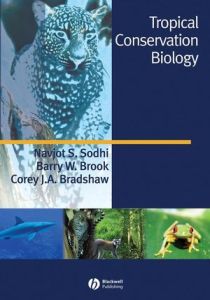
1405150734I’d like to introduce a (relatively) new textbook that my colleagues, Navjot Sodhi and Barry Brook, and I wrote and published last year with Blackwell (now Wiley-Blackwell) Scientific Publishing – Tropical Conservation Biology.

We’re rather proud of this book because it was a timely summary and assessment of the scientific evidence for the degree of devastation facing tropical biodiversity today and in the future. I’ve summarised some of the main issues in a previous post covering a paper we have ‘in press’ that was born of the text book, but obviously the book is a far more detailed account of the problems facing the tropics.

This introductory textbook examines diminishing terrestrial and aquatic habitats in the tropics, covering a broad range of topics including the fate of the coral reefs; the impact of agriculture, urbanisation, and logging on habitat depletion; and the effects of fire on plants and animal survival.

One of the highlights of the book is that each chapter (see below) Includes case studies and interviews with prominent conservation scientists to help situate key concepts in a real world context: Norman Myers (Chapter 1), Gretchen Daily (Chapter 2), William Laurance (Chapter 3), Mark Cochrane (Chapter 4), Daniel Simberloff (Chapter 5), Bruce Campbell (Chapter 6), Daniel Pauly (Chapter 7), Stephen Schneider (Chapter 8), Stuart Pimm (Chapter 9) and Peter Raven (Chapter 10). These biographies are followed by a brief set of questions and answers that focus on some of the most pertinent and pressing issues in tropical conservation biology today. It is our intention that readers of Tropical Conservation Biology will benefit from the knowledge and be inspired by the passion of these renowned conservation experts.

TABLE OF CONTENTS

  1. Chapter 1: Diminishing habitats in regions of high biodiversity. We report on the loss of tropical habitats across the tropics (e.g., deforestation rates). We also highlight the drivers of habitat loss such as human population expansion. Finally, we identify the areas in immediate need of conservation action by elucidating the concept of biodiversity hotspots. Read the rest of this entry »


Classics: Ecosystem Services

2 09 2008

‘Classics’ is a category of posts highlighting research that has made a real difference to biodiversity conservation. All posts in this category will be permanently displayed on the Classics page of ConservationBytes.com

tobewell_homeEhrlich, P.R., H. A. Mooney. (1983). Extinction, substitution, and ecosystem services. BioScience 33, 248-254

I may be mistaken, but I think this is one of the earliest appearances of the term ‘ecosystem services‘, which is essentially the concept that intact biological communities and functioning species interactions provide humanity with a host of ‘services’ that support or improve our quality of life. The ongoing assault on species and habitats around the globe are, to use Ehrlich & Mooney’s words “accompanied by severe degradation of the public service functions of the systems”.

What are ecosystem services? The list is long and varied, and much of them remain largely unquantified, but I’ll attempt to list the more important ones here:

Add your favourite to the list – there are plenty of sources that expand on these. For starters try the Millennium Ecosystem Assessment, the Wikipedia entry, the Ecological Society of America and Gretchen Daily’s lab at Standford University.

What is the value of ecosystem services to humanity?

This is a fairly controversial area because of the difficulty of measuring the link between ecosystem function and the services they provide, but also by the decision to include direct and direct costs of providing the services artificially. However, many people have attempted to put them into financial terms – Robert Costanza and colleagues put together some figures (see here, here, and here for examples) that attracted some criticism. Nonetheless, ecosystems are estimated to provide us with trillions of dollars worth of goods and services. Some examples from the Ecological Society of America:

  • Much of the Mississippi River Valley’s natural flood protection services were destroyed when adjacent wetlands were drained and channels altered. As a result, the 1993 floods resulted in property damages estimated at twelve billion dollars partially from the inability of the Valley to lesson the impacts of the high volumes of water.
  • Over 100,000 different animal species – including bats, bees, flies, moths, beetles, birds, and butterflies – provide free pollination services. One third of human food comes from plants pollinated by wild pollinators. The value of pollination services from wild pollinators in the U.S. alone is estimated at four to six billion dollars per year.
  • Eighty percent of the world’s population relies upon natural medicinal products. Of the top 150 prescription drugs used in the U.S., 118 originate from natural sources: 74 percent from plants, 18 percent from fungi, 5 percent from bacteria, and 3 percent from one vertebrate (snake species). Nine of the top 10 drugs originate from natural plant products.

What does this mean for conservation of biodiversity? Well, since scientists and policy makers alike have embraced the concept, we now have a much more convincing argument for maintaining the intactness of natural ecosystems. In the past we found it hard to convince those struggling to make ends meet (or even to obtain their next meal) about the importance of preventing species extinctions. Why should someone worried about whether or not his or her family will survive another day give a rat’s arse about species conservation? Well, the degradation of ecosystem services ensuing from species extinctions means that everyone’s – including the poorest – lives are reduced in quality and duration as we destroy these systems. See a previous post on Conservation for the People for more information.

CJA Bradshaw

Add to FacebookAdd to NewsvineAdd to DiggAdd to Del.icio.usAdd to StumbleuponAdd to RedditAdd to BlinklistAdd to Ma.gnoliaAdd to TechnoratiAdd to Furl


Australian Wet Tropics Biosequestration Project

28 08 2008

Guest post from Penny van Oosterzee, Degree Celsius:

© P. van Oosterzee
© P. van Oosterzee

The Wet Tropics Regional Biosequestration Project Development Document was launched last week on the global stage, for public scrutiny, via the Climate Community and Biodiversity (CCB) website. There are only a dozen other cases in the world that have managed to reach this level of scrutiny.

The CCB standards are used in both the voluntary global markets and also for CDM (clean development mechanism) projects (only afforestation and reforestation) that have significant biodiversity outcomes. It is well known that land use, land use change, and forestry provides the most cost-effective means of reducing greenhouse gas emissions globally, and we believe the Wet Tropics project is at the leading edge of showing how.

The Wet Tropics Project is the world’s first regional biocarbon verification case based on community NRM (Natural Resource Management) activities, aggregating different bio-sequestration activities (reforestation, assisted natural regeneration, avoided deforestation, grazing land management, reduced use of fertiliser in agriculture) of myriad landholders in one verification case.

The initiative of using NRM Regional Plan’s as a basis for biosequestration project design is an innovation that can be rolled out across the state and nationally. Using Regional Plans ensures scientifically robust monitoring outcomes because of the adoption of systems already in place for monitoring. Economically the approach allows trading to occur at the regional and landholder level, and sets the stage for new livelihoods in regional Australia in a climate constrained world.

The Wet Tropics Project is itself a pilot for the NRM regions comprising the catchments of the Great Barrier Reef which are pivotal for its the survival. The Wet Tropics Project also helps to inform national policy debates since both Garnaut and the Federal Government’s Green Paper point out the importance of forestry and agriculture but fail to provide any way forward, and are on a watching brief for solutions.

The Wet Tropics initiative with its link to regional plans immediately enables entry into other global developments such as water quality credits and biodiversity credits.

See also the Degree Celsius website for more information.

Add to FacebookAdd to NewsvineAdd to DiggAdd to Del.icio.usAdd to StumbleuponAdd to RedditAdd to BlinklistAdd to Ma.gnoliaAdd to TechnoratiAdd to Furl


Native forests reduce the risk of catastrophic floods

20 08 2008

A-Pakistan-Army-helicopte-004Each year extreme floods kill or displace hundreds of thousands of people and cause billions of dollars in damage to property. The consequences of floods are particularly catastrophic in developing countries generally lacking the infrastructure to deal adequately with above-average water levels.

For centuries it has been believed that native forest cover reduced the risk and severity of catastrophic flooding, but there has been strong scientific debate over the role of forests in flood mitigation.

Forest loss is currently estimated at 13 million hectares each year, with 6 million hectares of that being primary forest previously untouched by human activities. These primary forests are considered the most biologically diverse ecosystems on the planet, but this realisation has not halted their immense rate of loss.

Last year my colleagues and I published a paper entitled Global evidence that deforestation amplifies flood risk and severity in the developing world in Global Change Biology (highlighted in Nature and Faculty of 1000) that has finally provided tangible evidence that there is a strong link between deforestation and flood risk. Read the rest of this entry »


Tropical turmoil – a biodiversity tragedy in progress

18 08 2008

fragmentationWe recently published (online) a major review showing that the world is losing the battle over tropical habitat loss with potentially disastrous implications for biodiversity and human well-being.

Published online in the Ecological Society of America’s journal Frontiers in Ecology and the Environment, our review Tropical turmoil – a biodiversity crisis in progress concludes that we are “on a trajectory towards disaster” and calls for an immediate global, multi-pronged conservation approach to avert the worst outcomes.

Tropical forests support more than 60 % of all known species, but represent only about 7 % of the Earth’s land surface. But up to 15 million hectares of tropical rainforest are being lost every year and species are being lost at a rate of up to 10000 times higher than would happen randomly without humans present.

This is not just a tragedy for tropical biodiversity, this is a crisis that will directly affect human livelihoods. This is not just about losing tiny species found in the canopies of big rain forest trees few people will ever see, this is about a complete change in ecosystem services that directly benefit human life. Read the rest of this entry »


Saving species does not harm poor

17 08 2008

Poor-Amongst-YouHere’s a great one for the Potential list:

A paper just published online in the journal Oryx by Kent Redford and colleagues entitled What is the role for conservation organizations in poverty alleviation in the world’s wild places? challenges one argument used by anti-conservation humanists to avoid preserving intact habitats.

When rainforests and other high conservation-value habitats are set aside for protection, humanists will often complain that it destroys the livelihoods of the people living there because the listing prevents them from farming, hunting or otherwise providing themselves with income. Not so say Redford and colleagues – they found that most of the world’s poor (measured by proxy using infant mortality rates) were predominately associated with high-density urban areas and not with more intact wild areas.

Critics of the finding argue that this should not take the onus away from richer nations or governments to bolster the economic prosperity of these people, and I agree. However, this is a major finding that in some ways validates what we are beginning to understand about habitat intactness and ecosystem services. Destroy the ecosystems around you and you generally have lower water quality, higher incidence of catastrophic events, poor agricultural returns, greater disease prevalence, etc. that will drive people into poverty, rather than drop them further down the economic scale.

If this conclusion stands up to analytical scrutiny and supporting evidence from other analyses, I dearly hope that it is noticed and embraced by governments worldwide struggling to find the balance between economic development, poverty alleviation and conservation of biodiversity to maintain ecosystem services.

CJA Bradshaw

Add to FacebookAdd to NewsvineAdd to DiggAdd to Del.icio.usAdd to StumbleuponAdd to RedditAdd to BlinklistAdd to Ma.gnoliaAdd to TechnoratiAdd to Furl


InVEST for ecosystem services

18 07 2008

I’m currently attending the Society for Conservation Biology‘s Annual Meeting in Chattanooga, Tennessee, USA and blogging on presentations I think are worth mentioning.

A great talk that I had the pleasure of moderating was given by Taylor Ricketts of the World Wildlife Fund. He and an impressive team of conservation scientists have recently put together some spatially explicit software – InVEST – that quantifies the values of ecosystem services and compares those to biodiversity values (richness, endemism, etc.). A clever way to find the right balance between ecosystem functions that benefit humans and species preservation, this software and approach appears to be a great way to optimise land use in our changing environment. Definitely one to watch. The first paper describing this is by Erik Nelson and colleagues (including Ricketts) and will be appearing shortly in Frontiers in Ecology and the Environment.

CJA Bradshaw


‘Conservation for the people’

11 07 2008

This, the title of Peter Kareiva and Michelle Marvier’s paper in Scientific American, embodies in some ways, what this website is all about. Certainly not the first researchers to conclude that people will only value biodiversity if it has direct implications for their own well-being (economic prosperity, health, longevity, etc.), Kareiva and Marvier’s paper nicely summarises, however, the extent to which conservation research MUST quantify these links. The corollary is that if we don’t, conservation research will pass into oblivion (along with the species we are attempting to protect from extinction). Nice paper, and certainly one to watch.

CJA Bradshaw

Add to FacebookAdd to NewsvineAdd to DiggAdd to Del.icio.usAdd to StumbleuponAdd to RedditAdd to BlinklistAdd to Ma.gnoliaAdd to TechnoratiAdd to Furl


Conservation Letters – a scientific journal with a difference?

5 07 2008

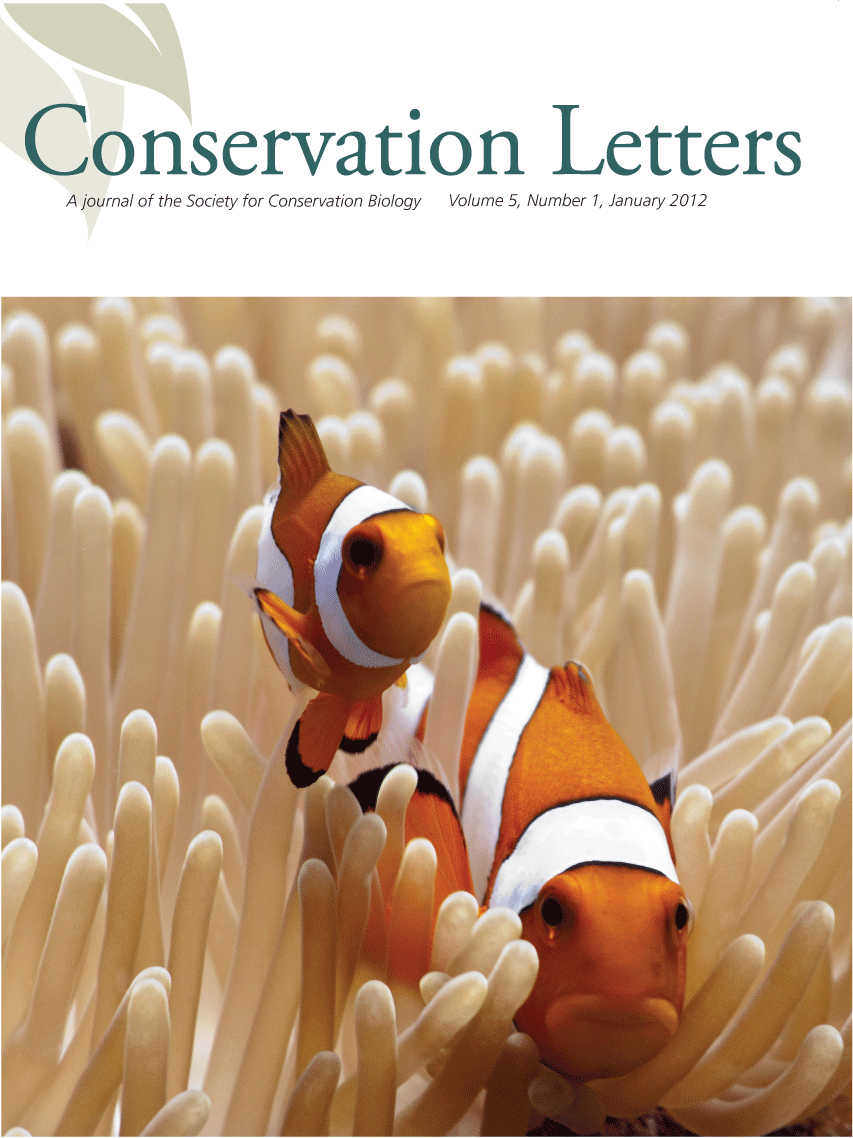
ConLetters-Jan12I’d like to introduce the latest scientific conservation journal – Conservation Letters (Wiley-Blackwell). If you are a publishing conservation scientist then you will have undoubtedly heard about this already. I must admit my biased opinion up front – I have the role of Senior Editor for the journal under the auspices of the venerable Editors-in-Chief, Professor Richard Cowling, Professor Hugh Possingham, Professor Bill Sutherland and Dr. Michael Mascia.

We’ve been doing conservation science now for well over 50 years, and there has been some fantastic, hard-hitting, brilliant research done. However, extinction rates continue to soar, habitat loss and fragmentation abound, bushmeat hunting and other forms of direct over-exploitation show no signs of slowing and invasive species are penetrating into the most ‘pristine’ habitats. To top it all off, climate change is exacerbating each and every one of these extinction drivers.

So what have we been doing wrong?

Clearly the best research is going unheeded – this is not to say that some progress has not been made, and I hope to highlight the best examples of the hardest-hitting research on this site – it simply means that we are losing the battle. Enter Conservation Letters – a journal designed to make conservation research more available to policy makers and managers to make true strides forward in biodiversity conservation. I’m not suggesting for a moment that other well-known, respected and established conservation journals have not done their job; without the research those journals publish we’d certainly be much worse off. However, we have recognised that our research isn’t affecting as many people as it should.

With Conservation Letters now well into its first year, I hope that we start to see some changes here, and I hope that the discipline will have a much greater net effect on slowing (and perhaps) reversing the extinction trends we observe today. Climate change is making this much more challenging, as well as the ever-increasing human population. Can we make better progress? – I certainly hope so.

CJA Bradshaw

Add to FacebookAdd to NewsvineAdd to DiggAdd to Del.icio.usAdd to StumbleuponAdd to RedditAdd to BlinklistAdd to Ma.gnoliaAdd to TechnoratiAdd to Furl


Conservation that bites

2 07 2008

This new website will post examples of conservation science with real-world impacts to policy that improves biodiversity outcomes. Stay tuned.

CJA Bradshaw