Few people, many threats – Australia’s biodiversity shame

31 07 2009

bridled_nailtail_400I bang on a bit about human over-population and how it drives biodiversity extinctions. Yet, it isn’t always hordes of hungry humans descending on the hapless species of this planet  – Australia is a big place, but has few people (just over 20 million), yet it has one of the higher extinction rates in the world. Yes, most of the country is covered in some fairly hard-core desert and most people live in or near the areas containing the most species, but we have an appalling extinction record all the same.

A paper that came out recently in Conservation Biology and was covered a little in the media last week gives some telling figures for the Oceania region, and more importantly, explains that we have more than enough information now to implement sound, evidence-based policy to right the wrongs of the past and the present. Using IUCN Red List data, Michael Kingsford and colleagues (paper entitled Major conservation policy issues for biodiversity in Oceania), showed that of the 370 assessed species in Australia, 80 % of the threatened ones are listed because of habitat loss, 40 % from invasive species and 30 % from pollution. As we know well, it’s mainly habitat loss we have to control if we want to change things around for the better (see previous relevant posts here, here & here).

Kingsford and colleagues proceed to give a good set of policy recommendations for each of the drivers identified:

Habitat loss and degradation

  • Implement legislation, education, and community outreach to stop or reduce land clearing, mining, and unsustainable logging through education, incentives, and compensation for landowners that will encourage private conservation
  • Establish new protected areas for habitats that are absent or poorly represented
  • In threatened ecosystems (e.g., wetlands), establish large-scale restoration projects with local communities that incorporate conservation and connectivity
  • Establish transparent and evidence-based state of environment reporting on biodiversity and manage threats within and outside protected areas.
  • Protect free-flowing river systems (largely unregulated by dams, levees, and diversions) within the framework of the entire river basin and increase environmental flows on regulated rivers

Invasive species

  • Avoid deliberate introduction of exotic species, unless suitable analyses of benefits outweigh risk-weighted costs
  • Implement control of invasive species by assessing effectiveness of control programs and determining invasion potential
  • Establish regulations and enforcement for exchange or treatment of ocean ballast and regularly implement antifouling procedures

Climate change

  • Reduce global greenhouse gas emissions
  • Identify, assess, and protect important climate refugia
  • Ameliorate the impacts of climate change through strategic management of other threatening processes
  • Develop strategic plans for priority translocations and implement when needed

Overexploitation

  • Implement restrictions on harvest of overexploited species to maintain sustainability
  • Implement an ecosystem-based approach for fisheries, based on scientific data, that includes zoning the ocean; banning destructive fishing; adopting precautionary fishing principles that include size limits, quotas, and regulation with sufficient resources based on scientific assessments of stocks and; reducing bycatch through regulation and education
  • Implement international mechanisms to increase sustainability of fisheries by supporting international treaties for fisheries protection in the high seas; avoiding perverse subsidies and improve labelling of sustainable fisheries; and licensing exports of aquarium fish
  • Control unsustainable illegal logging and wildlife harvesting through local incentives and cessation of international trade

Pollution

  • Decrease pollution through incentives and education; reduce and improve treatment of domestic, industrial, and agriculture waste; and rehabilitate polluted areas
  • Strengthen government regulations to stop generation of toxic material from mining efforts that affects freshwater and marine environments
  • Establish legislation and regulations and financial bonds (international) to reinforce polluter-pays principles
  • Establish regulations, education programs, clean ups, labelling, and use of biodegradable packaging to reduce discarded fishing gear and plastics

Disease

  • Establish early-detection programs for pathological diseases and biosecurity controls to reduce translocation
  • Identify causes, risk-assessment methods, and preventative methods for diseases
  • Establish remote communities of organisms (captive) not exposed to disease in severe outbreaks

Implementation

  • Establish regional population policies based on ecologically sustainable human population levels and consumption
  • Ensure that all developments affecting the environment are adequately analysed for impacts over the long term
  • Promote economic and societal benefits from conservation through education
  • Determine biodiversity status and trends with indicators that diagnose and manage declines
  • Invest in taxonomic understanding and provision of resources (scientific and conservation) to increase capacity for conservation
  • Increase the capacity of government conservation agencies
  • Focus efforts of nongovernmental organisations on small island states on building indigenous capacity for conservation
  • Base conservation on risk assessment and decision support
  • Establish the effectiveness of conservation instruments (national and international) and their implementation

A very good set of recommendations that I hope we can continue to develop within our governments.

CJA Bradshaw

Add to FacebookAdd to NewsvineAdd to DiggAdd to Del.icio.usAdd to StumbleuponAdd to RedditAdd to BlinklistAdd to Ma.gnoliaAdd to TechnoratiAdd to Furl


To market, to market, to buy a fat… fish

4 05 2009

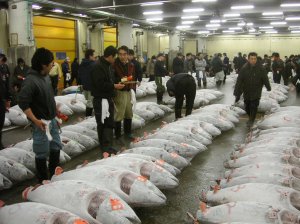
An interesting new paper just appeared online (uncorrected proof stage) in Biological Conservation. Brewer and colleagues’ paper entitled Thresholds and multiple scale interaction of environment, resource use, and market proximity on reef fishery resources in the Solomon Islands describes how the proximity of fish markets explains some of the variation in fisheries takes on South Pacific coral reefs. Well, that may seem intuitive, you say – if you can’t access even a local market, chances are your fish will only feed you and your immediate family. Make an economic link to a larger pool of demanding consumers, and you have all the incentive you need to over-exploit your little patch of finned money.

Of course, the advent of better, more efficient transport (including refrigerated transport) and the development of local markets (i.e., tapping into larger ones in more populated areas) has inevitably caused fish depletions across the globe. Brewer and colleagues’ work provides a quantitative link between human demand and biodiversity decline (including ‘fishing down the web‘), and suggests that our best way to manage fisheries is to target the source of this demand – the markets and patterns of consumption. Ultimately, it’s the consumer that will dictate what does and what does not go extinct (see also previous post on consumer preferences for rare species). After all, if there’s a demand, someone will step in to provide the resource (provided it’s still there). Better education, smarter consumption and regulation along the entire chain will be far more effective in the long run than just attempting to control the fishers’ behaviour.

CJA Bradshaw

Add to FacebookAdd to NewsvineAdd to DiggAdd to Del.icio.usAdd to StumbleuponAdd to RedditAdd to BlinklistAdd to Ma.gnoliaAdd to TechnoratiAdd to Furl


Get serious about understanding biodiversity

3 03 2009

Sometimes I realise I live inside something of a bubble where most of my immediate human contacts have a higher-than-average comprehension of basic life science (after all, I work at a university). I often find myself surprised when I overhear so-called ‘lay’ people discussing whether or not penguins are fish, or that environmental awareness is just a pre-occupation of deluded greenies with nothing better to do.

If only it were so innocuous.

I found a great little article in the Canberra Times that laments the populace’s general ignorance of natural and environmental sciences. In my view, we must be as ecologically literate as we are in economics, maths and literature (and as the rapidly changing climate stresses even our most resilient resources and systems, I argue it will become THE most important thing to teach the young).

I’ve reproduced the Canberra Times article by Rossyln Beeby below:

“You don’t have to look, you don’t have to see, you can feel it in your olfactory,” sang Loudon Wainwright in a chirpy song about skunk roadkill back in the 1970s.

Likewise, it could be argued that if, as claimed, 5000 eastern grey kangaroos have died of starvation “in one season” at a Federal department of defence training site in Canberra, our noses would know about it. Do the maths. Even if 5000 kangaroos had died in one year, that’s roughly 14 animals a day, building to 98 carcasses a week. There would be, as one kangaroo ecologist dryly observed, “a murder of crows” descending on the site. If we interpret “one season” as three months, the carcass count would be over 1600 a month – which would amount to a serious health hazard for any troops using the training site as well as a unique waste disposal problem. Let’s be blunt here, as well as a murder of crows, the decaying corpses would also attract a buzz of blowflies and a heave of maggots.
Can this estimate be accurate? Or does it simply reveal the usual flaw in using walked ground surveys, or line transects, to estimate kangaroo numbers? This accuracy of this method, and the correction factors required, have been debated since the mid-1980s. These issues were the subject of a paper published in the “Australian Zoologist” almost a decade ago, which argues a case for aerial surveys to gain a better estimate of kangaroo numbers.

And are kangaroos starving at the site? If such large numbers are dying over such a short period, then are we in fact looking at a fatal virus – similar to outbreaks recently reported in northern NSW – which attacks the brain and eyes of kangaroos. Or a macropod alphaherpes virus – similar to that now attacking the immune system of koalas – which was identified in nasal swabs taken from eastern grey kangaroos that died in captivity in Queensland. Has someone done the necessary pathology?

Research in universities across Australia is revealing that macropod biology – that’s the biology of more than 50 species of creatures that are usually lumped, by the unobservant, into the generic category of “kangaroo” – is far more complex than previously thought. Recent developments include the revelation that climate change is affecting the breeding patterns of red kangaroos. Heat stress is killing young animals, because they need to work harder – an increased rate of shallow panting and bigger breaths – to cool their bodies. The late Alan Newsome, a senior CSIRO researcher, also did pioneering research that found high temperatures reduced the fertility of male red kangaroos. Has anyone looked at the impact of temperature extremes on mortality rates in eastern greys? Is there a link between drought and increased gut parasite burdens?

Wildlife ecology should not be the domain of popular myth, casual speculation or media manipulation. It is a serious science, requiring mathematically based field work, an understanding of environmental complexities and a formidable intellect. At its best, it’s an enthralling, exhilarating science that’s right up there with the best of astronomy and quantum physics. It’s not about patting critters and taking a stroll through the bush.

As a nation, our politicians are mostly woefully uninformed about our biodiversity, and as a recent Australian Audit office report pointed out, our policy makers often are not fully across the complexities of environmental issues. Does anyone remember that episode of “The West Wing” (it’s in the second series) where the White House deputy chief of staff (Josh Lyman) and the communications director (the usually erudite Toby Ziegler) are describing one of America’s 12 subspecies of lynx as “a kind of possum'” when briefing the president on an emerging environmental issue? There’s also an episode where Josh (a character with a formidable knowledge of political systems) is struggling to establish the difference between a panda and a koala.

Given Australia’s vulnerability to climate change, we can’t afford this kind of muddle-headed confusion among our environmental policy makers.


The yob factor in conservation

29 09 2008

I believe that I am like most people when I say that I am generally annoyed by, but can live with, the yob (a.k.a. bogan, booner, westie, bevan, chigger, chav) culture pervading our society. I can live with the hooning (Why do they believe that pressing the foot 1 cm closer to the floor increases their perceived virility? I extend my curled little finger in response), bad music, mullets (indeed, those are just plain entertainment), their appalling diet, smoking and fashion statements (even more entertaining), and I can even live with their conservative political perspectives. After all, we live in an open and democratic society where one can choose to live anywhere within the yob-wanker spectrum (apologies to T.I.S.M.).

What I find more problematic is the overt anti-environmentalism the yob culture embraces. Sure, every time the petrol price notches up, I smile inside just a little bit at every unheard curse emanating from yobs around the country as they painfully fill their petrol-sucking yob cars with the latest in potential GHG emissions (small justices are hard won). But the real problem lies in the over-exploitation of our already stressed environments from some of our less-than-conscientious fisher friends. Not all recreational fishers are the kind that sport the classic ‘I Fish and I Vote’ stickers (also very amusing1) on the back of their utes, nor are they all convinced that fishing is an inalienable right granted by Poseidon himself. But a lot are.

Case in point, I found this little nugget in a certain state government’s ‘Recreational Fishing Guide‘ by a prominent producer of those petrol-guzzling yob cars:

Excuse me? Yes, you read correctly, the STATE GOVERNMENT’S Recreational Fishing Guide.

Is this really the kind of mentality that the state government is trying to promote amongst its recreational fishing community? Do we really believe that recreational fishing is so innocuous that plainly ridiculous acts that flout even the state’s own regulations are to be encouraged? I’d like to think otherwise, but I am clearly aware that there is high probability that I’ve hit the nail on the head.

Don’t get me wrong, I’ve fished many times myself and grew up with a father who would avoid any lake where another person was fishing just to have another lake to himself. I like fish and enjoy eating freshly caught ones when I can (which is not very often because I do not own a boat or fishing gear).

So, what’s the problem? This brings me to the core of this post and the reason I started with the uncharacteristic rant. Most fisheries around the world are already in big trouble (see previous post on this subject here), so when the number of intense-use recreational fishers is high, we have recipe for disaster.

A paper by Cooke & Cowx that appeared in 2004 entitled The role of recreational fishing in global fish crises gets my vote for the Potential list here at ConservationBytes.com. This paper identified that recreational fishing could account for as much as 12 % of the global fish harvest and lead to severe declines in fish populations, especially where participation is high and commercial fisheries operate in tandem. Again, a classic example of the tragedy of the commons. Lewin and colleagues in 2006 reiterated the point and demonstrated that recreational fishing must be tightly managed and good practices encouraged to avoid localised depletions and population declines.

So when state agencies encourage yobs to behave in ways our little advert implies (I can hear the ‘YEAHS and ‘WOOHOOS’ too clearly), we are failing to manage our tragic common goods correctly and to promote good practice. Indeed, for the very reason that good behaviour ensures a longer and more fulfilling future of angling for everyone, shouldn’t we be promoting the ‘less-is-more’ mantra more aggressively?

CJA Bradshaw

1I’ve always wondered about how people who put ‘I XXXX and I Vote’ stickers on their cars work through the logic. I eat toast and I vote, and I like rugby and I vote, and I detest listening to country music and I vote. I just ‘vote’ for the least idiotic of the choices presented before me at each election.

Add to FacebookAdd to NewsvineAdd to DiggAdd to Del.icio.usAdd to StumbleuponAdd to RedditAdd to BlinklistAdd to Ma.gnoliaAdd to TechnoratiAdd to Furl