Coming to grips with the buffalo problem

7 09 2009

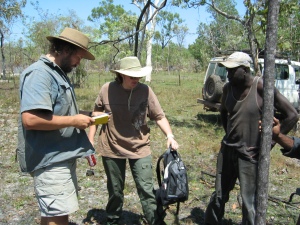
Clive McMahon (left) & colleaguesA good friend and colleague of mine, Dr. Clive McMahon, is visiting Adelaide for the next few weeks from Darwin. We’re attacking a few overdue manuscripts and sampling a few of Adelaide’s better drops of value-added grape juice, so I asked him to do a guest post on ConservationBytes.com about his work. So here it is, something perhaps even few Australians know much about, let alone overseas folks. If you can recall that very strange scene in the film Crocodile Dundee where the old croc hunter casts a gestured spell over a horned beast, then you’ll probably appreciate this post.

Yes, there are plenty of them in northern Australia

Invasive and feral species can be important drivers of biodiversity loss. Australia, like many other isolated islands has developed an ancient, unique and diverse ecosystem. This unique ecosystem has been under extreme pressure ever since humans arrived around 40000-60000 years ago. One of the more damaging and economically important introduced species in Australia is the Asian swamp buffalo (Bubalus bubalis). Ironically, swamp buffalo are listed as Endangered by the IUCN, and current estimates suggest that there are probably less than 4000 in their native habitats in Asia.
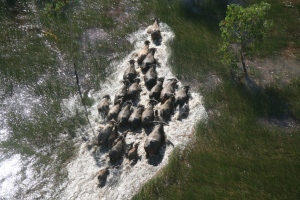
© B. Salu, Kakadu National Park

© B. Salau, Kakadu National Park

The first 16 buffalo were introduced to Australia in 1826 on Melville Island, and then to the mainland at Cobourg Peninsula a year later from Kupang (now West Timor, Indonesia). Another 18 buffalo were obtained from Kisar Island (northeast of modern Timor-Leste) and introduced to the Cobourg. In 1843, another 49 were introduced. When the first Cobourg settlement was abandoned in 1849, all the buffalo were released, and the population spread rapidly throughout the Northern Territory. Over the next 65 years, numbers and distribution increased to an estimated 350000 in the 1960s and 1970s and densities exceeded 25 km-2 in ‘prime’ habitat. However, the population was severely reduced during the 1980s and 1990s in parts of its range under the Brucellosis-Tuberculosis Eradication Campaign (BTEC). Although largely successful in eradicating buffalo from pastoral lands in the short term, there was no ongoing broad-scale management of numbers and the present-day population of free-ranging buffalo has recovered to former densities in some areas.
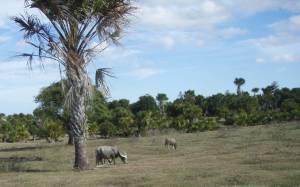
© C. Speed

© C. Speed

Buffalo were then and still are major problem in Australia due mainly to the environmental damage they cause, such as saltwater intrusion of wetlands and trampling of sensitive habitats, their potential threat to Australia’s livestock industry as hosts for disease, and the danger they pose to human safety. Given these ecological, economic and social impacts, there is an urgent need to manage buffalo numbers.

An important step to inform management of introduced and invasive species is to determine the history of introduction and quantify the rate of spread from introduction sites. Contemporary genetic techniques in conjunction with demographic and life history information are useful tools for understanding the dynamics, population structure, biology and colonisation dynamics of plants and animals, including invasive species such as buffalo.

We are currently in the final stages of providing the first detailed analysis of the buffalo population structure (demographic and genetic) to (1) establish the rate and most probable history of spread using detailed genetic information sampled from 8 sub-populations, (2) quantify the genetic distance and mixing rates between populations and (3) describe the age structure and therefore the demographic performance of this very successful invasive species.

Firstly to get an idea of genetic structure and relatedness, we collected a total of 430 small skin biopsies from buffalo across the Northern Territory, representing eight geographically distinct populations. To determine what has made the buffalo such a successful invader it is important to know the survival and breeding performance; we also constructed seven life tables based on culled samples at different densities and in different environments to work out what are the critical components of the population – i.e., where management intervention would be most successful.

As expected from a bottlenecked population, genetic variation is low compared to the that found in swamp buffalo from India and South East Asia. Despite this reduced genetic variation, the Australian population has thrived and spread outwards from introduction sites and into culled sites at high rates over the last 160 years (covering ~ 224 000 km2 in that time).
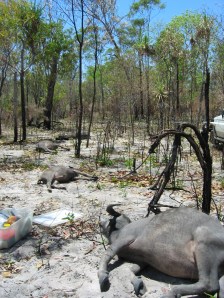
Although buffalo in Australia experienced two major periods of population reduction since their introduction, a small proportion (estimated at ~ 20 %) escaped the BTEC reduction in the eastern part of its north Australian range. BTEC did not operate with uniformity across the entire range of buffalo, concentrating its destocking efforts in a general area from the western coast of the Northern Territory to west of the Mann River in Arnhem Land, and south roughly to Kakadu National Park’s southern border. Coincidently and not surprisingly, it is in this area that we observe most migration activity.

The subpopulation structure detected here suggests that each population, while connected over generational time scales, generally remains in its immediate vicinity over the course of management-tractable periods. Therefore, management aimed at protecting Australia’s lucrative livestock industry trading under Australia’s disease-free status will benefit directly from this knowledge. For example, the localised introduction and subsequent rapid detection of disease could be efficiently managed from local culls because short-term movements of long-distance are less likely. Our results showcase how management of animals for disease control can be effectively informed via genetic studies and so avoid the need for expensive broad-scale intervention.

Our analyses of the age structure of buffalo reveals that buffalo have the capacity to recover swiftly after control because of high survival and fertility rates. Survival in the juvenile age classes was consistently the most important modifier of population growth. In populations where juvenile animals are harvested annually, fertility determined rebound potential. Thus, management aimed at long-term control of densities should focus primarily on the sustained culling of adult females and their offspring.

Given that numbers of buffalo are increasing and that buffalo are extremely well-adapted to the monsoonal tropics (unlike cattle, buffalo can maintain body condition and positive growth during times of food shortages), they are vulnerable to extended periods of harsh conditions. Climate change predictions herald increasing rainfall in the region, thereby potentially reducing the pressure on juvenile survival. As such, buffalo population growth could conceivably increase, making future management much more difficult. In essence, we need a large, evidence-based density reduction programme in place soon to prevent the worst ecological damage to Australia’s sensitive and unique ecosystems.

Check back here for announcements of upcoming publications arising from our work.

Clive McMahon & CJA Bradshaw

Add to FacebookAdd to NewsvineAdd to DiggAdd to Del.icio.usAdd to StumbleuponAdd to RedditAdd to BlinklistAdd to Ma.gnoliaAdd to TechnoratiAdd to Furl


Shocking continued loss of Australian mammals

21 08 2009

thylacineAs CB readers know, I’m in Brisbane this week for the 10th International Congress of Ecology (INTECOL). My last post was on a great plenary talk by biodiversity guru, Kevin Gaston of the University of Sheffield, and I’ve got one more before heading back to Adelaide tomorrow.

Today, the last day of INTECOL talks, brought together some great conservation minds in a session in which I was honoured to participate. I spoke on extinction synergies, but I think John Woinarski of the Northern Territory Government stole the show.

I used to live in the NT and have seen John speak many times; however, this was one of the best and most sobering of his talks I’ve seen yet.

In a nutshell, we are STILL experiencing a colossal decline in our mammals. I think many might know that Australia is the WORST country in the world for mammal extinctions already – even more gut-wrenching when you consider that our closest competitors are small islands that have a completely different set of threats. However, many don’t know (and this is John’s point), that we are still losing populations at an outrageous rate.

John’s been working on everything from Conilurus to quolls in the central and northern parts of Australia for over 20 years, and he’s got some of the best data around. Without fail, almost every remaining native small mammal population is in decline, even to the point of local extirpation in over 50 % of all his monitoring sites (and there are a lot of monitoring sites).

If that isn’t worrying enough, much of his data are collected in some of our biggest national parks (e.g., Kakadu National Park) – this basically means that despite restricting habitat loss (our greatest driver of extinction), mammal populations are still in ever-increasing states of buggery.

So, what are the causes? Anyone who’s been to Kakadu National Park, or (even luckier) has been to Arnhem Land, know that we’re literally burning the shit out of these places. Sure, fire is an integral part of northern Australian ecology, but the pervasive paradigm – unless-it’s-burnt-every-year-it’s-bad credence – means that nothing ever has a chance to come back after a population crash caused by a one-off fire.

Sure, things like cane toads and other feral animals might play a role, but it’s the ridiculous burning regime we’ve adopted that’s destroying our already depleted and unique mammalian species assemblage. Unless we reverse this trend NOW, we’ll have more or less condemned our one-of-a-kind mammals to extinction. As an Australian, can you live with that?

A stark reminder of how ridiculous the situation has become, esteemed Professor William Bond of South Africa stated in the question period after John’s talk (I paraphrase):

“When you arrive in Australia, you are bombarded with slogans of sporting victories, great food and fantastic wine [all true], but no one tells you of the biodiversity tragedy that has, and is continuing, to happen in Australia. In Africa, we have managed to convince people to conserve elephants that destroy their crops and kill their families – why can’t Australians realise their are destroying their very heritage? What are you doing to stop the carnage?”

I have no answer. Sorry, William. Sorry, John. Sorry, Australia.

CJA Bradshaw

Add to FacebookAdd to NewsvineAdd to DiggAdd to Del.icio.usAdd to StumbleuponAdd to RedditAdd to BlinklistAdd to Ma.gnoliaAdd to TechnoratiAdd to Furl


Ray of conservation light for Borneo

25 07 2009

This was the most interesting 20 minutes I’ve spent in the last wee while.

Up until just now, I had never heard of Willie Smits or what he’s been doing in Indonesia. I’ve been fairly hard on Indonesia in some of my papers and blog posts because of the ecological tragedy taking place there. I’ve focussed on the immense rate and extent of deforestation, the oil palm explosion, peatland destruction and air pollution arising from runaway fires there – I have thus far ignored any real positives because I didn’t really believe there were any.

Then I saw Smits’ TED talk. Two words – very impressed. I usually enjoy and even barrack for TED talks, and this is no exception.

This man and his organisation have really been applying a great deal of the research mentioned on ConservationBytes.com, as well as collecting data proving beyond a shadow of a doubt that if you integrate people’s needs with those of biodiversity, you can restore not only entire ecosystems, you can make humans benefit immensely in the process. A chronic pessimist, I can scarcely believe it.
He talks about a whole-system approach where agriculture, full rain forest restoration, climate control, carbon sequestration, monitoring and local governance all work together to turn once bare, fire-prone, species-poor deforested grasslands into teaming jungles that support happy, healthy, wealthy and well-governed human communities. Please watch this.

Vodpod videos no longer available.

CJA Bradshaw

Add to FacebookAdd to NewsvineAdd to DiggAdd to Del.icio.usAdd to StumbleuponAdd to RedditAdd to BlinklistAdd to Ma.gnoliaAdd to TechnoratiAdd to Furl


Monkeys and motorbikes

29 06 2009

flyingmonkeyThis post by a colleague of mine, Erik Meijaard of The Nature Conservancy, really nails down one of the principal bugbears of conservation science – how to make our research truly relevant to reducing or reversing the trends in species extinctions. It also goes straight to the Toothless page.
We as a discipline have been studying ways to improve the plight of biodiversity for over 50 years, but across the board, species are disappearing at faster and faster rates. So obviously we’re doing something dreadfully wrong. Yes, we have made huge scientific leaps in that time, quantified many hypothetical aspects of extinction and restoration (e.g., fragmentation, trophic cascades, protected areas, etc. – check out Conservation Classics for some of the more memorable conservation science advances), and identified some of the major socio-political impediments to achieving real conservation outcomes.

Yes, one can argue that without conservation science we’d already be a lot worse off and many species now just hanging on would have long since disappeared. It’s also arguable that our battle was lost before we begun fighting simply by virtue of the burgeoning human population and its never-ending quest to consume more – one step forward and two steps back.

I’m not at all trying to condemn the discipline, but I think it’s worth our while to hold our research up closely and regularly to the mirror and ask ourselves in the most objective manner whether we think we’re truly changing things for the better. Something to think about the next time you apply for that research grant.

Erik’s post is reproduced below.

Last year, The Nature Conservancy’s Indonesia program was offered an undisclosed amount of money from an anonymous motorbike company. Presumably because the company knew of the Conservancy’s expertise in primate research, they somewhat bizarrely requested us to investigate bike preference among Indonesian apes and monkeys.

As the senior scientist of the Indonesian forest program, I rejected the idea outright. The scientific scope of the study appeared far from our usual focus on proper applied conservation research. Do we really care which brand of motorbike different species of primate prefer? And if we knew, would it really help us to protect them any better? My answer to both questions was “no.”

Still, I couldn’t stop myself wondering. What if we simply took the money? It had been offered with virtually no strings attached. If we could do the study cheaply we might have some funds left for more relevant work.

So, weak as I am, I relented and took the cash and developed a minimalistic study in which we studied photos of primates on bikes. The results indicate that agile gibbons (Hylobates agilis) prefer Yamaha, crested black macaques (Macaca nigra) prefer Honda, and pig-tailed macaques (Macaca nemestrina) favor push bikes. Curiously, none of the species seem to favor the big handlebars on bikes called “ape hangers.”

Admittedly, the sample size of three is somewhat limited, but a tentative conclusion is that the higher evolved a primate is, the more expensive its bike selection. The donor company is extremely pleased with the results of this study, and they are now translating the findings into new marketing strategies for a very expensive bike for people, based on the assumption that humans are at the top rung of the evolutionary ladder.

Whether the story is factual or not, the moral of it is that most conservation research in places like Indonesia, but also elsewhere in the world, is largely irrelevant to conservation.

Douglas Sheil (a colleague of mine) and I published a paper some time ago in which we compiled, categorized and evaluated 284 publications on Bornean wildlife (Biodiversity and Conservation 16:3053–3065). We found that few studies address threats to species and fewer still provide input for or guidance to effective management.

Too often scientists working under the guise of conservation answer questions that are not important to conservation — and judging my CV, I am one of them. In the end, if we cannot come up with the facts and recommendations that can be directly applied by managers, decision makers, local communities and other people that really count in conservation, conservation science will have little to offer to conservation.

CJA Bradshaw

Add to FacebookAdd to NewsvineAdd to DiggAdd to Del.icio.usAdd to StumbleuponAdd to RedditAdd to BlinklistAdd to Ma.gnoliaAdd to TechnoratiAdd to Furl


Tropical forests worth more standing

4 06 2009
© R. Butler

© R. Butler

Keeping with the oil palm theme…

A paper just published online in Conservation Letters by Venter and colleagues entitled Carbon payments as a safeguard for threatened tropical mammals gets my vote for the Potential list.

We’ve been saying it again and again and again… tropical forests, the biodiversity they harbour and the ecosystem services they provide are worth more to humanity than the potential timber they represent. Now we find they’re even worth more than cash crops (e.g., oil palm) planned to replace them.

A few years ago some very clever economists and environmental policy makers came up with the concept of ‘REDD’ (reducing carbon emissions from deforestation and forest degradation), which is basically as system “… to provide financial incentives for developing countries that voluntarily reduce national deforestation rates and associated carbon emissions below a reference level”. Compensation can occur either via grant funding or through a carbon-trading scheme in international markets.

Now, many cash-greedy corporations argue that REDD could in no way compete with the classic rip-it-down-and-plant-the-shit-out-of-it-with-a-cash-crop approach, but Venter and colleagues now show this argument to be a bit of a furphy.

The authors asses the financial feasibility of REDD in all planned oil palm plantations in Kalimantan – Indonesia’s part of the island of Borneo in South East Asia. Borneo is also the heart of the environmental devastation typical of the tropics. They conclude that REDD is in fact a rather financially competitive scheme if we can manage to obtain carbon prices of around US$10-33/tonne. In fact, even when carbon prices are as low as US$2/tonne (as they are roughly now on the voluntary market), REDD is still competitive for areas of high forest carbon content and lower agricultural potential.

But the main advantage isn’t just the positive cash argument – many endangered mammals (and there are 46 of them in Kalimantan) such as the South East Asian equivalent of the panda (the orang-utan – ‘equivalent’ in the media-hype and political sensitivity sense, not taxonomic, of course) and the Bornean elephant (yes, they have them) are currently found in areas planned for plantation. So saving the forest obviously saves these and countless other taxa that only exist on this highly endemic island. Finally, Venter and colleagues found that where emission reductions were cheapest, these are also areas with higher-than-average densities of endangered mammals, suggesting that REDD is a fantastic option to keep developing countries in the black without compromising their extensive species richness and endemism.

Brilliant. Now if we can just get the economists and pollies to agree on a REDD model that actually works.

CJA Bradshaw

Add to FacebookAdd to NewsvineAdd to DiggAdd to Del.icio.usAdd to StumbleuponAdd to RedditAdd to BlinklistAdd to Ma.gnoliaAdd to TechnoratiAdd to Furl


Indonesia’s precious peatlands under oil palm fire

31 05 2009
© Cockroach Productions

© Cockroach Productions

A small opinion piece about to be published in Frontiers in Ecology and the Environment (June 2009 issue) discusses a major concern we (Lian Pin Koh, Rhett Butler and I) have with Indonesia’s decision to allow peatlands less than 3 m deep to be converted to oil palm. Is nothing immune to the spread of this crop (see previous posts here and here on oil palm plantations)?

Why is this such a big deal? Well, we list five main reasons why it’s a bad idea for Indonesia, the world in general and biodiversity:

  1. Peatlands are amazing carbon sinks, so their destruction necessarily equates to a large release of carbon into the atmosphere (Page et al. 2002)
  2. Tropical peatlands take a hell of a long time to generate – 100s to 1000s of years (Chimner and Ewel 2005)
  3. Tropical peatlands harbour a massive biodiversity, but they are still poorly described and their ecosystems only superficially understood
  4. The burning of peatlands to provide the conditions necessary to plant oil palm will contribute to the massive ‘haze’ problem in South East Asia (Lohman et al. 2007)
  5. The decision goes against the principles of ‘reducing carbon emissions from deforestation and forest degradation‘ (REDD), which means it will be more difficult to implement carbon trading schemes that intrinsically value intact forests

More detail can be found in the Write Back piece that will be published shortly in Frontiers in Ecology and the Environment. For more information on oil palm and its conservation implications, see the following:

CJA Bradshaw

Add to FacebookAdd to NewsvineAdd to DiggAdd to Del.icio.usAdd to StumbleuponAdd to RedditAdd to BlinklistAdd to Ma.gnoliaAdd to TechnoratiAdd to Furl


Celebrities actually doing something positive for conservation?

7 05 2009

When I first saw this on the BBC I thought to myself, “Well, just another toothless celebrity ego-stroke to make rich people feel better about the environmental mess we’re in” (well, I am a cynic by nature). I have blogged before on the general irrelevancy of celebrity conservation. But then I looked closer and saw that this was more than just an ‘awareness’ campaign (which alone is unlikely to change anything of substance). The good Prince of Wales and his mates/offspring have put forward The Prince’s Rainforest Project, which (thankfully) not only endeavours to raise awareness about the true value of rain forests, it actually proposes a mechanism to do so. It took a bit to find, but the 52-page report on the PRP website outlines from very sensible approaches. In essence, it all comes down to money (doesn’t everything?).

Their proposed plan to the United Nations Framework Convention on Climate Change (UNFCCC) details some of the following required changes:

  1. Payments to rain forest nations for not deforesting (establish transaction costs and setting short-term ‘conservation aid’ programmes)

  2. Multi-year service agreements (countries sign up for multi-year targets based on easily monitored performance indicators)

  3. Fund alternative, low-carbon economic development plans (fundamental shifts in development targets that explicitly avoid deforestation)

  4. Multi-stakeholder disbursement mechanisms (using funds equitably and minimising corruption)

  5. Tropical Forests Facility (a World Bank equivalent with the express purpose of organising, disbursing and monitoring anti-deforestation money flow)

  6. Country financing from public and private sources (funding initially derived from developed nations in form of ‘aid’)

  7. Rain forest bonds in private capital markets (value country-level ‘income’ as interest payments and incentives within a trade framework)

  8. Nations participate when ready (giving countries the option to advance at the pace dictated by internal politics and existing development rates)

  9. Accelerating long-term UNFCCC agreement on forests (transition to independence post-package)

  10. Global action to address drivers of deforestation (e.g., taxing/banning products grown on deforested land; ‘sustainability’ certification; consumer pressure; national procurement policies)

Now, I’m no economist, nor do I understand all the market nuances of the proposal, but it seems they are certainly on the right track. The value of tropical (well, ALL) forests to humanity are undeniable, and we’re currently in a state of crisis. Let’s hope the Prince and his mob can get the ball rolling.

For what it’s worth, here’s the video promoting the PRP. I could really care less what Harrison Ford and Pele have to say about this issue because I just don’t believe celebrities have any net effect on public behaviour (perceptions, yes, but not behaviour). But look beyond the superficiality and the cute computer-generated frog to the seriousness underneath. Despite my characteristically cynical tone, I give the PRP full support.

Vodpod videos no longer available.

more about “Rainforest film brings out stars“, posted with vodpod


CJA Bradshaw

Add to FacebookAdd to NewsvineAdd to DiggAdd to Del.icio.usAdd to StumbleuponAdd to RedditAdd to BlinklistAdd to Ma.gnoliaAdd to TechnoratiAdd to Furl


Tropical Turmoil II

8 03 2009

In August last year I covered a paper my colleagues (Navjot Sodhi and Barry Brook) and I had in press in Frontiers in Ecology and the Environment entitled Tropical turmoil – a biodiversity tragedy in progress. The paper is now available in the March 2009 issue of the journal (click here to access). We were also fortunate enough to grab the front cover (shown here) and have a dedicated podcast that you can listen to by clicking here about the paper and its findings. I encourage ConservationBytes.com readers to have a listen if they’re interested in learning more about the woeful state of tropical biotas worldwide, and maybe some ways to rectify the problems. The intro to the podcast can be viewed by clicking here.

CJA Bradshaw


One more (excellent) reason to conserve tropical forests

26 02 2009

© K. Sloan Brown

© K. Sloan Brown

Another nail in the deforesters’ justification coffin – tropical forests are worth more intact than cut down. This one from Mongabay.com and one for the Potential section:

Undisturbed tropical forests are absorbing nearly a fifth of carbon dioxide released annually by the burning of fossil fuels, according to an analysis of 40 years of data from rainforests in the Central African country of Gabon.

Writing in the journal Nature, Simon Lewis and colleagues report that natural forests are an immense carbon sink, helping slow the rise in atmospheric CO2 levels.

“We are receiving a free subsidy from nature,” said Simon Lewis, a Royal Society research fellow at the University of Leeds. “Tropical forest trees are absorbing about 18% of the CO2 added to the atmosphere each year from burning fossil fuels, substantially buffering the rate of climate change.”

But the good news may not last for long. Other research suggests that as tropical forests fall to loggers, dry out due to rising temperatures, and burn, their capacity to absorb carbon is reduced.

The research, which combined the new data from African rainforests with previously published data from the Americas and Asia, lends support to the idea that old-growth forests are critical to addressing climate change. Recent climate negotiations have included debates on compensating tropical countries for reducing emissions from deforestation and forest degradation (“REDD” or “avoided deforestation”).

“To get an idea of the value of the sink, the removal of nearly 5 billion tonnes of carbon dioxide from the atmosphere by intact tropical forests, based on realistic prices for a tonne of carbon, should be valued at around £13 billion per year,” said study co-author Lee White, Gabon’s Chief Climate Change Scientist. “This is a compelling argument for conserving tropical forests.”

“Predominantly rich polluting countries should be transferring substantial resources to countries with tropical forests to reduce deforestation rates and promote alternative development pathways,” added Lewis.

The new findings show that tropical forests account for roughly half of the 8.5 billion tons of carbon that is sequestered in terrestrial sources each year, the balance is absorbed by soils and other types of vegetation. Another 8.5 billion tons dissolved in oceans, leaving 15 billion of the 32 billion tons emitted by humans each year in the atmosphere. Deforestation accounts for roughly 6 billion tons of greenhouse gas emissions – greater than the emissions from all the world’s planes, ships, trucks, and cars.

Note – the contention by Muller-Landau that the Lewis and colleagues’ findings are not realistic due to ‘regeneration’ demonstrates her ignorance of recent work demonstrating the sequestration aspect of mature forests. But more importantly, this cherry-picked gripe, even if it were plausible, is almost of no consequence. With much of the world’s tropical forests already badly degraded or destroyed, there will inevitably be large areas of regenerating forests for centuries to come (i.e., time periods relevant to climate change projections). We haven’t even managed to reduce the RATE of tropical deforestation, so the opportunities for regeneration will persist, making the Lewis result all the more important. Muller-Landau is known for her unrealistic and anti-conservationist views, so her comments are hardly surprising. My advice – take her opinions with a very large shaker of salt (or better yet, ignore entirely).

CJA Bradshaw


Failing on ocean protection

24 11 2008

A new paper from Conservation Letters by Mark Spalding and colleagues entitled Toward representative protection of the world’s coasts and oceans-progress, gaps, and opportunities reminds us just how crap we are at protecting ocean habitats. I sincerely hope this one is a Potential given that the only direction one can move from absolute bottom is up. Richard Black at the BBC reports on the paper’s main findings:

toilet-ocean_squareLess than 1% of the world’s oceans have been given protected status, according to a major survey.

Governments have committed to a target of protecting 10% by 2012, which the authors of the new report say there is no chance of meeting.

Protecting ecologically important areas can help fish stocks to regenerate, and benefit the tourism industry.

The survey was led by The Nature Conservancy (TNC) and is published in the journal Conservation Letters.

“For those of us working in the issue full-time it’s not a surprise, we’ve known all along that marine protection is lagging behind what’s happening on land, but it’s nice to have it pinned down,” said TNC’s Mark Spalding.

“It’s depressing that we’ve still got so far to go, but there are points of hope,” he told BBC News.

Coastal concentration

Four years ago, signatories to the UN’s biodiversity convention – which includes almost every country – pledged to protect at least 10% of the oceans in a way that makes sense ecologically.

Protecting them does not mean banning activities such as fishing or shipping completely, but making sure they are carried out sustainably.

All of the areas currently protected fall into countries’ Exclusive Economic Zones, and the majority are along coasts, the study finds.

Even so, only about 4% of coastal waters are protected.

Countries diverge widely in how much protection they have mandated.

Whereas New Zealand has almost 70% of its coastline under some form of protection, countries around the Mediterranean have set aside less than 2%.

In the developing world, Dr Spalding cites Guinea-Bissau as a country that has had invested in protection, particularly in the Bijagos Archipelago, which is home to a community of hippos dwelling along its mangrove coast, as well as more conventional marine species.

Palau, Indonesia, Micronesia and several Caribbean states are also making significant progress, he said.

About 12% of the Earth’s land surface has been put under protection.

Download the Spalding paper free of charge here.


Save the biggest (and closest) ones

12 11 2008

© somapsychedelica

© somapsychedelica

A paper we recently wrote and published in Biological Conservation entitled Using biogeographical patterns of endemic land snails to improve conservation planning for limestone karsts lead by my colleague Reuben Clements of WWF has recently been highlighted at Mongabay.com. Our main result was that following the basic tenets of the theory of island biogeography, the largest, least-isolated limestone karsts in South East Asia (biologically rich limestone outcrops formed millions of years ago by the deposition of calcareous marine organisms) have the greatest proportion of endemic land snails (a surrogate taxon for uniqueness among other species). I’ll let Rhett at Mongabay.com do the rest (see original post):

Researchers have devised a scientific methodology for prioritizing conservation of limestone karsts, biologically-rich outcroppings found in Southeast Asia and other parts of the world. The findings are significant because karsts – formed millions of years ago by sea life – are increasingly threatened by mining and other development.

Using data from 43 karsts across Peninsular Malaysia and Sabah, authors led by Reuben Clements of WWF-Malaysia reported that larger karsts support greater numbers of endemic snails – a proxy for biological uniqueness among other species – making them a priority for protection.

“Larger areas tend to have greater habitat diversity, which enables them so support a higher number of unique species.” said Clements, species conservation manager for WWF-Malaysia.

With a variety of habitats including sinkholes, caves, cliffs, and underground rivers, and separated from other outcroppings by lowland areas, karsts support high levels of endemism among insects, snails, fish, plants, bats and other small mammals. Animals that inhabit karsts provide humans with important services including pest control, pollination, and a sustainable source of income (swiftlet nests used for bird nest soup, a Chinese delicacy, are found in karst caves). But karsts are increasingly under threat, especially from mining for cement and marble. An earlier study by Clements showed that limestone quarrying is increasing in Southeast Asia by 5.7 percent a year – the highest rate in the world – to fuel the region’s construction boom. The biodiversity of karsts – especially among animals that move to surrounding areas to feed – is also at risk from destruction of adjacent ecosystems, often by loggers or for agriculture.

Clements says the new study, which is published in the November issue of the journal Biological Conservation, will help set conservation priorities for karsts.

“The protection of karsts has been mainly ad hoc and they are usually spared from quarrying by virtue of being situated within state and national parks, or if they possess some form of aesthetic or cultural value,” he said. “Taking Peninsular Malaysia for example, our results suggest that we should set aside larger karsts on both sides of the Titiwangsa mountain range for protection if we want to maximize the conservation of endemic species. Protecting karsts on one side of the mountain chain is not enough.”

“With our findings, we hope that governments would reconsider issuing mining concessions for larger karsts as they tend to be more biologically important,” Clements said.


Unexpected benefits of falling palm oil prices

10 11 2008

© Google Earth

© Google Earth

This one from Mongabay.com and the Jakarta Post. It would almost be humorous, if it weren’t so pathetic. After years of so-called ‘greenwashing’ tactics to downplay the environmental degradation caused by expanding oil palm plantations (see also related post here), falling world palm oil prices may just be the thing needed to curb the greed. As a side note, I recently visited China and now realise where a good proportion of the oil palm is going – while the food was fantastic, the amount of oil used in almost everything is a bit over the top. For a ‘developing’ nation, there sure were quite a few fatties on the street. Convincing China to eat less oil will also reduce demand for oil palm and save SE Asia’s dwindling biodiversity.

The agricultural ministers for both countries [Indonesia and Malaysia] agreed to initiate a 300,000-hectare replanting program that will replace aging trees with seedlings of higher-yielding varieties. The seedlings will begin to bear oil palm fruit “fresh fruit bunches” for harvest in three to four years’ time.

“Demand is projected to slow down in every sector next year as a result of global recession. We’re preventing a possible oversupply of palm oil that may occur next year by replanting trees,” Achmad Mangga Barani, the director general for plantations for Indonesia’s Agriculture Ministry, was quoted as saying. “This hopefully will help boost the palm oil price to a normal level — at around US$700 to $800 per metric ton.”

Palm oil prices in Malaysia have fallen from more than $1200 per ton earlier this year to a three-year low of around $376 per ton on Oct. 28. Palm oil prices have lately moved in step with the price crude oil, which has also rapidly retreated from recent record high nominal prices.

The decline in palm oil prices is expected to slow expansion of oil palm plantations in Indonesia and Malaysia, a development that will please environmentalists who blame the palm oil industry for large-scale destruction of rainforests across Southeast Asia.

The new plan calls for replanting of 50,000 hectares in Indonesia and 250,000 in Malaysia. Indonesia, which has significantly lower palm oil yields than Malaysia due to marginal oil palm varieties and fewer industrial producers, will aim to replant 125,000 ha by 2011.


Primate conservation enhances human food availability

19 09 2008

This one from Mongabay.com – yet another reason to conserve species for human benefit…

© F. Möllers

© F. Möllers

Primate conservation may have the unintended benefit of enhancing food availability to humans, reports a study [Koné et al. 2008. Primate seed dispersal and its potential role in maintaining useful tree species in the Taï region, Côte-d’Ivoire: implications for the conservation of forest fragments. Tropical Conservation Science 1:293-306] led by African scientists.

The research, conducted in the Taï region of Côte-d’Ivoire, found that seven species of monkeys used about 75 species of plants as a source of fruit, of which 25 were also used by local human inhabitants for various purposes. Because monkeys are key seed dispersal agents, the results suggest that primate conservation may sustain the persistence of plant resources important for human livelihoods.

“The cost of losing monkeys extends beyond the loss of the animals themselves,” write the authors. “Indeed, the local extinction of frugivorous primates is predicted to have deleterious consequences for forest regeneration and/or tree species community composition.”

The authors, led by Inza Koné from the University of Cocody in Abidjan and the Taï Monkey Project, note that monkeys in the region are already experiencing “extreme hunting pressure” as a source of protein and as crop pests. Primates are also threatened by habitat loss caused by the conversion of forest for agriculture.

Koné and colleagues suggest measures to conserve monkeys will offer multiple benefits to the primates themselves as well as local communities.

“Results of this study suggest that maintaining populations of monkeys is important not only for forest regeneration, but also for human habitat use,” they continue. “The conservation of primate species is a critically important goal in itself; by working to ensure their protection in forest fragments, we protect indirectly the seed dispersal of important human resources in these fragments as well.”

“Protection of monkeys and seed dispersal systems outside protected areas is particularly relevant in this context, since it is in these areas… that primates are most at risk, and also where people are allowed to exploit forest plant resources.”


Oil palm plantations destroying tropical biodiversity

18 09 2008

This one from MongaBay.com

Conversion of primary rainforest to an oil palm plantation results in a loss of more than 80 percent of species, reports a new comprehensive review of the impacts of growing palm oil production. The research is published in the journal Trends in Ecology and Evolution.

“By compiling scientific studies of birds, bats, ants and other species, we were able to show that on average, fewer than one-sixth of the species recorded in primary forest were found in oil palm,” said led author Emily Fitzherbert from the Zoological Society of London and University of East Anglia. “Degraded forest, and even alternative crops such as rubber and cocoa, supported higher numbers of species than oil palm plantations.”

The results confirm that oil palm plantations are a poor substitute for natural forests when it comes to conservation of biological diversity.

The study warns that burgeoning demand for palm oil for use in foods, household products, and biodiesel will continue to fuel expansion in the tropics. Because planters can subsidize operations by the initial logging for forest plots, it seems likely that forests will continue to fall for new plantations despite the availability of large tracts of degraded and abandoned land.

“There is enough non-forested land suitable for plantation development to allow large increases in production without large impacts on tropical forests, but as a result of political inertia, competing priorities and lack of capacity and understanding, not to mention high levels of demand for timber and palm oil from wealthy consumers, it is still often cheaper and easier to clear forests. Unless these conditions change quickly, the impacts of oil palm expansion on biodiversity will be substantial,” the authors conclude.

See also Koh & Wilcove. 2008. Is oil palm agriculture really destroying tropical biodiversity? Conservation Letters 1: 60-64

CJA Bradshaw


Another nail in Borneo’s biodiversity coffin

11 09 2008

I always try to tell myself never “to underestimate the stupidity of the human race”; yet, I am too often surprised. Borneo is one of the places in the tropics with the worst track record in destroying ecosystems and the services they provide. The Malaysian government couldn’t be more self-destructive with this sort of policy.

This item from Mongaybay.com:

© CIFOR

© CIFOR

The Malaysian government is attempting to quell indigenous opposition to logging in the rainforests of Borneo by deposing community leaders and replacing them with timber company stakeholders, reports an environmental group.

The Bruno Manser Fund, a Swiss NGO that works on behalf of the forest people of Sarawak, Malaysia, says that the headmen of at least three Penan communities that have opposed logging have lost official recognition from Malaysian authorities over the past year. The government is working to install representatives who support logging.

“The non-recognition of the elected community headmen by the Sarawak State Government is a clear violation of the UN Declaration of the Rights of Indigenous Peoples,” stated the Bruno Manser Fund in an emailed release. “The Declaration, which has been adopted by Malaysia, upholds in its article 18 the right of indigenous communities ‘to participate in decision-making in matters which would affect their rights, through representatives chosen by themselves in accordance with their own procedures’.”

The Penan communities of Sarawak have waged a long battle against the logging of their ancestral homeland in the rainforests of Sarawak, on the island of Borneo. The opposition reached a crescendo in the 1980s when the Penan blocked logging roads and sabotaged equipment. The Malaysian government responded by closing down media access to the area and sending in armed forces to violently supress the unrest. While the attacks on the Penan brought international attention to the rapacious logging of Borneo’s forests, they had relatively little long-term impact.

Today the Penan face not only loggers but increased pressure from oil palm developers as well as an ambitious government plan to dam several rainforest rivers in an effort to generate electricity to attract aluminum smelters and mineral refiners.

Add to FacebookAdd to NewsvineAdd to DiggAdd to Del.icio.usAdd to StumbleuponAdd to RedditAdd to BlinklistAdd to Ma.gnoliaAdd to TechnoratiAdd to Furl


Tropical Conservation Biology

8 09 2008

An obvious personal plug – but I’m allowed to do that on my own blog ;-)

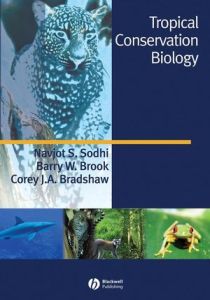
1405150734I’d like to introduce a (relatively) new textbook that my colleagues, Navjot Sodhi and Barry Brook, and I wrote and published last year with Blackwell (now Wiley-Blackwell) Scientific Publishing – Tropical Conservation Biology.

We’re rather proud of this book because it was a timely summary and assessment of the scientific evidence for the degree of devastation facing tropical biodiversity today and in the future. I’ve summarised some of the main issues in a previous post covering a paper we have ‘in press’ that was born of the text book, but obviously the book is a far more detailed account of the problems facing the tropics.

This introductory textbook examines diminishing terrestrial and aquatic habitats in the tropics, covering a broad range of topics including the fate of the coral reefs; the impact of agriculture, urbanisation, and logging on habitat depletion; and the effects of fire on plants and animal survival.

One of the highlights of the book is that each chapter (see below) Includes case studies and interviews with prominent conservation scientists to help situate key concepts in a real world context: Norman Myers (Chapter 1), Gretchen Daily (Chapter 2), William Laurance (Chapter 3), Mark Cochrane (Chapter 4), Daniel Simberloff (Chapter 5), Bruce Campbell (Chapter 6), Daniel Pauly (Chapter 7), Stephen Schneider (Chapter 8), Stuart Pimm (Chapter 9) and Peter Raven (Chapter 10). These biographies are followed by a brief set of questions and answers that focus on some of the most pertinent and pressing issues in tropical conservation biology today. It is our intention that readers of Tropical Conservation Biology will benefit from the knowledge and be inspired by the passion of these renowned conservation experts.

TABLE OF CONTENTS

  1. Chapter 1: Diminishing habitats in regions of high biodiversity. We report on the loss of tropical habitats across the tropics (e.g., deforestation rates). We also highlight the drivers of habitat loss such as human population expansion. Finally, we identify the areas in immediate need of conservation action by elucidating the concept of biodiversity hotspots. Read the rest of this entry »


Native forests reduce the risk of catastrophic floods

20 08 2008

A-Pakistan-Army-helicopte-004Each year extreme floods kill or displace hundreds of thousands of people and cause billions of dollars in damage to property. The consequences of floods are particularly catastrophic in developing countries generally lacking the infrastructure to deal adequately with above-average water levels.

For centuries it has been believed that native forest cover reduced the risk and severity of catastrophic flooding, but there has been strong scientific debate over the role of forests in flood mitigation.

Forest loss is currently estimated at 13 million hectares each year, with 6 million hectares of that being primary forest previously untouched by human activities. These primary forests are considered the most biologically diverse ecosystems on the planet, but this realisation has not halted their immense rate of loss.

Last year my colleagues and I published a paper entitled Global evidence that deforestation amplifies flood risk and severity in the developing world in Global Change Biology (highlighted in Nature and Faculty of 1000) that has finally provided tangible evidence that there is a strong link between deforestation and flood risk. Read the rest of this entry »


Tropical turmoil – a biodiversity tragedy in progress

18 08 2008

fragmentationWe recently published (online) a major review showing that the world is losing the battle over tropical habitat loss with potentially disastrous implications for biodiversity and human well-being.

Published online in the Ecological Society of America’s journal Frontiers in Ecology and the Environment, our review Tropical turmoil – a biodiversity crisis in progress concludes that we are “on a trajectory towards disaster” and calls for an immediate global, multi-pronged conservation approach to avert the worst outcomes.

Tropical forests support more than 60 % of all known species, but represent only about 7 % of the Earth’s land surface. But up to 15 million hectares of tropical rainforest are being lost every year and species are being lost at a rate of up to 10000 times higher than would happen randomly without humans present.

This is not just a tragedy for tropical biodiversity, this is a crisis that will directly affect human livelihoods. This is not just about losing tiny species found in the canopies of big rain forest trees few people will ever see, this is about a complete change in ecosystem services that directly benefit human life. Read the rest of this entry »


IUCN Chief Scientist & Asia

15 07 2008

I’m currently attending the Society for Conservation Biology‘s Annual Meeting in Chattanooga, Tennessee, USA and blogging on presentations I think are worth mentioning.

The first plenary talk was given by the IUCN’s Chief Scientist, Jeffrey McNeely, about the issues surrounding biodiversity conservation in Asia. Dr. McNeely gave an interesting background to the human cultural history and diversity of the region, followed by a brief exposé of the conservation issues there (habitat loss, over-exploitation, invasive species, etc). Overall, however, I was disappointed by his lack of emphasis on the magnitude of the conservation crisis Asia is undergoing. There was no mention of the perverse subsidies buffering unsustainable forestry and fishing, the corruption driving habitat loss and habitat degradation, or the massive problems driven by human over-population.

We recently published (currently online) a paper regarding the conservation crisis facing this (and similar regions) in the tropics Tropical turmoil – a biodiversity crisis in progress (see related post), and several of my colleagues have recently outlined just how badly biodiversity is faring in Asia (e.g., see Brook et al. 2003; Sodhi et al. 2004). While I was happy to see Dr. McNeely mention the need for more research on these issues, his statement that he had “depressed [us] with the problems” was a major understatement. He did not nearly go far enough to ‘depress’ his audience of conservation scientists. We are squarely within a crisis in the region, and if the Chief Scientist of the IUCN who has intimate knowledge of Asia is not singing that song loudly and clearly, I fear it will get far worse before we see any real positive change.

CJA Bradshaw