Addressing biodiversity decline at home

30 11 2008

© CJA Bradshaw

© CJA Bradshaw

I was recently invited to sit on a panel organised by the Conservation Council of South Australia (CCSA) to discuss issues of marine and coastal conservation under a rapidly changing climate. The results of that will be released soon (I’ll blog about that later), but in the interim, I want to highlight to readers of ConservationBytes.com how the CCSA is setting up the challenge to local governments to implement positive steps forward for the conservation of biodiversity in South Australia. I’m reproducing the executive summary of their Summit Report on Biodiversity in a Changing Climate (download full report here). It’s a good example of how we can all (industry, government, academia) work together to promote our own well-being.

…South Australia’s biodiversity is declining at an alarming rate. It has been suggested by scientists that it will take many millions of years for biodiversity to recover from the impacts of humans over the last 200 years. In South Australia the key threat to biodiversity is land clearance; clearance of remnant native vegetation and subsequent fragmentation of habitat for native fauna species. Other key threats to biodiversity in South Australia include:

  • Habitat fragmentation from development
  • Competition from introduced flora
  • Predation by introduced animals
  • Direct competition for food, shelter and resources from introduced fauna
  • Introduced diseases
  • Collection of firewood from remnant vegetation
  • Altered fire regimes
  • Inappropriate grazing/overgrazing
  • Inappropriate management activities
  • Water extraction/pollution
  • Climate change – including increasing oceanic temperatures and acidification

Much of South Australia’s economy is based on the use of biological resources and the need to maintain ecosystem services. This includes activities such as tourism and recreation, nature conservation, pastoralism, agriculture, horticulture, and forestry which all benefit from healthy ecosystems.

Our primary production systems require biodiversity for pest control/management, soil conservation, enhanced productivity and stabilisation, pollination, salinity amelioration, and water purification.

To address and reverse current biodiversity trends our society must recognise, understand and value biodiversity. Land managers, indigenous communities, local industries, government and the broader community may value biodiversity in different ways, however conservation and effective management of biodiversity is essential to ensure the continuation of these values for future generations. Biodiversity values may include:

  • Production value for the provision of food, medicines, clothing and building materials consumed by society
  • Ecosystem services for the maintenance of ecosystem services (natural storing and cycling of nutrients, stabilising soil formation, protection of water resources and breakdown of pollution), and maintenance of biodiversity
  • Socio-economic value for recreation, research, education and monitoring, and cultural values
  • Future value to maintain the capacity to identify future direct or indirect utilitarian value

The South Australian government has recognised the significance of biodiversity through integrated approaches such as the National Strategy for the Conservation of Australia’s Biological Diversity, a joint initiative of the Commonwealth and State and Territory governments. This strategy supports other intergovernmental agreements, such as the National Strategy for Ecologically Sustainable Development, the National Greenhouse Strategy, the National Forest Policy Statement, the Decade of Landcare Plan, the Wetlands Policy of the Commonwealth Government of Australia, the Inter-Governmental Agreement on the Environment, the Natural Heritage Trust Partnership Agreements and the National Framework for the Management and Monitoring of Australia’s Native Vegetation.

The South Australian government has also implemented its own biodiversity focused strategies including No Species Loss, NatureLinks, Tackling Climate Change, and the State Strategic Plan. Regional biodiversity plans are being facilitated to assist in the management and rehabilitation of natural habitats throughout regions of the state.

However, despite the government’s recognition of biodiversity as a serious issue, South Australia’s biodiversity continues to decline at an alarming rate. Actions for conservation, management and awareness raising must be backed by political will and be targeted and supported financially.

Investing in biodiversity is essential to maintaining ecosystems services and in turn to provide dividends to human health and wellbeing. Policies and regulations must ensure all stakeholders are accountable for their environmental footprint and role in implementing change for the future protection of our state’s biodiversity. The aim of this report is to provide policy recommendations to increase the effectiveness of biodiversity conservation in South Australia’s changing climate…

to view the Report’s recommendations, read on… Read the rest of this entry »


Failing on ocean protection

24 11 2008

A new paper from Conservation Letters by Mark Spalding and colleagues entitled Toward representative protection of the world’s coasts and oceans-progress, gaps, and opportunities reminds us just how crap we are at protecting ocean habitats. I sincerely hope this one is a Potential given that the only direction one can move from absolute bottom is up. Richard Black at the BBC reports on the paper’s main findings:

toilet-ocean_squareLess than 1% of the world’s oceans have been given protected status, according to a major survey.

Governments have committed to a target of protecting 10% by 2012, which the authors of the new report say there is no chance of meeting.

Protecting ecologically important areas can help fish stocks to regenerate, and benefit the tourism industry.

The survey was led by The Nature Conservancy (TNC) and is published in the journal Conservation Letters.

“For those of us working in the issue full-time it’s not a surprise, we’ve known all along that marine protection is lagging behind what’s happening on land, but it’s nice to have it pinned down,” said TNC’s Mark Spalding.

“It’s depressing that we’ve still got so far to go, but there are points of hope,” he told BBC News.

Coastal concentration

Four years ago, signatories to the UN’s biodiversity convention – which includes almost every country – pledged to protect at least 10% of the oceans in a way that makes sense ecologically.

Protecting them does not mean banning activities such as fishing or shipping completely, but making sure they are carried out sustainably.

All of the areas currently protected fall into countries’ Exclusive Economic Zones, and the majority are along coasts, the study finds.

Even so, only about 4% of coastal waters are protected.

Countries diverge widely in how much protection they have mandated.

Whereas New Zealand has almost 70% of its coastline under some form of protection, countries around the Mediterranean have set aside less than 2%.

In the developing world, Dr Spalding cites Guinea-Bissau as a country that has had invested in protection, particularly in the Bijagos Archipelago, which is home to a community of hippos dwelling along its mangrove coast, as well as more conventional marine species.

Palau, Indonesia, Micronesia and several Caribbean states are also making significant progress, he said.

About 12% of the Earth’s land surface has been put under protection.

Download the Spalding paper free of charge here.


Throw another roo on the barbie

21 11 2008

Following a previous post on ConservationBytes.com extolling the environmental virtues of eating more kangaroo and less beef (Beef is Bad; Skippy is Better), here’s an article from the Melbourne Age by David Sutherland (reproduced below):

LAST week only one of my five local butchers could sell me kangaroo. And that was frozen, not fresh. One said he occasionally got it in if people requested it. Another directed me to a butcher several suburbs away. Another said he didn’t sell roo because they moved too fast and he couldn’t catch them.

The only roo meat I could buy fresh within five kilometres of home was at a Coles supermarket. Supplied by South Australian game meat wholesaler Macro Meats, it was packed like any other supermarket meat. The difference was the spiel written on the back of the container.

It detailed the health and environmental advantages of eating kangaroo meat, including the fact that kangaroos produce lower levels of greenhouse gases than cattle and sheep.

In Professor Ross Garnaut’s final report on tackling climate change, he said that the carbon benefits of eating kangaroo meat could be one of Australia’s great contributions to the global problem.

But it would seem that producers believe consumers are reluctant to eat kangaroo and need to be convinced otherwise. Could it be the “skippy syndrome” – a dread of munching on a national emblem? Or a lasting stigma from the days when roo was considered dirty and only fit for pet food? Regardless, there’s no doubt kangaroo as a food continues to battle an image problem in some quarters.

Interesting then that, according to recent government figures, roo meat is experiencing steady growth. A national report, Consumer Attitudes to Kangaroo Meat Products by the Rural Industries Research and Development Corporation, released in February, found that 58.5% of respondents had tried kangaroo meat and that men were more likely to consume it than women. Sales of roo meat through Coles have increased by 9% over the past financial year.

It’s largely home cooks who are driving the boom.

Paula Mauriks runs Auscroc, a game meat wholesaler based in Melbourne. When she started the business 10 years ago, kangaroo made up a tiny proportion of her business. But five years later it started to take off, and in the past 18 months Mauriks says sales have tripled, mainly due to roo’s popularity in home kitchens.

“We used to sell more to restaurants, but now wholesale has taken over as the biggest market,” she says. “New butchers, chicken shops and other specialist meat retailers are coming to us all the time looking to source kangaroo meat.”

Mauriks believes people’s increased willingness to try new foods has contributed to improved sales for kangaroo meat products.

“Most people know by now that kangaroo is low in fat and high in iron, and quite a few of those are willing to see if they like the taste,” she says. “Then it becomes a matter of educating people how best to cook it so they enjoy it and come back for more.”

Kangaroo Cookin’ (Wakefield Press), a cookbook comprised solely of recipes using kangaroo meat, was the first kangaroo cookbook. From soups and pastas to char grills, stir-fries and one-pot dishes, the 88 recipes in this deliberately down-to-earth book illustrate the versatility of this often-underrated meat.

Gary Hunt and his wife Janine have been selling kangaroo meat from the Chicken Pantry at Queen Victoria Market for almost 12 years. Their pepper-marinated kangaroo has always been the strongest seller in their roo range, but in the past couple of years other products and cuts have started to take off.

“We’ve noticed lots of people buying kangaroo who are advised by their doctors to lower their fat intake or increase their levels of iron,” says Hunt. “Many more women are buying it these days.”

Mornington Peninsula butcher Greg Goss, from Greg’s Family Gourmet Butchers, has been selling meat for more than 40 years and has noticed the recent interest in kangaroo meat.

“Two years ago we did well to sell 5 kilos in a month,” he says. “Now we’re probably selling 100 kilos in that same time.”

Goss sees sales of roo meat increase in spring, summer and autumn, and spike as fine weekends loom, which he puts down to the lure of outdoor cooking.

“Kangaroo comes up beautifully on the barbie,” he says, “seared on the outside and pink on the inside.”

Here’s hoping some of my local butchers read the market too, and order in some fresh for this weekend.


Save the biggest (and closest) ones

12 11 2008

© somapsychedelica

© somapsychedelica

A paper we recently wrote and published in Biological Conservation entitled Using biogeographical patterns of endemic land snails to improve conservation planning for limestone karsts lead by my colleague Reuben Clements of WWF has recently been highlighted at Mongabay.com. Our main result was that following the basic tenets of the theory of island biogeography, the largest, least-isolated limestone karsts in South East Asia (biologically rich limestone outcrops formed millions of years ago by the deposition of calcareous marine organisms) have the greatest proportion of endemic land snails (a surrogate taxon for uniqueness among other species). I’ll let Rhett at Mongabay.com do the rest (see original post):

Researchers have devised a scientific methodology for prioritizing conservation of limestone karsts, biologically-rich outcroppings found in Southeast Asia and other parts of the world. The findings are significant because karsts – formed millions of years ago by sea life – are increasingly threatened by mining and other development.

Using data from 43 karsts across Peninsular Malaysia and Sabah, authors led by Reuben Clements of WWF-Malaysia reported that larger karsts support greater numbers of endemic snails – a proxy for biological uniqueness among other species – making them a priority for protection.

“Larger areas tend to have greater habitat diversity, which enables them so support a higher number of unique species.” said Clements, species conservation manager for WWF-Malaysia.

With a variety of habitats including sinkholes, caves, cliffs, and underground rivers, and separated from other outcroppings by lowland areas, karsts support high levels of endemism among insects, snails, fish, plants, bats and other small mammals. Animals that inhabit karsts provide humans with important services including pest control, pollination, and a sustainable source of income (swiftlet nests used for bird nest soup, a Chinese delicacy, are found in karst caves). But karsts are increasingly under threat, especially from mining for cement and marble. An earlier study by Clements showed that limestone quarrying is increasing in Southeast Asia by 5.7 percent a year – the highest rate in the world – to fuel the region’s construction boom. The biodiversity of karsts – especially among animals that move to surrounding areas to feed – is also at risk from destruction of adjacent ecosystems, often by loggers or for agriculture.

Clements says the new study, which is published in the November issue of the journal Biological Conservation, will help set conservation priorities for karsts.

“The protection of karsts has been mainly ad hoc and they are usually spared from quarrying by virtue of being situated within state and national parks, or if they possess some form of aesthetic or cultural value,” he said. “Taking Peninsular Malaysia for example, our results suggest that we should set aside larger karsts on both sides of the Titiwangsa mountain range for protection if we want to maximize the conservation of endemic species. Protecting karsts on one side of the mountain chain is not enough.”

“With our findings, we hope that governments would reconsider issuing mining concessions for larger karsts as they tend to be more biologically important,” Clements said.


Water neutrality and its biodiversity benefits

5 11 2008

blog-water-balance-200x200The world’s freshwater ecosystems are in trouble. We’ve extracted, poisoned, polluted, damned and diverted a large proportion of the finite (and rather small!) amount of freshwater on the planet. Now, most people might immediately see the problem here from a selfish perspective – no clean, abundant water source = human disease, suffering and death. Definitely something to avoid, and a problem that all Australians are facing (i.e., it’s not just restricted to developing nations). Just look at the Murray-Darling problem.

In addition to affecting our own personal well-being, freshwater ecosystems are thought to support over 10000 fish species worldwide, and the majority of amphibians and aquatic reptiles. Current estimates suggest that about 1/3 of all vertebrate biodiversity (in this case, number of species) is confined to freshwater. As an example, the Mekong River system alone is thought to support up to 1700 different species of fish.

So, what are some of the ways forward? The concept of ‘water neutrality’ is essentially the wet version of carbon neutrality. It basically means that water usage can be offset by interventions to improve freshwater habitats and supply.

A great new paper by Nel and colleagues published online in Conservation Letters entitled Water neutrality: a first quantitative framework for investing in water in South Africa (definitely one for the Potential list) gives us a good model for how water neutrality should work. Using a South African example, they describe a scheme where investors are required to (1) review their water use, (2) implement a reduction strategy and (3) replenish water to hydrological systems through the investment in catchment services equivalent to their water use. It’s in this last act that the ‘neutrality’ can be achieved for the betterment of biodiversity – in the South African example, participants replenish their water use through investment in clearing of water-intensive invasive alien plants that choke freshwater systems and otherwise use much of the available water. And we all know how destructive invasive species can be (see previous post on this subject).

Not only does the scheme produce more water, it restores fragile freshwater ecosystems and does so within the economic framework that allows schemes like carbon trading to operate. We desperately need something like this in Australia. Imagine, more water for everyone AND healthy river systems (again, think Murray-Darling) – all paid for by previously water-intensive, but now ‘water-neutral’ firms. Imagine seeing labels on Australian produce that say ‘This is a Water Neutral product that supports freshwater ecosystem health’.

CJA Bradshaw

Add to FacebookAdd to NewsvineAdd to DiggAdd to Del.icio.usAdd to StumbleuponAdd to RedditAdd to BlinklistAdd to Ma.gnoliaAdd to TechnoratiAdd to Furl


International Conspiracy to Catch All Tunas

2 11 2008

tuna-660x433Otherwise known as the International Commission for the Conservation of Atlantic Tunas (ICCAT) based in Madrid, ICCAT is charged with “the conservation of tunas and tuna-like species in the Atlantic Ocean and its adjacent seas”. However, according to a paper entitled Impending collapse of bluefin tuna in the northeast Atlantic and Mediterranean to forthcoming in Conservation Letters (read post about the journal here) by Brian MacKenzie of the Technical University of Denmark, they don’t seem to be doing their job very well.

In perhaps the best example of the plundering of the seas for overt profit instead of food provision per se, the north-east Atlantic and Mediterranean population of bluefin tuna (Thunnus thynnus) has been overfished and will continue to decline to near extinction if the harvest isn’t stopped immediately and for several years to come.

Chronically obese probability.

The demand (and money) associated with tuna harvest appears to negate all scientific evidence that the population is in serious trouble – because of us. The Economist recently featured the paper’s results and therein quoted the opinion of independent ICCAT reviewers who described the situation as “an international disgrace” (read full article here).

I want to list MacKenzie et al.’s paper forthcoming in Conservation Letters as a ‘Potential‘ here at ConservationBytes.com, but I doubt it will change the tuna’s situation that much, and it may only ruffle a few European (and Japanese) feathers (scales?). Who knows? Perhaps the paper will result in a massive down-scaling of the harvest and some serious commitment to REAL tuna conservation.

CJA Bradshaw

Add to FacebookAdd to NewsvineAdd to DiggAdd to Del.icio.usAdd to StumbleuponAdd to RedditAdd to BlinklistAdd to Ma.gnoliaAdd to TechnoratiAdd to Furl


Remove, Flog and Dump: The Story of Stuff

18 10 2008
© Tides Foundation & Funders Workgroup for Sustainable Production and Consumption

© Tides Foundation & Funders Workgroup for Sustainable Production and Consumption

Related to a recent post on the idiocy of anthropogenically induced climate change, the lunacy of our current economic system and the complete lack of valuing undervaluing of ecosystem services on which our lives depend, I invite you to watch the highly entertaining Story of Stuff. Although terribly American (well, I guess that’s excusable given it is made by an American and targets other Americans, the greatest per capita resource consumers in the world), it applies to everyone, everywhere.

From its extraction through sale, use and disposal, all the stuff in our lives affects communities at home and abroad, yet most of this is hidden from view. The Story of Stuff is a 20-minute, fast-paced, fact-filled look at the underside of our production and consumption patterns. The Story of Stuff exposes the connections between a huge number of environmental and social issues, and calls us together to create a more sustainable and just world. It’ll teach you something, it’ll make you laugh, and it just may change the way you look at all the stuff in your life forever.


Loss of nature’s value makes bank crisis look ridiculous

13 10 2008

Thanks for pointing this one out, Tim (see ConsBlog.org). In the theme of demonstrating (how many different ways do we need to show this before it bloody well sinks in?) the value of ecosystem services currently being degraded by habitat loss, invasive species, over-exploitation and climate change, some people in power are starting to take notice.

All you investors, bankers, share brokers and buyers – beware! Without a large upheaval of the current economic system that promotes absolute consumption and growth in a finite and dwindling resource base, you will lose a lot more that the value of a few shares.

The global economy is losing more money from the disappearance of forests than through the current banking crisis, according to an EU-commissioned study.

It puts the annual cost of forest loss at between $2 trillion and $5 trillion… (read on)


Classics: Fragmentation

3 10 2008
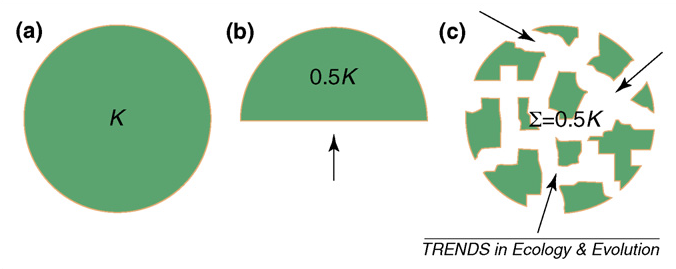
Figure 2 from Brook et al. (2008): Synergies among threatening processes relative to habitat loss and fragmentation. a) A large population within unmodified, contiguous habitat occupies all available niches so that long-term abundance fluctuates near full carrying capacity (K). b) When habitat is reduced (e.g. 50 % area loss), total abundance declines accordingly. c) However, this simple habitat-abundance relationship is complicated by the spatial configuration of habitat loss. In this example, all remaining fragmented subpopulations might fall below their minimum viable population (MVP) sizes even though total abundance is the same proportion of K as in panel B. As such, limited connectivity between subpopulations implies much greater extinction risk than that predicted for the same habitat loss in less fragmented landscapes. Further synergies (positive feedbacks among threatening processes; black arrows) might accompany high fragmentation, such as enhanced penetration of predators, invasive species or wildfire, micro-habitat edge effects, and reduced resistance to drought with climate change.

Figure 2 from Brook et al. (2008): Synergies among threatening processes relative to habitat loss and fragmentation. a) A large population within unmodified, contiguous habitat occupies all available niches so that long-term abundance fluctuates near full carrying capacity (K). b) When habitat is reduced (e.g., 50 % area loss), total abundance declines accordingly. c) However, this simple habitat-abundance relationship is complicated by the spatial configuration of habitat loss. In this example, all remaining fragmented subpopulations might fall below their minimum viable population (MVP) sizes even though total abundance is the same proportion of K as in panel B. As such, limited connectivity between subpopulations implies much greater extinction risk than that predicted for the same habitat loss in less fragmented landscapes. Further synergies (positive feedbacks among threatening processes; black arrows) might accompany high fragmentation, such as enhanced penetration of predators, invasive species or wildfire, micro-habitat edge effects, and reduced resistance to drought with climate change.

This is, perhaps, one of the most important concepts that the field of conservation biology has identified as a major driver of extinction. It may appear on the surface a rather simple notion that the more ‘habitat’ you remove, the fewer species (and individuals) there will be (see MacArthur & Wilson’s Classic contribution: The Theory of Island Biogeography), but it took us decades (yes, embarrassingly – decades) to work out that fragmentation is bad (very, very bad).

Habitat fragmentation occurs when a large expanse of a particular, broadly defined habitat ‘type’ is reduced to smaller patches that are isolated by surrounding, but different habitats. The surrounding habitat is typically defined a ‘matrix’, and in the case of forest fragmentation, generally means ‘degraded’ habitat (fewer native species, urban/rural/agricultural development, etc.).

Fragmentation is bad for many reasons: it (1) reduces patch area, (2) increases isolation among populations associated with fragments, and (3) creates ‘edges’ where unmodified habitat abuts matrix habitat. Each of these has dire implications for species, for we now know that (1) the smaller an area, the fewer individuals and species in can contain, (2) the more isolated a population, the less chance immigrants will ‘rescue’ it from catastrophes, and (3) edges allow the invasion of alien species, make the microclimate intolerable, increase access to bad humans and lead to cascading ecological events (e.g., fire penetration). Make no mistake, the more fragmented an environment, the worse will be the extinction rates of species therein.

What’s particularly sad about all this is that fragmentation was actually seen as a potentially GOOD thing by conservation biologists for many long years. The so-called SLOSS (Single Large or Several Small) debate pervaded the early days of conservation literature. The debate was basically the argument that several small reserves would provide more types of habitat juxtapositions and more different species complexes, making overall diversity (species richness) higher, than one large reserve. It was an interesting, if not deluded, intellectual debate because both sides presented some rather clever theoretical and empirical arguments. Part of the attraction of the ‘Several Small’ idea was that it was generally easier to find series of small habitat fragments to preserve than one giant no-go area.

However, we now know that the ‘Several Small’ idea is completely inferior because of the myriad synergistic effects of fragmentation. It actually took Bruce Wilcox and Dennis Murphy until 1985 to bring this to everyone’s attention in their classic paper The effects of fragmentation on extinction to show how silly the SLOSS debate really was. It wasn’t, however, until the mid- to late 1990s that people finally started to accept the idea that fragmentation really was one of the biggest conservation evils. Subsequent work (that I’ll showcase soon on ConservationBytes.com) finally put the nail in the SLOSS debate coffin, and indeed, we haven’t heard a whisper of it for over a decade.

For more general information, I invite you to read the third chapter in our book Tropical Conservation Biology entitled Broken homes: tropical biotas in fragmented landscapes, and our recent paper in Trends in Ecology and Evolution entitled Synergies among extinction drivers under global change.

CJA Bradshaw

Add to FacebookAdd to NewsvineAdd to DiggAdd to Del.icio.usAdd to StumbleuponAdd to RedditAdd to BlinklistAdd to Ma.gnoliaAdd to TechnoratiAdd to Furl


Potsdam Initiative: Economics of Ecosystems and Biodiversity

1 10 2008

moneygamiA recent report from the European Union with which I was marginally involved has been published online.

The meeting of the environment ministers of the G8 countries and upcoming industrialising countries took part in what has been dubbed the ‘Potsdam Initiative‘ have commissioned a series of reports on the ‘Economic significance of the global loss of biological diversity’.

I quote:

‘In a global study we will initiate the process of analysing the global economic benefit of biological diversity, the costs of the loss of biodiversity and the failure to take protective measures versus the costs of effective conservation.’

The first stage was the report was entitled ‘The Economics of Ecosystems & Biodiversity (TEEB)’. Mr Pavan Sukhdev, Managing Director and Head of Deutsche Bank’s Global Markets business in India, and a Founder-Director of the ‘Green Accounting for Indian States Project’, an initiative of the Green Indian States Trust (GIST) to set up an economic valuation and national accounting framework to measure sustainability for India, was recently appointed as the independent Study Leader.

The overall aims of the study are to evaluate the costs of the loss of biodiversity and the associated decline in ecosystem services, and to compare them with the costs of effective conservation and ‘sustainable’ use. The overall aim is to increase awareness of the value of biodiversity and ecosystem services to facilitate the development of cost-effective policy responses to the problem.

The interim report is available here, and the final report will be published shortly on the dedicated website here. The title of the final report of the first phase is THE ECONOMICS OF ECOSYSTEMS AND BIODIVERSITY: SCOPING THE SCIENCE.

I was involved specifically in Section 4.13 ‘Regulation of Natural Hazards’ which are defined ‘as infrequent natural phenomena that – during a relatively short period of time – pose a high level of threat to [human] life, health or property. These include seismic events (volcanic eruptions, earthquakes, tsunamis), extreme weather events (hurricanes, floods), avalanches and land slides. My contribution was mainly with respect to the role of deforestation on flood risk.

The report was jointly prepared by Ana Rodrigues and Andrew Balmford.

CJA Bradshaw

Add to FacebookAdd to NewsvineAdd to DiggAdd to Del.icio.usAdd to StumbleuponAdd to RedditAdd to BlinklistAdd to Ma.gnoliaAdd to TechnoratiAdd to Furl


Oil palm plantations destroying tropical biodiversity

18 09 2008

This one from MongaBay.com

Conversion of primary rainforest to an oil palm plantation results in a loss of more than 80 percent of species, reports a new comprehensive review of the impacts of growing palm oil production. The research is published in the journal Trends in Ecology and Evolution.

“By compiling scientific studies of birds, bats, ants and other species, we were able to show that on average, fewer than one-sixth of the species recorded in primary forest were found in oil palm,” said led author Emily Fitzherbert from the Zoological Society of London and University of East Anglia. “Degraded forest, and even alternative crops such as rubber and cocoa, supported higher numbers of species than oil palm plantations.”

The results confirm that oil palm plantations are a poor substitute for natural forests when it comes to conservation of biological diversity.

The study warns that burgeoning demand for palm oil for use in foods, household products, and biodiesel will continue to fuel expansion in the tropics. Because planters can subsidize operations by the initial logging for forest plots, it seems likely that forests will continue to fall for new plantations despite the availability of large tracts of degraded and abandoned land.

“There is enough non-forested land suitable for plantation development to allow large increases in production without large impacts on tropical forests, but as a result of political inertia, competing priorities and lack of capacity and understanding, not to mention high levels of demand for timber and palm oil from wealthy consumers, it is still often cheaper and easier to clear forests. Unless these conditions change quickly, the impacts of oil palm expansion on biodiversity will be substantial,” the authors conclude.

See also Koh & Wilcove. 2008. Is oil palm agriculture really destroying tropical biodiversity? Conservation Letters 1: 60-64

CJA Bradshaw


Primary forests as global carbon sinks

13 09 2008

Certainly one for the Potential list…

p00zbhgzA new paper by Sebastien Luyssaert  and colleagues in Nature entitled Old-growth forests as global carbon sinks deserves a mention here.

Many have argued under the climate change mitigation banner that so-called ‘old-growth’ (let’s call them primary forests henceforth to distinguish them from [usually] younger secondary forests) do not provide net carbon uptake because most of their growth has occurred in the past. In other words, they provide a carbon store, but do not take much more out of the atmosphere once they’ve attained a certain ecological equilibrium. This was a major impediment for the argument that protecting such forests could be achieved economically by valuing them in national or global carbon-trading schemes. It was a shame considering that it seems the economic incentives to protect such forests were falling on deaf ears because (a) governments and industry tend to regard the quick turn-around option of timber extraction as more economically sensible and (b) of the difficulty of valuing ecosystem services provided by primary forests.

But not so, say Luyssaert and colleagues! After scouring an array of studies and databases they conclude that forests between 15 and 800 years of age do in fact continue to uptake carbon and so are not carbon ‘neutral’. Brilliant! With this latest evidence in hand, I hope the economic incentives to preserve the little remaining primary forests around the world and the ecosystem services they provide will encourage governments and industry to invest more in their preservation than their destruction. It’s worth noting here too that once such forests are destroyed (e.g., timber extraction), the majority of their stored carbon (both actual and potential via future carbon uptake) are released back to the atmosphere, thus exacerbating climate change. As such, valuing the preservation of pristine forests on the carbon-trading market should receive a far higher weighting that secondary plantations or other sequestration schemes.

CJA Bradshaw

Add to FacebookAdd to NewsvineAdd to DiggAdd to Del.icio.usAdd to StumbleuponAdd to RedditAdd to BlinklistAdd to Ma.gnoliaAdd to TechnoratiAdd to Furl


Threatened species depend on protected areas

4 09 2008

One for the Potential list:

3932397_origA great new paper has just come out in Global Change Biology by Sarah Jackson and Kevin Gaston: Land use change and the dependence of national priority species on protected areas. In what is simultaneously frightening and ecouraging is the observation that of nearly 400 Biodiversity Action Plan (BAP) species considered either to be globally threatened or rapidly declining in the UK (i.e., > 50 % decline over 25 years), 55 % were largely restricted to statuatory protected areas in the UK. These areas cover about 11.5 % of Britain’s land surface.

What’s amazing about this is that without these reserves, these (hundreds) of species would already be extinct (or very close to it) – if this isn’t one of the strongest arguments for reserves, I don’t know what is. Not only are reserves essential for maintaining populations of threatened species, their spatial connectivity is also highly influential on persistence probability (future posts on fragmentation coming).

Much of the planet has now been modified to the point where any sort of species preservation will necessarily require large, expansive, contiguous networks of protected areas. Jackson & Gaston conclude:

Britain has undergone particularly extensive land transformation, reducing many originally much more widespread vegetation/habitat types to scattered fragments, few of which can be considered strictly natural (Rackham, 1986). A proportion of these fragments receive statutory protection and intensive management, increasing the likelihood that species of conservation concern are restricted to such areas. This circumstance is not unique to Britain, being found in many heavily developed regions including much of northwestern Europe, although it is not so extreme in many others. Britain may, thus, represent a possible future scenario for such regions. Under such circumstances, it is not unlikely that many species if they are not already restricted to protected areas will become so (e.g. species confined to tropical forest habitats following deforestation).

 Keeping things off limits from the burgeoning human population is therefore one of the major ways we can stem the tide of extinctions.

CJA Bradshaw

Add to FacebookAdd to NewsvineAdd to DiggAdd to Del.icio.usAdd to StumbleuponAdd to RedditAdd to BlinklistAdd to Ma.gnoliaAdd to TechnoratiAdd to Furl


Wordle of ConservationBytes

4 09 2008

The Wordle (word cloud) of ConservationBytes.com as of today. This is what we’ve been talking about since inception:

(seems I use a lot of exempli gratia)


Assessing Conservation Actions

3 09 2008

A good post from Tim Bean (Berkeley) over at ConsBlog.org – one for the Potential list:

12353889-stock-market-growth-and-success-with-a-growing-green-tree-in-the-shape-of-a-stock-investment-graph-s

This paper in press at Conservation Letters by Haines et al. presents a novel method for assessing conservation actions. There’s been quite a bit of work done in the past decade, particularly by NGOs, to develop methods to assess whether their actions have actually succeeded; this work was spear-headed in particular by Nick Salafsky and his Foundations of Success. This paper suggests that many of conservation biggest problems can be monitored with spatial datasets and proposes using the Human Footprint as a basis for such monitoring. The Human Footprint is, in essence, a collection of spatial datasets that holistically represent the collective anthropogenic impact on the land. In their paper, Haines et al. suggest that by tracking these spatial datasets through time in a paired way – conservation action site randomly paired with a control – we can get a better handle on whether the particular action was successful. The nice thing about the paper is how clear-eyed it is about what is and is not possible using this approach:

The human footprint is a spatially explicit approach to conservation planning that may serve as an effective visual medium to public audiences and stakeholders worldwide by simplifying the presentation of complex information.

(This is always the last, best resort for spatial analysts: even if the model isn’t perfect, it’s a great communication tool. ) But they also warn:

Spatial data rarely produce a complete picture of what negative impacts are occurring because human footprint data are not well-suited to track anthropogenic impacts that lack a spatial signature…[e.g.] the spread of some chemical pollutants, invasive species, diseases, and impacts of poaching…

Although I have to disagree partially with these particulars – presence of roads is often a very good correlative of poaching – their main point is an important one to consider. How well does a spatial model of human influence catch these hidden factors? A few years ago I did an informal (and sadly never completed) analysis of invasive plants and the Human Footprint and found that they were actually fairly well correlated. You could also argue that disease may be higher amongst individuals that are negatively impacted by the presence of humans. There’s plenty of opportunity here for further exploration.

Thanks, Tim.

Add to FacebookAdd to NewsvineAdd to DiggAdd to Del.icio.usAdd to StumbleuponAdd to RedditAdd to BlinklistAdd to Ma.gnoliaAdd to TechnoratiAdd to Furl


Classics: Ecosystem Services

2 09 2008

‘Classics’ is a category of posts highlighting research that has made a real difference to biodiversity conservation. All posts in this category will be permanently displayed on the Classics page of ConservationBytes.com

tobewell_homeEhrlich, P.R., H. A. Mooney. (1983). Extinction, substitution, and ecosystem services. BioScience 33, 248-254

I may be mistaken, but I think this is one of the earliest appearances of the term ‘ecosystem services‘, which is essentially the concept that intact biological communities and functioning species interactions provide humanity with a host of ‘services’ that support or improve our quality of life. The ongoing assault on species and habitats around the globe are, to use Ehrlich & Mooney’s words “accompanied by severe degradation of the public service functions of the systems”.

What are ecosystem services? The list is long and varied, and much of them remain largely unquantified, but I’ll attempt to list the more important ones here:

Add your favourite to the list – there are plenty of sources that expand on these. For starters try the Millennium Ecosystem Assessment, the Wikipedia entry, the Ecological Society of America and Gretchen Daily’s lab at Standford University.

What is the value of ecosystem services to humanity?

This is a fairly controversial area because of the difficulty of measuring the link between ecosystem function and the services they provide, but also by the decision to include direct and direct costs of providing the services artificially. However, many people have attempted to put them into financial terms – Robert Costanza and colleagues put together some figures (see here, here, and here for examples) that attracted some criticism. Nonetheless, ecosystems are estimated to provide us with trillions of dollars worth of goods and services. Some examples from the Ecological Society of America:

  • Much of the Mississippi River Valley’s natural flood protection services were destroyed when adjacent wetlands were drained and channels altered. As a result, the 1993 floods resulted in property damages estimated at twelve billion dollars partially from the inability of the Valley to lesson the impacts of the high volumes of water.
  • Over 100,000 different animal species – including bats, bees, flies, moths, beetles, birds, and butterflies – provide free pollination services. One third of human food comes from plants pollinated by wild pollinators. The value of pollination services from wild pollinators in the U.S. alone is estimated at four to six billion dollars per year.
  • Eighty percent of the world’s population relies upon natural medicinal products. Of the top 150 prescription drugs used in the U.S., 118 originate from natural sources: 74 percent from plants, 18 percent from fungi, 5 percent from bacteria, and 3 percent from one vertebrate (snake species). Nine of the top 10 drugs originate from natural plant products.

What does this mean for conservation of biodiversity? Well, since scientists and policy makers alike have embraced the concept, we now have a much more convincing argument for maintaining the intactness of natural ecosystems. In the past we found it hard to convince those struggling to make ends meet (or even to obtain their next meal) about the importance of preventing species extinctions. Why should someone worried about whether or not his or her family will survive another day give a rat’s arse about species conservation? Well, the degradation of ecosystem services ensuing from species extinctions means that everyone’s – including the poorest – lives are reduced in quality and duration as we destroy these systems. See a previous post on Conservation for the People for more information.

CJA Bradshaw

Add to FacebookAdd to NewsvineAdd to DiggAdd to Del.icio.usAdd to StumbleuponAdd to RedditAdd to BlinklistAdd to Ma.gnoliaAdd to TechnoratiAdd to Furl


Show me the (conservation) evidence

29 08 2008

Guest post from Professor William J. Sutherland, Miriam Rothschild Chair in Conservation Biology, Department of Zoology, University of Cambridge, Cambridge CB2 3EJ, United Kingdom:

We carry out research in conservation largely under the belief that this is making a difference to the planet. However, research (e.g., Sutherland et al. 2004) shows that little of this research is used in practice. There are many good reasons why practitioners only use a small fraction of the available science: most do not have access to the scientific search engines, they usually have very limited access to scientific journals and most importantly, they usually do not have the time or training to search the literature. Another important problem is that the most important source of information is the experience of practitioners, but this is rarely quantified or documented.

To help overcome these problems the website ConservationEvidence.com has been established. It has two main objectives: (1) providing a means for practitioners to document their experience through the online journal Conservation Evidence and (2) summarising the global literature including unpublished report and papers in languages other than English. Currently (August 2008), this has details of over 1200 interventions but the aim is to increase this to 10,000 interventions. The next stage, which is currently being worked on, is then to provide summaries of the consequences of different interventions.

The ambitious objective is to change the way in which global conservation practice is carried out so that practitioners have ready access to information on the effectiveness of interventions including the experience of other practitioners.

Add to FacebookAdd to NewsvineAdd to DiggAdd to Del.icio.usAdd to StumbleuponAdd to RedditAdd to BlinklistAdd to Ma.gnoliaAdd to TechnoratiAdd to Furl


Australian Wet Tropics Biosequestration Project

28 08 2008

Guest post from Penny van Oosterzee, Degree Celsius:

© P. van Oosterzee
© P. van Oosterzee

The Wet Tropics Regional Biosequestration Project Development Document was launched last week on the global stage, for public scrutiny, via the Climate Community and Biodiversity (CCB) website. There are only a dozen other cases in the world that have managed to reach this level of scrutiny.

The CCB standards are used in both the voluntary global markets and also for CDM (clean development mechanism) projects (only afforestation and reforestation) that have significant biodiversity outcomes. It is well known that land use, land use change, and forestry provides the most cost-effective means of reducing greenhouse gas emissions globally, and we believe the Wet Tropics project is at the leading edge of showing how.

The Wet Tropics Project is the world’s first regional biocarbon verification case based on community NRM (Natural Resource Management) activities, aggregating different bio-sequestration activities (reforestation, assisted natural regeneration, avoided deforestation, grazing land management, reduced use of fertiliser in agriculture) of myriad landholders in one verification case.

The initiative of using NRM Regional Plan’s as a basis for biosequestration project design is an innovation that can be rolled out across the state and nationally. Using Regional Plans ensures scientifically robust monitoring outcomes because of the adoption of systems already in place for monitoring. Economically the approach allows trading to occur at the regional and landholder level, and sets the stage for new livelihoods in regional Australia in a climate constrained world.

The Wet Tropics Project is itself a pilot for the NRM regions comprising the catchments of the Great Barrier Reef which are pivotal for its the survival. The Wet Tropics Project also helps to inform national policy debates since both Garnaut and the Federal Government’s Green Paper point out the importance of forestry and agriculture but fail to provide any way forward, and are on a watching brief for solutions.

The Wet Tropics initiative with its link to regional plans immediately enables entry into other global developments such as water quality credits and biodiversity credits.

See also the Degree Celsius website for more information.

Add to FacebookAdd to NewsvineAdd to DiggAdd to Del.icio.usAdd to StumbleuponAdd to RedditAdd to BlinklistAdd to Ma.gnoliaAdd to TechnoratiAdd to Furl


Classics: Biodiversity Hotspots

25 08 2008

‘Classics’ is a category of posts highlighting research that has made a real difference to biodiversity conservation. All posts in this category will be permanently displayed on the Classics page of ConservationBytes.com

info-chap7-slide-pic03Myers, N., Mittermeier, R.A., Mittermeier, C.G., da Fonseca, G.A.B. & Kent, J. (2000). Biodiversity hotspots for conservation priorities. Nature, 403, 853-858

According to Google Scholar, this paper has over 2500 citations. Even though it was published less than a decade ago, already Myers and colleagues’ ‘hotspots’ concept has become the classic lexicon for, as they defined it, areas with high species endemism and degradation by humans. In other words, these are places on the planet (originally only terrestrial, but the concept has been extended to the marine realm) where at the current rates of habitat loss, exploitation, etc., we stand to lose far more irreplaceable species. The concept has been criticised for various incapacities to account for all types of threats – indeed, many other prioritisation criteria have been proposed (assessed nicely by Brooks et al. 2006 and Orme et al. 2005), but it’s the general idea proposed by Myers and colleagues that has set the conservation policy stage for most countries. One little gripe here – although the concept ostensibly means areas of high endemic species richness AND associated threat, people often take the term ‘hotspot’ to mean just a place with lots of species. Not so. Ah, the intangible concept of biodiversity!

CJA Bradshaw

Add to FacebookAdd to NewsvineAdd to DiggAdd to Del.icio.usAdd to StumbleuponAdd to RedditAdd to BlinklistAdd to Ma.gnoliaAdd to TechnoratiAdd to Furl


Investor creates first tropical biodiversity credits

23 08 2008

Post reproduced from TakeCover08:

An Australian investment company has launched what it describes as the first tropical biodiversity credit scheme, Mongabay.com reports (more detail here).

New Forests, a Sydney-based firm, has established the Malua Wildlife Habitat Conservation Bank in Malaysia as an attempt to raise funds for rainforest conservation.

The “Malua BioBank” will use an investment from a private equity fund to restore and protect 34,000 hectares of formerly logged forest.

The area will serve as a buffer between biological-rich forest reserve and oil palm plantations.

The credit scheme will generate “Biodiversity Conservation Certificates”, which will be sold to bankroll a perpetual conservation trust and produce a return on investment for the Sabah Government and the private equity fund.

Add to FacebookAdd to NewsvineAdd to DiggAdd to Del.icio.usAdd to StumbleuponAdd to RedditAdd to BlinklistAdd to Ma.gnoliaAdd to TechnoratiAdd to Furl