Deforestation and disease

10 09 2008

Humans have such a short memory…

A recent theme in many of my posts is the concept of ecosystem services provided to us essentially free of charge, and their continued degradation due to the burgeoning human population, bad land management and excessive resource consumption. We are indeed degrading the very life-support system species assemblages provide us. I’ve previously posted a long list of ecosystem services that you can consult here, but this recent paper in BioScience highlights one that is probably largely overlooked – the role of forests in reducing the incidence of human disease.

In their article entitled Deforestation, mosquitoes, and Ancient Rome: lessons for today, Lara O’Sullivan and colleagues discuss the evidence from Ancient Rome that deforestation rapidly increased the prevalence of malarial diseases. They also go on to cite several examples from the modern world where deforestation appears to be linked to greater manifestation of diseases like malaria.

The evidence isn’t just linked to Africa and the Amazon, but the authors suggest that the incidence of mosquito-borne diseases in Australia such as Ross River fever may also be on the rise as forests are quickly degraded and destroyed.

In two previous posts (see here and here), I commented on the escalating biodiversity crisis in the tropics driven largely by habitat loss (i.e., deforestation) – add increasing human disease to the long list of negatives associated with degrading or disappearing ecosystem services such as increased frequency and severity of floods, reduced food provision, reduced availability of clean water, reduced pollination, etc. We MUST educate the masses with the increasing body of scientific evidence that our behaviour is self-defeating (see previous post on this issue).

Indeed, it’s no longer the days of the capitalists versus the ‘greenies’ – the rapid decline in the quality of human life and and our own survival is affecting all of us, including the wealthy. In fact, I would argue that environmentalism has fully developed as the principal rationale in conservation ecology, such that it has become much less of an esoteric struggle for maintaining all things beautiful (the capitalist viewpoint of the traditional ‘greeny’), to a science-driven means to maintain human life and prosperity. Can we afford to continue along this path? Definitely not. Only an idiot with the foresight of a slug could ignore our current trajectory – and that includes the millionaire sport heroes, actors, and entrepreneurs who have benefited directly from our collective resource exploits. If you give a shit about the quality of life you and your descendants will have in the very near future, do not ignore habitat loss any longer.

CJA Bradshaw

Add to FacebookAdd to NewsvineAdd to DiggAdd to Del.icio.usAdd to StumbleuponAdd to RedditAdd to BlinklistAdd to Ma.gnoliaAdd to TechnoratiAdd to Furl


Tropical Conservation Biology

8 09 2008

An obvious personal plug – but I’m allowed to do that on my own blog ;-)

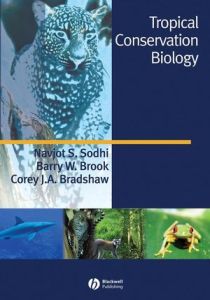
1405150734I’d like to introduce a (relatively) new textbook that my colleagues, Navjot Sodhi and Barry Brook, and I wrote and published last year with Blackwell (now Wiley-Blackwell) Scientific Publishing – Tropical Conservation Biology.

We’re rather proud of this book because it was a timely summary and assessment of the scientific evidence for the degree of devastation facing tropical biodiversity today and in the future. I’ve summarised some of the main issues in a previous post covering a paper we have ‘in press’ that was born of the text book, but obviously the book is a far more detailed account of the problems facing the tropics.

This introductory textbook examines diminishing terrestrial and aquatic habitats in the tropics, covering a broad range of topics including the fate of the coral reefs; the impact of agriculture, urbanisation, and logging on habitat depletion; and the effects of fire on plants and animal survival.

One of the highlights of the book is that each chapter (see below) Includes case studies and interviews with prominent conservation scientists to help situate key concepts in a real world context: Norman Myers (Chapter 1), Gretchen Daily (Chapter 2), William Laurance (Chapter 3), Mark Cochrane (Chapter 4), Daniel Simberloff (Chapter 5), Bruce Campbell (Chapter 6), Daniel Pauly (Chapter 7), Stephen Schneider (Chapter 8), Stuart Pimm (Chapter 9) and Peter Raven (Chapter 10). These biographies are followed by a brief set of questions and answers that focus on some of the most pertinent and pressing issues in tropical conservation biology today. It is our intention that readers of Tropical Conservation Biology will benefit from the knowledge and be inspired by the passion of these renowned conservation experts.

TABLE OF CONTENTS

  1. Chapter 1: Diminishing habitats in regions of high biodiversity. We report on the loss of tropical habitats across the tropics (e.g., deforestation rates). We also highlight the drivers of habitat loss such as human population expansion. Finally, we identify the areas in immediate need of conservation action by elucidating the concept of biodiversity hotspots. Read the rest of this entry »


Threatened species depend on protected areas

4 09 2008

One for the Potential list:

3932397_origA great new paper has just come out in Global Change Biology by Sarah Jackson and Kevin Gaston: Land use change and the dependence of national priority species on protected areas. In what is simultaneously frightening and ecouraging is the observation that of nearly 400 Biodiversity Action Plan (BAP) species considered either to be globally threatened or rapidly declining in the UK (i.e., > 50 % decline over 25 years), 55 % were largely restricted to statuatory protected areas in the UK. These areas cover about 11.5 % of Britain’s land surface.

What’s amazing about this is that without these reserves, these (hundreds) of species would already be extinct (or very close to it) – if this isn’t one of the strongest arguments for reserves, I don’t know what is. Not only are reserves essential for maintaining populations of threatened species, their spatial connectivity is also highly influential on persistence probability (future posts on fragmentation coming).

Much of the planet has now been modified to the point where any sort of species preservation will necessarily require large, expansive, contiguous networks of protected areas. Jackson & Gaston conclude:

Britain has undergone particularly extensive land transformation, reducing many originally much more widespread vegetation/habitat types to scattered fragments, few of which can be considered strictly natural (Rackham, 1986). A proportion of these fragments receive statutory protection and intensive management, increasing the likelihood that species of conservation concern are restricted to such areas. This circumstance is not unique to Britain, being found in many heavily developed regions including much of northwestern Europe, although it is not so extreme in many others. Britain may, thus, represent a possible future scenario for such regions. Under such circumstances, it is not unlikely that many species if they are not already restricted to protected areas will become so (e.g. species confined to tropical forest habitats following deforestation).

 Keeping things off limits from the burgeoning human population is therefore one of the major ways we can stem the tide of extinctions.

CJA Bradshaw

Add to FacebookAdd to NewsvineAdd to DiggAdd to Del.icio.usAdd to StumbleuponAdd to RedditAdd to BlinklistAdd to Ma.gnoliaAdd to TechnoratiAdd to Furl


Classics: The Living Dead

30 08 2008

‘Classics’ is a category of posts highlighting research that has made a real difference to biodiversity conservation. All posts in this category will be permanently displayed on the Classics page of ConservationBytes.com

Zombie_ElephantTilman, D., May, R.M., Lehman, C.L., Nowak, M.A. (1994) Habitat destruction and the extinction debt. Nature 371, 65-66

In my opinion, this is truly a conservation classic because it shatters optimistic notions that extinction is something only rarely the consequence of human activities (see relevant post here). The concept of ‘extinction debt‘ is pretty simple – as habitats become increasingly fragmented, long-lived species that are reproductively isolated from conspecifics may take generations to die off (e.g., large trees in forest fragments). This gives rise to a higher number of species than would be otherwise expected for the size of the fragment, and the false impression that many species can persist in habitat patches that are too small to sustain minimum viable populations.

These ‘living dead‘ or ‘zombie‘ species are therefore committed to extinction regardless of whether habitat loss is arrested or reversed. Only by assisted dispersal and/or reproduction can such species survive (an extremely rare event).

Why has this been important? Well, neglecting the extinction debt is one reason why some people have over-estimated the value of fragmented and secondary forests in guarding species against extinction (see relevant example here for the tropics and Brook et al. 2006). It basically means that biological communities are much less resilient to fragmentation than would otherwise be expected given data on species presence collected shortly after the main habitat degradation or destruction event. To appreciate fully the extent of expected extinctions may take generations (e.g., hundreds of years) to come to light, giving us yet another tool in the quest to minimise habitat loss and fragmentation.

CJA Bradshaw

Add to FacebookAdd to NewsvineAdd to DiggAdd to Del.icio.usAdd to StumbleuponAdd to RedditAdd to BlinklistAdd to Ma.gnoliaAdd to TechnoratiAdd to Furl


Investor creates first tropical biodiversity credits

23 08 2008

Post reproduced from TakeCover08:

An Australian investment company has launched what it describes as the first tropical biodiversity credit scheme, Mongabay.com reports (more detail here).

New Forests, a Sydney-based firm, has established the Malua Wildlife Habitat Conservation Bank in Malaysia as an attempt to raise funds for rainforest conservation.

The “Malua BioBank” will use an investment from a private equity fund to restore and protect 34,000 hectares of formerly logged forest.

The area will serve as a buffer between biological-rich forest reserve and oil palm plantations.

The credit scheme will generate “Biodiversity Conservation Certificates”, which will be sold to bankroll a perpetual conservation trust and produce a return on investment for the Sabah Government and the private equity fund.

Add to FacebookAdd to NewsvineAdd to DiggAdd to Del.icio.usAdd to StumbleuponAdd to RedditAdd to BlinklistAdd to Ma.gnoliaAdd to TechnoratiAdd to Furl


Native forests reduce the risk of catastrophic floods

20 08 2008

A-Pakistan-Army-helicopte-004Each year extreme floods kill or displace hundreds of thousands of people and cause billions of dollars in damage to property. The consequences of floods are particularly catastrophic in developing countries generally lacking the infrastructure to deal adequately with above-average water levels.

For centuries it has been believed that native forest cover reduced the risk and severity of catastrophic flooding, but there has been strong scientific debate over the role of forests in flood mitigation.

Forest loss is currently estimated at 13 million hectares each year, with 6 million hectares of that being primary forest previously untouched by human activities. These primary forests are considered the most biologically diverse ecosystems on the planet, but this realisation has not halted their immense rate of loss.

Last year my colleagues and I published a paper entitled Global evidence that deforestation amplifies flood risk and severity in the developing world in Global Change Biology (highlighted in Nature and Faculty of 1000) that has finally provided tangible evidence that there is a strong link between deforestation and flood risk. Read the rest of this entry »


Tropical turmoil – a biodiversity tragedy in progress

18 08 2008

fragmentationWe recently published (online) a major review showing that the world is losing the battle over tropical habitat loss with potentially disastrous implications for biodiversity and human well-being.

Published online in the Ecological Society of America’s journal Frontiers in Ecology and the Environment, our review Tropical turmoil – a biodiversity crisis in progress concludes that we are “on a trajectory towards disaster” and calls for an immediate global, multi-pronged conservation approach to avert the worst outcomes.

Tropical forests support more than 60 % of all known species, but represent only about 7 % of the Earth’s land surface. But up to 15 million hectares of tropical rainforest are being lost every year and species are being lost at a rate of up to 10000 times higher than would happen randomly without humans present.

This is not just a tragedy for tropical biodiversity, this is a crisis that will directly affect human livelihoods. This is not just about losing tiny species found in the canopies of big rain forest trees few people will ever see, this is about a complete change in ecosystem services that directly benefit human life. Read the rest of this entry »


IUCN Chief Scientist & Asia

15 07 2008

I’m currently attending the Society for Conservation Biology‘s Annual Meeting in Chattanooga, Tennessee, USA and blogging on presentations I think are worth mentioning.

The first plenary talk was given by the IUCN’s Chief Scientist, Jeffrey McNeely, about the issues surrounding biodiversity conservation in Asia. Dr. McNeely gave an interesting background to the human cultural history and diversity of the region, followed by a brief exposé of the conservation issues there (habitat loss, over-exploitation, invasive species, etc). Overall, however, I was disappointed by his lack of emphasis on the magnitude of the conservation crisis Asia is undergoing. There was no mention of the perverse subsidies buffering unsustainable forestry and fishing, the corruption driving habitat loss and habitat degradation, or the massive problems driven by human over-population.

We recently published (currently online) a paper regarding the conservation crisis facing this (and similar regions) in the tropics Tropical turmoil – a biodiversity crisis in progress (see related post), and several of my colleagues have recently outlined just how badly biodiversity is faring in Asia (e.g., see Brook et al. 2003; Sodhi et al. 2004). While I was happy to see Dr. McNeely mention the need for more research on these issues, his statement that he had “depressed [us] with the problems” was a major understatement. He did not nearly go far enough to ‘depress’ his audience of conservation scientists. We are squarely within a crisis in the region, and if the Chief Scientist of the IUCN who has intimate knowledge of Asia is not singing that song loudly and clearly, I fear it will get far worse before we see any real positive change.

CJA Bradshaw


Conservation Letters – a scientific journal with a difference?

5 07 2008

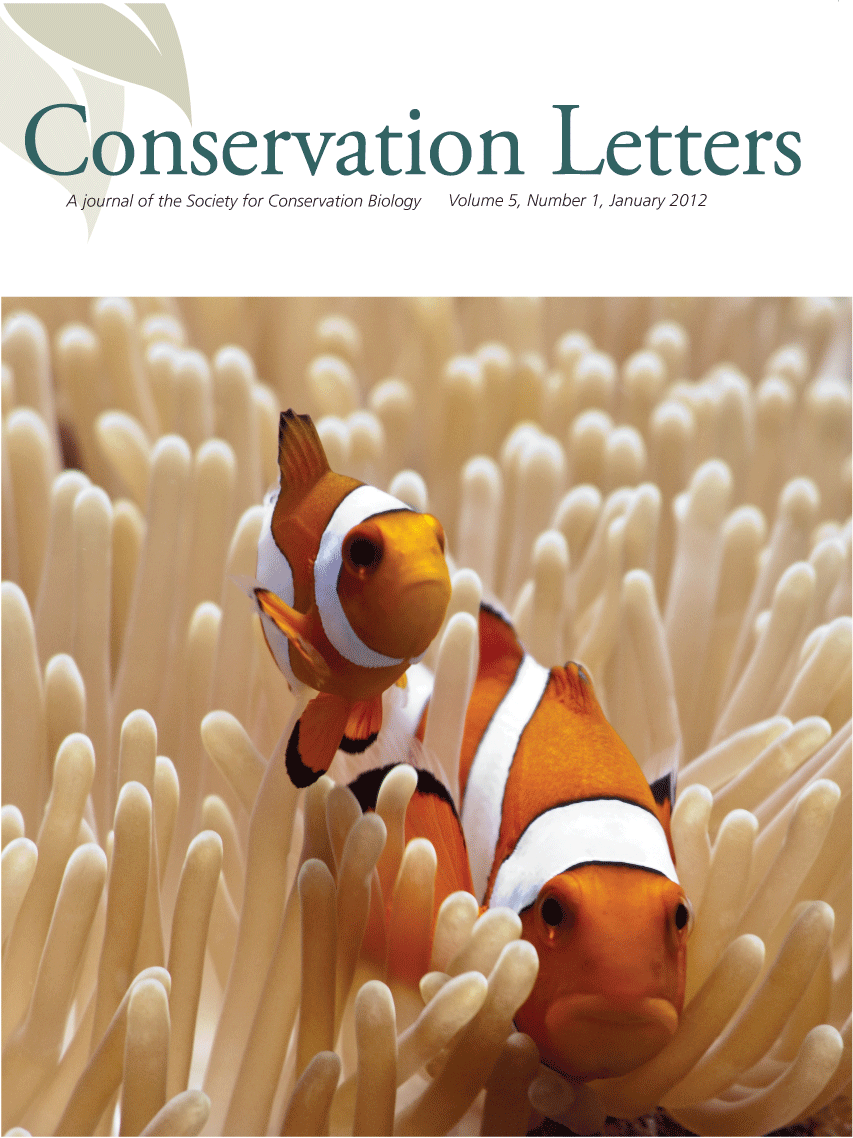
ConLetters-Jan12I’d like to introduce the latest scientific conservation journal – Conservation Letters (Wiley-Blackwell). If you are a publishing conservation scientist then you will have undoubtedly heard about this already. I must admit my biased opinion up front – I have the role of Senior Editor for the journal under the auspices of the venerable Editors-in-Chief, Professor Richard Cowling, Professor Hugh Possingham, Professor Bill Sutherland and Dr. Michael Mascia.

We’ve been doing conservation science now for well over 50 years, and there has been some fantastic, hard-hitting, brilliant research done. However, extinction rates continue to soar, habitat loss and fragmentation abound, bushmeat hunting and other forms of direct over-exploitation show no signs of slowing and invasive species are penetrating into the most ‘pristine’ habitats. To top it all off, climate change is exacerbating each and every one of these extinction drivers.

So what have we been doing wrong?

Clearly the best research is going unheeded – this is not to say that some progress has not been made, and I hope to highlight the best examples of the hardest-hitting research on this site – it simply means that we are losing the battle. Enter Conservation Letters – a journal designed to make conservation research more available to policy makers and managers to make true strides forward in biodiversity conservation. I’m not suggesting for a moment that other well-known, respected and established conservation journals have not done their job; without the research those journals publish we’d certainly be much worse off. However, we have recognised that our research isn’t affecting as many people as it should.

With Conservation Letters now well into its first year, I hope that we start to see some changes here, and I hope that the discipline will have a much greater net effect on slowing (and perhaps) reversing the extinction trends we observe today. Climate change is making this much more challenging, as well as the ever-increasing human population. Can we make better progress? – I certainly hope so.

CJA Bradshaw

Add to FacebookAdd to NewsvineAdd to DiggAdd to Del.icio.usAdd to StumbleuponAdd to RedditAdd to BlinklistAdd to Ma.gnoliaAdd to TechnoratiAdd to Furl


Conservation that bites

2 07 2008

This new website will post examples of conservation science with real-world impacts to policy that improves biodiversity outcomes. Stay tuned.

CJA Bradshaw