Global biodiversity loss estimated at 14 trillion Euros

15 09 2008

A recent post from Ecology & Policy

Yet more evidence that we have to stop the extinction crisis.

A new report commissioned by the European Commission – ‘The Cost of Policy Inaction (COPI): The case of not meeting the 2010 biodiversity target’ – indicates that biodiversity is set to continue declining. Key drivers of biodiversity loss include overexploitation, invasion of non-native species and conversion of natural habitat to agricultural landscapes.

It has long been known that ecosystems provide a wide range of goods and services to humankind, such as the provision of clean water, climate regulation, food and clothing, flood protection to mention but a few. Although these goods and services (Ecosystem Services (ES)) provided by biodiversity have been widely recognised, so far efforts to put a monetary value on these services has proved difficult at best.

The new report attempts to value ecosystem services in terms of the cost to the global economy of future biodiversity loss as a result of policy inaction. The study used a baseline valuation from 2000 to extrapolate ES loss to 2050, assuming predicted population growth takes place with the associated demand for energy and resources and that average global GDP increases 2.8% per annum with the highest growth in China and India.

The key findings of the study include:

  • 50 billion € worth of biodiversity providing ecosystem services is being lost each year
  • Land-based ecosystem loss is estimated at 545 billion € by 2010
  • Annual loss in ecosystem services from biodiversity loss could exceed 14 trillion € by 2050

This study is part of a much larger research effort on a global scale: The Economics of Ecosystems & Biodiversity. It is hoped this study will result in a much wider global awareness of the cost of losing biodiversity and associated ES to mankind in an economic context, and ultimately result in a ‘valuation toolkit’ that will provide environmental economists and policy-makers a standardised approach to ES valuation.

Download the report here.
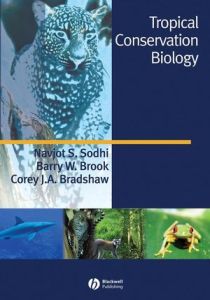


Tropical Conservation Biology

8 09 2008

An obvious personal plug – but I’m allowed to do that on my own blog ;-)

1405150734I’d like to introduce a (relatively) new textbook that my colleagues, Navjot Sodhi and Barry Brook, and I wrote and published last year with Blackwell (now Wiley-Blackwell) Scientific Publishing – Tropical Conservation Biology.

We’re rather proud of this book because it was a timely summary and assessment of the scientific evidence for the degree of devastation facing tropical biodiversity today and in the future. I’ve summarised some of the main issues in a previous post covering a paper we have ‘in press’ that was born of the text book, but obviously the book is a far more detailed account of the problems facing the tropics.

This introductory textbook examines diminishing terrestrial and aquatic habitats in the tropics, covering a broad range of topics including the fate of the coral reefs; the impact of agriculture, urbanisation, and logging on habitat depletion; and the effects of fire on plants and animal survival.

One of the highlights of the book is that each chapter (see below) Includes case studies and interviews with prominent conservation scientists to help situate key concepts in a real world context: Norman Myers (Chapter 1), Gretchen Daily (Chapter 2), William Laurance (Chapter 3), Mark Cochrane (Chapter 4), Daniel Simberloff (Chapter 5), Bruce Campbell (Chapter 6), Daniel Pauly (Chapter 7), Stephen Schneider (Chapter 8), Stuart Pimm (Chapter 9) and Peter Raven (Chapter 10). These biographies are followed by a brief set of questions and answers that focus on some of the most pertinent and pressing issues in tropical conservation biology today. It is our intention that readers of Tropical Conservation Biology will benefit from the knowledge and be inspired by the passion of these renowned conservation experts.

TABLE OF CONTENTS

  1. Chapter 1: Diminishing habitats in regions of high biodiversity. We report on the loss of tropical habitats across the tropics (e.g., deforestation rates). We also highlight the drivers of habitat loss such as human population expansion. Finally, we identify the areas in immediate need of conservation action by elucidating the concept of biodiversity hotspots. Read the rest of this entry »


Classics: The Living Dead

30 08 2008

‘Classics’ is a category of posts highlighting research that has made a real difference to biodiversity conservation. All posts in this category will be permanently displayed on the Classics page of ConservationBytes.com

Zombie_ElephantTilman, D., May, R.M., Lehman, C.L., Nowak, M.A. (1994) Habitat destruction and the extinction debt. Nature 371, 65-66

In my opinion, this is truly a conservation classic because it shatters optimistic notions that extinction is something only rarely the consequence of human activities (see relevant post here). The concept of ‘extinction debt‘ is pretty simple – as habitats become increasingly fragmented, long-lived species that are reproductively isolated from conspecifics may take generations to die off (e.g., large trees in forest fragments). This gives rise to a higher number of species than would be otherwise expected for the size of the fragment, and the false impression that many species can persist in habitat patches that are too small to sustain minimum viable populations.

These ‘living dead‘ or ‘zombie‘ species are therefore committed to extinction regardless of whether habitat loss is arrested or reversed. Only by assisted dispersal and/or reproduction can such species survive (an extremely rare event).

Why has this been important? Well, neglecting the extinction debt is one reason why some people have over-estimated the value of fragmented and secondary forests in guarding species against extinction (see relevant example here for the tropics and Brook et al. 2006). It basically means that biological communities are much less resilient to fragmentation than would otherwise be expected given data on species presence collected shortly after the main habitat degradation or destruction event. To appreciate fully the extent of expected extinctions may take generations (e.g., hundreds of years) to come to light, giving us yet another tool in the quest to minimise habitat loss and fragmentation.

CJA Bradshaw

Add to FacebookAdd to NewsvineAdd to DiggAdd to Del.icio.usAdd to StumbleuponAdd to RedditAdd to BlinklistAdd to Ma.gnoliaAdd to TechnoratiAdd to Furl


Cost, not biodiversity, dictates decision to conserve

26 08 2008

One for the Potential list:

originalEuroGreen_LogoI’ve just read a great new paper by Bode et al. (2008) entitled Cost-effective global conservation spending is robust to taxonomic group.

After the hugely influential biodiversity ‘hotspot concept hit the global stage, there was a series of subsequent research papers examining just how we should measure the ‘biodiversity’ component of areas needing to be conserved (and invested in). The problem was that depending on which taxa you looked at, and what measure of ‘biodiversity’ you used (e.g., species richness, endemism, latent threat, evolutionary potential, functional redundancy), the priority list of where, how much and when to invest in conservation differed quite a lot. In other words, the congruency among listed areas was rather low (summarised nicely in Thomas Brooks‘ paper in Science Global biodiversity conservation priorities and examined also by Orme et al. 2005). This causes all sorts of problems for conservation investment planners – what to invest in and where?

Bode and colleagues’ newest paper demonstrates at least for endemism, the taxon on which you base your assessment is much less important for maximising species conservation than factors such as land cost and the degree of threat (e.g., as measured by the IUCN Red List).

Of course, their findings could be considered too simplistic because they don’t (couldn’t) evaluate other potentially more important components of ‘biodiversity’ such as genetic history (evolutionary potential) or ecological functional redundancy (the idea that a species becomes more important to conserve if no other species provide the same ecosystem functions); however, I think this paper is something of a landmark in that it shows that ‘socio-economic’ uncertainty generally outweighs uncertainty due to biodiversity measures. The long and short of this is that planners should start investing if there is evidence of heightened threat and land is cheap.

A few other missing bits means that the paper is more heuristic than prescriptive (something the authors state right up front). There is no attempt to take biodiversity, threat or land cost changes arising from climate change into account (see relevant post here), so some of the priorities are questionable. Related to this is the idea of latent risk (see relevant paper by Cardillo et al. 2006) – what’s not necessarily threatened now but likely will be in the very near future. Also, only a small percentage of species are listed in the IUCN Red List (see relevant post here), so perhaps we’re missing some important trends. Finally, I had to note that almost all the priority areas outlined in the paper happened to be in the tropics, which stands to reason given the current and ongoing extinction crisis occurring in this realm. See a more detailed post on ‘tropical turmoil‘.

Despite the caveats, I think this could provide a way forward to the conservation planning stalemate.

CJA Bradshaw

Add to FacebookAdd to NewsvineAdd to DiggAdd to Del.icio.usAdd to StumbleuponAdd to RedditAdd to BlinklistAdd to Ma.gnoliaAdd to TechnoratiAdd to Furl


Classics: Biodiversity Hotspots

25 08 2008

‘Classics’ is a category of posts highlighting research that has made a real difference to biodiversity conservation. All posts in this category will be permanently displayed on the Classics page of ConservationBytes.com

info-chap7-slide-pic03Myers, N., Mittermeier, R.A., Mittermeier, C.G., da Fonseca, G.A.B. & Kent, J. (2000). Biodiversity hotspots for conservation priorities. Nature, 403, 853-858

According to Google Scholar, this paper has over 2500 citations. Even though it was published less than a decade ago, already Myers and colleagues’ ‘hotspots’ concept has become the classic lexicon for, as they defined it, areas with high species endemism and degradation by humans. In other words, these are places on the planet (originally only terrestrial, but the concept has been extended to the marine realm) where at the current rates of habitat loss, exploitation, etc., we stand to lose far more irreplaceable species. The concept has been criticised for various incapacities to account for all types of threats – indeed, many other prioritisation criteria have been proposed (assessed nicely by Brooks et al. 2006 and Orme et al. 2005), but it’s the general idea proposed by Myers and colleagues that has set the conservation policy stage for most countries. One little gripe here – although the concept ostensibly means areas of high endemic species richness AND associated threat, people often take the term ‘hotspot’ to mean just a place with lots of species. Not so. Ah, the intangible concept of biodiversity!

CJA Bradshaw

Add to FacebookAdd to NewsvineAdd to DiggAdd to Del.icio.usAdd to StumbleuponAdd to RedditAdd to BlinklistAdd to Ma.gnoliaAdd to TechnoratiAdd to Furl


The extinction vortex

25 08 2008

One for the Potential list:

vortexFirst coined by Gilpin & Soulé in 1986, the extinction vortex is the term used to describe the process that declining populations undergo when”a mutual reinforcement occurs among biotic and abiotic processes that drives population size downward to extinction” (Brook, Sodhi & Bradshaw 2008).

Although several types of ‘vortices’ were labelled by Gilpin & Soulé, the concept was subsequently simplified by Caughley (1994) in his famous paper on the declining and small population paradigms, but only truly quantified for the first time by Fagan & Holmes (2006) in their Ecology Letters paper entitled Quantifying the extinction vortex.

Fagan and Holmes compiled a small time-series database of ten vertebrate species (two mammals, five birds, two reptiles and a fish) whose final extinction was witnessed via monitoring. They confirmed that the time to extinction scales to the logarithm of population size. In other words, as populations decline, the time elapsing before extinction occurs becomes rapidly (exponentially) smaller and smaller. They also found greater rates of population decline nearer to the time of extinction than earlier in the population’s history, confirming the expectation that genetic deterioration contributes to a general corrosion of individual performance (fitness). Finally, they found that the variability in abundance was also highest as populations approached extinction, irrespective of population size, thus demonstrating indirectly that random environmental fluctuations take over to cause the final extinction regardless of what caused the population to decline in the first place.

What does this mean for conservation efforts? It was fundamentally the first empirical demonstration that the theory of accelerating extinction proneness occurs as populations decline, meaning that all attempts must be made to ensure large population sizes if there is any chance of maintaining long-term persistence. This relates to the minimum viable population size concept that should underscore each and every recovery and target set or desired for any population in trouble or under conservation scrutiny.

CJA Bradshaw

Add to FacebookAdd to NewsvineAdd to DiggAdd to Del.icio.usAdd to StumbleuponAdd to RedditAdd to BlinklistAdd to Ma.gnoliaAdd to TechnoratiAdd to Furl


Classics: Declining and small population paradigms

23 08 2008

‘Classics’ is a category of posts highlighting research that has made a real difference to biodiversity conservation. All posts in this category will be permanently displayed on the Classics page of ConservationBytes.com

image0032Caughley, G. (1994). Directions in conservation biology. Journal of Animal Ecology, 63, 215-244.

Cited around 800 times according to Google Scholar, this classic paper demonstrated the essential difference between the two major paradigms dominating the discipline of conservation biology: (1) the ‘declining’ population paradigm, and the (2) ‘small’ population paradigm. The declining population paradigm is the identification and management of the processes that depress the demographic rate of a species and cause its populations to decline deterministically, whereas the small population paradigm is the study of the dynamics of small populations that have declined owing to some (deterministic) perturbation and which are more susceptible to extinction via chance (stochastic) events. Put simply, the forces that drive populations into decline aren’t necessarily those that drive the final nail into a species’ coffin – we must manage for both types of processes  simultaneously , and the synergies between them, if we want to reduce the likelihood of species going extinct.

CJA Bradshaw

Add to FacebookAdd to NewsvineAdd to DiggAdd to Del.icio.usAdd to StumbleuponAdd to RedditAdd to BlinklistAdd to Ma.gnoliaAdd to TechnoratiAdd to Furl


Classics: Red List of Threatened Species

22 08 2008

‘Classics’ is a category of posts highlighting research that has made a real difference to biodiversity conservation. All posts in this category will be permanently displayed on the Classics page of ConservationBytes.com

3_en_redlist_rgb_sitoMace, G.M. & Lande, R. (1991). Assessing extinction threats: toward a re-evaluation of IUCN threatened species categories. Conservation Biology, 51, 148-157.

I was recently fortunate enough to have the chance to speak with Georgina Mace, current president of the Society for Conservation Biology, to ask her which was the defining paper behind the hugely influential IUCN Red List of Threatened Species. There is little doubt that the Red List has been one of the most influential conservation policy tools constructed. Used as the global standard for the assessment of threat (i.e., extinction risk) for now > 40000 species, the Red List is the main tool by which most people judge the status, extinction risk, and recovery potential of threatened species worldwide. Far from complete (e.g., it covers about 2 % of described species), the Red List is an evolving and improving assessment by the world’s best experts. It has become very much more than just a ‘list’.

Indeed, it is used often in the conservation ecology literature as a proxy for extinction risk (although see post on Minimum Viable Population size for some counter-arguments to that idea). We’ve used it that way ourselves in several recent papers (see below), and there are plenty of other examples. From extinction theory to policy implementation, Mace & Lande’s contribution to biodiversity conservation via the Red List was a major step forward.

See also:

CJA Bradshaw

Add to FacebookAdd to NewsvineAdd to DiggAdd to Del.icio.usAdd to StumbleuponAdd to RedditAdd to BlinklistAdd to Ma.gnoliaAdd to TechnoratiAdd to Furl


Classics: Minimum Viable Population size

21 08 2008

‘Classics’ is a category of posts highlighting research that has made a real difference to biodiversity conservation. All posts in this category will be permanently displayed on the Classics page of ConservationBytes.com

Too-Few-CaloriesShaffer, M.L. (1981). Minimum population sizes for species conservation. BioScience 31, 131–134

Small and isolated populations are particularly vulnerable to extinction through random variation in birth and death rates, variation in resource or habitat availability, predation, competitive interactions and single-event catastrophes, and inbreeding. Enter the concept of the Minimum Viable Population (MVP) size, which was originally defined as the smallest number of individuals required for an isolated population to persist (at some predefined ‘high’ probability) for some ‘long’ time into the future. In other words, the MVP size is the number of individuals in the population that is needed to withstand normal (expected) variation in all the things that affect individual persistence through time. Drop below your MVP size, and suddenly your population’s risk of extinction sky-rockets. In some ways, MVP size can be considered the threshold dividing the ‘small’ and ‘declining’ population paradigms (see Caughley 1994), so that different management strategies can be applied to populations depending on their relative distance to (population-specific) MVP size.

This wonderfully simply, yet fundamental concept of extinction dynamics provides the target for species recovery, minimum reserve size and sustainable harvest if calculated correctly. Indeed, it is a concept underlying threatened species lists worldwide, including the most well-known (IUCN Red List of Threatened Species). While there are a host of methods issues, genetic considerations and policy implementation problems, Shaffer’s original paper spawned an entire generation of research and mathematical techniques in conservation biology, and set the stage for tangible, mathematically based conservation targets.

Want more information? We have published some papers and articles on the subject that elaborate more on the methods, expected ranges, subtleties and implications of the MVP concept that you can access below.

CJA Bradshaw

Add to FacebookAdd to NewsvineAdd to DiggAdd to Del.icio.usAdd to StumbleuponAdd to RedditAdd to BlinklistAdd to Ma.gnoliaAdd to TechnoratiAdd to Furl


Classics: Island Biogeography

19 08 2008

‘Classics’ is a category of posts highlighting research that has made a real difference to biodiversity conservation. All posts in this category will be permanently displayed on the Classics page of ConservationBytes.com

cimage_4c1402ed91-thumbbMacArthur, R.H. & Wilson, E.O. (1967). The Theory of Island Biogeography. Princeton University Press, Princeton, NJ

Although this classic book was written before the discipline of conservation biology really kicked off, it has to be one of the more influential in terms of reserve design and the estimation of extinction rates. The original theory was proposed as a determinant of total species richness on islands as a function of island size. Put (almost too) simply the bigger the island, the more species it contains. This ultimately lead to the branch of biogeography/conservation biology that applied ‘species-area’ relationships to habitat fragments to extrapolate total species number and more importantly (in the context of the extinction crisis), estimate rates of species loss. The species-area literature is a hot-bed of critique and polemic, yet no one can deny that this seminal book really kicked off the idea that reduced and fragmented areas are bad for biodiversity. We wouldn’t have nature reserves today if it wasn’t for this simple, yet brilliant piece of work.

CJA Bradshaw

Add to FacebookAdd to NewsvineAdd to DiggAdd to Del.icio.usAdd to StumbleuponAdd to RedditAdd to BlinklistAdd to Ma.gnoliaAdd to TechnoratiAdd to Furl


Tropical turmoil – a biodiversity tragedy in progress

18 08 2008

fragmentationWe recently published (online) a major review showing that the world is losing the battle over tropical habitat loss with potentially disastrous implications for biodiversity and human well-being.

Published online in the Ecological Society of America’s journal Frontiers in Ecology and the Environment, our review Tropical turmoil – a biodiversity crisis in progress concludes that we are “on a trajectory towards disaster” and calls for an immediate global, multi-pronged conservation approach to avert the worst outcomes.

Tropical forests support more than 60 % of all known species, but represent only about 7 % of the Earth’s land surface. But up to 15 million hectares of tropical rainforest are being lost every year and species are being lost at a rate of up to 10000 times higher than would happen randomly without humans present.

This is not just a tragedy for tropical biodiversity, this is a crisis that will directly affect human livelihoods. This is not just about losing tiny species found in the canopies of big rain forest trees few people will ever see, this is about a complete change in ecosystem services that directly benefit human life. Read the rest of this entry »


Global warming and biodiversity extinction

14 08 2008

My colleague Barry Brook recently posted a discussion on the impacts of climate change on biodiversity extinction rates and patterns. A very good introduction to the subject.

CJA Bradshaw


Captive breeding for conservation

7 08 2008

My first attempt at this potentially rather controversial section of ConservationBytes.com. Inspired by my latest post (30/07/2008), I must comment on what I believe is one of the biggest wasters of finite conservation (financial) resources – captive breeding for population recovery. The first laureate of the Toothless category goes to 7 authors (Snyder et al.) who I believe deserve at least a round of beers for their bold paper published way back in 1996 in Conservation BiologyLimitations of captive breeding in endangered species recovery.

The paper describes basically that in most situations, captive breeding for population recovery is ill-conceived, badly planned, overly expensive and done without any notion of the particular species’ minimum viable population size (the population size required to provide a high probability of persistence over a long period). Examples of ridiculous cloning experiments done in the name of ‘conservation’ (one example with which I am familiar is the case of the SE Asian banteng cloning experiment – these conservation-challenged scientists actually claimed “We hope that the birth of these animals will open the way for a new strategy to help maintain valuable biodiversity and to respond to the challenge of large-scale extinctions ahead.” after spending amounts that would make Bill Gates blush). Come on! Minimum viable population sizes number in the thousands to tens of thousands (e.g., Brook et al. 2006; Traill et al. 2007), not to mention the genetic diversity necessary for persistence captive populations generally lack (see Frankham et al. 2004).

In the spirit of ecological triage, we must focus on conservation efforts that have a high probability of changing the extinction risk of species. Wasting millions of dollars to save a handful of inbred individuals (insert your favourite example here) WILL NOT, in most cases, make any difference to population viability (with only a few exceptions). Good on Snyder et al. (1996) for their analysis and conclusions, but zoos, laboratories and other captive-rearing organisations around the world continue to throw away millions using the ‘conservation’ rationale to justify their actions. Rubbish. I’m afraid there is little evidence that the Snyder et al. paper changed anything. (post original published in Toothless 31/07/2008).

CJA Bradshaw

Add to FacebookAdd to NewsvineAdd to DiggAdd to Del.icio.usAdd to StumbleuponAdd to RedditAdd to BlinklistAdd to Ma.gnoliaAdd to TechnoratiAdd to Furl


The Great Disruption

6 08 2008

If ever there was a plea for conservation actions that really do something to reverse the catastrophic ecosystem and ensuing economic crashes that are happening worldwide, its embodied in this essay by Paul Gilding. I won’t write much more on the subject because Paul says it so much more eloquently and thoroughly than I can. Please read his Scream Crash Boom 2: The Great Disruption.

CJA Bradshaw


From the mountains to the sea

18 07 2008

The theme of this year’s Society for Conservation Biology annual meeting in Chattanooga, Tennessee, USA.

The positives: I was fortunate to meet some great established and up-and-coming conservation biologists that I had not yet met face to face; the people were friendly; the organisation was efficient; and many of the talks were good, solid science.

The negatives: I truly felt a lack of excitement or passion at the conference. There was nothing to suggest that we are in the midst of a conservation crisis; perhaps we as scientists have seen and heard it so much that the ‘crisis’ tone has been lost in our delivery. Have we given up? The quality of the the research and the dedication of those involved suggest otherwise, but I can’t help think that there is a spark missing from those responsible for convincing the rest of the world that we are in serious trouble. It’s almost as if we’ve come full circle – the early days of conservation biology (the discipline) struggled to find its place among the more classic scientific research fields, but over 50 years of excellent and ground-breaking research has secured its place among the most relevant of today’s scientific endeavours. Conservation scientists began to take on bolder roles as advocates in addition to being purely objective information providers. The world’s sad state has ratified the importance of what we do like never before, but it would be sadder still if we slipped back into the passionless role of mere data providers.

I hope the next conference inspires me more. No offence intended to the conference organisers – my statements reflect the apparent laissez-faire of all of us.


Realistic conservation investment

18 07 2008

I’m currently attending the Society for Conservation Biology‘s Annual Meeting in Chattanooga, Tennessee, USA and blogging on presentations I think are worth mentioning.

In a surprise shift from the previously planned final plenary talk, Prof. Helene Marsh of James Cook University gave a nice example of how good research can be melded with non-technical opinion to weight threatened species for recovery investment. Using a north Queensland example, she described how technical assessments of relative threat risk combined with weightings from non-technical policy makers can provide the most realistic and relevant conservation investment when used simultaneously. Based on their paper in 2007 (‘Optimizing allocation of management resources for wildlife‘), Prof. Marsh outlined a quantitative approach to meld these decision-making components with real-world outcomes. I’d like to see some of the real outcomes in terms of recovery of north Queensland threatened species, but at least the State appears to be on the right track by using this tool.

CJA Bradshaw


‘Conservation for the people’

11 07 2008

This, the title of Peter Kareiva and Michelle Marvier’s paper in Scientific American, embodies in some ways, what this website is all about. Certainly not the first researchers to conclude that people will only value biodiversity if it has direct implications for their own well-being (economic prosperity, health, longevity, etc.), Kareiva and Marvier’s paper nicely summarises, however, the extent to which conservation research MUST quantify these links. The corollary is that if we don’t, conservation research will pass into oblivion (along with the species we are attempting to protect from extinction). Nice paper, and certainly one to watch.

CJA Bradshaw

Add to FacebookAdd to NewsvineAdd to DiggAdd to Del.icio.usAdd to StumbleuponAdd to RedditAdd to BlinklistAdd to Ma.gnoliaAdd to TechnoratiAdd to Furl


Conservation Letters – a scientific journal with a difference?

5 07 2008

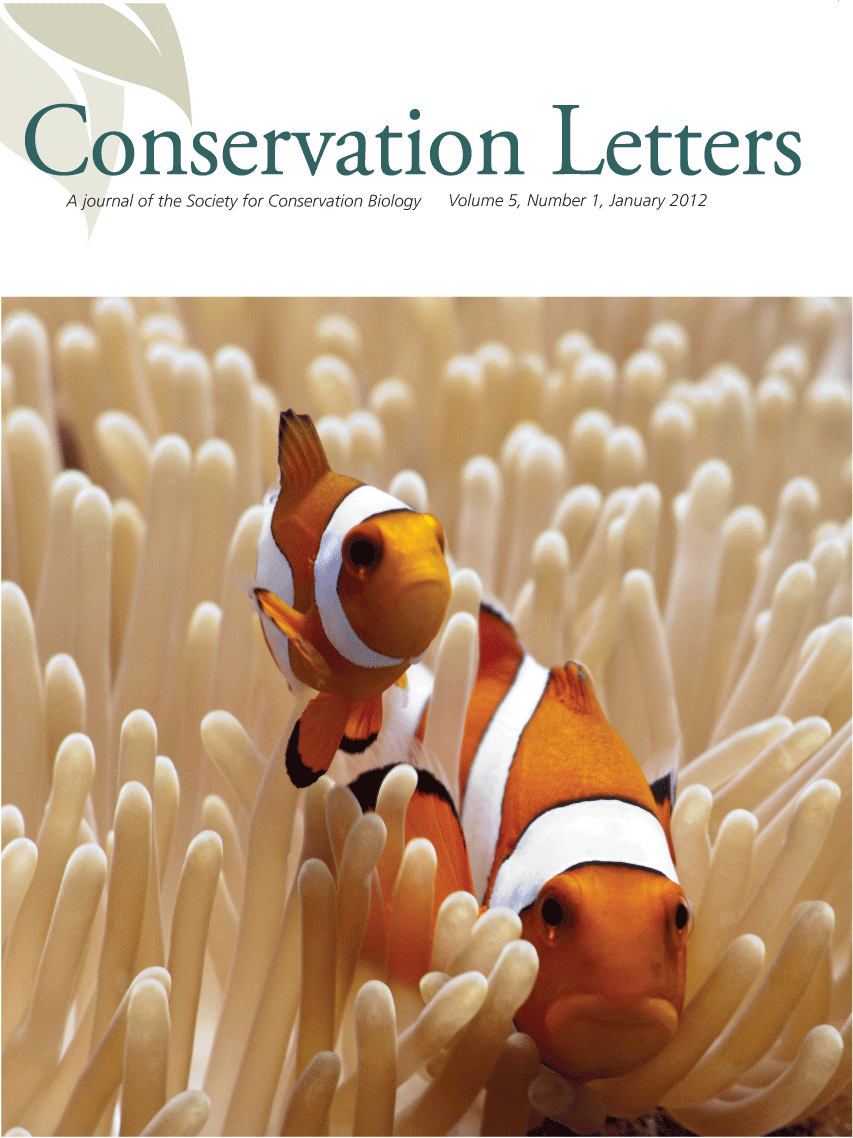
ConLetters-Jan12I’d like to introduce the latest scientific conservation journal – Conservation Letters (Wiley-Blackwell). If you are a publishing conservation scientist then you will have undoubtedly heard about this already. I must admit my biased opinion up front – I have the role of Senior Editor for the journal under the auspices of the venerable Editors-in-Chief, Professor Richard Cowling, Professor Hugh Possingham, Professor Bill Sutherland and Dr. Michael Mascia.

We’ve been doing conservation science now for well over 50 years, and there has been some fantastic, hard-hitting, brilliant research done. However, extinction rates continue to soar, habitat loss and fragmentation abound, bushmeat hunting and other forms of direct over-exploitation show no signs of slowing and invasive species are penetrating into the most ‘pristine’ habitats. To top it all off, climate change is exacerbating each and every one of these extinction drivers.

So what have we been doing wrong?

Clearly the best research is going unheeded – this is not to say that some progress has not been made, and I hope to highlight the best examples of the hardest-hitting research on this site – it simply means that we are losing the battle. Enter Conservation Letters – a journal designed to make conservation research more available to policy makers and managers to make true strides forward in biodiversity conservation. I’m not suggesting for a moment that other well-known, respected and established conservation journals have not done their job; without the research those journals publish we’d certainly be much worse off. However, we have recognised that our research isn’t affecting as many people as it should.

With Conservation Letters now well into its first year, I hope that we start to see some changes here, and I hope that the discipline will have a much greater net effect on slowing (and perhaps) reversing the extinction trends we observe today. Climate change is making this much more challenging, as well as the ever-increasing human population. Can we make better progress? – I certainly hope so.

CJA Bradshaw

Add to FacebookAdd to NewsvineAdd to DiggAdd to Del.icio.usAdd to StumbleuponAdd to RedditAdd to BlinklistAdd to Ma.gnoliaAdd to TechnoratiAdd to Furl


Feral predators – ‘super’ cats, foxes and dingoes

3 07 2008

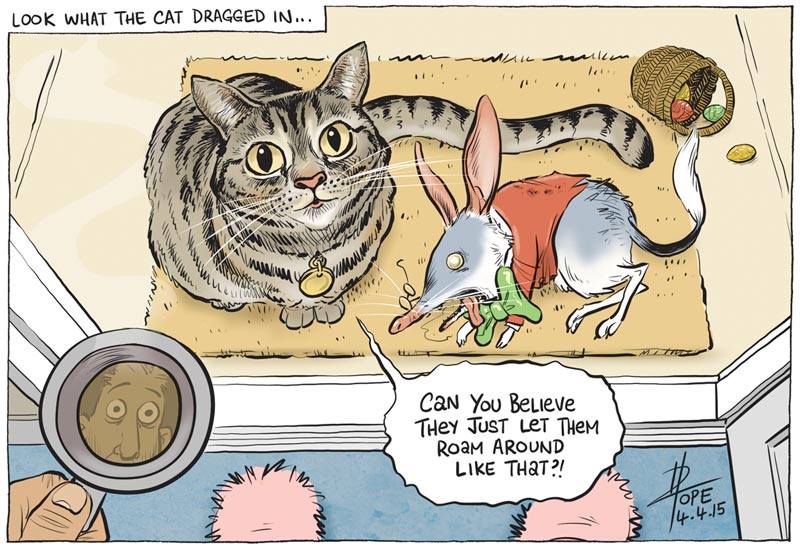
cat and bilbyHere’s one to get us going. A recent news item on ABC News discusses the prospect of importing so-called ‘super cats’ (‘savannah cats’ = domestic cat x African serval) into Australia. Although most of the items and people commenting on the subject deplore the very notion, I cannot believe that there was the legal capacity to import these things in the first place! Or indeed, that the company attempting to commit the heinous conservation crime has the right even to exist in this country. You’d think we’d learn after swamp buffalo, cane toads, foxes and a host of other alien nasties have caused Australian fauna to experience some of the higher rates of extinction known in the modern context. Indeed, it is my opinion that all cats (domestic and otherwise) should be declared illegal in Australia and destroyed. This is where it gets interesting though. One for the ‘papers to watch’ categories is by a mate and colleague of mine, Professor Chris Johnson of James Cook University in Townsville. He and his colleagues last year published a paper in Proc. R. Soc. B. called ‘Rarity of a top predator triggers continent-wide collapse of mammal prey: dingoes and marsupials in Australia‘.

dingo-21Here, they showed how dingoes (themselves ‘alien species’, but from some time ago) actually appear to suppress the populations of more recent alien predator arrivals (e.g., cats and foxes). The upshot is that more dingoes = fewer cats/foxes = more native fauna. Brilliant! I hope we can say in a few years how the careful management of dingoes and promotion of their conservation has benefitted an array of threatened marsupials in Australia. Well done Chris and colleagues.

CJA Bradshaw


Conservation that bites

2 07 2008

This new website will post examples of conservation science with real-world impacts to policy that improves biodiversity outcomes. Stay tuned.

CJA Bradshaw