Managing for extinction

9 10 2009

ladderAh, it doesn’t go away, does it? Or at least, we won’t let it.

That concept of ‘how many is enough?’ in conservation biology, the so-called ‘minimum viable population size‘, is enough to drive some conservation practitioners batty.

How many times have we heard the (para-) phrase: “It’s simply impractical to bring populations of critically endangered species up into the thousands”?

Well, my friends, if you’re not talking thousands, you’re wasting everyone’s time and money. You are essentially managing for extinction.

Our new paper out online in Biological Conservation entitled Pragmatic population viability targets in a rapidly changing world (Traill et al.) shows that populations of endangered species are unlikely to persist in the face of global climate change and habitat loss unless they number around 5000 mature individuals or more.

After several meta-analytic, time series-based and genetic estimates of the magic minimum number all agreeing, we can be fairly certain now that if a population is much less than several thousands (median = 5000), its likelihood of persisting in the long run in the face of normal random variation is pretty small.

We conclude essentially that many conservation biologists routinely underestimate or ignore the number of animals or plants required to prevent extinction. In fact, aims to maintain tens or hundreds of individuals, when thousands are actually needed, are simply wasting precious and finite conservation resources. Thus, if it is deemed unrealistic to attain such numbers, we essentially advise that in most cases conservation triage should be invoked and the species in question be abandoned for better prospects

A long-standing idea in species restoration programs is the so-called ‘50/500’ rule; this states that at least 50 adults are required to avoid the damaging effects of inbreeding, and 500 to avoid extinctions due to the inability to evolve to cope with environmental change. Our research suggests that the 50/500 rule is at least an order of magnitude too small to stave off extinction.

This does not necessarily imply that populations smaller than 5000 are doomed. But it does highlight the challenge that small populations face in adapting to a rapidly changing world.

We are battling to prevent a mass extinction event in the face of a growing human population and its associated impact on the planet, but the bar needs to be a lot higher. However, we shouldn’t necessarily give up on critically endangered species numbering a few hundred of individuals in the wild. Acceptance that more needs to be done if we are to stop ‘managing for extinction’ should force decision makers to be more explicit about what they are aiming for, and what they are willing to trade off, when allocating conservation funds.

CJA Bradshaw

(with thanks to Lochran Traill, Barry Brook and Dick Frankham)

Add to FacebookAdd to NewsvineAdd to DiggAdd to Del.icio.usAdd to StumbleuponAdd to RedditAdd to BlinklistAdd to Ma.gnoliaAdd to TechnoratiAdd to Furl

This post was chosen as an Editor's Selection for ResearchBlogging.orgResearchBlogging.org

Traill, L.W., Brook, B.W., Frankham, R.R., & Bradshaw, C.J.A. (2009). Pragmatic population viability targets in a rapidly changing world Biological Conservation DOI: 10.1016/j.biocon.2009.09.001



How to make an effective marine protected area

22 09 2009

Here’s a nice little review from the increasingly impressive Frontiers in Ecology and the Environment which seems to be showcasing a lot of good conservation research lately.

© USGS

© USGS

As we know, the world’s oceans are under huge threat, with predictions of 70 % loss of coral reefs by 2050, decline in kelp forests, loss of seagrasses, over-fishing, pollution and a rapidly warming and acidifying physical environment. Given all these stressors, it is absolutely imperative we spend a good deal of time thinking about the right way to impose restrictions on damage to marine areas – the simplest way to do this is via marine protected areas (MPA).

The science of MPA network design has matured over the last 10-20 years such that there is a decent body of literature now on what we need to do (now the policy makers just have to listen – some  progress there too, but see also here). McLeod and colleagues in the latest issue of Frontiers in Ecology and the Environment have published a review outlining the best, at least for coral reefs, set of recommendations for MPA network design given available information (paper title: Designing marine protected area networks to address the impacts of climate change). Definitely one for the Potential list.

Here’s what they recommend:

Size

  • bigger is always better
  • minimum diameter of an MPA should be 10-20 km to ensure exchange of propagules among protected benthic populations

Shape

  • simple shapes best (squares, rectangles)
  • avoid convoluted shapes to minimise edge effects

Representation

  • protect at least 20-30 % of each habitat

Replication

  • protect at least 3 examples of each marine habitat

Spread

  • select MPA in a variety of temperature regimes to avoid risk of all protected reefs succumbing to future climate changes

Critical Areas

  • protect nursery areas, spawning aggregations, and areas of high species diversity
  • protect areas demonstrating natural resilience or rapid recovery from previous disturbances

Connectivity

  • measure connectivity between MPA to ensure replenishment
  • space maximum distance of 15-20 km apart
  • include whole ecological units
  • buffer core areas
  • protect adjacent areas such as outlying reefs, seagrass beds, mangroves

Ecosystem Function

  • maintain key functional groups of species (e.g., herbivorous fishes)

Ecosystem Management

  • embed MPA in broader management frameworks addressing other threats
  • address and rectify sources of pollution
  • monitor changes

Of course, this is just a quick-and-dirty list as presented here – I highly recommend reading the review for specifics.

CJA Bradshaw

ResearchBlogging.orgMcLeod, E., Salm, R., Green, A., & Almany, J. (2009). Designing marine protected area networks to address the impacts of climate change Frontiers in Ecology and the Environment, 7 (7), 362-370 DOI: 10.1890/070211


Can we solve Australia’s mammal extinction crisis?

3 09 2009

© F. O'Connor

© F. O'Connor

This ‘In DepthScience Opinion piece from the ABC couldn’t have come at a better time. Written by Ian Gordon of the CSIRO, this opinion piece was written off the back of the special session on mammalian extinctions held at the recent International Congress of Ecology in Brisbane. Three previous ConservationBytes.com blogs in August (here, here and here) were devoted to specific talks at the Congress, including one about John Woinarksi’s gloomy tale of dwindling mammal populations in the Top End (which is especially frightening considering its also going on in our so-called ‘protected’ areas such as Kakadu, Litchfield and Garig Gunak Barlu National Parks!).

So, I recommend you have a read of my blog post on the shocking continued loss of Australian mammals, then read Ian’s piece copied below. Bottom lines – stop burning the shit out of our forests and encourage dingo population recovery and expansion.

Australia leads the world in mammal extinctions.

Over the last two hundred years 22 mammal species have become extinct, and over 100 are now on the threatened and endangered species list, compiled as part of the federal government’s Environment Protection and Biodiversity Conservation Act.

Evidence suggests Australia is on the cusp of another wave of mammal extinctions with a reduction in the abundance of some species and alarmingly, their range.

This is undoubtedly one of the major biodiversity conservation issues affecting Australia. It’s crucial we focus on the management solutions required to stop these species falling into extinction.

A South American success story

Working as a zoologist has allowed me to be involved in projects across the globe, looking at species at risk of extinction due to over-exploitation by humans.

Earlier this year I edited a book on the South American vicuña‘s comeback from the brink of extinction. Once abundant in the Andes, this wild relative of the llama suffered a sharp population drop in the 1960s due to international demand for its fleece.

An international moratorium on the sale of vicuña fleece in 1969 saw populations recover enough by 1987 for Andean communities to be able to harvest the fibre in a sustainable way. Population numbers of vicuña have remained healthy ever since, making it one of the few success stories of wildlife conservation worldwide.

Australia’s mammal extinction crisis

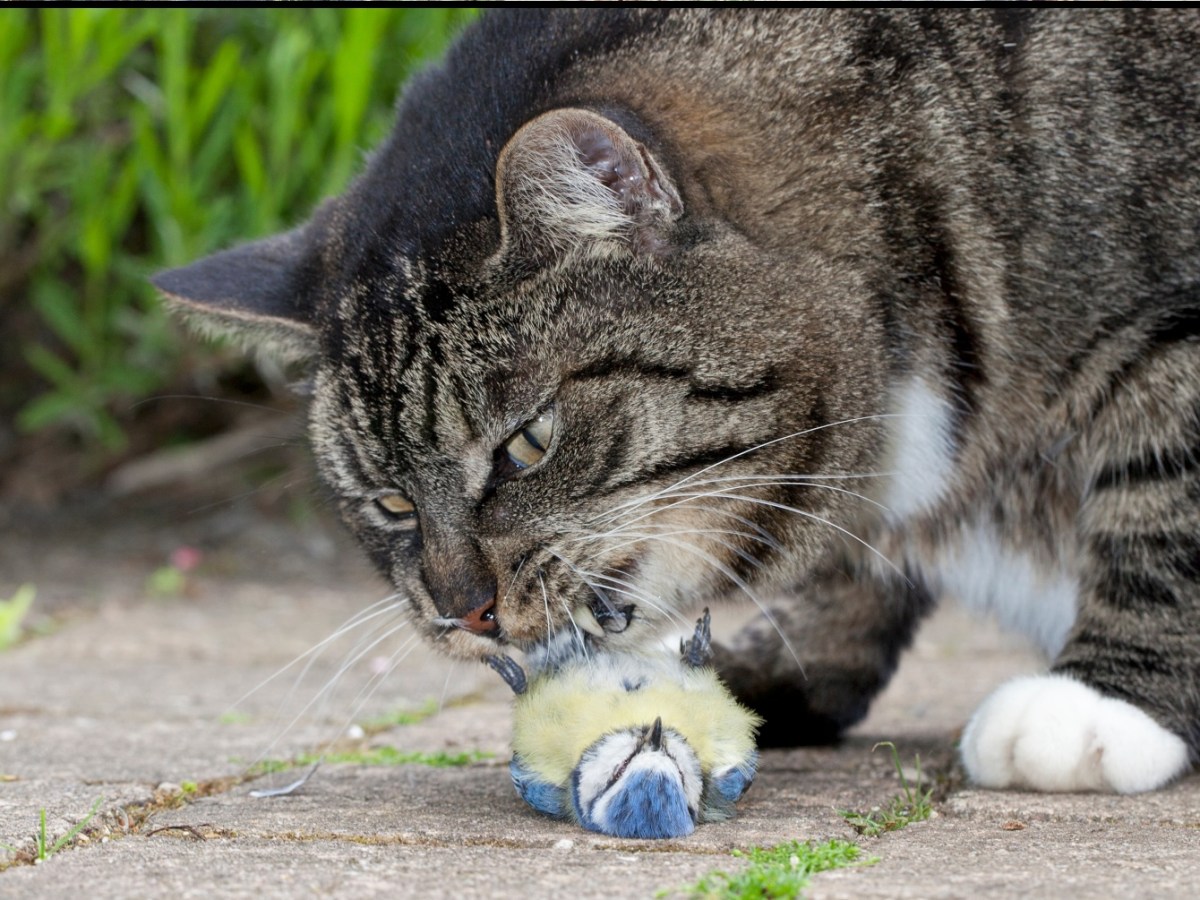
However Australia’s medium-sized mammals have had to deal with a different range of issues to the vicuña: the introduction of feral animals, particularly cats and foxes; increased grazing pressure; altered fire regimes; the clearing of habitat for development and production; and now, the effects of climate change.

It isn’t that any of these pressures are particularly important by themselves, but the fact that many of them act in concert has had a significant impact on causing the crashes in population numbers, and increasing the risk of species becoming extinct.

For example, the crescent nailtail wallaby was once an abundant and widespread macropod of central and western Australia. The pressures of feral cats and foxes coupled with clearing for agriculture and grazing, and altered fire regimes pushed this little species over the edge and it is now classified as extinct.

The problem is also more far-reaching than we first assumed. Many people may think that animals are becoming extinct in the south of Australia where habitat destruction is quite evident.

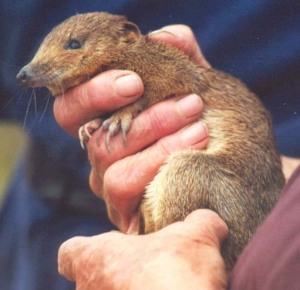
But the populations of iconic species in the north of Australia such as the northern quoll, golden bandicoot and the Carpentarian rock-rat are also collapsing. In our lifetime populations of some species have greatly reduced in number, and others have completely disappeared in landscapes that are considered to be in excellent condition.

The golden bandicoot, listed as a vulnerable species, used to be found across much of the north of Australia. It is now only found in very small populations in the Northern Territory and on the isolated Burrow Island off the coast of Western Australia.

Time to bring back the dingo?

Further research on the impacts of fire, grazing, invasive species and climate change on Australian mammals would be extremely valuable, but ecologists recognise that crucial management decisions need to be made now.

We’ve found ourselves in a position where we have identified the threats to Australian mammal species and documented the loss of these species, the role of science must turn more directly to identifying the opportunities for assisting the survival of these mammals.

In August I chaired a panel with Professor Chris Johnson from James Cook University at the International Congress of Ecology, to discuss what management could be put in place now to help beleaguered populations of small mammals recover.

Johnson’s main focus is to bring back the top-order predator.

He believes there is now good evidence that a stable population of dingoes suppresses the numbers and activity of foxes and cats, and some other feral animal species as well.

He argues that the effect of using a top predator like the dingo to hold down populations of foxes and cats is that the total intensity of predation on smaller native mammals can be reduced.

Bringing back the dingo has many sheep and cattle farmers raising their eyebrows because the wild dogs are known to kill stock. But guardian sheepdogs can protect stock herds by fighting off dingoes if they come too close. This still allows the dingoes to have a beneficial effect in the ecosystem.

Current trials of Maremma dogs, a type of sheepdog, at Dunluce sheep station in northwest Queensland demonstrate that they can be effective dingo deterrents in a pastoral zone.

This is just one potential solution that may work in some areas. Reinstating mosaic fire regimes, where patches of land are burnt at different times to allow the land to recover in stages, and controlling grazing around sensitive habitat of endangered mammals are other potential solutions that are currently under trial in various parts of the country.

Working together

Even though science doesn’t have all the answers I believe that it is more important than ever for land managers and scientists to work together to put new management regimes on the ground.

Our scientific knowledge can provide guidelines for land managers to reduce the pressures on our biodiversity. Through monitoring how species and ecosystems respond to on-ground management we can then learn and adapt our advice to meet future challenges facing Australia’s threatened species.

We need to act now: the international community is watching Australia and we have an opportunity to show how we can apply science through collaborative agreements with land managers to reduce the threats and protect endangered species.

We’ll then be able to add Australian animals to the short list of species, like the vicuña, that have been brought back from the brink of extinction.

CJA Bradshaw

Add to FacebookAdd to NewsvineAdd to DiggAdd to Del.icio.usAdd to StumbleuponAdd to RedditAdd to BlinklistAdd to Ma.gnoliaAdd to TechnoratiAdd to Furl


Not-so-scary maths and extinction risk

27 08 2009
© P. Horn

© P. Horn

Population viability analysis (PVA) and its cousin, minimum viable population (MVP) size estimation, are two generic categories for mathematically assessing a population’s risk of extinction under particular environmental scenarios (e.g., harvest regimes, habitat loss, etc.) (a personal plug here, for a good overview of general techniques in mathematical conservation ecology, check out our new chapter entitled ‘The Conservation Biologist’s Toolbox…’ in Sodhi & Ehrlich‘s edited book Conservation Biology for All by Oxford University Press [due out later this year]). A long-standing technique used to estimate extinction risk when the only available data for a population are in the form of population counts (abundance estimates) is the stochastic exponential growth model (SEG). Surprisingly, this little beauty is relatively good at predicting risk even though it doesn’t account for density feedback, age structure, spatial complexity or demographic stochasticity.

So, how does it work? Well, it essentially calculates the mean and variance of the population growth rate, which is just the logarithm of the ratio of an abundance estimate in one year to the abundance estimate in the previous year. These two parameters are then resampled many times to estimate the probability that abundance drops below a certain small threshold (often set arbitrarily low to something like < 50 females, etc.).

It is simple (funny how maths can become so straightforward to some people when you couch them in words rather than mathematical symbols), and rather effective. This is why a lot of people use it to prescribe conservation management interventions. You don’t have to be a modeller to use it (check out Morris & Doak’s book Quantitative Conservation Biology for a good recipe-like description).

But (there’s always a but), a new paper just published online in Conservation Letters by Bruce Kendall entitled The diffusion approximation overestimates extinction risk for count-based PVA questions the robustness when the species of interest breeds seasonally. You see, the diffusion approximation (the method used to estimate that extinction risk described above) generally assumes continuous breeding (i.e., there are always some females producing offspring). Using some very clever mathematics, simulation and a bloody good presentation, Kendall shows quite clearly that the diffusion approximation SEG over-estimates extinction risk when this happens (and it happens frequently in nature). He also offers a new simulation method to get around the problem.

Who cares, apart from some geeky maths types (I include myself in that group)? Well, considering it’s used so frequently, is easy to apply and it has major implications for species threat listings (e.g., IUCN Red List), it’s important we estimate these things as correctly as we can. Kendall shows how several species have already been misclassified for threat risk based on the old technique.

So, once again mathematics has the spotlight. Thanks, Bruce, for demonstrating how sound mathematical science can pave the way for better conservation management.

CJA Bradshaw

Add to FacebookAdd to NewsvineAdd to DiggAdd to Del.icio.usAdd to StumbleuponAdd to RedditAdd to BlinklistAdd to Ma.gnoliaAdd to TechnoratiAdd to Furl


August issue of Conservation Letters

6 08 2009

© Discovery Channel/W. Sloss

© Discovery Channel/W. Sloss

The latest edition of Conservation Letters is now out. Click here for full access (yes, all articles are still free!).

Papers in this issue:


June Issue of Conservation Letters

6 06 2009

Quick off the mark this month is the new issue of Conservation Letters. There are some exciting new papers (listed below). I encourage readers to have a look:

Policy Perspectives

Letters

CJA Bradshaw


To market, to market, to buy a fat… fish

4 05 2009

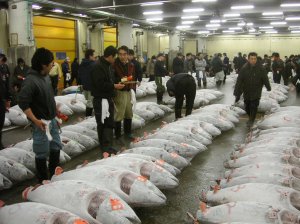
An interesting new paper just appeared online (uncorrected proof stage) in Biological Conservation. Brewer and colleagues’ paper entitled Thresholds and multiple scale interaction of environment, resource use, and market proximity on reef fishery resources in the Solomon Islands describes how the proximity of fish markets explains some of the variation in fisheries takes on South Pacific coral reefs. Well, that may seem intuitive, you say – if you can’t access even a local market, chances are your fish will only feed you and your immediate family. Make an economic link to a larger pool of demanding consumers, and you have all the incentive you need to over-exploit your little patch of finned money.

Of course, the advent of better, more efficient transport (including refrigerated transport) and the development of local markets (i.e., tapping into larger ones in more populated areas) has inevitably caused fish depletions across the globe. Brewer and colleagues’ work provides a quantitative link between human demand and biodiversity decline (including ‘fishing down the web‘), and suggests that our best way to manage fisheries is to target the source of this demand – the markets and patterns of consumption. Ultimately, it’s the consumer that will dictate what does and what does not go extinct (see also previous post on consumer preferences for rare species). After all, if there’s a demand, someone will step in to provide the resource (provided it’s still there). Better education, smarter consumption and regulation along the entire chain will be far more effective in the long run than just attempting to control the fishers’ behaviour.

CJA Bradshaw

Add to FacebookAdd to NewsvineAdd to DiggAdd to Del.icio.usAdd to StumbleuponAdd to RedditAdd to BlinklistAdd to Ma.gnoliaAdd to TechnoratiAdd to Furl