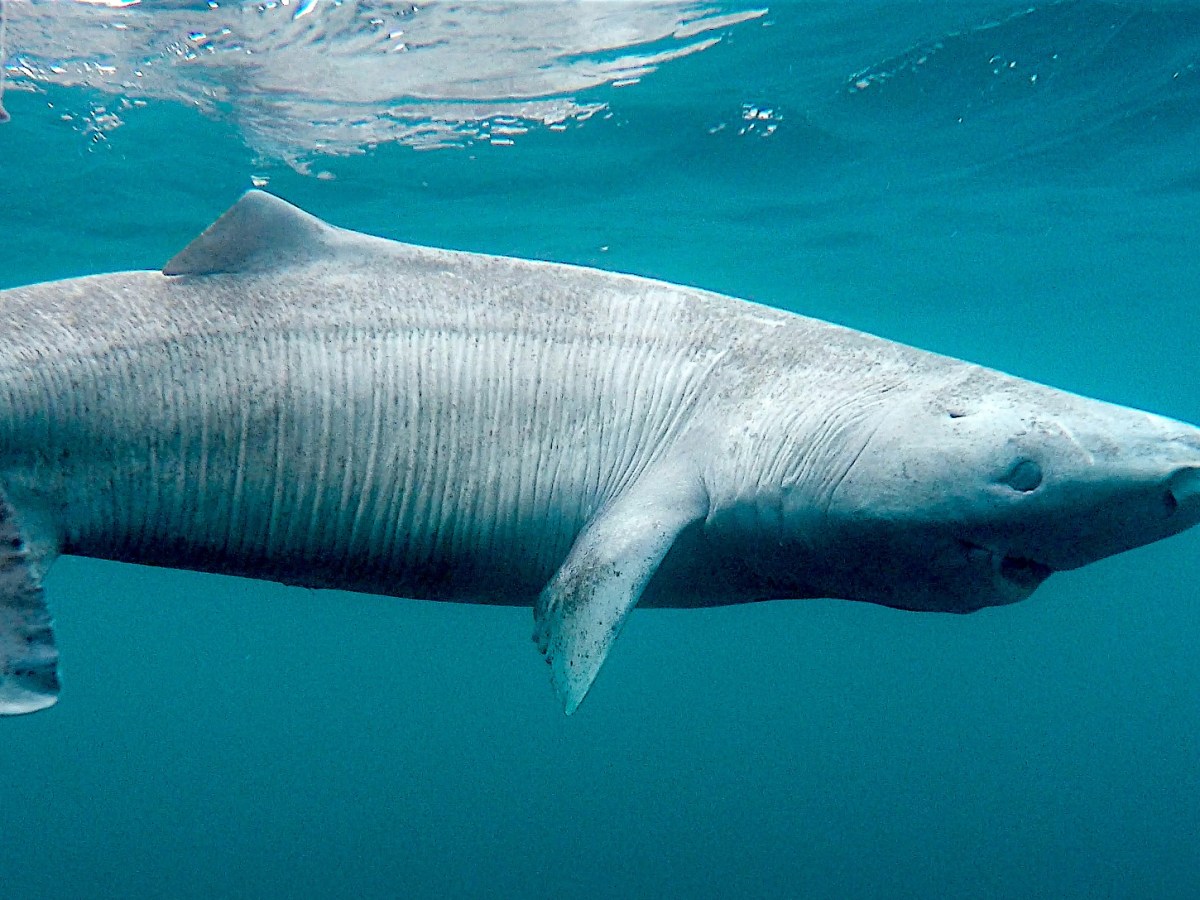
Gagging scientists about marine parks

14 08 2011

© Louisa Gouliamaki AFP

Apologies to my readers for the lack of a post this past week – I’ve been attending the Ecological Society of America‘s 96th Annual Meeting in an extremely hot (42 °C) Austin, Texas. As usual, I’ll provide a synopsis of the conference in a little bit, but I have some rather worrisome reports about the marine park process in Australia with which to regale you first.

My last post was the reproduction of a letter cosigned by over 150 marine scientists (mostly from Australia, including me) who are concerned that the a proposed network of marine reserves in the Commonwealth waters of the South West bioregional marine planning region is not based on sound scientific principles, and is instead a mash-up of what amounts to leftovers that industry hasn’t yet found a way to exploit. Not the best way to plan for marine biodiversity conservation in the long run.

After the post went live, I had a few interesting (and frightening) e-mail exchanges with a few colleagues who work for various Australian marine science institutions who complained that they were forbidden to cosign the letter. What? What? What? What? What? Read the rest of this entry »


More than leftovers: getting marine parks right in Australia

7 08 2011
Taken by user Hossen27

Image via Wikipedia

A few weeks back I cosigned a ‘statement of concern’ about the proposal for Australia’s South West Marine Region organised by Hugh Possingham. The support has been overwhelming by Australia’s marine science community (see list of supporting scientists below). I’ve reproduced the letter addressed to the Australian government – distribute far and wide if you give more than a shit about the state of our marine environment (and the economies it supports). Basically, the proposed parks are merely a settlement between government and industry where nothing of importance is really being protected. The parks are just the leftovers industry doesn’t want. No way to ensure the long-term viability of our seas.

On 5 May 2011 the Australian Government released a draft proposal for a network of marine reserves in the Commonwealth waters of the South West bioregional marine planning region.

Australia’s South West is of global significance for marine life because it is a temperate region with an exceptionally high proportion of endemic species – species found nowhere else in the world.

Important industries, such as tourism and fisheries, depend on healthy marine ecosystems and the services they provide. Networks of protected areas, with large fully protected core zones, are essential to maintain healthy ecosystems over the long-term – complemented by responsible fisheries management1.

The selection and establishment of marine reserves should rest on a strong scientific foundation. We are greatly concerned that what is currently proposed in the Draft South West Plan is not based on the three core science principles of reserve network design: comprehensiveness, adequacy and representation. These principles have been adopted by Australia for establishing our National Reserve System and are recognized internationally2.

Specifically, the draft plan fails on the most basic test of protecting a representative selection of habitats within the bioregions of the south-west. There are no highly protected areas proposed at all in three of the seven marine bioregions lying on the continental shelf3. Overall less than 3.5% of the shelf, where resource use and biodiversity values are most intense, is highly protected. Further, six of the seven highly protected areas that are proposed on the shelf are small (< 20 km in width)4 and all are separated by large distances (> 200 km)5. The ability of such small isolated areas to maintain connectivity and fulfil the goal of protecting Australia’s marine biodiversity is limited. Read the rest of this entry »


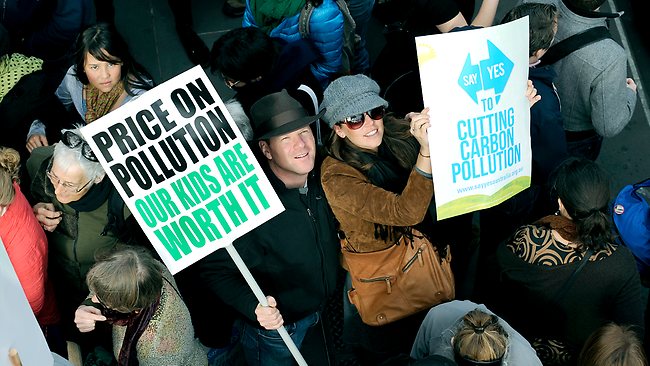
Australian ecologists support carbon tax

18 07 2011

© Herald Sun

Last week I came across a report that 60 % of economists support the newly proposed Australian carbon tax initiative, and that most believed the Coalition’s plan was inferior and would likely be more costly.

I thought that it would be good to survey ecologists on this very same issue because we are the people dealing with the fall-out of climate change to natural systems, and we are the group communicating it and its consequences to the greater public. Climate change effects on the Australian biota are already being witnessed, and if we don’t take the lead in this over-populated world of myopic, self-interested growth addicts, it’s our children who will suffer most.

Usually, ecologists and economists tend to disagree on major policies because of the general view that development is incompatible with functioning ecosystems; however in this case, it’s telling that the two seem to agree. If economists and ecologists together support something, it’s probably a good idea to give it a go. Read the rest of this entry »


Do ecologists support Australia’s new carbon tax?

13 07 2011

Today on The Conversation, it was reported that 60 % of 145 economists surveyed support Australia’s new Carbon Tax scheme.

I am wondering what kind of support there is for it out there amongst ecologists. If you are one, please complete the following short survey by clicking here.

I’ll post the results in a few days.

CJA Bradshaw


Deforesting and reforesting Australia

13 07 2011

A couple of weeks ago we (Andy Lowe and I) did a small interview on ABC television about the current status of Australia forests, followed by a discussion regarding our recently funded Australian Research Council Linkage Project Developing best-practice approaches for restoring forest ecosystems that are resilient to climate change. Just in case you didn’t see it, I’ve managed to upload a copy of the piece to Youtube.com and reproduce it here:

I’m actually in the process of writing a paper on all this for a special issue of Journal of Plant Ecology (that is nearly already overdue!), but here are a few facts for you in the interim:

  • Australian eucalypt forests are globally unique, with one of the longest evolutionary histories among the world’s forests
  • Australia has about 147 million ha of native forest remaining, and about 2 million ha of plantations Read the rest of this entry »


Who’s your carbon daddy?

20 04 2011

The other day, Bill Laurance asked Barry Brook and me to comment on an opinion editorial he was doing up, so I feel fully justified in reproducing it here (and he asked me to ;-). It has just been published online in Australian Geographic.

I hate to be the bearer of bad news, but here it is: China is now the biggest global emitter of carbon dioxide (CO2), the chief greenhouse gas – and Australia has helped it attain that dubious honour.

China now spews out about 6.5 billion tons of CO2 annually, whereas the USA emits 5.8 billion tons a year (based on data for 2008 compiled by the U.S. Department of Energy). Collectively, these two countries account for over 40 per cent of global CO2 emissions. Number three on the list is Russia, with 1.7 billion tons per year, followed closely by India.

Of course, China’s huge leap in emissions is largely down to its dramatic industrial and economic growth, in concert with the fact that it is the world’s most populous nation, with over 1.3 billion people. To help fuel its growth, China is now building nearly one new coal-fired power-generating plant per week. Read the rest of this entry »


Crocodiles, spiders and leeches

11 04 2011

I just wrote a fun little piece for a new section in the journal Frontiers in Ecology and the Environment that they’re calling Trails and Tribulations. The basic idea is that the author recounts a particularly interesting field-related experience through which an ecological concept is woven.

Editor-in-Chief Sue Silver said that I could reproduce my article here as long as I acknowledged Frontiers and the Ecological Society of America. It was fun to write, and I hope you enjoy it too [the PDF of the article is available free of charge here].

“So does each team get a hand gun?”

“No, you get an oar”

“What good is an oar?”

“Listen, mate. When a 3-metre croc jumps out of the swamp at you, there is nothing more natural in the world than to thump him with a big stick. It’s an autonomous response. With a gun, IF you manage to keep it dry, and IF you manage to get it out in time before the croc bites off your head, chances are you’ll just shoot the bloke in front of you anyway. So you get an oar.”

“Fair enough”.

That is an approximate, paraphrased reproduction of the initial conversation I had with renowned Australian crocodile biologist, Grahame Webb, just prior to my first (and as it turns out, only) trip to collect crocodile eggs for his Darwin wildlife park and crocodile farm. I volunteered to take part in the collection because I had recently begun working with Grahame and his team tracking the world’s largest crocodile species – the saltwater or estuarine crocodile Crocodylus porosus – and modelling aspects of its populations (Bradshaw et al. 2006). Having already been out on several occasions to harpoon and satellite-tag animals (some measuring > 4 m) on the Mary River, and cage-trap others in Kakadu National Park, I thought a little egg collection would be a proverbial walk in the park. Little did I know that it would end up being one of my more memorable experiences.

Let me walk you through the process. First, you wait until the height of the wet season and drive out as far as you can toward the breeding swamp of interest (in this case, Melacca Swamp in the Adelaide River flood plain, about one hour’s drive from Darwin). Then you and two other loonies pile into a small helicopter equipped with landing pontoons which ferries you to one of many previously identified crocodile nests. Because there is usually too much vegetation around the nest itself, the helicopter must land about 100-300 m away. Clothed only in long pants, a long-sleeved shirt and cotton gloves to protect your skin from the slicing blade grass, you jump off the helicopter’s pontoons into impenetrably murky, chest-deep water. One of the team drags an esky (chiller box into which eggs will be placed) and another carries an oar. As the noise of the departing helicopter becomes a faint buzz, you suddenly realise via the rapid expansion of your terminal sphincter that you are in the middle of a crocodile-filled swamp – and you are holding an oar. Read the rest of this entry »


Disaster coming to a coastline near you

24 02 2011

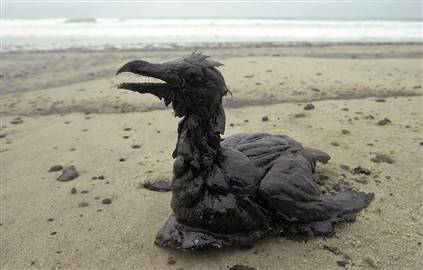
Many of you already know that against all better judgement, the spectacularly audacious Australian Commonwealth government has granted BP offshore drilling rights in our southern waters.

You’d think that with all the evidence that BP is a company that cannot be trusted with this particular form of resource exploitation, we’d be a little bit more discerning when granting exploration permits to them. Apparently not.

In protest and within my rights as an Australian citizen, I wrote to the Minister responsible for the decision, MP Martin Ferguson (Federal Minister for Resources and Energy) to register my protest:

Dear Minister Ferguson,

As an ecologist, academic and citizen, I find it rather astounding that Australia has permitted the deep-sea exploration of oil by BP in our own back garden. The unreasonable environmental risk aside, it simply equates to poor economics – the very real probability of a disaster on the same scale (or larger) than the Gulf of Mexico’s fiasco last year will effectively destroy the commercial fishing and aquaculture industry of our southern coastline overnight. The loss of tourism dollars could arguably exceed even that.

This is most definitely not in Australia’s best interest, and will represent yet another blight on our already poor environmental record (see http://wp.me/phhT4-1cf and http://wp.me/phhT4-Zt). I urge you to reconsider your permission and revoke the licence to drill in our waters. It is a mistake you and your government will regret for decades, and will make the recent flooding disaster in Queensland appear mild in comparison.

Sincerely,
Professor Corey J. A. Bradshaw

I certainly wasn’t expecting the Minister to say suddenly “Oh my. You are right, Prof. Bradshaw. It is a bad decision. I’ll revoke that permission forthwith”, but I was expecting a little bit more than the jumbled form letter I received in reply: Read the rest of this entry »


Deforestation partly to blame for Queensland floods

17 01 2011

© recoverling

Last week I sent a fairly random Tweet about deforestation in south-eastern Queensland being partially responsible for the record floods there. It went more or less unnoticed, but I thought the comment deserved a proper explanation.

As many of you might know, my colleagues and I wrote an article a few years ago about the global-scale evidence for deforestation leading to a higher incidence and severity of floods in the developing world. This was fairly controversial, but it was nonetheless the first broad-scale evidence for the fabled deforestation-flood link yet published (in my not-so-humble opinion). Subsequent comment reiterated the point with new data.

Now, I will begin by saying I have no data yet to back up my Queensland-specific hypothesis, but I am contemplating a time-series paper on floods in Australia, especially after the events of the last month. This post is therefore merely a reasoned hypothesis.

The hypothesis itself is rather simple. Testing is not. I submit that the recent flooding in Australia has been exacerbated (not caused) by the rapid loss of forest cover over the last 40 years. We know that this is a particularly intense La Niña in Australia and our unusually high rainfall arises from this meteorological phenomenon, but I hypothesise that it wouldn’t have been as bad if this part of Australia hadn’t been so careless with its forest cover since the 1970s. Read the rest of this entry »


Want a cool conservation job in beautiful southern Australia?

14 12 2010

I was asked to post this cool-sounding job on ConservationBytes.com – relevant punters welcome to respond.

Australian Wildlife Conservancy (AWC) is a non‐profit organisation dedicated to the conservation of Australia’s threatened wildlife and their habitats. AWC now owns and manages more land than any other private conservation organisation in Australia ‐  21 properties, covering more than 2.6 million hectares ‐ protecting more than 1,200 fauna species through active land management informed by strategic scientific research.

AWC is seeking an experienced and committed ecologist who will be pivotal in the development and implementation of the conservation and science program throughout south‐eastern Australia. The position will be based at Scotia Wildlife Sanctuary (where on‐site accommodation will be provided), but will include work at other AWC sanctuaries, especially Kalamurina (Lake Eyre), Buckaringa (Flinders Ranges), Yookamurra (Riverlands), Dakalanta (Eyre Peninsula), Bowra (Mulga Lands) and North Head (Sydney) sanctuaries.

Scotia is a large property (65,000 ha) that lies on the NSW‐SA border between Wentworth and Broken Hill, and includes Australia’s largest area free of foxes, cats and rabbits (8,000 ha) and where seven regionally extinct species have been reintroduced (bilby, boodie, woylie, bridled nailtail wallaby, numbat, greater stick‐nest rat, mala and black‐eared miner). In addition, the property has outstanding conservation values because it protects habitats, in good condition, that have been extensively cleared in western NSW.

Read the rest of this entry »


Blog Action Day 2010 – Water neutrality and its biodiversity benefits

16 10 2010

In my little bid to participate in Change.org’s Blog Action Day 2010 – Water, I’ve re-hashed a post from 2008 on ‘water neutrality’. This will also benefit my recently joined readers, and re-invigorate a concept I don’t think has received nearly enough attention globally (or even in parched Australia where I live). So here we go:

The world’s freshwater ecosystems are in trouble. We’ve extracted, poisoned, polluted, damned and diverted a large proportion of the finite (and rather small!) amount of freshwater on the planet. Now, most people might immediately see the problem here from a selfish perspective – no clean, abundant water source = human disease, suffering and death. Definitely something to avoid, and a problem that all Australians are facing (i.e., it’s not just restricted to developing nations). Just look at the Murray-Darling problem.

In addition to affecting our own personal well-being, freshwater ecosystems are thought to support over 10000 fish species worldwide (see also a recent post on Africa’s freshwater biodiversity’s susceptibility to climate change), and the majority of amphibians and aquatic reptiles. Current estimates suggest that about 1/3 of all vertebrate biodiversity (in this case, number of species) is confined to freshwater. As an example, the Mekong River system alone is thought to support up to 1700 different species of fish.

So, what are some of the ways forward? The concept of ‘water neutrality’ is essentially the wet version of carbon neutrality. It basically means that water usage can be offset by interventions to improve freshwater habitats and supply. Read the rest of this entry »


Humans 1, Environment 0

27 09 2010

© flickr.com/photos/singapore2010

While travelling to our Supercharge Your Science workshop in Cairns and Townsville last week (which, by the way, went off really well and the punters gave us the thumbs up – stay tuned for more Supercharge activities at a university near you…), I stumbled across an article in the Sydney Morning Herald about the state of Australia.

That Commonwealth purveyor of numbers, the Australian Bureau of Statistics (ABS), put together a nice little summary of various measures of wealth, health, politics and environment and their trends over the last decade. The resulting Measures of Australia’s Progress is an interesting read indeed. I felt the simple newspaper article didn’t do the environmental components justice, so I summarise the salient points below and give you my tuppence as well. Read the rest of this entry »


Toilet Torrens II: The Plot Sickens

14 02 2009
© CJA Bradshaw

© CJA Bradshaw

A few days into the Torrens ‘River’ disaster, and we see very little in the way of a truly dedicated, organised clean-up. With some token efforts to clean up the more obvious rubbish in the lake section itself (i.e., cars, fridges, etc.), there is nothing suggesting the true problems are going to be addressed. Indeed, the authorities are desperately trying to ‘find’ water to cover the problem up rather than deal with it.

Instead of a catchment-wide mass clean-up, the removal of the water-sucking invasive plants that line the river’s edge (see photos below), the implementation of a water neutrality scheme, and the removal of hundreds of untreated drainage pipes, they are willing to spend over $1 million to pipe in water from elsewhere.

I can’t believe it.

This is the best opportunity Adelaide has ever had to rectify the problem and clean the mess up once and for all; instead, the investment is going toward a cosmetic cover-up that will effectively fix nothing. Toothless. Some images I took today while cycling along the Torrens path follow:

© CJA Bradshaw

© CJA Bradshaw

© CJA Bradshaw

© CJA Bradshaw

© CJA Bradshaw

© CJA Bradshaw

CJA Bradshaw

Add to FacebookAdd to NewsvineAdd to DiggAdd to Del.icio.usAdd to StumbleuponAdd to RedditAdd to BlinklistAdd to Ma.gnoliaAdd to TechnoratiAdd to Furl


Adelaide’s shame – the ‘River’ (toilet) Torrens

12 02 2009

I’ve put this post off for too long as it is, but after today’s ridiculous dereliction of dutymalfunction‘, I can no longer hold my tongue (as it were).

I’ve been living in Adelaide for about a year now, and it’s been slowly dawning on me just how badly managed, for decades, the Torrens River has been. I cycle or run to work along the Torrens cycle path and see and smell the amazing neglect that has accumulated over the years.

The river literally stinks of rot and filth. What am I saying? The Torrens is about as much a river as a trickle in public urinal. Actually, most urinals are a hell of a lot cleaner.

It’s not just the rubbish, the unregulated and ubiquitous pipes of untreated run-off entering every 100 m or so, the almost complete lack of flows during the summer, the terribly regulated flows during the infrequent winter rains, the toxic build-up of blue-green algae, or the choking invasive alien plants lining its entire course, it’s the unbelievable neglect, cover-up and blind ignorance that has lead to one of the most polluted, unnatural and degraded streams in Australia.

And it’s in the middle of Adelaide.

This is how some would rather you think of the Torrens:

But scratch just a little under the surface and you find this:
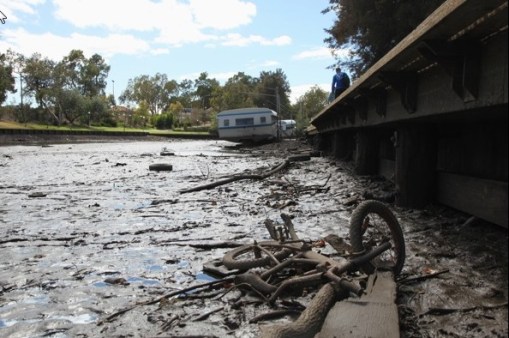
and this:
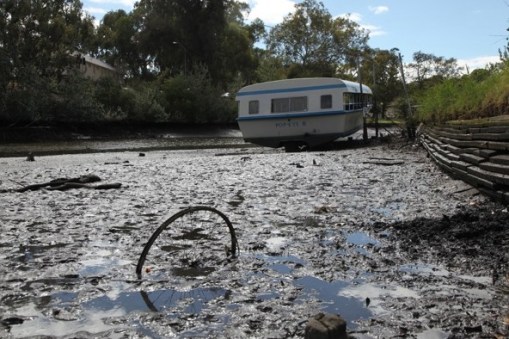
Yes, today’s mishap exposed decades of bad management to the press and the public in general; the authorities can’t wait for a little rain to cover up the ’embarrassment’, but they’ll have to wait a long time. This isn’t “embarrasing“, it’s shameful, disgusting, neglectful, irresponsible and naïve.

Of course, a few people have some partially right approaches to address the problem – indeed, Tourism Minister Jane Lomax-Smith suggests we take advantage of the low water levels and clean up the mess. I couldn’t agree more. However, apart from a few derelict cars pulled out, I’ve not seen a single attempt to get out there and do the job properly. We need to remove every last scrap of rubbish from the Adelaide Hills to Henley beach – this means the trolleys, oil drums, bicycles, wheelie bins and other assorted crap (I think I even saw a fridge today). I’m willing to help.

We need a major overhaul, clean-up and rethink about this so-called ‘river’.

The ‘drought’ that Australia seems convinced will some day end will not go away – climate change will ensure that, along with the persistence of some very bad urban water policies. We need to get used to the idea that we’ll have less and less water, not suddenly more when the ‘drought’ ends. Sorry, the drought won’t end.

So, what can we do? There are some very obvious improvements that can be made:

1. Undeniably, a massive, catchment-wide, get-your-hands-dirty clean-up is required to remove the astounding array of rubbish.

2. Yes, we have reduced flows and will continue to have in this state for a long time to come. So, we need to minimise waste. A paper I recently covered in ConservationBytes.com detailed how a water neutrality programme would benefit water supply AND biodiversity. The idea is relatively simple – the water allocated to industry, residents, etc. is taxed according to total use. The monies received are then invested in removing all those invasive reeds, rushes, palms, bamboo, etc. that line the water course (all of these are water-hungry pests that have no business being there in the first place). In one fell swoop you have an employment program, an incentive to use less water, a ‘water-neutrality’ scheme that makes water-intensive products (e.g., fruits and vegetables) more attractive to environmentally conscious consumers, removal of alien species that consume too much water and prevent native species from proliferating, and importantly, a functioning ecosystem that provides water more regularly.

3. Get rid or divert all those untreated storm pipes from all and sundry lining the Torrens along its path. I’ve seen campground drainages with all sorts of filth flow into the river, car park drainages and inappropriate garden waste ooze into the river right along its course.

4. Let’s get rid of the horses grazing on the denuded banks of the river near Henley Beach. What the hell is livestock doing grazing in the middle of a city?

5. Remove golf courses lining the river.

6. Debunk the myth that bore water used to keep artificially lush gardens in the wealthier neighbourhoods lining the Torrens is somehow not subject to the same problems as rainfall-sourced water. 72 % of the Torrens’ water use is residential. We waste far too much of the underground water on these ridiculous gardens in our desert city – I’m sorry, the prominent display of ‘Bore Water in Use’ in so many gardens around Adelaide is contemptuous and ignorant.

Can we mend the Torrens? Yes, yes we can. A lot of rivers is much worse shape have been brought back to life over the years (see examples here, here and here), so we can do it too. It just takes a little political will, some intelligent policy, a bit of money and public commitment.

CJA Bradshaw

P.S. I recommend you avoid swimming anywhere near Henley Beach for the next few weeks.

Add to FacebookAdd to NewsvineAdd to DiggAdd to Del.icio.usAdd to StumbleuponAdd to RedditAdd to BlinklistAdd to Ma.gnoliaAdd to TechnoratiAdd to Furl