Deforestation and disease

10 09 2008

Humans have such a short memory…

A recent theme in many of my posts is the concept of ecosystem services provided to us essentially free of charge, and their continued degradation due to the burgeoning human population, bad land management and excessive resource consumption. We are indeed degrading the very life-support system species assemblages provide us. I’ve previously posted a long list of ecosystem services that you can consult here, but this recent paper in BioScience highlights one that is probably largely overlooked – the role of forests in reducing the incidence of human disease.

In their article entitled Deforestation, mosquitoes, and Ancient Rome: lessons for today, Lara O’Sullivan and colleagues discuss the evidence from Ancient Rome that deforestation rapidly increased the prevalence of malarial diseases. They also go on to cite several examples from the modern world where deforestation appears to be linked to greater manifestation of diseases like malaria.

The evidence isn’t just linked to Africa and the Amazon, but the authors suggest that the incidence of mosquito-borne diseases in Australia such as Ross River fever may also be on the rise as forests are quickly degraded and destroyed.

In two previous posts (see here and here), I commented on the escalating biodiversity crisis in the tropics driven largely by habitat loss (i.e., deforestation) – add increasing human disease to the long list of negatives associated with degrading or disappearing ecosystem services such as increased frequency and severity of floods, reduced food provision, reduced availability of clean water, reduced pollination, etc. We MUST educate the masses with the increasing body of scientific evidence that our behaviour is self-defeating (see previous post on this issue).

Indeed, it’s no longer the days of the capitalists versus the ‘greenies’ – the rapid decline in the quality of human life and and our own survival is affecting all of us, including the wealthy. In fact, I would argue that environmentalism has fully developed as the principal rationale in conservation ecology, such that it has become much less of an esoteric struggle for maintaining all things beautiful (the capitalist viewpoint of the traditional ‘greeny’), to a science-driven means to maintain human life and prosperity. Can we afford to continue along this path? Definitely not. Only an idiot with the foresight of a slug could ignore our current trajectory – and that includes the millionaire sport heroes, actors, and entrepreneurs who have benefited directly from our collective resource exploits. If you give a shit about the quality of life you and your descendants will have in the very near future, do not ignore habitat loss any longer.

CJA Bradshaw

Add to FacebookAdd to NewsvineAdd to DiggAdd to Del.icio.usAdd to StumbleuponAdd to RedditAdd to BlinklistAdd to Ma.gnoliaAdd to TechnoratiAdd to Furl


Tropical Conservation Biology

8 09 2008

An obvious personal plug – but I’m allowed to do that on my own blog ;-)

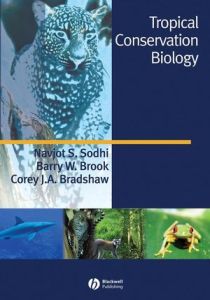
1405150734I’d like to introduce a (relatively) new textbook that my colleagues, Navjot Sodhi and Barry Brook, and I wrote and published last year with Blackwell (now Wiley-Blackwell) Scientific Publishing – Tropical Conservation Biology.

We’re rather proud of this book because it was a timely summary and assessment of the scientific evidence for the degree of devastation facing tropical biodiversity today and in the future. I’ve summarised some of the main issues in a previous post covering a paper we have ‘in press’ that was born of the text book, but obviously the book is a far more detailed account of the problems facing the tropics.

This introductory textbook examines diminishing terrestrial and aquatic habitats in the tropics, covering a broad range of topics including the fate of the coral reefs; the impact of agriculture, urbanisation, and logging on habitat depletion; and the effects of fire on plants and animal survival.

One of the highlights of the book is that each chapter (see below) Includes case studies and interviews with prominent conservation scientists to help situate key concepts in a real world context: Norman Myers (Chapter 1), Gretchen Daily (Chapter 2), William Laurance (Chapter 3), Mark Cochrane (Chapter 4), Daniel Simberloff (Chapter 5), Bruce Campbell (Chapter 6), Daniel Pauly (Chapter 7), Stephen Schneider (Chapter 8), Stuart Pimm (Chapter 9) and Peter Raven (Chapter 10). These biographies are followed by a brief set of questions and answers that focus on some of the most pertinent and pressing issues in tropical conservation biology today. It is our intention that readers of Tropical Conservation Biology will benefit from the knowledge and be inspired by the passion of these renowned conservation experts.

TABLE OF CONTENTS

  1. Chapter 1: Diminishing habitats in regions of high biodiversity. We report on the loss of tropical habitats across the tropics (e.g., deforestation rates). We also highlight the drivers of habitat loss such as human population expansion. Finally, we identify the areas in immediate need of conservation action by elucidating the concept of biodiversity hotspots. Read the rest of this entry »


Threatened species depend on protected areas

4 09 2008

One for the Potential list:

3932397_origA great new paper has just come out in Global Change Biology by Sarah Jackson and Kevin Gaston: Land use change and the dependence of national priority species on protected areas. In what is simultaneously frightening and ecouraging is the observation that of nearly 400 Biodiversity Action Plan (BAP) species considered either to be globally threatened or rapidly declining in the UK (i.e., > 50 % decline over 25 years), 55 % were largely restricted to statuatory protected areas in the UK. These areas cover about 11.5 % of Britain’s land surface.

What’s amazing about this is that without these reserves, these (hundreds) of species would already be extinct (or very close to it) – if this isn’t one of the strongest arguments for reserves, I don’t know what is. Not only are reserves essential for maintaining populations of threatened species, their spatial connectivity is also highly influential on persistence probability (future posts on fragmentation coming).

Much of the planet has now been modified to the point where any sort of species preservation will necessarily require large, expansive, contiguous networks of protected areas. Jackson & Gaston conclude:

Britain has undergone particularly extensive land transformation, reducing many originally much more widespread vegetation/habitat types to scattered fragments, few of which can be considered strictly natural (Rackham, 1986). A proportion of these fragments receive statutory protection and intensive management, increasing the likelihood that species of conservation concern are restricted to such areas. This circumstance is not unique to Britain, being found in many heavily developed regions including much of northwestern Europe, although it is not so extreme in many others. Britain may, thus, represent a possible future scenario for such regions. Under such circumstances, it is not unlikely that many species if they are not already restricted to protected areas will become so (e.g. species confined to tropical forest habitats following deforestation).

 Keeping things off limits from the burgeoning human population is therefore one of the major ways we can stem the tide of extinctions.

CJA Bradshaw

Add to FacebookAdd to NewsvineAdd to DiggAdd to Del.icio.usAdd to StumbleuponAdd to RedditAdd to BlinklistAdd to Ma.gnoliaAdd to TechnoratiAdd to Furl


Wordle of ConservationBytes

4 09 2008

The Wordle (word cloud) of ConservationBytes.com as of today. This is what we’ve been talking about since inception:

(seems I use a lot of exempli gratia)


Assessing Conservation Actions

3 09 2008

A good post from Tim Bean (Berkeley) over at ConsBlog.org – one for the Potential list:

12353889-stock-market-growth-and-success-with-a-growing-green-tree-in-the-shape-of-a-stock-investment-graph-s

This paper in press at Conservation Letters by Haines et al. presents a novel method for assessing conservation actions. There’s been quite a bit of work done in the past decade, particularly by NGOs, to develop methods to assess whether their actions have actually succeeded; this work was spear-headed in particular by Nick Salafsky and his Foundations of Success. This paper suggests that many of conservation biggest problems can be monitored with spatial datasets and proposes using the Human Footprint as a basis for such monitoring. The Human Footprint is, in essence, a collection of spatial datasets that holistically represent the collective anthropogenic impact on the land. In their paper, Haines et al. suggest that by tracking these spatial datasets through time in a paired way – conservation action site randomly paired with a control – we can get a better handle on whether the particular action was successful. The nice thing about the paper is how clear-eyed it is about what is and is not possible using this approach:

The human footprint is a spatially explicit approach to conservation planning that may serve as an effective visual medium to public audiences and stakeholders worldwide by simplifying the presentation of complex information.

(This is always the last, best resort for spatial analysts: even if the model isn’t perfect, it’s a great communication tool. ) But they also warn:

Spatial data rarely produce a complete picture of what negative impacts are occurring because human footprint data are not well-suited to track anthropogenic impacts that lack a spatial signature…[e.g.] the spread of some chemical pollutants, invasive species, diseases, and impacts of poaching…

Although I have to disagree partially with these particulars – presence of roads is often a very good correlative of poaching – their main point is an important one to consider. How well does a spatial model of human influence catch these hidden factors? A few years ago I did an informal (and sadly never completed) analysis of invasive plants and the Human Footprint and found that they were actually fairly well correlated. You could also argue that disease may be higher amongst individuals that are negatively impacted by the presence of humans. There’s plenty of opportunity here for further exploration.

Thanks, Tim.

Add to FacebookAdd to NewsvineAdd to DiggAdd to Del.icio.usAdd to StumbleuponAdd to RedditAdd to BlinklistAdd to Ma.gnoliaAdd to TechnoratiAdd to Furl


Classics: Ecosystem Services

2 09 2008

‘Classics’ is a category of posts highlighting research that has made a real difference to biodiversity conservation. All posts in this category will be permanently displayed on the Classics page of ConservationBytes.com

tobewell_homeEhrlich, P.R., H. A. Mooney. (1983). Extinction, substitution, and ecosystem services. BioScience 33, 248-254

I may be mistaken, but I think this is one of the earliest appearances of the term ‘ecosystem services‘, which is essentially the concept that intact biological communities and functioning species interactions provide humanity with a host of ‘services’ that support or improve our quality of life. The ongoing assault on species and habitats around the globe are, to use Ehrlich & Mooney’s words “accompanied by severe degradation of the public service functions of the systems”.

What are ecosystem services? The list is long and varied, and much of them remain largely unquantified, but I’ll attempt to list the more important ones here:

Add your favourite to the list – there are plenty of sources that expand on these. For starters try the Millennium Ecosystem Assessment, the Wikipedia entry, the Ecological Society of America and Gretchen Daily’s lab at Standford University.

What is the value of ecosystem services to humanity?

This is a fairly controversial area because of the difficulty of measuring the link between ecosystem function and the services they provide, but also by the decision to include direct and direct costs of providing the services artificially. However, many people have attempted to put them into financial terms – Robert Costanza and colleagues put together some figures (see here, here, and here for examples) that attracted some criticism. Nonetheless, ecosystems are estimated to provide us with trillions of dollars worth of goods and services. Some examples from the Ecological Society of America:

  • Much of the Mississippi River Valley’s natural flood protection services were destroyed when adjacent wetlands were drained and channels altered. As a result, the 1993 floods resulted in property damages estimated at twelve billion dollars partially from the inability of the Valley to lesson the impacts of the high volumes of water.
  • Over 100,000 different animal species – including bats, bees, flies, moths, beetles, birds, and butterflies – provide free pollination services. One third of human food comes from plants pollinated by wild pollinators. The value of pollination services from wild pollinators in the U.S. alone is estimated at four to six billion dollars per year.
  • Eighty percent of the world’s population relies upon natural medicinal products. Of the top 150 prescription drugs used in the U.S., 118 originate from natural sources: 74 percent from plants, 18 percent from fungi, 5 percent from bacteria, and 3 percent from one vertebrate (snake species). Nine of the top 10 drugs originate from natural plant products.

What does this mean for conservation of biodiversity? Well, since scientists and policy makers alike have embraced the concept, we now have a much more convincing argument for maintaining the intactness of natural ecosystems. In the past we found it hard to convince those struggling to make ends meet (or even to obtain their next meal) about the importance of preventing species extinctions. Why should someone worried about whether or not his or her family will survive another day give a rat’s arse about species conservation? Well, the degradation of ecosystem services ensuing from species extinctions means that everyone’s – including the poorest – lives are reduced in quality and duration as we destroy these systems. See a previous post on Conservation for the People for more information.

CJA Bradshaw

Add to FacebookAdd to NewsvineAdd to DiggAdd to Del.icio.usAdd to StumbleuponAdd to RedditAdd to BlinklistAdd to Ma.gnoliaAdd to TechnoratiAdd to Furl


Classics: The Living Dead

30 08 2008

‘Classics’ is a category of posts highlighting research that has made a real difference to biodiversity conservation. All posts in this category will be permanently displayed on the Classics page of ConservationBytes.com

Zombie_ElephantTilman, D., May, R.M., Lehman, C.L., Nowak, M.A. (1994) Habitat destruction and the extinction debt. Nature 371, 65-66

In my opinion, this is truly a conservation classic because it shatters optimistic notions that extinction is something only rarely the consequence of human activities (see relevant post here). The concept of ‘extinction debt‘ is pretty simple – as habitats become increasingly fragmented, long-lived species that are reproductively isolated from conspecifics may take generations to die off (e.g., large trees in forest fragments). This gives rise to a higher number of species than would be otherwise expected for the size of the fragment, and the false impression that many species can persist in habitat patches that are too small to sustain minimum viable populations.

These ‘living dead‘ or ‘zombie‘ species are therefore committed to extinction regardless of whether habitat loss is arrested or reversed. Only by assisted dispersal and/or reproduction can such species survive (an extremely rare event).

Why has this been important? Well, neglecting the extinction debt is one reason why some people have over-estimated the value of fragmented and secondary forests in guarding species against extinction (see relevant example here for the tropics and Brook et al. 2006). It basically means that biological communities are much less resilient to fragmentation than would otherwise be expected given data on species presence collected shortly after the main habitat degradation or destruction event. To appreciate fully the extent of expected extinctions may take generations (e.g., hundreds of years) to come to light, giving us yet another tool in the quest to minimise habitat loss and fragmentation.

CJA Bradshaw

Add to FacebookAdd to NewsvineAdd to DiggAdd to Del.icio.usAdd to StumbleuponAdd to RedditAdd to BlinklistAdd to Ma.gnoliaAdd to TechnoratiAdd to Furl


Show me the (conservation) evidence

29 08 2008

Guest post from Professor William J. Sutherland, Miriam Rothschild Chair in Conservation Biology, Department of Zoology, University of Cambridge, Cambridge CB2 3EJ, United Kingdom:

We carry out research in conservation largely under the belief that this is making a difference to the planet. However, research (e.g., Sutherland et al. 2004) shows that little of this research is used in practice. There are many good reasons why practitioners only use a small fraction of the available science: most do not have access to the scientific search engines, they usually have very limited access to scientific journals and most importantly, they usually do not have the time or training to search the literature. Another important problem is that the most important source of information is the experience of practitioners, but this is rarely quantified or documented.

To help overcome these problems the website ConservationEvidence.com has been established. It has two main objectives: (1) providing a means for practitioners to document their experience through the online journal Conservation Evidence and (2) summarising the global literature including unpublished report and papers in languages other than English. Currently (August 2008), this has details of over 1200 interventions but the aim is to increase this to 10,000 interventions. The next stage, which is currently being worked on, is then to provide summaries of the consequences of different interventions.

The ambitious objective is to change the way in which global conservation practice is carried out so that practitioners have ready access to information on the effectiveness of interventions including the experience of other practitioners.

Add to FacebookAdd to NewsvineAdd to DiggAdd to Del.icio.usAdd to StumbleuponAdd to RedditAdd to BlinklistAdd to Ma.gnoliaAdd to TechnoratiAdd to Furl


Cost, not biodiversity, dictates decision to conserve

26 08 2008

One for the Potential list:

originalEuroGreen_LogoI’ve just read a great new paper by Bode et al. (2008) entitled Cost-effective global conservation spending is robust to taxonomic group.

After the hugely influential biodiversity ‘hotspot concept hit the global stage, there was a series of subsequent research papers examining just how we should measure the ‘biodiversity’ component of areas needing to be conserved (and invested in). The problem was that depending on which taxa you looked at, and what measure of ‘biodiversity’ you used (e.g., species richness, endemism, latent threat, evolutionary potential, functional redundancy), the priority list of where, how much and when to invest in conservation differed quite a lot. In other words, the congruency among listed areas was rather low (summarised nicely in Thomas Brooks‘ paper in Science Global biodiversity conservation priorities and examined also by Orme et al. 2005). This causes all sorts of problems for conservation investment planners – what to invest in and where?

Bode and colleagues’ newest paper demonstrates at least for endemism, the taxon on which you base your assessment is much less important for maximising species conservation than factors such as land cost and the degree of threat (e.g., as measured by the IUCN Red List).

Of course, their findings could be considered too simplistic because they don’t (couldn’t) evaluate other potentially more important components of ‘biodiversity’ such as genetic history (evolutionary potential) or ecological functional redundancy (the idea that a species becomes more important to conserve if no other species provide the same ecosystem functions); however, I think this paper is something of a landmark in that it shows that ‘socio-economic’ uncertainty generally outweighs uncertainty due to biodiversity measures. The long and short of this is that planners should start investing if there is evidence of heightened threat and land is cheap.

A few other missing bits means that the paper is more heuristic than prescriptive (something the authors state right up front). There is no attempt to take biodiversity, threat or land cost changes arising from climate change into account (see relevant post here), so some of the priorities are questionable. Related to this is the idea of latent risk (see relevant paper by Cardillo et al. 2006) – what’s not necessarily threatened now but likely will be in the very near future. Also, only a small percentage of species are listed in the IUCN Red List (see relevant post here), so perhaps we’re missing some important trends. Finally, I had to note that almost all the priority areas outlined in the paper happened to be in the tropics, which stands to reason given the current and ongoing extinction crisis occurring in this realm. See a more detailed post on ‘tropical turmoil‘.

Despite the caveats, I think this could provide a way forward to the conservation planning stalemate.

CJA Bradshaw

Add to FacebookAdd to NewsvineAdd to DiggAdd to Del.icio.usAdd to StumbleuponAdd to RedditAdd to BlinklistAdd to Ma.gnoliaAdd to TechnoratiAdd to Furl


Classics: Biodiversity Hotspots

25 08 2008

‘Classics’ is a category of posts highlighting research that has made a real difference to biodiversity conservation. All posts in this category will be permanently displayed on the Classics page of ConservationBytes.com

info-chap7-slide-pic03Myers, N., Mittermeier, R.A., Mittermeier, C.G., da Fonseca, G.A.B. & Kent, J. (2000). Biodiversity hotspots for conservation priorities. Nature, 403, 853-858

According to Google Scholar, this paper has over 2500 citations. Even though it was published less than a decade ago, already Myers and colleagues’ ‘hotspots’ concept has become the classic lexicon for, as they defined it, areas with high species endemism and degradation by humans. In other words, these are places on the planet (originally only terrestrial, but the concept has been extended to the marine realm) where at the current rates of habitat loss, exploitation, etc., we stand to lose far more irreplaceable species. The concept has been criticised for various incapacities to account for all types of threats – indeed, many other prioritisation criteria have been proposed (assessed nicely by Brooks et al. 2006 and Orme et al. 2005), but it’s the general idea proposed by Myers and colleagues that has set the conservation policy stage for most countries. One little gripe here – although the concept ostensibly means areas of high endemic species richness AND associated threat, people often take the term ‘hotspot’ to mean just a place with lots of species. Not so. Ah, the intangible concept of biodiversity!

CJA Bradshaw

Add to FacebookAdd to NewsvineAdd to DiggAdd to Del.icio.usAdd to StumbleuponAdd to RedditAdd to BlinklistAdd to Ma.gnoliaAdd to TechnoratiAdd to Furl


The extinction vortex

25 08 2008

One for the Potential list:

vortexFirst coined by Gilpin & Soulé in 1986, the extinction vortex is the term used to describe the process that declining populations undergo when”a mutual reinforcement occurs among biotic and abiotic processes that drives population size downward to extinction” (Brook, Sodhi & Bradshaw 2008).

Although several types of ‘vortices’ were labelled by Gilpin & Soulé, the concept was subsequently simplified by Caughley (1994) in his famous paper on the declining and small population paradigms, but only truly quantified for the first time by Fagan & Holmes (2006) in their Ecology Letters paper entitled Quantifying the extinction vortex.

Fagan and Holmes compiled a small time-series database of ten vertebrate species (two mammals, five birds, two reptiles and a fish) whose final extinction was witnessed via monitoring. They confirmed that the time to extinction scales to the logarithm of population size. In other words, as populations decline, the time elapsing before extinction occurs becomes rapidly (exponentially) smaller and smaller. They also found greater rates of population decline nearer to the time of extinction than earlier in the population’s history, confirming the expectation that genetic deterioration contributes to a general corrosion of individual performance (fitness). Finally, they found that the variability in abundance was also highest as populations approached extinction, irrespective of population size, thus demonstrating indirectly that random environmental fluctuations take over to cause the final extinction regardless of what caused the population to decline in the first place.

What does this mean for conservation efforts? It was fundamentally the first empirical demonstration that the theory of accelerating extinction proneness occurs as populations decline, meaning that all attempts must be made to ensure large population sizes if there is any chance of maintaining long-term persistence. This relates to the minimum viable population size concept that should underscore each and every recovery and target set or desired for any population in trouble or under conservation scrutiny.

CJA Bradshaw

Add to FacebookAdd to NewsvineAdd to DiggAdd to Del.icio.usAdd to StumbleuponAdd to RedditAdd to BlinklistAdd to Ma.gnoliaAdd to TechnoratiAdd to Furl


Synergies among extinction drivers

24 08 2008

Hopefully one for the Potential list:

© J. Hance

Brook, BW, NS Sodhi, CJA Bradshaw. (2008) Synergies among extinction drivers under global change. Trends in Ecology and Evolution 23, 453-460

A review my colleagues, Barry Brook and Navjot Sodhi, and I have just published in Trends in Ecology and Evolution demonstrates how separate drivers of extinction (e.g., habitat loss, over-exploitation [hunting, fishing, etc.], climate change, invasive species, etc.) tend to work together to heighten the extinction probability of the species they affect more than the simple sum of the individual effects alone.

In what we termed ‘synergies’, the review compiles evidence from observational, experimental and meta-analytic research demonstrating the positive and self-reinforcing actions of multiple drivers of population decline and eventual extinction. Examples include experimental evidence that wild radishes experiencing inbreeding depression have lower fitness than expected from simple population reduction (Elam et al. 2007), inter-tidal polychaetes succumb to pollution effects much more so at low densities than when populations are abundant (Hollows et al. 2007), and habitat fragmentation, harvest and simulated climate warming increase rotifer extinction risk up to 50 times more than expected from the additive effects of the threatening processes (Mora et al. 2007).

We argued that conservation actions only targeting single drivers will more than likely be inadequate because of the cascading effects caused by unmanaged synergies. Climate change will also interact with and accelerate ongoing threats to biodiversity, so the importance of accounting for these interactions cannot be understated.

CJA Bradshaw

Add to FacebookAdd to NewsvineAdd to DiggAdd to Del.icio.usAdd to StumbleuponAdd to RedditAdd to BlinklistAdd to Ma.gnoliaAdd to TechnoratiAdd to Furl


Investor creates first tropical biodiversity credits

23 08 2008

Post reproduced from TakeCover08:

An Australian investment company has launched what it describes as the first tropical biodiversity credit scheme, Mongabay.com reports (more detail here).

New Forests, a Sydney-based firm, has established the Malua Wildlife Habitat Conservation Bank in Malaysia as an attempt to raise funds for rainforest conservation.

The “Malua BioBank” will use an investment from a private equity fund to restore and protect 34,000 hectares of formerly logged forest.

The area will serve as a buffer between biological-rich forest reserve and oil palm plantations.

The credit scheme will generate “Biodiversity Conservation Certificates”, which will be sold to bankroll a perpetual conservation trust and produce a return on investment for the Sabah Government and the private equity fund.

Add to FacebookAdd to NewsvineAdd to DiggAdd to Del.icio.usAdd to StumbleuponAdd to RedditAdd to BlinklistAdd to Ma.gnoliaAdd to TechnoratiAdd to Furl


Classics: Declining and small population paradigms

23 08 2008

‘Classics’ is a category of posts highlighting research that has made a real difference to biodiversity conservation. All posts in this category will be permanently displayed on the Classics page of ConservationBytes.com

image0032Caughley, G. (1994). Directions in conservation biology. Journal of Animal Ecology, 63, 215-244.

Cited around 800 times according to Google Scholar, this classic paper demonstrated the essential difference between the two major paradigms dominating the discipline of conservation biology: (1) the ‘declining’ population paradigm, and the (2) ‘small’ population paradigm. The declining population paradigm is the identification and management of the processes that depress the demographic rate of a species and cause its populations to decline deterministically, whereas the small population paradigm is the study of the dynamics of small populations that have declined owing to some (deterministic) perturbation and which are more susceptible to extinction via chance (stochastic) events. Put simply, the forces that drive populations into decline aren’t necessarily those that drive the final nail into a species’ coffin – we must manage for both types of processes  simultaneously , and the synergies between them, if we want to reduce the likelihood of species going extinct.

CJA Bradshaw

Add to FacebookAdd to NewsvineAdd to DiggAdd to Del.icio.usAdd to StumbleuponAdd to RedditAdd to BlinklistAdd to Ma.gnoliaAdd to TechnoratiAdd to Furl


Classics: Red List of Threatened Species

22 08 2008

‘Classics’ is a category of posts highlighting research that has made a real difference to biodiversity conservation. All posts in this category will be permanently displayed on the Classics page of ConservationBytes.com

3_en_redlist_rgb_sitoMace, G.M. & Lande, R. (1991). Assessing extinction threats: toward a re-evaluation of IUCN threatened species categories. Conservation Biology, 51, 148-157.

I was recently fortunate enough to have the chance to speak with Georgina Mace, current president of the Society for Conservation Biology, to ask her which was the defining paper behind the hugely influential IUCN Red List of Threatened Species. There is little doubt that the Red List has been one of the most influential conservation policy tools constructed. Used as the global standard for the assessment of threat (i.e., extinction risk) for now > 40000 species, the Red List is the main tool by which most people judge the status, extinction risk, and recovery potential of threatened species worldwide. Far from complete (e.g., it covers about 2 % of described species), the Red List is an evolving and improving assessment by the world’s best experts. It has become very much more than just a ‘list’.

Indeed, it is used often in the conservation ecology literature as a proxy for extinction risk (although see post on Minimum Viable Population size for some counter-arguments to that idea). We’ve used it that way ourselves in several recent papers (see below), and there are plenty of other examples. From extinction theory to policy implementation, Mace & Lande’s contribution to biodiversity conservation via the Red List was a major step forward.

See also:

CJA Bradshaw

Add to FacebookAdd to NewsvineAdd to DiggAdd to Del.icio.usAdd to StumbleuponAdd to RedditAdd to BlinklistAdd to Ma.gnoliaAdd to TechnoratiAdd to Furl


Classics: Minimum Viable Population size

21 08 2008

‘Classics’ is a category of posts highlighting research that has made a real difference to biodiversity conservation. All posts in this category will be permanently displayed on the Classics page of ConservationBytes.com

Too-Few-CaloriesShaffer, M.L. (1981). Minimum population sizes for species conservation. BioScience 31, 131–134

Small and isolated populations are particularly vulnerable to extinction through random variation in birth and death rates, variation in resource or habitat availability, predation, competitive interactions and single-event catastrophes, and inbreeding. Enter the concept of the Minimum Viable Population (MVP) size, which was originally defined as the smallest number of individuals required for an isolated population to persist (at some predefined ‘high’ probability) for some ‘long’ time into the future. In other words, the MVP size is the number of individuals in the population that is needed to withstand normal (expected) variation in all the things that affect individual persistence through time. Drop below your MVP size, and suddenly your population’s risk of extinction sky-rockets. In some ways, MVP size can be considered the threshold dividing the ‘small’ and ‘declining’ population paradigms (see Caughley 1994), so that different management strategies can be applied to populations depending on their relative distance to (population-specific) MVP size.

This wonderfully simply, yet fundamental concept of extinction dynamics provides the target for species recovery, minimum reserve size and sustainable harvest if calculated correctly. Indeed, it is a concept underlying threatened species lists worldwide, including the most well-known (IUCN Red List of Threatened Species). While there are a host of methods issues, genetic considerations and policy implementation problems, Shaffer’s original paper spawned an entire generation of research and mathematical techniques in conservation biology, and set the stage for tangible, mathematically based conservation targets.

Want more information? We have published some papers and articles on the subject that elaborate more on the methods, expected ranges, subtleties and implications of the MVP concept that you can access below.

CJA Bradshaw

Add to FacebookAdd to NewsvineAdd to DiggAdd to Del.icio.usAdd to StumbleuponAdd to RedditAdd to BlinklistAdd to Ma.gnoliaAdd to TechnoratiAdd to Furl


Native forests reduce the risk of catastrophic floods

20 08 2008

A-Pakistan-Army-helicopte-004Each year extreme floods kill or displace hundreds of thousands of people and cause billions of dollars in damage to property. The consequences of floods are particularly catastrophic in developing countries generally lacking the infrastructure to deal adequately with above-average water levels.

For centuries it has been believed that native forest cover reduced the risk and severity of catastrophic flooding, but there has been strong scientific debate over the role of forests in flood mitigation.

Forest loss is currently estimated at 13 million hectares each year, with 6 million hectares of that being primary forest previously untouched by human activities. These primary forests are considered the most biologically diverse ecosystems on the planet, but this realisation has not halted their immense rate of loss.

Last year my colleagues and I published a paper entitled Global evidence that deforestation amplifies flood risk and severity in the developing world in Global Change Biology (highlighted in Nature and Faculty of 1000) that has finally provided tangible evidence that there is a strong link between deforestation and flood risk. Read the rest of this entry »


Classics: Island Biogeography

19 08 2008

‘Classics’ is a category of posts highlighting research that has made a real difference to biodiversity conservation. All posts in this category will be permanently displayed on the Classics page of ConservationBytes.com

cimage_4c1402ed91-thumbbMacArthur, R.H. & Wilson, E.O. (1967). The Theory of Island Biogeography. Princeton University Press, Princeton, NJ

Although this classic book was written before the discipline of conservation biology really kicked off, it has to be one of the more influential in terms of reserve design and the estimation of extinction rates. The original theory was proposed as a determinant of total species richness on islands as a function of island size. Put (almost too) simply the bigger the island, the more species it contains. This ultimately lead to the branch of biogeography/conservation biology that applied ‘species-area’ relationships to habitat fragments to extrapolate total species number and more importantly (in the context of the extinction crisis), estimate rates of species loss. The species-area literature is a hot-bed of critique and polemic, yet no one can deny that this seminal book really kicked off the idea that reduced and fragmented areas are bad for biodiversity. We wouldn’t have nature reserves today if it wasn’t for this simple, yet brilliant piece of work.

CJA Bradshaw

Add to FacebookAdd to NewsvineAdd to DiggAdd to Del.icio.usAdd to StumbleuponAdd to RedditAdd to BlinklistAdd to Ma.gnoliaAdd to TechnoratiAdd to Furl


Tropical turmoil – a biodiversity tragedy in progress

18 08 2008

fragmentationWe recently published (online) a major review showing that the world is losing the battle over tropical habitat loss with potentially disastrous implications for biodiversity and human well-being.

Published online in the Ecological Society of America’s journal Frontiers in Ecology and the Environment, our review Tropical turmoil – a biodiversity crisis in progress concludes that we are “on a trajectory towards disaster” and calls for an immediate global, multi-pronged conservation approach to avert the worst outcomes.

Tropical forests support more than 60 % of all known species, but represent only about 7 % of the Earth’s land surface. But up to 15 million hectares of tropical rainforest are being lost every year and species are being lost at a rate of up to 10000 times higher than would happen randomly without humans present.

This is not just a tragedy for tropical biodiversity, this is a crisis that will directly affect human livelihoods. This is not just about losing tiny species found in the canopies of big rain forest trees few people will ever see, this is about a complete change in ecosystem services that directly benefit human life. Read the rest of this entry »


Saving species does not harm poor

17 08 2008

Poor-Amongst-YouHere’s a great one for the Potential list:

A paper just published online in the journal Oryx by Kent Redford and colleagues entitled What is the role for conservation organizations in poverty alleviation in the world’s wild places? challenges one argument used by anti-conservation humanists to avoid preserving intact habitats.

When rainforests and other high conservation-value habitats are set aside for protection, humanists will often complain that it destroys the livelihoods of the people living there because the listing prevents them from farming, hunting or otherwise providing themselves with income. Not so say Redford and colleagues – they found that most of the world’s poor (measured by proxy using infant mortality rates) were predominately associated with high-density urban areas and not with more intact wild areas.

Critics of the finding argue that this should not take the onus away from richer nations or governments to bolster the economic prosperity of these people, and I agree. However, this is a major finding that in some ways validates what we are beginning to understand about habitat intactness and ecosystem services. Destroy the ecosystems around you and you generally have lower water quality, higher incidence of catastrophic events, poor agricultural returns, greater disease prevalence, etc. that will drive people into poverty, rather than drop them further down the economic scale.

If this conclusion stands up to analytical scrutiny and supporting evidence from other analyses, I dearly hope that it is noticed and embraced by governments worldwide struggling to find the balance between economic development, poverty alleviation and conservation of biodiversity to maintain ecosystem services.

CJA Bradshaw

Add to FacebookAdd to NewsvineAdd to DiggAdd to Del.icio.usAdd to StumbleuponAdd to RedditAdd to BlinklistAdd to Ma.gnoliaAdd to TechnoratiAdd to Furl