Take credit for your work

6 05 2013

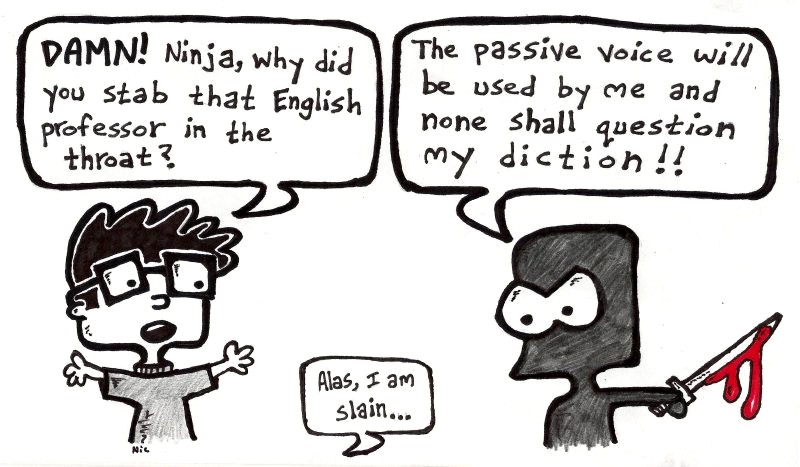
passive voice ninjaIf science is the best way to reduce subjectivity when asking a question of how something works, then an inherently essential aspect of this is getting your message across to as many people and as clearly as possible. And as CB readers will know, I’m all about ‘getting the message out’.

As such, when asked by a stranger about what I do, I often respond ‘writer’, because perhaps next to maths, I spend most of my time writing. I tend to argue that without good oral and (especially) written communication skills, even the most brilliant scientist is functionally useless to the rest of society.

So being a writer means that focussing on what some would describe as mundane – spelling, grammar, writing style and clarity – is an essential preoccupation. I’ve written about grammatical and style issues before (see here and here), and in the spirit of providing tips to young scientists out there, here’s another suggestion.

Please, please, please use your own voice.

I’m talking about that archaic style of zombie writing that has plagued scientific writing since its inception – the passive voice.

Read the rest of this entry »


Touchy-feely ecologists

18 04 2013

happy scientistOne of the many reasons I started this blog nearly five years ago was to engage both minds and hearts that my (and my colleagues’) scientific journal papers were failing to do. Of course we have emotional attachment to our areas of expertise (I’ve never met a good scientist who wasn’t passionate about what they studied) – but as Alejandro Frid encourages – we just have to transmit that emotional component better to our fellow human beings.

The title is not a joke about sensitive, New Age guys. I am quite serious about it. Though no academic superstar, I have been publishing in ecological and conservation journals for almost twenty years. I love the discipline. I’d hate to see it fail.

What I am talking about is this: ecologists read and write about ‘extinction’, ‘over-exploitation’, ‘climate change’ and so forth as a matter of routine. Yet at the same time, science journals are full of examples of how resources can be used more sustainably, of human behaviours that reduce the greenhouse gases that alter the climate and acidify the oceans, and of alternative economic models that value a healthy biosphere. So why do consumer apathy and political inertia still run the same old show?

I know, I know. Social scientists are working hard on this question (check out, for instance, just about any issue of Nature Climate Change). But what matters is not the rigorous answer that they might produce (we already know that it is 42 – Douglas Adams couldn’t be wrong); it is instead that most non-scientists probably don’t even care about the question. Read the rest of this entry »


Why every scientist needs an online profile

31 01 2013
hide

Don’t be guilty of this.

It astounds me every time I hear about a scientist who is reluctant to place her or his track record on the internet. Now, I may be a little over-the-top when it comes to my own web-presence (some have labelled me a ‘media tart’, but I don’t mind), but I am convinced that without a strong, regularly updated web presence, you’re doing yourself a horrible disservice.

Let’s go through the regularly raised objections that some academics make for avoiding the investment in a strong web presence:

  1. My employer will get angry
  2. My track record isn’t good enough (i.e., I’m embarrassed)
  3. What I do is no one else’s business
  4. I couldn’t be bothered; it’s too much work
  5. No one reads it anyway

While there might be some truth to items 1 & 2 (although the justification is weak or often plainly untrue), the last three are pure bullshit.

Let’s start by analysing the bullshit (rolls up sleeves, starts digging…).

Read the rest of this entry »


How to write a scientific paper

22 10 2012

Several years ago, my long-time mate, colleague and co-director, Barry Brook, and I were lamenting how most of our neophyte PhD students were having a hard time putting together their first paper drafts. It’s a common problem, and most supervisors probably get their collective paper-writing wisdom across in dribs and drabs over the course of their students’ torment… errhm, PhD. And I know that every supervisor has a different style, emphasis, short-cut (or two) and focus when writing a paper, and students invariably pick at least some of these up.

But the fact that this knowledge isn’t innate, nor is it in any way taught in probably most undergraduate programmes (I include Honours in that list), means that most supervisors must bleed heavily on those first drafts presented to them by their students. Bleeding is painful for both the supervisor and student who has to clean up the mess – there has to be a better way.

Yes, there are books on the issue (see, for example, Day & Castel 2011, Hofmann 2009, Schimel 2011), but how many starting PhDs sit down and read such books cover to cover? Hell, I can barely get them to read the basic statistics texts.

So as is classic for Barry, he came up with his own approach that I like to call ‘La Méthode Brookoise’ (a tribute to another clever jeu de mots). This short-cut guide to setting up a scientific paper is simple, effective and intuitive. Sure, it was designed with ecology in mind, but it should apply to most scientific disciplines. It appeals to most of our students, and we have both been asked for copies by other supervisors over the years. Our original intention was to write a paper about writing papers to flesh out the full Méthode, but that has yet to happen.

Therefore, for the benefit of the up-and-comings (and perhaps to a few of those longer in tooth), behold La Méthode Brookoise for writing papers: Read the rest of this entry »


Knowledge slavery

29 01 2012

manaclesAnother workshop; another productive week.

As many readers will know, I’ve spent the last week in the mountains north of Madrid working on a series of conservation ecology papers with host Miguel Araújo (of the Integrative Biology and Global Change Group at the Spanish National Museum of Natural Sciences), my lab colleagues, Barry Brook, Damien Fordham and Salvador Herrando-Pérez, and Miguel’s post-doc, Regan Early.

Let me tell you, staying in the craggy granite Sierra de Guadarrama mountains at a well-known health spa eating explosively flavourful Spanish food and drinking an immodest selection of the region’s delicious wines, is particularly conducive to scientific productivity (yes, I AM a jammy tart). Although unlikely to be followed by many (even if they have the means), I highly recommend the experience for those suffering from writer’s block.

But this post isn’t about the scenery, food, wine, hydrothermal treatment or even the content of the workshop at all (I just prefaced it as such to gloat); it’s about a particularly sore point for me and hundreds of thousands of other scientists the world over – our slavery to the scientific publishing industry.

And ‘slavery’ is definitely the most appropriate term here, for how else would you describe a business where the product is produced by others for free1 (scientific results), is assessed for quality by others for free (reviewing), is commissioned, overviewed and selected by yet others for free (editing), and then sold back to the very same scientists and the rest of the world’s consumers at exorbitant prices.

This isn’t just a whinge about a specialised and economically irrelevant sector of the economy, we’re talking about an industry worth hundreds of billions of dollars annually. In fact, Elsevier (agreed by many to be the leader in the greed-pack – see how some scientists are staging their protest; also here) made US$1.1 billion in 2010! Read the rest of this entry »


Supercharge Your Science V.2

24 11 2011

I suspect a lot of ConservationBytes.com readers will be attending the imminent 25th International Congress for Conservation Biology to be held in Auckland from 5-9 December 2011 (it was to be held in Christchurch, but the venue was changed after that city fell down). I’ve now been to 3 previous ICCBs myself, and it should prove to be a good, informative (and fun) meeting.

I’ll be giving a talk or two, as will some of my students and postdocs, but I’m not spruiking those here (but you’re all invited, of course).

The main reason for this short post today is to advertise for Version 2 of our (i.e., Bill Laurance and me) popular ‘Supercharge Your Science‘ workshop. Yes, the organising committee of the ICCB decided it was a good idea to accept our application to repeat our previously successful series of presentations extolling the virtues of positive and controlled media interactions, social media and good writing techniques for ‘supercharging’ the impact of one’s science. You can read more about the content of this workshop here and here.

The description of the workshop (to be held from 19.00 – 21.00 on 6 December in the SkyCity venue) on the ICCB website is: Read the rest of this entry »


A supervisor’s lament

5 09 2011

© hradcanska http://ow.ly/6lCAO

Time for a little supervisory whinge. I’ve lamented these very issues over many a beer at many a conference, so I thought I’d solidify those hazy arguments into a blog post.

I’m by no means the most burdened academic when it comes to student load. We tend to be very picky in our lab when engaging post-graduate student prospects, and even pickier when hiring post-doctoral fellows (because the latter require little things like salaries that unfortunately, do not grow on trees). We also endeavour to share the load – most of our post-docs have at least one primary PhD student responsibility which reduces some of my burden and gives the post-doc in question the requisite experience in supervising. In my opinion, it’s a good way to run a lab, and allows for a high number of productive students, yet is not overly onerous for any one person.

That said, I make sure I read EVERYTHING my students produce, and I take a certain amount of pride in providing as much of my intellectual input as possible: from study design right through to proof correction. If my name is going to be on a paper, I had better bloody well earn my co-authorship. Read the rest of this entry »


Demise of the Australian ERA journal rankings

3 06 2011

Earlier this week Australian Senator Kim Carr (Minister for Innovation, Industry, Science and Research) announced the removal of the somewhat controversial ERA rankings for scientific journals.

Early last year I posted about the Excellence in Research for Australia (ERA) journal rankings for ecology and conservation journals. To remind you, the ERA has ranked > 20,000 unique peer-reviewed journals, with each given a single quality rating – and they are careful to say that “A journal’s quality rating represents the overall quality of the journal. This is defined in terms of how it compares with other journals and should not be confused with its relevance or importance to a particular discipline.”.

Now, after much to-ing and fro-ing about what the four rankings actually mean (A*, A, B & C), Senator Carr has announced that he’s dumping them under the advice of the Australian Research Council. Read the rest of this entry »


Build a bridge out of ‘er

12 03 2011

Apologies to Monty Python and my poor attempt to make the over-used expression ‘bridging the gap’ humorous.

Today’s guest post comes from across the Pacific Ocean. Dr. Sara Maxwell is a postdoctoral fellow with Marine Conservation Biology Institute and University of California Santa Cruz, Long Marine Laboratory. She was kind enough to contribute to ConservationBytes.com about an issue I’ve covered before in various forms – making conservation research relevant for conservation action.

© R. Arlettaz

In a catalyzing article titled “From publications to public actions: when conservation biologists bridge the gap between research and implementation” in the November 2010 issue of BioScience, Raphaël Arlettaz1 and his colleagues Michael Schaub2, Jérôme Fournier3, Thomas Reichlin2, Antoine Sierro4, James Watson5 and Veronika Braunisch2 explore reasons for our hard work as conservation biologists not reaching the implementation phase. This article strongly resonated with my colleague, Kiki Jenkins6 and I, Sara Maxwell. This resulted in a series of letters published in BioScience and now we join together, along with Jeffrey Camm7, Guillaume Chapron8, Liana Joseph9, and Rudi Suchant10 to synthesize our ideas and present them to the larger conservation community via ConservationBytes.

The article that sparked the discussion

In their article, Arlettaz and colleagues highlight some of the main roadblocks to implementing conservation research. The main reasons are that:

  1. The research made by conservation biologists’ does not lend itself well to implementation, i.e., as a community we often focus on the wrong questions or address them in ways that do not lead to practical applications for practitioners;
  2. The outcomes of conservation biologists’ research tends not to reach practitioners and so fails to be put into action;
  3. When we successfully align and collaborate with practitioners, there is a lack of economic or political support to make the changes that need to happen; or
  4. Conservation biologists do not commit to engaging themselves in the implementation of their recommendations due to a lack of reward structure for this behaviour and the conflicting roles of academia and conservation.

Arlettaz and colleagues illustrate how to overcome these roadblocks using a case study of their own work on the endangered hoopoe (Upupa epops) in Switzerland, showing how they followed through the recommendations of their work to implementation and had a direct impact on species recovery. They highlight means by which other conservation biologists can do the same.

Read the rest of this entry »


Biodiversity begins at home

20 01 2011

A few months ago I was involved in a panel discussion entitled ‘Biodiversity begins at home’ held at the Royal Institution of Australia in Adelaide and sponsored by the Don Dunstan Foundation.

The main thrust of the evening was to have both academic (me & Andy Lowe) and on-the-ground, local conservationists (Sarah Lance, Craig Gillespie and Matt Turner) talk about what people can do to stem the tide of biodiversity loss. The video is now available, so I thought I’d reproduce it here. We talked about a lot of issues (from global to local scale), so if you have a spare hour, you might get something out of this. I did, but it certainly wasn’t long enough to discuss such big issues.

Warning – this was supposed to be more of a discussion and less of a talkfest; unfortunately, many of the panel members seemed to forget this and instead dominated the session. We really needed 4 hours to do this properly (but then, who would have watched the video?).

Read the rest of this entry »


Leaving Conservation Letters

21 12 2010

It is with both sighs of relief and some sentimentality that I announce my departure from the Senior Editor’s position at Conservation Letters.

After 3 volumes and 17 issues, and a very good prospect for an ISI Impact Factor > 3.0 coming out in June 2011, I feel that I’ve contributed sufficiently for the journal to persist in the conservation publication space for the coming decades.

Now I need a beer. ;-)

The road to Senior Editor certainly involved a steep learning curve for me, and I sincerely thank the four Editors-in-Chief (Hugh Possingham, Bill Sutherland, Richard Cowling & Mike Mascia) for their faith in my abilities and the flexibility to allow me to make important decisions. But most importantly, I thank our highly professional and rigorous editorial board who really did all the hard work (voluntarily, I might add). The full list of editors can be found here, but I want to pass on some extra gratitude to a few specific people here:

In a word, you lot were brilliant. Thank you for going well beyond expectations and handling some very difficult manuscripts. Your expertise, professionalism and generosity will not go unnoticed, I can guarantee that.

I also thank Jennifer Mahar for keeping me (mostly) on the ball and for making the whole thing come together. Marjorie Spencer, whose brainchild this journal was, was a breath of fresh air and enthusiasm. Thanks for stepping up for me (oh, and thanks too for the many drinks courtesy of Uncle Wiley).

Read the rest of this entry »


Biowealth – a lexical leap forward for biodiversity appreciation

17 12 2010

Here’s a little idea I’ve been kicking around in my head that I’d like to invite you to debate. Call it an ‘Open Thread’ in the spirit of BraveNewClimate.com’s successful series.

© The Economist

Let’s face it, ‘biodiversity’ is a slippery and abstract concept for most people. Hell, even most ecologists have a hard time describing what biodiversity means. To the uninitiated, it seems simple enough. It’s just the number of species, isn’t it?

Well, no. It isn’t.

Unfortunately, it’s far, far more complicated. First, the somewhat arbitrary pigeon-holing of organisms into Linnaean taxonomic boxes doesn’t really do justice to the genetic gradients within species, among populations and even between individuals. We use the pigeon-hole taxonomy because it’s convenient, that’s all. Sure, molecular genetics has revolutionised the concept, but to most people, a kangaroo is a kangaroo, a robin is a robin and an earthworm is an earthworm. Hierarchical Linnaean taxonomy prevails.

Then there’s the more prickly issue of α, β and γ diversity. α diversity essentially quantifies species richness within a particular area, whereas β diversity is the difference in α diversity between ecosystems. γ diversity is used to measure overall diversity for the different constituent ecosystems of a region. Scale is very, very important (see our recent book chapter for more on this). Read the rest of this entry »


Appalling behaviour of even the most influential journalists

4 11 2010


© J. Dunn


I’ve said it a few times in public and in private – one of the main reasons I, as a busy scientist with probably insufficient time to devote to a lay blog (no different to any busy scientist, mind), got into this whole gig in the first place was to fight back against dodgy reporters and shonky ‘journalists’.
For the most part I have to say that I’ve been represented reasonably well in the media – even if most of it is owned by a few highly questionable moguls who espouse wildly partisan views. There have been a few occasions though where I’ve been the victim of simply crap reporting, terribly investigation and downright dirty tactics done by so-called journalists. I’ve talked about this on a few occasions on ConservationBytes.com (see ‘Crap environmental reporting‘, ‘Science turned bad by the media‘ and ‘Poor media coverage promotes environmental apathy and untruths‘).

In a bit of a coincidental turn of events, Bill Laurance sent me an interesting piece published in Nature on this very subject just while Paul Ehrlich and I (most of you know that Paul is in Adelaide at the moment) were talking about ways in which scientists could turn around public opinion from one of suspicion of science, logic and intellectualism, to one applauding the application of objective techniques to solve the world’s worst problems. Paul half-jokingly said “what if there is no solution?” – but I suspect that one such as he has found that constant writing, outreach and excellent research are the only ways to tear down the walls of ignorance, despite all the stupidity of certain elected officials. Two steps forward, one step back.

Bill suggested ConservationBytes would be a good place to reproduce this excellent article by Simon Lewis of the University of Leeds, and I agree. So here it is: Read the rest of this entry »


Conservation Biology Students’ Wonder Wiki

8 10 2010


© H Grebe


After the last full day of Supercharge Your Science in Townsville a few weeks ago, the other presenters and I, plus a few keen punters, headed to the pub for a few well-earned beers. There I had the distinct pleasure of meeting up again with Piero Visconti, a PhD candidate at James Cook University and in the Centre of Excellence for Coral Reef Studies (we had met previously in July at the International Congress for Conservation Biology in Edmonton).

Piero, in his typically Italian exuberance, was excited to tell me about a Society for Conservation Biology initiative especially geared toward conservation biology students. I said I had never heard of the idea, so suggested Piero write a little post for ConservationBytes.com telling the world about it. Piero has come through with the goods, and so I give you the conservation biology students’ wiki:

About a year ago in Prague at the European Congress of Conservation Biology, a group of students met informally to discuss what the Society for Conservation Biology (SCB) could do to help students during their career. The group came up with a bunch of good ideas, but one especially turned out to be a great success: a wiki for conservation biology students.

This wiki would be accessible and open to everyone’s contribution. It would host anything from upcoming events, scholarship offers, grant notices, jobs adverts, advice on writing abstracts, presentations for conferences…etc., etc. The idea there was that a wiki would be a great way to provide students with a continuous and interactive experience with their peers.

Also, there are plenty of useful resources out there for conservation biology students; they just need to be organised into a single, easy-to-access and open website. Finally, with international SCB conferences occurring every two years from 2011, the SCB needed a fast and interactive media platform to stay in touch with its student members and listen to their requests. Read the rest of this entry »


Supercharge your science: Blogito ergo sum

22 09 2010

Alas, I didn’t make up that wonderful expression (can anyone tell me who did?), but it was a very appropriate title for the presentation I gave today at the Supercharge Your Science workshop held at the JCU Cairns campus. For those of you who have never read any Descartes (I will forgive you – boring as philosophy gets), it comes from his well-known Cogito ergo sum (I think therefore I am/exist) statement. Someone cleverly adapted it to blogging.

So this post really just focuses on my component of the 5-presentation workshop extravaganza. Bill Laurance gave his two popular Interacting with the media and How to write a paper presentations (podcasted here), Mike Seyfang gave a great look at the current and future applications of social media to science, Jennifer Lappin showed how her organisation, the ARC Centre of Excellence for Coral Reef Studies, really blitzed the world with top-notch media engagement, and I gave my advice on science blogging (why, what, how, do, don’t, where). The full webinar is reproduced below via Slideshare.

Where taking the show on the road and will be giving the workshop again in Townsville on Friday. I dare say too that we’ll be giving it at many other venues in Australia and perhaps overseas over the coming months. The interest seems massive.

Don’t forget to follow and engage using the associated Twitter hashtag #4ss.

CJA Bradshaw


Supercharge Your Science

10 09 2010

In a little under two weeks I’ll be co-running a workshop of the same name at James Cook University at both the Cairns and Townsville campuses.

With me will be super-scientist, media-guru and anti-deforestation advocate, Distinguished Professor Bill Laurance (who you might remember came to Adelaide earlier this year and gave some great talk), ex-Microsoft man and social media guru (and self-entitled ‘geezer’), Mike Seyfang, and the Media Coordinator for the Australian Research Council Centre of Excellence for Coral Reef Studies, Jennifer Lappin.

Should be heaps of fun (and hopefully highly educational). Basically we’ll be preaching to aspiring and well-established researchers in many areas about how they can maximise the impact of their scientific research, in terms of media, education, outreach and policy.

I’ll be talking about science blogging (and blogging science!), other social media uses in science, and some of my personal experiences with ConservationBytes.com. I haven’t yet finalised my presentation, but I think it’ll be insightful.

Here’s the official blurb for the 1-day workshop: Read the rest of this entry »


Long, deep and broad

24 08 2010

© T. Holub Flickr

Thought that would get your attention ;-)

More scientists need to be trained in quantitative synthesis, visualization and other software tools.” D. Peters (2010)

In fact, that is part of the title of today’s focus paper in Trends in Ecology and Evolution by D. Peters – Accessible ecology: synthesis of the long, deep,and broad.

As a ‘quantitative’ ecologist (modeller, numerate, etc.) whose career has been based to a large degree on the analysis of large ecological datasets, I am certainly singing Peters’ tune. However, it’s much deeper and more important than my career – good (long, deep, broad – see definitions below) ecological data are ESSENTIAL to avoid some of the worst ravages of biodiversity loss over the coming decades and centuries. Unfortunately, investment in long-term ecological studies is poor in most countries (Australia is no exception), and it’s not improving.

But why are long-term ecological data essential? Let’s take a notable example. Climate change (mainly temperature increases) measured over the last century or so (depending on the area) has been determined mainly through the analysis of long-term records. This, one of the world’s most important (yet sadly, not yet even remotely acted upon) issues today, derives from relatively simple long-term datasets. Another good example is the waning of the world’s forests (see posts herehere and here for examples) and our increasing political attention on what this means for human society. These trends can only be determined from long-term datasets.

For a long time the dirty word ‘monitoring’ was considered the bastion of the uncreative and amateur – ‘real’ scientists performed complicated experiments, whereas ‘monitoring’ was viewed mainly as a form of low-intellect showcasing to please someone somewhere that at least something was being done. I’ll admit, there are many monitoring programmes producing data that aren’t worth the paper their printed on (see a good discussion of this issue in ‘Monitoring does not always count‘), but I think the value of good monitoring data has been mostly vindicated. You see, many ecological systems are far too complex to manipulate easily, or are too broad and interactive to determine much with only a few years of data; only by examining over the ‘long’ term do patterns (and the effect of extremes) sometimes become clear.

But as you’ll see, it’s not just the ‘long’ that is required to determine which land- and sea-use decisions will be the best to minimise biodiversity loss – we also need the ‘deep’ and the ‘broad’. But first, the ‘long’. Read the rest of this entry »


Conservation research rarely equals conservation

21 07 2010

This post was chosen as an Editor's Selection for ResearchBlogging.org

I am currently attending the 2010 International Meeting of the Association for Tropical Biology and Conservation (ATBC) in Sanur, Bali (Indonesia). As I did a few weeks ago at the ICCB in Canada, I’m tweeting and blogging my way through.

Yesterday I attended a talk by my good friend Trish Shanley (formerly of CIFOR) where she highlighted the disconnect between conservation research and actual conservation. I’ve posted about this before (see Out of touch, impractical and irrelevantMake your conservation PhD relevant), but this was a sobering reminder of how conservation research can be a self-perpetuating phenomenon and often not touch the people who need it most.

Presenting the highlights of her paper published earlier this year in Biotropica entitled Out of the loop: why research rarely reaches policy makers and the public and what can be done, one comment she made during the talk that really caught my attention was the following (I’m paraphrasing, of course).

Most of the world’s poor living off the land are unconcerned about biodiversity per se. As conservationists we should not therefore adopt the typical preamble that biodiversity (e.g., forests) represent the “lungs of our planet” – what people (and especially women) need to know is how biodiversity loss affects “food for my children”.

The paper itself was an interview 268 researchers from 29 countries (of which I was one) about their views on the relevance of their work. Not surprisingly (but amazingly that we were so honest), most respondents stated that their principal target was other scientists, with policy makers and other marginalised groups/local people holding a distant second place. Corporate targets were also pretty rare – I guess we feel as a group that that’s generallly a lost cause.
Neither a surprise was that we generally view peer-reviewed scientific publications as the main vehicle for the dissemination of our results. What was a bit of a surprise though is that we fully admit papers aren’t the best way to trickle down the information (again, more of that brutal honesty); apparently we mainly believe ‘stakeholder meetings’
are more effective (I have my doubts).


Big Blog Theory Finalist: please vote

13 07 2010

Just a quick post to mention that ConservationBytes.com has been chosen as a finalist in the 2010 National Science Week‘s Big Blog Theory Australia’s Best Science Blogger competition. Voting starts now, and I need votes to win!

If you enjoy my posts, please vote for me by navigating to this website.

Thanks for your support!

CJA Bradshaw

Add to FacebookAdd to DiggAdd to Del.icio.usAdd to StumbleuponAdd to RedditAdd to BlinklistAdd to TwitterAdd to TechnoratiAdd to Yahoo BuzzAdd to Newsvine