Australia leads the world in mammal extinctions.
Over the last two hundred years 22 mammal species have become extinct, and over 100 are now on the threatened and endangered species list, compiled as part of the federal government’s Environment Protection and Biodiversity Conservation Act.
Evidence suggests Australia is on the cusp of another wave of mammal extinctions with a reduction in the abundance of some species and alarmingly, their range.
This is undoubtedly one of the major biodiversity conservation issues affecting Australia. It’s crucial we focus on the management solutions required to stop these species falling into extinction.
A South American success story
Working as a zoologist has allowed me to be involved in projects across the globe, looking at species at risk of extinction due to over-exploitation by humans.
Earlier this year I edited a book on the South American vicuña‘s comeback from the brink of extinction. Once abundant in the Andes, this wild relative of the llama suffered a sharp population drop in the 1960s due to international demand for its fleece.
An international moratorium on the sale of vicuña fleece in 1969 saw populations recover enough by 1987 for Andean communities to be able to harvest the fibre in a sustainable way. Population numbers of vicuña have remained healthy ever since, making it one of the few success stories of wildlife conservation worldwide.
Australia’s mammal extinction crisis
However Australia’s medium-sized mammals have had to deal with a different range of issues to the vicuña: the introduction of feral animals, particularly cats and foxes; increased grazing pressure; altered fire regimes; the clearing of habitat for development and production; and now, the effects of climate change.
It isn’t that any of these pressures are particularly important by themselves, but the fact that many of them act in concert has had a significant impact on causing the crashes in population numbers, and increasing the risk of species becoming extinct.
For example, the crescent nailtail wallaby was once an abundant and widespread macropod of central and western Australia. The pressures of feral cats and foxes coupled with clearing for agriculture and grazing, and altered fire regimes pushed this little species over the edge and it is now classified as extinct.
The problem is also more far-reaching than we first assumed. Many people may think that animals are becoming extinct in the south of Australia where habitat destruction is quite evident.
But the populations of iconic species in the north of Australia such as the northern quoll, golden bandicoot and the Carpentarian rock-rat are also collapsing. In our lifetime populations of some species have greatly reduced in number, and others have completely disappeared in landscapes that are considered to be in excellent condition.
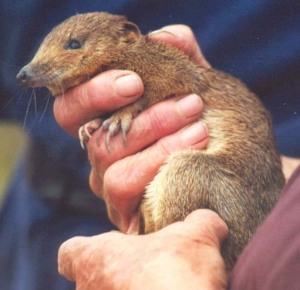
The golden bandicoot, listed as a vulnerable species, used to be found across much of the north of Australia. It is now only found in very small populations in the Northern Territory and on the isolated Burrow Island off the coast of Western Australia.
Time to bring back the dingo?
Further research on the impacts of fire, grazing, invasive species and climate change on Australian mammals would be extremely valuable, but ecologists recognise that crucial management decisions need to be made now.
We’ve found ourselves in a position where we have identified the threats to Australian mammal species and documented the loss of these species, the role of science must turn more directly to identifying the opportunities for assisting the survival of these mammals.
In August I chaired a panel with Professor Chris Johnson from James Cook University at the International Congress of Ecology, to discuss what management could be put in place now to help beleaguered populations of small mammals recover.
Johnson’s main focus is to bring back the top-order predator.
He believes there is now good evidence that a stable population of dingoes suppresses the numbers and activity of foxes and cats, and some other feral animal species as well.
He argues that the effect of using a top predator like the dingo to hold down populations of foxes and cats is that the total intensity of predation on smaller native mammals can be reduced.
Bringing back the dingo has many sheep and cattle farmers raising their eyebrows because the wild dogs are known to kill stock. But guardian sheepdogs can protect stock herds by fighting off dingoes if they come too close. This still allows the dingoes to have a beneficial effect in the ecosystem.
Current trials of Maremma dogs, a type of sheepdog, at Dunluce sheep station in northwest Queensland demonstrate that they can be effective dingo deterrents in a pastoral zone.
This is just one potential solution that may work in some areas. Reinstating mosaic fire regimes, where patches of land are burnt at different times to allow the land to recover in stages, and controlling grazing around sensitive habitat of endangered mammals are other potential solutions that are currently under trial in various parts of the country.
Working together
Even though science doesn’t have all the answers I believe that it is more important than ever for land managers and scientists to work together to put new management regimes on the ground.
Our scientific knowledge can provide guidelines for land managers to reduce the pressures on our biodiversity. Through monitoring how species and ecosystems respond to on-ground management we can then learn and adapt our advice to meet future challenges facing Australia’s threatened species.
We need to act now: the international community is watching Australia and we have an opportunity to show how we can apply science through collaborative agreements with land managers to reduce the threats and protect endangered species.
We’ll then be able to add Australian animals to the short list of species, like the vicuña, that have been brought back from the brink of extinction.




 I love these sorts of experiments. Ecology (and considering conservation ecology a special subset of the larger discipline) is a messy business, mainly because ecosystems are complex, non-linear, emergent, interactive, stochastic and meta-stable entities that are just plain difficult to manipulate experimentally. Therefore, making inference of complex ecological processes tends to be enhanced when the simplest components are isolated.


 A good friend and colleague of mine, Dr.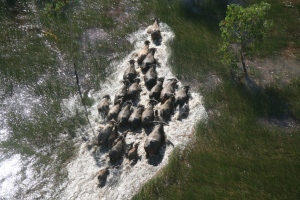
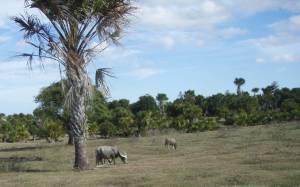
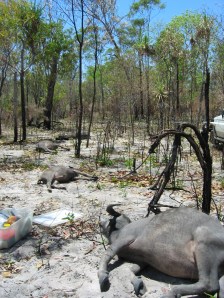 Although buffalo in Australia experienced two major periods of population reduction since their introduction, a small proportion (estimated at ~ 20 %) escaped the BTEC reduction in the eastern part of its north Australian range. BTEC did not operate with uniformity across the entire range of buffalo, concentrating its destocking efforts in a general area from the western coast of the Northern Territory to west of the Mann River in Arnhem Land, and south roughly to Kakadu National Park’s southern border. Coincidently and not surprisingly, it is in this area that we observe most migration activity.




 “…nobody puts a value on pollination; national accounts do not reflect the value of ecosystem services that stop soil erosion or provide watershed protection.“


 Last year our group published a paper in