Small populations of Stone Age people drove dwarf hippos and elephants to extinction on Cyprus

18 09 2024

Corey J. A. Bradshaw, Flinders University; Christian Reepmeyer, Deutsches Archäologisches Institut – German Archaeological Institute, and Theodora Moutsiou, University of Cyprus


Imagine growing up beside the eastern Mediterranean Sea 14,000 years ago. You’re an accomplished sailor of the small watercraft you and your fellow villagers make, and you live off both the sea and the land.

But times have been difficult — there just isn’t the same amount of game or fish around as when you were a child. Maybe it’s time to look elsewhere for food.

Now imagine going farther than ever before in your little boat, accompanied maybe by a few others, when suddenly you spot something on the horizon. Is that an island?

The western coast of Cyprus. CJA Bradshaw / Flinders University

An island of tiny elephants and hippos

Welcome to Cyprus as the world emerges from the last ice age. You are the first human to set your eyes on this huge, heavily forested island teeming with food.

When you beach your boat to have a look around, you can’t believe what you’re seeing — tiny boar-sized hippos and horse-sized elephants that look like babies to your eyes. There are so many of them, and you’re hungry after the long journey.

The diminutive beasts don’t seem to show any fear. You easily kill a few and preserve the meat as best you can for the long journey back.

When you get home, you are excited to let everyone in the village know what you’ve found. Soon enough, you organise a major expedition back to the island.

Of course, we’ll never know if this kind of scenario took place, but it’s a plausible story of how and when the first humans managed to get to Cyprus. It also illustrates how they might have quickly brought about the demise of the tiny hippopotamus Phanourios minor, as well as the dwarf elephant Palaeoloxodon cypriotes.

Read the rest of this entry »


Indigenous fire management began more than 11,000 years ago: new research

12 03 2024

Wildfire burns between 3.94 million and 5.19 million square kilometres of land every year worldwide. If that area were a single country, it would be the seventh largest in the world.

In Australia, most fire occurs in the vast tropical savannas of the country’s north. In new research published in Nature Geoscience, we show Indigenous management of fire in these regions began at least 11,000 years ago – and possibly as long as 40,000 years ago.

Fire and humans

In most parts of the planet, fire has always affected the carbon cycle, the distribution of plants, how ecosystems function, and biodiversity patterns more generally.

But climate change and other effects of human activity are making wildfires more common and more severe in many regions, often with catastrophic results. In Australia, fires have caused major economic, environmental and personal losses, most recently in the south of the country.

One likely reason for the increase of catastrophic fires in Australia is the end of Indigenous fire management after Europeans arrived. This change has caused a decline in biodiversity and the buildup of burnable material, or “fuel load”.

Read the rest of this entry »


People once lived in a vast region in north-western Australia – and it had an inland sea

21 12 2023

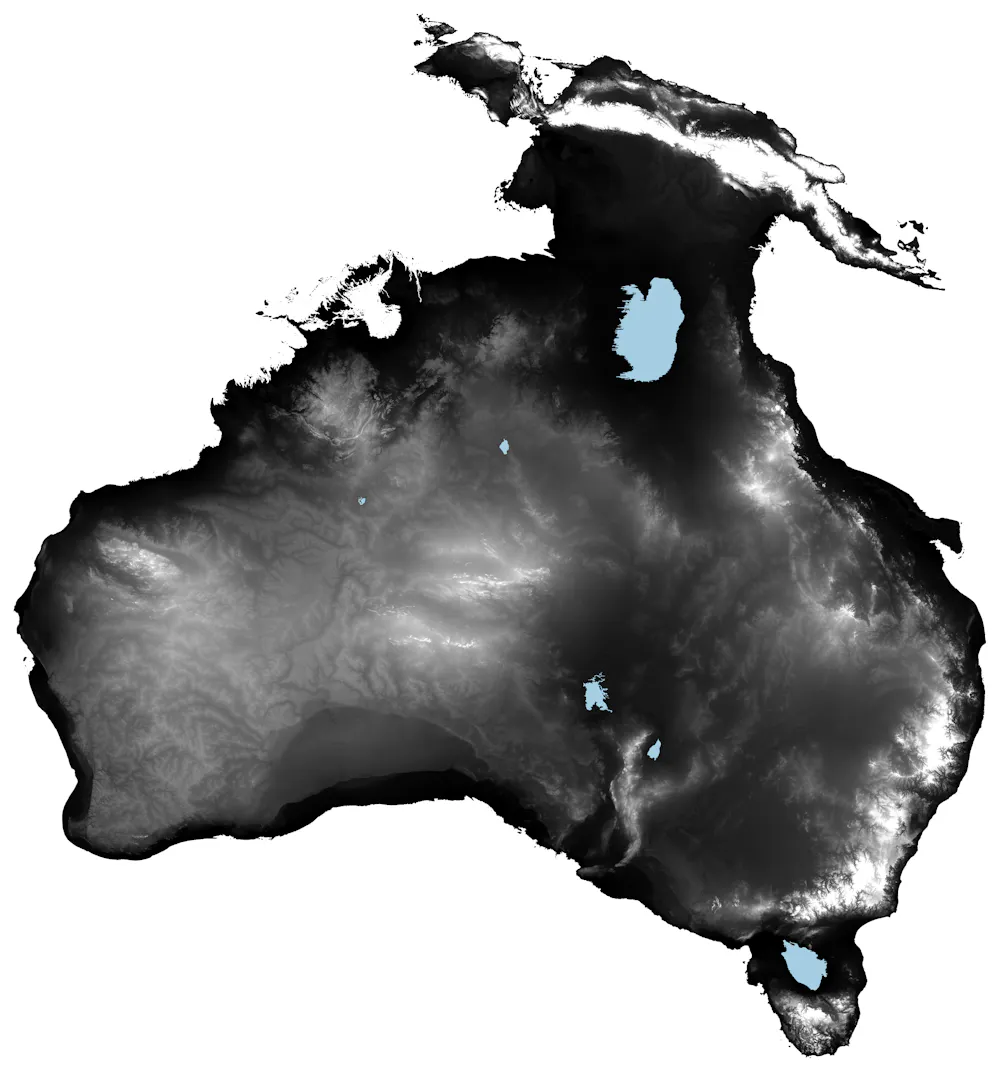
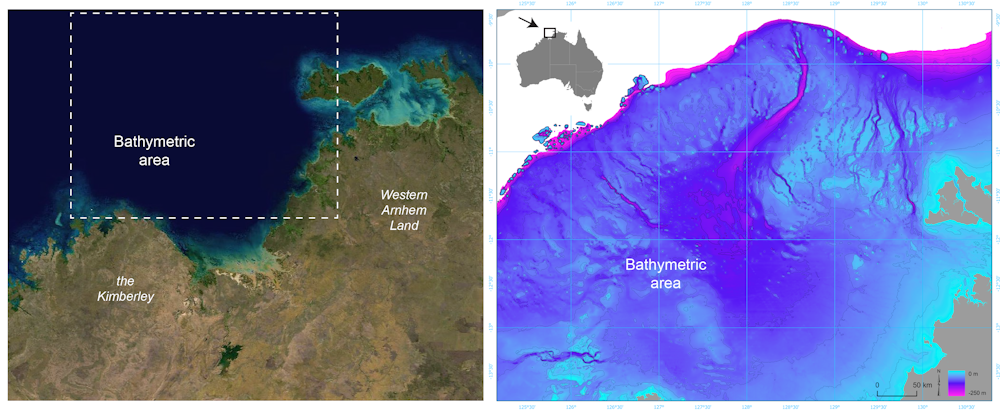
For much of the 65,000 years of Australia’s human history, the now-submerged northwest continental shelf connected the Kimberley and western Arnhem Land. This vast, habitable realm covered nearly 390,000 square kilometres, an area one-and-a-half times larger than New Zealand is today.

Overhead image of a coastline with modern day outlines and what it used to look like
Left: Satellite image of the submerged northwest shelf region. Right: Drowned landscape map of the study area. US Geological Survey, Geoscience Australia

It was likely a single cultural zone, with similarities in ground stone-axe technology, styles of rock art, and languages found by archaeologists in the Kimberley and Arnhem Land.

There is plenty of archaeological evidence humans once lived on continental shelves – areas that are now submerged – all around the world. Such hard evidence has been retrieved from underwater sites in the North Sea, Baltic Sea and Mediterranean Sea, and along the coasts of North and South America, South Africa and Australia.

In a newly published study in Quaternary Science Reviews, we reveal details of the complex landscape that existed on the Northwest Shelf of Australia. It was unlike any landscape found on our continent today.

A continental split

Around 18,000 years ago, the last ice age ended. Subsequent warming caused sea levels to rise and drown huge areas of the world’s continents. This process split the supercontinent of Sahul into New Guinea and Australia, and cut Tasmania off from the mainland.

Unlike in the rest of the world, the now-drowned continental shelves of Australia were thought to be environmentally unproductive and little used by First Nations peoples.

But mounting archaeological evidence shows this assumption is incorrect. Many large islands off Australia’s coast – islands that once formed part of the continental shelves – show signs of occupation before sea levels rose.

Stone tools have also recently been found on the sea floor off the coast of the Pilbara region of Western Australia.

Read the rest of this entry »


The sixth mass extinction is happening now, and it doesn’t look good for us

2 03 2022

Mounting evidence is pointing to the world having entered a sixth mass extinction. If the current rate of extinction continues we could lose most species by 2200. The implication for human health and wellbeing is dire, but not inevitable.

In the timeline of fossil evidence going right back to the first inkling of any life on Earth — over 3.5 billion years ago — almost 99 percent of all species that have ever existed are now extinct. That means that as species evolve over time — a process known as ‘speciation’ — they replace other species that go extinct.

Extinctions and speciations do not happen at uniform rates through time; instead, they tend to occur in large pulses interspersed by long periods of relative stability. These extinction pulses are what scientists refer to as mass extinction events.

The Cambrian explosion was a burst of speciation some 540 million years ago. Since then, at least five mass extinction events have been identified in the fossil record (and probably scores of smaller ones). Arguably the most infamous of these was when a giant asteroid smashed into Earth about 66 million years ago in what is now the Gulf of Mexico. The collision vapourised species immediately within the blast zone. Later, species were killed off by climate change arising from pulverised particulates suspended in the atmosphere, as well as intense volcano activity stimulated by the buckling of the Earth’s crust from the asteroid’s impact. Together, about 76 percent of all species around at the time went extinct, of which the disappearance of the dinosaurs is most well-known. But dinosaurs didn’t disappear altogether — the survivors just evolved into birds.

Read the rest of this entry »


Population of First Australians grew to millions, much more than previous estimates

30 04 2021

Shutterstock/Jason Benz Bennee


We know it is more than 60,000 years since the first people entered the continent of Sahul — the giant landmass that connected New Guinea, Australia and Tasmania when sea levels were lower than today.

But where the earliest people moved across the landscape, how fast they moved, and how many were involved, have been shrouded in mystery.

Our latest research, published today shows the establishment of populations in every part of this giant continent could have occurred in as little as 5,000 years. And the entire population of Sahul could have been as high as 6.4 million people.

This translates to more than 3 million people in the area that is now modern-day Australia, far more than any previous estimate.


Read more: We mapped the ‘super-highways’ the First Australians used to cross the ancient land


The first people could have entered through what is now western New Guinea or from the now-submerged Sahul Shelf off the modern-day Kimberley (or both).

But whichever the route, entire communities of people arrived, adapted to and established deep cultural connections with Country over 11 million square kilometres of land, from northwestern Sahul to Tasmania.

A map showing a much larger landmass as Australia is joined to both Tasmania and New Guinea due to lower sea levels

Map of what Australia looked like for most of the human history of the continent when sea levels were lower than today. Author provided


This equals a rate of population establishment of about 1km per year (based on a maximum straight-line distance of about 5,000km from the introduction point to the farthest point).

That’s doubly impressive when you consider the harshness of the Australian landscape in which people both survived and thrived.

Previous estimates of Indigenous population

Various attempts have been made to calculate the number of people living in Australia before European invasion. Estimates vary from 300,000 to more than 1,200,000 people. Read the rest of this entry »


Climate change and humans together pushed Australia’s biggest beasts to extinction

25 11 2019

people-megafaunaOver the last 60,000 years, many of the world’s largest species disappeared forever. Some of the largest that we generally call ‘megafauna’ were first lost in Sahul — the super-continent formed by the connection of Australia and New Guinea during periods of low sea level. The causes of these extinctions have been heavily debated for decades within the scientific community.
Three potential drivers of these extinctions have been suggested. The first is climate change that assumes an increase in arid conditions that eventually became lethal to megafauna. The second proposed mechanism is that the early ancestors of Aboriginal people who either hunted megafauna species to extinction, or modified ecosystems to put the largest species at a disadvantage. The third and most nuanced proposed driver of extinction is the combination of the first two.

The primary scientific tools we scientists use to determine which of these proposed causes of extinction have the most support are dated fossil records from the extinct species themselves, as well as archaeological evidence from early Aboriginal people. Traditionally, the main way we use these data is to construct a timeline of when the last fossil of a species was preserved, and compare this to evidence indicating when people arrived. We can also reconstruct climate patterns back tens of thousands of years using models similar to the ones used today to predict future climates. Based on the comparison of all of these different timelines, we conclude that abrupt climate changes in the past were influential if they occurred at or immediately before a recorded extinction event. On the other hand, if megafauna extinctions occur immediately after humans are thought to have arrived, we attribute more weight to human arrival as a driver.

Read the rest of this entry »


Transition from the Anthropocene to the Minicene

24 09 2016

Going, going ...

Going, going … © CJA Bradshaw

I’ve just returned from a life-changing trip to South Africa, not just because it was my first time to the continent, but also because it has redefined my perspective on the megafauna extinctions of the late Quaternary. I was there primarily to attend the University of Pretoria’s Mammal Research Institute 50thAnniversary Celebration conference.

As I reported in my last post, the poaching rates in one of the larger, best-funded national parks in southern Africa (the Kruger) are inconceivably high, such that for at least the two species of rhino there (black and white), their future persistence probability is dwindling with each passing week. African elephants are probably not far behind.

As one who has studied the megafauna extinctions in the Holarctic, Australia and South America over the last 50,000 years, the trip to Kruger was like stepping back into the Pleistocene. I’ve always dreamed of walking up to a grazing herd of mammoths, woolly rhinos or Diprotodon, but of course, that’s impossible. What is entirely possible though is driving up to a herd of 6-tonne elephants and watching them behave naturally. In the Kruger anyway, you become almost blasé about seeing yet another group of these impressive beasts as you try to get that rare glimpse of a leopard, wild dogs or sable antelope (missed the two former, but saw the latter). Read the rest of this entry »


Why and how did Pleistocene megafauna go extinct?

27 05 2010

Just a quick post to say that I’m currently at Duke University in the USA attending a special National Evolutionary Synthesis Centre ‘Catalysis Meeting’ entitled: Integrating datasets to investigate megafaunal extinction in the Late Quaternary.

The meeting is basically about nailing down some of the remaining mysteries and controversies surrounding the extinction of many species during periods of rapid climate change 11-60 thousand years ago.

It’s been fun so far, and a lot of exciting analysis will ensue, but for the meantime I’ll just summarise what we’re trying to do. Read the rest of this entry »