Navjot Sodhi is gone, but not forgotten

13 06 2011

I woke up this morning to a battery of emails expressing condolences on the tragic passing of Navjot Sodhi. I have to say that his death is personally a huge blow, and professionally, a tragic loss to the fields of ecology and conservation biology. He was a good friend, and a bloke with whom I had some great times. He was someone I could trust.

Many of you will know that Navjot had been ill for the last few months. I was told that at first it was something unidentifiable, then it was suspected diabetes, then the shock – some sort of ‘blood cancer’. I found out today it was one of the worst and most aggressive kinds of lymphoma that shuffled dear Navjot off this mortal coil. And it acted fast.

As I reflect on this moment, I remember all the times I spent with Navjot. I first met him in 1992 in the most unlikely of places – Edmonton, Canada at the University of Alberta where I was doing my MSc, and he his post-doc with Sue Hannon. Many years later, Navjot confessed that he thought I was a complete knob when he first met me, and that’s something we’ve laughed about on many occasions thereafter. Read the rest of this entry »


Demise of the Australian ERA journal rankings

3 06 2011

Earlier this week Australian Senator Kim Carr (Minister for Innovation, Industry, Science and Research) announced the removal of the somewhat controversial ERA rankings for scientific journals.

Early last year I posted about the Excellence in Research for Australia (ERA) journal rankings for ecology and conservation journals. To remind you, the ERA has ranked > 20,000 unique peer-reviewed journals, with each given a single quality rating – and they are careful to say that “A journal’s quality rating represents the overall quality of the journal. This is defined in terms of how it compares with other journals and should not be confused with its relevance or importance to a particular discipline.”.

Now, after much to-ing and fro-ing about what the four rankings actually mean (A*, A, B & C), Senator Carr has announced that he’s dumping them under the advice of the Australian Research Council. Read the rest of this entry »


Getting conservation stakeholders involved

14 04 2011

Here’s another guest post from another switched-on Queensland student, Duan Biggs. Duan, originally from Namibia and South Africa, is doing his PhD at the ARC Centre for Coral Reef Studies at James Cook University in Townsville, Queensland. His PhD is investigating the resilience of nature-based tourism to climate change. I’ve met Duan a few times, and I’m impressed by his piercing views on conservation science and its implementation. Duan has already posted here on ConservationBytes.com (‘Make your conservation PhD relevant‘) and now adds his latest post discussing a paper he’s just had published in Conservation Letters. Thanks, Duan.

Achieving conservation outcomes almost always means working with stakeholders. ConservationBytes readers who have participated in multi-stakeholder conservation processes will know how difficult they are. Even more so when parties come from very different backgrounds and cultures. Farmers feel they just cannot comprehend what scientists are saying… ecologists silently curse [CJAB’s note: well, not always silently] because government officials ‘just don’t get it’ and so forth. So often, conservation projects are impeded, or even brought to a grinding halt because the very different perspectives that stakeholders bring to the table and the inability to see eye to eye.  This has left many a fervent conservationist and scientist feeling like the associated cartoon.

However, our new paper entitled The implementation crisis in conservation planning – could ‘mental models’ help? just out in Conservation Letters suggests ways of dealing with this almighty challenge.

Effective conservation requires conservation scientists to partner successfully with managers, extractive users and other stakeholder groups. Often, key stakeholders come from very different backgrounds and cultures, and hence have a diversity of values that result in a range of perspectives on issues. These differences are frequently a source of failure in conservation projects.

Read the rest of this entry »


Resolving the Environmentalist’s Paradox

7 04 2011

Here’s an extremely thought-provoking guest post by Megan Evans, Research Assistant at the University of Queensland in Kerrie Wilson‘s lab. Megan did her Honours degree with Hugh Possingham and Kerrie, and has already published heaps from that and other work. I met Megan first in 2009 and have been extremely impressed with her insights, broad range of interests and knowledge, and her finely honed grasp of social media in science. Smarter than your average PhD student, without a doubt (and she has even done one yet). Take it away, Megan.

© T. Toles

Resolving the ‘Environmentalist’s Paradox’, and the role of ecologists in advancing economic thinking

Aldo Leopold famously described the curse of an ecological education as “to be the doctor who sees the marks of death in a community that believes itself well and does not want to be told otherwise”. Ecologists do have a tendency for making dire warnings for the future, but for anyone concerned about the myriad of problems currently facing the Earth – climate change, an ongoing wave of species extinctions and impending peak oil, phosphate, water , (everything?) crises – the continued ignorance or ridicule of such warnings can be a frustrating experience. Environmental degradation and ecological overshoot isn’t just about losing cute plants and animals, given the widespread acceptance that long-term human well-being ultimately rests on the ability for the Earth to supply us with ecosystem services.

In light of this doom and gloom, things were shaken up a bit late last year when an article1 published in Bioscience pointed out that in spite of declines in the majority of ecosystem services considered essential to human well-being by The Millenium Ecosystem Assessment (MA), aggregate human well-being (as measured by the Human Development Index) has risen continuously over the last 50 years. Ciara Raudsepp-Hearne and the co-authors of the study suggested that these conflicting trends presented an ‘environmentalist’s paradox’ of sorts – do we really depend on nature to the extent that ecologists have led everyone to believe? Read the rest of this entry »


Build a bridge out of ‘er

12 03 2011

Apologies to Monty Python and my poor attempt to make the over-used expression ‘bridging the gap’ humorous.

Today’s guest post comes from across the Pacific Ocean. Dr. Sara Maxwell is a postdoctoral fellow with Marine Conservation Biology Institute and University of California Santa Cruz, Long Marine Laboratory. She was kind enough to contribute to ConservationBytes.com about an issue I’ve covered before in various forms – making conservation research relevant for conservation action.

© R. Arlettaz

In a catalyzing article titled “From publications to public actions: when conservation biologists bridge the gap between research and implementation” in the November 2010 issue of BioScience, Raphaël Arlettaz1 and his colleagues Michael Schaub2, Jérôme Fournier3, Thomas Reichlin2, Antoine Sierro4, James Watson5 and Veronika Braunisch2 explore reasons for our hard work as conservation biologists not reaching the implementation phase. This article strongly resonated with my colleague, Kiki Jenkins6 and I, Sara Maxwell. This resulted in a series of letters published in BioScience and now we join together, along with Jeffrey Camm7, Guillaume Chapron8, Liana Joseph9, and Rudi Suchant10 to synthesize our ideas and present them to the larger conservation community via ConservationBytes.

The article that sparked the discussion

In their article, Arlettaz and colleagues highlight some of the main roadblocks to implementing conservation research. The main reasons are that:

  1. The research made by conservation biologists’ does not lend itself well to implementation, i.e., as a community we often focus on the wrong questions or address them in ways that do not lead to practical applications for practitioners;
  2. The outcomes of conservation biologists’ research tends not to reach practitioners and so fails to be put into action;
  3. When we successfully align and collaborate with practitioners, there is a lack of economic or political support to make the changes that need to happen; or
  4. Conservation biologists do not commit to engaging themselves in the implementation of their recommendations due to a lack of reward structure for this behaviour and the conflicting roles of academia and conservation.

Arlettaz and colleagues illustrate how to overcome these roadblocks using a case study of their own work on the endangered hoopoe (Upupa epops) in Switzerland, showing how they followed through the recommendations of their work to implementation and had a direct impact on species recovery. They highlight means by which other conservation biologists can do the same.

Read the rest of this entry »


What the hell is a banteng?

21 02 2011

A few years ago (ok, 6 years), ABC‘s Catalyst did a piece on our banteng research programme in Garig Gunak Barlu National Park in the Northern Territory. The show basically talks about the conservation and management conundrum of having a successful feral species in Australia that is also highly endangered in its native range (South East Asia). Do we shoot them all, or legislate them as an endangered species? It’s for Australians to decide.

I finally got around to uploading it on Youtube. I hope I haven’t contravened some copyright law, but I figure after such a lag, no one will care. I await the imminent contradiction from the ABC’s lawyers…

I hope you enjoy.

For the scientific papers arising from the work, see: Read the rest of this entry »


Appalling behaviour of even the most influential journalists

4 11 2010


© J. Dunn


I’ve said it a few times in public and in private – one of the main reasons I, as a busy scientist with probably insufficient time to devote to a lay blog (no different to any busy scientist, mind), got into this whole gig in the first place was to fight back against dodgy reporters and shonky ‘journalists’.

For the most part I have to say that I’ve been represented reasonably well in the media – even if most of it is owned by a few highly questionable moguls who espouse wildly partisan views. There have been a few occasions though where I’ve been the victim of simply crap reporting, terribly investigation and downright dirty tactics done by so-called journalists. I’ve talked about this on a few occasions on ConservationBytes.com (see ‘Crap environmental reporting‘, ‘Science turned bad by the media‘ and ‘Poor media coverage promotes environmental apathy and untruths‘).

In a bit of a coincidental turn of events, Bill Laurance sent me an interesting piece published in Nature on this very subject just while Paul Ehrlich and I (most of you know that Paul is in Adelaide at the moment) were talking about ways in which scientists could turn around public opinion from one of suspicion of science, logic and intellectualism, to one applauding the application of objective techniques to solve the world’s worst problems. Paul half-jokingly said “what if there is no solution?” – but I suspect that one such as he has found that constant writing, outreach and excellent research are the only ways to tear down the walls of ignorance, despite all the stupidity of certain elected officials. Two steps forward, one step back.

Bill suggested ConservationBytes would be a good place to reproduce this excellent article by Simon Lewis of the University of Leeds, and I agree. So here it is: Read the rest of this entry »


Conservation Biology Students’ Wonder Wiki

8 10 2010


© H Grebe


After the last full day of Supercharge Your Science in Townsville a few weeks ago, the other presenters and I, plus a few keen punters, headed to the pub for a few well-earned beers. There I had the distinct pleasure of meeting up again with Piero Visconti, a PhD candidate at James Cook University and in the Centre of Excellence for Coral Reef Studies (we had met previously in July at the International Congress for Conservation Biology in Edmonton).

Piero, in his typically Italian exuberance, was excited to tell me about a Society for Conservation Biology initiative especially geared toward conservation biology students. I said I had never heard of the idea, so suggested Piero write a little post for ConservationBytes.com telling the world about it. Piero has come through with the goods, and so I give you the conservation biology students’ wiki:

About a year ago in Prague at the European Congress of Conservation Biology, a group of students met informally to discuss what the Society for Conservation Biology (SCB) could do to help students during their career. The group came up with a bunch of good ideas, but one especially turned out to be a great success: a wiki for conservation biology students.

This wiki would be accessible and open to everyone’s contribution. It would host anything from upcoming events, scholarship offers, grant notices, jobs adverts, advice on writing abstracts, presentations for conferences…etc., etc. The idea there was that a wiki would be a great way to provide students with a continuous and interactive experience with their peers.

Also, there are plenty of useful resources out there for conservation biology students; they just need to be organised into a single, easy-to-access and open website. Finally, with international SCB conferences occurring every two years from 2011, the SCB needed a fast and interactive media platform to stay in touch with its student members and listen to their requests. Read the rest of this entry »


The conservation biologist’s toolbox

31 08 2010

Quite some time ago I blogged about a ‘new’ book published by Oxford University Press and edited by Navjot Sodhi and Paul Ehrlich called Conservation Biology for All in which Barry Brook and I wrote a chapter entitled The conservation biologist’s toolbox – principles for the design and analysis of conservation studies.

More recently, I attended the 2010 International Meeting of the Association for Tropical Biology and Conservation (ATBC) in Bali where I gave a 30-minute talk about the chapter, and I was overwhelmed with positive responses from the audience. The only problem was that 30 minutes wasn’t even remotely long enough to talk about all the topics we covered in the chapter, and I had to skip over a lot of material.

So…, I’ve blogged about the book, and now I thought I’d blog about the chapter.

The topics we cover are varied, but we really only deal with the ‘biological’ part of conservation biology, even though the field incorporates many other disciplines. Indeed, we write:

“Conservation biology” is an integrative branch of biological science in its own right; yet, it borrows from most disciplines in ecology and Earth systems science; it also embraces genetics, dabbles in physiology and links to veterinary science and human medicine. It is also a mathematical science because nearly all measures are quantified and must be analyzed mathematically to tease out pattern from chaos; probability theory is one of the dominant mathematical disciplines conservation biologists regularly use. As rapid human-induced global climate change becomes one of the principal concerns for all biologists charged with securing and restoring biodiversity, climatology is now playing a greater role. Conservation biology is also a social science, touching on everything from anthropology, psychology, sociology, environmental policy, geography, political science, and resource management. Because conservation biology deals primarily with conserving life in the face of anthropogenically induced changes to the biosphere, it also contains an element of economic decision making.”

And we didn’t really cover any issues in the discipline of conservation planning (that is a big topic indeed and a good starting point for this can be found by perusing The Ecology Centre‘s website). So what did we cover? The following main headings give the general flavour: Read the rest of this entry »


Long, deep and broad

24 08 2010

© T. Holub Flickr

Thought that would get your attention ;-)

More scientists need to be trained in quantitative synthesis, visualization and other software tools.” D. Peters (2010)

In fact, that is part of the title of today’s focus paper in Trends in Ecology and Evolution by D. Peters – Accessible ecology: synthesis of the long, deep,and broad.

As a ‘quantitative’ ecologist (modeller, numerate, etc.) whose career has been based to a large degree on the analysis of large ecological datasets, I am certainly singing Peters’ tune. However, it’s much deeper and more important than my career – good (long, deep, broad – see definitions below) ecological data are ESSENTIAL to avoid some of the worst ravages of biodiversity loss over the coming decades and centuries. Unfortunately, investment in long-term ecological studies is poor in most countries (Australia is no exception), and it’s not improving.

But why are long-term ecological data essential? Let’s take a notable example. Climate change (mainly temperature increases) measured over the last century or so (depending on the area) has been determined mainly through the analysis of long-term records. This, one of the world’s most important (yet sadly, not yet even remotely acted upon) issues today, derives from relatively simple long-term datasets. Another good example is the waning of the world’s forests (see posts herehere and here for examples) and our increasing political attention on what this means for human society. These trends can only be determined from long-term datasets.

For a long time the dirty word ‘monitoring’ was considered the bastion of the uncreative and amateur – ‘real’ scientists performed complicated experiments, whereas ‘monitoring’ was viewed mainly as a form of low-intellect showcasing to please someone somewhere that at least something was being done. I’ll admit, there are many monitoring programmes producing data that aren’t worth the paper their printed on (see a good discussion of this issue in ‘Monitoring does not always count‘), but I think the value of good monitoring data has been mostly vindicated. You see, many ecological systems are far too complex to manipulate easily, or are too broad and interactive to determine much with only a few years of data; only by examining over the ‘long’ term do patterns (and the effect of extremes) sometimes become clear.

But as you’ll see, it’s not just the ‘long’ that is required to determine which land- and sea-use decisions will be the best to minimise biodiversity loss – we also need the ‘deep’ and the ‘broad’. But first, the ‘long’. Read the rest of this entry »


ISI 2009 Impact Factors now out

18 06 2010

Last year I reported the 2008 ISI Impact Factors for some prominent conservation journals and a few other journals occasionally publishing conservation-related material. ISI just released the 2009 Impact Factors, so I’ll do the same again this year, and add some general ecology journals as well. For all you Australians, I also recently reported the ERA Journal Rankings.

So here are the 2009 Impact Factors for the journals listed on this site’s Journals page and their 2008 values for comparison: Read the rest of this entry »


Nothing’s changed – scientific peer review

7 12 2009

Couldn’t resist posting this – a gem for anyone who has ever had their paper go through the peer-review crunch.


Charles Darwin, evolution and climate change denial

5 08 2009

DarwinThis week a mate of mine was conferred her degree at the University of Adelaide and she invited me along to the graduation ceremony. Although academic graduation ceremonies can be a bit long and involve a little too much applause (in my opinion), I was fortunate enough to listen to the excellent and inspiring welcoming speech made by the University of Adelaide’s Dean of Science, Professor Bob Hill.

Professor Hill is a world-renown expert in plant evolution, systematics and ecophysiology, and he gave a wonderful outline of the importance of Darwin’s legacy for today’s burgeoning problem solvers. I am reproducing Prof. Hill’s speech here (with his permission) as a gift to readers of ConservationBytes.com. I hope you enjoy it as much as I did.

Chancellor, Vice Chancellor, distinguished guests, members of staff, friends and family of graduates, and, most importantly of all, the new graduates, I am very pleased to have been asked to speak to you today, because 2009 marks one of the great anniversaries that we will see in our lifetimes. 200 years ago, on February 12th 1809, Charles Robert Darwin was born. To add to the auspicious nature of this year, 150 years ago, John Murray published the first edition of Darwin’s most famous book, titled On the origin of species by means of natural selection, or the preservation of favoured races in the struggle for life, better known to us all today as The Origin of Species.

I believe that from a modern perspective, Darwin was the most influential person who has ever lived. Darwin’s impact on how we think and work is much more profound than most people realise. He changed the entire way in which we go about living. Today, I want to talk to you briefly about how Darwin had this impact.

Darwin was a great observer and a great writer, but above all he was a great critical thinker. He became a scientist by a round about route, planning to be a doctor and a minister of religion along the way, although his passion was always natural history. He was not a great undergraduate student, but he benefited enormously from contact he had with University staff outside the formal classroom. His potential must have been obvious, because he was strongly recommended at a relatively young age, to take the position of naturalist and gentleman companion to Captain Robert Fitzroy on his famous five year voyage of the Beagle. Following this voyage, Darwin never physically left Britain again, but intellectually he roamed far and wide. Darwin was one of the great letter writers. He wrote thousands of letters to contacts all over the world, requesting specimens, data and opinions, and he worked relentlessly at analysing what he received back.

Over many years as a practising scientist I have met a lot of people with a passion for natural history, some of them trained scientists like Darwin, some of them gifted amateurs. There is a very obvious distinction between those with and without formal scientific training at a Tertiary level, but it took me a long time to work out what that distinction is. Let me digress slightly before I explain it.

In today’s terminology we talk a lot about graduate attributes. For some graduates, it is reasonably simple to define the kinds of attributes you expect them to have. I prefer engineers whose bridges don’t fall down, lawyers who keep me out of jail unnecessarily, accountants who can add up and doctors who do their best to keep me alive and healthy. However, the key attributes we expect of Science graduates are not so simple to define. You will all have one or more specialities where you have more knowledge than those who did not do the relevant courses, but if you are anything like I was when I was sitting out there waiting to graduate, you probably think you did what you had to do in order to pass your exams and you now think you have forgotten most of what you were taught. I can assure you that you haven’t, but I can also assure you that specific knowledge of a scientific subject is not the most important thing you have been taught here.

So what is that special something that separates out a professional scientist? It is the capacity for critical scientific thinking. You are now ready to work as professionals in many fields, and employers will actively seek to hire you because they know you have been trained here to apply a particular approach to problem solving. That approach is not easily obtained and has been taught to you in the most subtle way over the full breadth of what you have been exposed to during your time here. I suspect most of you don’t even know that you now have this skill, but you do. Darwin had it in the most sublime fashion.

When Darwin published the Origin of Species it was the culmination of decades of data gathering, backed up by meticulous analysis. Darwin never swayed from that rigorous approach, which strongly reflected the training he received as a student.

When you are exposed to a new problem, you will approach the solution in a similar way to Darwin. Let me consider the example of climate change. There is a remarkable parallel between the public reaction to the publication of the Origin of Species and the current public reaction to climate change. Darwin suffered a public backlash from people who were not ready to accept such a radical proposition as evolution by means of natural selection and this was reinforced by a significant number of professional scientists who were willing to speak out against him and his theory. As time went by, professional scientists were gradually won over by the weight of evidence, to the point where mainstream science no longer considers evolution as a theory but as scientific fact.

The reality of climate change and its potential impacts has not had a single champion like Darwin, but it has involved a similar slow accumulation of data and very careful analysis and critical thinking over the implications of what the data tell us. Initially, there were many scientists who spoke against the human-caused impact on climate change, but their number is diminishing. Most significantly, the critical analysis undertaken by thousands of mainstream scientists has gained broad political acceptance, despite the best efforts of special interest lobbyists. I suspect Darwin would be fascinated by the way this debate has developed.

Lobbyists who write stern words about how scientists as a whole are engaged in some conspiracy theory to alarm the general population simply do not understand or choose to ignore how scientists work. The world needs the critical and analytical thinking that scientists bring more than ever before. We live on a wonderful, resilient planet, that will, in the very long run, survive and thrive no matter what we do to it. But we are an extremely vulnerable species, and our survival in a manner we would consider as acceptable, is nowhere near as certain. That is the legacy of my generation to yours. I have faith that your generation will be wiser than mine has been, and I know that good science will lead the charge towards providing that wisdom.

Charles Darwin was the greatest scientist of all, and that is partly because he was a great observer and a great writer. But most of all, Darwin was the consummate critical thinker – he collected masses of data himself and from colleagues all over the world and he fashioned those data into the most relevant and elegant theory of all. I will conclude with a brief and well known passage from the first edition of the Origin of Species, which clearly demonstrates the power of Darwin’s writing:

Thus, from the war of nature, from famine and death, the most exalted object which we are capable of conceiving, namely, the production of the higher animals, directly follows. There is grandeur in this view of life, with its several powers having been originally breathed into a few forms or into one; and that, whilst this planet has gone cycling on according to the fixed law of gravity, from so simple a beginning endless forms most beautiful and most wonderful have been, and are being, evolved.

I hope that the next Charles Darwin is sitting amongst you today. I know that at the very least I am standing in front of a group of people who have all the attributes necessary to be great contributors to the well-being of society and the planet. Be confident of your training and use your skills well. You have a grand tradition to uphold.
Add to FacebookAdd to NewsvineAdd to DiggAdd to Del.icio.usAdd to StumbleuponAdd to RedditAdd to BlinklistAdd to Ma.gnoliaAdd to TechnoratiAdd to Furl


Monkeys and motorbikes

29 06 2009

flyingmonkeyThis post by a colleague of mine, Erik Meijaard of The Nature Conservancy, really nails down one of the principal bugbears of conservation science – how to make our research truly relevant to reducing or reversing the trends in species extinctions. It also goes straight to the Toothless page.

We as a discipline have been studying ways to improve the plight of biodiversity for over 50 years, but across the board, species are disappearing at faster and faster rates. So obviously we’re doing something dreadfully wrong. Yes, we have made huge scientific leaps in that time, quantified many hypothetical aspects of extinction and restoration (e.g., fragmentation, trophic cascades, protected areas, etc. – check out Conservation Classics for some of the more memorable conservation science advances), and identified some of the major socio-political impediments to achieving real conservation outcomes.

Yes, one can argue that without conservation science we’d already be a lot worse off and many species now just hanging on would have long since disappeared. It’s also arguable that our battle was lost before we begun fighting simply by virtue of the burgeoning human population and its never-ending quest to consume more – one step forward and two steps back.

I’m not at all trying to condemn the discipline, but I think it’s worth our while to hold our research up closely and regularly to the mirror and ask ourselves in the most objective manner whether we think we’re truly changing things for the better. Something to think about the next time you apply for that research grant.

Erik’s post is reproduced below.

Last year, The Nature Conservancy’s Indonesia program was offered an undisclosed amount of money from an anonymous motorbike company. Presumably because the company knew of the Conservancy’s expertise in primate research, they somewhat bizarrely requested us to investigate bike preference among Indonesian apes and monkeys.

As the senior scientist of the Indonesian forest program, I rejected the idea outright. The scientific scope of the study appeared far from our usual focus on proper applied conservation research. Do we really care which brand of motorbike different species of primate prefer? And if we knew, would it really help us to protect them any better? My answer to both questions was “no.”

Still, I couldn’t stop myself wondering. What if we simply took the money? It had been offered with virtually no strings attached. If we could do the study cheaply we might have some funds left for more relevant work.

So, weak as I am, I relented and took the cash and developed a minimalistic study in which we studied photos of primates on bikes. The results indicate that agile gibbons (Hylobates agilis) prefer Yamaha, crested black macaques (Macaca nigra) prefer Honda, and pig-tailed macaques (Macaca nemestrina) favor push bikes. Curiously, none of the species seem to favor the big handlebars on bikes called “ape hangers.”

Admittedly, the sample size of three is somewhat limited, but a tentative conclusion is that the higher evolved a primate is, the more expensive its bike selection. The donor company is extremely pleased with the results of this study, and they are now translating the findings into new marketing strategies for a very expensive bike for people, based on the assumption that humans are at the top rung of the evolutionary ladder.

Whether the story is factual or not, the moral of it is that most conservation research in places like Indonesia, but also elsewhere in the world, is largely irrelevant to conservation.

Douglas Sheil (a colleague of mine) and I published a paper some time ago in which we compiled, categorized and evaluated 284 publications on Bornean wildlife (Biodiversity and Conservation 16:3053–3065). We found that few studies address threats to species and fewer still provide input for or guidance to effective management.

Too often scientists working under the guise of conservation answer questions that are not important to conservation — and judging my CV, I am one of them. In the end, if we cannot come up with the facts and recommendations that can be directly applied by managers, decision makers, local communities and other people that really count in conservation, conservation science will have little to offer to conservation.

CJA Bradshaw

Add to FacebookAdd to NewsvineAdd to DiggAdd to Del.icio.usAdd to StumbleuponAdd to RedditAdd to BlinklistAdd to Ma.gnoliaAdd to TechnoratiAdd to Furl


New Impact Factors for conservation journals

23 06 2009

For those of you who follow the ISI Impact Factors for journals (the ratio of the number of total citations i+3 for the papers published in years i and i+1 divided by the total number of citable papers published in years i and i+1), you might know that the 2008 IFs have just been published. Now, whether you put stock or not in these is somewhat irrelevant – enough people do to make it relevant to who publishes what where, and who cites or does not cite scientific papers. It’s also in our scientific culture – pretty much everyone in a field will have a rough idea of the range of IFs their specific discipline’s journals span, and so it acts as a kind of target for varying qualities of science. Far from perfect, but it’s what we have to deal with.

So, I thought I’d publish the 2008 Impact Factors for the journals listed on this site’s Journals page and compare them to the 2007 values:

and for some more general journals that occasionally publish conservation papers:

Almost across the board, conservation journals have seen an increase in their Impact Factors. There are many other good conservation papers published in other journals, but this list probably represents the main outlets. I hope we continue to focus more on conservation outcomes rather than scientific kudos per se, although I’m certainly cognisant of the hand that feeds. Good luck with your publishing.

CJA Bradshaw

Add to FacebookAdd to NewsvineAdd to DiggAdd to Del.icio.usAdd to StumbleuponAdd to RedditAdd to BlinklistAdd to Ma.gnoliaAdd to TechnoratiAdd to Furl


Conservation Letters starts to Twitter

21 06 2009

Conservation LettersConservation Letters has joined the Twitter-sphere.

Click here to follow.

Click on the Journals page of ConservationBytes.com to access specific issues.

CJA Bradshaw


Underwater deforestation

26 05 2009
© C. Connell

© S. Connell

I’ve been meaning to blog on this for a while, but am only now getting around to it.

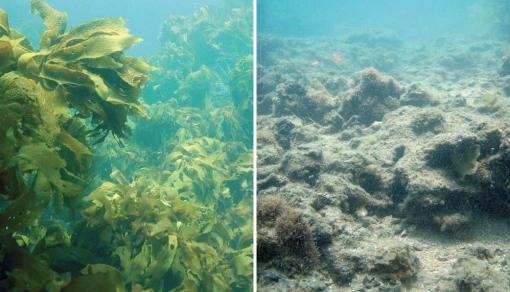
Now, it’s not bulldozers razing our underwater forests – it’s our own filth. Yes, we do indeed have underwater forests, and they are possibly the most important set of species from a biodiversity perspective in temperate coastal waters around the world. I’m talking about kelp. I’ve posted previously about the importance of kelp and how climate change poses a threat to these habitat-forming species that support a wealth of invertebrates and fish. In fact, kelp forests are analogous to coral reefs in the tropics for their role in supporting other biodiversity.

The paper I’m highlighting for the ConservationBytes.com Potential list is by a colleague of mine at the University of Adelaide, Associate Professor Sean Connell, and his collaborators entitled “Recovering a lost baseline: missing kelp forests from a metropolitan coast“. This paper is interesting, novel and applied for several reasons.

First, it sets out some convincing evidence that the Adelaide coastline has experienced a fairly hefty loss of canopy-forming kelp (mainly species like Ecklonia radiata and Cystophora spp.) since urbanisation (up to 70 % !). Now, this might not seem too surprising – we humans have a horrible track record for damaging, exploiting or maltreating biodiversity – but it’s actually a little unexpected given that Adelaide is one of Australia’s smaller major cities, and certainly a tiny city from a global perspective. There hasn’t been any real kelp harvesting around Adelaide, or coastal overfishing that could lead to trophic cascades causing loss through herbivory. Connell and colleagues pretty much are able to isolate the main culprits: sedimentation and nutrient loading (eutrophication) from urban run-off.

Second, one might expect this to be strange because other places around the world don’t have the same kind of response. The paper points out that in the coastal waters of South Australia, the normal situation is characterised by low nutrient concentrations in the water (what we term ‘oligotrophic’) compared to other places like New South Wales. Thus, when you add even a little bit extra to a system not used to it, these losses of canopy-forming kelp ensue. So understanding the underlying context of an ecosystem will tell you how much it can be stressed before all hell breaks loose.

Finally, the paper makes some very strong arguments for why good marine data are required to make long-term plans for conservation – there simply isn’t enough investment in basic marine research to ensure that we can plan responsibly for the future (see also previous post on this topic).

A great paper that uses a combination of biogeography, time series and chemistry to inform about a major marine conservation problem.

CJA Bradshaw

Add to FacebookAdd to NewsvineAdd to DiggAdd to Del.icio.usAdd to StumbleuponAdd to RedditAdd to BlinklistAdd to Ma.gnoliaAdd to TechnoratiAdd to Furl


The non-human view of the (real) world

21 05 2009

cokebottleglassesWe all have a distorted view of the planet. Our particular experiences, drives, beliefs and predilections all taint our ability to perceive and interpret our world objectively and rationally.

Enter science.

Science, in all its manifestations, aims, outcomes and applications, is united by one basic principle: to reduce human subjectivity. Contrary to popular belief, science isn’t a ‘thing’; and it’s certainly not a belief system. It isn’t even a philosophy (although there are several different major branches of the philosophy of science). It is, put way too simplistically, a method that attempts to isolate pattern from noise and objectivity from desire. It’s by no means a perfect system because human subjectivity can still creep in even when we make our best attempts to avoid it, but it’s the best system we have. Chances are too that if you’ve made a mistake and haven’t been as objective as you could have been, some other scientist will come along and rip down your house of cards. Two steps forward and one step back. That’s science.

So, where am I going? You might have seen this before, but I thought it worthwhile reproducing some of the images from Daniel Dorling, Mark Newman and Anna Barford’s The Atlas of the Real World: Mapping the Way We Live (Thames & Hudson 2008). There are some fascinating images of the world map that alter the ‘volume’ of a country relative to a particular resource use or conservation measure. The example shows the use of coal power, ecological footprint, forest depletion, water depletion, waste recycled, extinct species, species at risk, plants at risk, mammals at risk (check out the IUCN Red List for the last 4 categories), greenhouse gas emissions, energy depletion, and biocapacity. Check out your country and see how well or poorly you’re doing relative to the rest of the world.

CJA Bradshaw

Add to FacebookAdd to NewsvineAdd to DiggAdd to Del.icio.usAdd to StumbleuponAdd to RedditAdd to BlinklistAdd to Ma.gnoliaAdd to TechnoratiAdd to Furl


Latest issue of Conservation Letters now out

13 05 2009

Conservation Letters

The April issue of Conservation Letters is now out (a little late, but worth the wait). There are some good titles in this one, and I’ve blogged about a few of them already:

Happy reading!

CJA Bradshaw


Get serious about understanding biodiversity

3 03 2009

Sometimes I realise I live inside something of a bubble where most of my immediate human contacts have a higher-than-average comprehension of basic life science (after all, I work at a university). I often find myself surprised when I overhear so-called ‘lay’ people discussing whether or not penguins are fish, or that environmental awareness is just a pre-occupation of deluded greenies with nothing better to do.

If only it were so innocuous.

I found a great little article in the Canberra Times that laments the populace’s general ignorance of natural and environmental sciences. In my view, we must be as ecologically literate as we are in economics, maths and literature (and as the rapidly changing climate stresses even our most resilient resources and systems, I argue it will become THE most important thing to teach the young).

I’ve reproduced the Canberra Times article by Rossyln Beeby below:

“You don’t have to look, you don’t have to see, you can feel it in your olfactory,” sang Loudon Wainwright in a chirpy song about skunk roadkill back in the 1970s.

Likewise, it could be argued that if, as claimed, 5000 eastern grey kangaroos have died of starvation “in one season” at a Federal department of defence training site in Canberra, our noses would know about it. Do the maths. Even if 5000 kangaroos had died in one year, that’s roughly 14 animals a day, building to 98 carcasses a week. There would be, as one kangaroo ecologist dryly observed, “a murder of crows” descending on the site. If we interpret “one season” as three months, the carcass count would be over 1600 a month – which would amount to a serious health hazard for any troops using the training site as well as a unique waste disposal problem. Let’s be blunt here, as well as a murder of crows, the decaying corpses would also attract a buzz of blowflies and a heave of maggots.

Can this estimate be accurate? Or does it simply reveal the usual flaw in using walked ground surveys, or line transects, to estimate kangaroo numbers? This accuracy of this method, and the correction factors required, have been debated since the mid-1980s. These issues were the subject of a paper published in the “Australian Zoologist” almost a decade ago, which argues a case for aerial surveys to gain a better estimate of kangaroo numbers.

And are kangaroos starving at the site? If such large numbers are dying over such a short period, then are we in fact looking at a fatal virus – similar to outbreaks recently reported in northern NSW – which attacks the brain and eyes of kangaroos. Or a macropod alphaherpes virus – similar to that now attacking the immune system of koalas – which was identified in nasal swabs taken from eastern grey kangaroos that died in captivity in Queensland. Has someone done the necessary pathology?

Research in universities across Australia is revealing that macropod biology – that’s the biology of more than 50 species of creatures that are usually lumped, by the unobservant, into the generic category of “kangaroo” – is far more complex than previously thought. Recent developments include the revelation that climate change is affecting the breeding patterns of red kangaroos. Heat stress is killing young animals, because they need to work harder – an increased rate of shallow panting and bigger breaths – to cool their bodies. The late Alan Newsome, a senior CSIRO researcher, also did pioneering research that found high temperatures reduced the fertility of male red kangaroos. Has anyone looked at the impact of temperature extremes on mortality rates in eastern greys? Is there a link between drought and increased gut parasite burdens?

Wildlife ecology should not be the domain of popular myth, casual speculation or media manipulation. It is a serious science, requiring mathematically based field work, an understanding of environmental complexities and a formidable intellect. At its best, it’s an enthralling, exhilarating science that’s right up there with the best of astronomy and quantum physics. It’s not about patting critters and taking a stroll through the bush.

As a nation, our politicians are mostly woefully uninformed about our biodiversity, and as a recent Australian Audit office report pointed out, our policy makers often are not fully across the complexities of environmental issues. Does anyone remember that episode of “The West Wing” (it’s in the second series) where the White House deputy chief of staff (Josh Lyman) and the communications director (the usually erudite Toby Ziegler) are describing one of America’s 12 subspecies of lynx as “a kind of possum'” when briefing the president on an emerging environmental issue? There’s also an episode where Josh (a character with a formidable knowledge of political systems) is struggling to establish the difference between a panda and a koala.

Given Australia’s vulnerability to climate change, we can’t afford this kind of muddle-headed confusion among our environmental policy makers.