Gagging scientists about marine parks

14 08 2011

© Louisa Gouliamaki AFP

Apologies to my readers for the lack of a post this past week – I’ve been attending the Ecological Society of America‘s 96th Annual Meeting in an extremely hot (42 °C) Austin, Texas. As usual, I’ll provide a synopsis of the conference in a little bit, but I have some rather worrisome reports about the marine park process in Australia with which to regale you first.

My last post was the reproduction of a letter cosigned by over 150 marine scientists (mostly from Australia, including me) who are concerned that the a proposed network of marine reserves in the Commonwealth waters of the South West bioregional marine planning region is not based on sound scientific principles, and is instead a mash-up of what amounts to leftovers that industry hasn’t yet found a way to exploit. Not the best way to plan for marine biodiversity conservation in the long run.

After the post went live, I had a few interesting (and frightening) e-mail exchanges with a few colleagues who work for various Australian marine science institutions who complained that they were forbidden to cosign the letter. What? What? What? What? What? Read the rest of this entry »



Pickled niches

2 08 2011

Another fine contribution from Salvador Herrando-Pérez (see previous posts here, here, here and here).

Sometimes evolution fails to shape new species that are able to expand the habitat of their ancestors. This failure does not rein in speciation, but forces it to take place in a habitat that changes little over geological time. Such evolutionary outcomes are important to predict the distribution of groups of phylogenetically related species.

Those who have ever written a novel, a biography, or even a court application, will know that a termite-eaten photo or an old hand-written letter can help rebuild moments of our lives with surgical precision. Likewise, museums of natural sciences store historical biodiversity data of great value for modern research and conservation1.

A notable example is the study of chameleons from Madagascar by Chris Raxworthy and colleagues2. By collating 621 records of 11 species of the tongue-throwing reptiles, these authors subsequently concentrated survey efforts on particular regions where they discovered the impressive figure of seven new species to science, which has continued to expand3 (see figure below). The trick was to characterise the habitat at historical and modern chameleon records on the basis of satellite data describing climate, hydrology, topography, soil and vegetation, then extrapolate over the entire island to predict what land features were most likely to harbour other populations and species. This application of species distribution models4 supports the idea that the phenotypic, morphological and ecological shifts brought about by speciation can take place at slower rates than changes in the habitats where species evolve – the so-called ‘niche conservatism’ (a young concept with already contrasting definitions, e.g.,5-7).

Read the rest of this entry »


Australian ecologists support carbon tax

18 07 2011

© Herald Sun

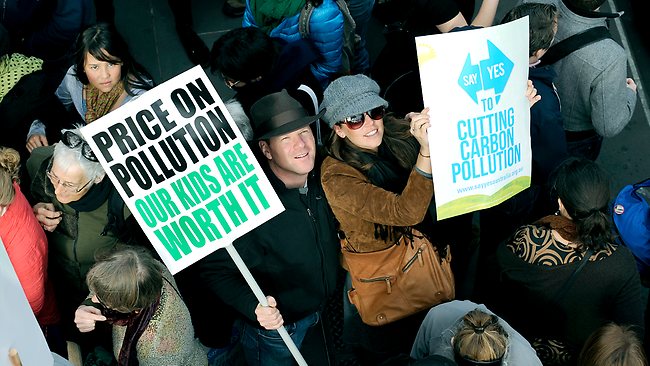
Last week I came across a report that 60 % of economists support the newly proposed Australian carbon tax initiative, and that most believed the Coalition’s plan was inferior and would likely be more costly.

I thought that it would be good to survey ecologists on this very same issue because we are the people dealing with the fall-out of climate change to natural systems, and we are the group communicating it and its consequences to the greater public. Climate change effects on the Australian biota are already being witnessed, and if we don’t take the lead in this over-populated world of myopic, self-interested growth addicts, it’s our children who will suffer most.

Usually, ecologists and economists tend to disagree on major policies because of the general view that development is incompatible with functioning ecosystems; however in this case, it’s telling that the two seem to agree. If economists and ecologists together support something, it’s probably a good idea to give it a go. Read the rest of this entry »


Do ecologists support Australia’s new carbon tax?

13 07 2011

Today on The Conversation, it was reported that 60 % of 145 economists surveyed support Australia’s new Carbon Tax scheme.

I am wondering what kind of support there is for it out there amongst ecologists. If you are one, please complete the following short survey by clicking here.

I’ll post the results in a few days.

CJA Bradshaw


Deforesting and reforesting Australia

13 07 2011

A couple of weeks ago we (Andy Lowe and I) did a small interview on ABC television about the current status of Australia forests, followed by a discussion regarding our recently funded Australian Research Council Linkage Project Developing best-practice approaches for restoring forest ecosystems that are resilient to climate change. Just in case you didn’t see it, I’ve managed to upload a copy of the piece to Youtube.com and reproduce it here:

I’m actually in the process of writing a paper on all this for a special issue of Journal of Plant Ecology (that is nearly already overdue!), but here are a few facts for you in the interim:

  • Australian eucalypt forests are globally unique, with one of the longest evolutionary histories among the world’s forests
  • Australia has about 147 million ha of native forest remaining, and about 2 million ha of plantations Read the rest of this entry »


Life, death and Linneaus

9 07 2011

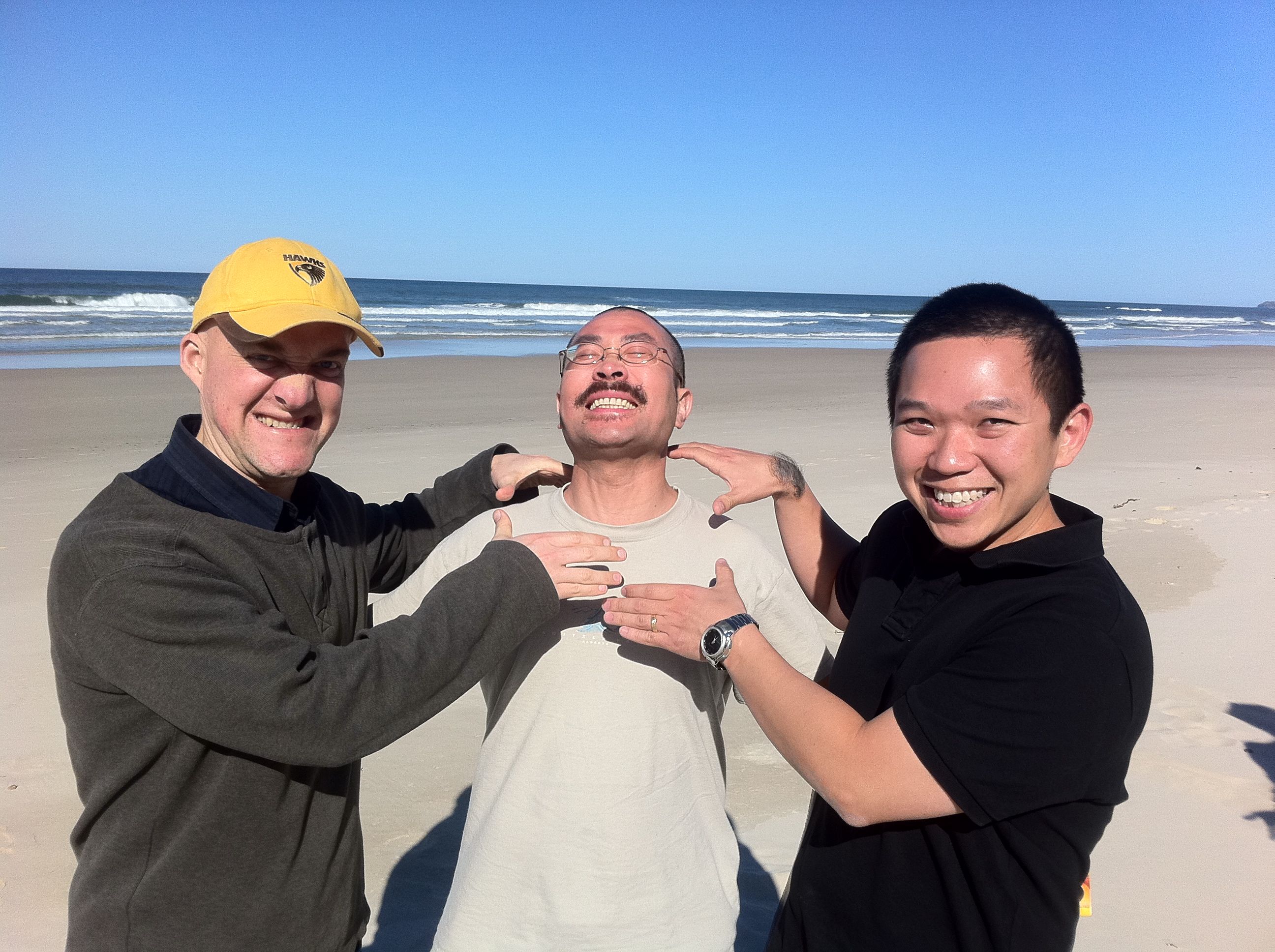
Barry Brook (left) and Lian Pin Koh (right) attacking Fangliang He (centre). © CJA Bradshaw

I’m sitting in the Brisbane airport contemplating how best to describe the last week. If you’ve been following my tweets, you’ll know that I’ve been sequestered in a room with 8 other academics trying to figure out the best ways to estimate the severity of the Anthropocene extinction crisis. Seems like a pretty straight forward task. We know biodiversity in general isn’t doing so well thanks to the 7 billion Homo sapiens on the planet (hence, the Anthropo prefix) – the question though is: how bad?

I blogged back in March that a group of us were awarded a fully funded series of workshops to address that question by the Australian Centre for Ecological Synthesis and Analysis (a Terrestrial Ecosystem Research Network facility based at the University of Queensland), and so I am essentially updating you on the progress of the first workshop.

Before I summarise our achievements (and achieve, we did), I just want to describe the venue. Instead of our standard, boring, windowless room in some non-descript building on campus, ACEAS Director, Associate Professor Alison Specht, had the brilliant idea of putting us out away from it all on a beautiful nature-conservation estate on the north coast of New South Wales.

What a beautiful place – Linneaus Estate is a 111-ha property just a few kilometres north of Lennox Head (about 30 minutes by car south of Byron Bay) whose mission is to provide a sustainable living area (for a very lucky few) while protecting and restoring some pretty amazing coastal habitat along an otherwise well-developed bit of Australian coastline. And yes, it’s named after Carl Linnaeus. Read the rest of this entry »


The few, the loud and the factually challenged

18 06 2011

© The Guardian

Here’s a little paraphrased response I received from a colleague who works for a particular agency concerned about the ridiculous politicking and misinformation associated with marine parks proposed for South Australia.

I’ve posted several times before why marine parks are a win for all involved, from the biodiversity it is meant to protect, to the fishers who benefit from the free, public-good resource that they assist in maintaining (see here, here and here). The evidence is clear world-wide: marine parks benefit pretty much everything and everyone.

However, just like the climate change denalists who use every psychological tactic in the book to try to convince people that climate change is a belief when in fact, it is a soundly evidenced phenomenon, there are those Luddites who think that any change in the marine setting fundamentally threatens their way of life.

Here’s what my colleague had to say about some recent ill-informed comments on this blog:

I wondered when they would find your blog. In my experience, do not engage. A game of intimidation has started. Read the rest of this entry »



Cartoon guide to biodiversity loss XII

30 05 2011

The latest six cartoons… (see full stock of previous ‘Cartoon guide to biodiversity loss’ compendia here).

Read the rest of this entry »


The evil sextet

18 05 2011

This post doubles as a Conservation Classic and a new take on an old concept. It’s new in the sense that it updates what we believe is an advance on a major milestone in conservation biology, even though some of the add-on concepts themselves have been around for a while.

First, the classic.

The ‘evil quartet’, or ‘four horsemen of the ecological apocalypse’, was probably the first treatment of extinction dynamics as a biological discipline in its own right. Jarod Diamond (1984) took a sweeping historical and contemporary view of extinction, then simplified the problem to four principal mechanisms:

  1. overhunting (or overexploitation),
  2. introduced species,
  3. habitat destruction and
  4. chains of linked extinctions (trophic cascades, or co-extinctions).

Far from a mere review or list of unrelated mechanisms, Diamond’s evil quartet crystallized conservation biologists’ thinking about key mechanisms and, more importantly, directed attention towards those factors likely to drive extinctions in the future. The unique combination of prehistorical through to modern examples gave conservation biologists a holistic view of extinction dynamics and helped spawn many of the papers described hereafter. Read the rest of this entry »


生态学 = ‘Ecology’ in China

13 05 2011

I’m just heading home after a very inspiring workshop organised by Fangliang He at Sun Yat-sen University in Guangzhou, China (I’m writing this from the Qantas Club in the Hong Kong airport).

Before I proceed to regale you with the salient details of the ‘International Symposium for Biodiversity and Theoretical Ecology‘, I am compelled to state publicly that I offer my sincerest condolences to Fangliang and his family; unfortunately Fangliang’s brother passed away while we were at the workshop and so Fangliang wasn’t able to spend much time reaping the fruits of his organisational labour. If you know Fangliang, please send him a supporting email.

That sad note aside, I am delighted to say that the workshop was compelling, challenging and also rather fortuitous. I was one of many overseas invitees, and I must say that I was at times overwhelmed by the size of the brains they managed to pack into the auditorium. Many colleagues I didn’t know attended, and I hope that many will become collaborators. The international invitees were: Read the rest of this entry »


Tropical forests cooking their biodiversity

5 05 2011

Another ‘hot’ essay by Bill Laurance recently published online by Yale Environment 360 (a publication of the Yale University School of Forestry & Environmental Studies). Bill asked me to relay it on ConservationBytes.com, so here it is in full:

Much attention has been paid to how global warming is affecting the world’s polar regions and glaciers. But a leading authority on tropical forests [that would be Bill] warns that rising temperatures could have an equally profound impact on rainforests and are already taking a toll on some tropical species.

On Jan. 12, 2002, in the Australian state of New South Wales, biologist Justin Welbergen was observing a colony of flying foxes for his Ph.D. research. The temperatures that day on Australia’s subtropical, eastern coast reached record highs, soaring to 42.9 ° C (109 ° F) at the weather station closest to Welbergen’s study site — nearly 8 ° C higher than the average summer maximum temperature.

The flying foxes, or giant fruit bats, normally just doze in the treetops through the day, but on this afternoon they were fanning themselves, panting frantically, jostling for shady spots, and licking their wrists in a desperate effort to cool down. Suddenly, when the thermometer hit 42 ° C, the bats began falling from the trees. Most quickly died. Welbergen and his colleagues counted 1,453 flying foxes that died from the heat in one colony alone. The scorching heat that day killed at least 2,200 additional flying foxes in eight other colonies along a 250-kilometre stretch of coastline. All the deaths occurred in colonies where temperatures soared above 41.7 ° C. Read the rest of this entry »


Who’s your carbon daddy?

20 04 2011

The other day, Bill Laurance asked Barry Brook and me to comment on an opinion editorial he was doing up, so I feel fully justified in reproducing it here (and he asked me to ;-). It has just been published online in Australian Geographic.

I hate to be the bearer of bad news, but here it is: China is now the biggest global emitter of carbon dioxide (CO2), the chief greenhouse gas – and Australia has helped it attain that dubious honour.

China now spews out about 6.5 billion tons of CO2 annually, whereas the USA emits 5.8 billion tons a year (based on data for 2008 compiled by the U.S. Department of Energy). Collectively, these two countries account for over 40 per cent of global CO2 emissions. Number three on the list is Russia, with 1.7 billion tons per year, followed closely by India.

Of course, China’s huge leap in emissions is largely down to its dramatic industrial and economic growth, in concert with the fact that it is the world’s most populous nation, with over 1.3 billion people. To help fuel its growth, China is now building nearly one new coal-fired power-generating plant per week. Read the rest of this entry »


Biodiversity begins at home

20 01 2011

A few months ago I was involved in a panel discussion entitled ‘Biodiversity begins at home’ held at the Royal Institution of Australia in Adelaide and sponsored by the Don Dunstan Foundation.

The main thrust of the evening was to have both academic (me & Andy Lowe) and on-the-ground, local conservationists (Sarah Lance, Craig Gillespie and Matt Turner) talk about what people can do to stem the tide of biodiversity loss. The video is now available, so I thought I’d reproduce it here. We talked about a lot of issues (from global to local scale), so if you have a spare hour, you might get something out of this. I did, but it certainly wasn’t long enough to discuss such big issues.

Warning – this was supposed to be more of a discussion and less of a talkfest; unfortunately, many of the panel members seemed to forget this and instead dominated the session. We really needed 4 hours to do this properly (but then, who would have watched the video?).

Read the rest of this entry »


Deforestation partly to blame for Queensland floods

17 01 2011

© recoverling

Last week I sent a fairly random Tweet about deforestation in south-eastern Queensland being partially responsible for the record floods there. It went more or less unnoticed, but I thought the comment deserved a proper explanation.

As many of you might know, my colleagues and I wrote an article a few years ago about the global-scale evidence for deforestation leading to a higher incidence and severity of floods in the developing world. This was fairly controversial, but it was nonetheless the first broad-scale evidence for the fabled deforestation-flood link yet published (in my not-so-humble opinion). Subsequent comment reiterated the point with new data.

Now, I will begin by saying I have no data yet to back up my Queensland-specific hypothesis, but I am contemplating a time-series paper on floods in Australia, especially after the events of the last month. This post is therefore merely a reasoned hypothesis.

The hypothesis itself is rather simple. Testing is not. I submit that the recent flooding in Australia has been exacerbated (not caused) by the rapid loss of forest cover over the last 40 years. We know that this is a particularly intense La Niña in Australia and our unusually high rainfall arises from this meteorological phenomenon, but I hypothesise that it wouldn’t have been as bad if this part of Australia hadn’t been so careless with its forest cover since the 1970s. Read the rest of this entry »


Cartoon guide to biodiversity loss X

14 01 2011

The latest batch of six cartoons…

See also full stock of previous ‘Cartoon guide to biodiversity loss’ compendia here.

Read the rest of this entry »


Biowealth – a lexical leap forward for biodiversity appreciation

17 12 2010

Here’s a little idea I’ve been kicking around in my head that I’d like to invite you to debate. Call it an ‘Open Thread’ in the spirit of BraveNewClimate.com’s successful series.

© The Economist

Let’s face it, ‘biodiversity’ is a slippery and abstract concept for most people. Hell, even most ecologists have a hard time describing what biodiversity means. To the uninitiated, it seems simple enough. It’s just the number of species, isn’t it?

Well, no. It isn’t.

Unfortunately, it’s far, far more complicated. First, the somewhat arbitrary pigeon-holing of organisms into Linnaean taxonomic boxes doesn’t really do justice to the genetic gradients within species, among populations and even between individuals. We use the pigeon-hole taxonomy because it’s convenient, that’s all. Sure, molecular genetics has revolutionised the concept, but to most people, a kangaroo is a kangaroo, a robin is a robin and an earthworm is an earthworm. Hierarchical Linnaean taxonomy prevails.

Then there’s the more prickly issue of α, β and γ diversity. α diversity essentially quantifies species richness within a particular area, whereas β diversity is the difference in α diversity between ecosystems. γ diversity is used to measure overall diversity for the different constituent ecosystems of a region. Scale is very, very important (see our recent book chapter for more on this). Read the rest of this entry »


History and future (of Australian ecology and society)

11 12 2010

I’ve just returned from a week-long conference in Canberra where the Ecological Society of Australia (of which I am a relatively new member) has just completed its impressive 50th anniversary conference. It was a long, but good week.

It’s almost a bit embarrassing that I’ve never attended an ESA1 conference before, but I think I waited for the right one. However, the main reason I attended was that I was fortunate to have received the ESA’s 3rd Australian Ecology Research Award (AERA), and the kick-back was a fully funded trip. My only reciprocation was to give a 40-minute plenary lecture – a small price to pay.

I entitled my talk ‘Heads in the desert sand: why Australians should wake up to the biodiversity crisis’, and I received a lot of good feedback. I talked about the global and Australian trends of biodiversity loss and associated ecosystem services, focussing the middle section on some of our work on feral animal ecology (see example). I then gave my views on the seriousness of our current situation and why some of the fastest losses of sensitive ecosystem services are happening right here, right now. I finished off with a section on how I think Australian ecologists could get more relevant and active in terms of research uptake by policy makers. I hope that the talk will be podcastable soon, so stay tuned.

But that was just ‘my’ bit. This post is more about a quick summary of the highlights and my overall impressions.

Read the rest of this entry »


The Joke’s On Us

30 11 2010


© decostudio.pl

Here’s an idea to garner some appreciation for the dire straits in which humanity finds itself mounting from the global biodiversity crisis. More importantly, I hope that ‘appreciation’ would translate into ‘action’ as a result.

The idea came, as good ideas often tend to, around a table with some mates1,2 and several bottles of wine. The idea got more outlandish as the bottles were emptied, and I have to say I can’t remember many of the finer details (probably a good thing).

But the nugget of that idea is, I think, a very good one. I’d like to hear your opinions about it, and some suggestions about how to make it happen.

(get to the point, Bradshaw)

Right.

The idea would be to create an international (televised) comedy festival called ‘The Joke’s On Us‘ where very high-profile comedians would be individually matched to high-profile scientists of various areas of expertise. Let’s say we had a climate change scientist like James Hansen sit down with, oh, maybe Eddie Izzard, the famous and highly regarded Gaia creator, James Lovelock, locked in a room for a few days with Michael McIntyre, tropical deforestation specialist, Bill Laurance, matched with Chris Rock, and that population bomb, Paul Ehrlich, with Robin Williams or Jerry Seinfeld. The possible combinations are endless. Read the rest of this entry »


The other, other global crisis

22 11 2010

Another quick and informative introduction to the problems of over-population and agricultural intensification. Like the nice little video introduction to the importance of biodiversity, if you want to teach someone quickly about why we need to think about over-population, show them this quick video about the other, other global crisis – agriculture.

Highlights:

  • 40 % of the world’s land surface has been cleared for agriculture
  • globally, croplands cover 16 million km2 (area the size of South America
  • humans use 2800 km3 of water to irrigate crops each year
  • fertilizers have more than doubled the P and N in the environment
  • agriculture contributes 30 % of greenhouse gases


The Amazing Paul (Mc)Ehrlich

15 11 2010

© CJA Bradshaw

A few years ago when I first wrote about Paul Ehrlich in our book, Tropical Conservation Biology, I quickly became impressed. His track record is, without any exaggeration, truly awe-inspiring. With over 1000 articles published and almost 50 books, the man has been a scientific writing machine for his entire career. He’s also highly influential in the socio-political sphere, and counts among his close friends some of the most politically and scientifically powerful people on the planet. In a word, he’s easily among the world’s greatest living scientists.

Remember, this was my opinion all before I actually met the man. Travelling through central California last year, I was lucky enough to be invited by Paul’s close colleague, Gretchen Daily, to give a talk at their Stanford University lab. It was fortunate that Paul was about at the time and not off promoting his new book or traipsing through the mountains of Colorado chasing butterflies.

We hit it off immediately and it seemed became mates within the space of a few hours. I learnt then that he and his equally famous wife, Anne, were regular visitors to Australia and that he had a particular love affair going with many Australian wines. I invited him to come to Adelaide the following year, he agreed (and importantly, so did the director of the Environment Institute, Mike Young), and it came to pass. Read the rest of this entry »