I can’t believe I’ve now done twenty of these – another 6 biodiversity cartoons while I’m travelling (see full stock of previous ‘Cartoon guide to biodiversity loss’ compendia here).
—
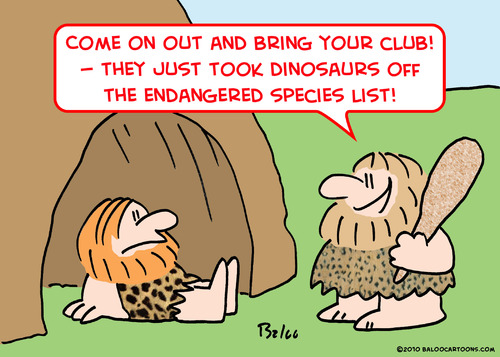
I can’t believe I’ve now done twenty of these – another 6 biodiversity cartoons while I’m travelling (see full stock of previous ‘Cartoon guide to biodiversity loss’ compendia here).
—

© W. Osborn (AIMS)
My recently finished PhD student, Ana Sequeira, has not only just had a superb paper just accepted in Global Change Biology, she’s recently been offered (and accepted) a postdoctoral position based at the University of Western Australia‘s Oceans Institute (in partnership with AIMS and CSIRO). As any supervisor, I’m certainly pleased when a student completes her PhD, but my pride as an academic papa truly soars when she gets her first job. Well done, Ana. This post by Ana is about her latest paper.
—
Following our previous whale shark work (see here, here, here, here, here, here and here), especially the recent review where we inferred global connectivity and suggest possible pathways for their migration, we have now gone a step further and modelled the habitat suitability for the species at at global scale. This paper sets a nice scene regarding current habitat suitability, which also demonstrates the potential connectivity pathways we hypothesised previously. But the paper goes much further; we extend our predictions to a future scenario for 2070 when water temperatures are expected to increase on average by 2 °C.

Global predictions of current seasonal habitat suitability for whale sharks. Black triangles indicate known aggregation locations. Solid line delineates areas where habitat suitability > 0.1 was predicted.
Regarding the current range of whale sharks (i.e., its currently suitable habitat), we already know that whale sharks span latitudes between about 35 º North to South. We also know that this geographical range has been exceeded on several occasions. What we did not know was whether conditions were suitable enough for whale sharks to cross from the Indian Ocean to the Atlantic Ocean – in other words, whether they could travel between ocean basins south of South Africa. Our global model results demonstrate that suitable habitat in this region does exist at least during the summer, thus supporting our hypotheses regarding global connectivity!
It’s true that the extensive dataset we used (30 years’ worth of whale shark sightings collected by tuna purse seiners in the three major oceans – data provided by the IRD, IOTC and SPC) has many caveats (as do all opportunistically collected data), but we went to great trouble to deal with them in this paper (you can request a copy here or access it directly here). And the overall result: the current global habitat suitability for whale sharks does agree well with current locations of whale shark occurrence, with the exception of the Eastern Pacific for where we did not have enough data to validate. Read the rest of this entry »

© CSIC Andalusia Audiovisual Bank/H. Garrido
The Iberian lynx is the world’s most threatened cat, with recent counts estimating only 250 individuals surviving in the wild. Recent declines of Iberian lynx have been associated with sharp regional reductions in the abundance of its main prey, the European rabbit, caused mainly by myxomatosis virus and rabbit haemorrhagic disease. At present, only two Iberian lynx populations persist in the wild compared with nine in the 1990s.
Over €90 million has been spent since 1994 to mitigate the extinction risk of this charismatic animal, mainly through habitat management, reduction of human-caused mortality and, more recently, translocation. Although lynx abundance might have increased in the last ten years in response to intensive management, a new study published in Nature Climate Change warns that the ongoing conservation strategies could buy just a few decades before the species goes extinct.
The study led by Damien Fordham from The Environment Institute (The University of Adelaide) and Miguel Araújo from the Integrative Biogeography and Global Change Group (Spanish Research Council) shows that climate change could lead to a rapid and severe decrease in lynx abundance in coming decades, and probably result in its extinction in the wild within 50 years. Current management efforts could be futile if they do not take into account the combined effects of climate change, land use and prey abundance on population dynamics of the Iberian Lynx.
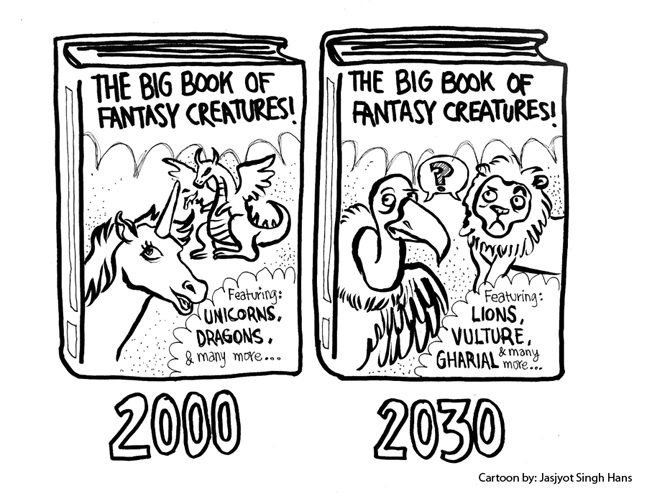
Here are 6 more biodiversity cartoons illustrating through humour the sad state of the natural world (see full stock of previous ‘Cartoon guide to biodiversity loss’ compendia here).
—
telegraph.co.uk
Another soul-searching post from Alejandro Frid.
—
Confession time. This is going to be delicate, and might even ruffle some big feathers. Still, all of us need to talk about it. In fact, I want to trigger a wide conversation on the flaws and merits of what I did.
Back in March of this year I saw a posting for a job with the Smithsonian Conservation Biology Institute (SCBI) seeking a ‘conservation biologist to provide expert advice in the design and implementation of a Biodiversity Monitoring and Assessment Program (BMAP) in northern British Columbia, Canada’. The job sounded cool and important. I was suited for it, knew northern British Columbia well, and loved the idea of working there.
But there was a catch. The job was focused on the local impacts of fossil fuel infrastructure while dissociating itself from the climate impacts of burning that fuel, and involved collaborating with the fossil fuel company. According to the posting, this was not a new thing for the Smithsonian:
Guided by the principles of the Convention on Biological Diversity, SCBI works with a selected group of oil and gas companies since 1996 to develop models designed to achieve conservation and sustainable development objectives while also protecting and conserving biodiversity, and maintaining vital ecosystem services that benefit both humans and wildlife.
Given that climate change already is diminishing global biodiversity and hampering the ecosystem services on which we all depend, the logic seemed inconsistent to me. But there was little time to ponder it. The application deadline had just passed and my soft-money position with the Vancouver Aquarium Marine Science Centre was fizzling out. So I applied, hastily, figuring that I would deal with the issue later, if they ever got back to me. Read the rest of this entry »
 One of the many reasons I started this blog nearly five years ago was to engage both minds and hearts that my (and my colleagues’) scientific journal papers were failing to do. Of course we have emotional attachment to our areas of expertise (I’ve never met a good scientist who wasn’t passionate about what they studied) – but as Alejandro Frid encourages – we just have to transmit that emotional component better to our fellow human beings.
—
The title is not a joke about sensitive, New Age guys. I am quite serious about it. Though no academic superstar, I have been publishing in ecological and conservation journals for almost twenty years. I love the discipline. I’d hate to see it fail.
What I am talking about is this: ecologists read and write about ‘extinction’, ‘over-exploitation’, ‘climate change’ and so forth as a matter of routine. Yet at the same time, science journals are full of examples of how resources can be used more sustainably, of human behaviours that reduce the greenhouse gases that alter the climate and acidify the oceans, and of alternative economic models that value a healthy biosphere. So why do consumer apathy and political inertia still run the same old show?
I know, I know. Social scientists are working hard on this question (check out, for instance, just about any issue of Nature Climate Change). But what matters is not the rigorous answer that they might produce (we already know that it is 42 – Douglas Adams couldn’t be wrong); it is instead that most non-scientists probably don’t even care about the question. Read the rest of this entry »

© Beboy-Fotolia
Today we announced a HEAP of positions in our Global Ecology Lab for hot-shot, up-and-coming ecologists. If you think you’ve got what it takes, I encourage you to apply. The positions are all financed by the Australian Research Council from grants that Barry Brook, Phill Cassey, Damien Fordham and I have all been awarded in the last few years. We decided to do a bulk advertisement so that we maximise the opportunity for good science talent out there.
We’re looking for bright, mathematically adept people in palaeo-ecology, wildlife population modelling, disease modelling, climate change modelling and species distribution modelling.
The positions are self explanatory, but if you want more information, just follow the links and contacts given below. For my own selfish interests, I provide a little more detail for two of the positions for which I’m directly responsible – but please have a look at the lot.
Good luck!
—
Job Reference Number: 17986 & 17987
The world-leading Global Ecology Group within the School of Earth and Environmental Sciences currently has multiple academic opportunities. For these two positions, we are seeking a Postdoctoral Research Associate and a Research Associate to work in palaeo-ecological modelling. Read the rest of this entry »
 Today, a paper by my colleague, Barry Brook, appeared online in Trends in Ecology and Evolution. It’s bound to turn a few heads.
Let’s not get distracted by the title of the post, or the potential for a false controversy. It’s important to be clear that the planet is indeed ill, and it’s largely due to us. Species are going extinct faster than the would have otherwise. The planet’s climate system is being severely disrupted, so is the carbon cycle. Ecosystem services are on the decline.
But – and it’s a big ‘but’ – we have to be wary of claiming the end of the world as we know it or people will shut down and continue blindly with their growth and consumption obsession. We as scientists also have to be extremely careful not to pull concepts and numbers out of our bums without empirical support.
Specifically, I’m referring to the latest ‘craze’ in environmental science writing – the idea of ‘planetary tipping points‘ and the related ‘planetary boundaries‘. It’s really the stuff of Hollywood disaster blockbusters – the world suddenly shifts into a new ‘state’ where some major aspect of how the world functions does an immediate about-face. Read the rest of this entry »
Here’s the latest 6 biodiversity cartoons for your simultaneous viewing pleasure and pain (see full stock of previous ‘Cartoon guide to biodiversity loss’ compendia here).
—

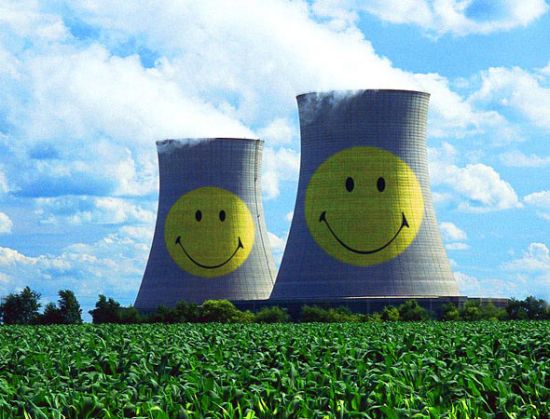 There’s a gradual, but rising tide of rational, enviro-progressive scientists out there who are committed to solving some of the world’s biggest problems. Many of these problems involve touchy subjects, including ways to reduce poverty while improving or maintaining high standards of living elsewhere, the means for ‘sustainable’ electricity generation, and how to limit the human population’s over-consumption and over-production.
Inevitably, however, many well-intentioned, but grossly misinformed environmentalists (‘enviro-conservatives’?) object to technical solutions based on emotional or ideological grounds alone. As self-professed enviro-progressives (but also scientists who base decisions on evidence, logic and balancing trade-offs as part of our everyday work), we hope to reduce this backlash by providing the data and analyses needed to make the best and most coherent decisions about our future.
—
On 14 September 2012, Japan’s government announced a nuclear-free policy to phase out its nuclear power generation by 2040. Of course, electricity demand would have to be supplied by both renewable energy and fossil fuels to respond the public unwillingness for nuclear power.
But is this most environmentally sound, safest and economically rational aim? In a new paper we’ve just had published in the peer-reviewed journal Energy Policy, we set out to test Japan’s intentions the best way we know – using empirical data and robust scenario modelling.
Before the March 2011 earthquake and tsunami, Japan produced 25% of its total electricity consumption from nuclear power, 63% from fossil fuels (mostly coal and liquefied natural gas), and 10% from renewables (including hydro). Originally, the Japanese government had planned to increase nuclear power up to 45% of supply, and include new renewables builds, to combine to make major cuts in greenhouse gas emissions by 2030 and meet or exceed their Kyoto targets. However, the original plan could reduce emissions by the energy sector from 1122 Mt CO2e in 2010 to < 720 Mt CO2e by 2030 (< 70% of 1990 emission levels). Read the rest of this entry »
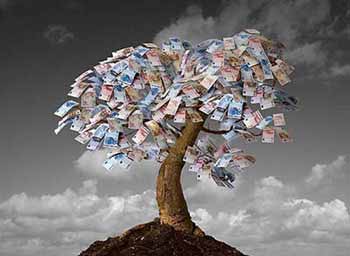 As more and more empirical evidence pours in from all corners of the globe, we can only draw one conclusion about the crude measure of species richness (i.e., number of species) – having more species around makes us richer.
And I’m not talking about the esoteric or ‘spiritual’ richness that the hippies dribble about around the campfire after a few dozen cones pulled off the bong (I’ll let the confused among you try to work the meaning of that one out by yourselves), I’m talking about real money (incorporated into my concept of ‘biowealth‘).
The idea that ‘more is better’ in terms of the number of species has traditionally found some (at times, conflicting) empirical support in the plant ecology literature, the latest evidence about which I wrote last year. This, the so-called ‘diversity-productivity’ relationship (DPR), demonstrates that as a forest or grass ecosystem gains more species, its average or total biomass production increases.
 I’ve written before about how we should all be substantially more concerned about the future than what we as a society appear to be. Climate disruption is society’s enemy number one, especially considering that:
That’s probably the most succinct way that I know of describing the mess we are in, which is why I tend to be more of a pragmatic pessimist when it comes to the future. I’ve discussed before how this outlook makes getting on with my job even more important – if I can’t reduce the rate of destruction and give my family a slightly better future in spite of this reality, at least I will damn well die trying. Read the rest of this entry »
I’m winding down here for the year (although there might be a few more posts before the New Year), so here’s the latest batch of 6 biodiversity cartoons (see full stock of previous ‘Cartoon guide to biodiversity loss’ compendia here).
—
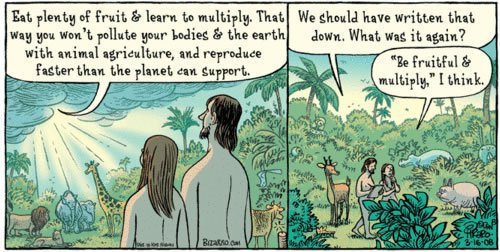
While in transit between tropical and temperate Australia, here’s the latest batch of 6 biodiversity cartoons (see full stock of previous ‘Cartoon guide to biodiversity loss’ compendia here).
—

 The primary scientific literature on climate change spawns hundreds of debates on an array of topics. When the technical debate among experts, and the obvious uncertainties, are taken up by the media, they are typically treated as any other topic, which ends up in some people not trusting science and others exploiting the ‘debate’ for their own interests.
Many media debates consist of one moderator and several speakers with two confronting views. When the topic under discussion affects our daily life (e.g., unemployment), the average spectator will often agree with one of the views. When the topic affects people (apparently) in a general fashion (e.g., climate change), the spectator might distrust or simply ignore both views. Thus, the media shapes public opinion such that people’s perception of the news becomes black, white, “I don’t believe it” or “it doesn’t exist”. Public debates on climate change are like a ‘contact sport’ (1), a team has to win in a contest where both parties alternate attack and defence. The participation of speakers without specialised expertise on climate change, especially if they represent short-term political and economic interests, instigates public mistrust and inhibition (2). This situation erodes the informative role that science and scientists must play in the creation of novel environmental policies aiming to improve the present and future wellbeing of our society (3, a Science paper unsurprisingly challenged by US administration’ bastion Fred Singer: 4). Read the rest of this entry »
 I’ve just returned from a 6-week trip to the United States and I am now dealing with the intensity of things left undone for so long [sigh]. But that trip was interesting for many reasons. First, and as I’ve already posted, I finished a book with Paul Ehrlich that will be out sometime early in 2013 (but I won’t deal with that here). I also attended an interesting, if slightly confusing, conference on ecosystem services. And finally, I had the pleasure of meeting Tony Barnosky in person, and we decided that we should definitely collaborate on a few things.
Another thing that struck me – and this happens no matter how often I visit the U.S., is just how completely insane that country’s politics are. The extremist, libertarian, plutotheocratic bullshit spewed by the far right to the detriment of the very people who support them is enough to make you vomit. And this startling and thoroughly backward world-view is now starting to penetrate more and more into Australian society and politics. From an environmental perspective, it’s a continuation of a downhill slide that started with Reagan’s destruction of environmentalism in the U.S., and Joh Bjelke-Petersen‘s war on the environment in Australia, and will only continue to get worse.
Of course, the main victim of reason in all these polemic politics is that we are doing next to nothing to mitigate horrendous climate disruption. Only yesterday, George Monbiot was lamenting (nay, pleading) that our governments are doing practically nil to avoid what can only be described as the greatest threat to our way of life since the World War II – in fact, the War and its associated holocaust is small bikkies compared to what awaits us.
And this is the most stressing part – even people who choose to use their brains and accept that we have an immense, global problem on our hands generally are not even remotely concerned enough. Read the rest of this entry »
 I should have published these ages ago, but like many things I have should have done earlier, I didn’t.
I also apologise for a bit of silence over the past week. After coming back from the ESP Conference in Portland, I’m now back at Stanford University working with Paul Ehrlich trying to finish our book (no sneak peaks yet, I’m afraid). I have to report that we’ve completed about about 75 % it, and I’m starting to feel like the end is in sight. We hope to have it published early in 2013.
So here they are – the latest 9 PhD offerings from us at the Global Ecology Laboratory. If you want to get more information, contact the first person listed as the first supervisor at the end of each project’s description.
—
1. Optimal survey and harvest models for South Australian macropods (I’ve advertised this before, but so far, no takers):
The South Australia Department of Environment, Water and Natural Resources (DEWNR) is custodian of a long-term macropod database derived from the State’s management of the commercial kangaroo harvest industry. The dataset entails aerial survey data for most of the State from 1978 to present, annual population estimates, quotas and harvests for three species: red kangaroo (Macropus rufus), western grey kangaroo (Macropus fuliginosus), and the euro (Macropus robustus erubescens).
DEWNR wishes to improve the efficiency of surveys and increase the precision of population estimates, as well as provide a more quantitative basis for setting harvest quotas.
We envisage that the PhD candidate will design and construct population models:
Supervisors: me, A/Prof. Phill Cassey, Dr Damien Fordham, Dr Brad Page (DEWNR), Professor Michelle Waycott (DEWNR).
2. Correcting for the Signor-Lipps effect
The ‘Signor-Lipps effect’ in palaeontology is the notion that the last organism of a given species will never be recorded as a fossil given the incomplete nature of the fossil record (the mirror problem is the ‘Jaanusson effect’, where the first occurrence is delayed past the true time of origination). This problem makes inference about the timing and speed of mass extinctions (and evolutionary diversification events) elusive. The problem is further complicated by the concept known as the ‘pull of the recent’, which states that the more time since an event occurred, the greater the probability that evidence of that event will have disappeared (e.g., erased by erosion, hidden by deep burial, etc.).
In a deep-time context, these problems confound the patterns of mass extinctions – i.e., the abruptness of extinction and the dynamics of recovery and speciation. This PhD project will apply a simulation approach to marine fossil time series (for genera and families, and some individual species) covering the Phanerozoic Aeon, as well as other taxa straddling the K-T boundary (Cretaceous mass extinction). The project will seek to correct for taphonomic biases and assess the degree to which extinction events for different major taxa were synchronous.
The results will also have implications for the famous Sepkoski curve, which describes the apparent logistic increase in marine species diversity over geological time with an approximate ‘carrying capacity’ reached during the Cenozoic. Despite recent demonstration that this increase is partially a taphonomic artefact, a far greater development and validation/sensitivity analysis of underlying statistical models is needed to resolve the true patterns of extinction and speciation over this period.
The approach will be to develop a series of models describing the interaction of the processes of speciation, local extinction and taphonomic ‘erasure’ (pull of the recent) to simulate how these processes interact to create the appearance of growth in numbers of taxa over time (Sepkoski curve) and the abruptness of mass extinction events. The candidate will estimate key parameters in the model to test whether the taphonomic effect is strong enough to be the sole explanation of the apparent temporal increase in species diversity, or whether true diversification accounts for this.
Supervisors: me, Prof. Barry Brook
3. Genotypic relationships of Australian rabbit populations and consequences for disease dynamics
Historical evidence suggests that there were multiple introduction events of European rabbits into Australia. In non-animal model weed systems it is clear that biocontrol efficacy is strongly influenced by the degree of genetic diversity and number of breed variants in the population.
The PhD candidate will build phylogenetic relationships for Australian rabbit populations and develop landscape genetic models for exploring the influence of myxomatosis and rabbit haemorrhagic disease virus (RHDV) on rabbit vital rates (survival, reproduction and dispersal) at regional and local scales. Multi-model synthesis will be used to quantify the relative roles of environment (including climate) and genotype on disease prevalence and virulence in rabbit populations.
Supervisors: A/Prof Phill Cassey, Dr Damien Fordham, Prof Barry Brook Read the rest of this entry »
 It’s sometimes difficult to take a long, hard look in the mirror and admit one’s failings. Today’s post is a thought-provoking challenge to all ecologists (indeed, all scientists) who gaily flit all over the known universe in the name of science. I’m certainly in one of the upper guilt echelons on this issue – and while I tell myself each January that “this year I’ll fly much less frequently”, I usually end up breaking my resolution by month’s end.
In some defence of my sins, I have to state that while I should always endeavour to fly less, I am convinced that strategic, well-planned (and usually small) meetings are some of the best ways to advance scientific ideas. As CB readers might know, I am particularly impressed with the results of dedicated workshops in this regard.
I also think that even if all aeroplanes suddenly fell from the sky and one could no longer enjoy that transcontinental G & T, we’d still be in a terribly climate-change mess – we need BIG solutions beyond simple consumption reduction.
Now I’m just making excuses. Thanks again to Alejandro Frid for providing this challenge to me and our colleagues.
—
Recently I asked a math savvy graduate student at Simon Fraser University, in Western Canada, to proofread an equation. ‘No problem’, she replied, ‘but could you wait a few days? I am about to fly to Korea for a conference but I will return shortly.’
Hmmmm? So this is what the system promotes: gallivanting halfway around the world and back within a week, burning extraordinary amounts of fossil fuels, all in the name of scientific career advancement. Who are the climate change culprits? Not us ecologists, right?
Of course I am being unfair to Ms. Maths Savvy. Most of us are equally guilty of boarding that big ol’ jet airliner in the name of scientific meetings or the pursuit of ecological knowledge in far off study sites. Yet the inconvenient truth, according to a recent editorial in Nature Climate Change1, is that “international air travel accounts for about 5% of global warming”. Flying all over the world in the name of ecology and conservation therefore implies that we believe that (i) there are no alternative means to accomplish the same goal with far less emissions, and (ii) that the benefits of our work outweigh the atmospheric impacts of flying. Think again.
For insight into these issues, I interviewed Kevin Anderson, deputy director of the Tyndall Centre for Climate Change Research at the University of Manchester and arguably the climate conscience of scientists. I was attracted to Anderson’s perspective because of its blunt honesty. He calls air travel “…the most emission profligate activity per hour”2 and has little patience for the irony that “international climate jamborees”, otherwise known as climate science meetings, have contributed far more to increasing carbon emissions than to any meaningful action on climate change. His recent commentary in Nature3 makes it amply clear that buying carbon offsets when flying may ease our perceived guilt but not emission rates. Read the rest of this entry »
 This last post before Easter is something I’ve thought more and more about over the last few years. I wouldn’t have given it much time in the past, but I’m now convinced roads are one of the humanity’s most destructive devices. Let me explain.
Before I had a good grasp of extinction dynamics, I wouldn’t have attributed much import to the role of roads in conservation. I mean, really, a little road here and there (ok, even a major motorway) couldn’t possibly be a problem? It’s mostly habitat destruction itself, right?
Not exactly. With our work on extinction synergies, I eventually came to realise that roads are some of the first portals to the devastation to come. Read the rest of this entry »
 I begin with the proverbial WTF? The title of this post sounds a little like the legalese accompanying a witchcraft trial, but it’s jargon that’s all the rage in the ‘trading-carbon-for-biodiversity’ circles.
I’m sure that most of my readers will have come across the term ‘REDD‘ (Reduced Emissions from Deforestation and forest Degradation), which is the clever idea of trading carbon credits to keep forests intact. As we know, living forests can suck up a lot of carbon from the atmosphere (remember your high school biology lesson on photosynthesis? Carbon dioxide in. Oxygen out), even though climate change is threatening this invaluable ecosystem service. So the idea of paying a nation (usual a developing country) to protect its forests in exchange for carbon pollution offsets can potentially save two birds with one feeder – reducing overall emissions by keeping the trees alive, and ensuring a lot of associated biodiversity gets caught up in the conservation process.
The problem with REDD though is that it’s a helluva thing to bank on given a few niggly problems essentially revolving around trust. Ah yes, the bugbear of any business transaction. As the carbon credit ‘buyer’ (the company/nation/individual who wishes to offset its carbon output by ‘buying’ the carbon uptake services provided by the intact forest), you’d want to make damn sure that all the money you spend to offset your carbon actually does just that, and that it doesn’t just end up in the hands of some corrupt official, or even worse, used to generate industry that results in even higher emissions! As the buyer, of course you want to entice investors to give you lots of money, and if you bugger up the transaction (by losing the resource you are providing), you’re not likely to have any more investors coming knocking on your door.
Enter the unholy trinity of leakage, permanence and additionality.
This horrible jargon essentially describes the REDD investment problem:


Those of us living with cats share our homes with an ancestral predator, one adapted for hunting and the frequent, exclusive consumption of meat. These instincts become fully activated outside the domestic environment, where cats pose a global threat to wildlife. Pets are family. We celebrate their arrival with the same joy as a grand…

Many animals avoid contact with people. In protected areas of the African savanna, mammals flee more intensely upon hearing human conversations than when they hear lions or sounds associated with hunting. This fear of humans affects how species use and move in their habitat. Throughout our lives, we interact with hundreds of wildlife species without…
Deep-sea sharks include some of the longest-lived vertebrates known. The record holder is the Greenland shark, with a recently estimated maximum age of nearly 400 years. Their slow life cycle makes them vulnerable to fisheries. Humans rarely live longer than 100 years. But many other animals and plants can live for several centuries or even millennia, particularly…




 ConservationBytes.com