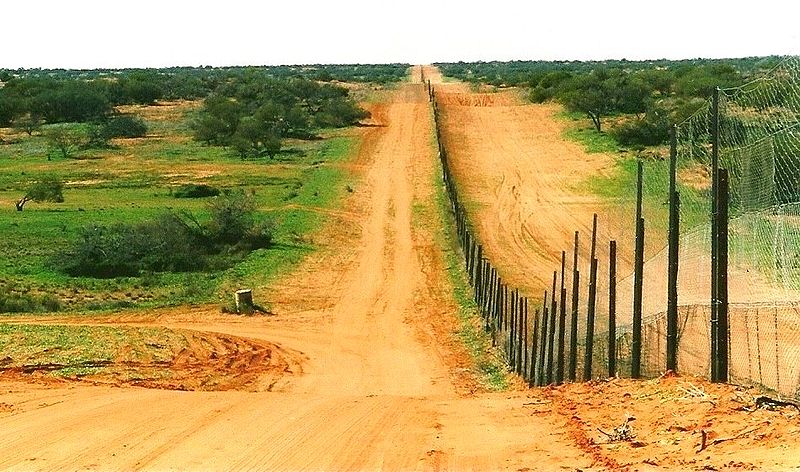
Can Australia afford the dingo fence?

18 05 2012

I wrote this last night with Euan Ritchie of Deakin University in response to some pretty shoddy journalism that misrepresented my comments (and Euan’s work). Our article appeared first in The Conversation this morning (see original article).

We feel we have to set the record straight after some of our (Bradshaw’s) comments were taken grossly out of context, or not considered at all (Ritchie’s). A bubbling kerfuffle in the media over the last week compels us to establish some facts about dingoes in Australia, and more importantly, about how we as a nation choose to manage them.

A small article in the News Ltd. Adelaide Advertiser appeared on 11 May in which one of us (Bradshaw) was quoted as advocating the removal of the dingo fence because it was not “cost effective” (sic). Despite nearly 20 minutes on the telephone explaining to the paper the complexities of feral animal management, the role of dingoes in suppressing feral predators, and the “costs” associated with biodiversity enhancement and feral control, there wasn’t a single mention of any of this background or justification.

Another News Ltd. article denouncing Ritchie’s work on the role of predators in Australian ecosystems appeared in The Weekly Times the day before, to which Ritchie responded in full.

So it’s damage control, and mainly because we want to state categorically that our opinion is ours alone, and not that of our respective universities, schools, institutes or even Biosecurity SA (which some have claimed or insinuated, falsely, that we represent). Biosecurity SA is responsible for, inter alia, the dingo fence in South Australia. Although our opinions differ on its role, we are deeply impressed, grateful and supportive of their work in defending us from biological problems. Read the rest of this entry »




If a tree falls… preventing deforestation with insurance

3 05 2012

As CB readers will know, I’ve reported a few times on our iREDD idea, and it got a little pick-up overseas. Here’s a great article by Rachel Nuwer covering the concept, published in Ecoimagination.com.

Almost everything we own – our houses and cars and our very health – is insured. It works on a simple principal: the higher the risk, the higher the premium. It’s an age-old concept that ecological modelers have decided to apply to a new area: forest preservation.

A new proposal, published in the journal Conservation Letters, would create forest insurance to make the U.N. forest preservation program Reduced Emissions from Deforestation and forest Degradation, or REDD, more effective. REDD is generally supposed to function by paying developing countries to protect their forests in exchange for carbon pollution credits. Currently the program has 42 partner countries across the globe. The program is crucial to the fight against climate change since deforestation and forest degradation accounts for about 20 percent of global greenhouse gas emissions and threatens biodiversity.

“REDD is a fantastic idea,” said Corey Bradshaw, director of ecological modeling at the University of Adelaide and co-author of the study. “You get a carbon advantage and biodiversity doesn’t get wiped out at the same time, it seems perfect.”

But it has a few major flaws that the insurance scheme, called iREDD, seeks to remedy.

REDD only works if the parties are honest and stick to the agreement. Bradshaw doesn’t have much faith that will happen. “If there’s a way to cheat, people will cheat. That’s the nature of all life, not just humans, but we excel at it,” he said. If, for example, a country is paid to conserve one forest but moves its deforestation efforts to an adjacent forest in order to get both money and timber, in terms of carbon offsets, that transaction was a failure. This phenomenon is called “leakage.”

Carbon-capture also only works if it’s maintained indefinitely. If a country accepts money for ten years and then cuts its forest the day after the agreement expires, then all of that conservation was for naught. This issue is called “permanence,” usually translated into an arbitrarily defined period of time set by countries in terms of decades or centuries. Read the rest of this entry »



We only have decades…

26 04 2012

… not centuries.

Here’s a little video production The Environment Institute put together that explains some of our lab‘s work and future directions.


CJA Bradshaw


Take a leaf from insurance industry’s book

18 04 2012

Just a quick one rehashing today’s media release on the iREDD paper I blogged about a while back. The full, online version is available upon request. Stay tuned for media coverage.

A group of environmental scientists say a problem-ridden economic model designed to slow deforestation can be improved by applying key concepts from the insurance industry.

REDD (Reduced Emissions from Deforestation and forest Degradation) is a UN-promoted scheme that allows countries to trade in carbon credits to keep forests intact. It is mainly targeted at developing nations where deforestation and exploitation are a major threat.

In a paper published online in the journal Conservation Letters, ecology researchers from Australia and South Africa argue that REDD projects can suffer from three major problems. They have proposed strengthening the scheme by using insurance policies and premiums, creating a new scheme known as iREDD.

“The idea of paying a nation to protect its forests in exchange for carbon pollution offsets can potentially reduce overall emissions by keeping the trees alive, and ensure a lot of associated biodiversity gets caught up in the conservation process,” says Professor Corey Bradshaw,, Director of Ecological Modelling at the University of Adelaide’s Environment Institute and a senior author of the paper.

“However, there are three main problems with REDD: these are known as leakage, permanence and additionality.” Read the rest of this entry »


Humans suddenly become intelligent

1 04 2012

Some described it as the “eco-topia”; some believed they had died in the night and awoken in a different universe. Some just stood there gaping stupidly.

Yet the events of 01 April 2012 are real*. Humans suddenly became intelligent.

In an unprecedented emergency UN session this morning, all the world’s countries pledged to an immediate wind-down of the fossil-fuel economy and promised to invest in a rational combination of nuclear and renewable energy sources. Some experts believe the pledge would see a carbon-neutral planet by 2020.

Additionally, the session saw a world-wide pledge to halt all deforestation by 2013, with intensive reforestation programmes implemented immediately.

Family planning would be embraced worldwide, with a concerted effort to see the human population plateau by 2070, and begin declining to a stable 2 billion by 2300. Read the rest of this entry »



Unholy trinity of leakage, permanence and additionality

13 03 2012

I begin with the proverbial WTF? The title of this post sounds a little like the legalese accompanying a witchcraft trial, but it’s jargon that’s all the rage in the ‘trading-carbon-for-biodiversity’ circles.

I’m sure that most of my readers will have come across the term ‘REDD‘ (Reduced Emissions from Deforestation and forest Degradation), which is the clever idea of trading carbon credits to keep forests intact. As we know, living forests can suck up a lot of carbon from the atmosphere (remember your high school biology lesson on photosynthesis? Carbon dioxide in. Oxygen out), even though climate change is threatening this invaluable ecosystem service. So the idea of paying a nation (usual a developing country) to protect its forests in exchange for carbon pollution offsets can potentially save two birds with one feeder – reducing overall emissions by keeping the trees alive, and ensuring a lot of associated biodiversity gets caught up in the conservation process.

The problem with REDD though is that it’s a helluva thing to bank on given a few niggly problems essentially revolving around trust. Ah yes, the bugbear of any business transaction. As the carbon credit ‘buyer’ (the company/nation/individual who wishes to offset its carbon output by ‘buying’ the carbon uptake services provided by the intact forest), you’d want to make damn sure that all the money you spend to offset your carbon actually does just that, and that it doesn’t just end up in the hands of some corrupt official, or even worse, used to generate industry that results in even higher emissions! As the buyer, of course you want to entice investors to give you lots of money, and if you bugger up the transaction (by losing the resource you are providing), you’re not likely to have any more investors coming knocking on your door.

Enter the unholy trinity of leakage, permanence and additionality.

This horrible jargon essentially describes the REDD investment problem:

Read the rest of this entry »


Sink to source – the loss of biodiversity’s greatest ecosystem service

29 02 2012

I’ve mentioned this idea before, but it’s nice when some real data support a prediction (no matter how gloomy that prediction might have been). It’s what drives scientists toward discovery (or at least, it’s what I find particularly appealing about my job).

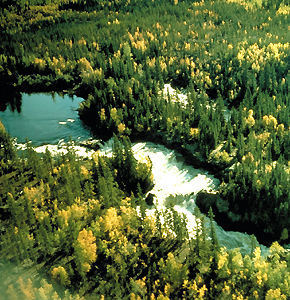
Several years ago, my colleagues (Navjot Sodhi† and Ian Warkentin) and I wrote a major review in TREE about the fate of the world’s ‘second’ lung of the planet, the great boreal forests of Russia, Canada & Scandinavia. We discussed how fragmentation was increasing at an alarming rate, and that although most species there are still relatively intact, we stand to lose a lot of its biodiversity if we don’t halt the fragmenting processes soon. We wrote more on the subject in a paper to appear imminently in Biological Conservation.

Another component though that we raised in the TREE paper was the boreal forests were very much in danger of turning into a net carbon producer. You see, the ‘lung’ analogy is very pertinent because on average, the growth of the massive expanse of the vegetation in the forest generally takes up much more atmospheric carbon that it exudes through decay and burning (for as we all know, plants take up carbon dioxide to produce sugars during photosynthesis, and produce oxygen as a ‘waste’ product). However, as we fragment, cut down and burn the forest, it can end up producing more than it takes up (i.e., turning from a ‘sink’ to a ‘source’). We highlighted several studies indicating how insect outbreaks and human-exacerbated fire intensities and frequencies could conceivably do this.

Now Zhihai Ma and colleagues have just compiled a paper in PNAS indicating that the danger is well on the way to becoming reality in Canada. The paper entitled Regional drought-induced reduction in the biomass carbon sink of Canada’s boreal forests reports the results from 96 long-term permanent sampling plots spread right across southern Canada – from British Columbia in the far west, to Newfoundland in the far east. Read the rest of this entry »


When the cure becomes the disease

6 02 2012

I’ve always barracked for Peter Kareiva‘s views and work; I particularly enjoy his no-bullshit, take-no-prisoners approach to conservation. Sure, he’s said some fairly radical things over the years, and has pissed off more than one conservationist in the process. But I think this is a good thing.

His main point (as is mine, and that of a growing number of conservation scientists) is that we’ve already failed biodiversity, so it’s time to move into the next phase of disaster mitigation. By ‘failing’ I mean that, love it or loathe it, extinction rates are higher now than they have been for millennia, and we have very little to blame but ourselves. Apart from killing 9 out of 10 people on the planet (something no war or disease will ever be able to do), we’re stuck with the rude realism that it’s going to get a lot worse before it gets better.

This post acts mostly an introduction to Peter Kareiva & collaborators’ latest essay on the future of conservation science published in the Breakthrough Institute‘s new journal. While I cannot say I agree with all components (especially the cherry-picked resilience examples), I fundamentally support the central tenet that we have to move on with a new state of play.

In other words, humans aren’t going to go away, ‘pristine’ is as unattainable as ‘infinity’, and reserves alone just aren’t going to cut it. Read the rest of this entry »


The seeds of tropical forest destruction

22 01 2012

Bill Laurance asked me to reproduce his latest piece originally published at Yale University‘s Environment 360 website.

We live in an era of unprecedented road and highway expansion — an era in which many of the world’s last tropical wildernesses, from the Amazon to Borneo to the Congo Basin, have been penetrated by roads. This surge in road building is being driven not only by national plans for infrastructure expansion, but by industrial timber, oil, gas, and mineral projects in the tropics.

Few areas are unaffected. Brazil is currently building 7,500 km of new paved highways that crisscross the Amazon basin. Three major new highways are cutting across the towering Andes mountains, providing a direct link for timber and agricultural exports from the Amazon to resource-hungry Pacific Rim nations, such as China. And in the Congo basin, a recent satellite study found a burgeoning network of more than 50,000 km of new logging roads. These are but a small sample of the vast number of new tropical roads, which inevitably open up previously intact tropical forests to a host of extractive and economic activities.

“Roads,” said the eminent ecologist Thomas Lovejoy, “are the seeds of tropical forest destruction.”

Despite their environmental costs, the economic incentives to drive roads into tropical wilderness are strong. Governments view roads as a cost-effective means to promote economic development and access natural No other region can match the tropics for the sheer scale and pace of road expansion. resources. Local communities in remote areas often demand new roads to improve access to markets and medical services. And geopolitically, new roads can be used to help secure resource-rich frontier regions. India, for instance, is currently constructing and upgrading roads to tighten its hold on Arunachal Pradesh state, over which it and China formerly fought a war.

Read the rest of this entry »


More is better

18 01 2012

In one of those rare moments of perusing the latest ecological literature, I stumbled across an absolute gem, and one that has huge conservation implications. Now, I’m really no expert in this particular area of ecology, but I dare say the paper I’m about to introduce should have been published in Nature or Science (I suspect it was submitted to at least one of these journals first). It was still published in an extremely high-impact journal in ecology though – the Journal of Ecology produced by the British Ecological Society (and one in which I too have had the honour of publishing an article).

Before I get into specifics, I have to say that one thing we conservation biologists tend to bang on about is that MORE SPECIES = BETTER, regardless of the ecosystem in question. We tend to value species richness as the gold standard of ecosystem ‘health’ and ‘resilience’, whether or not there is strong empirical evidence in support. It’s as if the more-is-better mantra strikes an intuitive chord and must, by all that’s ecologically right in the world, be true.

Of course, measuring what is ‘better’ is a difficult task, especially when we are talking about complex ecosystems comprising thousands, if not millions, of species. Does ‘better’ refer to the most temporally stable, the most genetically diverse, the most resilient to perturbation, or the provider of the greatest number of functions and hence, ecosystem services?

It’s up to you, but all these things tend to be difficult to measure for a large number of species and over time scales of sufficient duration to measure change. So the default for plants (i.e., the structural framework of almost all ecosystems) I guess has come down to a simpler measure of success – ‘productivity’. This essentially means how much biomass is produced per unit area/volume per time step. It’s not a great metric, but it’s probably one of the more readily quantifiable indices.

Enter the so-called ‘diversity-productivity relationship’, or ‘DPR’, which predicts that higher plant species diversity should engender higher net productivity (otherwise known as the ‘net biodiversity effect’). Read the rest of this entry »


Mucking around the edges

8 11 2011

Barry Brook over at BraveNewClimate.com beat me to the punch regarding our latest paper, so I better get off my arse and write my take on things.

This post is about a paper we’ve just had accepted and has come out online in Biological Conservation called Strange bedfellows? Techno-fixes to solve the big conservation issues in southern Asia – and it’s likely to piss off a few people, and hopefully motivate others.

We wrote the paper for a special issue of essays dedicated to the memory of our mate and colleague, Navjot Sodhi, who died earlier this year. The issue hasn’t been released yet, but we have managed to get our paper out well before.

Like Navjot, the paper is controversial. Also like Navjot, we hope it challenges a few minds and pushes a few boundaries. We, as conservation biologists, must accept the fact that we have largely failed – biodiversity is still being lost at an alarming rate despite decades and decades of good science, sound evidence-based policy recommendations and even some rescues of species on the ‘brink’. Huge consumption rates, a population of 7 billion humans and counting, carbon emissions exceeding all worst-case scenarios, and greater disparity of wealth distribution have all contributed to this poor performance.

So what else can we do? Read the rest of this entry »


Twenty landmark papers in biodiversity conservation

13 10 2011

While I can’t claim that this is the first time one of my peer-reviewed papers has been inspired by ConservationBytes.com, I can claim that this is the first time a peer-reviewed paper is derived from the blog.

After a bit of a sordid history of review (isn’t it more and more like that these days?), I have the pleasure of announcing that our paper ‘Twenty landmark papers in biodiversity conservation‘ has now been published as an open-access chapter in the new book ‘Research in Biodiversity – Models and Applications‘ (InTech).

Perhaps not the most conventional of venues (at least, not for me), but it is at the very least ‘out there’ now and freely available.

The paper itself was taken, modified, elaborated and over-hauled from text written in this very blog – the ‘Classics‘ section of ConservationBytes.com. Now, if you’re an avid follower of CB, then the chapter won’t probably represent anything terribly new; however, I encourage you to read it anyway given that it is a vetted overview of possibly some of the most important papers written in conservation biology.

If you are new to the field, an active student or merely need a ‘refresher’ regarding the big leaps forward in this discipline, then this chapter is for you.

The paper’s outline is as follows: Read the rest of this entry »



Rise of the phycologists

22 09 2011

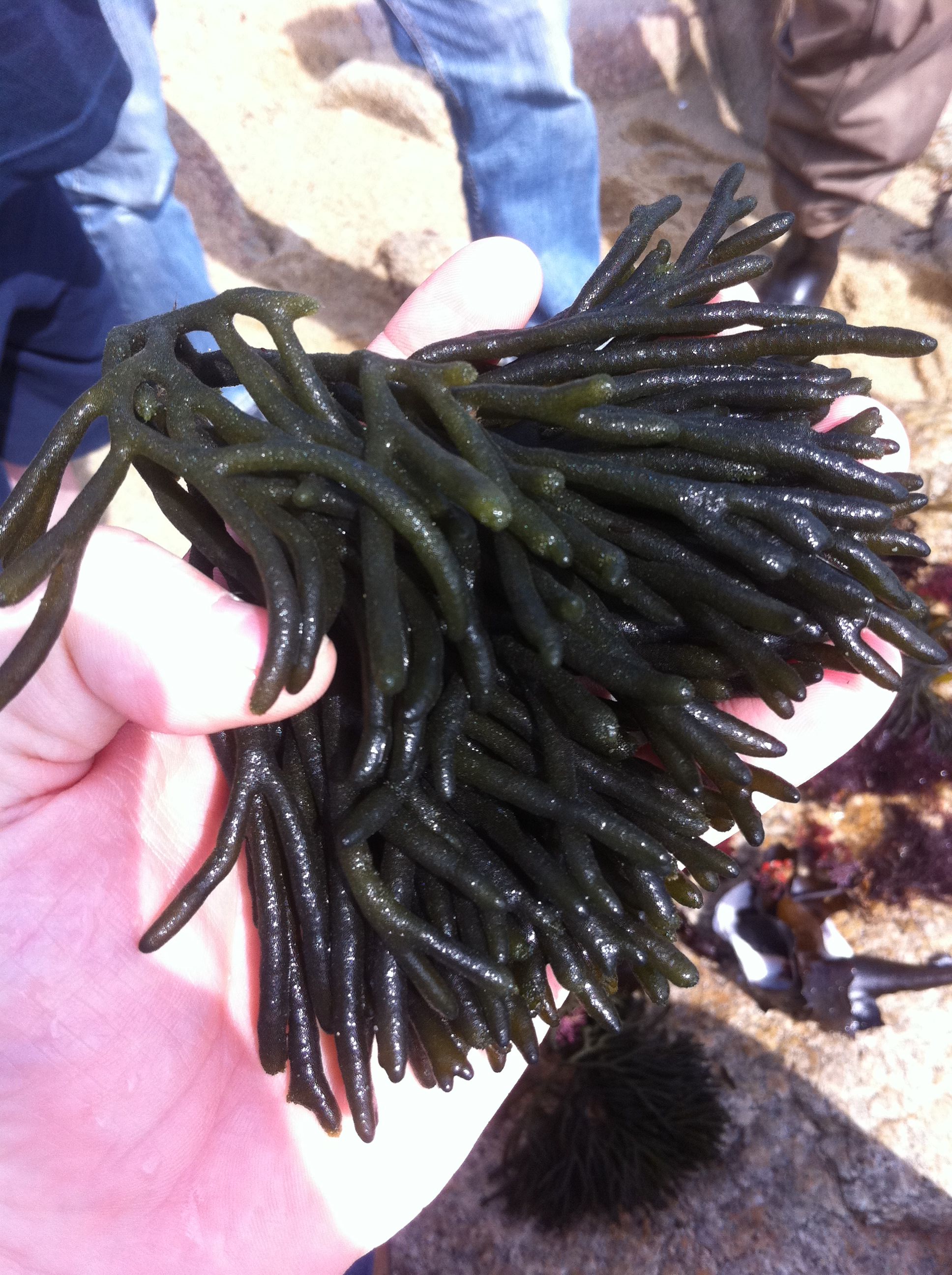
Dead man's fingers (Codium fragile) - © CJA Bradshaw

I’ve had an interesting week. First, it’s been about 6 years since I was last in Japan, and I love coming here; the food is exquisite, the people are fantastic (polite, happy, accommodating), everything works (trains, buses, etc.) and most importantly, it has an almost incredible proportion of its native forests intact.

But it wasn’t for forests that I travelled to Japan (nor the sumo currently showing on the guest-room telly where I’m staying – love the sumo): I was here for a calcareous macroalgae workshop.

What?

First, what are ‘macroalgae’, and why are some ‘calcareous’? And why should anyone in their right mind care?

Good questions. Answers: 1. Seaweeds; 2. Many incorporate calcium carbonate into their structures as added structural support; 3. Read on.

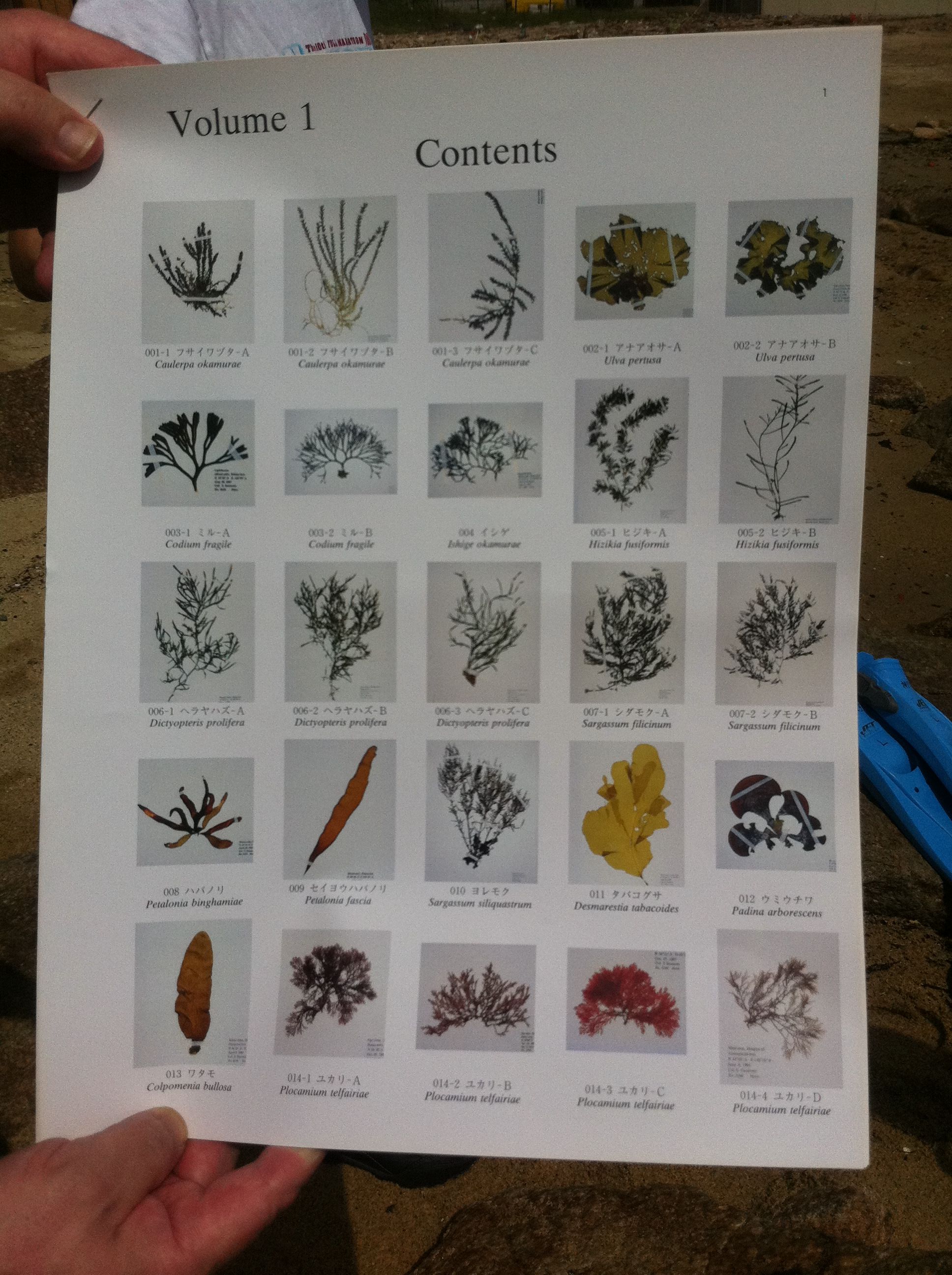
Now, I’m no phycologist (seaweed scientist), but I’m fascinated by this particular taxon. I’ve written a few posts about their vital ecological roles (see here and here), but let me regale you with some other important facts about these amazing species.

Some Japanese macroalgae - © CJA Bradshaw

There are about 12,000 known species of macroalgae described by phycologists, but as I’ve learnt this week, this is obviously a vast underestimate. For most taxa that people are investigating now using molecular techniques, the genetic diversity is so high and so geographically structured that there are obviously a huge number of ‘cryptic’ species within our current taxonomic divisions. This could mean that we’re out by up to a factor of 2 in the number of species in the world.

Another amazing fact – about 50 % of all known seaweed species are found in just two countries – Japan and Australia (hence the workshop between Japanese and Australian phycologists). Southern Australia in particular is an endemism hotspot.

Ok. Cool. So far so good. But so what? Read the rest of this entry »


More than leftovers: getting marine parks right in Australia

7 08 2011
Taken by user Hossen27

Image via Wikipedia

A few weeks back I cosigned a ‘statement of concern’ about the proposal for Australia’s South West Marine Region organised by Hugh Possingham. The support has been overwhelming by Australia’s marine science community (see list of supporting scientists below). I’ve reproduced the letter addressed to the Australian government – distribute far and wide if you give more than a shit about the state of our marine environment (and the economies it supports). Basically, the proposed parks are merely a settlement between government and industry where nothing of importance is really being protected. The parks are just the leftovers industry doesn’t want. No way to ensure the long-term viability of our seas.

On 5 May 2011 the Australian Government released a draft proposal for a network of marine reserves in the Commonwealth waters of the South West bioregional marine planning region.

Australia’s South West is of global significance for marine life because it is a temperate region with an exceptionally high proportion of endemic species – species found nowhere else in the world.

Important industries, such as tourism and fisheries, depend on healthy marine ecosystems and the services they provide. Networks of protected areas, with large fully protected core zones, are essential to maintain healthy ecosystems over the long-term – complemented by responsible fisheries management1.

The selection and establishment of marine reserves should rest on a strong scientific foundation. We are greatly concerned that what is currently proposed in the Draft South West Plan is not based on the three core science principles of reserve network design: comprehensiveness, adequacy and representation. These principles have been adopted by Australia for establishing our National Reserve System and are recognized internationally2.

Specifically, the draft plan fails on the most basic test of protecting a representative selection of habitats within the bioregions of the south-west. There are no highly protected areas proposed at all in three of the seven marine bioregions lying on the continental shelf3. Overall less than 3.5% of the shelf, where resource use and biodiversity values are most intense, is highly protected. Further, six of the seven highly protected areas that are proposed on the shelf are small (< 20 km in width)4 and all are separated by large distances (> 200 km)5. The ability of such small isolated areas to maintain connectivity and fulfil the goal of protecting Australia’s marine biodiversity is limited. Read the rest of this entry »


Taxonomy in the clouds

4 07 2011

Another post (see previous here, here and here) by my aspiring science-communicator PhD student, Salvador Herrando-Pérez.

Taxonomy uses rigorous rules of nomenclature to classify living beings, so every known species has a given ‘name’ and ‘surname’. The revision of certain taxonomic groups (particularly through genetic analyses) is favouring the proliferation of nominally new species, often propelled by virtue of their charisma and conservation status.

In secondary school, most of my classmates associated the subject ‘Biology’ with unpronounceable Latin taxonomic names, with which all known living beings are branded — ‘Canis lupus’ reads the identity card of humanity’s best friend. When the Swedish monk Carl Linnaeus proposed such binomial nomenclature, he could hardly imagine that, two hundred years later, his terminology would underpin national and transnational budgets for species conservation. Taxonomic nomenclature allows the classification of species into clusters of the same kind (e.g., diatoms, amanitas, polychaetes, skinks), and the calculation of an indispensable figure for conservation purposes: how many species are there at a given location, range, country, continent, or the entire planet?

Traditionally, taxonomists described species by examining their (external and internal) morphological features, the widest consensus being that two individuals of different species could not hybridise. However, a practical objection to that thinking was that if, for instance, an ocean separated two leopard populations, ethics should prevent us from bringing them in contact only to check if they produce fertile offspring, hence justifying a common-species status. Genetics currently provides a sort of ‘remote check’.

New species, new names

Over the last three decades, the boom of genetics and the global modernisation of environmental policies have fostered alternative criteria to differentiate species, populations, and even individuals. As a result, experts have created a colourful lexicon to label management or conservation units or new taxonomical categories such as that of a subspecies1, e.g., Canis lupus dingo for the wild Australian dog (dingo). These changes have shaken the foundations of taxonomy because several definitions of species (biological, phylogenetic, evolutionary) are forced to live under the umbrella of a common nomenclature. Read the rest of this entry »


Reforesting wealthy countries for the common good

29 06 2011

The Coalition of Financially Challenged Countries with Lots of Trees, known as ‘CoFCCLoT’, representing most of the world’s remaining tropical forests, is asking wealthy nations to share global responsibilities and reforest their land for the common good of stabilizing climate and protecting biodiversity.

“We are willing to play our part, but we require a level playing field in which we all commit to equal sacrifices,” a coalition spokeswoman says. “Returning forest cover in the G8 countries and the European Union back to historic coverage will benefit all of us in the long-term.”

Seventy-five per cent of Europe was once forested. Now it is 45 per cent. Some countries such as Ireland saw forest cover reduced to near zero. Most forest cover in the developed world is now often planted with stands of alien trees, turning them into deserts for biodiversity. Remaining natural forests are often highly fragmented and have few native species. Read the rest of this entry »


Infinite planet theory

24 05 2011

Rob Dietz over at the Centre for the Advancement of the Steady State Economy (CASSE) just e-mailed me and suggested I reproduce a recent post of theirs on ConservationBytes.com. Rob has produced a cracker – very funny, but ‘reality’ usually is. Many thanks, Rob, for a fine piece of writing.

Few people have read the dense volumes published by the economist Milton Mountebank, but his work has affected you, me and every single person on the planet. Dr. Mountebank has revolutionized economic thought, and now he has been recognized for his singular efforts. Yesterday at a gala reception in Stockholm, Sweden, the chairman of Sveriges Riksbank, Peter Norborg, presented Dr. Mountebank with the Nobel Prize in Economics for his lifetime of work on infinite planet theory.

In his presentation of the award, Mr. Norborg stated, “Dr. Mountebank has demonstrated imagination and inventiveness beyond what the rational mind can comprehend.” Indeed, it is because of his theories that we all do what we do economically. Nations strive for continuous GDP growth and endless expansion of consumption thanks to infinite planet theory. Mr. Norborg went on to say, “All of our banks, including Sveriges Riksbank, owe him a huge debt. We finance economic expansion. Our actions and decisions would be morally suspect if we lived on a finite planet.”

In a light-hearted moment during the presentation, Mr. Norborg asserted that Dr. Mountebank had provided an even greater service to humanity by reducing stress on individuals. “Best of all,” he said, “is that we can extract, consume and digest resources guilt-free. Planetary constraints have been conquered. They have gone the way of the dodo, the Roman Empire and the world’s major fisheries.” Read the rest of this entry »


Silence of the birds

2 05 2011

Yet another contribution from my PhD student, Salvador Herrando-Pérez (see his previous ConservationBytes.com posts on micro-evolution and pollination).

In the 1960s, Rachel Carson preoccupied (to put it mildly) the political and economic powers of the United States with the publication of her book, Silent Spring, an overwhelming essay highlighting the environmental impacts caused by the pesticide industry. Half a century later, the metaphor of that book – a spring devoid of bird song – stands in force as farmland birds keep declining worldwide at the mercy of agricultural practices insensitive to the ecosystem services biodiversity procures. The problem has been best studied in Europe where non-government organisations, such as the British Trust for Ornithology or the Sociedad Española de Ornitología, have been monitoring bird populations for decades, and the European Union has sumptuously financed research and management actions.

Sparrows are the commonest among common birds. Worldwide we see them wherever humans live, travel and take leisure, from mountains and beaches to stadiums and underground trains. These feathery dwarfs snick even through security checks and sliding doors at airports and shopping malls, and it is no one’s surprise to be overflown by one of them carrying a chip from the leftovers of a nearby food court. However, the deterioration of their populations has sown alarm among European politicians, society, and the scientific community. Read the rest of this entry »


Ecosystem services – the non-human perspective

29 04 2011

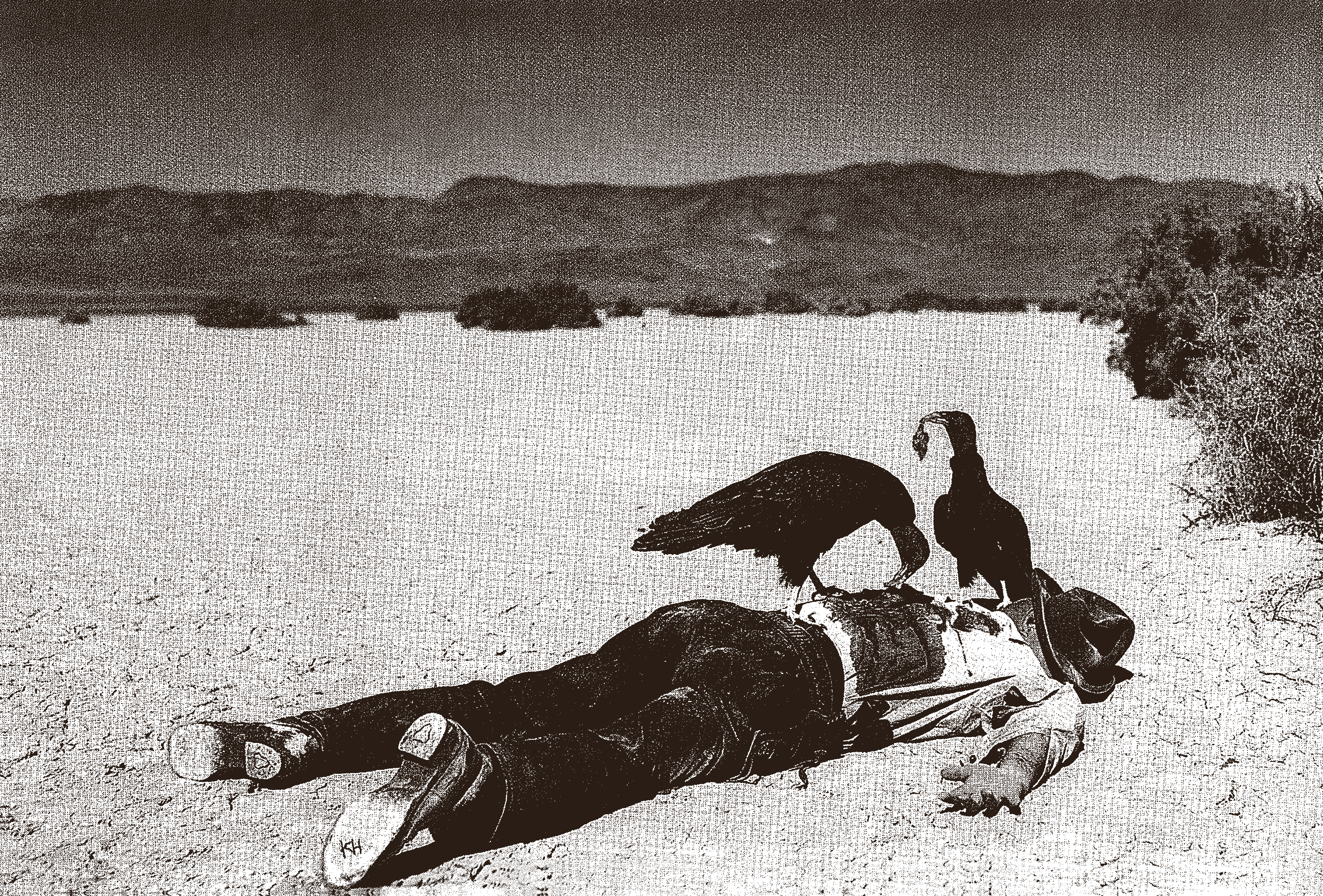
A picture is worth a large, generally unquantifiable number of words (in all languages):

Who says I’m a misanthropist?

Enjoy your weekend.

CJA Bradshaw


Resolving the Environmentalist’s Paradox

7 04 2011

Here’s an extremely thought-provoking guest post by Megan Evans, Research Assistant at the University of Queensland in Kerrie Wilson‘s lab. Megan did her Honours degree with Hugh Possingham and Kerrie, and has already published heaps from that and other work. I met Megan first in 2009 and have been extremely impressed with her insights, broad range of interests and knowledge, and her finely honed grasp of social media in science. Smarter than your average PhD student, without a doubt (and she has even done one yet). Take it away, Megan.

© T. Toles

Resolving the ‘Environmentalist’s Paradox’, and the role of ecologists in advancing economic thinking

Aldo Leopold famously described the curse of an ecological education as “to be the doctor who sees the marks of death in a community that believes itself well and does not want to be told otherwise”. Ecologists do have a tendency for making dire warnings for the future, but for anyone concerned about the myriad of problems currently facing the Earth – climate change, an ongoing wave of species extinctions and impending peak oil, phosphate, water , (everything?) crises – the continued ignorance or ridicule of such warnings can be a frustrating experience. Environmental degradation and ecological overshoot isn’t just about losing cute plants and animals, given the widespread acceptance that long-term human well-being ultimately rests on the ability for the Earth to supply us with ecosystem services.

In light of this doom and gloom, things were shaken up a bit late last year when an article1 published in Bioscience pointed out that in spite of declines in the majority of ecosystem services considered essential to human well-being by The Millenium Ecosystem Assessment (MA), aggregate human well-being (as measured by the Human Development Index) has risen continuously over the last 50 years. Ciara Raudsepp-Hearne and the co-authors of the study suggested that these conflicting trends presented an ‘environmentalist’s paradox’ of sorts – do we really depend on nature to the extent that ecologists have led everyone to believe? Read the rest of this entry »