Follow the TREND

24 10 2011

A little clichéd, I know, but that’s what it says on the T-shirt.

It’s been an interesting week. Not only did I return to some much-needed field work (even if it was diving in the muck of Adelaide’s Outer Harbour with 40-cm visability), but it was also the week when the TREND project became ‘official’ with the launching of its website and its public début at the Earth Station festival in Belair National Park over the weekend.

I can see the thought bubbles already – what the hell is ‘TREND‘ (apart from the obvious)?

Admittedly a somewhat contrived acronym, TREND stands for TRends in ENvironmental monitoring and Decision making – a multi-million dollar project financed mainly by the state government of South Australia and the Terrestrial Ecosystem Research Network (TERN – I know, another bloody acronym that is weirdly similar to TREND; oh how we Aussies love our acronyms and initialisms!). Here’s the official summary:

“TREND provides a system of data collection across native ecosystems, primary production regions and marine environments. By assessing the impacts of various potential climatic and environmental shifts, TREND will provide an early warning system for changes in South Australia’s diverse environments and a lasting legacy of long-term monitoring, informed policy and proactive response to environmental change. Read the rest of this entry »


Pickled niches

2 08 2011

Another fine contribution from Salvador Herrando-Pérez (see previous posts here, here, here and here).

Sometimes evolution fails to shape new species that are able to expand the habitat of their ancestors. This failure does not rein in speciation, but forces it to take place in a habitat that changes little over geological time. Such evolutionary outcomes are important to predict the distribution of groups of phylogenetically related species.

Those who have ever written a novel, a biography, or even a court application, will know that a termite-eaten photo or an old hand-written letter can help rebuild moments of our lives with surgical precision. Likewise, museums of natural sciences store historical biodiversity data of great value for modern research and conservation1.

A notable example is the study of chameleons from Madagascar by Chris Raxworthy and colleagues2. By collating 621 records of 11 species of the tongue-throwing reptiles, these authors subsequently concentrated survey efforts on particular regions where they discovered the impressive figure of seven new species to science, which has continued to expand3 (see figure below). The trick was to characterise the habitat at historical and modern chameleon records on the basis of satellite data describing climate, hydrology, topography, soil and vegetation, then extrapolate over the entire island to predict what land features were most likely to harbour other populations and species. This application of species distribution models4 supports the idea that the phenotypic, morphological and ecological shifts brought about by speciation can take place at slower rates than changes in the habitats where species evolve – the so-called ‘niche conservatism’ (a young concept with already contrasting definitions, e.g.,5-7).

Read the rest of this entry »


How to predict marine biodiversity

26 07 2011

One of the most important components of conservation ecology is arguably the focus on robust methods to predict ‘biodiversity’. This covers everything from detection issues (whether or not a species is in a particular area), species distribution models (to predict where a species should be given habitat and/or physical attributes), climate change predictions, to reserve design algorithms (to assess whether we are protecting what we think we are protecting).

It might seem a bit strange to the uninitiated that we have to spend so much time trying to figure out what’s there. Surely, one just goes to the area of interest and does a few quick surveys? Wouldn’t that be lovely; the truth is that most species are, in fact, rare, and the massive areas we must usually survey tend to preclude complete coverage. This is why experimental design and statistical techniques are so advanced in our discipline – to account for the probability of missing what’s actually there, and to estimate what should be in areas we haven’t even looked in.

Read the rest of this entry »


Over-estimating extinction rates

19 05 2011

I meant to get this out yesterday, but was too hamstrung with other commitments. Now the media circus has beat me to the punch. Despite the lateness (in news-time) of my post, my familiarity with the analysis and the people involved gives me a unique insight, I believe.

So a couple of months ago, Fangliang He and I were talking about some new analysis he was working on where he was testing the assumption that back-casted species-area relationships (SAR) gave reasonable estimates of inferred extinction rates. Well, that paper has just been published in today’s issue of Nature  by Fangliang He and Stephen Hubbell entitled: Species–area relationships always overestimate extinction rates from habitat loss (see also the News & Views piece by Carsten Rahbek and Rob Colwell).

The paper has already stirred up something of a controversy before the ink has barely had time to dry. Predictably, noted conservation biologists like Stuart Pimm and Michael Rosenzweig have already jumped down Fangliang’s throat.

Extinction rates of modern biota in the current biodiversity crisis (Ehrlich & Pringle 2008) are wildly imprecise. Indeed, it has been proposed that extinction rates exceed the deep-time average background rate by 100- to 10000-fold (Lawton & May 2008; May et al. 1995; Pimm & Raven 2000), and no rigorously quantification of these rates globally has ever been accomplished (although there are several taxon- and region-specific estimates of localised extinction rates (Brook et al. 2003; Regan et al. 2001; Hambler et al. 2011; Shaw 2005).

Much of the information used to infer past extinction rate estimates is based on  the species-area relationship (e.g., Brook et al. 2003); this method estimates extinction rates by reversing the species-area accumulation curve, extrapolating backward to smaller areas to calculate expected species loss. The concept is relatively simple, even though the underlying mathematics might not be. Read the rest of this entry »


生态学 = ‘Ecology’ in China

13 05 2011

I’m just heading home after a very inspiring workshop organised by Fangliang He at Sun Yat-sen University in Guangzhou, China (I’m writing this from the Qantas Club in the Hong Kong airport).

Before I proceed to regale you with the salient details of the ‘International Symposium for Biodiversity and Theoretical Ecology‘, I am compelled to state publicly that I offer my sincerest condolences to Fangliang and his family; unfortunately Fangliang’s brother passed away while we were at the workshop and so Fangliang wasn’t able to spend much time reaping the fruits of his organisational labour. If you know Fangliang, please send him a supporting email.

That sad note aside, I am delighted to say that the workshop was compelling, challenging and also rather fortuitous. I was one of many overseas invitees, and I must say that I was at times overwhelmed by the size of the brains they managed to pack into the auditorium. Many colleagues I didn’t know attended, and I hope that many will become collaborators. The international invitees were: Read the rest of this entry »


Tropical forests cooking their biodiversity

5 05 2011

Another ‘hot’ essay by Bill Laurance recently published online by Yale Environment 360 (a publication of the Yale University School of Forestry & Environmental Studies). Bill asked me to relay it on ConservationBytes.com, so here it is in full:

Much attention has been paid to how global warming is affecting the world’s polar regions and glaciers. But a leading authority on tropical forests [that would be Bill] warns that rising temperatures could have an equally profound impact on rainforests and are already taking a toll on some tropical species.

On Jan. 12, 2002, in the Australian state of New South Wales, biologist Justin Welbergen was observing a colony of flying foxes for his Ph.D. research. The temperatures that day on Australia’s subtropical, eastern coast reached record highs, soaring to 42.9 ° C (109 ° F) at the weather station closest to Welbergen’s study site — nearly 8 ° C higher than the average summer maximum temperature.

The flying foxes, or giant fruit bats, normally just doze in the treetops through the day, but on this afternoon they were fanning themselves, panting frantically, jostling for shady spots, and licking their wrists in a desperate effort to cool down. Suddenly, when the thermometer hit 42 ° C, the bats began falling from the trees. Most quickly died. Welbergen and his colleagues counted 1,453 flying foxes that died from the heat in one colony alone. The scorching heat that day killed at least 2,200 additional flying foxes in eight other colonies along a 250-kilometre stretch of coastline. All the deaths occurred in colonies where temperatures soared above 41.7 ° C. Read the rest of this entry »


Species’ Ability to Forestall Extinction – AudioBoo

8 04 2011

Here’s a little interview I just did on the SAFE index with ABC AM:

Not a bad job, really.

And here’s another one from Radio New Zealand:

CJA Bradshaw


Does the pope wear a funny hat?

5 04 2011

Does a one-legged duck swim in circles? Does an ursid defecate in a collection of rather tall vascular plants? Does fishing kill fish?

Silly questions, I know, but it’s the kind of question posed every time someone doubts the benefits (i.e., for biodiversity, fishing, local economies, etc.) of marine reserves.

I’ve blogged several times on the subject (see Marine protected areas: do they work?The spillover effectInterview with a social (conservation) scientist, and Failing on ocean protection), but considering Hugh Possingham is town today and presenting the case to the South Australian Parliament on why this state NEEDS marine parks, I thought I’d rehash an old post of his published earlier this year in Australasian Science:

Science has long demonstrated that marine reserves protect marine biodiversity. Rather than answer the same question again, isn’t it about time we started funding research that answers some useful scientific questions?

As marine reserves spread inexorably across the planet, the cry from skeptics and some fishermen is: “Do marine reserves work?” The science is pretty clear but acknowledgement of this by the public is another story. Let me begin with a story of my experience answering this question while communicating to stakeholders the subtleties of marine conservation planning during the rezoning of Moreton Bay.

I was asked by the then-Queensland Environmental Protection Agency to explain to stakeholders the process of marine reserve system design as it applied to the Moreton Bay rezoning. I told the gathering that the rezoning was about conserving a fraction of each mappable biodiversity attribute (species and habitats) for the minimum impact on the livelihood of others. Read the rest of this entry »


How fast are we losing species anyway?

28 03 2011

© W. Laurance

I’ve indicated over the last few weeks on Twitter that a group of us were recently awarded funding from the Australian Centre for Ecological Synthesis and Analysis – ACEAS – (much like the US version of the same thing – NCEAS) to run a series of analytical workshops to estimate, with a little more precision and less bias than has been done previously, the extinction rates of today’s biota relative to deep-time extinctions.

So what’s the issue? The Earth’s impressive diversity of life has experienced at least five mass extinction events over geological time. Species’ extinctions have kept pace with evolution, with more than 99 % of all species that have ever existed now gone (Bradshaw & Brook 2009). Despite general consensus that biodiversity has entered the sixth mass extinction event because of human-driven degradation of the planet, estimated extinction rates remain highly imprecise (from 100s to 10000s times background rates). This arises partly because the total number of species is unknown for many groups, and most extinctions go unnoticed.

So how are we going to improve on our highly imprecise estimates? One way is to look at the species-area relationship (SAR), which to estimate extinction requires one to extrapolate back to the origin in taxon- and region-specific SARs (e.g., with a time series of deforestation, one can estimate how many species would have been lost if we know how species diversity changes in relation to habitat area). Read the rest of this entry »


Big sharks. Big mystery.

9 03 2011

My PhD student, Ana Sequeira, has just written a great little guest blog post for the Environment Institute‘s blog. Given I’m en route to Tasmania for a quick consultancy meeting, I thought I’d let myself off the hook and reproduce the post here. Well done, Ana (and hint to my other students – your time on ConservationBytes.com is coming…).

This week is Seaweek and guest blogger Ana Sequeira describes how whale shark distribution might be shifting according to seasonal environmental predictors.

Ana Sequeira is a PhD student at the University of Adelaide (Global Ecology Group). Her main research interests are to develop models applied to the marine environment to describe key environmental processes, species distribution patterns and ecological interactions.

The main objective of her PhD thesis is to investigate behavioural ecology of whale sharks. She is now trying to understand which environmental variables may affect whale shark distribution.

The whale shark (Rhincodon typus, Smith 1828) is the largest fish in the ocean and can reach more than 12 m in total length. Although little is known about their habitat selection or migration patterns, the whale shark appears to be a highly mobile species. They predictably form near shore aggregations in some coastal locations (e.g. off Ningaloo reef in Western Australia) what makes them the subject of highly lucrative marine ecotourism industries. Also, artisanal and small-scale fisheries for the species still exist in many parts of the tropics.

Since the whale sharks is classified a Vulnerable species (IUCN Red List), understanding their migratory behaviour became of chief importance as they can be travelling from regions where they are protected to regions where they are still harvested. Read the rest of this entry »


They always whinge about the maths

18 11 2010

If you don’t know what a differential equation is, you are not a scientist” – Hugh Possingham 2009

At the end of 2009 I highlighted a new book edited by good mates Navjot Sodhi and Paul Ehrlich, Conservation Biology for All, in which Barry Brook and I had written a chapter. Now, despite my vested interest, I thought (and still think) that it was one of the best books on conservation biology yet published, and the subsequent reviews appear to be validating my subjective opinion.

I’ve given snippets of the book’s contents, from Paul Ehrlich‘s editorial on the human population’s rising negative influences on biodiversity, to a more detailed synopsis of our chapter, The Conservation Biologist’s Toolbox, and I’ve reproduced a review printed in Trends in Ecology and Evolution.

The latest review by Nicole Gross-Camp of the University of East Anglia published in Ecology is no less flattering – in fact, it is the most flattering to date. So this is by no means a whinge about a whinge; rather, consider it an academic lament followed by a query. First, the review:

Reaching higher in conservation

If a book could receive a standing ovation—this one is a candidate. Sodhi and Ehrlich have created a comprehensive introduction to conservation biology that is accessible intellectually, and financially, to a broad audience—indeed it is Conservation biology for all. The book is divided into 16 chapters that can stand alone and are complementary when read in sequence. The authors make excellent use of cross citations of chapters, a useful and often overlooked feature in texts of this nature. In the introductory chapter, Sodhi and Ehrlich eloquently summarize the gravity of the conservation crisis and still retain an optimistic outlook that encourages the reader to continue. I particularly found their recognition of population growth, consumption, and ethics in the conservation arena refreshing and a step toward what will likely become the next major issues of discussion and research in the conservation field. Read the rest of this entry »


Webinar: Modelling water and life

27 08 2010

Another quick one today just to show the webinar of my recent 10-minute ‘Four in 40’ talk sponsored by The Environment Institute and the Department for Water. This seminar series was entitled ‘Modelling as a Tool for Decision Support’ held at the Auditorium, Royal Institution Australia (RiAus).

“Four in 40″ is a collaboration between The University of Adelaide and the Department for Water, where 4 speakers each speak for 10 minutes on their research and its implications for policy. The purpose is to build understanding of how best to work with each other, build new business for both organisations and raise awareness of activity being undertaken in water/natural resource management policy and research.

CJA Bradshaw


Linking disease, demography and climate

1 08 2010

Last week I mentioned that a group of us from Australia were travelling to Chicago to work with Bob Lacy, Phil Miller, JP Pollak and Resit Akcakaya to make some pretty exciting developments in next-generation conservation ecology and management software. Also attending were Barry Brook, our postdocs: Damien Fordham, Thomas Prowse and Mike Watts, our colleague (and former postdoc) Clive McMahon, and a student of Phil’s, Michelle Verant. At the closing of the week-long workshop, I thought I’d share my thoughts on how it all went.

In a word, it was ‘productive’. It’s not often that you can spend 1 week locked in a tiny room with 10 other geeks and produce so many good and state-of-the-art models, but we certainly achieved more than we had anticipated.

Let me explain in brief why it’s so exciting. First, I must say that even the semi-quantitative among you should be ready for the appearance of ‘Meta-Model Manager (MMM)’ in the coming months. This clever piece of software was devised by JP, Bob and Phil to make disparate models ‘talk’ to each other during a population projection run. We had dabbled with MMM a little last year, but its value really came to light this week.

We used MMM to combine several different models that individually fail to capture the full behaviour of a population. Most of you will be familiar with the individual-based population viability (PVA) software Vortex that allows relatively easy PVA model building and is particular useful for predicting extinction risk of small populations. What you most likely don’t know exists is what Phil, Bob and JP call Outbreak – an epidemiological modelling software based on the classic susceptible-exposed-infectious-recovered framework. Outbreak is also an individual-based model that can talk directly to Vortex, but only through MMM. Read the rest of this entry »


Mega-meta-model manager

24 07 2010

As Barry Brook just mentioned over at BraveNewClimate.com, I’ll be travelling with him and several of our lab to Chicago tomorrow to work on some new aspects of linked climate, disease, meta-population, demographic and vegetation modelling. Barry has this to say, so I won’t bother re-inventing the wheel:

… working for a week with Dr Robert LacyProf Resit Akcakaya and collaborators, on integrating spatial-demographic ecological models with climate change forecasts, and implementing multi-species projections (with the aim of improving estimates of extinction risk and provide better ranking of management and adaptation options). This work builds on a major research theme at the global ecology lab, and consequently, a whole bunch of my team are going with me — Prof Corey Bradshaw (lab co-director), my postdocs Dr Damien FordhamDr Mike Watts and Dr Thomas Prowse and Corey’s and my ex-postdoc, Dr Clive McMahon. This builds on earlier work that Corey and I had been pursuing, which he described on ConservationBytes last year.

The ‘mega-meta-model manager’ part is a clever piece of control-centre software that integrates these disparate ecological, climate and disease dynamic inputs. Should be some good papers coming out of the work soon.

Of course, I’ll continue to blog over the coming week. I’m not looking forward to the 30-hour travel tomorrow to Chicago, but it should be fun and productive once I get there.

CJA Bradshaw

Add to FacebookAdd to DiggAdd to Del.icio.usAdd to StumbleuponAdd to RedditAdd to BlinklistAdd to TwitterAdd to TechnoratiAdd to Yahoo BuzzAdd to Newsvine


Faraway fettered fish fluctuate frequently

27 06 2010

Hello! I am Little Fish

Swimming in the Sea.

I have lots of fishy friends.

Come along with me.

(apologies to Lucy Cousins and Walker Books)

I have to thank my 3-year old daughter and one of her favourite books for that intro. Now to the serious stuff.

I am very proud to announce a new Report in Ecology we’ve just had published online early about a new way of looking at the stability of coral reef fish populations. Driven by one of the hottest young up-and-coming researchers in coral reef ecology, Dr. Camille Mellin (employed through the CERF Marine Biodiversity Hub and co-supervised by me at the University of Adelaide and Julian Caley and Mark Meekan of the Australian Institute of Marine Science), this paper adds a new tool in the design of marine protected areas.

Entitled Reef size and isolation determine the temporal stability of coral reef fish populations, the paper applies a well-known, but little-used mathematical relationship between the logarithms of population abundance and its variance (spatial or temporal) – Taylor’s power law.

Taylor’s power law is pretty straightforward itself – as you raise the abundance of a population by 1 unit on the logarithmic scale, you can expect its associated variance (think variance over time in a fluctuating population to make it easier) to rise by 2 logarithmic units (thus, the slope = 2). Why does this happen? Because a log-log (power) relationship between a vector and its square (remember: variance = standard deviation2) will give a multiplier of 2 (i.e., if xy2, then log10x ~ 2log10y).

Well, thanks for the maths lesson, but what’s the application? It turns out that deviations from the mathematical expectation of a power-law slope = 2 reveal some very interesting ecological dynamics. Famously, Kilpatrick & Ives published a Letter in Nature in 2003 (Species interactions can explain Taylor’s power law for ecological time series) trying to explain why so many real populations have Taylor’s power law slopes < 2. As it turns out, the amount of competition occurring between species reduces the expected fluctuations for a given population size because of a kind of suppression by predators and competitors. Cool.

But that application was more a community-based examination and still largely theoretical. We decided to turn the power law a little on its ear and apply it to a different question – conservation biogeography. Read the rest of this entry »


Biodiversity SNAFU in Australia’s Jewel

16 06 2010

I’ve covered this sad state of affairs and one of Australia’s more notable biodiversity embarrassments over the last year (see Shocking continued loss of Australian mammals and Can we solve Australia’s mammal extinction crisis?), and now the most empirical demonstration of this is now published.

The biodiversity guru of Australia’s tropical north, John Woinarksi, has just published the definitive demonstration of the magnitude of mammal declines in Kakadu National Park (Australia’s largest national park, World Heritage Area, emblem of ‘co-management’ and supposed biodiversity and cultural jewel in Australia’s conservation crown). According to Woinarski and colleagues, most of those qualifiers are rubbish.

The paper published in Wildlife Research is entitled Monitoring indicates rapid and severe decline of native small mammals in Kakadu National Park, northern Australia and it concludes:

The native mammal fauna of Kakadu National Park is in rapid and severe decline. The cause(s) of this decline are not entirely clear, and may vary among species. The most plausible causes are too frequent fire, predation by feral cats and invasion by cane toads (affecting particularly one native mammal species).

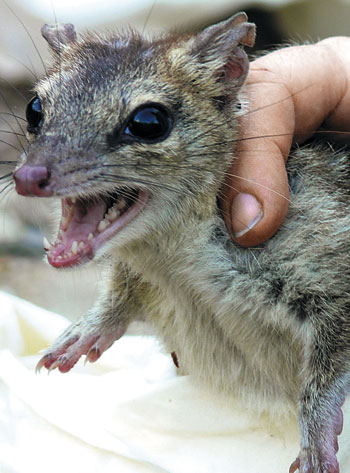
I’ve done quite a bit of work in Kakadu myself, and the one thing that hits you every time you travel through it is the lack of visible wildlife. Sure, you’ll see horses, pigs and buffalo, as well as cane toads and cats, but getting a glimpse of anything native, from Conilurus to Varanus, and you’d consider yourself extremely lucky.

We’ve written a lot about the feral animal problem in Kakadu and even developed software tools to assist in density-reduction programmes. It doesn’t appear that anyone is listening.

Another gob-smacking vista you’ll get when travelling through Kakadu any time from April to December is that it’s either been burnt, actively burning or targeted for burning. They burn the shit out of the place every year. No wonder the native mammals are having such a hard time.

Combine all this with the dysfunctional management arrangement, and you cease to have a National Park. Kakadu is now a lifeless shell that does precious little for conservation of biodiversity (and 3 of the 5 criteria it had to satisfy to become a World Heritage Area are specifically related to natural resource ‘values’). I say, delist Kakadu now and let’s stop fooling ourselves.

Ok, back from the rant. Woinarski and others superimposed a mammal monitoring programme over top a fire-regime experiment for vegetation. Although they couldn’t sample every plot every season, they staggered the sampling to cover the area as best they could over the 13 years of monitoring (1996-2009). What they observed was staggering. Read the rest of this entry »


Australian Ecology Research Award

7 06 2010

I had the immense pleasure of receiving a telephone call a few weeks back from the Ecological Society of Australia telling me that I had been awarded the 2010 Australian Ecology Research Award (AERA). They’ve just announced it, so I’m now allowed to boast a bit on Conservation Bytes.

If you’re going to the 50th Anniversary ESA annual conference in Canberra this year ‘Sustaining Biodiversity – the next 50 years‘ (6-10 December), I’ll be giving the AERA Plenary Lecture then. Thanks to the ESA for my selection, the University of Adelaide (The Environment Institute & School of Earth and Environmental Sciences), the South Australian Research and Development Institute, and all my students, post-docs and collaborators for your support. Many thanks also to Prof. Bill Laurance for the nomination!

The AERA blurb from the ESA site follows: Read the rest of this entry »


How many species are there?

4 06 2010

© japanprobe.com

An interesting research note just came out in the American Naturalist by Hamilton and colleagues entitled Quantifying uncertainty in estimation of tropical arthropod species richness. I retweeted a Science Daily twitter feed on this that had a terribly misleading opening line: “New calculations reveal that the number of species on Earth is likely to be in the order of several million rather than tens of millions“. This is, of course, absolute rubbish because the authors only looked at estimating tropical arthropod richness, not all species on Earth. The number of protists alone is probably > 4 million species, and there are an estimated > 1.5 fungi.

That whinge about crap reporting aside, this is what Hamilton and colleagues concluded:

  • using stochastic models, they predict medians of 3.7 million and 2.5 million tropical arthropod species globally
  • estimates of 30 million species or greater are predicted to have < 0.00001 probability
  • uncertainty in the proportion of canopy arthropod species that are beetles is the most influential parameter
  • in spite of 250 years of taxonomy and around 855000 species of arthropods already described, approximately 70 % await description

Interesting, but I didn’t give it much notice until New Scientist contacted me to get an assessment (their article will appear shortly). This is what I had to say: Read the rest of this entry »


Where in the world to invest in plant conservation

31 05 2010

© CBD

It’s been a good few weeks with many of our papers coming out online early – for example, I highlighted one last week on ecosystem function breakdown from global warming.

Although this has been out for a few weeks, our new paper lead by PhD candidate Xingli Giam (formerly of National University of Singapore, recently completed Australian Endeavour Scholar, now at Princeton University and all-round up-and-coming research star), and with contributions from Hugh “Vascular” Tan and Navjot Sodhi of National University of Singapore and me, is entitled Future habitat loss and the conservation of plant biodiversity (just published online in Biological Conservation).

This one is a bit of a complicated one, so let me walk you through it.

Plants not only represent a huge component of global biodiversity (~320 000 species), they represent the ‘habitats’ in which animals live and provide the major source of nutrients to food webs. They also provide most of our food and other materials essential for human existence. Basically we’d be screwed without them.

Because so many of the world’s biomes are severely threatened now because of massive habitat loss, degradation, over-exploitation, invasive species, extinction synergies and climate change, we need to maximise our efficiency in protecting what’s left. While global prioritisation schemes have a fruitful scientific history since Myers & colleagues’ classic paper (see Biodiversity Hotspots), there are a number of problems that plague the concept and its implementation. Read the rest of this entry »


Fanciful mathematics and ecological fantasy

3 05 2010

© flickr/themadlolscientist

Bear with me here, dear reader – this one’s a bit of a stretch for conservation relevance at first glance, but it is important. Also, it’s one of my own papers so I have the prerogative :-)

As some of you probably know, I dabble quite a bit in population dynamics theory, which basically means examining the mathematics people use to decipher ecological patterns. Why is this important? Well, most models predicting extinction risk, estimating optimal harvest rates, determining minimum viable population size and metapopulation dynamics for species’ persistence rely on good mathematical abstraction to be realistic. Get the maths wrong, and you could end up overharvesting a species (e.g., 99.99 % of fisheries management), underestimating extinction risk from habitat degradation, and getting your predictions wrong about the effects of invasive species. Expressed as an equation itself, (conservation) ecology = mathematics.

A long-standing family of models known as ‘phenomenological’ models (i.e., because they deal with the phenomenon of population size which is an emergent property of the mechanisms of birth, death and immigration) has been used to estimate everything from maximum sustainable yield targets, temporal abundance patterns, wildlife management interventions, extinction risk to epidemiological patterns. The basic form of the model describes the growth response, or the relationship between the population’s rate of change (growth) and its size. The simplest form (known as the Ricker), assumes a linear decline in population growth rate (r) as the number of individuals increases, which basically means that populations can’t grow indefinitely (i.e., they fluctuate around some carrying capacity if unperturbed). Read the rest of this entry »