Which countries protect the most of their land?

1 09 2017

forestOne potentially useful metric to measure how different nations value their biodiversity is just how much of a country’s land its government sets aside to protect its natural heritage and resources. While this might not necessarily cover all the aspects of ‘environment’ we need to explore, we know from previous research that the more emphasis a country places on protecting its biodiversity, the more it actually achieves this goal. This might sound intuitive, but there is no shortage of what have become known as ‘paper parks’ around the world, which are essentially only protected in principle, but not in practice.

For example, if a national park or some other type of protected area is not respected by the locals (who might rightly or wrongly perceive them as a limitation of their ‘rights’ of exploitation), or is pilfered by corrupt government officials in cahoots with extractive industries like logging or mining, then the park does not do well in protecting the species it was designed to safeguard. So, even though the proportion of area protected within a country is not a perfect reflection of its environmental performance, it tends to indicate to what extent its government, and therefore, its people, are committed to saving its natural heritage.

Read the rest of this entry »


Protecting one of the world’s marine wonders

17 06 2017
IMG_6789

© CJA Bradshaw

While I’m in transit (yet a-bloody-gain) to Helsinki, I wanted to take this opportunity to reflect on one of the most inspiring eco-tourism experiences I recently had in South Australia.

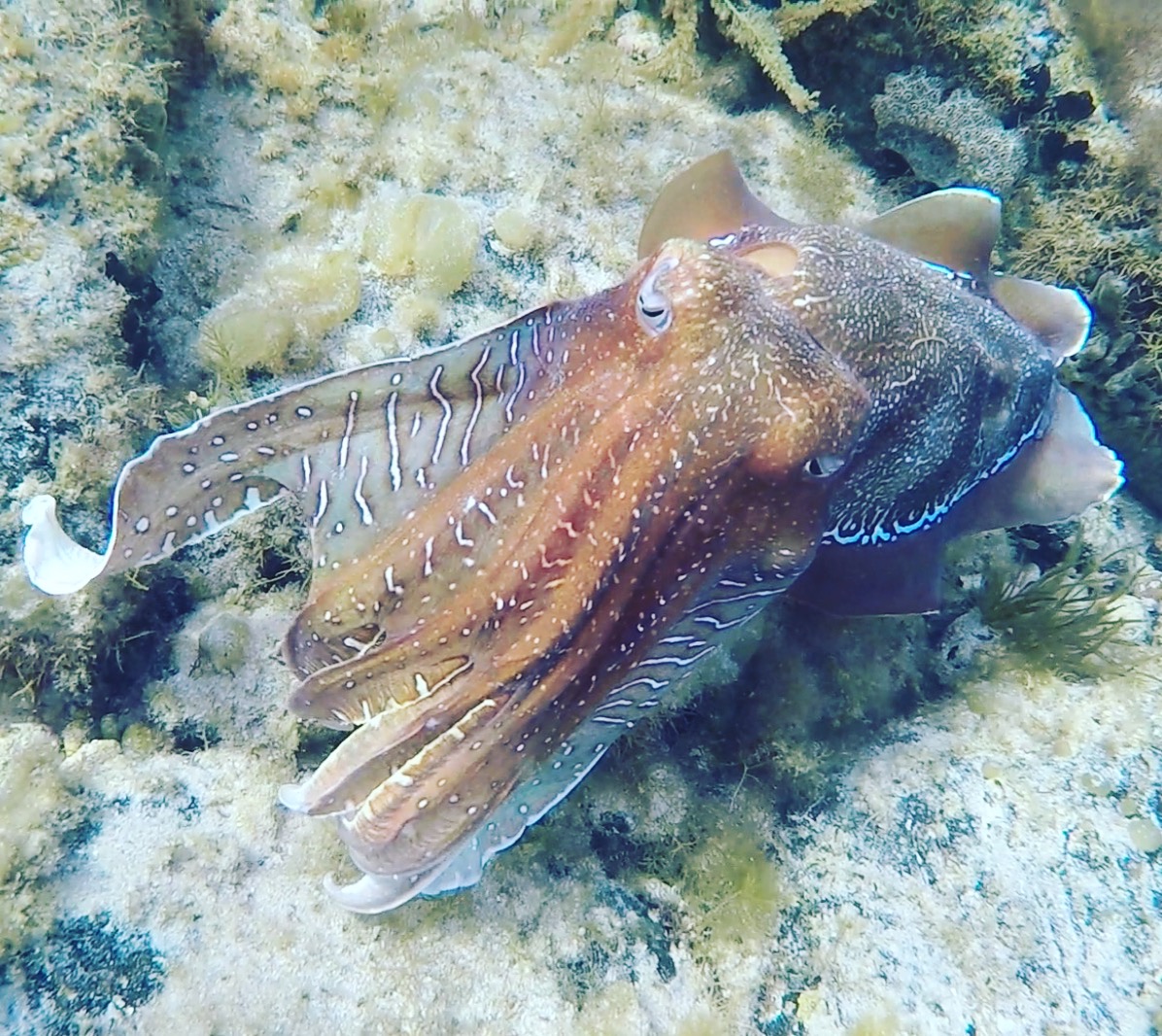
If you are South Australian and have even the slightest interest in wildlife, you will have of course at least heard of the awe-inspiring mass breeding aggregation of giant cuttlefish (Sepia apama) that occur in May-July every year in upper Spencer Gulf near the small town of Whyalla. If you have been lucky enough to go there and see these amazing creatures themselves, then you know exactly what I’m talking about. And if you haven’t yet been there, take it from me that it is so very much worth it to attempt the voyage.

DCIM100GOPROGOPR0121.

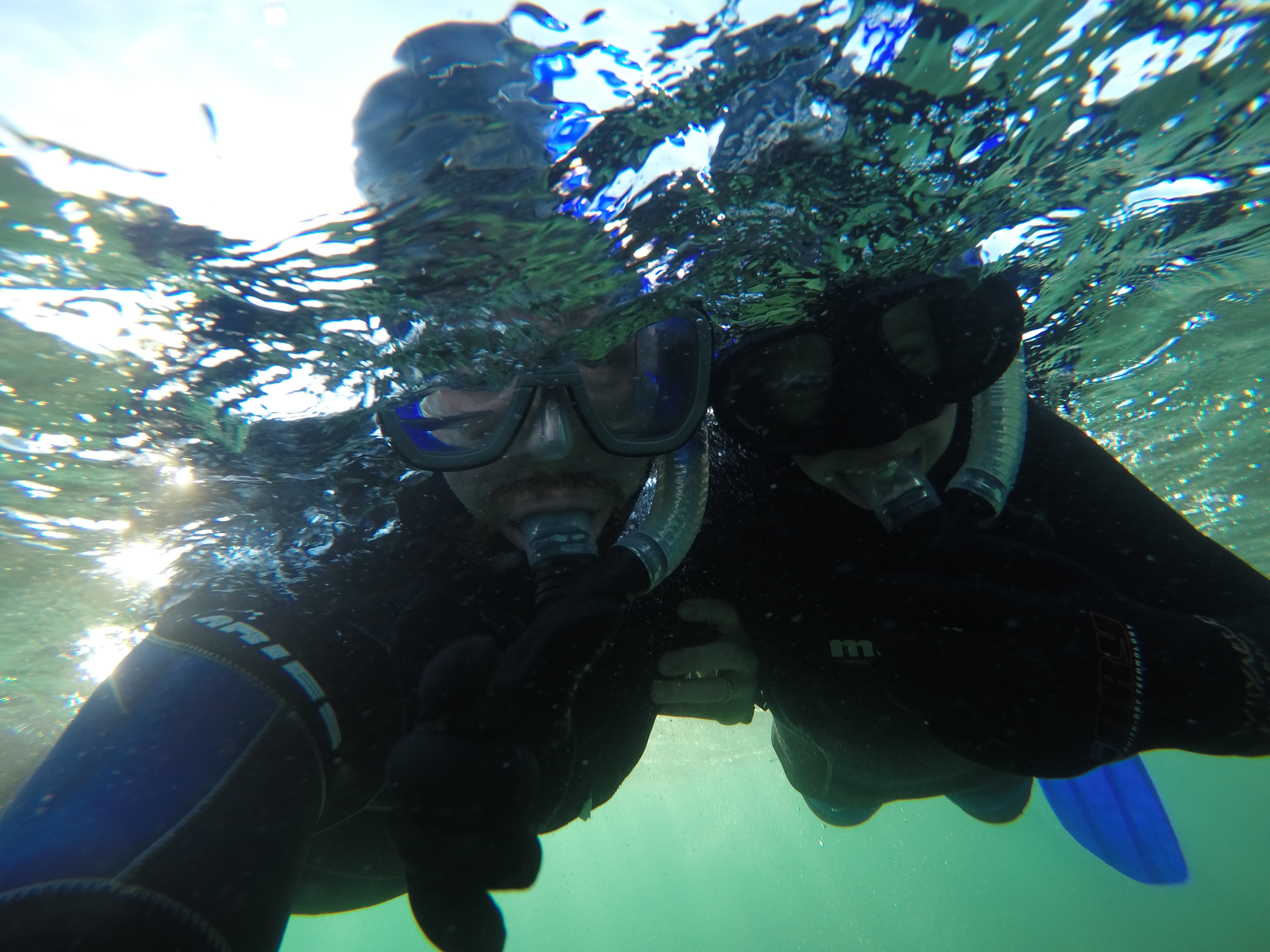
Father-daughter giant-cuttlefish-snorkelling selfie. © CJA Bradshaw

Despite having lived in South Australia for nearly a decade now, I only got my chance to see these wonderful creatures when a father at my daughter’s school organised a school trip. After driving for five hours from Adelaide to Whyalla, we hired our snorkelling gear and got into the water the very next morning. Read the rest of this entry »


Not all wetlands are created equal

13 02 2017

little-guyLast year I wrote what has become a highly viewed post here at ConservationBytes.com about the plight of the world’s freshwater biodiversity. In a word, it’s ‘buggered’.

But there are steps we can take to avoid losing even more of that precious freshwater biodiversity. The first, of course, is to stop sucking all the water out of our streams and wetlands. With a global population of 7.5 billion people and climbing, the competition for freshwater will usually mean that non-human life forms lose that race. However, the more people (and those making the decisions, in particular) realise that intact wetlands do us more good as wetlands rather than carparks, housing developments, or farmland (via freshwater filtering, species protection, carbon storage, etc.), the more we have a chance to save them.

My former MSc student, the very clever David Deane1, has been working tirelessly to examine different scenarios of wetland plant biodiversity change in South Australia, and is now the proud lead author of a corker of a new paper in Biological Conservation. Having already published one paper about how wetland plant biodiversity patterns are driven by rare terrestrial plants, his latest is a very important contribution about how to manage our precious wetlands. Read the rest of this entry »


Boreal forest on the edge of a climate-change tipping point

15 11 2016

As some know, I dabble a bit in the carbon affairs of the boreal zone, and so when writer Christine Ottery interviewed me about the topic, I felt compelled to reproduce her article here (originally published on EnergyDesk).

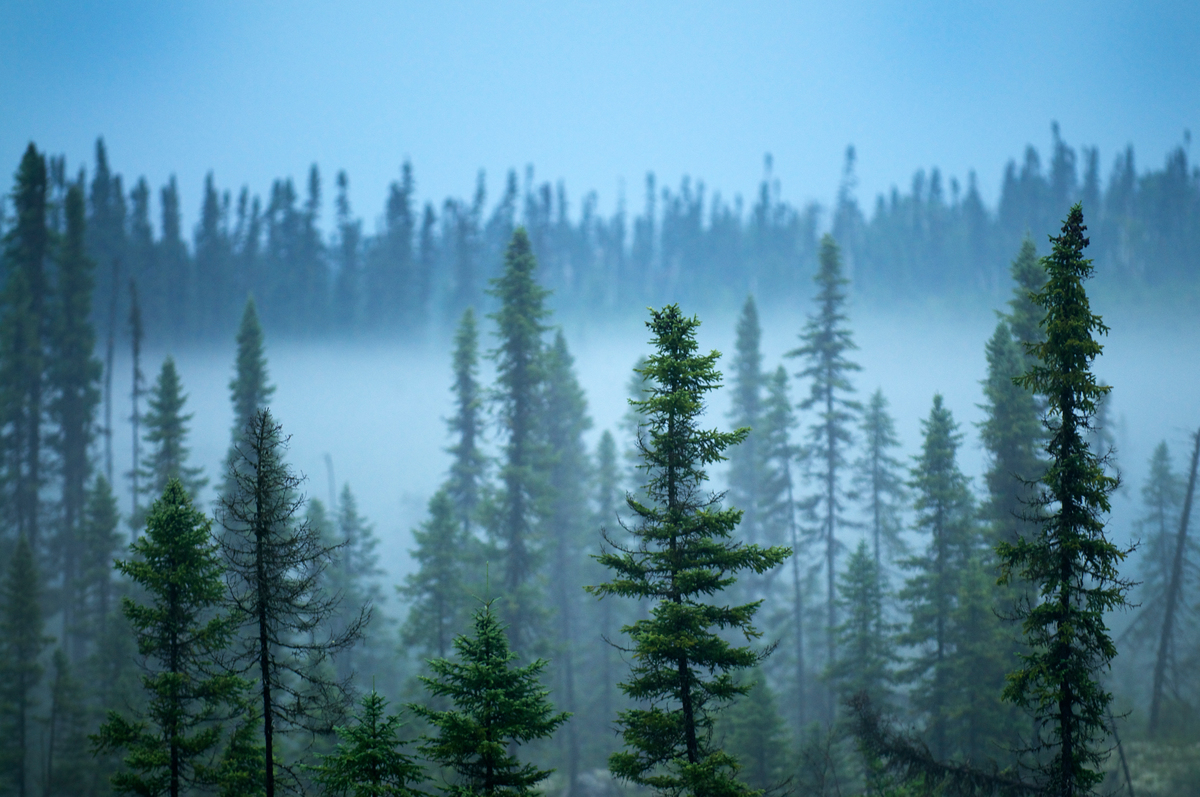
A view of the Waswanipi-Broadback Forest in the Abitibi region of Northern Quebec, one of the last remaining intact Boreal Forests in the province (source: EnergyDesk).

A view of the Waswanipi-Broadback forest in the Abitibi region of northern Quebec, one of the last remaining intact boreal forests in the Canadian province (source: EnergyDesk).

The boreal forest encircles the Earth around and just below the Arctic Circle like a big carbon-storing hug. It can mostly be found covering large swathes of Russia, Canada and Alaska, and some Scandinavian countries.

In fact, the boreal – sometimes called by its Russian name ‘taiga’ or ‘Great Northern Forest’ – is perhaps the biggest terrestrial carbon store in the world.

So it’s important to protect in a world where we’re aiming for 1.5 or – at worst – under two degrees celsius of global warming.

“Our capacity to limit average global warming to less than 2 degrees is already highly improbable, so every possible mechanism to reduce emissions must be employed as early as possible. Maintaining and recovering our forests is part of that solution,” Professor Corey Bradshaw, a leading researcher into boreal forests based at the University of Adelaide, told Energydesk.

It’s not that tropical rainforests aren’t important, but recent research led by Bradshaw published in Global and Planetary Change shows that that there is more carbon held in the boreal forests than previously realised.

But there’s a problem. Read the rest of this entry »


Transition from the Anthropocene to the Minicene

24 09 2016
Going, going ...

Going, going … © CJA Bradshaw

I’ve just returned from a life-changing trip to South Africa, not just because it was my first time to the continent, but also because it has redefined my perspective on the megafauna extinctions of the late Quaternary. I was there primarily to attend the University of Pretoria’s Mammal Research Institute 50thAnniversary Celebration conference.

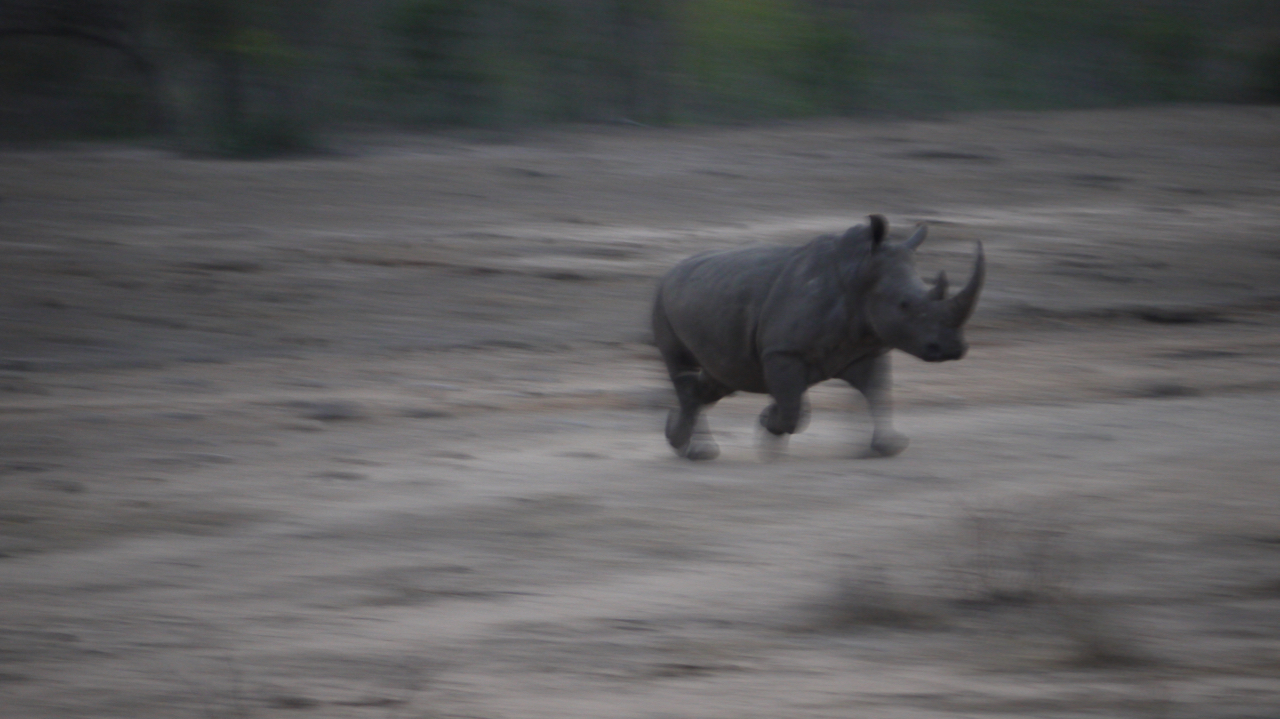
As I reported in my last post, the poaching rates in one of the larger, best-funded national parks in southern Africa (the Kruger) are inconceivably high, such that for at least the two species of rhino there (black and white), their future persistence probability is dwindling with each passing week. African elephants are probably not far behind.

As one who has studied the megafauna extinctions in the Holarctic, Australia and South America over the last 50,000 years, the trip to Kruger was like stepping back into the Pleistocene. I’ve always dreamed of walking up to a grazing herd of mammoths, woolly rhinos or Diprotodon, but of course, that’s impossible. What is entirely possible though is driving up to a herd of 6-tonne elephants and watching them behave naturally. In the Kruger anyway, you become almost blasé about seeing yet another group of these impressive beasts as you try to get that rare glimpse of a leopard, wild dogs or sable antelope (missed the two former, but saw the latter). Read the rest of this entry »


More things stay the same, more we retrogress

20 07 2016

obrazek_1idiommmmsmmWithin six months of Abbott and the Coalition seizing power in the 2013 Australian election, decades—if not centuries—of environmental damage and retrograde policies unfolded. But this was no run-of-the-mill incompetence and neglect by government—this was an all-out attack on anything with the merest whiff of environmental protection. The travesty is well-documented, from infamously axing both the carbon-pricing scheme and climate commission, eradicating Labor’s 80% emissions-reduction target by 2050, diluting the Renewable Energy Target, refusing to commit to enforcing the Illegal Logging Prohibition Act (fortunately, this is now law), defunding the only independent legal entity available to limit environmentally destructive development (Environmental Defenders Office), to even attempting to remove the rights of environmental groups to challenge development proposals (thankfully, that failed).

The Coalition’s backward and ineffectual climate change-mitigation policies alone are evidence enough for long-term damage, but their war on the environment in general means that even the future election of a more environmentally responsible government will not undo the damage quickly, if at all. As a result of these and other nearsighted policies, Australia remains one of the highest per-capita greenhouse-gas emitters on the planet, has one of the highest per-capita water uses of any nation, leads the world in mammal extinctions, continues to deforest its already forest-poor landscape, and is a society utterly unprepared to deal with the future challenges of a degraded planet.
Read the rest of this entry »


Most-Bestest Environment Minister in the World, Ever

4 04 2016
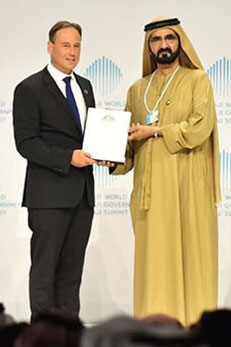
Our Most-Bestest Minister Ever

Our Most-Bestest Minister Ever (i.e., the bloke on the left; interestingly, the bloke on the right leads one of the few countries in the world with a higher per capita emissions rate than Australia)

Australia has an appalling environmental record — hell, I have even written an entire book on our sorry state of environmental affairs. Of course, environmental damage is a slow accumulation of bad political decisions, neglect, corruption, greed and society’s general I-couldn’t-give-a-shit attitude, but the record of our recent government demonstrates not just classic political buffoonery and neglect, but an outright attack on the environment.

So it was impossible to restrain a disgusted guffaw when, in February this year, our ‘Environment’ Minister won the coveted ‘Best Minister’ in the World award at the World Government Summit in Dubai by Sheikh Mohammed Bin Rashid Al Maktoum, Vice President and Prime Minister of the United Arab Emirates and Ruler of Dubai.

Deserved ridicule aside, I was asked recently by The Conversation to contribute to a special report examining the profile performance of cabinet and shadow cabinet ministers, which is not only a responsibility I take seriously, but an honour to be able to provide a serious and objective appraisal of our Most-Bestest Minister Ever. My contribution dealt specifically with the environmental portfolio, so I appraised both the sitting Minister and the Shadow Minister. Judge for yourself based on their performances. Read the rest of this entry »


Disadvantages of marine protected areas

29 02 2016


Stop wasting time

Stop wasting time


Outright bans of trophy hunting could do more harm than good

5 01 2016

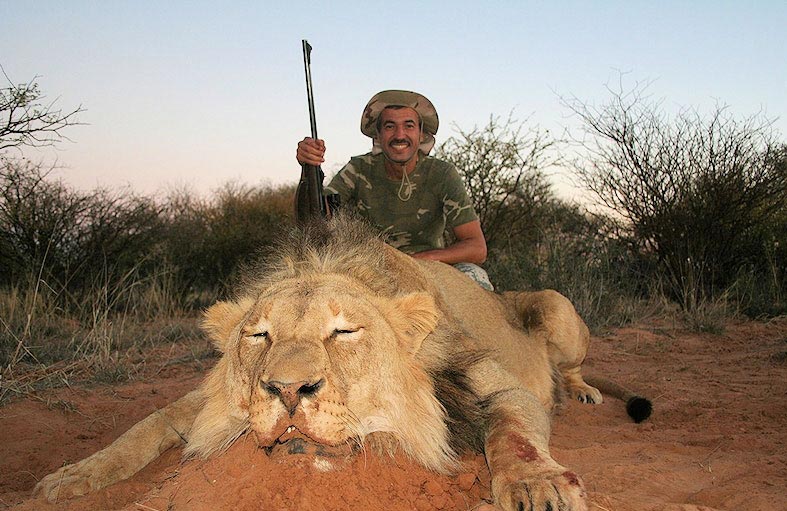
In July 2015 an American dentist shot and killed a male lion called ‘Cecil’ with a hunting bow and arrow, an act that sparked a storm of social media outrage. Cecil was a favourite of tourists visiting Hwange National Park in Zimbabwe, and so the allegation that he was lured out of the Park to neighbouring farmland added considerable fuel to the flames of condemnation. Several other aspects of the hunt, such as baiting close to national park boundaries, were allegedly done illegally and against the spirit and ethical norms of a managed trophy hunt.

In May 2015, a Texan legally shot a critically endangered black rhino in Namibia, which also generated considerable online ire. The backlash ensued even though the male rhino was considered ‘surplus’ to Namibia’s black rhino populations, and the US$350,000 generated from the managed hunt was to be re-invested in conservation. Together, these two incidents have triggered vociferous appeals to ban trophy hunting throughout Africa.

These highly politicized events are but a small component of a large industry in Africa worth > US$215 million per year that ‘sells’ iconic animals to (mainly foreign) hunters as a means of generating otherwise scarce funds. While to most people this might seem like an abhorrent way to generate money, we argue in a new paper that sustainable-use activities, such as trophy hunting, can be an important tool in the conservationist’s toolbox. Conserving biodiversity can be expensive, so generating money is a central preoccupation of many environmental NGOs, conservation-minded individuals, government agencies and scientists. Making money for conservation in Africa is even more challenging, and so we argue that trophy hunting should and could fill some of that gap. Read the rest of this entry »


Social and economic value of protected areas

2 03 2015
© P. Crowley/"mokolabs" via Flickr

© P. Crowley/”mokolabs” via Flickr

I’ve just come across an exceptionally important paper published recently in PLoS Biology by a team of venerable conservation biologists led by the eminent Andy Balmford of the University of Cambridge. My first response was ‘Holy shit’, and now that I contemplate the results further, I can now update that sentiment to ‘Holy shit!’.

Most people reading this blog wouldn’t bother questioning the importance of protected areas for the preservation of biodiversity – for them, it’s a given. While the effectiveness of protected areas globally is highly variable in that regard, there’s little contention among conservationists that we do not yet have enough of them to conserve biodiversity effectively, especially in the oceans that cover some 70% of the planet’s surface.

But that justification isn’t good enough for some people – perhaps even the majority. Even our own myopic, anti-environment political bungler Prime Minister has stated publicly that national parks just ‘lock up‘ areas to the exclusion of much more important things like jobs and income generation. He’s even stated that Australia has ‘too many‘ national parks already, and that timber workers are “the ultimate conservationists“. As I type those words, I can feel the bile accumulating in my throat. Read the rest of this entry »


The Abbott-oir survives another day to wreak more environmental havoc

9 02 2015

The Great Red UnderpantsTone Abbott-oir, easily the most environmentally destructive Prime Minister this country has seen in the modern era, has survived the party room spill for a leadership change. Although 39% of his own Fiberal Party MPs voted to dump him, he remains standing (limping) – for now.

I’ve seen rather a lot lately in the Australian media about the impending spill vote, and the potential political repercussions of a change (or not), but there’s been nearly no mention of what it all means for the continually degrading Australian environment.

As is typical in Australian politics, the environment takes a very distant back seat to the those oh-so-important societal issues like knighthoods, paid parental leave and where to put the next road in Melbourne, so I certainly wasn’t hopeful that a leadership change (or not) would have any positive environmental outcomes. This particular latte-snorting, quinoa-flavoured-pinot-grigio-in-the-artisanal-underpants-pouring, erect-nipple-paper-rubbing environmental scientist has nothing at all to celebrate, even if the no-confidence in The Great Red Underpants is potentially a positive sign. Read the rest of this entry »


We treat our wildlife like vermin

24 09 2014
Just a little of the dog fence's carnage and cruelty at work.

Just a little of the dog fence’s carnage and cruelty at work.

I’ve pointed out in several posts on ConservationBytes.com just how badly Australia is doing in the environmental stakes, with massive deforestation continuing since colonial times, feral predators and herbivores blanketing the continent, inadequate protected areas, piss-weak policies and a government at war with its own environment. Despite a few recent wins in marine conservation, Australia has a dreadful track record.

Now in another monumental demonstration of stupidity, corruption and colonial-era attitudes toward native wildlife, Western Australia has outdone itself by sneaking through legislation to extend its so-called ‘Barrier Fence’ in an effort to isolate its marginal farmland from dingoes, emus and other ‘nuisance’ species.

As I and several others have pointed out before, the mere existence of the record-breaking dingo fence is not only counter-productive, it is expensive and utterly archaic. It should be torn down entirely.

Instead, the Western Australian government wants to extend the national fence, and they’ve approved the plan it without going through any of the appropriate checks in the system. Its environmental impacts have not been adequately assessed, nor has the public been given the opportunity to oppose the plans. In my view, the people responsible for this act should go to gaol.

In a recent paper led by Keith Bradby entitled Ecological connectivity or Barrier Fence? Critical choices on the agricultural margins of Western Australia, we show how the Western Australia state government has not followed any of its own environmental legislation and rushed through these idiotic proposals. If you do not subscribe to Ecological Management and Restoration, you can obtain a copy of the paper by e-mailing Keith or me. Read the rest of this entry »


We generally ignore the big issues

11 08 2014

I’ve had a good week at Stanford University with Paul Ehrlich where we’ve been putting the final touches1 on our book. It’s been taking a while to put together, but we’re both pretty happy with the result, which should be published by The University of Chicago Press within the first quarter of 2015.

It has indeed been a pleasure and a privilege to work with one of the greatest thinkers of our age, and let me tell you that at 82, he’s still a force with which to be reckoned. While I won’t divulge much of our discussions here given they’ll appear soon-ish in the book, I did want to raise one subject that I think we all need to think about a little more.

The issue is what we, as ecologists (I’m including conservation scientists here), choose to study and contemplate in our professional life.

I’m just as guilty as most of the rest of you, but I argue that our discipline is caught in a rut of irrelevancy on the grander scale. We spend a lot of time refining the basics of what we essentially already know pretty well. While there will be an eternity of processes to understand, species to describe, and relationships to measure, can our discipline really afford to avoid the biggest issues while biodiversity (and our society included) are flushed down the drain?

Read the rest of this entry »


Biodiversity Hotspots have nearly burnt out

10 07 2014

dying embersI recently came across a really important paper that might have flown under the radar for many people. For this reason, I’m highlighting it here and will soon write up a F1000 Recommendation. This is news that needs to be heard, understood and appreciated by conservation scientists and environmental policy makers everywhere.

Sean Sloan and colleagues (including conservation guru, Bill Laurance) have just published a paper entitled Remaining natural vegetation in the global biodiversity hotspots in Biological Conservation, and it we are presented with some rather depressing and utterly sobering data.

Unless you’ve been living under a rock for the past 20 years, you’ll have at least heard of the global Biodiversity Hotspots (you can even download GIS layers for them here). From an initial 10, to 25, they increased penultimately to 34; most recently with the addition of the Forests of East Australia, we now have 35 Biodiversity Hotspots across the globe. The idea behind these is to focus conservation attention, investment and intervention in the areas with the most unique species assemblages that are simultaneously experiencing the most human-caused disturbances.

Indeed, today’s 35 Biodiversity Hotspots include 77 % of all mammal, bird, reptile and amphibian species (holy shit!). They also harbour about half of all plant species, and 42 % of endemic (not found anywhere else) terrestrial vertebrates. They also have the dubious honour of hosting 75 % of all endangered terrestrial vertebrates (holy, holy shit!). Interestingly, it’s not just amazing biological diversity that typifies the Hotspots – human cultural diversity is also high within them, with about half of the world’s indigenous languages found therein.

Of course, to qualify as a Biodiversity Hotspot, an area needs to be under threat – and under threat they area. There are now over 2 billion people living within Biodiversity Hotspots, so it comes as no surprise that about 85 % of their area is modified by humans in some way.

A key component of the original delimitation of the Hotspots was the amount of ‘natural intact vegetation’ (mainly undisturbed by humans) within an area. While revolutionary 30 years ago, these estimates were based to a large extent on expert opinions, undocumented assessments and poor satellite data. Other independent estimates have been applied to the Hotspots to estimate their natural intact vegetation, but these have rarely been made specifically for Hotspots, and they have tended to discount non-forest or open-forest vegetation formations (e.g., savannas & shrublands).

So with horribly out-of-date vegetation assessments fraught with error and uncertainty, Sloan and colleagues set out to estimate what’s really going on vegetation-wise in the world’s 35 Biodiversity Hotspots. What they found is frightening, to say the least.

Read the rest of this entry »


South Australia’s tattered environmental remains

16 04 2014
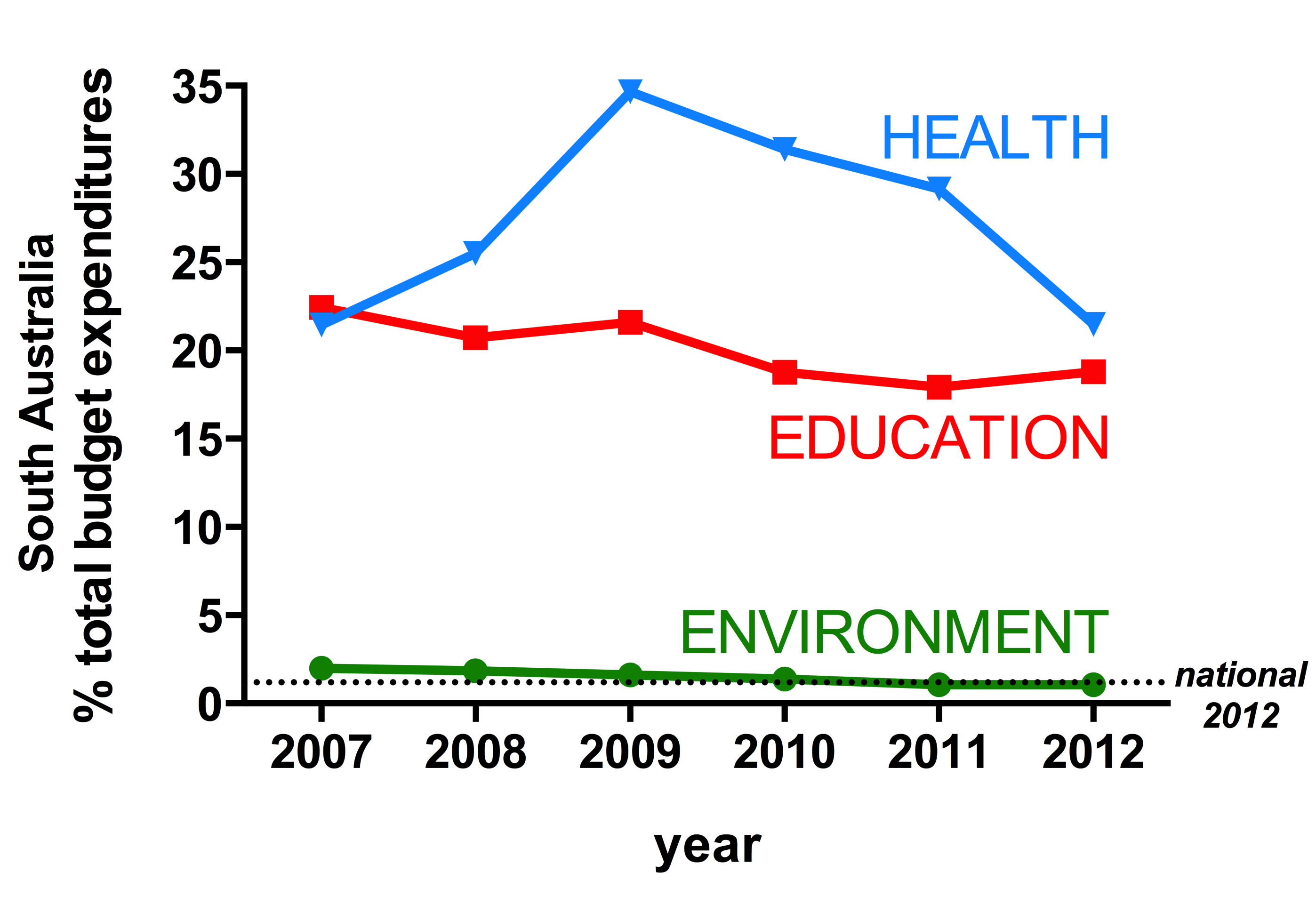
State budget percentage expenditures for health, education and environment

South Australia State budget percentage expenditures for health, education and environment

Yesterday I gave the second keynote address at the South Australia Natural Resource Management (NRM) Science Conference at the University of Adelaide (see also a brief synopsis of Day 1 here). Unfortunately, I’m missing today’s talks because of an acute case of man cold, but at least I can stay at home and work while sipping cups of hot tea.

Many people came up afterwards and congratulated me for “being brave enough to tell the truth”, which both encouraged and distressed me – I am encouraged by the positive feedback, but distressed by the lack of action on the part of our natural resource management leaders.

The simple truth is that South Australia’s biodiversity and ecosystems are in shambles, yet few seem to appreciate this.

So for the benefit of those who couldn’t attend, I’ve uploaded the podcast of my slideshow for general viewing here. I’ve also highlighted some key points from the talk below: Read the rest of this entry »


Alliance of Leading Environmental Researchers and Thinkers

11 03 2014

ALERTIf you’ve been following this blog or my Twitter feed over the last few weeks, you’ve surely noticed a few references to A.L.E.R.T. – the Alliance of Leading Environmental Researchers and Thinkers. You might also have asked yourself, what exactly is ALERT, and is it something I should pay attention to?

Today’s post attempts to explain this new organisation, and hopefully convince you that the answer to the second question is ‘yes’.

Several months ago, a slightly cryptic e-mail from eminent conservation biologist, Bill Laurance, arrived in my inbox. It asked – what do you think of this logo (see associated image)? A few e-mails later and a couple of minor tweaks, and we ended up with what I thought was a pretty cool logo for this new ‘ALERT’ thing. It wasn’t until quite some time later that I finally understood what Bill was attempting to create.

Is ALERT a news aggregator, a blog, an advocacy group, a science-communication resource or a science-policy interface? Why, yes it is!

Read the rest of this entry »


Abbott’s ‘No more parks’ vow a bad move

6 03 2014

environmentPublished simultaneously on ALERT:

An international scientific group has decried Australian Prime Minister Tony Abbott’s recent ‘no more parks’ pledge, saying it is badly out of step with environmental reality.

“Tony Abbott has blown it with that call,” said William Laurance, a professor at James Cook University and director of ALERT, the Alliance of Leading Environmental Researchers and Thinkers.

“Australia has some of the world’s most desperately endangered ecosystems and species, which direly need better protection,” said Laurance. “Just 7.7 percent of the continent is in national parks—that’s low by international standards.”

“It really is worrying,” said Thomas Lovejoy, a renowned ecologist and former environmental advisor to three U.S. presidents. “I hope the Prime Minister gets better advice in the future because the world really needs Australia’s leadership on the environment.”

As an example, the scientists cite the mountain ash forests of Victoria, which have been devastated by over-logging and fires, with just 1.2% of the old-growth forest remaining.

“The Leadbeater’s possum relies entirely on these old-growth forests and is endangered,” said Corey Bradshaw, a professor at the University of Adelaide. “There’s a dire need to create a new national park for this iconic species and ecosystem.” Read the rest of this entry »


Australia’s (latest) war on the environment

3 03 2014

monkYes, the signs were there, but they weren’t clandestine messages written in the stars or in the chaos of tea-leaf dregs. We saw this one coming, but Australians chose to ignore the warning signs and opt for the American political model of extremism, religiosity, plutocracy and science denial.

Enter the ‘Tea Party’ of Australia – the ‘new’ Coalition where reigning Rex perditor Prime Minister Tony The Monk Abbott1 has, in just a few short months, turned back the clock on Australian environmental protection some 40 years.

Yes, we saw it coming, but it wasn’t a tautological fait accompli just because it concerned a ‘conservative’ government. It’s difficult to remember, I know, that conservative governments of yesteryear implemented some strikingly powerful and effective environmental legislation. Indeed, it was the former incarnation of the Coalition government that implemented the once-formidable Environmental Protection and Biodiversity Conservation (EPBC) Act under the direction of then Environment Minister, Robert Hill. A colossus of sorts, the EPBC suffers from many ailments. While it’s the only really bitey environmental legislation we’ve got, that colossus is a lumbering, limping giant missing more than a few teeth – it needs a complete overhaul.

As most Australians are unfortunately aware, The Monk repeatedly and defiantly promised to repeal the Labor-government carbon price implemented in July 2012, despite the absolute necessity to tax the heaviest pollutersWhile somewhat sheepish about his recent climate disruption denialism following his election in 2013, a denialist he remains:

Let us re-familiarise ourselves with some of his historical pearlers: Read the rest of this entry »


Biodiversity needs more than just unwanted leftovers

28 02 2014

calm oceanThe real measure of conservation progress, on land or in the sea, is how much biodiversity we save from threatening processes.

A new paper co-authored by Memorial University’s Dr Rodolphe Devillers and an international group of researchers argues that established global marine protected areas are too often a case of all show with no substance and do not adequately protect the most vulnerable areas of the world’s oceans.

“There is a big pressure internationally to expand global MPA coverage from around 3 % of the oceans to 10 %, resulting in a race from countries to protect large and often unused portions of their territorial waters for a minimal political cost,” said Mr. Devillers. “Marine protected areas are the cornerstone of marine conservation, but we are asking whether picking low-hanging fruit really makes a difference in the long-term, or if smaller areas currently under threat should be protected before, or at the same time as, those larger areas that are relatively inaccessible and therefore less used by people.

“We need to stop measuring conservation success in terms of square kilometres,” he added. “The real measure of conservation progress, on land or in the sea, is how much biodiversity we save from threatening processes. Metrics such as square kilometres or percentages of jurisdictions are notoriously unreliable in telling us about the true purpose of protected areas.” Read the rest of this entry »