Ghost extinctions

5 07 2012

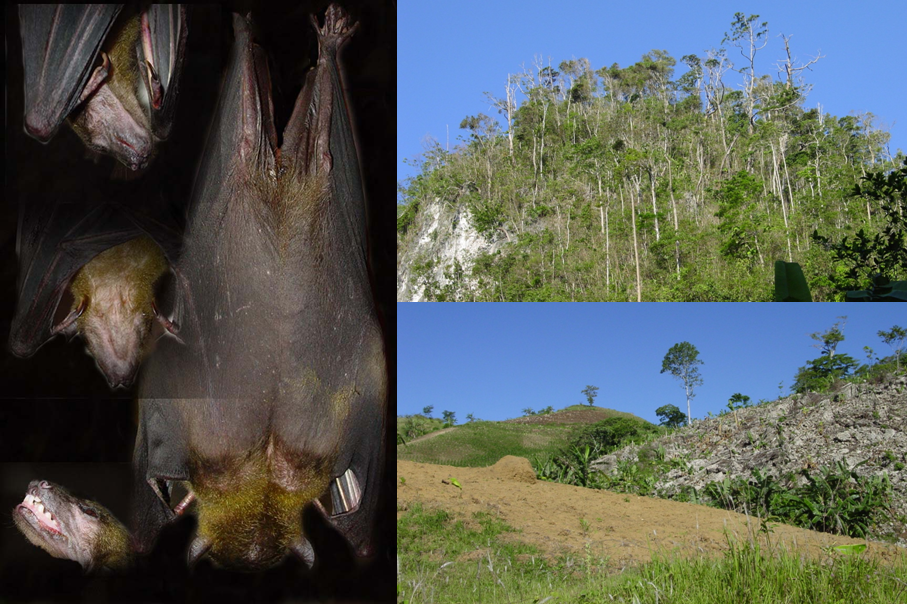
The Philippine bare-backed fruit bat (Dobsonia chapmani; body size = < 220 mm, < 150 g; IUCN status: ‘Critically Endangered A2cd’) is endemic to lowland rain forests [top habitat image] from Negros and Cebu islands. This species of flying fox had been missing from the 1970s and was declared extinct in 2002 (34). In May 2003, five specimens [one shown in the picture above] were trapped in night nets in the Calatong forest (Negros Island), a ~ 1,000-ha fragment of secondary rain forest and agricultural lands [bottom habitat image] (35). The species is reliant on fruit-bearing vegetation and caves for feeding and roosting, respectively. As with many other Philippine bats, it suffers from habitat degradation and hunting. The family Pteropodidae comprises > 150 species. Despite their Draculian look, they all feed on fruits and nectar, and act as important plant pollinators (36), as well as disease vectors such as Ebola virus (37). Flying foxes are distributed in the tropics and subtropics from the Eastern Mediterranean, through the Arabian Peninsula, Asia, Australia, and many islands of the Indian Ocean. Photos courtesy of Ely L. Alcala.

Jared Diamond (1) coined the expression ‘evil quartet’ for the four main human causes of species extinctions: habitat loss/fragmentation, overkill, introduced species and extinction chains [with climate change and extinction synergies (2), the updated expression would be ‘evil sextet”]. However, one third of ‘extinct’ mammal species has been ‘found’ again. Recent studies reveal that the probability of rediscovery depends on the cause of extinction.

Arriving in a city to search for an old friend, I would first look in the suburb where he lived, the pub where we enjoyed a drink and some music, or the park where we used to play football. But if my friend was an outlaw, or had recently gone through a traumatic experience, my chances of finding him at his favourite spots would shrink.

If, instead of a friend, we are searching for the last survivors of an extinct-declared species, surveys also tend to take place in the habitat in which the species was previously found. Such a strategy rests on the classical hypothesis that, given the spatial distribution of a species, its gradual decline must occur from the periphery to the core of its distribution (‘range collapse’) where, in theory, the habitat should be of better quality and the number of individuals higher (3). In contrast, recent work supports that the trajectory of demise of threatened vertebrates progresses from the core to the periphery (‘range eclipse’) (4), because many perturbations make their way as a progressive wave, e.g, fire, logging or urbanisation.

Diana Fisher (5) supports the ‘range eclipse’ hypothesis for ‘extinct’ mammals which have been rediscovered. She quantifies that 60% of the new records are made from peripheral habitats, mainly when the principal cause of extirpation is habitat loss. Not only that, on average species are rediscovered at altitudes 35 % higher than historical records, and only in 5 % of the cases at the locality where it had been last seen.

Read the rest of this entry »


Costs and benefits of a carbon economy for conservation

12 06 2012

I’ve had the good fortune of being involved now in a several endeavours funded by the Australian Centre for Ecological Analysis and Synthesis (ACEAS); two of those were workshops targeting specific questions regarding estimating modern extinction rates and examining the effects of genetic bottlenecks on Australian biota. The third was a bit different, to say the least – it was a little along the lines of ‘build it, and they will come‘. In other words, what happens when you bung 40 loosely associated researchers in a room for two days? Does anything of substance result, or does it degenerate into a mere talk-fest. I’m happy to say the former. The details of the ACEAS ‘Grand Workshop‘ are now being finalised in a paper that should be submitted by the end of the month. The ACEAS report is reproduced below.

—

The Grand ACEAS Workshop was something of an experiment: what will happen when we bring 30 of Australia’s top scientists working on land management issues into the same room?

The Grand Workshop participants came from academia, research institutions and the government, and had all received ACEAS funding for working groups. David Keith, Ted Lefroy, Jasmyn Lynch, Wayne Meyer and Dick Williams were amongst the attendees of the two-day workshop.

And when this group of people came together wanting to analyse and synthesise ecological data, great things happened.

“We decided to focus on how carbon pricing legislation will affect land use change and how will that spill over into biodiversity persistence”, said Professor Corey Bradshaw, Director of Ecological Modelling at The University of Adelaide, who led the synthesis activity at the Grand ACEAS Workshop.

“Will carbon pricing lead to good outcomes for biodiversity, or negative ones, or will it have no bearing whatsoever?”

The workshop participants broke into five groups to discuss how the carbon tax legislation will change land use when it is introduced in July 2012, and the potential impact on biodiversity.

Some of the questions asked included:

  • Is it enough simply to allow plants to re-grow to be eligible for carbon credits?
  • How will an increase in forestry plantations impact biodiversity, water catchments and fire regimes?
  • Will there be more kangaroo grazing to reduce methane emissions and erosion, replacing hard-hoofed livestock?
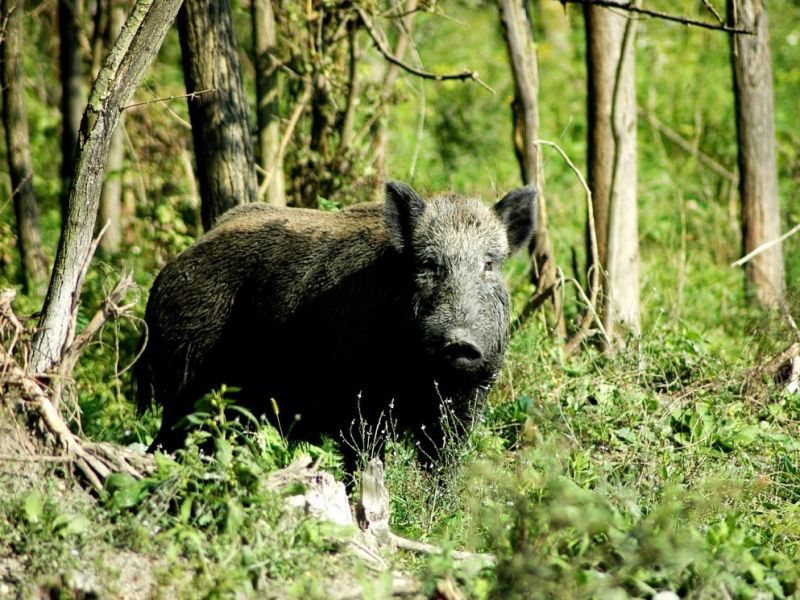
  • Can you receive carbon credits for shooting large feral animals like goats, camels, deer and boars?

The groups found many opportunities for positive biodiversity outcomes with the carbon sequestration activities encouraged by carbon pricing, but there are also many potential ‘bio-perversities’. Read the rest of this entry »


Get boreal

7 06 2012

I’ve been a little quiet this last week because I’ve had to travel to the other side of the planet for what turned out to be a very interesting and scientifically lucrative workshop. After travelling 31 hours from Adelaide to Umeå in northern Sweden, I wondered to myself if it was going to be worth it for a 2.5-day workshop on a little island (Norrbyskär) in the Baltic Sea (which, as it turned out, didn’t have internet access).

The answer is a categorical ‘yes’!

Many of you know that I’ve dabbled in boreal forest conservation in the past, but I could never claim any real expertise in the area. Hence it came as something of a shock when Jon Moen of Umeå University asked me to attend a specialist workshop focused loosely on making the plight and importance of the boreal forest more widely acknowledged. I dragged my feet initially, but Jon convinced me that I could add something to the mix.

It was a small workshop, but well-represented by all boreal countries save Norway (i.e., we had Russians, Swedes, Finns, Canadians and Americans – this Australian was indeed the odd one out). We also had a wide array of expertise, from carbon accountants, political scientists, political economists, native cultures experts, ecologists to foresters. Our mandate – justify why we should pay more attention to this globally important region.

Just how important is the boreal forest? We managed to unearth some little-appreciated facts: Read the rest of this entry »


Ghosts of bottlenecks past

25 05 2012

© D. Bathory

I’ve just spent the last week at beautiful Linnaeus Estate on the northern NSW coast for my third Australian Centre for Ecological Analysis and Synthesis (ACEAS) (see previous post about my last ACEAS workshop).

This workshop is a little different to my last one, and I’m merely a participant (not the organiser) this time. Our task was to examine the mounting evidence that many Australian species appear to show a rather shallow genetic pool from a (or several) major past bottlenecks.

What’s a ‘bottleneck’? In reference to the form after which it was named, a genetic bottleneck is the genetic diversity aftermath after a population declines to a small size and then later expands. The history of this reduction and subsequent expansion is written in the DNA, because inevitably gene ‘types’ are lost as most individuals shuffle off this mortal coil. In a way, it’s like losing a large population of people who all speak different languages – inevitably, you’d lose entire languages and the recovering population would grow out of a reduced ‘pool’ of languages, resulting in fewer overall surviving languages.

Our workshop focus started, as many scientific endeavours do, rather serendipitously. Several years ago, Jeremy Austin noticed that devils who had died out on the mainland several thousand years ago had a very low genetic diversity, as do modern-day devils surviving in Tasmania. He thought it was odd because they should have had more on the mainland given that was their principal distribution prior to Europeans arriving. He mentioned this in passing to Steve Donnellan one day and Steve announced that he had seem the same pattern in echidnas. Now, echidnas cover most of Australia’s surface, so that was equally odd. Then they decided to look at another widespread species – tiger snakes, emus, etc. – and found in many of them, the same patterns were there. Read the rest of this entry »


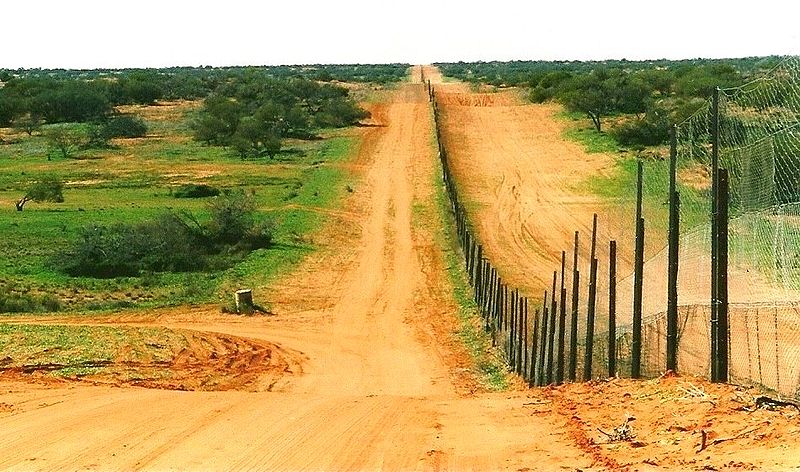
Can Australia afford the dingo fence?

18 05 2012

I wrote this last night with Euan Ritchie of Deakin University in response to some pretty shoddy journalism that misrepresented my comments (and Euan’s work). Our article appeared first in The Conversation this morning (see original article).

—

We feel we have to set the record straight after some of our (Bradshaw’s) comments were taken grossly out of context, or not considered at all (Ritchie’s). A bubbling kerfuffle in the media over the last week compels us to establish some facts about dingoes in Australia, and more importantly, about how we as a nation choose to manage them.

A small article in the News Ltd. Adelaide Advertiser appeared on 11 May in which one of us (Bradshaw) was quoted as advocating the removal of the dingo fence because it was not “cost effective” (sic). Despite nearly 20 minutes on the telephone explaining to the paper the complexities of feral animal management, the role of dingoes in suppressing feral predators, and the “costs” associated with biodiversity enhancement and feral control, there wasn’t a single mention of any of this background or justification.

Another News Ltd. article denouncing Ritchie’s work on the role of predators in Australian ecosystems appeared in The Weekly Times the day before, to which Ritchie responded in full.

So it’s damage control, and mainly because we want to state categorically that our opinion is ours alone, and not that of our respective universities, schools, institutes or even Biosecurity SA (which some have claimed or insinuated, falsely, that we represent). Biosecurity SA is responsible for, inter alia, the dingo fence in South Australia. Although our opinions differ on its role, we are deeply impressed, grateful and supportive of their work in defending us from biological problems. Read the rest of this entry »


If a tree falls… preventing deforestation with insurance

3 05 2012

As CB readers will know, I’ve reported a few times on our iREDD idea, and it got a little pick-up overseas. Here’s a great article by Rachel Nuwer covering the concept, published in Ecoimagination.com.

—

Almost everything we own – our houses and cars and our very health – is insured. It works on a simple principal: the higher the risk, the higher the premium. It’s an age-old concept that ecological modelers have decided to apply to a new area: forest preservation.

A new proposal, published in the journal Conservation Letters, would create forest insurance to make the U.N. forest preservation program Reduced Emissions from Deforestation and forest Degradation, or REDD, more effective. REDD is generally supposed to function by paying developing countries to protect their forests in exchange for carbon pollution credits. Currently the program has 42 partner countries across the globe. The program is crucial to the fight against climate change since deforestation and forest degradation accounts for about 20 percent of global greenhouse gas emissions and threatens biodiversity.

“REDD is a fantastic idea,” said Corey Bradshaw, director of ecological modeling at the University of Adelaide and co-author of the study. “You get a carbon advantage and biodiversity doesn’t get wiped out at the same time, it seems perfect.”

But it has a few major flaws that the insurance scheme, called iREDD, seeks to remedy.

REDD only works if the parties are honest and stick to the agreement. Bradshaw doesn’t have much faith that will happen. “If there’s a way to cheat, people will cheat. That’s the nature of all life, not just humans, but we excel at it,” he said. If, for example, a country is paid to conserve one forest but moves its deforestation efforts to an adjacent forest in order to get both money and timber, in terms of carbon offsets, that transaction was a failure. This phenomenon is called “leakage.”

Carbon-capture also only works if it’s maintained indefinitely. If a country accepts money for ten years and then cuts its forest the day after the agreement expires, then all of that conservation was for naught. This issue is called “permanence,” usually translated into an arbitrarily defined period of time set by countries in terms of decades or centuries. Read the rest of this entry »


We only have decades…

26 04 2012

… not centuries.

Here’s a little video production The Environment Institute put together that explains some of our lab‘s work and future directions.

—

—

CJA Bradshaw


To corridor, or not to corridor: size is the question

24 04 2012

I’ve just read a really interesting post by David Pannell from the University of Western Australia discussing the benefits (or lack thereof) of wildlife ‘corridors’. I’d like to elaborate on a few key issues, and introduce the most important aspect that really hasn’t been mentioned.

Some of you might be aware that the Australian Commonwealth Government has just released its Draft National Wildlife Corridors Plan for public comment, but many of you might not really know what a ‘corridor’ constitutes.

Wildlife or biodiversity ‘corridors’ have been around for a long time, at least in terms of proposals. The idea is fairly simple to conceive, but very difficult to implement in practice.

At least for as long as I’ve been in the conservation biology biz, ‘corridors’ have been proffered as one really good way to make broad-scale landscape restoration plausible and effective for (mainly) forest-dwelling species which have copped the worst of deforestation trends around Australia and the world. The idea is that because of intense habitat fragmentation, isolated patches of primary (or at least, reasonably intact secondary) forest can be linked by planting some sort of long corridor of similar habitat between them. Then, all the little creatures can merrily make their way back and forth between the patches, thus rescuing each other from extinction via migration. Read the rest of this entry »


Take a leaf from insurance industry’s book

18 04 2012

Just a quick one rehashing today’s media release on the iREDD paper I blogged about a while back. The full, online version is available upon request. Stay tuned for media coverage.

—

A group of environmental scientists say a problem-ridden economic model designed to slow deforestation can be improved by applying key concepts from the insurance industry.

REDD (Reduced Emissions from Deforestation and forest Degradation) is a UN-promoted scheme that allows countries to trade in carbon credits to keep forests intact. It is mainly targeted at developing nations where deforestation and exploitation are a major threat.

In a paper published online in the journal Conservation Letters, ecology researchers from Australia and South Africa argue that REDD projects can suffer from three major problems. They have proposed strengthening the scheme by using insurance policies and premiums, creating a new scheme known as iREDD.

“The idea of paying a nation to protect its forests in exchange for carbon pollution offsets can potentially reduce overall emissions by keeping the trees alive, and ensure a lot of associated biodiversity gets caught up in the conservation process,” says Professor Corey Bradshaw,, Director of Ecological Modelling at the University of Adelaide’s Environment Institute and a senior author of the paper.

“However, there are three main problems with REDD: these are known as leakage, permanence and additionality.” Read the rest of this entry »


Humans suddenly become intelligent

1 04 2012

Some described it as the “eco-topia”; some believed they had died in the night and awoken in a different universe. Some just stood there gaping stupidly.

Yet the events of 01 April 2012 are real*. Humans suddenly became intelligent.

In an unprecedented emergency UN session this morning, all the world’s countries pledged to an immediate wind-down of the fossil-fuel economy and promised to invest in a rational combination of nuclear and renewable energy sources. Some experts believe the pledge would see a carbon-neutral planet by 2020.

Additionally, the session saw a world-wide pledge to halt all deforestation by 2013, with intensive reforestation programmes implemented immediately.

Family planning would be embraced worldwide, with a concerted effort to see the human population plateau by 2070, and begin declining to a stable 2 billion by 2300. Read the rest of this entry »


Worlds collide: greenwashed development to kill biodiversity

15 03 2012

Another development fiasco that, if it goes ahead, will devastate a Biodiversity Hotspot and ultimately, reduce the livelihood prospects of millions of West Africans.

In yet another move to expose and shame the greedy developers behind another massive (and superlatively greenwashed) oil palm development in the tropics (see our previous Open Letter), Bill Laurance and Josh Linder have organised another Open Letter from some of the world’s top conservation scientists (again, I count myself fortunate to be included in that group) denouncing the project. The press release is below, followed by the letter itself:

—

Eleven of the world’s top scientists have produced an open letter to the public urging the Cameroon government to stop a giant oil palm plantation that they say will threaten some of Africa’s most important protected areas.

The project, sponsored by a subsidiary of U.S. agribusiness giant Herakles Farms in collaboration with a U.S. nonprofit organization, All for Africa, would span 70,000 hectares (154,000 acres), an area nearly the size of New York City.

“It’s simply frightening in scope,” said Thomas Struhsaker, a leading expert on African primates and rainforest ecology at Duke University in North Carolina, USA, who has worked in the region for nearly a half-century.

The project would destroy a critical forested area that currently links five national parks or protected areas in Cameroon, say the scientists.

“These forests are vital for wildlife, including the African elephant, chimpanzee and drill, all threatened or endangered species,” said anthropologist Joshua Linder of James Madison University in Virginia, USA, who has helped coordinate the protest. “These animals rely on the forests that would be destroyed to survive and move among the parks.”

“This area is a biodiversity hotspot, some of the world’s most biologically important real estate,” said tropical ecologist William Laurance of James Cook University in Australia, who studies threats to wildlife in the Congo Basin.

“There’s no way a project like this would be allowed in most countries, because the price for biodiversity is just too high,” said Laurance.

The project has been promoted in Cameroon as environmentally sustainable, but the scientists heatedly disagree. “Those promoting this project are misleading everyone—especially the people and government of Cameroon,” said Linder. “They claim the forests they want to clear are mostly logged and degraded, but we’ve shown clearly that they include lots of tall, dense forest that’s vital for wildlife and nature conservation.” Read the rest of this entry »


Unholy trinity of leakage, permanence and additionality

13 03 2012

I begin with the proverbial WTF? The title of this post sounds a little like the legalese accompanying a witchcraft trial, but it’s jargon that’s all the rage in the ‘trading-carbon-for-biodiversity’ circles.

I’m sure that most of my readers will have come across the term ‘REDD‘ (Reduced Emissions from Deforestation and forest Degradation), which is the clever idea of trading carbon credits to keep forests intact. As we know, living forests can suck up a lot of carbon from the atmosphere (remember your high school biology lesson on photosynthesis? Carbon dioxide in. Oxygen out), even though climate change is threatening this invaluable ecosystem service. So the idea of paying a nation (usual a developing country) to protect its forests in exchange for carbon pollution offsets can potentially save two birds with one feeder – reducing overall emissions by keeping the trees alive, and ensuring a lot of associated biodiversity gets caught up in the conservation process.

The problem with REDD though is that it’s a helluva thing to bank on given a few niggly problems essentially revolving around trust. Ah yes, the bugbear of any business transaction. As the carbon credit ‘buyer’ (the company/nation/individual who wishes to offset its carbon output by ‘buying’ the carbon uptake services provided by the intact forest), you’d want to make damn sure that all the money you spend to offset your carbon actually does just that, and that it doesn’t just end up in the hands of some corrupt official, or even worse, used to generate industry that results in even higher emissions! As the buyer, of course you want to entice investors to give you lots of money, and if you bugger up the transaction (by losing the resource you are providing), you’re not likely to have any more investors coming knocking on your door.

Enter the unholy trinity of leakage, permanence and additionality.

This horrible jargon essentially describes the REDD investment problem:

Read the rest of this entry »


Different is better

6 03 2012

I found a nice complement to my More is Better post from January where I reported the results of a new meta-analysis demonstrating how higher species evenness and diversity engendered greater forest productivity – great empirical evidence for the so-called diversity-productivity relationship.

The latest paper adding convincing evidence regarding the important role of species diversity in maintaining ecosystem function comes from Marc Cadotte and colleagues published online early in Ecology. The paper, Phylogenetic diversity promotes ecosystem stability, looks at the problem from a slightly different angle.

If you recall from Zhang and colleagues, forest plots composed of many different species were more productive than single-species stands, and more ‘even’ (i.e., a metric which includes relative abundance of each species in system) stands were more productive, and better at explaining the variance in productivity than species richness alone.

Of course, species richness is considered only a blunt instrument to measure ‘biodiversity’, with evenness providing only a slight improvement. Ideally, we should be talking about genetic diversity considering this is the fundamental unit on which most of evolutionary processes operate (i.e., genes and gene complexes).

So Cadotte and colleagues measured genetic diversity within experimental plots of grassland savanna species established in Minnesota, USA (i.e., consisting of C3 grasses, C4 grasses, legumes, non-legume herbaceous forbs and two woody species) and compared this to ecosystem ‘stability’ (i.e., above-ground biomass divided by inter-annual standard deviation). They measured genetic diversity using four different metrics:

  1. the sum of the phylogenetic branch lengths represented by a set of co-occurring species
  2. the mean nearest taxon distance = the average of the shortest phylogenetic distance for each species to its closest relative
  3. the mean pairwise distance = the average of all phylogenetic distances connecting species in the sample; and
  4. an entropic measure based on the relative distribution of evolutionary distinctiveness, measured as the amount of a species’ evolutionary history that is not shared with other species Read the rest of this entry »


Cartoon guide to biodiversity loss XV

13 02 2012

I’m in the field at the moment, so here are the latest six cartoons to pass the time (see full stock of previous ‘Cartoon guide to biodiversity loss’ compendia here). Enjoy.

—

Read the rest of this entry »


When the cure becomes the disease

6 02 2012

I’ve always barracked for Peter Kareiva‘s views and work; I particularly enjoy his no-bullshit, take-no-prisoners approach to conservation. Sure, he’s said some fairly radical things over the years, and has pissed off more than one conservationist in the process. But I think this is a good thing.

His main point (as is mine, and that of a growing number of conservation scientists) is that we’ve already failed biodiversity, so it’s time to move into the next phase of disaster mitigation. By ‘failing’ I mean that, love it or loathe it, extinction rates are higher now than they have been for millennia, and we have very little to blame but ourselves. Apart from killing 9 out of 10 people on the planet (something no war or disease will ever be able to do), we’re stuck with the rude realism that it’s going to get a lot worse before it gets better.

This post acts mostly an introduction to Peter Kareiva & collaborators’ latest essay on the future of conservation science published in the Breakthrough Institute‘s new journal. While I cannot say I agree with all components (especially the cherry-picked resilience examples), I fundamentally support the central tenet that we have to move on with a new state of play.

In other words, humans aren’t going to go away, ‘pristine’ is as unattainable as ‘infinity’, and reserves alone just aren’t going to cut it. Read the rest of this entry »


More is better

18 01 2012

In one of those rare moments of perusing the latest ecological literature, I stumbled across an absolute gem, and one that has huge conservation implications. Now, I’m really no expert in this particular area of ecology, but I dare say the paper I’m about to introduce should have been published in Nature or Science (I suspect it was submitted to at least one of these journals first). It was still published in an extremely high-impact journal in ecology though – the Journal of Ecology produced by the British Ecological Society (and one in which I too have had the honour of publishing an article).

Before I get into specifics, I have to say that one thing we conservation biologists tend to bang on about is that MORE SPECIES = BETTER, regardless of the ecosystem in question. We tend to value species richness as the gold standard of ecosystem ‘health’ and ‘resilience’, whether or not there is strong empirical evidence in support. It’s as if the more-is-better mantra strikes an intuitive chord and must, by all that’s ecologically right in the world, be true.

Of course, measuring what is ‘better’ is a difficult task, especially when we are talking about complex ecosystems comprising thousands, if not millions, of species. Does ‘better’ refer to the most temporally stable, the most genetically diverse, the most resilient to perturbation, or the provider of the greatest number of functions and hence, ecosystem services?

It’s up to you, but all these things tend to be difficult to measure for a large number of species and over time scales of sufficient duration to measure change. So the default for plants (i.e., the structural framework of almost all ecosystems) I guess has come down to a simpler measure of success – ‘productivity’. This essentially means how much biomass is produced per unit area/volume per time step. It’s not a great metric, but it’s probably one of the more readily quantifiable indices.

Enter the so-called ‘diversity-productivity relationship’, or ‘DPR’, which predicts that higher plant species diversity should engender higher net productivity (otherwise known as the ‘net biodiversity effect’). Read the rest of this entry »


When did it go extinct?

11 01 2012

It was bound to happen. After years of successful avoidance I have finally succumbed to the dark side: palaeo-ecology.

I suppose the delve from historical/modern ecology into prehistory was inevitable given (a) my long-term association with brain-the-size-of-a-planet Barry Brook (who, incidentally, has reinvented his research career many times) and (b) there is no logic to contend that palaeo extinction patterns differ in any meaningful way from modern biodiversity extinctions (except, of course, that the latter are caused mainly by human endeavour).

So while the last, fleeting days of my holiday break accelerate worringly toward office-incarceration next week, I take this moment to present a brand-new paper of ours that has just come out online in (wait for it) Quaternary Science Reviews entitled Robust estimates of extinction time in the geological record.

Let me explain my reasons for this strange departure.

It all started after a few drinks (doesn’t it always) discussing the uncertainties associated with the timing of megafauna extinctions – you might be aware that traditionally there have been two schools of thought on late-Pleistocene extinction pulses: (1) those who think there were mainly caused by massive climate shifts not to dissimilar to what we are experiencing now and (2) those who believe that the arrival of humans into naïve regions lead to a ‘blitzkrieg‘ of hunting and overkill. Rarely do adherents of each stance agree (and sometimes, the ‘debate’ can get ugly given the political incorrectness of inferring that prehistoric peoples were as destructive as we are today – cf. the concept of the ‘noble savage‘). Read the rest of this entry »


Cartoon guide to biodiversity loss XIV

30 12 2011

The last post of 2011, I thought I’d focus on the lighter side (that is to say, my brain is muddled by the lovely break from academia, so I don’t really feel like investing too much cerebral energy). Here, therefore, are the latest six cartoons… (see full stock of previous ‘Cartoon guide to biodiversity loss’ compendia here). May fewer species go extinct in 2012 than 2011…

—

Read the rest of this entry »


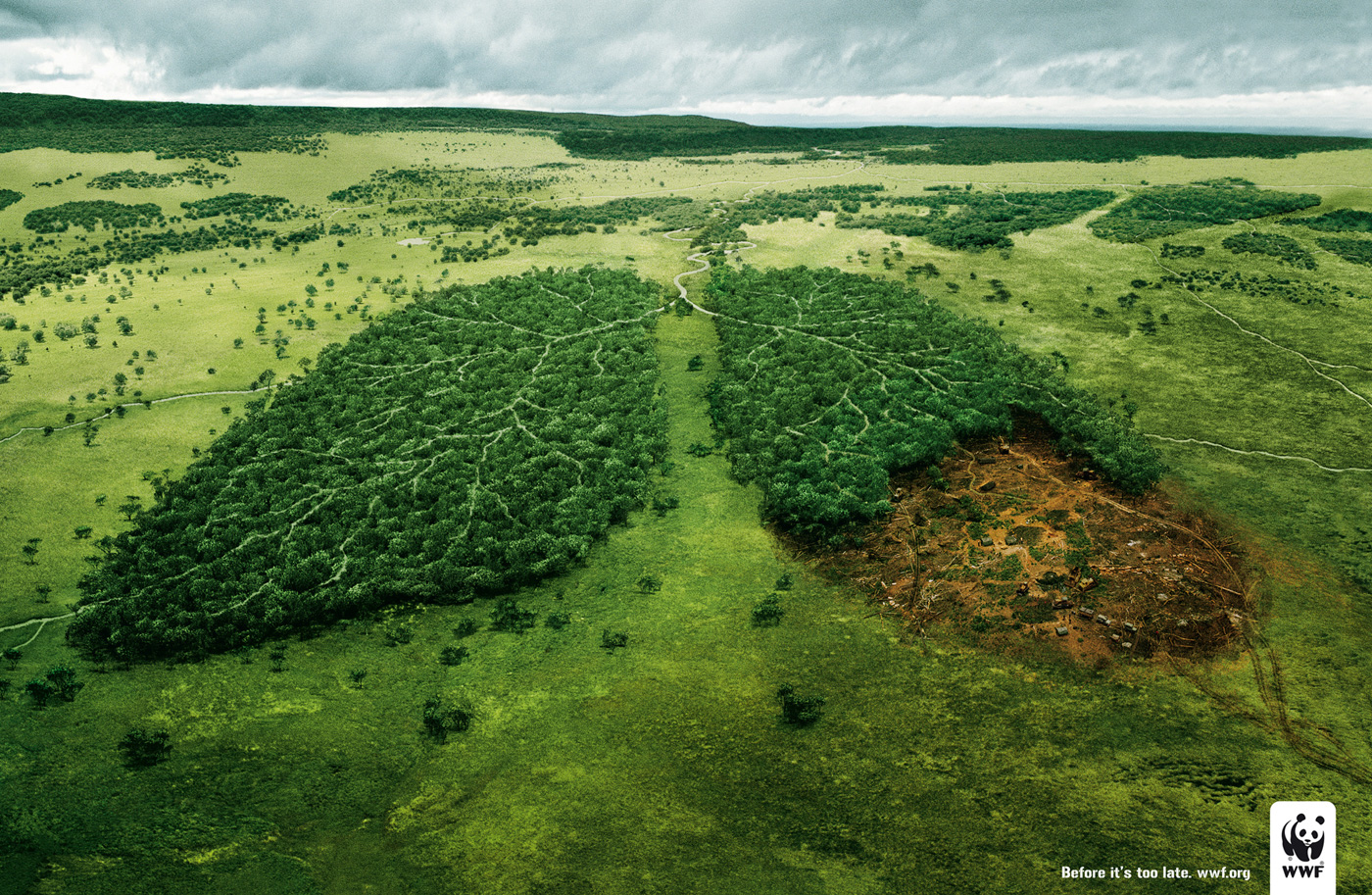
Slicing the second ‘lung of the planet’

12 12 2011

© WWF

Apologies for the slow-down in postings this past week – as many of you know, I was attending the International Congress for Conservation Biology in Auckland. I’ll blog about the conference later (and the stoush that didn’t really occur), but suffice it to say it was very much worthwhile.

This post doesn’t have a lot to do per se with the conference, but it was stimulated by a talk I attended by Conservation Scholar Stuart Pimm. Now, Stuart is known mainly as a tropical conservation biologist, but as it turns out, he also is a champion of temperate forests – he even sits on the science panel of the International Boreal Conservation Campaign.

I too have dabbled in boreal issues over my career, and most recently with a review published in Trends in Ecology and Evolution on the knife-edge plight of boreal biodiversity and carbon stores. That paper was in fact the result of a brain-storming session Navjot Sodhi and I had one day during my visit to Singapore sometime in 2007. We thought, “It doesn’t really seem that people are focussing their conservation attention on the boreal forest; how bad is it really?”.

Well, it turns out that the boreal forest is still a vast expanse and that there aren’t too many species in imminent danger of extinction; however, that’s where the good news ends. The forest itself is becoming more and more fragmented from industrial development (namely, forestry, mining, petroleum surveying and road-building) and the fire regime has changed irrevocably from a combination of climate change and intensified human presence. You can read all these salient features here.

So, back to my original thread – Stuart gave a great talk on the patterns of deforestation worldwide, with particular emphasis on how satellite imagery hides much of the fine-scale damage that we humans do to the world’s great forests. It was when he said (paraphrased) that “50,000 km2 of boreal forest is lost each year, but even that statistic hides a major checkerboard effect” that my interest was peaked. Read the rest of this entry »


Better SAFE than sorry

30 11 2011

Last day of November already – I am now convinced that my suspicions are correct: time is not constant and in fact accelerates as you age (in mathematical terms, a unit of time becomes a progressively smaller proportion of the time elapsed since your birth, so this makes sense). But, I digress…

This short post will act mostly as a spruik for my upcoming talk at the International Congress for Conservation Biology next week in Auckland (10.30 in New Zealand Room 2 on Friday, 9 December) entitled: Species Ability to Forestall Extinction (SAFE) index for IUCN Red Listed species. The post also sets a bit of the backdrop to this paper and why I think people might be interested in attending.

As regular readers of CB will know, we published a paper this year in Frontiers in Ecology and the Environment describing a relatively simple metric we called SAFE (Species Ability to Forestall Extinction) that could enhance the information provided by the IUCN Red List of Threatened Species for assessing relative extinction threat. I won’t go into all the detail here (you can read more about it in this previous post), but I do want to point out that it ended up being rather controversial.

The journal ended up delaying final publication because there were 3 groups who opposed the metric rather vehemently, including people who are very much in the conservation decision-making space and/or involved directly with the IUCN Red List. The journal ended up publishing our original paper, the 3 critiques, and our collective response in the same issue (you can read these here if you’re subscribed, or email me for a PDF reprint). Again, I won’t go into an detail here because our arguments are clearly outlined in the response.

What I do want to highlight is that even beyond the normal in-print tête-à-tête the original paper elicited, we were emailed by several people behind the critiques who were apparently unsatisfied with our response. We found this slightly odd, because many of the objections just kept getting re-raised. Of particular note were the accusations that: Read the rest of this entry »