June 2010 Issue of Conservation Letters

9 06 2010

The third issue of Conservation Letters Volume 3 is now out. A good line-up of papers, indeed. Note that we’ve gone up to 9 papers in this issue, so keep the good submissions coming. Conservation Letters will most likely be listed on ISI Web of Science this year, and receive its first Impact Factor in 2011.

Thanks for the support.

CJA Bradshaw


Make your conservation PhD relevant

23 04 2010

The other day I was approached by two PhD candidates from James Cook University in the ARC Centre of Excellence for Coral Reef Studies who requested I publish a short article they put together on making conservation PhDs relevant while achieving academic excellence. I’m delighted to say that I found the article very well written and topical, so I am pleased to present it in full here.

© J. Cham

Make your conservation PhD relevant – bridging the research-implementation gap

Duan Biggs & Tom Brewer

ARC Centre of Excellence for Coral Reef Studies, James Cook University, Townsville, Queensland, Australia

A recent paper, in Biotropica’s special issue on bridging the research-implementation gap (Duchelle et al. 2009) included examples of postgraduate students in the University of Florida’s Tropical Conservation and Development Program contributing to knowledge exchange with local stakeholders. The authors argue that this experience, during training, enables postgraduate students to develop their skills to confront the elaborate set of management and policy issues that will be present through their careers. We agree with Duchelle and her co-authors’ arguments, but believe that further discussion is required on finding the balance between the requirements of academic training and knowledge sharing with conservation stakeholders at the PhD level specifically.

Earning a PhD requires a novel theoretical contribution to a specific field of knowledge, and the practical value or contribution of that knowledge is of secondary importance, or irrelevant. Therefore, finding synergies between the requirements of academia and knowledge sharing can be particularly challenging at the PhD level. Yet, we believe that in an applied science like conservation, the quality of research and training will be enhanced through being more explicit about how to synergise a scientific contribution worthy of a PhD degree with related practical skills like knowledge sharing. In support of our argument, we propose the following six questions that PhD candidates, together with their academic supervisors, can consider during research design to enhance their contribution to knowledge exchange whilst meeting the requirements of academic training: Read the rest of this entry »


Conservation jobs at the University of Adelaide

13 04 2010

I’m posting the advertisements for two new conservation jobs in the Global Ecology Group at the University of Adelaide.

This Australian Research Council-funded Discovery Project seeks to determine whether functional forms of spatially explicit population dynamics are generalisable across taxa with similar attributes and range limiting factors. By considering the effects of multiple interacting factors (biotic and abiotic) on the demographic determinants of species’ habitat suitability and geographic distributional limits, the research will provide a foundation on which to develop adaptive conservation strategies in response to the anticipated impacts of global change; examine the complexities and potentially irreducible uncertainties in forecasting and managing biodiversity; and identify limitations associated with different modelling approaches. Read the rest of this entry »


Don’t miss Bill

25 03 2010

Yes, yes, I know I’ve posted only a little under two weeks ago that the venerable William (Bill) Laurance is coming to Adelaide, and anyone even remotely interested in biodiversity conservation would be a fool to miss his talks, and ra, ra, ra…

Well, you would be.

However, I don’t want anyone to miss this opportunity simply because of non-recognition. So I thought it prudent to remind people just how special this visit is, and what a researcher extraordinaire Bill really is. For those not necessarily following the trends in tropical conservation biology (probably not many in Adelaide, at least), you might not necessarily recognise his name.

So, I thought I’d give a little broadsheet of his achievements, Read the rest of this entry »


Bill Laurance coming to Adelaide

13 03 2010

We’ve got a real treat for biodiversity buffs scheduled for the end of March. Eminent (Distinguished, Famous, Respected… the list goes on) Professor William (Bill) Laurance is briefly leaving his tropical world and coming south to the temperate climes of Adelaide to regale us with his fascinating biodiversity research career.

Bill is a leading conservation biologist who has worked internationally on many high-profile threats to tropical forests—in the Amazon, Central America, Africa, and Australasia. A highly prolific scientist, to date he has published five books and over 300 scientific articles. Bill has recently commenced a position as Distinguished Research Professor at James Cook University and is involved with the Smithsonian Tropical Research Institute in Panama. He also happens to be the bloke that blew the lid open on the devastating effects of tropical fragmentation in the Amazon with some of the best long-term experiments ever done in conservation biology.

I’m personally very pleased for several reasons: (1) Although I have never met Bill in person yet, I’ve recently co-authored two papers with him (Wash and spin cycle threats to tropical biodiversity and Improving the performance of the Roundtable on Sustainable Palm Oil for nature conservation) and I’m keen to meet the man behind the pen; (2) we have had many email discussions (some of them rather heated!), so I’m keen to flesh some of these out over a nice glass of South Australian Shiraz; (3) he’s been a keen supporter of my work for years, and has given me many opportunities to get my research noticed; and (4) it’s high time to met one of ConservationBytes.com Conservation Scholars.

Bill has recently shifted shop from Panama (Smithsonian Tropical Research Institute) to Australia’s own James Cook University, and so we at the Environment Institute thought we should take advantage of his geographical disorientation and bring him down south for a while. But he’s going to have to sing for his supper, so he’s kindly agreed to give three talks in 3 days from 29-31 March 2010.

His first talk (on Monday 29 March) will be an in-house Environment Institute seminar, but the second two will be public events that I urge anyone remotely interested in biodiversity conservation research to attend. In fact, his Tuesday 30 March presentation (18.00-20.00 Napier G03, University of Adelaide) is even more generic than that, and word on the street is it is highly entertaining and extremely well attended wherever Bill’s is gracious enough to give it:

Amplify Your Voice: Keys to Having a Prolific Scientific Career (and Bill would know).

This will include (1) How to be more prolific: strategies for writing and publishing scientific papers and (2) Further ways to maximise your scientific impact – interacting with the popular media and how to promote yourself. Each topic will run for 50 minutes and will include 10 minutes for audience questions. A tea and coffee break will be held between sessions. Book here.

His second public talk on Wednesday 31 March (18.00-19.30 Napier 102, University of Adelaide) will be:

Diagnosis Critical | The lungs of our Planet

Here he will be discussing how the forests of our world are in crisis. Our drive for continued economic growth has had devastating consequences for the world’s ecosystems that provide critical human services. Our forests are a haven for countless plant and animal species that form the basis of ecological services, these services are the biological mechanisms that make the world our home. Book here.

So, if you have a couple of free nights at the end of the month and are in Adelaide, I strongly recommend you come out and see Bill do his thing.

CJA Bradshaw

Add to FacebookAdd to DiggAdd to Del.icio.usAdd to StumbleuponAdd to RedditAdd to BlinklistAdd to TwitterAdd to TechnoratiAdd to Yahoo BuzzAdd to Newsvine


Every extra human means fewer animals

8 02 2010

© The Sun

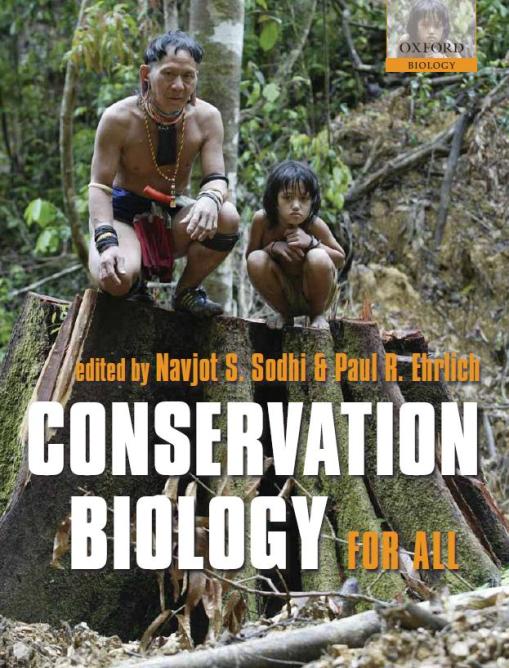
As promised some time ago when I blogged about the imminent release of the book Conservation Biology for All (edited by Navjot Sodhi and Paul Ehrlich), I am now posting a few titbits from the book.

Today’s post is a blurb from Paul Ehrlich on the human population problem for conservation of biodiversity.

The size of the human population is approaching 7 billion people, and its most fundamental connection with conservation is simple: people compete with other animals., which unlike green plants cannot make their own food. At present Homo sapiens uses, coopts, or destroys close to half of all the food available to the rest of the animal kingdom. That means that, in essence, every human being added to the population means fewer individuals can be supported in the remaining fauna.

But human population growth does much more than simply cause a proportional decline in animal biodiversity – since as you know, we degrade nature in many ways besides competing with animals for food. Each additional person will have a disproportionate negative impact on biodiversity in general. The first farmers started farming the richest soils they could find and utilised the richest and most accessible resources first (Ehrlich & Ehrlich 2005). Now much of the soil that people first farmed has been eroded away or paved over, and agriculturalists increasingly are forced to turn to marginal land to grow more food.

Equally, deeper and poorer ore deposits must be mined and smelted today, water and petroleum must come from lower quality resources, deeper wells, or (for oil) from deep beneath the ocean and must be transported over longer distances, all at ever-greater environmental cost [my addition – this is exactly why we need to embrace the cheap, safe and carbon-free energy provided by nuclear energy].

The tasks of conservation biologists are made more difficult by human population growth, as is readily seen in the I=PAT equation (Holdren & Ehrlich 1974; Ehrlich & Ehrlich 1981). Impact (I) on biodiversity is not only a result of population size (P), but of that size multiplied by affluence (A) measured as per capita consumption, and that product multiplied by another factor (T), which summarises the technologies  and socio-political-economic arrangements to service that consumption. More people surrounding a rainforest reserve in a poor nation often means more individuals invading the reserve to gather firewood or bush meat. More poeple in a rich country may mean more off-road vehicles (ORVs) assulting the biota – especially if the ORV manufacturers are politically powerful and can succesfully fight bans on their use. As poor countries’ populations grow and segments of them become more affluent, demand rises for meat and automobiles, with domesticated animals competing with or devouring native biota, cars causing all sorts of assults on biodiversity, and both adding to climate disruption. Globally, as a growing population demands greater quantities of plastics, industrial chemicals, pesticides, fertilisers, cosmetics, and medicines, the toxification of the planet escalates, bringing frightening problems for organisms ranging from polar bears to frogs (to say nothing of people!).

In sum, population growth (along with escalating consumption and the use of environmentally malign technologies) is a major driver of the ongoing destruction of populations, species, and communities that is a salient feature of the Anthropocene. Humanity , as the dominant animal (Ehrlich & Ehrlich 2008), simply out competes other animals for the planet’s productivity, and often both plants and animals for its freshwater. While dealing with more limited problems, it therefore behoves every conservation biologist to put part of her time into restraining those drivers, including working to humanely lower [sic] birth rates until population growth stops and begins a slow decline twoard a sustainable size (Daily et al. 1994).

Incidentally, Paul Ehrlich is travelling to Adelaide this year (November 2010) for some high-profile talks and meetings. Stay tuned for coverage of the events.

CJA Bradshaw

Add to FacebookAdd to DiggAdd to Del.icio.usAdd to StumbleuponAdd to RedditAdd to BlinklistAdd to TwitterAdd to TechnoratiAdd to Yahoo BuzzAdd to Newsvine


Parochial conservation

30 01 2010
© cagiecartoons.com

A little bit of conservation wisdom for you this weekend.

In last week’s issue of Nature, well-known conservation planner and all-round smart bloke, Reed Noss (who just happens to be an editor for Conservation Letters and Conservation Biology), provided some words of extreme wisdom. Not pulling any punches in his Correspondence piece entitled Local priorities can be too parochial for biodiversity, Noss essentially says ‘don’t leave the important biodiversity decisions to the locals’.

He argues rather strongly in his response to Smith and colleagues’ opinion piece (Let the locals lead) that local administrators just can’t be trusted to make good conservation decisions given their focus on local economic development and other political imperatives. He basically says that the big planning decisions should be made at grander scales that over-ride local concerns because, well, the big fish in their little ponds can’t be trusted (nor do they have the training) to do what’s best for regional biodiversity conservation.

I couldn’t agree more – he states:

“Academic researchers, conservation non-governmental organizations and other ‘foreign’ interests tend to be better informed, less subject to local political influence and more experienced in conservation planning than local agencies.”

Of course, being part of the first group, I’m probably a little biased, but I dare say that we’ve got a lot better handle on the science beyond saving biodiversity, as well as a better understanding of why that’s important, than your average regional representative, village council, chief, Lord Mayor or state member. Sure, ‘engage your stakeholders’ (I have images of shooting missiles at people holding star pickets with this gem of business jargon wankery, but there you go), but please base the decision on science first. I think Smith and colleagues have some good points, but I am more in favour of a broad-scale benevolent dictatorship in conservation planning than fine-scale democracy. Granted, the best formula is likely to be very context-specific, and of course, you need some people with local implementation power to make it happen.

Dear Honourable Minister, you may sign on the dotted line to make policy real, but please, please listen to us before you do. Your very life and those of your children depend on it.

CJA Bradshaw

ResearchBlogging.orgNoss, R. (2010). Local priorities can be too parochial for biodiversity Nature, 463 (7280), 424-424 DOI: 10.1038/463424a

Smith, R., Veríssimo, D., Leader-Williams, N., Cowling, R., & Knight, A. (2009). Let the locals lead Nature, 462 (7271), 280-281 DOI: 10.1038/462280a

Add to FacebookAdd to DiggAdd to Del.icio.usAdd to StumbleuponAdd to RedditAdd to BlinklistAdd to TwitterAdd to TechnoratiAdd to Yahoo BuzzAdd to Newsvine


Society for Conservation Biology’s 24th International Congress

15 01 2010

I’m off for a long weekend at the beach, so I decided to keep this short. My post concerns the upcoming (well, July 2010) 24th International Congress for Conservation Biology (Society for Conservation Biology – SCB) to be held in Edmonton, Canada from 3-7 July 2010. I hadn’t originally planned on attending, but I’ve changed my mind and will most certainly be giving a few talks there.

There’s not much to report yet, apart from the abstract submission deadline looming next week (20 January). If you plan on submitting an abstract, get it in now (I’m rushing too). Actual registration opens online on 15 February.

The conference’s theme is “Conservation for a Changing Planet” – well, you can’t get much more topical (and general) than that! The conference website states:

Humans are causing large changes to the ecology of the earth. Industrial development and agriculture are changing landscapes. Carbon emissions to the atmosphere are changing climates. Nowhere on earth are changes to climate having more drastic effects on ecosystems and human cultures than in the north. Circumpolar caribou and reindeer populations are declining with huge consequences for indigenous peoples of the north, motivating our use of caribou in the conference logo. Developing conservation strategies to cope with our changing planet is arguably the greatest challenge facing today’s world and its biodiversity.

Sort of hits home in a personal way for me – I did my MSc on caribou populations in northern Canada a long time before getting into conservation biology proper (see example papers: Woodland caribou relative to landscape patterns in northeastern Alberta, Effects of petroleum exploration on woodland caribou in Northeastern Alberta & Winter peatland habitat selection by woodland caribou in northeastern Alberta), and we’ve recently published a major review on the boreal ecosystem.

Only 3 plenary speakers listed so far: David Schindler, Shane Mahoney and Georgina Mace (the latter being a featured Conservation Scholar here on ConservationBytes.com). I’m particularly looking forward to Georgina’s presentation. I’ll hopefully be able to blog some of the presentations while there. If you plan on attending, please come up and say hello!

CJA Bradshaw


The biodiversity extinction numbers game

4 01 2010

© Ferahgo the Assassin

Not an easy task, measuring extinction. For the most part, we must use techniques to estimate extinction rates because, well, it’s just bloody difficult to observe when (and where) the last few individuals in a population finally kark it. Even Fagan & Holmes’ exhaustive search of extinction time series only came up with 12 populations – not really a lot to go on. It’s also nearly impossible to observe species going extinct if they haven’t even been identified yet (and yes, probably still the majority of the world’s species – mainly small, microscopic or subsurface species – have yet to be identified).

So conservation biologists do other things to get a handle on the rates, relying mainly on the species-area relationship (SAR), projecting from threatened species lists, modelling co-extinctions (if a ‘host’ species goes extinct, then its obligate symbiont must also) or projecting declining species distributions from climate envelope models.

But of course, these are all estimates and difficult to validate. Enter a nice little review article recently published online in Biodiversity and Conservation by Nigel Stork entitled Re-assessing current extinction rates which looks at the state of the art and how the predictions mesh with the empirical data. Suffice it to say, there is a mismatch.

Stork writes that the ‘average’ estimate of losing about 100 species per day has hardly any empirical support (not surprising); only about 1200 extinctions have been recorded in the last 400 years. So why is this the case?

As mentioned above, it’s difficult to observe true extinction because of the sampling issue (the rarer the individuals, the more difficult it is to find them). He does cite some other problems too – the ‘living dead‘ concept where species linger on for decades, perhaps longer, even though their essential habitat has been destroyed, forest regrowth buffering some species that would have otherwise been predicted to go extinct under SAR models, and differing extinction proneness among species (I’ve blogged on this before).

Of course, we could just all be just a pack of doomsday wankers vainly predicting the end of the world ;-)

Well, I think not – if anything, Stork concludes that it’s all probably worse than we currently predict because of extinction synergies (see previous post about this concept) and the mounting impact of rapid global climate change. If anything, the “100 species/day” estimate could look like a utopian ideal in a few hundred years. I do disagree with Stork on one issue though – he claims that deforestation isn’t probably as bad as we make it out. I’d say the opposite (see here, here & here) – we know so little of how tropical forests in particular function that I dare say we’ve only just started measuring the tip of the iceberg.

CJA Bradshaw

Add to FacebookAdd to NewsvineAdd to DiggAdd to Del.icio.usAdd to StumbleuponAdd to RedditAdd to BlinklistAdd to Ma.gnoliaAdd to TechnoratiAdd to Furl

This post was chosen as an Editor's Selection for ResearchBlogging.org

ResearchBlogging.orgStork, N. (2009). Re-assessing current extinction rates Biodiversity and Conservation DOI: 10.1007/s10531-009-9761-9


Conservation Biology for All

26 12 2009

A new book that I’m proud to have had a hand in writing is just about to come out with Oxford University Press called Conservation Biology for All. Edited by the venerable Conservation Scholars, Professors Navjot Sodhi (National University of Singapore) and Paul Ehrlich (Stanford University), it’s a powerhouse of some of the world’s leaders in conservation science and application.

The book strives to “…provide cutting-edge but basic conservation science to a global readership”. In short, it’s written to bring the forefront of conservation science to the general public, with OUP promising to make it freely available online within about a year from its release in early 2010 (or so the rumour goes). The main idea here is that those in most need of such a book – the conservationists in developing nations – can access the wealth of information therein without having to sacrifice the village cow to buy it.

I won’t go into any great detail about the book’s contents (mainly because I have yet to receive my own copy and read most of the chapters!), but I have perused early versions of Kevin Gaston‘s excellent chapter on biodiversity, and Tom Brook‘s overview of conservation planning and prioritisation. Our chapter (Chapter 16 by Barry Brook and me), is an overview of statistical and modelling philosophy and application with emphasis on conservation mathematics. It’s by no means a complete treatment, but it’s something we want to develop further down the track. I do hope many people find it useful.

I’ve reproduced the chapter title line-up below, with links to each of the authors websites.

  1. Conservation Biology: Past and Present (C. Meine)
  2. Biodiversity (K. Gaston)
  3. Ecosystem Functions and Services (C. Sekercioglu)
  4. Habitat Destruction: Death of a Thousand Cuts (W. Laurance)
  5. Habitat Fragmentation and Landscape Change (A. Bennett & D. Saunders)
  6. Overharvesting (C. Peres)
  7. Invasive Species (D. Simberloff)
  8. Climate Change (T. Lovejoy)
  9. Fire and Biodiversity (D. Bowman & B. Murphy)
  10. Extinctions and the Practice of Preventing Them (S. Pimm & C. Jenkins)
  11. Conservation Planning and Priorities (T. Brooks)
  12. Endangered Species Management: The US Experience (D. Wilcove)
  13. Conservation in Human-Modified Landscapes (L.P. Koh & T. Gardner)
  14. The Roles of People in Conservation (A. Claus, K. Chan & T. Satterfield)
  15. From Conservation Theory to Practice: Crossing the Divide (M. Rao & J. Ginsberg)
  16. The Conservation Biologist’s Toolbox – Principles for the Design and Analysis of Conservation Studies (C. Bradshaw & B. Brook)

As you can see, it’s a pretty impressive collection of conservation stars and hard-hitting topics. Can’t wait to get my own copy! I will probably blog individual chapters down the track, so stay tuned.

CJA Bradshaw

Add to FacebookAdd to NewsvineAdd to DiggAdd to Del.icio.usAdd to StumbleuponAdd to RedditAdd to BlinklistAdd to Ma.gnoliaAdd to TechnoratiAdd to Furl


A magic conservation number

15 12 2009

Although I’ve already blogged about our recent paper in Biological Conservation on minimum viable population sizes, American Scientist just did a great little article on the paper and concept that I’ll share with you here:

Imagine how useful it would be if someone calculated the minimum population needed to preserve each threatened organism on Earth, especially in this age of accelerated extinctions.

A group of Australian researchers say they have nailed the best figure achievable with the available data: 5,000 adults. That’s right, that many, for mammals, amphibians, insects, plants and the rest.

Their goal wasn’t a target for temporary survival. Instead they set the bar much higher, aiming for a census that would allow a species to pursue a standard evolutionary lifespan, which can vary from one to 10 million years.

That sort of longevity requires abundance sufficient for a species to thrive despite significant obstacles, including random variation in sex ratios or birth and death rates, natural catastrophes and habitat decline. It also requires enough genetic variation to allow adequate amounts of beneficial mutations to emerge and spread within a populace.

“We have suggested that a major rethink is required on how we assign relative risk to a species,” says conservation biologist Lochran Traill of the University of Adelaide, lead author of a Biological Conservation paper describing the projection.

Conservation biologists already have plenty on their minds these days. Many have concluded that if current rates of species loss continue worldwide, Earth will face a mass extinction comparable to the five big extinction events documented in the past. This one would differ, however, because it would be driven by the destructive growth of one species: us.

More than 17,000 of the 47,677 species assessed for vulnerability of extinction are threatened, according to the latest Red List of Threatened Species prepared by the International Union for Conservation of Nature. That includes 21 percent of known mammals, 30 percent of known amphibians, 12 percent of known birds and 70 percent of known plants. The populations of some critically endangered species number in the hundreds, not thousands.

In an effort to help guide rescue efforts, Traill and colleagues, who include conservation biologists and a geneticist, have been exploring minimum viable population size over the past few years. Previously they completed a meta-analysis of hundreds of studies considering such estimates and concluded that a minimum head count of more than a few thousand individuals would be needed to achieve a viable population.

“We don’t have the time and resources to attend to finding thresholds for all threatened species, thus the need for a generalization that can be implemented across taxa to prevent extinction,” Traill says.

In their most recent research they used computer models to simulate what population numbers would be required to achieve long-term persistence for 1,198 different species. A minimum population of 500 could guard against inbreeding, they conclude. But for a shot at truly long-term, evolutionary success, 5,000 is the most parsimonious number, with some species likely to hit the sweet spot with slightly less or slightly more.

“The practical implications are simply that we’re not doing enough, and that many existing targets will not suffice,” Traill says, noting that many conservation programs may inadvertently be managing protected populations for extinction by settling for lower population goals.

The prospect that one number, give or take a few, would equal the minimum viable population across taxa doesn’t seem likely to Steven Beissinger, a conservation biologist at the University of California at Berkeley.

“I can’t imagine 5,000 being a meaningful number for both Alabama beach mice and the California condors. They are such different organisms,” Beissinger says.

Many variables must be considered when assessing the population needs of a given threatened species, he says. “This issue really has to do with threats more than stochastic demography. Take the same rates of reproduction and survival and put them in a healthy environment and your minimum population would be different than in an environment of excess predation, loss of habitat or effects from invasive species.”

But, Beissinger says, Traill’s group is correct for thinking that conservation biologists don’t always have enough empirically based standards to guide conservation efforts or to obtain support for those efforts from policy makers.

“One of the positive things here is that we do need some clear standards. It might not be establishing a required number of individuals. But it could be clearer policy guidelines for acceptable risks and for how many years into the future can we accept a level of risk,” Beissinger says. “Policy people do want that kind of guidance.”

Traill sees policy implications in his group’s conclusions. Having a numerical threshold could add more precision to specific conservation efforts, he says, including stabs at reversing the habitat decline or human harvesting that threaten a given species.

“We need to restore once-abundant populations to the minimum threshold,” Traill says. “In many cases it will make more economic and conservation sense to abandon hopeless-case species in favor of greater returns elsewhere.


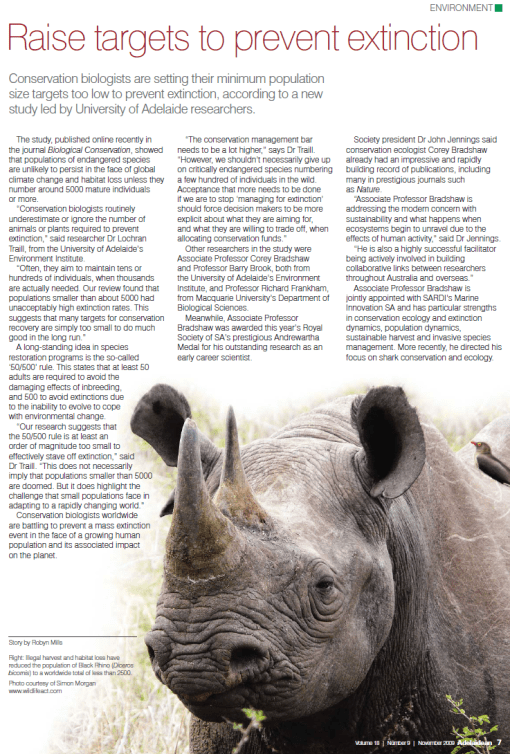
Raise targets to prevent extinction

12 11 2009

I know I’ve blogged recently about this, but The Adelaidean did a nice little article that I thought I’d reproduce here. The source can be found here.

Adelaidean story Nov 2009


Not so ‘looming’ – Anthropocene extinctions

4 11 2009

ABCclip031109

© ABC 2009

Yesterday I was asked to do a quick interview on ABC television (Midday Report) about the release of the 2009 IUCN Red List of Threatened Species. I’ve blogged about the importance of the Red List before, but believe we have a lot more to do with species assessments and getting prioritisation right with respect to minimum viable population size. Have a listen to the interview itself, and read the IUCN’s media release reproduced below.

My basic stance is that we’ve only just started to assess the number of species on the planet (under 50000), yet there are many millions of species still largely under-studied and/or under-described (e.g., extant species richness = > 4 million protists, 16600 protozoa, 75000-300000 helminth parasites, 1.5 million fungi, 320000 plants, 4-6 million arthropods, > 6500 amphibians, 10000 birds and > 5000 mammals – see Bradshaw & Brook 2009 J Cosmol for references). What we’re looking at here is a refinement of knowledge (albeit a small one). We are indeed in the midst of the Anthropocene mass extinction event – there is nothing ‘looming’ about it. We are essentially losing species faster than we can assess them. I believe it’s important to make this clearer to those not working directly in the field of biodiversity conservation.

CJA Bradshaw

Extinction crisis continues apace – IUCN

Gland, Switzerland, 3 November, 2009 (IUCN) – The latest update of the IUCN Red List of Threatened Species™ shows that 17,291 species out of the 47,677 assessed species are threatened with extinction.

The results reveal 21 percent of all known mammals, 30 percent of all known amphibians, 12 percent of all known birds, and 28 percent of reptiles, 37 percent of freshwater fishes, 70 percent of plants, 35 percent of invertebrates assessed so far are under threat.

“The scientific evidence of a serious extinction crisis is mounting,” says Jane Smart, Director of IUCN’s Biodiversity Conservation Group. “January sees the launch of the International Year of Biodiversity. The latest analysis of the IUCN Red List shows the 2010 target to reduce biodiversity loss will not be met. It’s time for governments to start getting serious about saving species and make sure it’s high on their agendas for next year, as we’re rapidly running out of time.”

Of the world’s 5,490 mammals, 79 are Extinct or Extinct in the Wild, with 188 Critically Endangered, 449 Endangered and 505 Vulnerable. The Eastern Voalavo (Voalavo antsahabensis) appears on the IUCN Red List for the first time in the Endangered category. This rodent, endemic to Madagascar, is confined to montane tropical forest and is under threat from slash-and-burn farming.

There are now 1,677 reptiles on the IUCN Red List, with 293 added this year. In total, 469 are threatened with extinction and 22 are already Extinct or Extinct in the Wild. The 165 endemic Philippine species new to the IUCN Red List include the Panay Monitor Lizard (Varanus mabitang), which is Endangered. This highly-specialized monitor lizard is threatened by habitat loss due to agriculture and logging and is hunted by humans for food. The Sail-fin Water Lizard (Hydrosaurus pustulatus) enters in the Vulnerable category and is also threatened by habitat loss. Hatchlings are heavily collected both for the pet trade and for local consumption.

“The world’s reptiles are undoubtedly suffering, but the picture may be much worse than it currently looks,” says Simon Stuart, Chair of IUCN’s Species Survival Commission. “We need an assessment of all reptiles to understand the severity of the situation but we don’t have the $2-3 million to carry it out.”

The IUCN Red List shows that 1,895 of the planet’s 6,285 amphibians are in danger of extinction, making them the most threatened group of species known to date. Of these, 39 are already Extinct or Extinct in the Wild, 484 are Critically Endangered, 754 are Endangered and 657 are Vulnerable.

The Kihansi Spray Toad (Nectophrynoides asperginis) has moved from Critically Endangered to Extinct in the Wild. The species was only known from the Kihansi Falls in Tanzania, where it was formerly abundant with a population of at least 17,000. Its decline is due to the construction of a dam upstream of the Kihansi Falls that removed 90 percent of the original water flow to the gorge. The fungal disease chytridiomycosis was probably responsible for the toad’s final population crash.

The fungus also affected the Rabb’s Fringe-limbed Treefrog (Ecnomiohyla rabborum), which enters the Red List as Critically Endangered. It is known only from central Panama. In 2006, the chytrid fungus (Batrachochytrium dendrobatidis) was reported in its habitat and only a single male has been heard calling since. This species has been collected for captive breeding efforts but all attempts have so far failed.

Of the 12,151 plants on the IUCN Red List, 8,500 are threatened with extinction, with 114 already Extinct or Extinct in the Wild. The Queen of the Andes (Puya raimondii) has been reassessed and remains in the Endangered category. Found in the Andes of Peru and Bolivia, it only produces seeds once in 80 years before dying. Climate change may already be impairing its ability to flower and cattle roam freely among many colonies, trampling or eating young plants.

There are now 7,615 invertebrates on the IUCN Red List this year, 2,639 of which are threatened with extinction. Scientists added 1,360 dragonflies and damselflies, bringing the total to 1,989, of which 261 are threatened. The Giant Jewel (Chlorocypha centripunctata), classed as Vulnerable, is found in southeast Nigeria and southwest Cameroon and is threatened by forest destruction.

Scientists also added 94 molluscs, bringing the total number assessed to 2,306, of which 1,036 are threatened. Seven freshwater snails from Lake Dianchi in Yunnan Province, China, are new to the IUCN Red List and all are threatened. These join 13 freshwater fishes from the same area, 12 of which are threatened. The main threats are pollution, introduced fish species and overharvesting.

There are now 3,120 freshwater fishes on the IUCN Red List, up 510 species from last year. Although there is still a long way to go before the status all the world’s freshwater fishes is known, 1,147 of those assessed so far are threatened with extinction. The Brown Mudfish (Neochanna apoda), found only in New Zealand, has been moved from Near Threatened to Vulnerable as it has disappeared from many areas in its range. Approximately 85-90 percent of New Zealand’s wetlands have been lost or degraded through drainage schemes, irrigation and land development.

“Creatures living in freshwater have long been neglected. This year we have again added a large number of them to the IUCN Red List and are confirming the high levels of threat to many freshwater animals and plants. This reflects the state of our precious water resources. There is now an urgency to pursue our effort but most importantly to start using this information to move towards a wise use of water resources,” says Jean-Christophe Vié, Deputy Head of the IUCN Species Programme.

“This year’s IUCN Red List makes for sobering reading,” says Craig Hilton-Taylor, Manager of the IUCN Red List Unit. “These results are just the tip of the iceberg. We have only managed to assess 47,663 species so far; there are many more millions out there which could be under serious threat. We do, however, know from experience that conservation action works so let’s not wait until it’s too late and start saving our species now.”

The status of the Australian Grayling (Prototroctes maraena), a freshwater fish, has improved as a result of conservation efforts. Now classed as Near Threatened as opposed to Vulnerable, the population has recovered thanks to fish ladders which have been constructed over dams to allow migration, enhanced riverside vegetation and the education of fishermen, who now face heavy penalties if found with this species.


Managing for extinction

9 10 2009

ladderAh, it doesn’t go away, does it? Or at least, we won’t let it.

That concept of ‘how many is enough?’ in conservation biology, the so-called ‘minimum viable population size‘, is enough to drive some conservation practitioners batty.

How many times have we heard the (para-) phrase: “It’s simply impractical to bring populations of critically endangered species up into the thousands”?

Well, my friends, if you’re not talking thousands, you’re wasting everyone’s time and money. You are essentially managing for extinction.

Our new paper out online in Biological Conservation entitled Pragmatic population viability targets in a rapidly changing world (Traill et al.) shows that populations of endangered species are unlikely to persist in the face of global climate change and habitat loss unless they number around 5000 mature individuals or more.

After several meta-analytic, time series-based and genetic estimates of the magic minimum number all agreeing, we can be fairly certain now that if a population is much less than several thousands (median = 5000), its likelihood of persisting in the long run in the face of normal random variation is pretty small.

We conclude essentially that many conservation biologists routinely underestimate or ignore the number of animals or plants required to prevent extinction. In fact, aims to maintain tens or hundreds of individuals, when thousands are actually needed, are simply wasting precious and finite conservation resources. Thus, if it is deemed unrealistic to attain such numbers, we essentially advise that in most cases conservation triage should be invoked and the species in question be abandoned for better prospects

A long-standing idea in species restoration programs is the so-called ‘50/500’ rule; this states that at least 50 adults are required to avoid the damaging effects of inbreeding, and 500 to avoid extinctions due to the inability to evolve to cope with environmental change. Our research suggests that the 50/500 rule is at least an order of magnitude too small to stave off extinction.

This does not necessarily imply that populations smaller than 5000 are doomed. But it does highlight the challenge that small populations face in adapting to a rapidly changing world.

We are battling to prevent a mass extinction event in the face of a growing human population and its associated impact on the planet, but the bar needs to be a lot higher. However, we shouldn’t necessarily give up on critically endangered species numbering a few hundred of individuals in the wild. Acceptance that more needs to be done if we are to stop ‘managing for extinction’ should force decision makers to be more explicit about what they are aiming for, and what they are willing to trade off, when allocating conservation funds.

CJA Bradshaw

(with thanks to Lochran Traill, Barry Brook and Dick Frankham)

Add to FacebookAdd to NewsvineAdd to DiggAdd to Del.icio.usAdd to StumbleuponAdd to RedditAdd to BlinklistAdd to Ma.gnoliaAdd to TechnoratiAdd to Furl

This post was chosen as an Editor's Selection for ResearchBlogging.orgResearchBlogging.org

Traill, L.W., Brook, B.W., Frankham, R.R., & Bradshaw, C.J.A. (2009). Pragmatic population viability targets in a rapidly changing world Biological Conservation DOI: 10.1016/j.biocon.2009.09.001


The rarity of commonness

18 08 2009

I’m attending the 10th International Congress of Ecology (INTECOL) in Brisbane this week and I have just managed to find (a) an internet connection and (b) a small window to write this post.

I have to say I haven’t been to a good plenary talk for some time – maybe it’s just bad luck, but often plenary talks can be less-than-inspiring.

Not so for INTECOL this year. I was very pleased to have the opportunity to listen to biodiversity guru Professor Kevin Gaston of the University of Sheffield give a fantastic talk on… common species (?!).

clones

If you have followed any of Kevin’s work, you’ll know he literally wrote the book on rarity – what species rarity is, how to measure it and what it means for preserving biodiversity as a whole.

Now he’s championing (in a very loose sense) the importance of common species because it is these taxa, he argues, that provide the backbone to the persistence of all biodiversity.

Yes, we conservation biologists have tended to focus on the rare and endemic species to make certain we have as much diversity in species (and genetic material) as possible when conserving habitats.

There are a lot more rare species than common ones, and the most common species (i.e., the ones you most often see) tend to have the broadest distributions. We know from much previous work that having a broad distribution reduces extinction risk, so why should we be concerned about common species?

Kevin made a very good point – if you turn the relationship on its head somewhat, you can state that the state of ‘commonness’ is itself ‘rare’. In fact, only about 25 % of the most common species account for about 90-95 % of ALL individuals. He used an interesting (and scary) example to show what this can mean from an extinction perspective. Although very back-of-the-envelope, there are about 2000 individual birds in a km2 of tropical forest; we are losing between 50000 and 120000 km2 of tropical forest per year, so this translates into the loss of about 100 to 240 million individual birds per year; this is the sum total of all birds in Great Britain (a bird-mad country). Yet where do we have the best information about birds? The UK.

Commonness is also geologically transient, meaning that just because you are a common species at some point in your evolutionary history doesn’t mean you have always been or always will be. In fact, most species never do become common.

But it is just these ‘rare’ common that drive the principal patterns we see globally in community structure. The true ‘rare’ species are, in fact, pretty crap predictors of biodiversity patterns. Kevin made a good point – when you look at a satellite image of a forest, it’s not all the little rare species you see, it’s the 2 or 3 most common tree species that make up the forest. Lose those, and you lose everything else.

Indeed, common species also form most trophic structure (the flow of energy through biological communities). Take away these, and ecosystem function degrades. They also tend to have the highest biomass and provide the structure that supports all those millions of rare species. Being common is quite an important job.

Kevin stated that the world is now in a state where many of the so-called common species are in fact, “artificially” common because of how much we’ve changed the planet. It is these benefactors of our world-destroying machinations that are now in decline themselves, and it is for this reason we should be worried.

When you start to see these bastions of ecosystems start to drop off (and the drop is usually precipitous because we don’t tend to notice their loss until they suddenly disappear), then you know we’re in trouble. And yet, even though once common, few, if any, once-common species have come back after a big decline.

So what does this mean for the way we do biodiversity research? Kevin proposes that we need a lot more good monitoring of these essential common species so that we can understand their structuring roles in the community and more importantly, be able to track their change before ecosystem collapse occurs. The monitoring is crucial – it wasn’t the demise of small companies that signalled the 2007 stock market crash responsible for the Global Financial Crisis in which we now find ourselves, the signal was derived from stock data obtained from just a few large (i.e., ‘common’) companies. All the small companies (‘rare’) ones then followed suit.

A very inspiring, worrying and somewhat controversial talk. Watch out for more things ‘Gaston’ on ConservationBytes.com in the near future.

CJA Bradshaw

Add to FacebookAdd to NewsvineAdd to DiggAdd to Del.icio.usAdd to StumbleuponAdd to RedditAdd to BlinklistAdd to Ma.gnoliaAdd to TechnoratiAdd to Furl


Interview with… ConservationBytes

16 07 2009

CBlogoA few months ago I was asked to do an online interview about ConservationBytes at The Reef Tank. I previously made mention of the interview (see post), but I think it’s time I reproduce it here.

The effects of pollution, carbon build up in the ocean, extinction, loss of coral reefs, over-fishing, and global warming is increasingly becoming more detrimental to our marine life and marine world.

Fortunately our marine ecosystems have Corey Bradshaw on their side. As a conservation ecologist, Corey studies these ecosystems with a passion, trying to understands the interactions between plants and animals that make up these ecosystems as well as what human activity is doing to them.

He has realised long ago that conservation and awareness is crucial to the survival of these living things and carries on the long tradition of studying and trying to understand these ecosystems at the School of Earth & Environmental Sciences at the University of Adelaide in South Australia.

He also avidly blogs about these pertinent issues at ConservationBytes.com, because he felt a need that these marine conservation issues needed to be heard. And he was more then right.

We were lucky enough to grab some time with Corey Bradshaw and he was kind enough to answer some important marine conservation questions, which are important in our desire: to make the marine world a better place.

What is your background in science and conservation?

I have a rather eclectic background in this area. I originally started my university education in general ecology, with a focus on plant ecology in particular (this was the strength of my undergraduate institution). There was no real emphasis on conservation per se until I started my postgraduate studies, although even then I was more interested in the empirical side of theoretical ecology than on conservation itself. It was more or less a gradual process that as I realised just how much we as a species have changed the planet in our (relatively) short time here, I became more and more dedicated to quantifying the links between species loss and how it affects human well-being.

After completing my MSc, PhD and first postdoctoral fellowship in New Zealand and Australia, I had the good fortune to work alongside a few excellent conservation ecologists specialising in extinction dynamics. This is where my mathematical bent and conservation interests really took off and eventually set the stage for most of my research today.

Your blog is ConservationBytes.com. Why the urge to start a blog on conservation only?

It may seem odd that I resisted blogging for many years because I thought it was a colossal time-waster that would take me away from my main scientific research. However, several things convinced me of its need and utility. First, it’s a wonderful vehicle to engage non-scientists about the research one does – let’s face it, most people don’t read scientific journals. Second, it’s interactive; people can ask questions or comment directly online. Third, it overcomes the strict language and technical rigour of most scientific publications and gets to the heart of the issue (it also allows me to express some opinions and speculations that are otherwise forbidden in scientific writing). Fourth, I realised there was a real lack of understanding about basic conservation science among the populace, so providing a vehicle for conservation science dissemination online appeared to be a good idea – there simply wasn’t anything like it when I started only a year ago. Finally, an effective, policy-changing scientist must advertise his/her research through the popular media to be recognised, so it obviously has career benefits.

Tell me about the conservation topics you cover?

ConservationBytes.com covers pretty much any topic that conforms to at least one of the following criteria:

  • It concerns research (previous, ongoing, planned) that is designed to improve the fate of biodiversity, whether locally, regionally or internationally

  • It concerns policy studies, actions or ideas that will have positive bearing on biodiversity conservation

  • It concerns demonstrations of the role biodiversity plays in providing humans with essential ecosystem services

I even have a section I call ‘Toothless’ that highlights ineffective conservation research or policy. Other areas include: exposés of well-known conservation scientists, a collection of links to conservation science journals, and my personal information (publications, CV, media attention).

What is your take on marine conservation? What does marine conservation include?

Given that I have worked in both marine and terrestrial realms from the tropics to the Antarctic, I really see little distinction in terms of conservation. True, the marine realm probably presents more challenges to conservation in some respects because it’s generally much more difficult and expensive to collect meaningful data, and it’s more difficult to control or mitigate people’s behaviour (especially in international waters), but the ecological patterns are the same (although I admit they may operate over different spatial and temporal scales).

Current ‘hot’ topics in marine conservation include the global degradation and loss of coral reef ecosystems (and what to do about it), terrestrial run-off of pollutants and nutrients affecting marine communities, over-fishing and better fishing management strategies, the design of effective marine protected areas, the socio-economic implications of moving people away from direct exploitation to behaviours and economic activities that promote longer-term biological community stability and resilience, and of course, how climate change (via acidification, hypercapnia, temperature change, storm intensification, seal level rise and modified current structure) might exacerbate the systems that are already stressed by the aforementioned problems.

Have you done any work, research in the area of marine conservation?

Yes, quite a bit. Some salient areas include

  • The grey nurse shark Carcharias taurus was the world’s first shark species to receive legislative protection when the east Australian population was listed under the 1984 New South Wales Fisheries Management Act. It has since been listed as globally Vulnerable by the IUCN in 1996 and the east Australian population was declared Critically Endangered in 2003. Previously, we constructed deterministic, density-independent PVA models for the east Australian population that suggested dire prospects for its long-term persistence without direct and immediate intervention. However, deterministic models might be overly optimistic because they do not incorporate stochastic fluctuations that can drive small populations extinct, whereas failing to account for density feedback can predict overly pessimistic. We recently completed a study demonstrating that the most effective measure to reduce extinction risk was to legislate the mandatory use of offset circle hooks in both recreational and commercial fisheries. The increase in dedicated marine reserves and shift from bather protection nets to drumlines had much lower effectiveness.

  • The global extent of illegal, unreported and unregulated (IUU) fishing is valued from US$10-23.5 billion per year, representing between 11 and 26 million tonnes of fish killed annually beyond legal commercial catches. In northern Australia, IUU fishing has advanced as a ‘protein-mining’ wave starting in the South China Sea in the 1970s and now penetrates consistently into the nation’s Exclusive Economic Zone. We have documented the extent of this wave and the implications for higher-order predators such as sharks, demonstrating that IUU fishing has already depleted large predators in Australian territorial waters. Given the negative relationship between IUU fishing takes and governance quality, we propose that deterring invading fishers will need substantially greater investment in border protection, and international accords to improve governance in neighbouring nations, if the tide of extinction is to be effectively mitigated.

  • Determining the extinction risk of the world’s shark and ray species – some work I’ve done recently with colleagues is to examine the patterns of shark biodiversity globally and determine which groups are most at risk of extinction. Not a surprise, but it turns out that the largest species of shark that reproduce the slowest are the most endangered (including all those bitey ones that frighten people).

  • Finally, I’m doing a lot of work now examining how the structure of coral reefs affects fish biodiversity patterns and long-term resilience. It turns out that basic biogeographic predictors (e.g., reef size and relative isolation from other reefs) really do dictate how temporally stable fish populations remain. And as we know, the more variable a population in time and space, the more likely it will go extinct (on average). The practical implication is that we can identify those coral reefs most likely to maintain their fish communities simply by measuring their size and position.

You’re from Australia, correct? What kind of marine conservation is going on there?

I’m originally from Canada, but I’ve spent most of my adult life in Australia (mostly in Tasmania, the Northern Territory, and now, Adelaide in South Australia). I did my PhD in the deep south of New Zealand (Otago University, Dunedin). In Australia, all the aforementioned ‘hot’ areas of marine conservation are in full swing, with greater and greater emphasis on climate change research. I think this aspect is pre-occupying most serious marine ecologists in Australia these days. For example, the southeast of Australia has already experienced some of the fastest warming in the Southern Hemisphere, with massive regional shifts in many species of fish, invertebrates, macroalgae and plankton.

What’s your take on ocean acidification? Do you think people need to be aware of this issue?

I used to believe ocean acidification was THE principal marine conservation issue facing us today, but now I think it’s just another stressor in a cornucopia of stressors. The main issue here is that we still understand so little of its implications for marine biodiversity. Sure, you lower the pH and up the partial CO2 (pCO2) of seawater, and many organisms don’t do so well (in terms of survival, reproduction and growth). However, it’s considerably more complex than this. pH and pCO2 vary substantially in space and time, and we have yet to quantify these patterns or how they are changing for most of the marine realm. Therefore, it’s difficult to simulate ‘real’ and future conditions in the lab.

Another issue is that temperature is changing must faster and so far exposure experiments indicate that it generally has a much more pronounced effect on marine organisms than acidification per se. However, like many climate change issues, a so-called ‘tipping point’ could be just around the corner that makes many marine communities collapse. It’s a frightening prospect, but one that needs a lot more dedicated research.

Can a person own an aquarium and still be considered a marine conservationist in your opinion?

Of course, provided one is cognisant of several important issues. First, most aquarists rely on the importation of non-native species. Lack of vigilance and carelessness has resulted in a suite of alien species being released into naïve ecosystems, resulting in the extinction or reduction of many native fish and invertebrates. Another issue is the transport cost – think how much carbon you are emitting by flying that tropical clownfish to your local pet shop in Norway. Third, do you know from which populations your displayed fish come? Were they harvested sustainably, or were they the last individuals plucked from a dying reef? A good knowledge of an animal’s origin is essential for the responsible aquarist. In my view one should play it safe. I think having aquaria filled with local species that are easily acquired, don’t cost the Earth to transport and pose no risk to native ecosystems is the most responsible way to go. You can also be a lot more certain of sustainable harvest if you live close by the source.

What is your take on climate change and its effect on marine life? Is being aware and educated on this particular topic and how it affects the marine world make someone a marine conservationist?

Awareness is only the first and most basic step. I’d say most of the world is ‘aware’ to some extent. It’s really the change in human behaviour that’s required before we make any true leaps forward. Some of the issues described above get to the heart of behavioural change. To use an analogy, it’s not enough to recognise that you’re an alcoholic, you have to stop drinking too to prevent the damage.

What can we do to raise awareness of the importance of marine conservation and conservation in general?

My personal take on this, and it applies to ALL biodiversity conservation (i.e., not just marine) is that people won’t take it seriously until they see how its loss affects their lives negatively. For example, let’s say we lose all commercially exploitable fish – not having access to delicious and healthy fish protein will mean people change the way fishing is done; that is, they’ll try to force fishers to fish sustainably and consumers to demand responsibly. The same can be said for more esoteric ecosystem services like carbon sequestration, oxygen production, water purification, pollination, waste detoxification, etc. if, and only if, we understand the economic and health benefits of keeping ecosystems intact. We need more research that makes the biodiversity-human benefit link so that people ultimately get the message. Destroying biodiversity means destroying yourself.

As I said before, awareness is only the first step.


Global conservation priorities based on human need

13 07 2009
nf2

© Wiley-Blackwell

A paper recently posted online in Conservation Letters caught my eye as a Potential on ConservationBytes.com.

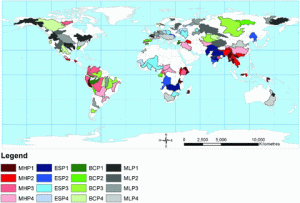
Gary Luck and colleagues’ paper Protecting ecosystem services and biodiversity in the world’s watersheds is a novel approach to an admittedly problematic aspect of conservation biology – global prioritisation schemes. While certainly coming in as a Conservation Classic, the first real global conservation prioritisation scheme (Myers and colleagues’ global biodiversity hotspots) was rather subjective in its approach, and many subsequent schemes have failed to reproduce the same kinds of priorities (the congruency problem). I’m certainly not knocking biodiversity hotspots because I believe it was one of the true paradigm shifts in conservation biology, but I am cognisant of its limitations.

Another big problem with conservation prioritisation schemes is that they are a hard sell to governments – how do you convince nations (especially poor ones) to forgo the immediate gains of resource exploitation to protect what many (incorrectly and short-sightedly) deem as irrelevant centres of biotic endemism?

Well, Luck and colleagues have taken us one step closer to global acceptance of conservation prioritisation schemes by basing this latest addition on ecosystem services. In their paper they divided the world by catchments (watersheds) and then estimated the services of water provision, flood prevention and carbon storage that each provides to humanity. Water provision was a estimated as a complex combination of variables that together can be interpreted as the capacity of ecosystems to regulate water flows and quality that benefit humans (e.g., influencing seasonal water availability or nutrient levels). Flood mitigation was estimated as the system’s capacity to reduce the impact of floods on communities, and carbon storage was estimated as the system’s capacity to uptake carbon in soils and vegetation.

In general, the catchments in need of the highest priority protection were found in the poorest areas (namely, South East Asia and Africa) because their protection would be the least costly and benefit the most people. Luck and colleagues are therefore the first to incorporate cost–benefit trade-offs explicitly in developing global priorities for protecting ecosystem services and biodiversity. I take my hat off to them for a modern and highly relevant twist on an old idea. Great paper and I hope people take notice.

CJA Bradshaw

Add to FacebookAdd to NewsvineAdd to DiggAdd to Del.icio.usAdd to StumbleuponAdd to RedditAdd to BlinklistAdd to Ma.gnoliaAdd to TechnoratiAdd to Furl


Out of touch, impractical and irrelevant

8 07 2009

argumentThe opening quote to this interesting little article says it all:

“We have all heard policy-makers in environment organisations accuse researchers as out of touch, impractical and irrelevant. We have all seen environment management agencies criticised by researchers in the media, in this journal, at conferences or in the tea room for ignoring, under-utilising or misrepresenting research findings when formulating or implementing policy.”

From the ‘researcher’ side, I can attest that I have on more than one occasion cursed the inability of policy makers (from high-level politicians down to municipal councillors) to implement sound, evidence-based advice on how to prevent (or at least minimise) environmental disasters (for a local example, see this post). I’m sure many policy makers think that (at least some) researchers are pie-in-the-sky, political naïfs that consistently fail to make their research relevant. I know that both extremes are unfortunate realities.

So when I saw Gibbons and colleagues’ paper Some practical suggestions for improving engagement between researchers and policy-makers in natural resource management, I was quite impressed with their excellent suggestions for bridging the gap.

It’s a short paper, but it recommends the following basic steps for improvement:

  1. Understand what motivates people on each side of the policy fence. For researchers, we are locked into a system that rewards success based on a some typically non-economic metrics, such as the quality and quantity of peer-reviewed articles we write, our academic reputation amongst our peers, the amount of external funding we can attract (generally linked to the publication criterion) and the number of students we supervise to research independence. Policy makers working within a more top-down environment are compelled to advance policies that reflect their government’s philosophy (which is dictated by their constituents), and often the deadlines are fierce.

  2. Build relationships. This goes without saying, but often doesn’t happen. Lack of trust can usually only be broken down if you respect and know your counterpart. Gibbons and company suggest that relationships can be built better through the regular dissemination of information back and forth, effective communication (clarity and brevity), and maintaining relationships after information exchange (keep in touch).

  3. Organise regular forums. These meetings are essential to build new and productive relationships. Ways to increase contact include: maintaining ‘who’s who’ lists, encouraging secondments (people exchanges), and organising annual science-policy colloquia.

  4. Explore alternate communication media. Face-to-face meetings are often difficult, so Gibbons et al. recommend that researchers attempt to disseminate their work regularly in other media, such as newsletters, broad-scope journals, journalistic magazines and blogs (this last suggestion is my own!). Governments can also make calls for research proposals in particular, policy-relevant areas, thus forcing alignment prior to research even getting off the ground.

Thanks for the advice.

CJA Bradshaw

Add to FacebookAdd to NewsvineAdd to DiggAdd to Del.icio.usAdd to StumbleuponAdd to RedditAdd to BlinklistAdd to Ma.gnoliaAdd to TechnoratiAdd to Furl


New Impact Factors for conservation journals

23 06 2009

For those of you who follow the ISI Impact Factors for journals (the ratio of the number of total citations i+3 for the papers published in years i and i+1 divided by the total number of citable papers published in years i and i+1), you might know that the 2008 IFs have just been published. Now, whether you put stock or not in these is somewhat irrelevant – enough people do to make it relevant to who publishes what where, and who cites or does not cite scientific papers. It’s also in our scientific culture – pretty much everyone in a field will have a rough idea of the range of IFs their specific discipline’s journals span, and so it acts as a kind of target for varying qualities of science. Far from perfect, but it’s what we have to deal with.

So, I thought I’d publish the 2008 Impact Factors for the journals listed on this site’s Journals page and compare them to the 2007 values:

and for some more general journals that occasionally publish conservation papers:

Almost across the board, conservation journals have seen an increase in their Impact Factors. There are many other good conservation papers published in other journals, but this list probably represents the main outlets. I hope we continue to focus more on conservation outcomes rather than scientific kudos per se, although I’m certainly cognisant of the hand that feeds. Good luck with your publishing.

CJA Bradshaw

Add to FacebookAdd to NewsvineAdd to DiggAdd to Del.icio.usAdd to StumbleuponAdd to RedditAdd to BlinklistAdd to Ma.gnoliaAdd to TechnoratiAdd to Furl


Conservation Letters starts to Twitter

21 06 2009

Conservation LettersConservation Letters has joined the Twitter-sphere.

Click here to follow.

Click on the Journals page of ConservationBytes.com to access specific issues.

CJA Bradshaw