Know thy threat

9 06 2011

Here’s another great guest post by Megan Evans of UQ – her previous post on resolving the environmentalist’s paradox was a real hit, so I hope you enjoy this one too.

The reasons for the decline of Australia’s unique biodiversity are many, and most are well known. Clearing of vegetation for urban and agricultural land uses, introduced species and changed fire patterns are regularly cited in State of the Environment reports, recovery plans and published studies as major threats to biodiversity. But, while these threats are widely acknowledged, little has been done to quantify them in terms of the proportion of species affected, or their spatial extent at a national, state or local scale. To understand why such information on threats may be useful, consider for instance how resources are allocated in public health care1.

Threat knowledge

Conditions such as cancer, heart disease and mental health are regarded as National Health Priority Areas in Australia, and have been given special attention when prioritising funds since the late 1980s. The burden of disease in these priority areas are quantified according to the incidence or prevalence of disease or condition, and its social and economic costs. Estimates of burden of disease and their geographic distribution (often according to local government areas) can assist in communicating broad trends in disease burden, but also in prioritising efforts to achieve the best outcomes for public health. An approach similar to that used in healthcare could help to identify priorities for biodiversity conservation – using information on the species which are impacted by key threats, the spatial distributions of species and threats, and the costs of implementing specific management actions to address these threats. Read the rest of this entry »


The evil sextet

18 05 2011

This post doubles as a Conservation Classic and a new take on an old concept. It’s new in the sense that it updates what we believe is an advance on a major milestone in conservation biology, even though some of the add-on concepts themselves have been around for a while.

First, the classic.

The ‘evil quartet’, or ‘four horsemen of the ecological apocalypse’, was probably the first treatment of extinction dynamics as a biological discipline in its own right. Jarod Diamond (1984) took a sweeping historical and contemporary view of extinction, then simplified the problem to four principal mechanisms:

  1. overhunting (or overexploitation),
  2. introduced species,
  3. habitat destruction and
  4. chains of linked extinctions (trophic cascades, or co-extinctions).

Far from a mere review or list of unrelated mechanisms, Diamond’s evil quartet crystallized conservation biologists’ thinking about key mechanisms and, more importantly, directed attention towards those factors likely to drive extinctions in the future. The unique combination of prehistorical through to modern examples gave conservation biologists a holistic view of extinction dynamics and helped spawn many of the papers described hereafter. Read the rest of this entry »


Species’ Ability to Forestall Extinction – AudioBoo

8 04 2011

Here’s a little interview I just did on the SAFE index with ABC AM:

Not a bad job, really.

And here’s another one from Radio New Zealand:

CJA Bradshaw


Classics: demography versus genetics

16 03 2011

Here’s another short, but sweet Conservation Classic highlighted in our upcoming book chapter (see previous entries on this book). Today’s entry comes from long-time quantitative ecology guru, Russ Lande, who is now based at the Silwood Park Campus (Imperial College London).

© IBL

In an influential review, Lande (1988) argued that

“…demography may usually be of more immediate importance than population genetics in determining the minimum viable size of wild populations”.

It was a well-reasoned case, and was widely interpreted to mean that demographic and ecological threats would provide the ‘killer blow’ to threatened species before genetic factors such as inbreeding and fitness effects of loss of genetic diversity had time to exert a major influence on small population dynamics.

Read the rest of this entry »


S.A.F.E. = Species Ability to Forestall Extinction

8 01 2011

Note: I’ve just rehashed this post (30/03/2011) because the paper is now available online (see comment stream). Stay tuned for the media release next week. – CJAB

I’ve been more or less underground for the last 3 weeks. It has been a wonderful break (mostly) from the normally hectic pace of academic life. Thanks for all those who remain despite the recent silence.

© Ezprezzo.com

But I’m back now with a post about a paper we’ve just had accepted in Frontiers in Ecology and Environment. In my opinion it’s a leap forward in how we measure relative threat risk among species, despite some criticism.

I’ve written in past posts about the ‘magic’ minimum number of individuals that should be in a population to reduce the chance of extinction from random events. The so-called ‘minimum viable population (MVP) size’ is basically the abundance of a (connected) population below which random events take over from factors causing sustained declines (Caughley’s distinction between the ‘declining’ and ‘small’ population paradigms).

Up until the last few years, the MVP size was considered to be a population- or species-specific value, and it required very detailed demographic, genetic and biogeographical data to estimate – not something that biologists tend to have at their fingertips for most high-risk species. However, several papers published by our group (Minimum viable population size and global extinction risk are unrelated, Minimum viable population size: a meta-analysis of 30 years of published estimates and Pragmatic population viability targets in a rapidly changing world) have shown that there is in fact little variation in this number among the best-studied species; both demographic and genetic data support a number of around 5000 to avoid crossing the deadly threshold.

Now the fourth paper in this series has just been accepted (sorry, no link yet, but I’ll let you all know as soon as it is available), and it was organised and led by Reuben Clements, and co-written by me, Barry Brook and Bill Laurance.

The idea is fairly simple and it somewhat amazes me that it hasn’t been implemented before. The SAFE (Species Ability to Forestall Extinction) index is simply the distance a population is (in terms of abundance) from its MVP. In the absence of a species-specific value, we used the 5000-individual threshold. Thus, Read the rest of this entry »


Want a cool conservation job in beautiful southern Australia?

14 12 2010

I was asked to post this cool-sounding job on ConservationBytes.com – relevant punters welcome to respond.

Australian Wildlife Conservancy (AWC) is a non‐profit organisation dedicated to the conservation of Australia’s threatened wildlife and their habitats. AWC now owns and manages more land than any other private conservation organisation in Australia ‐  21 properties, covering more than 2.6 million hectares ‐ protecting more than 1,200 fauna species through active land management informed by strategic scientific research.

AWC is seeking an experienced and committed ecologist who will be pivotal in the development and implementation of the conservation and science program throughout south‐eastern Australia. The position will be based at Scotia Wildlife Sanctuary (where on‐site accommodation will be provided), but will include work at other AWC sanctuaries, especially Kalamurina (Lake Eyre), Buckaringa (Flinders Ranges), Yookamurra (Riverlands), Dakalanta (Eyre Peninsula), Bowra (Mulga Lands) and North Head (Sydney) sanctuaries.

Scotia is a large property (65,000 ha) that lies on the NSW‐SA border between Wentworth and Broken Hill, and includes Australia’s largest area free of foxes, cats and rabbits (8,000 ha) and where seven regionally extinct species have been reintroduced (bilby, boodie, woylie, bridled nailtail wallaby, numbat, greater stick‐nest rat, mala and black‐eared miner). In addition, the property has outstanding conservation values because it protects habitats, in good condition, that have been extensively cleared in western NSW.

Read the rest of this entry »


Global erosion of ecosystem services

14 09 2010

A few months ago I was asked to give a lecture about erosion of ecosystem services to students in the University of Adelaide‘s Issues in Sustainable Environments unit. I gave that lecture last week and just uploaded a slidecast of the presentation (with audio) today.

I’ve reproduced the lecture here for your viewing pleasure. I hope you find the 45-minute presentation useful. Note that the first few minutes cover me referring to the Biodiversity film short that I posted not too long ago.

CJA Bradshaw


Student opportunities with Australian Wildlife Conservancy

8 09 2010

A colleague of mine, Dr. Matt Hayward of the Australian Wildlife Conservancy (AWC), asked me to circulate some Honours, MSc and PhD student project opportunities. I thought this would be best done by publishing the call as a blog post.

The AWC is a non-government, non-profit organisation dedicated to the conservation of Australia’s wildlife and their habitats. AWC’s south-east region has a team of 7 ecologists who work closely with the land managers to carry out AWC’s Conservation and Science Program. The Science Program includes strategic research designed to help us manage threatened species more effectively. Several of these research projects are suitable for Honours, Masters or PhD projects.

This prospectus provides an outline of the student projects that are currently on offer in the south-east region. The majority of the projects are based on one sanctuary, although some aspects of the research may be done on other AWC sanctuaries and/or government conservation areas.

AWC will partially support these projects with equipment, staff time and expertise, and accommodation. In some cases, AWC may also provide some vehicle use and office facilities onsite at The Scotia Field Research Centre. We anticipate these projects will be collaborative efforts with input from students, academics and AWC staff, with appropriate acknowledgement for all involved. These projects are offered on a first in, first approved basis and have been offered to multiple universities.

More details on the sanctuaries and AWC are available here. If you are keen do one of these projects, please contact Matt Hayward and we will then formulate a research proposal and research agreement. Eight project descriptions follow. Read the rest of this entry »


Webinar: Modelling water and life

27 08 2010

Another quick one today just to show the webinar of my recent 10-minute ‘Four in 40’ talk sponsored by The Environment Institute and the Department for Water. This seminar series was entitled ‘Modelling as a Tool for Decision Support’ held at the Auditorium, Royal Institution Australia (RiAus).

“Four in 40″ is a collaboration between The University of Adelaide and the Department for Water, where 4 speakers each speak for 10 minutes on their research and its implications for policy. The purpose is to build understanding of how best to work with each other, build new business for both organisations and raise awareness of activity being undertaken in water/natural resource management policy and research.

CJA Bradshaw


Who are the world’s biggest environmental reprobates?

5 05 2010

Everyone is a at least a little competitive, and when it comes to international relations, there could be no higher incentive for trying to do better than your neighbours than a bit of nationalism (just think of the Olympics).

We rank the world’s countries for pretty much everything, relative wealth, health, governance quality and even happiness. There are also many, many different types of ‘environmental’ indices ranking countries. Some attempt to get at that nebulous concept of ‘sustainability’, some incorporate human health indices, and other are just plain black box (see Böhringer et al. 2007 for a review).

With that in mind, we have just published a robust (i.e., to missing data, choices for thresholds, etc.), readily quantifiable (data available for most countries) and objective (no arbitrary weighting systems) index of a country’s relative environmental impact that focuses ONLY on environment (i.e., not human health or economic indicators) – something no other metric does. We also looked at indices relative to opportunity – that is, looking at how much each country has degraded relative to what it had to start with.

We used the following metrics to create a combined environmental impact rank: natural forest loss, habitat conversion, fisheries and other marine captures, fertiliser use, water pollution, carbon emissions from land-use change and threatened species.

The paper, entitled Evaluating the relative environmental impact of countries was just published in the open-access journal PLoS One with my colleagues Navjot Sodhi of the National University of Singapore (NUS) and Xingli Giam, formerly of NUS but now at Princeton University in the USA.

So who were the worst? Relative to resource availability (i.e,. how much forest area, coastline, water, arable land, species, etc. each country has), the proportional environmental impact ranked (from worst) the following ten countries:

  1. Singapore
  2. Korea
  3. Qatar
  4. Kuwait
  5. Japan
  6. Thailand
  7. Bahrain
  8. Malaysia
  9. Philippines
  10. Netherlands

When considering just the absolute impact (i.e., not controlling for resource availability), the worst ten were:

  1. Brazil
  2. USA
  3. China
  4. Indonesia
  5. Japan
  6. Mexico
  7. India
  8. Russia
  9. Australia
  10. Peru

Interestingly (and quite unexpectedly), the authors’ home countries (Singapore, Australia, USA) were in either the worst ten proportional or absolute ranks. Embarrassing, really (for a full list of all countries, see supporting information). Read the rest of this entry »


‘Amplify’ and ‘Lungs’ – William Laurance podcasts

1 04 2010

William Laurance has been here at the University of Adelaide for the past 4 days and has just left. He had a marathon talk-fest while here, and a very full social calendar. I bet he’s happy he’s back home so he can wind down a little.

Just a quick post to provide the links to the podcasts of his two public talks: “Amplify your Voice” and “Lungs of the Planet”, plus a radio interview he did yesterday on ABC.

The first public talk was split into two parts:

  1. How to be more prolific: strategies for writing and publishing scientific papers
  2. Further ways to maximise your scientific impact- interacting with the popular media and how to promote yourself

Part 1 MP3

Part 1 Slideshow

Part 2 MP3

Part 2 Slideshow

The other main talk ‘Lungs of our Planet’ was also in two bits (a more academically orientated one on Monday, and the public lecture on Wednesday):

  1. Emerging Challenges for Environmental Research in the Tropics
  2. Diagnosis critical – the lungs of the planet

Part 1 MP3

Part 1 Slideshow

Part 2 MP3

Part 2 Slideshow

And finally, the radio interview he did on ABC 891 Afternoons with Carole Whitelock (audio file courtesy of ABC 891, Afternoons with Carole Whitelock):

Enjoy!

CJA Bradshaw

Add to FacebookAdd to DiggAdd to Del.icio.usAdd to StumbleuponAdd to RedditAdd to BlinklistAdd to TwitterAdd to TechnoratiAdd to Yahoo BuzzAdd to Newsvine


The biodiversity extinction numbers game

4 01 2010

© Ferahgo the Assassin

Not an easy task, measuring extinction. For the most part, we must use techniques to estimate extinction rates because, well, it’s just bloody difficult to observe when (and where) the last few individuals in a population finally kark it. Even Fagan & Holmes’ exhaustive search of extinction time series only came up with 12 populations – not really a lot to go on. It’s also nearly impossible to observe species going extinct if they haven’t even been identified yet (and yes, probably still the majority of the world’s species – mainly small, microscopic or subsurface species – have yet to be identified).

So conservation biologists do other things to get a handle on the rates, relying mainly on the species-area relationship (SAR), projecting from threatened species lists, modelling co-extinctions (if a ‘host’ species goes extinct, then its obligate symbiont must also) or projecting declining species distributions from climate envelope models.

But of course, these are all estimates and difficult to validate. Enter a nice little review article recently published online in Biodiversity and Conservation by Nigel Stork entitled Re-assessing current extinction rates which looks at the state of the art and how the predictions mesh with the empirical data. Suffice it to say, there is a mismatch.

Stork writes that the ‘average’ estimate of losing about 100 species per day has hardly any empirical support (not surprising); only about 1200 extinctions have been recorded in the last 400 years. So why is this the case?

As mentioned above, it’s difficult to observe true extinction because of the sampling issue (the rarer the individuals, the more difficult it is to find them). He does cite some other problems too – the ‘living dead‘ concept where species linger on for decades, perhaps longer, even though their essential habitat has been destroyed, forest regrowth buffering some species that would have otherwise been predicted to go extinct under SAR models, and differing extinction proneness among species (I’ve blogged on this before).

Of course, we could just all be just a pack of doomsday wankers vainly predicting the end of the world ;-)

Well, I think not – if anything, Stork concludes that it’s all probably worse than we currently predict because of extinction synergies (see previous post about this concept) and the mounting impact of rapid global climate change. If anything, the “100 species/day” estimate could look like a utopian ideal in a few hundred years. I do disagree with Stork on one issue though – he claims that deforestation isn’t probably as bad as we make it out. I’d say the opposite (see here, here & here) – we know so little of how tropical forests in particular function that I dare say we’ve only just started measuring the tip of the iceberg.

CJA Bradshaw

Add to FacebookAdd to NewsvineAdd to DiggAdd to Del.icio.usAdd to StumbleuponAdd to RedditAdd to BlinklistAdd to Ma.gnoliaAdd to TechnoratiAdd to Furl

This post was chosen as an Editor's Selection for ResearchBlogging.org

ResearchBlogging.orgStork, N. (2009). Re-assessing current extinction rates Biodiversity and Conservation DOI: 10.1007/s10531-009-9761-9


Carbon = biodiversity

21 12 2009

I’ve decided to blog this a little earlier than I would usually simply because the COP15 is still fresh in everyone’s minds and the paper is now online as an ‘Accepted Article’, so it is fully citable.

The paper published in Conservation Letters by Strassburg and colleagues is entitled Global congruence of carbon storage and biodiversity in terrestrial ecosystems is noteworthy because it provides a very useful answer to a very basic question. If one were to protect natural habitats based on their carbon storage potential, would one also be protecting the most biodiversity (and of course, vice versa)?

Turns out, one would.

Using a global dataset of ~ 20,000 species of mammal, bird and amphibian, they compared three indices of biodiversity distribution (species richness, species threat & range-size rarity) to a new global above- and below-ground carbon biomass dataset. It turns out that at least for species richness, the correlations were fairly strong (0.8-ish, with some due to spatial autocorrelation); for threat and rarity indices, the correlations were rather weaker (~0.3-ish).

So what does this all mean for policy? Biodiversity hotspots – those areas around the globe with the highest biodiversity and greatest threats – have some of the greatest potential to store carbon as well as guard against massive extinctions if we prioritise them for conservation. Places such as the Amazon, Borneo Sumatra and New Guinea definitely fall within this category.

However, not all biodiversity hotspots are created equal; areas such as Brazil’s Cerrado or the savannas of the Rift Valley in East Africa have relatively lower carbon storage, and so carbon-trading schemes wouldn’t necessarily do much for biodiversity in these areas.

The overall upshot is that we should continue to pursue carbon-trading schemes such as REDD (Reduced Emissions from Deforestation and forest Degradation) because they will benefit biodiversity (contrary to what certain ‘green’ organisations say about it), but we can’t sit back and hope that REDD will solve all of biodiversity’s problems world wide.

CJAB

Add to FacebookAdd to NewsvineAdd to DiggAdd to Del.icio.usAdd to StumbleuponAdd to RedditAdd to BlinklistAdd to Ma.gnoliaAdd to TechnoratiAdd to Furl

ResearchBlogging.orgStrassburg, B., Kelly, A., Balmford, A., Davies, R., Gibbs, H., Lovett, A., Miles, L., Orme, C., Price, J., Turner, R., & Rodrigues, A. (2009). Global congruence of carbon storage and biodiversity in terrestrial ecosystems Conservation Letters DOI: 10.1111/j.1755-263X.2009.00092.x


Scoping the future threats and solutions to biodiversity conservation

4 12 2009

Way back in 1989, Jared Diamond defined the ‘evil quartet’ of habitat destruction, over-exploitation, introduced species and extinction cascades as the principal drivers of modern extinctions. I think we could easily update this to the ‘evil quintet’ that includes climate change, and I would even go so far as to add extinction synergies as a the sixth member of the ‘evil sextet’.

But the future could hold quite a few more latent threats to biodiversity, and a corresponding number of potential solutions to its degradation. That’s why Bill Sutherland of Cambridge University recently got together with some other well-known scientists and technology leaders to do a ‘horizon scanning’ exercise to define what these threats and solutions might be in the immediate future. It’s an interesting, eclectic and somewhat enigmatic list, so I thought I’d summarise it here. The paper is entitled A horizon scan of global conservation issues for 2010 and was recently published online in Trends in Ecology and Evolution.

In no particular order or relative rank, Sutherland and colleagues list the following 15 ‘issues’ that I’ve broadly divided into ‘Emerging Threats’ and ‘Potential Solutions’:

Emerging Threats

  1. Microplastic pollution – The massive increase in plastics found in the world’s waterways and oceans really doesn’t have much focus right now in conservation research, but it should. We really don’t know how much we’re potentially threatening species with this source of pollution.
  2. Nanosilver in wastewater – The ubiquity of antimicrobial silver oxide or ions in products these days needs careful consideration for what the waste might be doing to our microbial communities that keep ecosystems alive and functioning.
  3. Stratospheric aerosols – A simultaneous solution and threat. Creating what would in effect be an artificial global cooling by injecting particles like sulphate aerosols into the stratosphere might work to cool the planet down somewhat. However, it would not reduce carbon dioxide, ocean acidification or other greenhouse gas-related changes. This strikes me as a potential for serious mucking up of the global climate and only a band-aid solution to the real problem.
  4. Deoxygenation of the oceans – Very scary. Ironically today I was listening to a talk by Martin Kennedy on the deep-time past of ocean hypoxia and he suggests we’re well on our way to a situation where our shelf waters could essentially become too anoxic for marine life to persist. It’s happened before, and rapid climate change makes the prospect plausible within less than a century. And you thought acidification was scary.
  5. Changes in denitrifying bacteria – Just like we’re changing the carbon cycle, we’re buggering up the nitrogen cycle as well. Changing our water bodies to nitrogen sources rather than sinks could fundamentally change marine ecosystems for the worse.
  6. High-latitude volcanism – One of these horrible positive feedback ideas. Reducing high-latitude ice cover exposes all these slumbering volcanoes that once ‘released’, start increasing atmospheric gas concentrations and contributing to faster ice melt and sea level rise.
  7. Trans-Arctic dispersal and colonisation – Warming polar seas and less ice mean fewer barriers to species movements. Expect Arctic ecosystems to be a hotbed of invasion, regime shifts and community reshuffling as a result.
  8. Invasive Indo-Pacific lionfish – Not one I would have focussed on, but interesting. These spiny, venomous fish like to eat a lot of other species, and so represent a potentially important invasive species in the marine realm.
  9. REDD and non-forested ecosystems – Heralded as a great potential coup for forest preservation and climate change mitigation, focussing on maintaining forests for their carbon sequestration value might divert pressure toward non-forested habitats and ironically, threaten a whole new sphere of species.
  10. International land acquisition – Global financial crises and dwindling food supplies mean that governments are acquiring more and more huge tracts of land for agricultural development. While this might solve some immediate issues, it could potentially threaten a lot more undeveloped land in the long run, putting even more pressure on habitats.

Potential Solutions

  1. Synthetic meat – Ever thought about eating a sausage grown in a vat rather than cut from a dead pig? It could become the norm and a way of reducing the huge pressure on terrestrial and aquatic systems for the production of livestock and fish for human protein provision.
  2. Artificial life – Both a risk and a potential solution. While I’ve commented before on the pointlessness of cloning technology for conservation, the ability to create genomes and reinvigorate species on the brink is an exciting prospect. It’s also frightening as hell because we don’t know how all these custom-made genomes might react and transform naturally evolved ones.
  3. Biochar – Burn organic material (e.g., plant matter) in the absence of oxygen, you get biochar. This essentially sequesters a lot of carbon that can then be put underground. The upshot is that agricultural yields can also increase. Would there be a trade-off though between land available for biochar sequestration and natural habitats?
  4. Mobile-sensing technology – Not so much a solution per se, but the rapid acceleration of remote technology will make our ability to measure and predict the subtleties of ecosystem and climate change much more precise. A lot more work and application required here.
  5. Assisted colonisationI’ve blogged about this before. With such rapid shifts in climate, we might be obliged to move species around so that they can keep up with rapidly changing conditions. Many pros and cons here, not least of which is exacerbating the invasive species problems around the globe.

Certainly some interesting ideas here and worth a thought or two. I wonder if the discipline of ‘conservation biology’ might even exist in 50-100 years – we might all end up being climate or agricultural engineers with a focus on biodiversity-friendly technology. Who knows?

CJA Bradshaw

Add to FacebookAdd to NewsvineAdd to DiggAdd to Del.icio.usAdd to StumbleuponAdd to RedditAdd to BlinklistAdd to Ma.gnoliaAdd to TechnoratiAdd to Furl

ResearchBlogging.orgSutherland, W., Clout, M., Côté, I., Daszak, P., Depledge, M., Fellman, L., Fleishman, E., Garthwaite, R., Gibbons, D., & De Lurio, J. (2009). A horizon scan of global conservation issues for 2010 Trends in Ecology & Evolution DOI: 10.1016/j.tree.2009.10.003


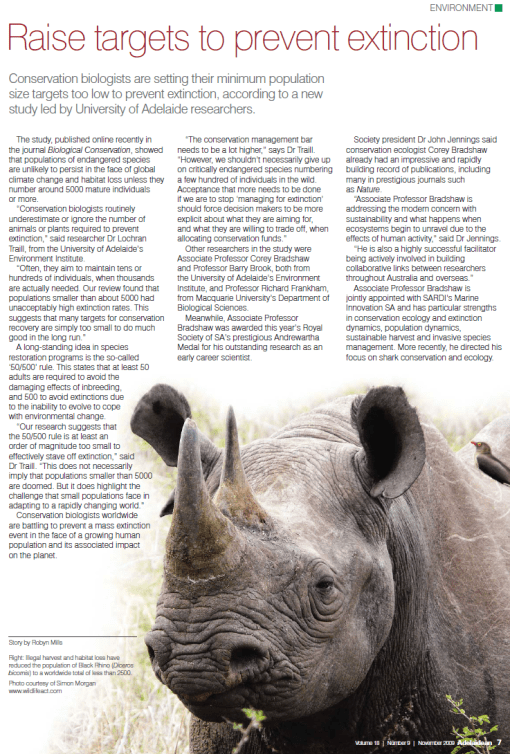
Raise targets to prevent extinction

12 11 2009

I know I’ve blogged recently about this, but The Adelaidean did a nice little article that I thought I’d reproduce here. The source can be found here.

Adelaidean story Nov 2009


Managing for extinction

9 10 2009

ladderAh, it doesn’t go away, does it? Or at least, we won’t let it.

That concept of ‘how many is enough?’ in conservation biology, the so-called ‘minimum viable population size‘, is enough to drive some conservation practitioners batty.

How many times have we heard the (para-) phrase: “It’s simply impractical to bring populations of critically endangered species up into the thousands”?

Well, my friends, if you’re not talking thousands, you’re wasting everyone’s time and money. You are essentially managing for extinction.

Our new paper out online in Biological Conservation entitled Pragmatic population viability targets in a rapidly changing world (Traill et al.) shows that populations of endangered species are unlikely to persist in the face of global climate change and habitat loss unless they number around 5000 mature individuals or more.

After several meta-analytic, time series-based and genetic estimates of the magic minimum number all agreeing, we can be fairly certain now that if a population is much less than several thousands (median = 5000), its likelihood of persisting in the long run in the face of normal random variation is pretty small.

We conclude essentially that many conservation biologists routinely underestimate or ignore the number of animals or plants required to prevent extinction. In fact, aims to maintain tens or hundreds of individuals, when thousands are actually needed, are simply wasting precious and finite conservation resources. Thus, if it is deemed unrealistic to attain such numbers, we essentially advise that in most cases conservation triage should be invoked and the species in question be abandoned for better prospects

A long-standing idea in species restoration programs is the so-called ‘50/500’ rule; this states that at least 50 adults are required to avoid the damaging effects of inbreeding, and 500 to avoid extinctions due to the inability to evolve to cope with environmental change. Our research suggests that the 50/500 rule is at least an order of magnitude too small to stave off extinction.

This does not necessarily imply that populations smaller than 5000 are doomed. But it does highlight the challenge that small populations face in adapting to a rapidly changing world.

We are battling to prevent a mass extinction event in the face of a growing human population and its associated impact on the planet, but the bar needs to be a lot higher. However, we shouldn’t necessarily give up on critically endangered species numbering a few hundred of individuals in the wild. Acceptance that more needs to be done if we are to stop ‘managing for extinction’ should force decision makers to be more explicit about what they are aiming for, and what they are willing to trade off, when allocating conservation funds.

CJA Bradshaw

(with thanks to Lochran Traill, Barry Brook and Dick Frankham)

Add to FacebookAdd to NewsvineAdd to DiggAdd to Del.icio.usAdd to StumbleuponAdd to RedditAdd to BlinklistAdd to Ma.gnoliaAdd to TechnoratiAdd to Furl

This post was chosen as an Editor's Selection for ResearchBlogging.orgResearchBlogging.org

Traill, L.W., Brook, B.W., Frankham, R.R., & Bradshaw, C.J.A. (2009). Pragmatic population viability targets in a rapidly changing world Biological Conservation DOI: 10.1016/j.biocon.2009.09.001


What is a species?

18 09 2009

In a bid to save some time given looming grant application deadlines and overdue paper revisions, I’ve opted to reproduce a nice little discussion about how we define ‘species’ in a biodiversity sense. This is a great little synopsis of the species concept by Professor Colin Groves of the Australian National University that aired on ABC Radio National‘s Ockham’s Razor show hosted by Robyn Williams. This is an important discussion because it really dictates how we measure biodiversity, and more importantly, how we should seek to restore it when ‘degraded’. The full transcript can be viewed here, and you can listen here. Below I reproduce the relevant bits of the essay.
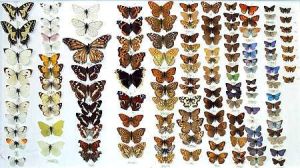
butterfliesSpecies, in the words of the great evolutionary biologist George Gaylord Simpson, are lineages evolving separately from others, each with its own unitary evolutionary role and tendencies. They are the units of biodiversity. Everybody uses the term, with greater or lesser degrees of precision, but even biologists, I regret to say, often use it without actually defining what they mean.

It was the great zoologist Ernst Mayr who in 1940 offered the best known definition: ‘A species is a group of actually or potentially interbreeding natural populations which is reproductively isolated from other such groups’. He called this the Biological Species Concept.

This definition of species, still widely accepted, has frequently been misinterpreted as meaning that ‘different species cannot interbreed’. It does not say this. In the first place, it refers to species as ‘natural populations’. It is referring to what happens in a state of nature, not what happens in zoos or in domestic animals. For example, lions and leopards, which although closely related are usually recognised as different species, live in the same habitats in Africa and India and, as far as I know, no authenticated hybrids are known from the wild. But in zoos, hybrids have been bred successfully.

Then there is the question of what exactly ‘reproductive isolation’ consists of. Mayr said that the mechanisms of reproductive isolation may be either pre-mating (where members of different species do not normally regard each other as potential mates) or post-mating (where they do mate, but the hybrids do not survive, or are sterile). In the case of lions and leopards, evidently the reproductive isolating mechanisms are pre-mating, because normally they do not regard each other as potential mates, but these can break down if a male of one species and a female of the other are caged together, a case of making the best of a bad job, if you like. Their post-mating reproductive isolation, however, is incomplete: male lion-leopard hybrids are thought to be sterile, but the females are fertile.

So far so good. According to the Biological Species Concept, different species are defined by not usually forming hybrids with each other, for whatever reason, under natural conditions. But it is not so simple.

Consider leopards, again. They live not only in Africa and India, but also on the island of Sri Lanka, and throughout Southeast Asia, including the island of Java. The leopards of Sri Lanka and Java obviously do not interbreed with those of the mainland, because they are separated by water barriers. According to Ernst Mayr’s definition, species are ‘actually or potentially interbreeding natural populations’, and presumably island leopards are to be regarded as ‘potentially interbreeding’ with mainland ones. But how do we know? How could we possibly know?
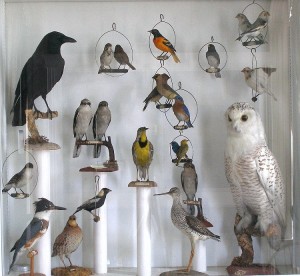
birds

© J. Dougherty

The closest relative of the lion and the leopard is the jaguar, which lives in South and Central America, and likewise doesn’t have the chance to interbreed with leopards (or with lions, for that matter), so again, the ‘potentially interbreeding’ criterion breaks down. I would ask, and it is legitimate to ask, why is the jaguar classified as a species separate from the African and mainland-Asian leopard, whereas the Sri Lankan and Javanese leopards are not?

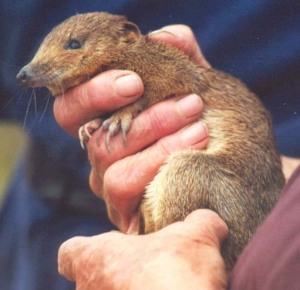
In my opinion, ‘potentially interbreeding’, is, really, a phantom concept. The Biological Species Concept offers no guidance at all for deciding whether populations living in different areas are distinct species or not. As one example from my own experience, mammal specialists have had heated discussions over whether the American bison and the European bison are or are not different species, a particularly pointless exercise if one accepts the Biological Species Concept. It was as early as the 1960s that a few taxonomists began to worry about this, because they were starting to realise that there were quite a lot of cases where they really needed to know. Gilbert’s potoroo, from the south-west of Western Australia, is it, or is it not, a different species from the Long-nosed potoroo, from south-eastern Australia? This may sound like a piece of pedantry, but it is in fact not a trivial decision, because Gilbert’s potoroo is critically endangered, and if it is not really a distinct species then it is less of a worry.

It was a group working in the American Museum of Natural History, known as the New York Group and already getting a reputation for asking awkward questions, that was pushing most strongly for a resolution, and in 1983, one of them, the ornithologist Joel Cracraft, proposed to replace the Biological Species Concept altogether and define a species ‘The smallest cluster of individual organisms within which there is a parental pattern of ancestry and descent, and that is diagnosably distinct from other such clusters by a unique combination of fixed character states’. What this means is that a species is a population or group of populations (this is the ‘parental pattern of ancestry and descent’ bit) which can be distinguished 100% from any other (this is the ‘diagnosably distinct’ bit). This concept of species is called the Phylogenetic Species Concept.

Many biologists, myself included, I’m afraid, started off by disliking the Phylogenetic Species Concept, and hoped it would die a natural death. But it did not; in fact it spread because many biologists, including taxonomists, and at long last I too, realised that it provides an objective criterion, diagnosability, for all cases, which the old Biological Species Concept does not. It tells us, for example, that Sri Lankan and Javanese leopards are not distinct species, because they cannot be 100% distinguished from the leopards of the mainland, whereas the jaguar is a distinct species because it is 100% distinct from its relatives.

© P. Mays

© P. Mays

Much taxonomy today depends on molecular genetics, DNA sequencing. At present, many molecular geneticists tend to distinguish species rather subjectively, if they differ ‘enough’, though what is meant by ‘enough difference’ varies from one study to another. The Phylogenetic Species Concept is of course excellently suited to DNA sequencing, and many species have been recognised by having consistent differences in DNA sequences (the diagnosability criterion).

The molecular revolution has also taught us something important about species, that they do in fact interbreed under natural conditions, to a much greater extent than we had thought. We know this, because there is a form of DNA, mitochondrial DNA, that is inherited not from both parents, but from the mother alone; it is passed solely down the female line (with apparently few exceptions). And we now know quite a number of cases where a population of one species has the mitochondrial DNA of a different, related species.

Here is a nice example. The common deer species of the eastern United States is the white-tailed deer. In the west, it is replaced by the mule deer, and in the middle they live side-by-side in the same habitats. On a large ranch in West Texas, there are herds of both species, and they have the same mitochondrial DNA! There has been some dispute in the past over whose mitochondrial DNA it actually is, but it now appears that it is that of the mule deer. We imagine that, at some time in the past, some white-tailed bucks, unable to find does of their own species, ‘made the best of a bad job’ and drove off some mule deer bucks and mated with mule deer does. Hybrids were born, and in the next generation more white-tail bucks came over and mated with them. The hybrids are now three-quarters white-tail, and one-quarter mule deer, but of course they still had the mitochondrial DNA of their mule deer grandmothers. In a few more generations, they would come to totally resemble white-tailed deer, the only legacy of their original maternal heritage being their mitochondrial DNA.


Can we solve Australia’s mammal extinction crisis?

3 09 2009

© F. O'Connor

© F. O'Connor

This ‘In DepthScience Opinion piece from the ABC couldn’t have come at a better time. Written by Ian Gordon of the CSIRO, this opinion piece was written off the back of the special session on mammalian extinctions held at the recent International Congress of Ecology in Brisbane. Three previous ConservationBytes.com blogs in August (here, here and here) were devoted to specific talks at the Congress, including one about John Woinarksi’s gloomy tale of dwindling mammal populations in the Top End (which is especially frightening considering its also going on in our so-called ‘protected’ areas such as Kakadu, Litchfield and Garig Gunak Barlu National Parks!).

So, I recommend you have a read of my blog post on the shocking continued loss of Australian mammals, then read Ian’s piece copied below. Bottom lines – stop burning the shit out of our forests and encourage dingo population recovery and expansion.

Australia leads the world in mammal extinctions.

Over the last two hundred years 22 mammal species have become extinct, and over 100 are now on the threatened and endangered species list, compiled as part of the federal government’s Environment Protection and Biodiversity Conservation Act.

Evidence suggests Australia is on the cusp of another wave of mammal extinctions with a reduction in the abundance of some species and alarmingly, their range.

This is undoubtedly one of the major biodiversity conservation issues affecting Australia. It’s crucial we focus on the management solutions required to stop these species falling into extinction.

A South American success story

Working as a zoologist has allowed me to be involved in projects across the globe, looking at species at risk of extinction due to over-exploitation by humans.

Earlier this year I edited a book on the South American vicuña‘s comeback from the brink of extinction. Once abundant in the Andes, this wild relative of the llama suffered a sharp population drop in the 1960s due to international demand for its fleece.

An international moratorium on the sale of vicuña fleece in 1969 saw populations recover enough by 1987 for Andean communities to be able to harvest the fibre in a sustainable way. Population numbers of vicuña have remained healthy ever since, making it one of the few success stories of wildlife conservation worldwide.

Australia’s mammal extinction crisis

However Australia’s medium-sized mammals have had to deal with a different range of issues to the vicuña: the introduction of feral animals, particularly cats and foxes; increased grazing pressure; altered fire regimes; the clearing of habitat for development and production; and now, the effects of climate change.

It isn’t that any of these pressures are particularly important by themselves, but the fact that many of them act in concert has had a significant impact on causing the crashes in population numbers, and increasing the risk of species becoming extinct.

For example, the crescent nailtail wallaby was once an abundant and widespread macropod of central and western Australia. The pressures of feral cats and foxes coupled with clearing for agriculture and grazing, and altered fire regimes pushed this little species over the edge and it is now classified as extinct.

The problem is also more far-reaching than we first assumed. Many people may think that animals are becoming extinct in the south of Australia where habitat destruction is quite evident.

But the populations of iconic species in the north of Australia such as the northern quoll, golden bandicoot and the Carpentarian rock-rat are also collapsing. In our lifetime populations of some species have greatly reduced in number, and others have completely disappeared in landscapes that are considered to be in excellent condition.

The golden bandicoot, listed as a vulnerable species, used to be found across much of the north of Australia. It is now only found in very small populations in the Northern Territory and on the isolated Burrow Island off the coast of Western Australia.

Time to bring back the dingo?

Further research on the impacts of fire, grazing, invasive species and climate change on Australian mammals would be extremely valuable, but ecologists recognise that crucial management decisions need to be made now.

We’ve found ourselves in a position where we have identified the threats to Australian mammal species and documented the loss of these species, the role of science must turn more directly to identifying the opportunities for assisting the survival of these mammals.

In August I chaired a panel with Professor Chris Johnson from James Cook University at the International Congress of Ecology, to discuss what management could be put in place now to help beleaguered populations of small mammals recover.

Johnson’s main focus is to bring back the top-order predator.

He believes there is now good evidence that a stable population of dingoes suppresses the numbers and activity of foxes and cats, and some other feral animal species as well.

He argues that the effect of using a top predator like the dingo to hold down populations of foxes and cats is that the total intensity of predation on smaller native mammals can be reduced.

Bringing back the dingo has many sheep and cattle farmers raising their eyebrows because the wild dogs are known to kill stock. But guardian sheepdogs can protect stock herds by fighting off dingoes if they come too close. This still allows the dingoes to have a beneficial effect in the ecosystem.

Current trials of Maremma dogs, a type of sheepdog, at Dunluce sheep station in northwest Queensland demonstrate that they can be effective dingo deterrents in a pastoral zone.

This is just one potential solution that may work in some areas. Reinstating mosaic fire regimes, where patches of land are burnt at different times to allow the land to recover in stages, and controlling grazing around sensitive habitat of endangered mammals are other potential solutions that are currently under trial in various parts of the country.

Working together

Even though science doesn’t have all the answers I believe that it is more important than ever for land managers and scientists to work together to put new management regimes on the ground.

Our scientific knowledge can provide guidelines for land managers to reduce the pressures on our biodiversity. Through monitoring how species and ecosystems respond to on-ground management we can then learn and adapt our advice to meet future challenges facing Australia’s threatened species.

We need to act now: the international community is watching Australia and we have an opportunity to show how we can apply science through collaborative agreements with land managers to reduce the threats and protect endangered species.

We’ll then be able to add Australian animals to the short list of species, like the vicuña, that have been brought back from the brink of extinction.

CJA Bradshaw

Add to FacebookAdd to NewsvineAdd to DiggAdd to Del.icio.usAdd to StumbleuponAdd to RedditAdd to BlinklistAdd to Ma.gnoliaAdd to TechnoratiAdd to Furl


Few people, many threats – Australia’s biodiversity shame

31 07 2009

bridled_nailtail_400I bang on a bit about human over-population and how it drives biodiversity extinctions. Yet, it isn’t always hordes of hungry humans descending on the hapless species of this planet  – Australia is a big place, but has few people (just over 20 million), yet it has one of the higher extinction rates in the world. Yes, most of the country is covered in some fairly hard-core desert and most people live in or near the areas containing the most species, but we have an appalling extinction record all the same.

A paper that came out recently in Conservation Biology and was covered a little in the media last week gives some telling figures for the Oceania region, and more importantly, explains that we have more than enough information now to implement sound, evidence-based policy to right the wrongs of the past and the present. Using IUCN Red List data, Michael Kingsford and colleagues (paper entitled Major conservation policy issues for biodiversity in Oceania), showed that of the 370 assessed species in Australia, 80 % of the threatened ones are listed because of habitat loss, 40 % from invasive species and 30 % from pollution. As we know well, it’s mainly habitat loss we have to control if we want to change things around for the better (see previous relevant posts here, here & here).

Kingsford and colleagues proceed to give a good set of policy recommendations for each of the drivers identified:

Habitat loss and degradation

  • Implement legislation, education, and community outreach to stop or reduce land clearing, mining, and unsustainable logging through education, incentives, and compensation for landowners that will encourage private conservation
  • Establish new protected areas for habitats that are absent or poorly represented
  • In threatened ecosystems (e.g., wetlands), establish large-scale restoration projects with local communities that incorporate conservation and connectivity
  • Establish transparent and evidence-based state of environment reporting on biodiversity and manage threats within and outside protected areas.
  • Protect free-flowing river systems (largely unregulated by dams, levees, and diversions) within the framework of the entire river basin and increase environmental flows on regulated rivers

Invasive species

  • Avoid deliberate introduction of exotic species, unless suitable analyses of benefits outweigh risk-weighted costs
  • Implement control of invasive species by assessing effectiveness of control programs and determining invasion potential
  • Establish regulations and enforcement for exchange or treatment of ocean ballast and regularly implement antifouling procedures

Climate change

  • Reduce global greenhouse gas emissions
  • Identify, assess, and protect important climate refugia
  • Ameliorate the impacts of climate change through strategic management of other threatening processes
  • Develop strategic plans for priority translocations and implement when needed

Overexploitation

  • Implement restrictions on harvest of overexploited species to maintain sustainability
  • Implement an ecosystem-based approach for fisheries, based on scientific data, that includes zoning the ocean; banning destructive fishing; adopting precautionary fishing principles that include size limits, quotas, and regulation with sufficient resources based on scientific assessments of stocks and; reducing bycatch through regulation and education
  • Implement international mechanisms to increase sustainability of fisheries by supporting international treaties for fisheries protection in the high seas; avoiding perverse subsidies and improve labelling of sustainable fisheries; and licensing exports of aquarium fish
  • Control unsustainable illegal logging and wildlife harvesting through local incentives and cessation of international trade

Pollution

  • Decrease pollution through incentives and education; reduce and improve treatment of domestic, industrial, and agriculture waste; and rehabilitate polluted areas
  • Strengthen government regulations to stop generation of toxic material from mining efforts that affects freshwater and marine environments
  • Establish legislation and regulations and financial bonds (international) to reinforce polluter-pays principles
  • Establish regulations, education programs, clean ups, labelling, and use of biodegradable packaging to reduce discarded fishing gear and plastics

Disease

  • Establish early-detection programs for pathological diseases and biosecurity controls to reduce translocation
  • Identify causes, risk-assessment methods, and preventative methods for diseases
  • Establish remote communities of organisms (captive) not exposed to disease in severe outbreaks

Implementation

  • Establish regional population policies based on ecologically sustainable human population levels and consumption
  • Ensure that all developments affecting the environment are adequately analysed for impacts over the long term
  • Promote economic and societal benefits from conservation through education
  • Determine biodiversity status and trends with indicators that diagnose and manage declines
  • Invest in taxonomic understanding and provision of resources (scientific and conservation) to increase capacity for conservation
  • Increase the capacity of government conservation agencies
  • Focus efforts of nongovernmental organisations on small island states on building indigenous capacity for conservation
  • Base conservation on risk assessment and decision support
  • Establish the effectiveness of conservation instruments (national and international) and their implementation

A very good set of recommendations that I hope we can continue to develop within our governments.

CJA Bradshaw

Add to FacebookAdd to NewsvineAdd to DiggAdd to Del.icio.usAdd to StumbleuponAdd to RedditAdd to BlinklistAdd to Ma.gnoliaAdd to TechnoratiAdd to Furl


Hot inbreeding

22 07 2009
inbreeding

© R. Ballen

Sounds really disgusting a little rude, doesn’t it? Well, if you think losing species because of successive bottlenecks from harvesting, habitat loss and genetic deterioration is rude, then the title of this post is appropriate.

I’m highlighting today a paper recently published in Conservation Biology by Kristensen and colleagues entitled Linking inbreeding effects in captive populations with fitness in the wild: release of replicated Drosophila melanogaster lines under different temperatures.

The debate has been around for years – do inbred populations have lower fitness (e.g., reproductive success, survival, dispersal, etc.) than their ‘outbred’ counterparts? Is one of the reasons small populations (below their minimum viable population size) have a high risk of extinction because genetic deterioration erodes fitness?

While there are many species that seem to defy this assumption, the increasing prevalence of Allee effects, and the demonstration that threatened species have lower genetic diversity than non-threatened species, all seem to support the idea. Kristensen & colleagues’ paper uses that cornerstone of genetic guinea pigs, the Drosophila fruit fly, not only to demonstrate inbreeding depression in the lab, but also the subsequent fate of inbred individuals released into the wild.

What they found was quite amazing. Released inbred flies only did poorly (i.e., weren’t caught as frequently meaning that they probably were less successful in finding food and perished) relative to outbred flies when the temperature was warm (daytime). Cold (i.e., night) releases failed to show any difference between inbred and outbred flies.

Basically this means that the environment interacts strongly with the genetic code that signals for particularly performances. When the going is tough (and if you’re an ectothermic fly, extreme heat can be the killer), then genetically compromised individuals do badly. Another reasons to be worried about runaway global climate warming.

Another important point was that the indices of performance didn’t translate universally to the field conditions, so lab-only results might very well give us some incorrect predictions of animal performance when populations reach small sizes and become inbred.

CJA Bradshaw