The third set of six biodiversity cartoons for 2019. See full stock of previous ‘Cartoon guide to biodiversity loss’ compendia here.
—
The third set of six biodiversity cartoons for 2019. See full stock of previous ‘Cartoon guide to biodiversity loss’ compendia here.
—
The second set of six biodiversity cartoons for 2019. See full stock of previous ‘Cartoon guide to biodiversity loss’ compendia here.
—
The island of Mauritius is known, particularly in conservation circles, for the ill-fated extinction of the dodo, but also for its many conservation success stories. These include the recovery of emblematic birds such as the Mauritius kestrel (Falco punctatus) and the pink pigeon (Nesoenas mayeri) that narrowly avoided extinction several decades ago.

Behind this veil of achievements, however, local political realities are increasingly making the protection and management of Mauritian biodiversity more complex and challenging as new conservation issues emerge.
In the midst of the third government-led mass cull of the Endangered Mauritian flying fox (Pteropus niger) in 2018, a paper published in the Journal for Nature Conservation shed light on the events that led to the government’s choice to do the first two mass culls of the Mauritian flying fox in 2015 and 2016. Documentation of human-wildlife conflict in Mauritius is relatively new, as noted by the authors, but provides a unique case study.
Given that the mass-culling opted for did not increase fruit growers’ profits (in fact, fruit production dropped substantially after the mass-culls) and that the flying fox, a keystone species for the native biodiversity, became more threatened with extinction following the mass culls, it appears that Mauritius provides a rare opportunity to study what precisely should be avoided when trying to resolve such a HWC [Human-wildlife conflict],
Florens & Bader (2019)
Indeed, to mitigate rising conflicts between fruit farmers and the Mauritian flying fox, the Mauritian government opted in 2006 to cull this threatened species (only six individuals were culled at the time). Despite disputes over the population size of the Mauritian flying fox and the extent of damage it caused to commercial fruit growers, as well as scientific arguments against the cull, culling continues to be the preferred approach.
This focus on culling as a solution contributed to a legal amendment in October 2015 that now facilitates the population control of any species of wildlife, irrespective of its origin and its conservation status. The Native Terrestrial Biodiversity and National Parks Bill was passed on 20 October 2015, just two weeks after the government announced its plan to cull 18,000 threatened native bats.
Read the rest of this entry »Climate change is one ingredient of a cocktail of factors driving the ongoing destruction of pristine forests on Earth. We here highlight the main physiological challenges trees must face to deal with increasing drought and heat.

A common scene when we return from a long trip overseas is to find our indoor plants wilting if no one has watered them in our absence. But … what does a thirsty plant experience internally?
Like animals, plants have their own circulatory system and a kind of plant blood known as sap. Unlike the phloem (peripheral tissue underneath the bark of trunks and branches, and made up of arteries layered by live cells that transport sap laden with the products of photosynthesis, along with hormones and minerals — see videos here and here), the xylem is a network of conduits flanked by dead cells that transport water from the roots to the leaves through the core of the trunk of a tree (see animation here). They are like the pipes of a building within which small pressure differences make water move from a collective reservoir to every neighbours’ kitchen tap.
Water relations in tree physiology have been subject to a wealth of research in the last half a decade due to the ongoing die-off of trees in all continents in response to episodes of drought associated with temperature extremes, which are gradually becoming more frequent and lasting longer at a planetary scale (1).
During a hot drought, trees must cope with a sequence of two major physiological challenges (2, 3, 4). More heat and less internal water increase sap tension within the xylem and force trees to close their stomata (5). Stomata are small holes scattered over the green parts of a plant through which gas and water exchanges take place. Closing stomata means that a tree is able to reduce water losses by transpiration by two to three orders of magnitude. However, this happens at the expense of halting photosynthesis, because the main photosynthetic substrate, carbon dioxide (CO2), uses the same path as water vapour to enter and leave the tissues of a tree.
If drought and heat persist, sap tension reaches a threshold leading to cavitation or formation of air bubbles (6). Those bubbles block the conduits of the xylem such that a severe cavitation will ultimately cause overall hydraulic failure. Under those conditions, the sap does not flow, many parts of the tree dry out gradually, structural tissues loose turgor and functionality, and their cells end up dying. Thus, the aerial photographs showing a leafy blanket of forest canopies profusely coloured with greys and yellows are in fact capturing a Dantesque situation: trees in photosynthetic arrest suffering from embolism (the plant counterpart of a blood clot leading to brain, heart or pulmonary infarction), which affects the peripheral parts of the trees in the first place (forest dieback).
Read the rest of this entry »The first set of six biodiversity cartoons for 2019 to usher in the New Year. See full stock of previous ‘Cartoon guide to biodiversity loss’ compendia here.
—
Adrenaline makes experiences hyper-real. Everything seems to move in slow motion, apart from my heart, which is so loud that I am sure people can hear it even over the traffic.
It’s 11:03 on a sunny November morning in central London. As the green man starts to shine, I walk into the middle of the road and sit down. On either side of me, people do the same. There can only be about 50 of us sitting on this pedestrian crossing, and I murmur ‘are we enough?’
‘Look behind you,’ says a new friend.
I turn. Blackfriar’s Bridge, usually covered in cars and buses, is filling with people. Citizens walking into the road and staying there, unfurling colourful flags with hourglass symbols on them. The police film us, standing close, but make no move to arrest anyone. Later, we discover that at least some of them encourage our disobedience.
Messages start coming in — 6,000 people are here, and we’ve blocked five bridges in central London with Extinction Rebellion, protesting for action to stop climate change and species extinctions. I’m a scientist participating in my first ever civil disobedience, and for me, this changes everything.

Left to right: protestors include kids, company directors, and extinct species.
What makes a Cambridge academic — and thousands of other people — decide that sitting in a road is their best chance of being heard? In short, nothing else has got us the emissions cuts we need. The declaration that global warming is real and that greenhouse-gas emissions need to be cut came in 1988, when I was a year old. Since then, scientists have continued to be honest brokers, monitoring greenhouse gases, running models, presenting the facts to governments and to the people. And emissions have continued to climb. The 2018 IPCC report that shocked many of us into action told us we have 12 years to almost halve emissions, or face conditions incompatible with civilisation. How did we end up here? Read the rest of this entry »
 Just under two weeks ago, Giovanni Strona and I published a paper in Scientific Reports on measuring the co-extinction effect from climate change. What we found even made me — an acknowledged pessimist — stumble in shock and incredulity.
But a bit of back story is necessary before I launch into describing what we discovered.
Last year, some Oxbridge astrophysicists (David Sloan and colleagues) published a rather sensational paper in Scientific Reports claiming that life on Earth would likely survive in the face of cataclysmic astrophysical events, such as asteroid impacts, supernovae, or gamma-ray bursts. This rather extraordinary conclusion was based primarily on the remarkable physiological adaptations and tolerances to extreme conditions displayed by tardigrades1 — those gloriously cute, but tiny (most are around 0.5 mm long as adults) ‘water bears’ or ‘moss piglets’ — could you get any cuter names?
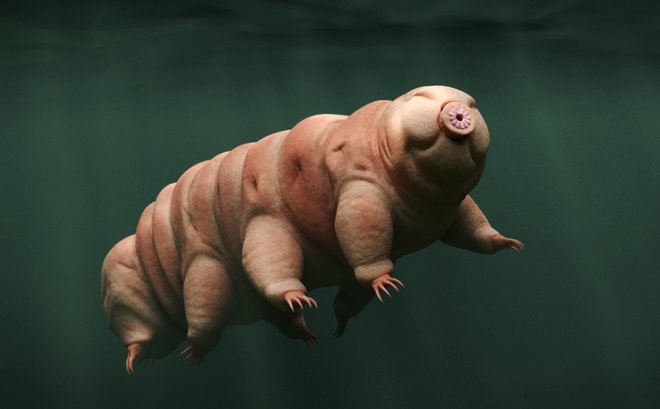
Found almost everywhere and always (the first fossils of them date back to the early Cambrian over half a billion years ago), these wonderful little creatures are some of the toughest metazoans (multicellular animals) on the planet. Only a few types of extremophile bacteria are tougher.
So, boil, fry or freeze the Earth, and you’ll still have tardigrades around, concluded Sloan and colleagues.
When Giovanni first read this, and then passed the paper along to me for comment, our knee-jerk reaction as ecologists was a resounding ‘bullshit!’. Even neophyte ecologists know intuitively that because species are all interconnected in vast networks linked by trophic (who eats whom), competitive, and other ecological functions (known collectively as ‘multiplex networks’), they cannot be singled out using mere thermal tolerances to predict the probability of annihilation. Read the rest of this entry »
 I’m excited to announce the upcoming public lecture by world-renowned sustainability scientist, Professor Andrew Balmford, at Flinders University on 17 July 2018.
Andrew is Professor of Conservation Science and a Royal Society Wolfson Research Merit Award holder at the Department of Zoology, University of Cambridge, and is on sabbatical at University of Tasmania until December 2018. His main research interests are exploring how conservation might best be reconciled with land-demanding activities such as farming, quantifying the costs and benefits of effective conservation, and examining what works in conservation. In his book Wild Hope (Chicago University Press), he argues that cautious optimism is essential in tackling environmental challenges. Andrew helped establish the Student Conference on Conservation Science, and Earth Optimism.
 Professor Balmford will be presenting his seminar “How to feed the world without costing the Earth” (hosted by the Ecology & Evolution Research Group) at the Bedford Park Campus of Flinders University in South Lecture Theatre 1, from 12:00-13:00 on 17 July 2018. All are welcome.
Abstract: Globally, agriculture is the greatest threat to biodiversity and a major contributor to anthropogenic greenhouse gas emissions. How we choose to deal with rising human food demand will to a large degree determine the state of biodiversity and the wider environment in the 21st century. Read the rest of this entry »

© Reuters/Thomas Mukoya
I published this last week on The Conversation, and now reproducing it here for CB.com readers.
—
Two days ago, the last male northern white rhino (Ceratotherium simum cottoni) died. His passing leaves two surviving members of his subspecies: both females who are unable to bear calves.
Even though it might not be quite the end of the northern white rhino because of the possibility of implanting frozen embryos in their southern cousins (C. simum simum), in practical terms, it nevertheless represents the end of a long decline for the subspecies. It also raises the question: how many individuals does a species need to persist?
Fiction writers have enthusiastically embraced this question, most often in the post-apocalypse genre. It’s a notion with a long past; the Adam and Eve myth is of course based on a single breeding pair populating the entire world, as is the case described in the Ragnarok, the final battle of the gods in Norse mythology.
This idea dovetails neatly with the image of Noah’s animals marching “two by two” into the Ark. But the science of “minimum viable populations” tells us a different story.
The global gold standard used to assess the extinction risk of any species is the International Union for the Conservation of Nature (IUCN) Red List of Threatened Species. Read the rest of this entry »
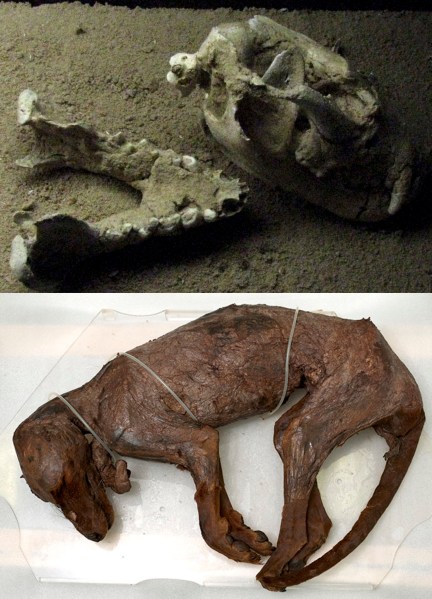 We’ve just published an analysis of new radiocarbon dates showing that thylacines (Tasmanian ‘tigers’, Thylacinus cynocephalus) and Tasmanian devils (Sarcophilus harrisi) went extinct on the Australian mainland at the same time — some 3200 years ago.
For many years, we’ve been uncertain about when thylacines and devils went extinct in mainland Australia (of course, devils are still in Tasmania, and thylacines went extinct there in the 1930s) — a recent age for the devil extinction (500 years before present) has recently been shown to be unreliable. The next youngest reliable devil fossil is 25000 years old.
So, knowing when both species went extinct is essential to be able to determine the drivers of these extinctions, and why they survived in Tasmania. If the two extinctions on the mainland happened at the same time, this would support the hypothesis that a common driver (or set of drivers) caused both species to go extinct. Read the rest of this entry »
The last set of biodiversity cartoons for 2017. See full stock of previous ‘Cartoon guide to biodiversity loss’ compendia here.
—
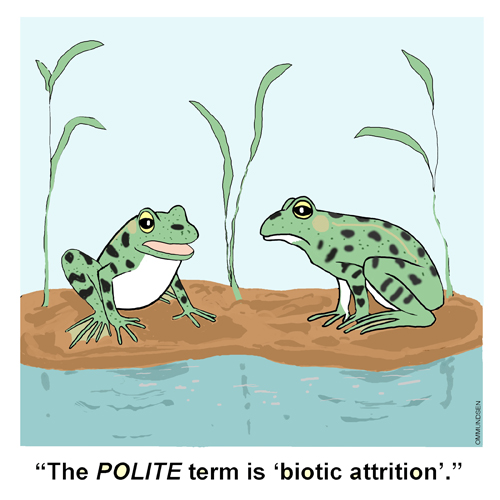
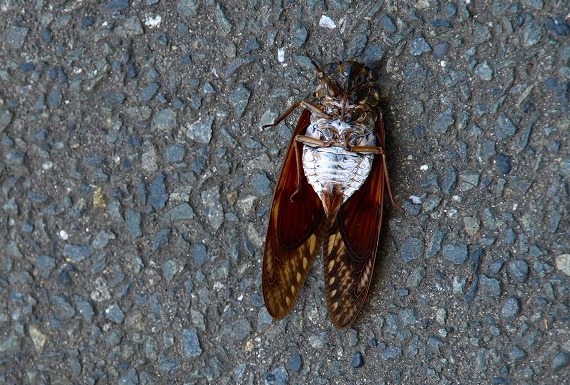 Last Friday, ABC 891 here in Adelaide asked me to comment on a conservation paper doing the news rounds last week. While it has been covered extensively in the media (e.g., The Guardian, CNN, and Science), I think it’s probably going to be one of those things that people unfortunately start to forget right away. But this is decidedly something that no one should be forgetting.
While you can listen to me chat about this with the lovely Sonya Feldhoff on the ABC (I start chin-wagging around the 14:30 mark), I thought it prudent to remind CB.com readers just how devastatingly important this study is.
While anyone with a modicum of conservation science under her belt will know that the Earth’s biodiversity is not doing well, the true extent of the ecological tragedy unfolding before our very eyes really came home to us back in 2014 with the publication of WWF’s Living Planet Report. According to a meta-analysis of 10,380 population trends from over 3000 species of birds, reptiles, amphibians, mammals, and fish, the report concluded that the Earth has lost over 50% of the individuals in vertebrate populations since 1970. Subsequent revisions (and more population trends from more species) place the decline at over 60% by 2020 (that’s only a little over two years away). You can also listen to me speak about this on another radio show.
If that little bit of pleasant news didn’t make the pit of your stomach gurgle and a cold sweat break out on the back of your neck, you’re probably not human. But hang on, boys and girls — it gets so much worse! The publication in PLoS One on 18 October about Germany’s insect declines might be enough to tip you over the edge and into the crevasse of mental instability. Read the rest of this entry »
Here’s another set of biodiversity cartoons to make you giggle, groan, and contemplate the Anthropocene extinction crisis. See full stock of previous ‘Cartoon guide to biodiversity loss’ compendia here.
—


I’ve recently read perhaps the most comprehensive treatise of forest fragmentation research ever compiled, and I personally view this rather readable and succinct review by Bill Laurance and colleagues as something every ecology and conservation student should read.
The ‘Biological Dynamics of Forest Fragments Project‘ (BDFFP) is unquestionably one of the most important landscape-scale experiments ever conceived and implemented, now having run 38 years since its inception in 1979. Indeed, it was way ahead of its time.
Experimental studies in ecology are comparatively rare, namely because it is difficult, expensive, and challenging in the extreme to manipulate entire ecosystems to test specific hypotheses relating to the response of biodiversity to environmental change. Thus, we ecologists tend to rely more on mensurative designs that use existing variation in the landscape (or over time) to infer mechanisms of community change. Of course, such experiments have to be large to be meaningful, which is one reason why the 1000 km2 BDFFP has been so successful as the gold standard for determining the effects of forest fragmentation on biodiversity.
And successful it has been. A quick search for ‘BDFFP’ in the Web of Knowledge database identifies > 40 peer-reviewed articles and a slew of books and book chapters arising from the project, some of which are highly cited classics in conservation ecology (e.g., doi:10.1046/j.1523-1739.2002.01025.x cited > 900 times; doi:10.1073/pnas.2336195100 cited > 200 times; doi:10.1016/j.biocon.2010.09.021 cited > 400 times; and doi:10.1111/j.1461-0248.2009.01294.x cited nearly 600 times). In fact, if we are to claim any ecological ‘laws’ at all, our understanding of fragmentation on biodiversity could be labelled as one of the few, thanks principally to the BDFFP. Read the rest of this entry »
I’m travelling again, so here’s another set of fishy cartoons to appeal to your sense of morbid fascination with biodiversity loss in the sea. See full stock of previous ‘Cartoon guide to biodiversity loss’ compendia here.
—


Three of the coral species studied by Muir (2): (a) Acropora pichoni: Pohnpei Island, Pacific Ocean — deep-water species/IUCN ‘Near threatened’; (b) Acropora divaricate: Maldives, Indian ocean — mid-water species/IUCN ‘Near threatened’; and (c) Acropora gemmifera: Orpheus Island, Australia — shallow-water species/IUCN ‘Least Concern’. The IUCN states that the 3 species are vulnerable to climate change (acidification, temperature extremes) and demographic booms of the invading predator, the crown-of-thorns starfish Acanthaster planci. Photos courtesy of Paul Muir.
Global warming of the atmosphere and the oceans is modifying the distribution of many plants and animals. However, marine species are bound to face non-thermal barriers that might preclude their dispersal over wide stretches of the sea. Sunlight is one of those invisible obstacles for corals from the Indian and Pacific Oceans.
If we were offered a sumptuous job overseas, our professional success in an unknown place could be limited by factors like cultural or linguistic differences that have nothing to do with our work experience or expertise. If we translate this situation into biodiversity terms, one of the best-documented effects of global warming is the gradual dispersal of species tracking their native temperatures from the tropics to the poles (1). However, as dispersal progresses, many species encounter environmental barriers that are not physical (e.g., a high mountain or a wide river), and whose magnitude could be unrelated to ambient temperatures. Such invisible obstacles can prevent the establishment of pioneer populations away from the source.
Corals are ideal organisms to study this phenomenon because their life cycle is tightly geared to multiple environmental drivers (see ReefBase: Global Information System for Coral Reefs). Indeed, the growth of a coral’s exoskeleton relies on symbiotic zooxanthellae (see video and presentation), a kind of microscopic algae (Dinoflagellata) whose photosynthetic activity is regulated by sea temperature, photoperiod and dissolved calcium in the form of aragonite, among other factors.
My travel is finishing for now, but while in transit I’m obliged to do another instalment of biodiversity cartoons (and the second for 2017). See full stock of previous ‘Cartoon guide to biodiversity loss’ compendia here.
—
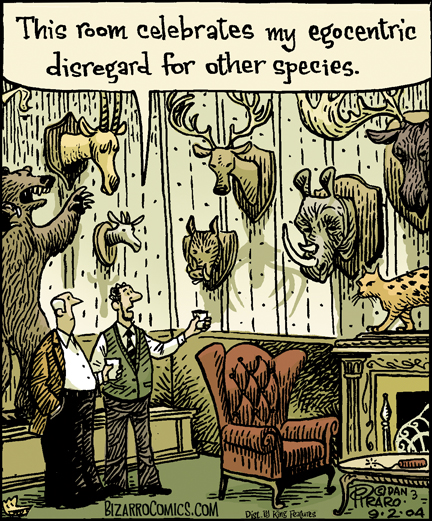
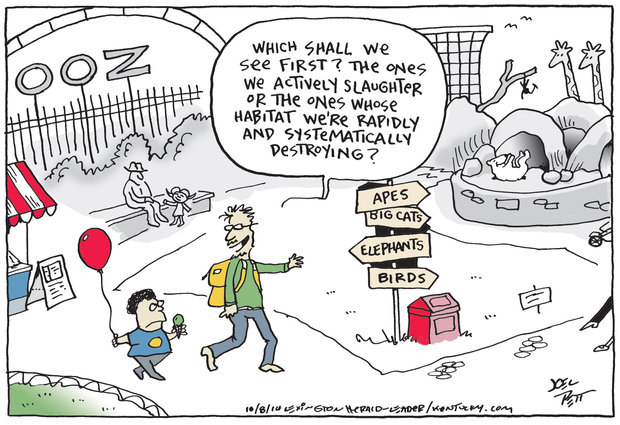
Number 41 of my semi-regular instalment of biodiversity cartoons, and the first for 2017. See full stock of previous ‘Cartoon guide to biodiversity loss’ compendia here.
—

Emaciated female polar bear on drift ice in Hinlopen Strait (Svalbard, Norway), in July 2015 – courtesy of Kerstin Langenberger (www.arctic-dreams.com)
Evolution has designed polar bears to move, hunt and reproduce on a frozen and dynamic habitat that wanes and grows in thickness seasonally. But the modification of the annual cycle of Arctic ice due to global warming is triggering a trophic cascade, which already links polar bears to marine birds.
Popular and epicurean gastronomy claims that the best recipes should use seasonal veggies and fruits. Once upon a time, when there were no greenhouses, international trade routes, or as much frozen and canned food, our grandparents enjoyed what was available at the time. So in some years we had plenty of cherries, while during others we might have feasted on plums. Read the rest of this entry »
 As I have done for the last three years (2015, 2014, 2013), here’s another retrospective list of the top 20 influential conservation papers of 2016 as assessed by experts in F1000 Prime.


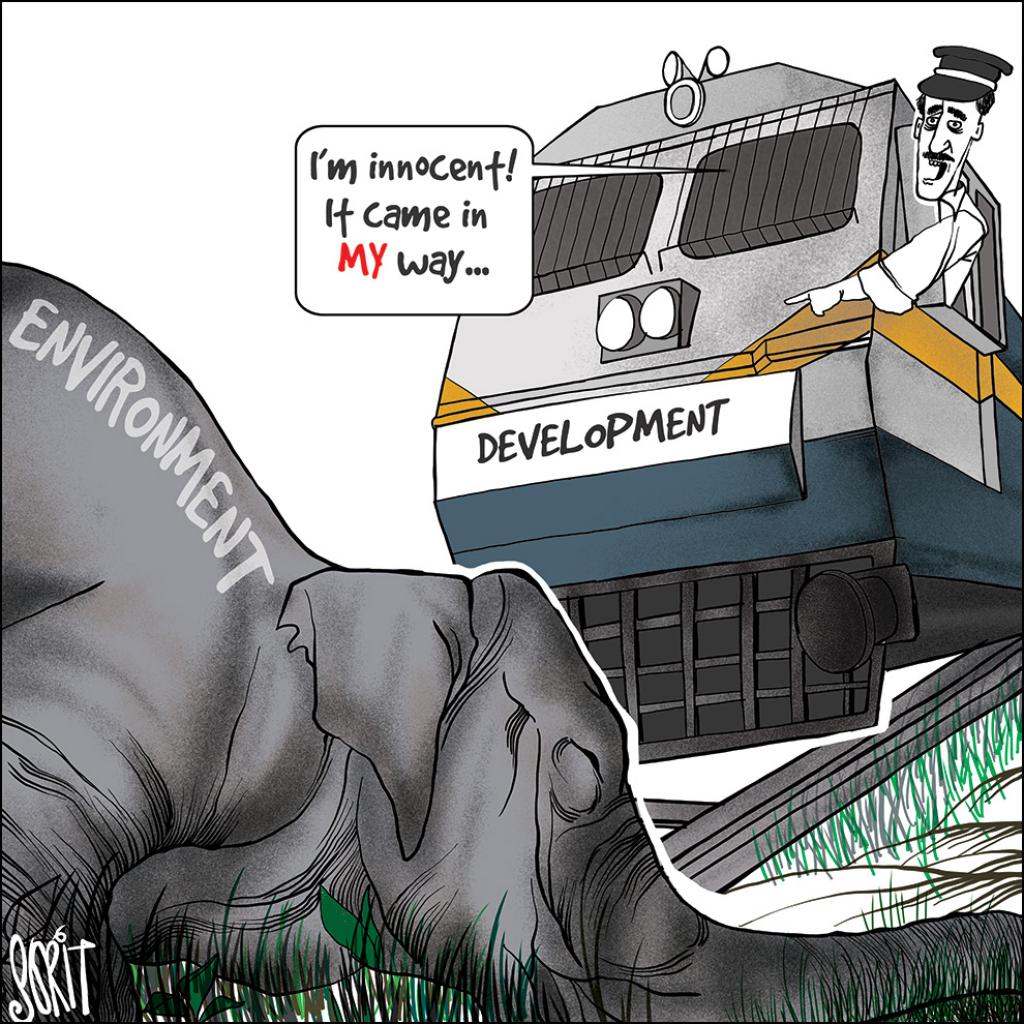
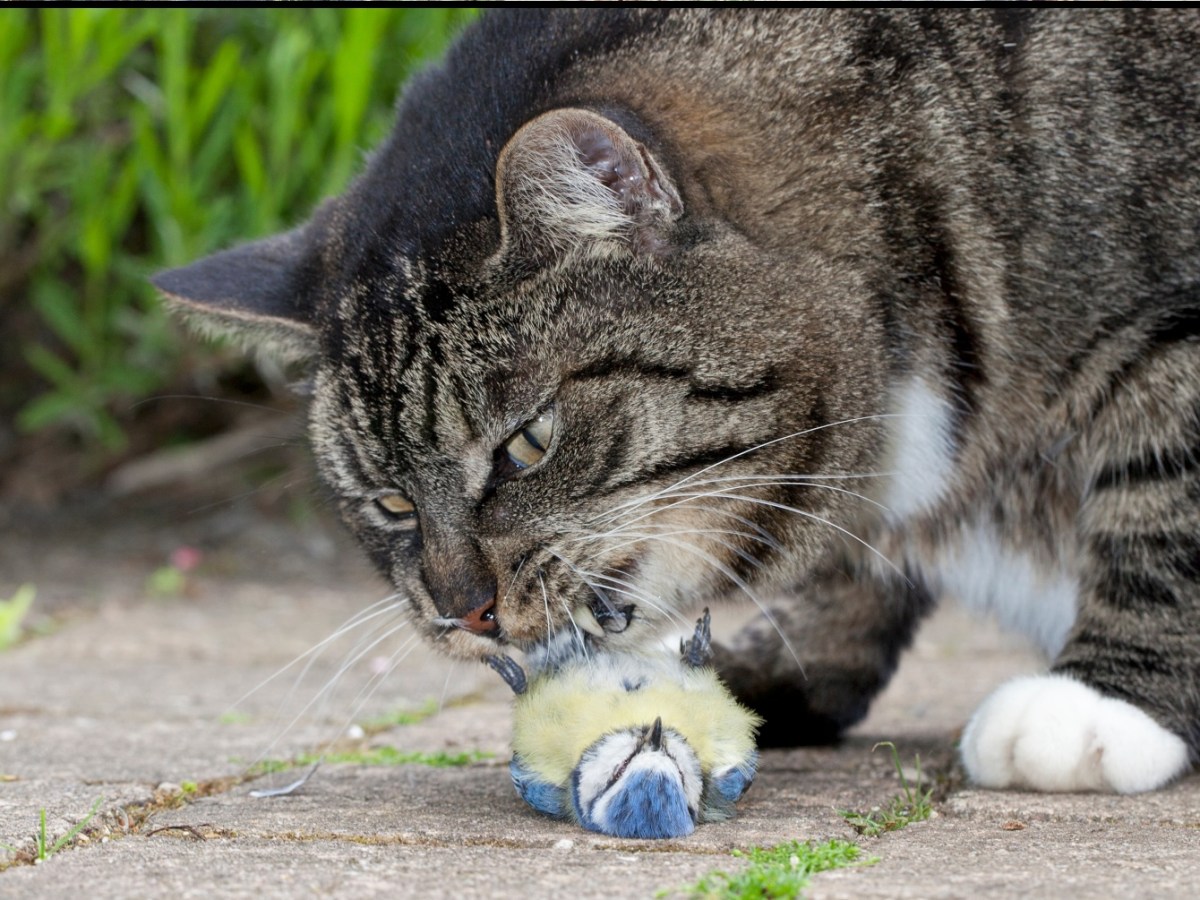
Those of us living with cats share our homes with an ancestral predator, one adapted for hunting and the frequent, exclusive consumption of meat. These instincts become fully activated outside the domestic environment, where cats pose a global threat to wildlife. Pets are family. We celebrate their arrival with the same joy as a grand…

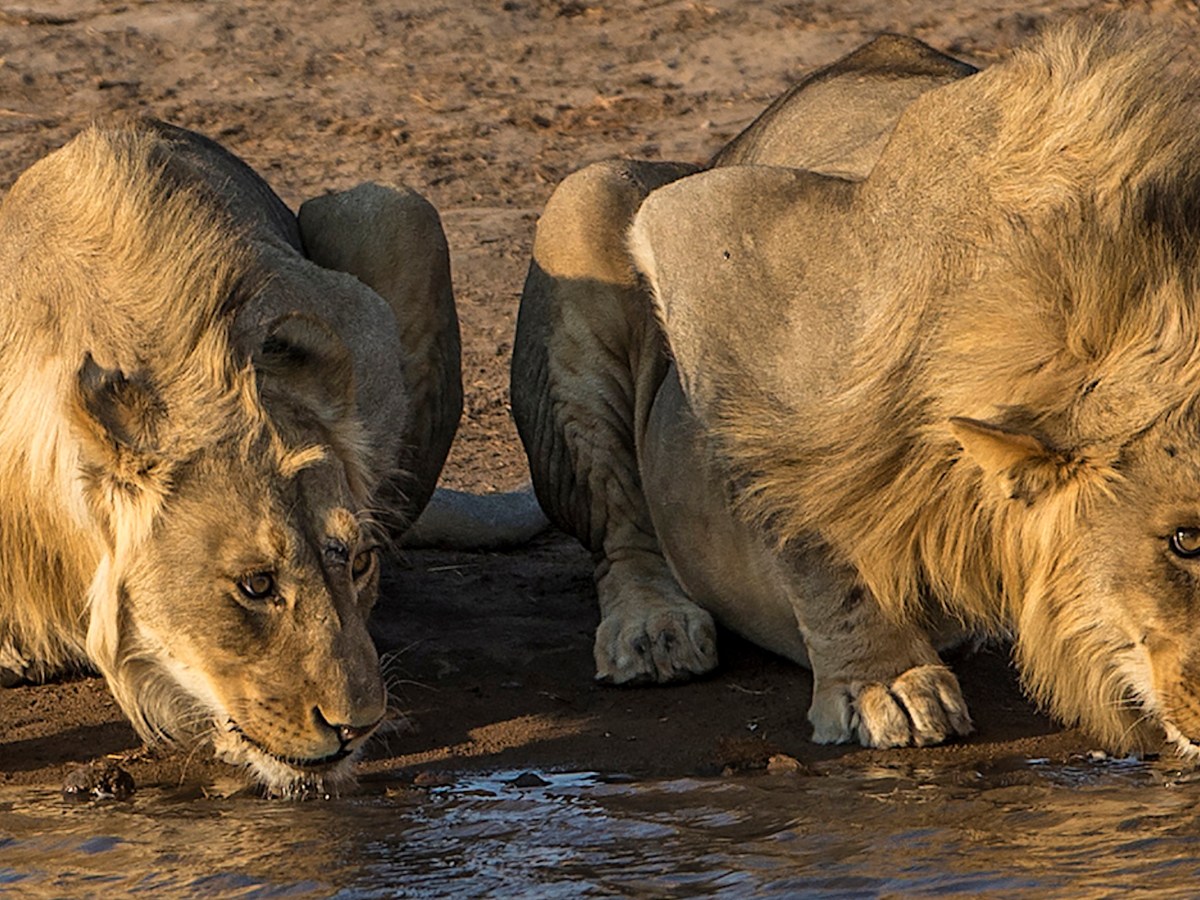
Many animals avoid contact with people. In protected areas of the African savanna, mammals flee more intensely upon hearing human conversations than when they hear lions or sounds associated with hunting. This fear of humans affects how species use and move in their habitat. Throughout our lives, we interact with hundreds of wildlife species without…
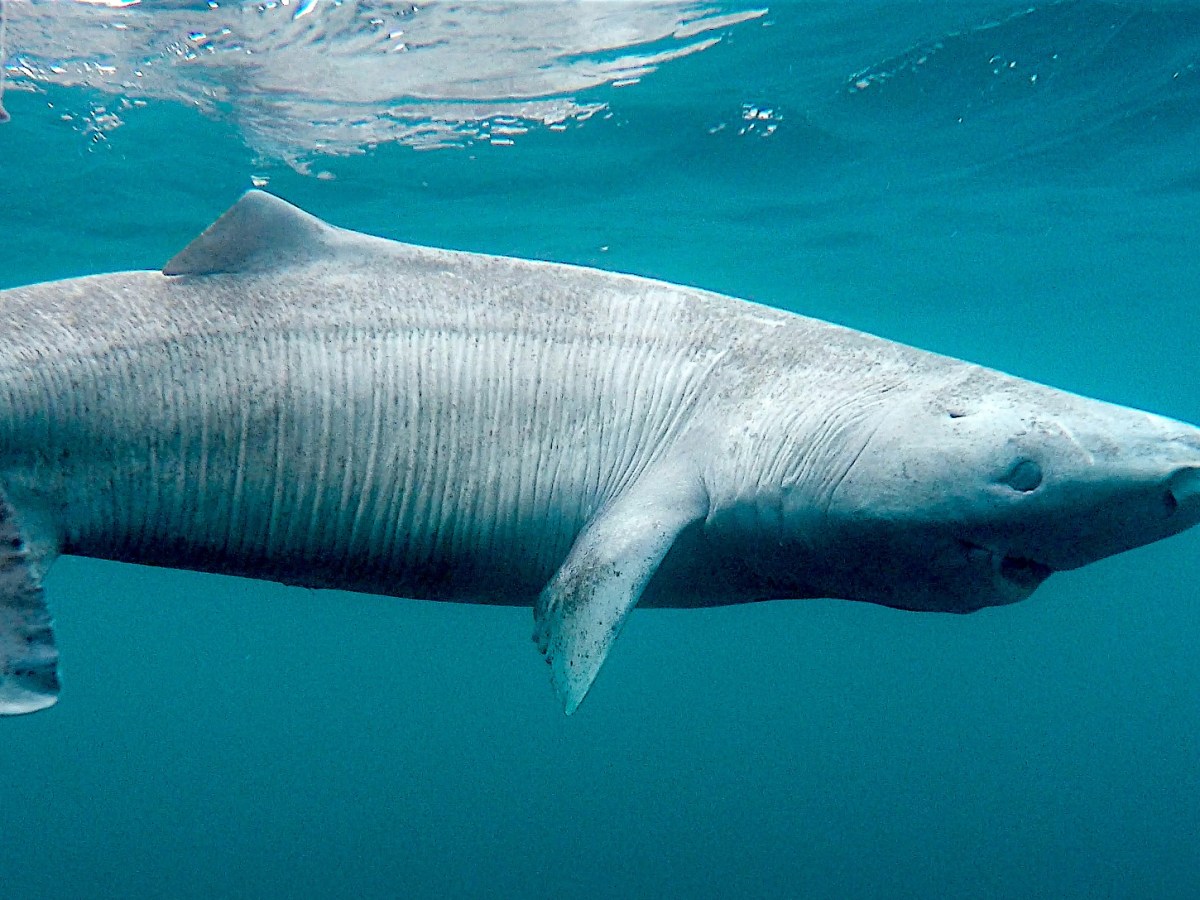
Deep-sea sharks include some of the longest-lived vertebrates known. The record holder is the Greenland shark, with a recently estimated maximum age of nearly 400 years. Their slow life cycle makes them vulnerable to fisheries. Humans rarely live longer than 100 years. But many other animals and plants can live for several centuries or even millennia, particularly…


 ConservationBytes.com