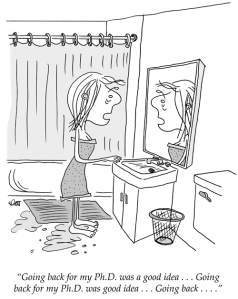
Science immortalised in cartoon Version 2.0

24 09 2013

© Seppo Leinonen

I’m in the middle of participating in a short-course on science communication based at the University of Helsinki‘s Lammi Biological Station (about 1.5 hours north of Helsinki by car). Organised by two fantastic people, Mar Cabeza and Tomas Roslin, it’s an eclectic mix of instruction for (mainly) PhD students on how to promote yourself and your science in print, in media, in illustration, in citizen science and for policy makers.

While we aren’t yet finished, I wanted to report that I had the immense pleasure of finally meeting the immeasurably talented environmental cartoonist, Seppo Leinonen. Not only is he an extremely talented artist and a dedicated environmentalist, he’s just a top bloke.

If you haven’t checked out Seppo.net and his cartoons yet, you should.

This is just a brief post to spruik his fine work, and show off his parting cartoon gift to me: Read the rest of this entry »


Early to press is best for success

19 09 2013

publishingThis paper is bound to piss off a few people. So be it. This is what we found, regardless of what you want to believe.

Led by the extremely prolific Bill Laurance, we have just published a paper (online early) that looks at the correlates of publication success for biologists.

I have to preface the main message with a little philosophical discussion of that loaded word – ‘success’. What do we mean by scientific ‘success’? There are several bucket loads of studies that have attempted to get at this question, and several more that have lamented the current system that emphasises publication, publication, publication. Some have even argued that the obsession of ever-more-frequent publication has harmed scientific advancement because of our preoccupation with superficial metrics at the expense of in-depth scientific enquiry.

Well, one can argue these points of view, and empirically support the position that publication frequency is a poor metric. I tend to agree. At the same time, I am not aware of a single scientist known for her or his important scientific contributions that doesn’t have a prolific publication output. No, publishing shitloads of papers won’t win you the Nobel Prize, but if you don’t publish, you won’t win either.

So, publication frequency is certainly correlated with success, even if it’s not the perfect indicator. But my post today isn’t really about that issue. If you accept that writing papers is part of a scientist’s job, then read on. If you don’t, well …

So today I report the result of our study published online in BioScience, Predicting publication success for biologists. We asked the question: what makes someone publish more than someone else? Read the rest of this entry »


Ecologists: join F1000Research’s open science ecosystem

8 08 2013

f1000researchlogoThe people at the new open-access journal F1000Research (a Faculty of 1000 publication) have asked me to help them announce their new deal for ecologists – no processing fees until 2014! Might have to give it a go myself…

F1000Research covers all areas of life sciences, but we know that different fields each have their own unique characteristics, and some features of our journal are of particular interest to certain disciplines.

For the coming months, one area we’ll be focussing on is ecology. To encourage ecologists to try F1000Research, we’re waiving the article processing charge for all first submissions of an ecology paper until 2014. (Use code ECOL15 when submitting).

F1000Research is an ideal venue for publishing an ecology paper. Research, which includes full datasets, is openly available and its speed of publication and transparency in reviews makes it a refreshing alternative to traditional publishing.” Gary Luck, Institute for Land, Water and Society, Charles Sturt University, Australia

Three good reasons to send your ecology papers to F1000Research:

1.     Quickly reach a wide audience

All articles are fully open access and include all data, and with our post-publication peer review model, your article can be online within a week (find out more about our speedy publication process). Read the rest of this entry »


Ecology: the most important science of our times

12 07 2013

rocket-scienceThe title of this post is deliberately intended to be provocative, but stay with me – I do have an important point to make.

I’m sure most every scientist in almost any discipline feels that her or his particular knowledge quest is “the most important”. Admittedly, there are some branches of science that are more applied than others – I have yet to be convinced, for example, that string theory has an immediate human application, whereas medical science certainly does provide answers to useful questions regarding human health. But the passion for one’s own particular science discipline likely engenders a sort of tunnel vision about its intrinsic importance.

So it comes down to how one defines ‘important’. I’m not advocating in any way that application or practicality should be the only yardstick to ascertain importance. I think superficially impractical, ‘blue-skies’ theoretical endeavours are essential precursors to all so-called applied sciences. I’ll even go so far as to say that there is fundamentally no such thing as a completely unapplied science discipline or question. As I’ve said many times before, ‘science’ is a brick wall of evidence, where individual studies increase the strength of the wall to a point where we can call it a ‘theory’. Occasionally a study comes along and smashes the wall (paradigm shift), at which point we begin to build a new one. Read the rest of this entry »


I fucking love biodiversity

18 06 2013
© G. Gallice

© G. Gallice

A corker of an idea, and post, from Diogo Veríssimo.

I don’t like biodiversity. I like beef lasagna, I like the British museum and I like everything Jules Verne ever wrote. When it comes to biodiversity, it’s different. I think about it all the time, try to be close to it and suffer emotional distress when I think of it going irretrievably away. This is LOVE.

Understanding how to get this passion across effectively has always been one of my main goals. That is why my research has focused on the links between marketing and conservation. But recently I started feeling a bit more empowered to take this mission seriously, and all thanks to the Facebook page I fucking love Science. This page became an internet sensation amassing more than 5 million fans and engaging frequently over 4 million users in any given week. Forget the New York Times and National Geographic, this is the real deal.

So I wondered, why can’t I do the same for biodiversity? The idea lingered in my head until I read a recent paper by McCallum and Bury on Google search patterns, which shows how even during the United Nations Decade on Biodiversity we are failing to mainstream biodiversity and its associated issues. If fact, people seem to be less interested. Whatever we are doing is clearly not working. So why not give this concept a try? And so I fucking love Biodiversity (IFLB) was born.

Read the rest of this entry »


Learning how to fail

6 06 2013

On the way to work yesterday I was listening to ABC Radio National‘s Life Matters program hosted by Natasha Mitchell about how school children are now apparently being given so much positive praise and encouragement that they can no longer handle failure. Poor, wee dears. Maybe that’s why we have such a high attrition rate once they get up to postgraduate level, because that’s when they REALLY experience failure.

Jokes and whinges aside, there is a hard truth in that message that applies to all scientists, and especially the early-career ones. I’m talking about having your paper rejected from a journal.

Even the terms we use to describe the peer-review gauntlet appear designed to instil fear and inadequacy: reject or accept. I don’t know how many times I’ve seen a PhD student’s face figuratively melt off the skull as they shuffle into my office to show me the journal’s rejection letter (now just usually forwarded in an email accompanied by implied stooped shoulders – is there an emoticon for that?). As I’ve mentioned before, we scientists can be real bastards to each other, and it comes out in spades during peer review.

While neophytes tend to take these hits the hardest, I want to impart a little wisdom from some of my very well-established and successful colleagues. Rejection should be viewed as an asset, not a mark of failure. Let me explain. Read the rest of this entry »


Take credit for your work

6 05 2013

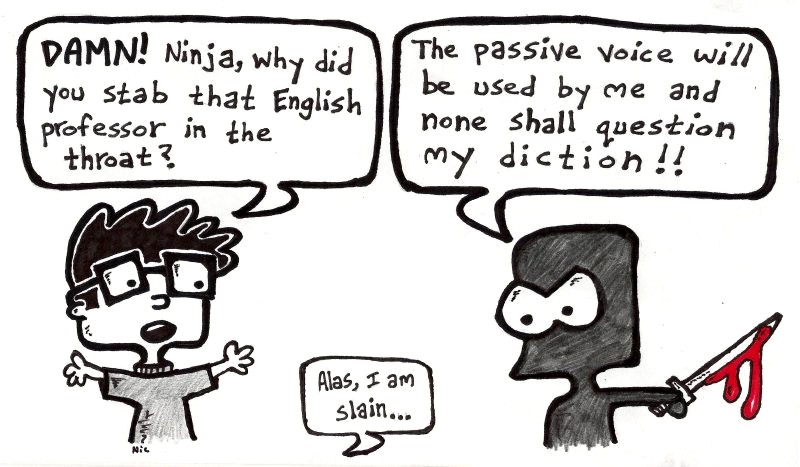
passive voice ninjaIf science is the best way to reduce subjectivity when asking a question of how something works, then an inherently essential aspect of this is getting your message across to as many people and as clearly as possible. And as CB readers will know, I’m all about ‘getting the message out’.

As such, when asked by a stranger about what I do, I often respond ‘writer’, because perhaps next to maths, I spend most of my time writing. I tend to argue that without good oral and (especially) written communication skills, even the most brilliant scientist is functionally useless to the rest of society.

So being a writer means that focussing on what some would describe as mundane – spelling, grammar, writing style and clarity – is an essential preoccupation. I’ve written about grammatical and style issues before (see here and here), and in the spirit of providing tips to young scientists out there, here’s another suggestion.

Please, please, please use your own voice.

I’m talking about that archaic style of zombie writing that has plagued scientific writing since its inception – the passive voice.

Read the rest of this entry »


Help us restore a forest

12 04 2013

plantingI’m not usually one to promote conservation volunteer opportunities, but this is a little different. First, I’m involved in this one, and second, it’s very near to my home. As you might know, the Mount Lofty Ranges area has had about 90 % of its forests destroyed since European settlement, with a corresponding loss of ecosystem services. We need smart restoration on massive scale, and Monarto is one place where we can develop the best practices to achieve this goal. We really do need some help here, so I encourage anyone in the Adelaide area with an interest in evidence-based forest restoration to lend us a hand.

The Monarto Restoration Project will provide an internationally recognised opportunity to experience and engage with wild Australia as it was.

Our aim is restore and expand habitats at Monarto to represent what used to exist in the region before clearing for agriculture and the introduction of pest species. Monarto used to be teeming with wildlife. The remnant vegetation at Monarto is unique as it is located at the cross-over of two vegetation communities (the Mt Lofty Ranges and Murray Mallee). This means it provides important habitat for a range of threatened bird and plant species. However, there are still a number of species in danger of being lost from the area, so we need to focus on restoring habitat to support them too.

We provide an opportunity to see the bush in a way that is no longer possible in most parts of Australia. We hope to help you see what we have lost and encourage you to participate in conservation. It gives us the opportunity to include everyone in on-ground conservation work and pass on skills that can be applied beyond a day or this project. With your help we can reduce the impacts of pest species on the property and re-introduce some of the native species that are now locally extinct. Read the rest of this entry »


Want to work with us?

22 03 2013
© Beboy-Fotolia

© Beboy-Fotolia

Today we announced a HEAP of positions in our Global Ecology Lab for hot-shot, up-and-coming ecologists. If you think you’ve got what it takes, I encourage you to apply. The positions are all financed by the Australian Research Council from grants that Barry Brook, Phill Cassey, Damien Fordham and I have all been awarded in the last few years. We decided to do a bulk advertisement so that we maximise the opportunity for good science talent out there.

We’re looking for bright, mathematically adept people in palaeo-ecology, wildlife population modelling, disease modelling, climate change modelling and species distribution modelling.

The positions are self explanatory, but if you want more information, just follow the links and contacts given below. For my own selfish interests, I provide a little more detail for two of the positions for which I’m directly responsible – but please have a look at the lot.

Good luck!

CJA Bradshaw

Job Reference Number: 17986 & 17987

The world-leading Global Ecology Group within the School of Earth and Environmental Sciences currently has multiple academic opportunities. For these two positions, we are seeking a Postdoctoral Research Associate and a Research Associate to work in palaeo-ecological modelling. Read the rest of this entry »


Why every scientist needs an online profile

31 01 2013
hide

Don’t be guilty of this.

It astounds me every time I hear about a scientist who is reluctant to place her or his track record on the internet. Now, I may be a little over-the-top when it comes to my own web-presence (some have labelled me a ‘media tart’, but I don’t mind), but I am convinced that without a strong, regularly updated web presence, you’re doing yourself a horrible disservice.

Let’s go through the regularly raised objections that some academics make for avoiding the investment in a strong web presence:

  1. My employer will get angry
  2. My track record isn’t good enough (i.e., I’m embarrassed)
  3. What I do is no one else’s business
  4. I couldn’t be bothered; it’s too much work
  5. No one reads it anyway

While there might be some truth to items 1 & 2 (although the justification is weak or often plainly untrue), the last three are pure bullshit.

Let’s start by analysing the bullshit (rolls up sleeves, starts digging…).

Read the rest of this entry »


Scaring our children with the future

21 01 2013

frightened childI’ve written before about how we should all be substantially more concerned about the future than what we as a society appear to be. Climate disruption is society’s enemy number one, especially considering that:

  1. all this unprecedented warming is happening on a template of highly degraded land- and seascapes. Extinction synergies (more extinctions than would otherwise be predicted by the simple sum of the different pressures) mean that climate change exacerbates the extinctions to which we are already committed;
  2. we show no sign of slowing emissions rates, partly because of the world’s ridiculous refusal to embrace the only known energy technology that can safely meet emissions-reduction requirements: nuclear power;
  3. there are 7 billion hungry, greedy humans on planet Earth, and that number is growing;
  4. scientific evidence denial, plutocracy and theocracy are all on the rise, meaning that logical, evidence-based decision making is being progressively tossed out the window.

That’s probably the most succinct way that I know of describing the mess we are in, which is why I tend to be more of a pragmatic pessimist when it comes to the future. I’ve discussed before how this outlook makes getting on with my job even more important – if I can’t reduce the rate of destruction and give my family a slightly better future in spite of this reality, at least I will damn well die trying. Read the rest of this entry »


Rocking the scientific boat

14 12 2012
© C. Simpson

© C. Simpson

One thing that has simultaneously amused, disheartened, angered and outraged me over the past decade or so is how anyone in their right mind could even suggest that scientists band together into some sort of conspiracy to dupe the masses. While this tired accusation is most commonly made about climate scientists, it applies across nearly every facet of the environmental sciences whenever someone doesn’t like what one of us says.

First, it is essential to recognise that we’re just not that organised. While I have yet to forget to wear my trousers to work (I’m inclined to think that it will happen eventually), I’m still far, far away from anything that could be described as ‘efficient’ and ‘organised’. I can barely keep it together as it is. Such is the life of the academic.

More importantly, the idea that a conspiracy could form among scientists ignores one of the most fundamental components of scientific progress – dissension. And hell, can we dissent!

Yes, the scientific approach is one where successive lines of evidence testing hypotheses are eventually amassed into a concept, then perhaps a rule of thumb. If the rule of thumb stands against the scrutiny of countless studies (i.e., ‘challenges’ in the form of poison-tipped, flaming literary arrows), then it might eventually become a ‘theory’. Some theories even make it to become the hallowed ‘law’, but that is very rare indeed. In the environmental sciences (I’m including ecology here), one could argue that there is no such thing as a ‘law’.

Well-informed non-scientists might understand, or at least, appreciate that process. But few people outside the sciences have even the remotest clue about what a real pack of bastards we can be to each other. Use any cliché or descriptor you want – it applies: dog-eat-dog, survival of the fittest, jugular-slicing ninjas, or brain-eating zombies in lab coats.

Read the rest of this entry »


Tropical protected areas still in trouble

8 10 2012

© P. Harris

There’s nothing like a bit of good, intelligent and respectful debate in science.

After the publication in Nature of our paper on tropical protected areas (Averting biodiversity collapse in tropical forest protected areas), some interesting discussion has ensued regarding some of our assumptions and validations.

As is their wont, Nature declined to publish these comments (and our responses) in the journal itself, but the new commenting feature at Nature.com allowed the exchange to be published online with the paper. Cognisant that probably few people will read this exchange, Bill Laurance and I decided to reproduce them here in full for your intellectual pleasure. Any further comments? We’d be keen to hear them.

COMMENT #1 (by Hari Sridhar of the Centre for Ecological Sciences at the Indian Institute of Science in Bangalore)

In this paper, Laurance and co-authors have tapped the expert opinions of ‘veteran field biologists and environmental scientists’ to understand the health of protected areas in the tropics worldwide. This is a novel and interesting approach and the dataset they have gathered is very impressive. Given that expert opinion can be subject to all kinds of biases and errors, it is crucial to demonstrate that expert opinion matches empirical reality. While the authors have tried to do this by comparing their results with empirical time-series datasets, I argue that their comparison does not serve the purpose of an independent validation.

Using 59 available time-series datasets from 37 sources (journal papers, books, reports etc.), the authors find a fairly good match between expert opinion and empirical data (in 51/59 cases, expert opinion matched empirically-derived trend). For this comparison to serve as an independent validation, it is crucial that the experts were unaware of the empirical trends at the time of the interviews. However, this is unlikely to be true because, in most cases, the experts themselves were involved in the collection of the time-series datasets (at least 43/59 to my knowledge, from a scan of references in Supplementary Table 1). In other words, the same experts whose opinions were being validated were involved in collection of the data used for validation.

OUR RESPONSE (William F. Laurance, Corey J. A. Bradshaw, Susan G. Laurance)

Sridhar raises a relevant point but one that, on careful examination, does not weaken our validation analysis. Read the rest of this entry »


Global Ecology postgraduate opportunities

12 08 2012

I should have published these ages ago, but like many things I have should have done earlier, I didn’t.

I also apologise for a bit of silence over the past week. After coming back from the ESP Conference in Portland, I’m now back at Stanford University working with Paul Ehrlich trying to finish our book (no sneak peaks yet, I’m afraid). I have to report that we’ve completed about about 75 % it, and I’m starting to feel like the end is in sight. We hope to have it published early in 2013.

So here they are – the latest 9 PhD offerings from us at the Global Ecology Laboratory. If you want to get more information, contact the first person listed as the first supervisor at the end of each project’s description.

1. Optimal survey and harvest models for South Australian macropods (I’ve advertised this before, but so far, no takers):

The South Australia Department of Environment, Water and Natural Resources (DEWNR) is custodian of a long-term macropod database derived from the State’s management of the commercial kangaroo harvest industry. The dataset entails aerial survey data for most of the State from 1978 to present, annual population estimates, quotas and harvests for three species: red kangaroo (Macropus rufus), western grey kangaroo (Macropus fuliginosus), and the euro (Macropus robustus erubescens).

DEWNR wishes to improve the efficiency of surveys and increase the precision of population estimates, as well as provide a more quantitative basis for setting harvest quotas.

We envisage that the PhD candidate will design and construct population models:

  • to predict population size/densities with associated uncertainty, linking fluctuations to environmental variability (including future climate change projections)
  • to evaluate the efficiency of spatially explicit aerial surveys
  • to estimate demographic parameters (e.g., survival rate) from life tables and
  • to estimate spatially explicit sustainable harvest quotas

 Supervisors: me, A/Prof. Phill Cassey, Dr Damien Fordham, Dr Brad Page (DEWNR), Professor Michelle Waycott (DEWNR).

2. Correcting for the Signor-Lipps effect

The ‘Signor-Lipps effect’ in palaeontology is the notion that the last organism of a given species will never be recorded as a fossil given the incomplete nature of the fossil record (the mirror problem is the ‘Jaanusson effect’, where the first occurrence is delayed past the true time of origination). This problem makes inference about the timing and speed of mass extinctions (and evolutionary diversification events) elusive. The problem is further complicated by the concept known as the ‘pull of the recent’, which states that the more time since an event occurred, the greater the probability that evidence of that event will have disappeared (e.g., erased by erosion, hidden by deep burial, etc.).

In a deep-time context, these problems confound the patterns of mass extinctions – i.e., the abruptness of extinction and the dynamics of recovery and speciation. This PhD project will apply a simulation approach to marine fossil time series (for genera and families, and some individual species) covering the Phanerozoic Aeon, as well as other taxa straddling the K-T boundary (Cretaceous mass extinction). The project will seek to correct for taphonomic biases and assess the degree to which extinction events for different major taxa were synchronous.

The results will also have implications for the famous Sepkoski curve, which describes the apparent logistic increase in marine species diversity over geological time with an approximate ‘carrying capacity’ reached during the Cenozoic. Despite recent demonstration that this increase is partially a taphonomic artefact, a far greater development and validation/sensitivity analysis of underlying statistical models is needed to resolve the true patterns of extinction and speciation over this period.

The approach will be to develop a series of models describing the interaction of the processes of speciation, local extinction and taphonomic ‘erasure’ (pull of the recent) to simulate how these processes interact to create the appearance of growth in numbers of taxa over time (Sepkoski curve) and the abruptness of mass extinction events. The candidate will estimate key parameters in the model to test whether the taphonomic effect is strong enough to be the sole explanation of the apparent temporal increase in species diversity, or whether true diversification accounts for this.

Supervisors: me, Prof. Barry Brook

3. Genotypic relationships of Australian rabbit populations and consequences for disease dynamics

Historical evidence suggests that there were multiple introduction events of European rabbits into Australia. In non-animal model weed systems it is clear that biocontrol efficacy is strongly influenced by the degree of genetic diversity and number of breed variants in the population.

The PhD candidate will build phylogenetic relationships for Australian rabbit populations and develop landscape genetic models for exploring the influence of myxomatosis and rabbit haemorrhagic disease virus (RHDV) on rabbit vital rates (survival, reproduction and dispersal) at regional and local scales. Multi-model synthesis will be used to quantify the relative roles of environment (including climate) and genotype on disease prevalence and virulence in rabbit populations.

Supervisors: A/Prof Phill Cassey, Dr Damien Fordham, Prof Barry Brook Read the rest of this entry »


Arguing for scientific socialism in ecology funding

26 06 2012

What makes an ecologist ‘successful’? How do you measure ‘success’? We’d all like to believe that success is measured by our results’ transformation of ecological theory and practice – in a conservation sense, this would ultimately mean our work’s ability to prevent (or at least, slow down) extinctions.

Alas, we’re not that good at quantifying such successes, and if you use the global metric of species threats, deforestation, pollution, invasive species and habitat degradation, we’ve failed utterly.

So instead, we measure scientific ‘success’ via peer-reviewed publications, and the citations (essentially, scientific cross-referencing) that arise from these. These are blunt instruments, to be sure, but they are really the only real metrics we have. If you’re not being cited, no one is reading your work; and if no one is reading you’re work, your cleverness goes unnoticed and you help nothing and no one.

A paper I just read in the latest issue of Oikos goes some way to examine what makes a ‘successful’ ecologist (i.e., in terms of publications, citations and funding), and there are some very interesting results. Read the rest of this entry »


Knowledge slavery

29 01 2012

manaclesAnother workshop; another productive week.

As many readers will know, I’ve spent the last week in the mountains north of Madrid working on a series of conservation ecology papers with host Miguel Araújo (of the Integrative Biology and Global Change Group at the Spanish National Museum of Natural Sciences), my lab colleagues, Barry Brook, Damien Fordham and Salvador Herrando-Pérez, and Miguel’s post-doc, Regan Early.

Let me tell you, staying in the craggy granite Sierra de Guadarrama mountains at a well-known health spa eating explosively flavourful Spanish food and drinking an immodest selection of the region’s delicious wines, is particularly conducive to scientific productivity (yes, I AM a jammy tart). Although unlikely to be followed by many (even if they have the means), I highly recommend the experience for those suffering from writer’s block.

But this post isn’t about the scenery, food, wine, hydrothermal treatment or even the content of the workshop at all (I just prefaced it as such to gloat); it’s about a particularly sore point for me and hundreds of thousands of other scientists the world over – our slavery to the scientific publishing industry.

And ‘slavery’ is definitely the most appropriate term here, for how else would you describe a business where the product is produced by others for free1 (scientific results), is assessed for quality by others for free (reviewing), is commissioned, overviewed and selected by yet others for free (editing), and then sold back to the very same scientists and the rest of the world’s consumers at exorbitant prices.

This isn’t just a whinge about a specialised and economically irrelevant sector of the economy, we’re talking about an industry worth hundreds of billions of dollars annually. In fact, Elsevier (agreed by many to be the leader in the greed-pack – see how some scientists are staging their protest; also here) made US$1.1 billion in 2010! Read the rest of this entry »


Surgical conservation: gain requires some pain

21 12 2011

© 2008-2011 ~Hiuki http://fav.me/d1j3ns9

I apologise to CB readers for the unusually low frequency of posts this month. With the International Congress for Conservation Biology taking up a lot of my time earlier this month, and the standard palaver of xmas preparations (i.e., getting shit done before the end of the year), I’m afraid the blog has taken a back seat. Now officially ‘on leave’ (whatever that means for an academic), I have found a brief window during which I can put a few thoughts together.

For this post I must take you back to October 2011 when, if you were in Australia, you might have heard about the so-called ‘debacle‘ of the Macquarie Island rabbit/rate/mouse-eradication programme in which it was identified that a few thousand seabirds had become the collateral damage.

To recap, an intense poisoning programme was initiated on subantarctic Macquarie Island to eradicate these pests after years of massive environmental degradation had finally forced the government’s (of Tasmania and the Commonwealth) hand to do something. What caught my eye in all this was the sheer stupidity and politicking associated with the programme, in which hyper-conservative Eric Abetz (Liberal Senator for Tasmania) managed to turn this amazing success into a Labor-bashing political sledge-hammer.

Abetz is no stranger to anti-environmentalism and fights vehemently for Tasmania’s forest-raping industry; he considers political parties such as the Greens, environmental groups such as The Wilderness Society and pro-democracy groups such as Get Up! his mortal enemies. He’s even had a go at esteemed author Richard Flanagan for supporting the anti-deforestation movement in Tasmania! Read the rest of this entry »


Supercharge Your Science V.2

24 11 2011

I suspect a lot of ConservationBytes.com readers will be attending the imminent 25th International Congress for Conservation Biology to be held in Auckland from 5-9 December 2011 (it was to be held in Christchurch, but the venue was changed after that city fell down). I’ve now been to 3 previous ICCBs myself, and it should prove to be a good, informative (and fun) meeting.

I’ll be giving a talk or two, as will some of my students and postdocs, but I’m not spruiking those here (but you’re all invited, of course).

The main reason for this short post today is to advertise for Version 2 of our (i.e., Bill Laurance and me) popular ‘Supercharge Your Science‘ workshop. Yes, the organising committee of the ICCB decided it was a good idea to accept our application to repeat our previously successful series of presentations extolling the virtues of positive and controlled media interactions, social media and good writing techniques for ‘supercharging’ the impact of one’s science. You can read more about the content of this workshop here and here.

The description of the workshop (to be held from 19.00 – 21.00 on 6 December in the SkyCity venue) on the ICCB website is: Read the rest of this entry »


A supervisor’s lament

5 09 2011

© hradcanska http://ow.ly/6lCAO

Time for a little supervisory whinge. I’ve lamented these very issues over many a beer at many a conference, so I thought I’d solidify those hazy arguments into a blog post.

I’m by no means the most burdened academic when it comes to student load. We tend to be very picky in our lab when engaging post-graduate student prospects, and even pickier when hiring post-doctoral fellows (because the latter require little things like salaries that unfortunately, do not grow on trees). We also endeavour to share the load – most of our post-docs have at least one primary PhD student responsibility which reduces some of my burden and gives the post-doc in question the requisite experience in supervising. In my opinion, it’s a good way to run a lab, and allows for a high number of productive students, yet is not overly onerous for any one person.

That said, I make sure I read EVERYTHING my students produce, and I take a certain amount of pride in providing as much of my intellectual input as possible: from study design right through to proof correction. If my name is going to be on a paper, I had better bloody well earn my co-authorship. Read the rest of this entry »


Time to cough up for Navjot

27 06 2011

© N. Kantonicolas

You’d have to have been living under a rock for the last two weeks not to know that our esteemed colleague, great mate and all-round poker-in-the-eyes-of-convention, Professor Navjot Sodhi, died tragically on 12 June 2011 of lymphoma. but just in case you were under a rock, you can read about it here.

In the weeks that have elapsed, several amazing things have happened – despite Navjot being a complete bastard (note: I use this term in the Australian parlance meaning ‘one who could hold his own, who could detect bullshit at 100 m, who was a wonderful mate, and an even more terrible enemy’ – in essence, the highest compliment and expression of platonic love a man can give to another), his army of students, colleagues, admirers and distant relatives have flown into action to make damn sure he is not forgotten.

First, the outpouring of grief and accolades in the blogosphere hit a pick the week following his death (see here, here and here for examples). There was even a Facebook tribute page established within days. It just so happened too that he died during the Association for Tropical Biology and Conservation‘s annual meeting in Arusha, Tanzania (and with whom Navjot was a council member). I have heard from the likes of Bill Laurance, Luke Gibson, Nigel Stork and others that the meeting ended up essentially being in honour of Navjot once everyone heard the dreadful news. Read the rest of this entry »