One-two carbon punch of defaunation

30 04 2016

1-2 punchI’ve just read a well-planned and lateral-thinking paper in Nature Communications that I think readers of CB.com ought to appreciate. The study is a simulation of a complex ecosystem service that would be nigh impossible to examine experimentally. Being a self-diagnosed fanatic of simulation studies for just such purposes, I took particular delight in the results.

In many ways, the results of the paper by Osuri and colleagues are intuitive, but that should never be a reason to avoid empirical demonstration of a suspected phenomenon because intuition rarely equals fact. The idea itself is straightforward, but takes more than a few logical steps to describe: Read the rest of this entry »


Shadow of ignorance veiling society despite more science communication

19 04 2016

imagesI’ve been thinking about this post for a while, but it wasn’t until having some long, deep chats today with staff and students at Simon Fraser University‘s Department of Biological Sciences (with a particular hat-tip to the lovely Nick Dulvy, Isabelle Côté & John Reynolds) that the full idea began to take shape in my brain. It seems my presentation was a two-way street: I think I taught a few people some things, and they taught me something back. Nice.

There’s no question at all that science communication has never before been so widespread and of such high quality. More and more scientists and science students are now blogging, tweeting and generally engaging the world about their science findings. There is also an increasing number of professional science communication associations out there, and a growing population of professional science communicators. It is possibly the best time in history to be involved in the generation and/or communication of scientific results.

Why then is the public appreciation, acceptance and understanding of science declining? It really doesn’t make much sense if you merely consider that there has never been more good science ‘out there’ in the media — both social and traditional. For the source literature itself, there has never before been as many scientific journals, articles and even scientists writing. Read the rest of this entry »


Biowealth

24 02 2016

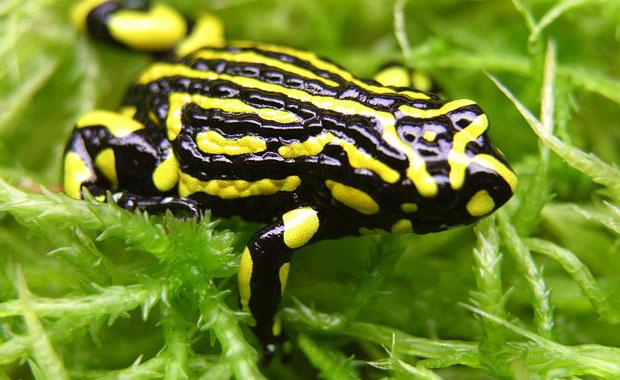
frogWhile I’ve blogged about this before in general terms (here and here), I thought it wise to reproduce the (open-access) chapter of the same name published in late 2013 in the unfortunately rather obscure book The Curious Country produced by the Office of the Chief Scientist of Australia. I think it deserves a little more limelight.

As I stepped off the helicopter’s pontoon and into the swamp’s chest-deep, tepid and opaque water, I experienced for the first time what it must feel like to be some other life form’s dinner. As the helicopter flittered away, the last vestiges of that protective blanket of human technological innovation flew away with it.

Two other similarly susceptible, hairless, clawless and fangless Homo sapiens and I were now in the middle of one of the Northern Territory’s largest swamps at the height of the crocodile-nesting season. We were there to collect crocodile eggs for a local crocodile farm that, ironically, has assisted the amazing recovery of the species since its near-extinction in the 1960s. Removing the commercial incentive to hunt wild crocodiles by flooding the international market with scar-free, farmed skins gave the dwindling population a chance to recover.

redwoodConservation scientists like me rejoice at these rare recoveries, while many of our fellow humans ponder why we want to encourage the proliferation of animals that can easily kill and eat us. The problem is, once people put a value on a species, it is usually consigned to one of two states. It either flourishes as do domestic crops, dogs, cats and livestock, or dwindles towards or to extinction. Consider bison, passenger pigeons, crocodiles and caviar sturgeon.

As a conservation scientist, it’s my job not only to document these declines, but to find ways to prevent them. Through careful measurement and experiments, we provide evidence to support smart policy decisions on land and in the sea. We advise on the best way to protect species in reserves, inform hunters and fishers on how to avoid over-harvesting, and demonstrate the ways in which humans benefit from maintaining healthy ecosystems. Read the rest of this entry »


Outright bans of trophy hunting could do more harm than good

5 01 2016

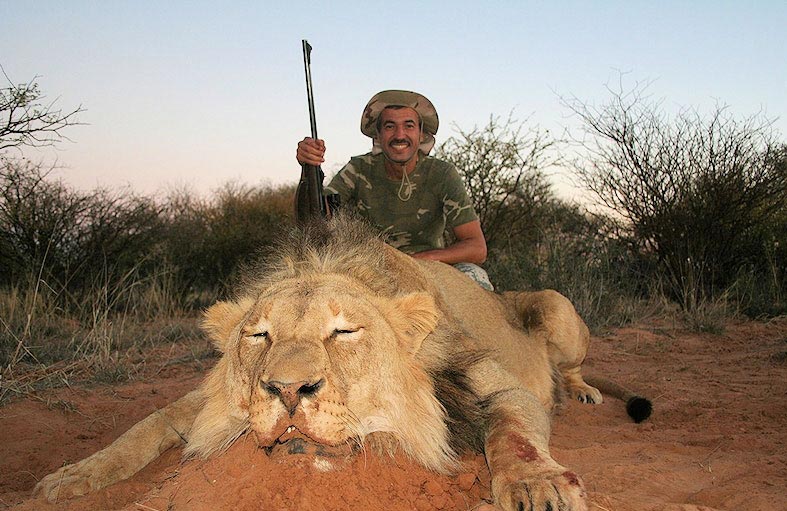
In July 2015 an American dentist shot and killed a male lion called ‘Cecil’ with a hunting bow and arrow, an act that sparked a storm of social media outrage. Cecil was a favourite of tourists visiting Hwange National Park in Zimbabwe, and so the allegation that he was lured out of the Park to neighbouring farmland added considerable fuel to the flames of condemnation. Several other aspects of the hunt, such as baiting close to national park boundaries, were allegedly done illegally and against the spirit and ethical norms of a managed trophy hunt.

In May 2015, a Texan legally shot a critically endangered black rhino in Namibia, which also generated considerable online ire. The backlash ensued even though the male rhino was considered ‘surplus’ to Namibia’s black rhino populations, and the US$350,000 generated from the managed hunt was to be re-invested in conservation. Together, these two incidents have triggered vociferous appeals to ban trophy hunting throughout Africa.

These highly politicized events are but a small component of a large industry in Africa worth > US$215 million per year that ‘sells’ iconic animals to (mainly foreign) hunters as a means of generating otherwise scarce funds. While to most people this might seem like an abhorrent way to generate money, we argue in a new paper that sustainable-use activities, such as trophy hunting, can be an important tool in the conservationist’s toolbox. Conserving biodiversity can be expensive, so generating money is a central preoccupation of many environmental NGOs, conservation-minded individuals, government agencies and scientists. Making money for conservation in Africa is even more challenging, and so we argue that trophy hunting should and could fill some of that gap. Read the rest of this entry »


Game bird madness

4 11 2015

Gamecart_largeI just returned to Paris after a brief visit to the University of Aberdeen over the weekend. My hosts, Xavier Lambin and Beth Scott, were not only marvellously welcoming, I also learned a lot about the travesty that is game bird management in the United Kingdom, and especially in Scotland.

As you might already know, the Great Britons are a little cuckoo for birds — I’d even wager that the country produces more twitchers than any other country on Earth. The plus side is that there are few national taxa better censused and studied that British birds, because so many non-scientists get into the spirit of data collection. Hell, I’ve even had a play with some of their datasets.

The other side of this bird madness is not so good — I’m talking about the massive biomass of game birds reared, released and shot every year in the United Kingdom. It’s not the hunting per se with which I take issue, it’s the insane manipulation of an entire ecosystem for the benefit of a few species. Read the rest of this entry »


Ice Age? No. Abrupt warmings and hunting together polished off Holarctic megafauna

24 07 2015
Oh shit oh shit oh shit ...

Oh shit oh shit oh shit …

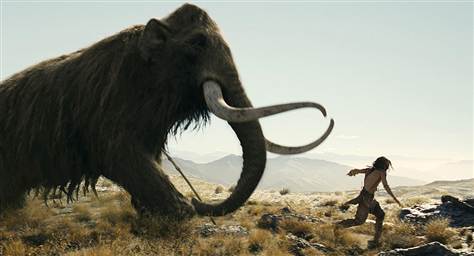
Did ice ages cause the Pleistocene megafauna to go extinct? Contrary to popular opinion, no, they didn’t. But climate change did have something to do with them, only it was global warming events instead.

Just out today in Science, our long-time-coming (9 years in total if you count the time from the original idea to today) paper ‘Abrupt warmings drove Late Pleistocene Holarctic megafaunal turnover‘ demonstrates for the first time that abrupt warming periods over the last 60,000 years were at least partially responsible for the collapse of the megafauna in Eurasia and North America.

You might recall that I’ve been a bit sceptical of claims that climate changes had much to do with megafauna extinctions during the Late Pleistocene and early Holocene, mainly because of the overwhelming evidence that humans had a big part to play in their demise (surprise, surprise). What I’ve rejected though isn’t so much that climate had nothing to do with the extinctions; rather, I took issue with claims that climate change was the dominant driver. I’ve also had problems with blanket claims that it was ‘always this’ or ‘always that’, when the complexity of biogeography and community dynamics means that it was most assuredly more complicated than most people think.

I’m happy to say that our latest paper indeed demonstrates the complexity of megafauna extinctions, and that it took a heap of fairly complex datasets and analyses to demonstrate. Not only were the data varied – the combination of scientists involved was just as eclectic, with ancient DNA specialists, palaeo-climatologists and ecological modellers (including yours truly) assembled to make sense of the complicated story that the data ultimately revealed. Read the rest of this entry »


How things have (not) changed

13 04 2015

The other night I had the pleasure of dining with the former Australian Democrats leader and senator, Dr John Coulter, at the home of Dr Paul Willis (Director of the Royal Institution of Australia). It was an enlightening evening.

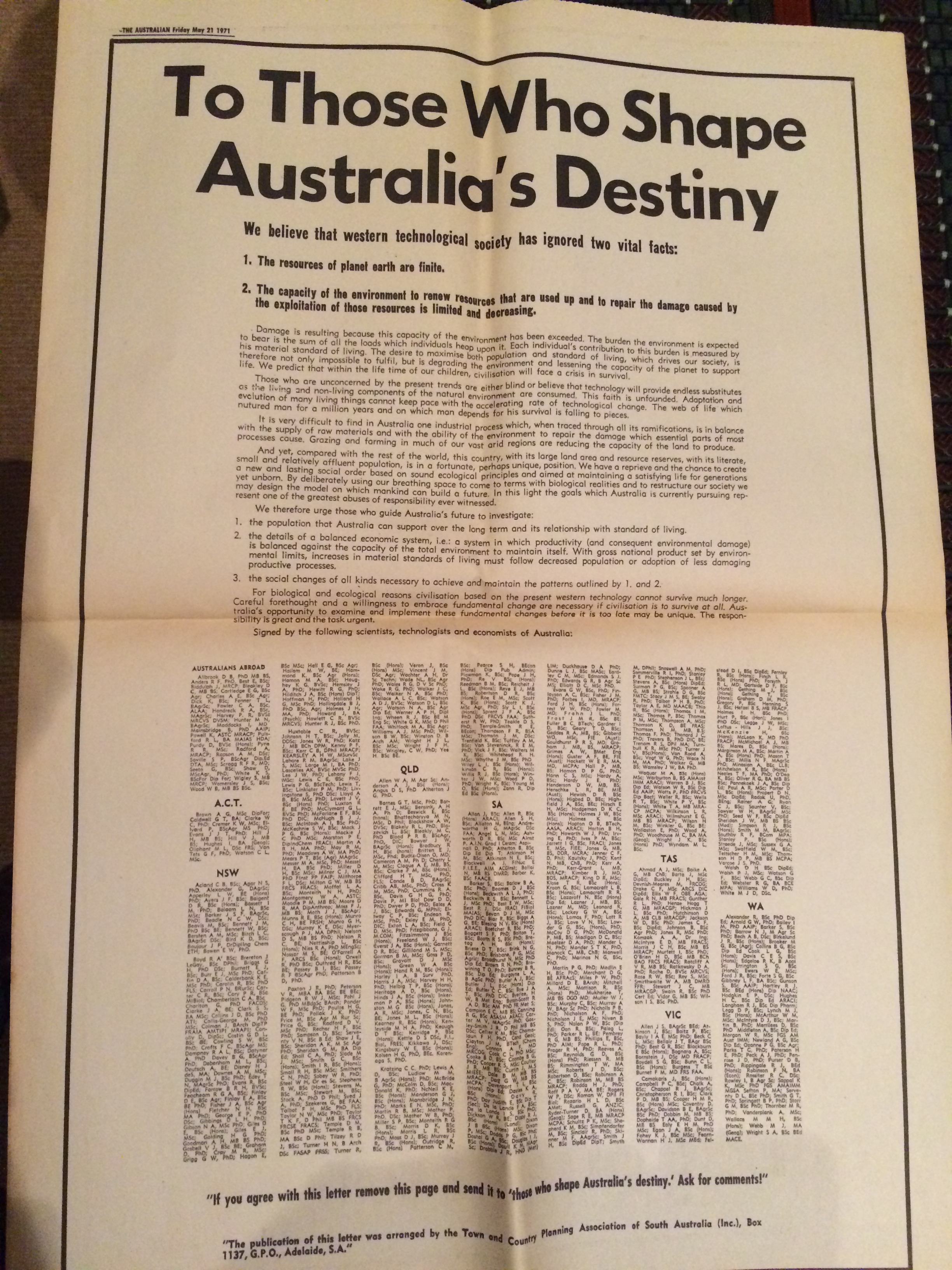
While we discussed many things, the 84 year-old Dr Coulter showed me a rather amazing advert that he and several hundred other scientists, technologists and economists constructed to alert the leaders of Australia that it was heading down the wrong path. It was amazing for three reasons: (i) it was written in 1971, (ii) it was published in The Australian, and (iii) it could have, with a few modifications, been written for today’s Australia.

If you’re an Australian and have even a modicum of environmental understanding, you’ll know that The Australian is a Murdochian rag infamous for its war on science and reason. Even I have had a run-in with its outdated, consumerist and blinkered editorial board. You certainly wouldn’t find an article like Dr Coulter’s in today’s Australian.

More importantly, this 44 year-old article has a lot today that is still relevant. While the language is a little outdated (and sexist), the grammar could use a few updates, and there are some predictions that clearly never came true, it’s telling that scientists and others have been worrying about the same things for quite some time.

In reading the article (reproduced below), one could challenge the authors for being naïve about how society can survive and even prosper despite a declining ecological life-support system. As I once queried Paul Ehrlich about some of his particularly doomerist predictions from over 50 years ago, he politely pointed out that much of what he predicted did, in fact, come true. There are over 1 billion people today that are starving, and another billion or so that are malnourished; combined, this is greater than the entire world population when Paul was born.

So while we might have delayed the crises, we certainly haven’t averted them. Technology does potentially play a positive role, but it can also increase our short-term carrying capacity and buffer the system against shocks. We then tend to ignore the indirect causes of failures like wars, famines and political instability because we do not recognise the real drivers: resource scarcity and ecosystem malfunction.

Australia has yet to learn its lesson.

To Those Who Shape Australia’s Destiny

We believe that western technological society has ignored two vital facts: Read the rest of this entry »


When human society breaks down, wildlife suffers

22 01 2015

bearGlobal human society is a massive, consumptive beast that on average degrades its life-support system. As we’ve recently reported, this will only continue to get worse in the decades to centuries to come. Some have argued that as long as we can develop our societies enough, the impact of this massive demographic force can be lessened – a concept described by the environmental Kuznets curve. However, there is little evidence that negative societal impact on the environment is lessened as per capita wealth exceeds some threshold; unfortunately environmental damage tends to, on average, increase as a nation’s net wealth increases. That’s not to say that short-term improvements cannot be achieved through technological innovation – in fact, they will be essential to offset the inexorable growth of the global human population.

So poor nations as well as the wealthy ones are responsible for environmental damage. Poorer nations often have ineffective governance systems so they fail to enforce compliance in environmental regulations, but wealthier nations often exploit a high proportion of their natural resources, with the inevitable environmental damage this entails. In some cases however, biodiversity can temporarily escape some of the ravages of society because humans either perceive the area to be too dangerous, or otherwise have no incentive to go there. There are some good examples of the latter, such as the vicinity around the Chernobyl nuclear reactor that melted down in 1986, or the Korean demilitarised zone.

In this vein, I just stumbled across an extremely interesting paper today published online early in Conservation Biology that describes trends in charismatic wildlife (i.e., big mammals) as the former Soviet Union collapsed in 1991 and societal breakdown ensued. The authors had access to an amazing dataset that spanned the decade prior to the collapse, the decade immediately following, and a subsequent decade of societal renewal. What they found was fascinating. Read the rest of this entry »


Help Hawaii’s hyper-threatened birds

6 01 2015
Puaiohi or small Kaua'i thrush. Photo by Lucas Behnke

Puaiohi or small Kaua’i thrush. Photo by Lucas Behnke

You wouldn’t want to be a bird in Hawaii. There are more avian species threatened with extinction there than anywhere else in the USA. After humans arrived, some 70+ species have become extinct, and 31 are listed as threatened with extinction. In addition, 43% of 157 species are not native; among land birds, 69% are introduced species.

My friend, Cali Crampton asked me to promote their new crowdfunding project to reduce the threat of feral rats on Hawaiian birds. Please help if you can.

The Kaua‘i Forest Bird Recovery Project, a collaborative project of the Hawaii Department of Land and Natural Resources, Division of Forestry and Wildlife, the University of Hawaii Pacific Cooperative Studies Unit, and Garden Island Research and Development, has announced the launch of a crowdfunding and outreach campaign to generate support for protecting the native birds of Kaua’i by controlling rats with humane, self-resetting rat traps.

The campaign, named “Birds, not Rats!” runs through to 31 January 2015, with goals of increasing awareness of the threats that rats pose to birds and native ecosystems, and raising at least $10,000 for rat control through many small, individual donations.

Hawai’i is at the epicentre of the current global extinction crisis. Of the original 130+ native Hawaiian bird species, many have been lost forever, and only 11 are not yet endangered. Today, Kaua’i is home to eight native forest bird species, three of which are federally listed as endangered: the puaiohi or small Kaua’i thrush, the akeke’e or Kaua’i akepa, and the akikiki or Kaua’i creeper. Populations of these birds have plummeted as much as 90% in the last five years; the akikiki and the puaiohi now number fewer than 500 individuals, and the akeke’e numbers fewer than 1000 individuals. The Kaua’i Forest Bird Recovery Project’s goal is to reverse these declines. Read the rest of this entry »


Give some flair to your scientific presentation

18 11 2014

Smoko3

As the desert spring came to the great Centre Red,
Scores of sandalled folk from tin birds descend-ed.
Alice Town had been invaded,
Bearded alike and unshorn-legged.
 
They sat and stared at words and the odd trend.
Billies boiled to get them through to day’s end
They swapped bush stories that made good sense,
Trying to understand Aussie environments.
 
One bloke‘s tales caught the punters’ attention,
So this bush poet deserves special mention.
To standard rules he would not kowtow,
So his special science verse I present to you now.

If none of that made any sense, then let me help you out. At the last Ecological Society of Australia meeting in Alice Springs, I witnessed a rather unique way to give a scientific presentation – via bush poetry. Dr. Dale Nimmo of Deakin University was particularly engaging, and he agreed to have his presentation poem reproduced here. Who said scientists were boring? Honourable mention too to Simon Watson for another audience-engaging, bush-poetry seminar (but I don’t have that to reproduce here). There also might be a slidecast of Dale’s presentation coming soon. For now, please enjoy the poetic delivery of science in text.

The Old Grey Box of Heathcote Town

Dale Nimmo

Down around old Heathcote town, just east of Bendigo,
A big old grey box tree casts an eye.
The sallee fills the understory bright as sunlights glow,
As the silvereyes and thornbills flitter by.
 
This landscape, bruised and battered from 200 years of change,
Holds the secrets of a time lost somehow.
One of Jaara land, where lowan dug and dingoes howled,
The latter two, here, just distant memories now.
 
The gold rush came like bushfire, ring barked trees fell like boughs
Of the red gums scattered on the old flood plains,
That made way for sheep and cattle, while, fighting a losing battle,
rufous bettongs were never seen again.
 
When a man of English gentry, Professor Bennett was his name,
Found the woodlands to his aristocratic tastes.
Many days he’d venture in, binoculars under his chin,
He never let a single bird call go to waste.
 
While at the old St Arnaud Inn, over a couple pints of gin,
Bennet and a bloke called Radford got to talking.
Stealing horses was his game, but he’d give it all away,
To join Bennett in woodlands, bird walking

Read the rest of this entry »


It’s not all about cats

20 10 2014

Snake+OilIf you follow any of the environment news in Australia, you will most certainly have seen a lot about feral cats in the last few weeks. I’ve come across dozens of articles in the last week alone talking about the horrendous toll feral cats have had on Australian wildlife since European arrival. In principle, this is a good thing because finally Australians are groggily waking to the fact that our house moggies and their descendants have royally buggered our biodiversity. As a result, we have the highest mammal extinction rate of any country.

But I argue that the newfound enthusiasm for killing anything feline is being peddled mainly as a distraction from bigger environmental issues and to camouflage the complete incompetence of the current government and their all-out war on the environment.

Call me cynical, but when I read headlines like “Australia aims to end extinction of native wildlife by 2020” and Environment Minister Hunt’s recent speech that he has “… set a goal of ending the loss of mammal species by 2020“, I get more than just a little sick to the stomach.

What a preposterous load of shite. Moreover, what a blatant wool-pulling-over-the-eyes public stunt. Read the rest of this entry »


Biodiversity Hotspots have nearly burnt out

10 07 2014

dying embersI recently came across a really important paper that might have flown under the radar for many people. For this reason, I’m highlighting it here and will soon write up a F1000 Recommendation. This is news that needs to be heard, understood and appreciated by conservation scientists and environmental policy makers everywhere.

Sean Sloan and colleagues (including conservation guru, Bill Laurance) have just published a paper entitled Remaining natural vegetation in the global biodiversity hotspots in Biological Conservation, and it we are presented with some rather depressing and utterly sobering data.

Unless you’ve been living under a rock for the past 20 years, you’ll have at least heard of the global Biodiversity Hotspots (you can even download GIS layers for them here). From an initial 10, to 25, they increased penultimately to 34; most recently with the addition of the Forests of East Australia, we now have 35 Biodiversity Hotspots across the globe. The idea behind these is to focus conservation attention, investment and intervention in the areas with the most unique species assemblages that are simultaneously experiencing the most human-caused disturbances.

Indeed, today’s 35 Biodiversity Hotspots include 77 % of all mammal, bird, reptile and amphibian species (holy shit!). They also harbour about half of all plant species, and 42 % of endemic (not found anywhere else) terrestrial vertebrates. They also have the dubious honour of hosting 75 % of all endangered terrestrial vertebrates (holy, holy shit!). Interestingly, it’s not just amazing biological diversity that typifies the Hotspots – human cultural diversity is also high within them, with about half of the world’s indigenous languages found therein.

Of course, to qualify as a Biodiversity Hotspot, an area needs to be under threat – and under threat they area. There are now over 2 billion people living within Biodiversity Hotspots, so it comes as no surprise that about 85 % of their area is modified by humans in some way.

A key component of the original delimitation of the Hotspots was the amount of ‘natural intact vegetation’ (mainly undisturbed by humans) within an area. While revolutionary 30 years ago, these estimates were based to a large extent on expert opinions, undocumented assessments and poor satellite data. Other independent estimates have been applied to the Hotspots to estimate their natural intact vegetation, but these have rarely been made specifically for Hotspots, and they have tended to discount non-forest or open-forest vegetation formations (e.g., savannas & shrublands).

So with horribly out-of-date vegetation assessments fraught with error and uncertainty, Sloan and colleagues set out to estimate what’s really going on vegetation-wise in the world’s 35 Biodiversity Hotspots. What they found is frightening, to say the least.

Read the rest of this entry »


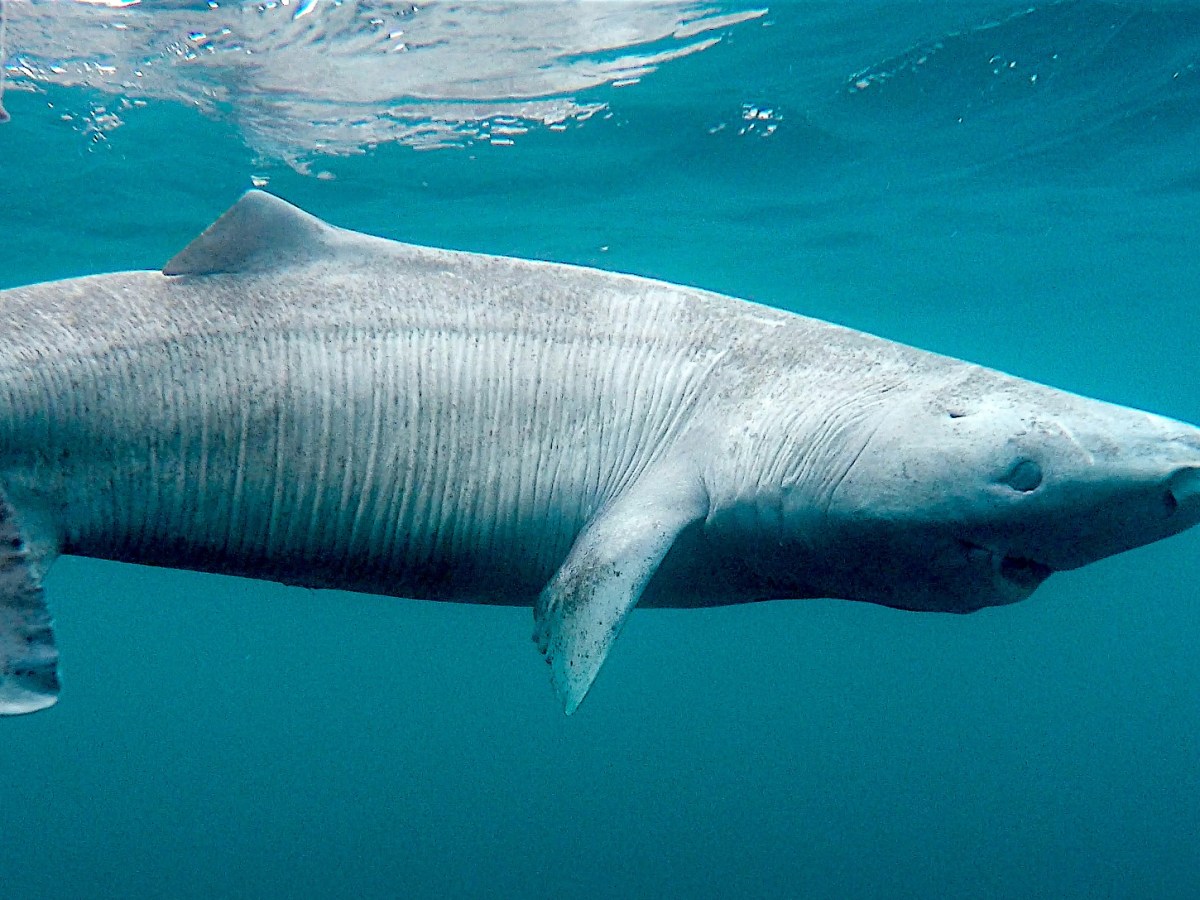
Western Australia’s moronic shark cull

4 07 2014

another stupid politicianA major media release today coordinated by Jessica Meeuwig in Western Australia makes the (obvious) point that there’s no biological justification to cull sharks.

301 Australian and International Scientists experts have today provided their submission to the Western Australia Environmental Protection Authority (EPA), rejecting the scientific grounds for the proposed three-year drum-line programme.

Coordinating scientist, Professor Jessica Meeuwig from the University of Western Australia said:

“To have over 300 researchers, including some of the world’s top shark specialists and marine ecologists, all strongly agreeing that there is no scientific basis for the lethal drum-line programme, tells you how unjustified the government’s proposal is. If the EPA and the Federal Minister for the Environment are using science for decisions, the drum-line proposal should not be approved.”

The experts agree that the proposal presents no evidence that the lethal drum-line programme, as implemented, will improve ocean safety. It ignores evidence from other hook-based programs in Hawaii and Queensland that have been shown to be ineffective in reducing shark attacks on humans.

Dr. Christopher Neff from the University of Sydney stated:

“There is no evidence that drum lines reduce shark bites. The Western Australia EPA now faces a question of science versus politics with global implications because it is considering establishing a new international norm that would allow for the killing of protected white sharks.”

The drum lines are ineffective and indiscriminate, with 78% of the sharks captured not considered ‘threatening’ to humans. Yet, scientifically supported, non-lethal alternatives such as the South African ‘Shark Spotter’ and Brazil’s ‘Tag and Remove’ programmes are not adequately assessed as viable options for Western Australia. Read the rest of this entry »


50/500 or 100/1000 debate not about time frame

26 06 2014

Not enough individualsAs you might recall, Dick Frankham, Barry Brook and I recently wrote a review in Biological Conservation challenging the status quo regarding the famous 50/500 ‘rule’ in conservation management (effective population size [Ne] = 50 to avoid inbreeding depression in the short-term, and Ne = 500 to retain the ability to evolve in perpetuity). Well, it inevitably led to some comments arising in the same journal, but we were only permitted by Biological Conservation to respond to one of them. In our opinion, the other comment was just as problematic, and only further muddied the waters, so it too required a response. In a first for me, we have therefore decided to publish our response on the arXiv pre-print server as well as here on ConservationBytes.com.

50/500 or 100/1000 debate is not about the time frame – Reply to Rosenfeld

cite as: Frankham, R, Bradshaw CJA, Brook BW. 2014. 50/500 or 100/1000 debate is not about the time frame – Reply to Rosenfeld. arXiv: 1406.6424 [q-bio.PE] 25 June 2014.

The Letter from Rosenfeld (2014) in response to Jamieson and Allendorf (2012) and Frankham et al. (2014) and related papers is misleading in places and requires clarification and correction, as follows: Read the rest of this entry »


Ecological processes depend on …

14 05 2014
© Cagan Sekercioglu

© Cagan Sekercioglu

I have been known to say (ok – I say it all the time) that ecologists should never equivocate when speaking to the public. Whether it’s in a media release, blog post, television presentation or newspaper article, just stick to ‘yes’ or ‘no’. In other words, don’t qualify your answer with some horrid statistical statement (i.e., in 95% of cases …) or say something like “… but it really depends on …”. People don’t understand uncertainty – to most people, ‘uncertainty’ means “I don’t know” or worse, “I made it all up”.

But that’s only in the movies.

In real ‘ecological’ life, things are vastly different. It’s never as straightforward as ‘yes’ or ‘no’, because ecology is complex. There are times that I forget this important aspect when testing a new hypothesis with what seem like unequivocal data, but then reality always hits.

Our latest paper is the epitome of this emergent complexity from what started out as a fairly simple question using some amazing data. What makes birds change their range1? We looked at this question from a slightly different angle than had been done before because we had access to climate data, life-history data and most importantly, actual range change data. It’s that latter titbit that is typically missing from studies aiming to understand what drives species toward a particular fate; whether it’s a species distribution model predicting the future habitat suitability of some species as a function of climate change, or the past dynamics of some species related to its life history pace, most often the combined dynamics are missing. Read the rest of this entry »


If biodiversity is so important, why is Europe not languishing?

17 03 2014

collapseI don’t often respond to many comments on this blog unless they are really, really good questions (and if I think I have the answers). Even rarer is devoting an entire post to answering a question. The other day, I received a real cracker, and so I think it deserves a highlighted response.

Two days ago, a certain ‘P. Basu’ asked this in response to my last blog post (Lose biodiversity and you’ll get sick):

I am an Indian who lived in Germany for quite a long period. Now, if I am not grossly mistaken, once upon a time Germany and other west european countries had large tracts of “real” forests with bears, wolves, foxes and other animals (both carnivore and herbivore). Bear has completely disappeared from these countries with the advent of industrialization. A few wolves have been kept in more or less artificially created forests. Foxes, deer and hares, fortunately, do still exist. My question is, how come these countries are still so well off – not only from the point of view of economy but also from the angle of public health despite the loss of large tracts of natural forests? Or is it that modern science and a health conscious society can compensate the loss of biodiversity.

“Well”, I thought to myself, “Bloody good question”.

I have come across this genre of question before, but usually under more hostile circumstances when an overtly right-wing respondent (hell, let’s call a spade a spade – a ‘completely selfish arsehole’) has challenged me on the ‘value of nature’ logic (I’m not for a moment suggesting that P. Basu is this sort of person; on the contrary, he politely asked an extremely important question that requires an answer). The comeback generally goes something like this: “If biodiversity is so important, why aren’t super-developed countries wallowing in economic and social ruin because they’ve degraded their own life-support systems? Clearly you must be wrong, Sir.”

There have been discussions in the ecological and sustainability literature that have attempted to answer this, but I’ll give it a shot here for the benefit of CB.com readers. Read the rest of this entry »


Lose biodiversity and you’ll get sick

14 03 2014

dengueHere’s a (paraphrased) recommendation I did recently for F1000 about a cool avenue of research I’ve been following for a few years now. Very interesting, but much, much more to do.

The core concepts of conservation ecology are well-established: we know that habitat lossfragmentation, invasive species, over-exploitation and of course, climate change, are bad for biodiversity. This well-quantified scientific baseline has led the discipline recently to embark on questions pertaining more to the (a) implications of biodiversity loss for humanity and (b) what we can do to offset these. A recent paper by Morand and colleagues addresses perhaps one of the most compelling reasons that human society should appreciate biodiversity beyond its intrinsic value; as biodiversity degrades, so too does human health.

Some argue that the only way to convince society in general that biodiversity is worth protecting is that we link its loss directly to degrading human health, wealth and well-being. Confirmation of such relationships at a variety of spatial and temporal scales is therefore essential. Morand and colleagues used data from a variety of sources to test two predictions: (1) that the number of infectious disease should increase as overall biodiversity increases and (2) that biodiversity loss, inferred from species threat and deforestation data, should increase the number of infectious disease outbreaks in humans. Using data from 28 countries in the Asia-Pacific region, they confirmed both predictions. Read the rest of this entry »



Australia’s (latest) war on the environment

3 03 2014

monkYes, the signs were there, but they weren’t clandestine messages written in the stars or in the chaos of tea-leaf dregs. We saw this one coming, but Australians chose to ignore the warning signs and opt for the American political model of extremism, religiosity, plutocracy and science denial.

Enter the ‘Tea Party’ of Australia – the ‘new’ Coalition where reigning Rex perditor Prime Minister Tony The Monk Abbott1 has, in just a few short months, turned back the clock on Australian environmental protection some 40 years.

Yes, we saw it coming, but it wasn’t a tautological fait accompli just because it concerned a ‘conservative’ government. It’s difficult to remember, I know, that conservative governments of yesteryear implemented some strikingly powerful and effective environmental legislation. Indeed, it was the former incarnation of the Coalition government that implemented the once-formidable Environmental Protection and Biodiversity Conservation (EPBC) Act under the direction of then Environment Minister, Robert Hill. A colossus of sorts, the EPBC suffers from many ailments. While it’s the only really bitey environmental legislation we’ve got, that colossus is a lumbering, limping giant missing more than a few teeth – it needs a complete overhaul.

As most Australians are unfortunately aware, The Monk repeatedly and defiantly promised to repeal the Labor-government carbon price implemented in July 2012, despite the absolute necessity to tax the heaviest pollutersWhile somewhat sheepish about his recent climate disruption denialism following his election in 2013, a denialist he remains:

Let us re-familiarise ourselves with some of his historical pearlers: Read the rest of this entry »


You know it’s hot when it’s too hot to ….

16 01 2014
© T. Brandon

© T. Brandon

My post’s title might be a good candidate title for a punk song in the 2030s (maybe by a re-incarnation of the Dead Kennedys).

I am currently sitting under my solar-powered ceiling fan as Adelaide is declared the world’s hottest city (and not in the funky, cultural, fun way), and I can’t help but contemplate climate change models predicting the fate of biodiversity over the coming decades. Because it’s far, far too hot to work outside, I’m perusing the latest interesting articles on the subject and I came across this recent little gem.

Also recommended on F1000Prime by Ary Hoffman, the paper, Using physiology to predict the responses of ants to climatic warming, by Sarah Diamond and colleagues touches on many aspects of climate predictions that need to be considered. I summarise these briefly here.

While no physiologist, I have dabbled in the past, although up until quite recently I didn’t see that physiology per se had much to do with conservation. It turns out that climate change has spawned an entire sub-discipline called ‘conservation physiology‘, which focuses inter alia on how species can/will/might respond and adapt to a warmer, climatically disrupted world.

What struck me about Diamond & colleagues’ paper was that yet again, it’s not as simple as heat-stressing a species experimentally and making a prediction on its future distribution (ecology is complex). No, the complexity comes in various forms that makes each species a little different from each other. Using North American ant species subjected to various warming scenarios in large (5 m) enclosures, they found the following: Read the rest of this entry »


Essential role of carnivores on the wane

10 01 2014
© Luca Galuzzi www.galuzzi.it

© Luca Galuzzi http://www.galuzzi.it

This interesting review has just come out in Science, and because I was given a heads-up about it, I decided to do a F1000 recommendation. That’s more or less what follows, with some additional thoughts.

Ripple and colleagues can perhaps be excused for stating what might appear to many ‘in the biz’ to be blatantly obvious, but their in-depth review of the status of the world’s carnivores is a comprehensive overview of this essential guild’s worldwide plight. It not only represents an excellent teaching tool, the review elegantly summarises the current status of these essential ecosystem engineers.

The world’s 245 terrestrial carnivores might seem to be ecologically redundant to the informed given their natural rarity, low densities and cryptic behaviour, but nothing could be farther from the truth. Ecologists have only within the last decade or so revealed the essential ecosystem functions of these species (see former posts on CB.com here, here and here). The review focuses on the largest and most well-studied species, but the trends likely apply across most of the order. Read the rest of this entry »