To spare or to share, that is a muddled question

9 10 2015
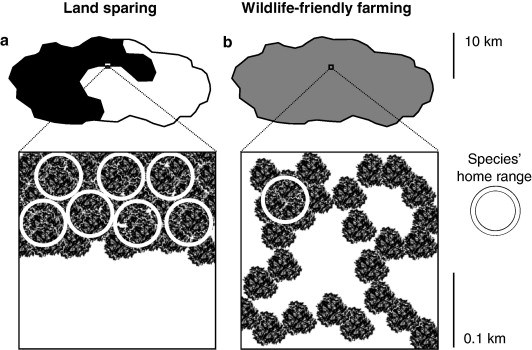
Unfortunately, it ain't this simple (from doi:10.1016/j.foodpol.2010.11.008)

Unfortunately, it ain’t this simple (from doi:10.1016/j.foodpol.2010.11.008)

Certain research trends in any field are inevitable, because once a seductive can of research-question worms is opened, it’s difficult to resist the temptation to start hooking in. Of course, I’m not against popular trends in research per se if they lead to a productive, empirical evaluation of the complexities involved, but it can sometimes result in a lot of wasted time. For example, in conservation ecology we’ve had to suffer 15 years of wasted effort on disproving neutral theory, we’ve bashed heads unnecessarily regarding the infamous SLOSS (‘Single Large Or Several Small’ reserves) debates of the 1970s and 1980s, and we’ve pilfered precious years arguing about whether density feedback actually exists (answer: it does).

The latest populist research trend in conservation seems to be the ‘land sparing versus land sharing’ debate, which, I (and others) argue, is largely an overly simplistic waste of time, money and intellectual advancement to the detriment of both biodiversity and human well-being.

Land sparing is generally used in reference to agricultural practices (although in theory, it could apply to any human endeavour where native vegetation cover is required to be removed or degraded, such as for electricity production) that are purposely made to be high-yielding so that they require the smallest amount of land. At the other extreme (and the ‘two extremes’ of a continuum concept is half the bloody problem here), land sharing requires a larger land footprint because it relies on lower-yielding, biodiversity-friendly (agricultural) practices. Proponents of land sparing argue that only by amalgamating patches of remnant native vegetation can we avoid massive fragmentation and the pursuant loss of biodiversity, whereas those pushing for land sparing argue that the matrix between the big undeveloped bits must be exploited in a more biodiversity-friendly way to allow species to persist.

As it turns out, they’re both right (but their single-minded, extremist positions are not). Read the rest of this entry »


How things have (not) changed

13 04 2015

The other night I had the pleasure of dining with the former Australian Democrats leader and senator, Dr John Coulter, at the home of Dr Paul Willis (Director of the Royal Institution of Australia). It was an enlightening evening.

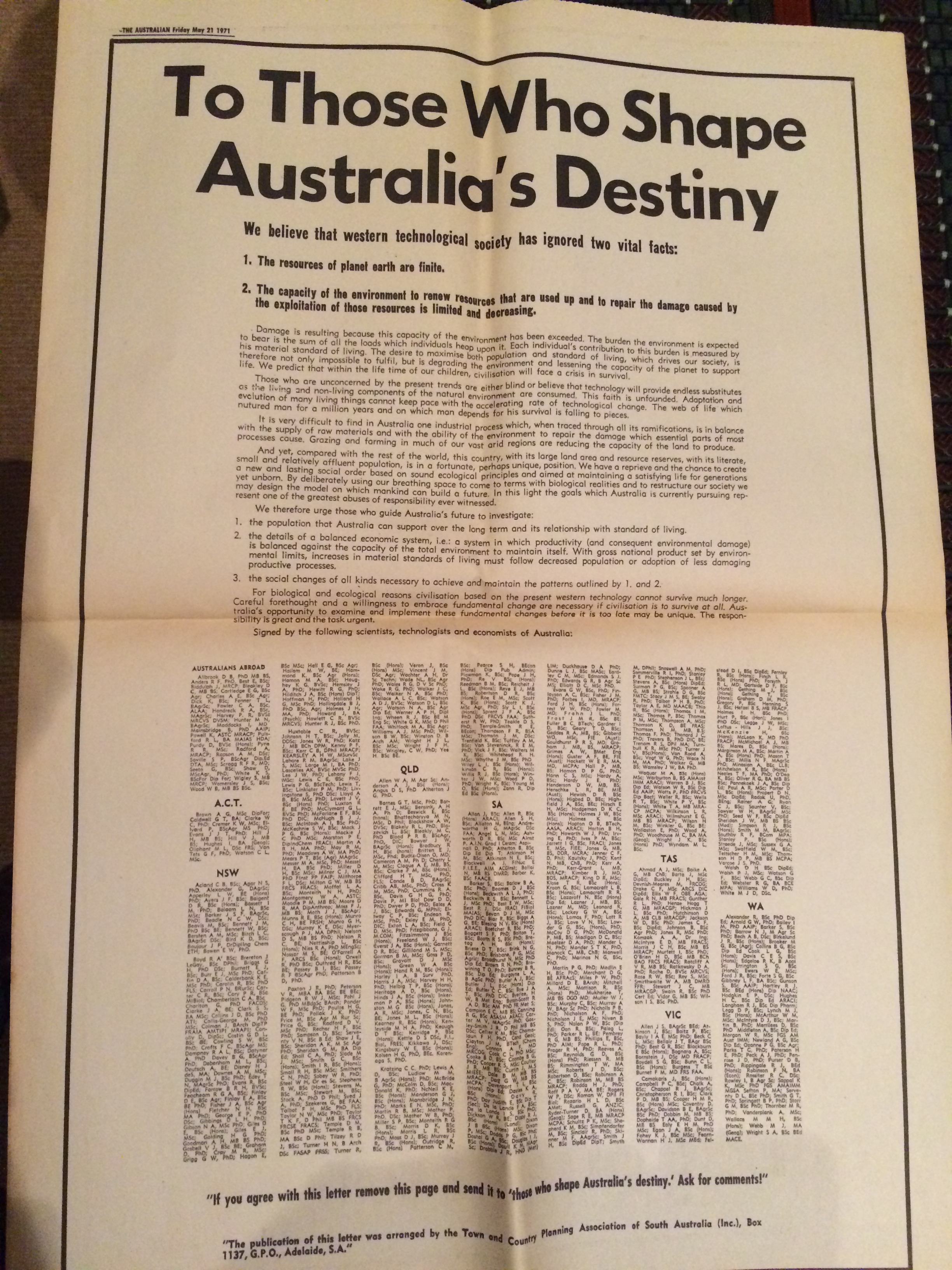
While we discussed many things, the 84 year-old Dr Coulter showed me a rather amazing advert that he and several hundred other scientists, technologists and economists constructed to alert the leaders of Australia that it was heading down the wrong path. It was amazing for three reasons: (i) it was written in 1971, (ii) it was published in The Australian, and (iii) it could have, with a few modifications, been written for today’s Australia.

If you’re an Australian and have even a modicum of environmental understanding, you’ll know that The Australian is a Murdochian rag infamous for its war on science and reason. Even I have had a run-in with its outdated, consumerist and blinkered editorial board. You certainly wouldn’t find an article like Dr Coulter’s in today’s Australian.

More importantly, this 44 year-old article has a lot today that is still relevant. While the language is a little outdated (and sexist), the grammar could use a few updates, and there are some predictions that clearly never came true, it’s telling that scientists and others have been worrying about the same things for quite some time.

In reading the article (reproduced below), one could challenge the authors for being naïve about how society can survive and even prosper despite a declining ecological life-support system. As I once queried Paul Ehrlich about some of his particularly doomerist predictions from over 50 years ago, he politely pointed out that much of what he predicted did, in fact, come true. There are over 1 billion people today that are starving, and another billion or so that are malnourished; combined, this is greater than the entire world population when Paul was born.

So while we might have delayed the crises, we certainly haven’t averted them. Technology does potentially play a positive role, but it can also increase our short-term carrying capacity and buffer the system against shocks. We then tend to ignore the indirect causes of failures like wars, famines and political instability because we do not recognise the real drivers: resource scarcity and ecosystem malfunction.

Australia has yet to learn its lesson.

To Those Who Shape Australia’s Destiny

We believe that western technological society has ignored two vital facts: Read the rest of this entry »


Australia’s perfect storm of negligence

17 03 2015

If, for the purposes of some sick and twisted thought experiment, you were to design policies that would ensure the long-term failure of a wealthy, developed nation, you wouldn’t have to look farther than Australia’s current recipe for future disaster. I’m not trying to be provocative, but the warning signs are too bold and flashy to ignore. Let’s just run through some of the main ones:

1. As the lambasted and thoroughly flawed 2015 Intergenerational Report clearly demonstrates, our current government has no idea about the future threats of climate change. Dragged kicking and screaming into only a symbolic recognition of some ‘distant and currently irrelevant problem’, the Abbott-oir and his intergenerational criminals are well known for killing the carbon-pricing scheme, dismantling the Department of Climate Change, pulling out of major international talks on climate-change mitigation and installing a half-arsed, ineffective policy that will do nothing to stem our emissions. Combine that with comments like “coal is good for humanity“, and it’s easy to see how our current leaders have little idea about the future mess they’re creating.

2. Not content just to kick the shit out of any meaningful climate action, our government has also turned its back on any renewable energy target, and facilitated the fossil-fuel barons to dig more coal out of the ground. While South Australia’s Royal Commission on the nuclear fuel cycle is a welcome candle in the climate change-mitigation darkness here, it is far from becoming a national priority any time soon.

3. As has been well documented, the Abbott-oir ship of fools has also done whatever it can to turn back decades of environmental protections in less than six months of taking office. Everything from opening up national parks for exploitation, failing to protect marine sanctuaries, limiting environmental checks to promoting logging in World Heritage Areas, there is little room for hope that our crumbling environmental system will improve at all in the near to long term. Read the rest of this entry »


When human society breaks down, wildlife suffers

22 01 2015

bearGlobal human society is a massive, consumptive beast that on average degrades its life-support system. As we’ve recently reported, this will only continue to get worse in the decades to centuries to come. Some have argued that as long as we can develop our societies enough, the impact of this massive demographic force can be lessened – a concept described by the environmental Kuznets curve. However, there is little evidence that negative societal impact on the environment is lessened as per capita wealth exceeds some threshold; unfortunately environmental damage tends to, on average, increase as a nation’s net wealth increases. That’s not to say that short-term improvements cannot be achieved through technological innovation – in fact, they will be essential to offset the inexorable growth of the global human population.

So poor nations as well as the wealthy ones are responsible for environmental damage. Poorer nations often have ineffective governance systems so they fail to enforce compliance in environmental regulations, but wealthier nations often exploit a high proportion of their natural resources, with the inevitable environmental damage this entails. In some cases however, biodiversity can temporarily escape some of the ravages of society because humans either perceive the area to be too dangerous, or otherwise have no incentive to go there. There are some good examples of the latter, such as the vicinity around the Chernobyl nuclear reactor that melted down in 1986, or the Korean demilitarised zone.

In this vein, I just stumbled across an extremely interesting paper today published online early in Conservation Biology that describes trends in charismatic wildlife (i.e., big mammals) as the former Soviet Union collapsed in 1991 and societal breakdown ensued. The authors had access to an amazing dataset that spanned the decade prior to the collapse, the decade immediately following, and a subsequent decade of societal renewal. What they found was fascinating. Read the rest of this entry »


It’s all about the variation, stupid

12 01 2015

val-1-3It is one of my long-suffering ecological quests to demonstrate to the buffoons in government and industry that you can’t simply offset deforestation by planting another forest elsewhere. While it sounds attractive, like carbon offsetting or even water neutrality, you can’t recreate a perfectly functioning, resilient native forest no matter how hard you try.

I’m not for a moment suggesting that we shouldn’t reforest much of what we’ve already cut down over the last few centuries; reforestation is an essential element of any semblance of meaningful terrestrial ecological restoration. Indeed, without a major commitment to reforestation worldwide, the extinction crisis will continue to spiral out of control.

What I am concerned about, however, is that administrators continue to push for so-called ‘biodiversity offsets’ – clearing a forest patch here for some such development, while reforesting or even afforesting another degraded patch there. However, I’ve blogged before about studies, including some of my own, showing that one simply cannot replace primary forests in terms of biodiversity and long-term carbon storage. Now we can add resilience to that list.

While I came across this paper a while ago, I’ve only found the time to blog about it now. Published in PLoS One in early December, the paper Does forest continuity enhance the resilience of trees to environmental change?1 by von Oheimb and colleagues shows clearly that German oak forests that had been untouched for over 100 years were more resilient to climate variation than forests planted since that time. I’ll let that little fact sink in for a moment … Read the rest of this entry »


Using ecological theory to make more money

1 12 2014

huge.9.46974Let’s face it: Australia doesn’t have the best international reputation for good ecological management. We’ve been particularly loathsome in our protection of forests, we have an appalling record of mammal extinctions, we’re degenerate water wasters and carbon emitters, our country is overrun with feral animals and weeds, and we have a long-term love affair with archaic, deadly, cruel, counter-productive and xenophobic predator management. To top it all off, we have a government hell-bent on screwing our already screwed environment even more.

Still, we soldier on and try to fix the damages already done or convince people that archaic policies should be scrapped and redrawn. One such policy that I’ve written about extensively is the idiocy and cruelty of the dingo fence.

The ecological evidence that dingoes are good for Australian wildlife and that they pose less threat to livestock than purported by some evidence-less graziers is becoming too big to ignore any longer. Poisoning and fencing are not only counter-productive, they are cruel, ineffective and costly.

So just when ecologists thought that dingoes couldn’t get any cooler, out comes our latest paper demonstrating that letting dingoes do their thing results in a net profit for cattle graziers.

Come again? Read the rest of this entry »


InvaCost – estimating the economic damage of invasive insects

7 11 2014

insectinvasionThis is a blosh (rehash of someone else’s blog post) of Franck Courchamp‘s posts on an exciting new initiative of which I am excited to be a part. Incidentally, Franck’s spending the week here in Adelaide.

Don’t forgot to vote for the project to receive 50 000 € public-communication grant!

Climate change will make winters milder and habitats climatically more suitable year-round for cold-blooded animals like insects, but there are many questions remaining regarding whether such insects will be able to invade other regions as the climate shifts. There are many nasty bugs out there.

For example, the Asian predatory wasp is an invasive hornet in Europe that butchers pollinating insects, especially bees, thereby affecting the production of many wild and cultivated plants. I hope that we all remember what Einstein said about pollinators:

If bees were to disappear, humans will disappear within a few years.

(we all should remember that because it’s one of the few things he said that most of us understood). The highly invasive red fire ant is feared for its impacts on biodiversity, agriculture and cattle breeding, and the thousands of anaphylactic shocks inflicted to people by painful stings every year (with hundreds of deaths). Between the USA and Australia, over US$10 billion is spent yearly on the control of this insect alone. Tiger mosquitoes are vectors of pathogens that cause dengue fever, chikungunya virus and of about 30 other viruses. We could go on.

Most of these nasty creatures are now unable to colonise northern regions of Europe or America, or southern regions of Australia, for example, because they cannot survive cold temperatures. But how will this change? Where, when and which species will invade with rising temperatures? What will be the costs in terms of species loss? In terms of agricultural or forestry loss? In terms of diseases to cattle, domestic animals and humans? What will be the death toll if insects that are vectors of malaria can establish in new, highly populated areas?

We’ve proposed to study these and others from a list of 20 of the worst invasive insect species worldwide, and we got selected (i.e., financed!) by the Fondation BNP Paribas. In addition, the Fondation BNP Paribas has selected five scientific programmes on climate change and will give 50,000 € (that’s US$62,000) to the one selected by the public, for a communication project on their scientific programme. This is why we need you to vote for our project: InvaCost. Read the rest of this entry »


We generally ignore the big issues

11 08 2014

I’ve had a good week at Stanford University with Paul Ehrlich where we’ve been putting the final touches1 on our book. It’s been taking a while to put together, but we’re both pretty happy with the result, which should be published by The University of Chicago Press within the first quarter of 2015.

It has indeed been a pleasure and a privilege to work with one of the greatest thinkers of our age, and let me tell you that at 82, he’s still a force with which to be reckoned. While I won’t divulge much of our discussions here given they’ll appear soon-ish in the book, I did want to raise one subject that I think we all need to think about a little more.

The issue is what we, as ecologists (I’m including conservation scientists here), choose to study and contemplate in our professional life.

I’m just as guilty as most of the rest of you, but I argue that our discipline is caught in a rut of irrelevancy on the grander scale. We spend a lot of time refining the basics of what we essentially already know pretty well. While there will be an eternity of processes to understand, species to describe, and relationships to measure, can our discipline really afford to avoid the biggest issues while biodiversity (and our society included) are flushed down the drain?

Read the rest of this entry »


Tropical forest resilience depends on past disturbance frequency

16 07 2014

I’ve recently come across an interesting study that perfectly marries palaeo-ecological data with modern conservation philosophy. It’s not often that such a prehistorical perspective dating at least to the Last Glacial Maximum has been used so effectively to inform future conservation outlooks. I’m particularly interested in this sort of approach considering my own palaeo dabblings of late.

Published in Nature Communications this May, Lydia Cole and colleagues’ paper Recovery and resilience of tropical forests after disturbance is a meta-analysis of 71 studies covering nearly 300 disturbance events in tropical forests over the last 20,000 years or so. Using fossil pollen records as an index of vegetation change, they demonstrated the (somewhat intuitive) main result that the time to recovery following a disturbance generally decreases as the past disturbance frequency increased.

This appears to be a vindication of the idea that a system’s adaptive strategies evolve as a product of the local disturbance regime. More importantly, they found that recovery was faster following ‘large infrequent events’, which are natural perturbations such as cyclones and major fires. While most past disturbances were caused by humans clearing forest, the fact that tropical forest systems were most resilient to ‘natural’ events means that if we can’t stop human disturbances, at least we can attempt to emulate natural processes to maximise the rebound potential. Much like many modern forestry operations try to emulate natural disturbances to limit their damage, we should at least manage our impacts by understanding so-called ‘natural’ regimes as much as possible. Read the rest of this entry »


A convenient truth: global push for carbon-based conservation

19 05 2014

Eucalyptus viminalis (Manna Gum) - leaf, adultI’ve just written an article for the Australian River Restoration Centre‘s RipRap magazine, and they have given me permission to reproduce it here.

The brave, new green world of the carbon economy hasn’t exactly taken off as desired. Perhaps it’s because it wasn’t really planned from the outset, or maybe it is still too abstract for most people to accept, digest and incorporate into their daily lives. An emergent property of society’s generally slow awakening to the challenge of climate disruption, is that it will be a long time before we accept its full suite of incarnations.

The infant carbon economy is, however, well and truly alive and kicking, so it is important to try and plan for its growing influence on our decision making. Bumps in the road aside, the carbon economy has mostly been a blessing (actual and potential) for biodiversity conservation projects the world over.

In principle, the aim of the carbon economy is rather straight-forward: charge people a certain amount for each unit of carbon dioxide equivalents they release, and then use that money to develop approaches that further increase carbon sequestration or limit emissions. It’s a ‘build-it-and-they-will-come’ framework, where increasing financial impetus to restrict emissions is enhanced by society’s evolution towards better approaches and technology.

The operational side of the carbon economy is unfortunately much more muddled, with vested interests and political gaming weakening its implementation. Nonetheless, we persevere. Read the rest of this entry »



If biodiversity is so important, why is Europe not languishing?

17 03 2014

collapseI don’t often respond to many comments on this blog unless they are really, really good questions (and if I think I have the answers). Even rarer is devoting an entire post to answering a question. The other day, I received a real cracker, and so I think it deserves a highlighted response.

Two days ago, a certain ‘P. Basu’ asked this in response to my last blog post (Lose biodiversity and you’ll get sick):

I am an Indian who lived in Germany for quite a long period. Now, if I am not grossly mistaken, once upon a time Germany and other west european countries had large tracts of “real” forests with bears, wolves, foxes and other animals (both carnivore and herbivore). Bear has completely disappeared from these countries with the advent of industrialization. A few wolves have been kept in more or less artificially created forests. Foxes, deer and hares, fortunately, do still exist. My question is, how come these countries are still so well off – not only from the point of view of economy but also from the angle of public health despite the loss of large tracts of natural forests? Or is it that modern science and a health conscious society can compensate the loss of biodiversity.

“Well”, I thought to myself, “Bloody good question”.

I have come across this genre of question before, but usually under more hostile circumstances when an overtly right-wing respondent (hell, let’s call a spade a spade – a ‘completely selfish arsehole’) has challenged me on the ‘value of nature’ logic (I’m not for a moment suggesting that P. Basu is this sort of person; on the contrary, he politely asked an extremely important question that requires an answer). The comeback generally goes something like this: “If biodiversity is so important, why aren’t super-developed countries wallowing in economic and social ruin because they’ve degraded their own life-support systems? Clearly you must be wrong, Sir.”

There have been discussions in the ecological and sustainability literature that have attempted to answer this, but I’ll give it a shot here for the benefit of CB.com readers. Read the rest of this entry »


Lose biodiversity and you’ll get sick

14 03 2014

dengueHere’s a (paraphrased) recommendation I did recently for F1000 about a cool avenue of research I’ve been following for a few years now. Very interesting, but much, much more to do.

The core concepts of conservation ecology are well-established: we know that habitat lossfragmentation, invasive species, over-exploitation and of course, climate change, are bad for biodiversity. This well-quantified scientific baseline has led the discipline recently to embark on questions pertaining more to the (a) implications of biodiversity loss for humanity and (b) what we can do to offset these. A recent paper by Morand and colleagues addresses perhaps one of the most compelling reasons that human society should appreciate biodiversity beyond its intrinsic value; as biodiversity degrades, so too does human health.

Some argue that the only way to convince society in general that biodiversity is worth protecting is that we link its loss directly to degrading human health, wealth and well-being. Confirmation of such relationships at a variety of spatial and temporal scales is therefore essential. Morand and colleagues used data from a variety of sources to test two predictions: (1) that the number of infectious disease should increase as overall biodiversity increases and (2) that biodiversity loss, inferred from species threat and deforestation data, should increase the number of infectious disease outbreaks in humans. Using data from 28 countries in the Asia-Pacific region, they confirmed both predictions. Read the rest of this entry »


Terrestrial biodiversity’s only chance is avoided deforestation

24 01 2014

farming forestsToday I was shocked, stunned and pleasantly (for a change) surprised. Australia has its first ‘avoided deforestation’ carbon farming project.

It is understandable that this sort of news doesn’t make the Jane & Joe Bloggs of the world stand up and cheer, but it should make conservation biologists jump for bloody joy.

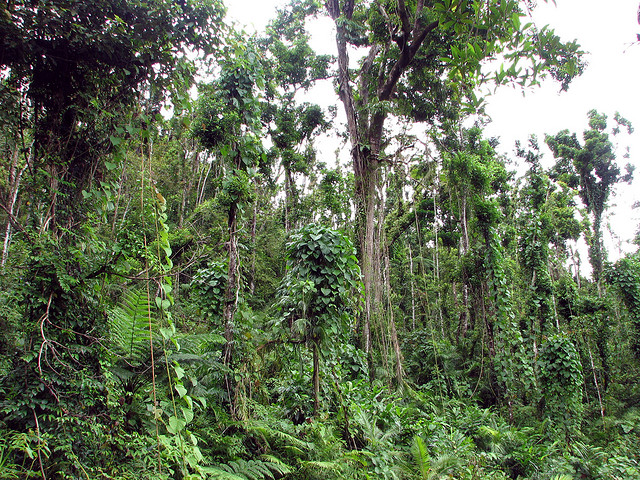
So why exactly am I so excited about the setting aside of a mere 9000 ha (90 km2, or 10 × 9 km) of semi-arid scrub in western New South Wales? It’s simple – nothing can replace the biodiversity or carbon value of primary forest. In other words, forest restoration – while laudable and needed – can never achieve what existing forest already does. We know now from various parts of the world that biodiversity is nearly always much higher in primary forest, and that the carbon structure of the forest (especially below-ground carbon) can take centuries to recover.

Another problem with restoration – and if you’ve ever been involved in any tree planting yourself, you’ll know what I mean – is that it’s incredibly expensive, time-consuming and slow. Wouldn’t it make more financial sense just to save forests instead of trying to rebuild them?

Of course it is, so the logical conclusion from a conservation perspective is to save primary forest first, then worry about restoration next. The problem is, there are few, if any, financial incentives for keeping forests standing in the private sector. The stumbling rise of the carbon economy is a potential resolution to this problem, although neither the Kyoto Protocol nor most national carbon-trading schemes adequately account for the carbon value of existing forests.

Up until today, even Australia didn’t have any examples.

Read the rest of this entry »


Biowealth: all creatures great and small

4 12 2013

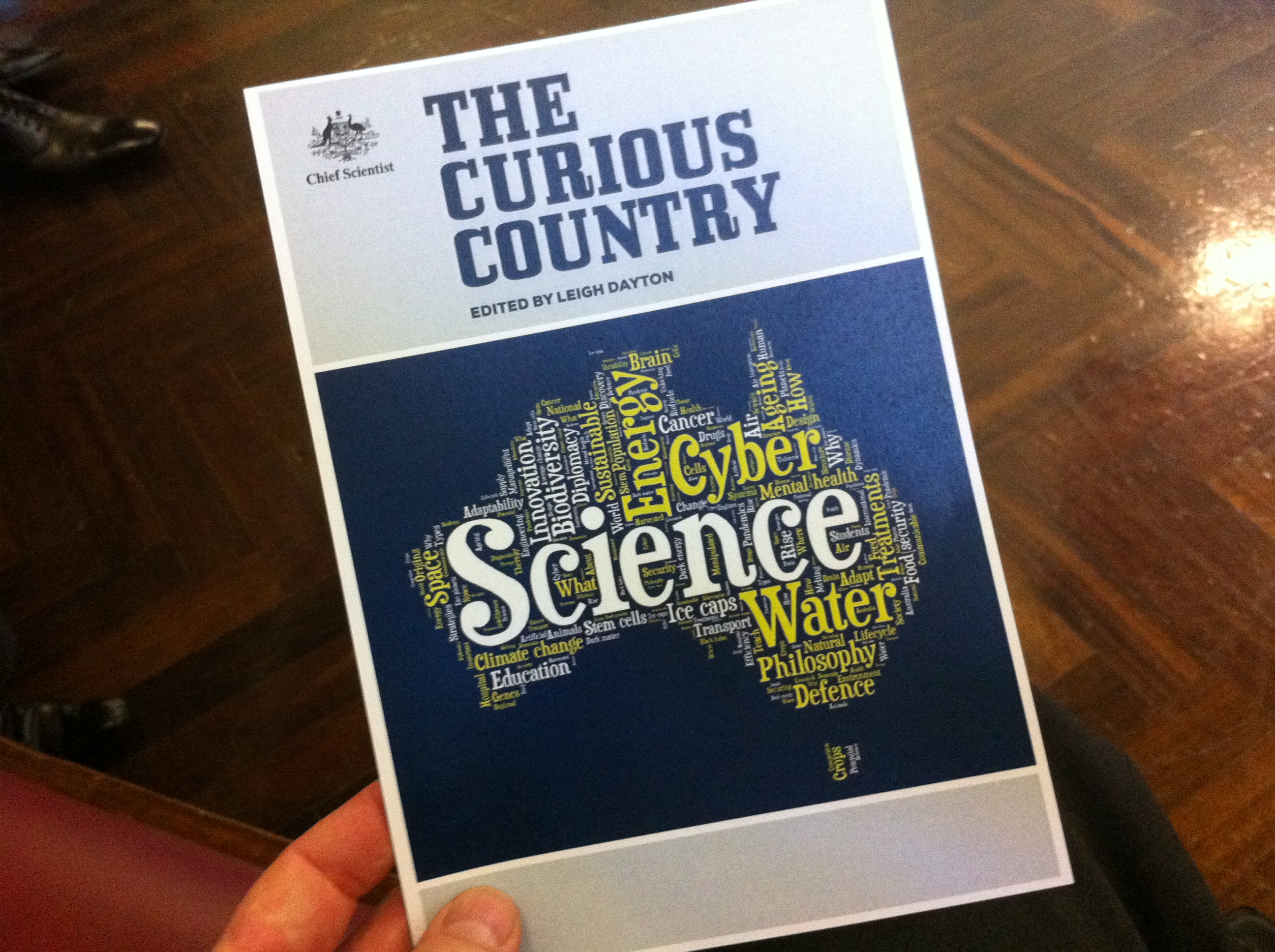
Curious Country flyer“So consider the crocodiles, sharks and snakes, the small and the squirmy, the smelly, slimy and scaly. Consider the fanged and the hairy, the ugly and the cute alike. The more we degrade this astonishing diversity of evolved life and all its interactions on our only home, the more we expose ourselves to the ravages of a universe that is inherently hostile to life.”

excerpt from ‘Biowealth: all creatures great and small’ The Curious Country (C.J.A. Bradshaw 2013).

I’ve spent the last few days on the east coast with my science partner-in-crime, Barry Brook, and one of our newest research associates (Marta Rodrigues-Rey Gomez). We first flew into Sydney at sparrow’s on Monday, then drove a hire car down to The ‘Gong to follow up on some Australian megafauna databasing & writing with Bert Roberts & Zenobia Jacobs. On Tuesday morning we then flitted over to Canberra where we had the opportunity to attend the official launch of a new book that Barry and I had co-authored.

The book, The Curious Country, is an interesting experiment in science communication and teaching dreamed up by Australia’s Chief Scientist, Professor Ian Chubb. Realising that the average Aussie has quite a few questions about ‘how stuff works’, but has little idea how to answer those questions, Ian engaged former Quantum star and science editor, Leigh Dayton, to put together a short, punchy, topical and easily understood book about why science is good for the country.

Yes, intuitive for most of you out there reading this, but science appreciation isn’t always as high as it should be amongst the so-called ‘general public’. Ian thought this might be one way to get more people engaged.

When honoured with the request to write an interesting chapter on biodiversity for the book, I naturally accepted. It turns out Barry was asked to do one on energy provision at the same time (but we didn’t know we had both been asked at the time). Our former lab head, Professor David Bowman, was also asked to write a chapter about fire risk, so it was like a mini-reunion yesterday for the three of us.

Read the rest of this entry »


King for a day – what conservation policies would you make?

29 11 2013

CrownI have been thinking a lot lately about poor governance and bad choices when it comes to biodiversity conservation policy. Perhaps its all that latent anger arising from blinkered, backward policies recently implemented by conservative state and national governments in Australia and elsewhere that leads me to contemplate: What would I do if I had the power to change policy?

While I am certain I have neither the experience or complete knowledge to balance national budgets, ensure prosperity and maintain the health of an entire country, I do have some ideas about what we’re doing wrong conservation-wise, and how we could potentially fix things. This is not meant to be an exhaustive list – it is more a discussion point where people can suggest their own ideas.

So here are 16 things I’d change or implement (mainly in Australia) if I were king for a day:

Read the rest of this entry »


Quantity, but not quality – slow recovery of disturbed tropical forests

8 11 2013

tropical regrowthIt is a sobering statistic that most of the world’s tropical forests are not ‘primary’ – that is, those that have not suffered some alteration or disturbance from humans (previously logged, cleared for agriculture, burned, etc.).

Today I highlight a really cool paper that confirms this, plus adds some juicy (and disturbing – pun intended – detail). The paper by Phil Martin and colleagues just published in Proceedings of the Royal Society B came to my attention through various channels – not least of which was their citation of one of our previous papers ;-), as well as a blog post by Phil himself. I was so impressed with it that I made my first Faculty of 1000 Prime recommendation1 of the paper (which should appear shortly).

As we did in 2011 (to which Phil refers as our “soon-to-be-classic work” – thanks!), Martin and colleagues amassed a stunning number of papers investigating the species composition of disturbed and primary forests from around the tropics. Using meta-analysis, they matched disturbed and undisturbed sites, recording the following statistics: Read the rest of this entry »


MPs’ ignorance puts national parks in peril

30 08 2013

greedyLed by Bill Laurance, our latest opinion editorial in the Higher Education supplement. Interestingly, it has already spawned a bilious and spittle-flecked response by Queensland’s Acting National Parks Minister, Tim Mander. Given the evidence, who’s side do you take? I’m happy that at least one of the worst culprit state governments is at least now paying some attention to the issue.

LAST week the world was appalled when Ecuador decided to open up one of its iconic national parks for petroleum development, with Leonardo di Caprio being among the chorus of dissenting voices. Yet the world should be even more disappointed in Australia, a far wealthier nation whose parks could be facing even worse threats.

Why is Australia going down this reckless path? It’s all down to the state governments – especially in Victoria, Queensland and NSW.

For the conservative politicians currently holding sway in these States, it seems it’s time to generate some quick cash while cutting park budgets – and never mind the impact on Australia’s imperilled ecosystems and biodiversity.

In Victoria, for instance, land developers are now being allowed to build hotels and other ventures in national parks. In NSW, recreational shooting and possibly logging will be allowed in parks if new legislation is passed. In NSW’s marine parks, bans on shore-based recreational fishing are being lifted [see previous post here].

Other parks in NSW and Queensland are being opened up to livestock grazing. In Morrinya National Park in Queensland, a strip of forest 20 km long was recently cleared for fencing, with new stock-watering tanks being established throughout the park. Read the rest of this entry »


Guilty until proven innocent

18 07 2013

precautionary principleThe precautionary principle – the idea that one should adopt an approach that minimises risk – is so ingrained in the mind of the conservation scientist that we often forget what it really means, or the reality of its implementation in management and policy. Indeed, it has been written about extensively in the peer-reviewed conservation literature for over 20 years at least (some examples here, here, here and here).

From a purely probabilistic viewpoint, the concept is flawlessly logical in most conservation questions. For example, if a particular by-catch of a threatened species is predicted [from a model] to result in a long-term rate of instantaneous population change (r) of -0.02 to 0.01 [uniform distribution], then even though that interval envelops r = 0, one can see that reducing the harvest rate a little more until the lower bound is greater than zero is a good idea to avoid potentially pushing down the population even more. In this way, our modelling results would recommend a policy that formally incorporates the uncertainty of our predictions without actually trying to make our classically black-and-white laws try to legislate uncertainty directly. Read the rest of this entry »


Brave new green world: biodiversity’s response to Australia’s carbon economy

12 03 2013

carbon farming 2I’ve had a busy weekend entertaining visiting colleagues and participating in WOMADelaide‘s first-ever ‘The Planet Talks‘. If you haven’t heard of WOMADelaide, you’re truly missing out in one of the best music festivals going (and this is from a decidedly non-festival-going sort). Planet Talks this year was a bit of an experiment after the only partially successful Earth Station festival held last year (it was well-attended, but apparently wasn’t as financially successful as they had hoped). So this year they mixed a bit of science with a bit of music – hence ‘Planet Talks’. Paul Ehrlich was one of the star attractions, and I had the honour of going onstage with him yesterday to discuss a little bit about human population growth and sustainability. It was also great to see Robyn Williams again. All the Talks were packed out – indeed, I was surprised they were so popular, especially in the 39-degree heat. Rob Brookman, WOMADelaide’s founder and principal organiser, told me afterward that they’d definitely be doing it again.

But my post really isn’t about WOMADelaide or The Planet Talks (even though I got the bonus of meeting one of my favourite latin bands, Novalima, creators of one of my favourite songs). It’s instead about a paper I heralded last year that’s finally been accepted.

In early 2012 at the Terrestrial Ecosystem Research Network (TERN) symposium in Adelaide, the Australian Centre for Ecological Analysis and Synthesis (ACEAS) put on what they called the ‘Grand Challenges’ workshop. I really didn’t get the joke at the time, but apparently the ‘grand challenge’ was locking 30 scientists with completely different backgrounds in a room for two days to see if they could do anything other than argue and bullshit. Well, we rose to that challenge and produced something that I think is rather useful.

I therefore proudly introduce the paper entitled Brave new green world: consequences of a carbon economy for the conservation of Australian biodiversity just accepted in Biological Conservation. The online version isn’t quite ready yet (should be in the next few weeks), but you are welcome to request a preprint from me now. If you attended (the surprisingly excellent) TERN symposium in Canberra last month, you might have seen me give a brief synopsis of our results.

The paper is a rather  in-depth review of how we, 30 fire, animal, plant, soil, landscape, agricultural and freshwater biologists, believe Australia’s new carbon-influenced economy (i.e., carbon price) will impact the country’s biodiversity. Read the rest of this entry »


Crying ‘wolf’ overlooks the foxes: challenging ‘planetary tipping points’

28 02 2013

tipping pointToday, a paper by my colleague, Barry Brook, appeared online in Trends in Ecology and Evolution. It’s bound to turn a few heads.

Let’s not get distracted by the title of the post, or the potential for a false controversy. It’s important to be clear that the planet is indeed ill, and it’s largely due to us. Species are going extinct faster than the would have otherwise. The planet’s climate system is being severely disrupted, so is the carbon cycle. Ecosystem services are on the decline.

But – and it’s a big ‘but’ – we have to be wary of claiming the end of the world as we know it or people will shut down and continue blindly with their growth and consumption obsession. We as scientists also have to be extremely careful not to pull concepts and numbers out of our bums without empirical support.

Specifically, I’m referring to the latest ‘craze’ in environmental science writing – the idea of ‘planetary tipping points‘ and the related ‘planetary boundaries‘. It’s really the stuff of Hollywood disaster blockbusters – the world suddenly shifts into a new ‘state’ where some major aspect of how the world functions does an immediate about-face. Read the rest of this entry »