Influential conservation ecology papers of 2019

24 12 2019

Bradshaw-Waves breaking on rocks Macquarie Island
As I’ve done for the last six years, I am publishing a retrospective list of the ‘top’ 20 influential papers of 2019 as assessed by experts in F1000 Prime (in no particular order). See previous years’ lists here: 20182017, 20162015, 2014, and 2013.

Read the rest of this entry »


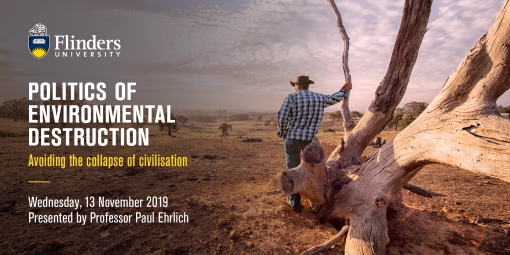
The politics of environmental destruction

22 10 2019

C_SE 409521698 Paul Ehrlich Lecture Event - Eventbrite2

You’d think I’d get tired of this, wouldn’t you? Alas, the fight does wear me down, but I must persist.

My good friend and colleague, the legendary Professor Paul Ehrlich of Stanford University, as well as his equally legendary wife, Anne, will be joining us in Adelaide for a brief visit during their annual southern migration.

Apart from just catching up over a few good bottles of wine (oh, do those two enjoy fine wines!), we have the immense privilege of having Paul appear at two events while he’s in town.

I’m really only going to be talking about the second of the two events (the first is a Science Meets Parliament gig with me and many others at the South Australia Parliament on 12 November): a grand, public lecture and Q&A session held at Flinders University on Wednesday, 13 November.

Haven’t heard of Paul? Where have you been hiding? If by some miracle you haven’t, here’s a brief bio:

Paul Ehrlich is Bing Professor of Population Studies Emeritus, President of the Center for Conservation Biology, Department of Biology, Stanford University and Adjunct Professor, University of Technology, Sydney. He does research in population biology (includes ecology, evolutionary biology, behavior, and human ecology and cultural evolution). Ehrlich has carried out field, laboratory and theoretical research on a wide array of problems ranging from the dynamics and genetics of insect populations, studies of the ecological and evolutionary interactions of plants and herbivores, and the behavioral ecology of birds and reef fishes, to experimental studies of the effects of crowding on human beings and studies of cultural evolution, especially the evolution of norms. He is President of the Millennium Alliance for Humanity and the Biosphere and is author and coauthor of more than 1100 scientific papers and articles in the popular press and over 40 books. He is best known to his efforts to alert the public to the many intertwined drivers that are pushing humanity toward a collapse of civilization – especially overpopulation, overconsumption by the rich, and lack of economic, racial, and gender equity. Ehrlich is a Fellow of the American Academy of Arts and Sciences, the American Entomological Society and the Beijer Institute of Ecological Economics, and a member of the United States National Academy of Sciences and the American Philosophical Society.  He is a Foreign Member of the Royal Society, an Honorary Member of the British Ecological Society and an Honorary Fellow of the Royal Entomological Society.  Among his many other honours are the Royal Swedish Academy of Sciences, Crafoord Prize in Population Biology and the Conservation of Biological Diversity (an explicit replacement for the Nobel Prize); a MacArthur Prize Fellowship; the Volvo Environment Prize; UNEP Sasakawa Environment Prize; the Heinz Award for the Environment; the Tyler Prize for Environmental Achievement; the Heineken Prize for Environmental Sciences; the Blue Planet Prize;  the Eminent Ecologist award of the Ecological Society of America, the Margalef Prize in Ecology and Environmental Sciences, and the BBVA Frontiers of Knowledge Award in Ecology and Conservation Biology. Prof Ehrlich has appeared as a guest on more than 1000 TV and radio programs; he also was a correspondent for NBC News. He has given many hundreds of public lectures in the past 50 years.

I hope your jaw just dropped.

Read the rest of this entry »


Environmental damage kills children

1 10 2019

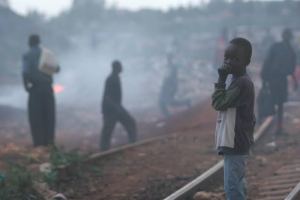
Yes, childrenairpollutionit’s a provocative title, I agree. But then again, it’s true.
But I don’t just mean in the most obvious ways. We already have good data showing that lack of access to clean water and sanitation kills children (especially in developing nations), that air pollution is a nasty killer of young children in particular, and now even climate change is starting to take its toll.

These aspects of child health aren’t very controversial, but when we talk about the larger suite of indicators of environmental ‘damage’, such as deforestation rates, species extinctions, and the overall reduction of ecosystem services, the empirical links to human health, and to children in particular, are far rarer.

This is why I’m proud to report the publication today of a paper on which I and team of wonderful collaborators (Sally Otto, Zia Mehrabi, Alicia Annamalay, Sam Heft-Neal, Zach Wagner, and Peter Le Souëf) have worked for several years.

I won’t lie — the path to publishing this paper was long and hard, I think mainly because it traversed so many different disciplines. But we persevered and today published the paper entitled ‘Testing the socioeconomic and environmental determinants of better child-health outcomes in Africa: a cross-sectional study among nations* in the journal BMJ Open.

Read the rest of this entry »


The Great Dying

30 09 2019

Here’s a presentation I gave earlier in the year for the Flinders University BRAVE Research and Innovation series:

There is No Plan(et) B — What you can do about Earth’s extinction emergency

Earth is currently experiencing a mass extinction brought about by, … well, … us. Species are being lost at a rate similar to when the dinosaurs disappeared. But this time, it’s not due to a massive asteroid hitting the Earth; species are being removed from the planet now because of human consumption of natural resources. Is a societal collapse imminent, and do we need to prepare for a post-collapse society rather than attempt to avoid one? Or, can we limit the severity and onset of a collapse by introducing a few changes such as removing political donations, becoming vegetarians, or by reducing the number of children one has?

Read the rest of this entry »


Nothing like a good forest

31 07 2019

Our history and culture are intimately tied to the planet’s forests and the services they provide to all living beings. In modern times, forests also help combat the impacts of anthropogenic climate change, not only by acting as powerful sinks of the carbon excess resulting from our greenhouse-gas emissions, but also as thermal shields we and many other species can benefit from.

55_ForestBufferingPhotoPortadaQuercusCoverProposed2

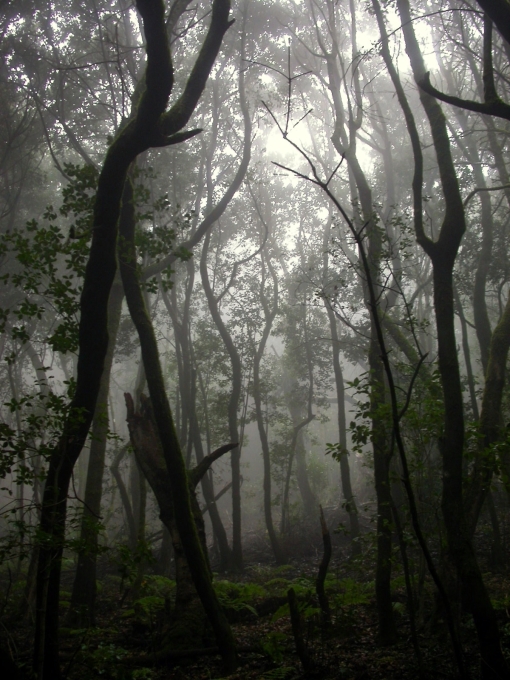
Understory of the laurel forest in Garajonay National Park (La Gomera, Canary Islands) – also part of the World Network of Biosphere Reserves since 2012. The fog, combined with the cloud belt blowing from the Atlantic Ocean against the mountains (Garajonay is the highest peak at 1500 m), creates a mesic microclimate crucial for plant endemism. Forest canopies reinforce humidity and buffer temperature variation for many species. Photo: Paco Rodríguez.

If we were to choose a house to live, most would likely opt for one with water and electricity supply, noiseless nights, nearby leisure and shopping, and easy communication by public transport. Lacking only one of those aspects could be off-putting.

In truth, those who have the privilege of living in a stable household value it by the full set of available commodities. Similarly, the value of an ecosystem rests on its entire repertoire of ecological functions (1). And this is particularly so for forest ecosystems.

The ecological value of a forest relies on the collection of its native characteristics (2): how many autochthonous and mature trees it can host, how much photosynthesis it fuels, how many pollinisers it feeds, how much soil and water it creates and retains, and many more (3). Read the rest of this entry »


Academics and Indigenous groups unite to stand up for the natural world

26 04 2019
rainforest

Rain forest gives way to pastures in the Brazilian Amazon in Mato Grosso. Photo by Thiago Foresti.

More than 600 scientists from every country in the EU and 300 Brazilian Indigenous groups have come together for the first time. This is because we see a window of opportunity in the ongoing trade negotiations between the EU and Brazil. In a Letter published in Science today, we are asking the EU to stand up for Brazilian Indigenous rights and the natural world. Strong action from the EU is particularly important given Brazil’s recent attempts to dismantle environmental legislation and ‘develop the unproductive Amazon’.

It’s worth clarifying — this isn’t about the EU trying to control Brazil — it’s about making sure our imports aren’t driving violence and deforestation. Foreign white people trying to ‘protect nature’ abroad have a dark and shameful past, where actions done in the name of conservation have led to the eviction of millions of Indigenous people. This has predominantly been to create (what we in the world of conservation would call) ‘protected areas’. The harsh reality is that most protected areas either are or have been ancestral lands of Indigenous people who are closely linked to their land and depend on it for their survival. Clearly, conservationists need to support Indigenous people. This new partnership between European scientists and Brazilian Indigenous groups is doing just that.

Brazil

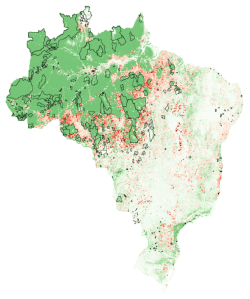
Brazil’s forest loss 2001-2013 shown in red. Indigenous lands outlined. By Mike Clark; data from GlobalForestWatch.org

In Brazil, many Indigenous groups still have a right to their land. This land is predominantly found in the Amazon rainforest, where close to a million Indigenous people live and depend on a healthy forest. Indigenous people are some of the best protectors of this vast forest, and are crucial to a future of long-term successful conservation. But Brazilian Indigenous groups and local communities are increasingly under attack. Violence on deforestation frontiers in Brazil has spiked this month, with at least 9 people found dead. The future is particularly scary for Indigenous people when there are quotes such as this from the man who is currently the President It’s a shame that the Brazilian cavalry hasn’t been as efficient as the Americans, who exterminated the Indians.

On top of human rights and environmental concerns, there is a strong profit driven case for halting deforestation. For example, ongoing deforestation in the Amazon risks flipping large parts of the rainforest to savanna – posing a serious risk to agricultural productivity, food security, local livelihoods, and the Brazilian economy. Zero-deforestation doesn’t harm agri-business, it allows for its longevity. Read the rest of this entry »


Influential conservation ecology papers of 2018

17 12 2018

e35f9ddeada029a053a15cd023abadf5
For the last five years I’ve published a retrospective list of the ‘top’ 20 influential papers of the year as assessed by experts in F1000 Prime — so, I’m doing so again for 2018 (interesting side note: six of the twenty papers highlighted here for 2018 appear in Science magazine). See previous years’ posts here: 2017, 20162015, 2014, and 2013.

Read the rest of this entry »


Perseverance eventually gets the policy makers’ attention

10 12 2018
IMG_2819

My entry badge today to the South Australian Parliament (sorry for the shitty reproduction, but it’s a shitty photo of a shitty photo)

I’ve often commented on it over the years, as well as written about it both in my latest book, as well as featured it here on CB.com, that little of the conservation science we do appears to reach the people making all the decisions. This is, of course, a massive problem because so much policy that affects biodiversity is not evidence-based, nor do we seem to be getting any better at telling them how buggered our natural world is.

Even the Extinction Rebellion, or school kids screaming in the streets about lack of climate-change policies appears unable to budge the entrenched, so what hope do we lonely little scientists have of getting in a Minister’s ear? It’s enough to make one depressed.

look-at-me-girlSo, we go through the motions; we design ideal reserves with the aid of our computers, we tell people how much to fish, we tell them why feral species are bad, etc., etc., and then we publish our findings and walk away. We might do a little more and shout our messages loudly from the media rooftops, or submit comments to proposed policies, or even draft open letters or petitions. Yet no matter how hard we seem to try, our messages of urgency and despair largely fall on deaf ears.

It’s enough to make you reconsider and not bothering at all.

But! Despite my obviously jaded perspective, two things have happened to me recently that attest to how a little perseverance, sticking to your guns, and staying on message can reach the ears of the powerful. My examples are minuscule in the grand scheme of things, nor will they necessarily translate into anything really positive on the ground; yet, they give me a modicum of hope that we can make a positive difference.

The first event happened a few weeks ago after we did a press release about our paper on co-extinction cascades published in Scientific Reports. Yes, it got into a few big newspapers and radio, but I thought it wouldn’t do much more than peak the punters’ interest for the typical 24-hour news cycle. However, after the initial media interest died down, I received an e-mail from one of my university’s media officers saying that the we had been cited in The Senate (one of the two houses in the Australian Parliament)! An excerpt of the transcript is shown below (you can read the whole thing — if you could be bothered — here): Read the rest of this entry »


South Australia doesn’t value its environment

5 09 2018

how we treat our environmentThe South Australian State Budget was released yesterday, and as has been the trend for the last ten years or so, the numbers are not good for the State’s environment.

While it has been reported that the budget includes the loss of 115 full-time staff from the Department of Environment and Water, the overall cuts run much deeper. They also herald a new era of not giving a tinker’s cuss for the sorry state of our environment.

I took the liberty of amassing the budget data with respect to environmental spending in this State since 2002-2003 (the earliest year I could find budget papers), and now I’ve just added the 2018-2019 data.

If I’ve selected the appropriate amounts, — side note: someone desperately needs to teach these budget bean-counters how to standardise, report, itemise, and organise data much, much better than they do (my first-year students could do a better job drunk and blindfolded) — then this is what environmental spending (including environment, biodiversity, water, and the Environment Protection Authority) has looked like since 2002: Read the rest of this entry »


Primate woes where the oil palm grows

16 08 2018

gorilla

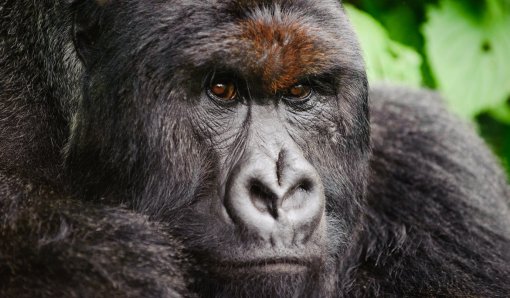
A new article just published in PNAS reveals how future expansion of the palm-oil industry could have terrible consequences for African primates.

Researchers from the European Commission’s Joint Research Centre, CIRAD, Liverpool John Moores University, and ETH Zurich searched for “areas of compromise” combining high oil palm suitability with low primate vulnerability, as possible locations where to accommodate new oil-palm plantations while reducing detrimental effects on primate populations.

Results show that there is small room for compromise. In fact, potential areas of compromise are rare across the whole African continent, covering a total extent of 0.13 Mha of land highly suited to oil palm cultivation where primate vulnerability is low, rising to just 3.3 Mha if all land with at least minimum suitability to grow oil palm is taken into account.

Palm oil production is steadily rising, and expected to accelerate in response to growing world’s population, with future demand driven not only by the food industry, but also by the biofuel market. Read the rest of this entry »


Some scary stats about agriculture and biodiversity

20 07 2018

84438Last week we had the pleasure of welcoming the eminent sustainability scientist, Professor Andrew Balmford of the University of Cambridge, to our humble Ecology and Evolution Seminar Series here at Flinders University. While we couldn’t record the seminar he gave because of some of the unpublished and non-proprietary nature of some of his slides, I thought it would be interesting, useful, and thought-provoking to summarise some of the information he gave.
Andrew started off by telling us some of the environmental implications of farming worldwide. Today, existing agriculture covers more than half of ‘useable’ land (i.e., excluding unproductive deserts, etc.), and it has doubled nitrogen fixation rates from a pre-industrial baseline. Globally, agriculture is responsible for between 19 and 35% of all greenhouse gas emissions, and it has caused approximately 40% increase in observed sea-level rise (1961-2003). Not surprisingly, agriculture already occupies the regions of highest biodiversity globally, and is subsequently the greatest source of threat to species.

Read the rest of this entry »


What Works in Conservation 2018

23 05 2018
P1230308

Do you have a copy of this book? If not, why not?


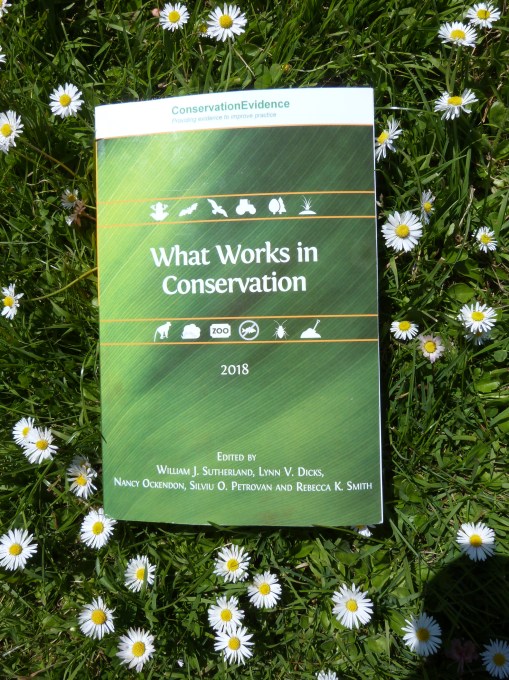
This book is free to download. This book contains the evidence for the effectiveness of over 1200 things you might do for conservation. If you don’t have a copy, go and download yourself a free one here, right now, before you even finish reading this article. Seriously. Go. You’ll laugh, you’ll cry, it’ll change your life.

Why you’ll laugh

OK, I may have exaggerated the laughing part. ‘What Works in Conservation 2018’ is a serious and weighty tome, 660 pages of the evidence for 1277 conservation interventions (anything you might do to conserve a species or habitat), assessed by experts and graded into colour-coded categories of effectiveness. This is pretty nerdy stuff, and probably not something you’ll lay down with on the beach or dip into as you enjoy a large glass of scotch (although I don’t know your life, maybe it is).

But that’s not really what it’s meant for. This is intended as a reference book for conservation managers and policymakers, a way to scan through your possible solutions and get a feel for those that are most likely to be effective. Once you have a few ideas in mind, you can follow the links to see the full evidence base for each study at conservationevidence.com, where over 5000 studies have been summarised into digestible paragraphs.

The book takes the form of discrete chapters on taxa, habitats or topics (such as ‘control of freshwater invasives’). Each chapter is split into IUCN threat categories such as ‘Agriculture’ or ‘Energy production and mining’. For each threat there are a series of interventions that could be used to tackle it, and for each of these interventions the evidence has been collated. Experts have then graded the body of the evidence over three rounds of Delphi scoring, looking at the effectiveness, certainty in the evidence (i.e., the quality and quantity of evidence available), and any harms to the target taxa. These scores combine to place each intervention in a category from ‘Beneficial’ to ‘Likely to be ineffective or harmful’. Read the rest of this entry »


Offshore Energy & Marine Spatial Planning

22 02 2018

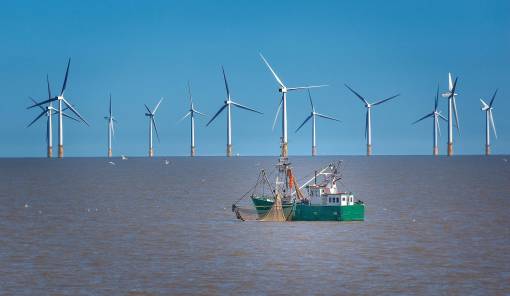
FishingOffshoreWind

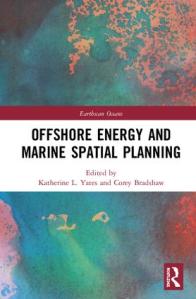
I have the pleasure (and relief) of announcing a new book that’s nearly ready to buy, and I think many readers of CB.com might be interested in what it describes. I know it might be a bit premature to announce it, but given that we’ve just finished the last few details (e.g., and index) and the book is ready to pre-order online, I don’t think it’s too precocious to advertise now.

9781138954533-2

A little history is in order. The brilliant and hard-working Katherine Yates (now at the University of Salford in Manchester, UK) approached me back in 2014 to assist her with co-editing the volume that she wanted to propose for the Routledge Earthscan Ocean series. I admit that I reluctantly agreed at the time, knowing full well what was in store (anyone who has already edited a book will know what I mean). Being an active researcher in energy and biodiversity (perhaps not so much on the ‘planning’ side per se) certainly helped in my decision.

And yes, there were ups and downs, and sometimes it was a helluva lot of work, but Katherine certainly made my life easier, and she has finally driven the whole thing to completion. She deserves most of the credit.

Read the rest of this entry »


Bring it back

13 02 2018
fynbos

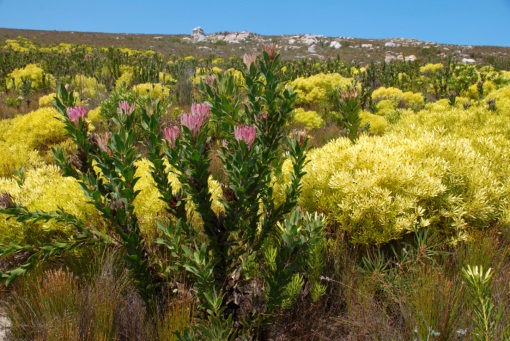
Protea compacta in fynbos, a form of shrubland at Soetanysberg, South Africa. Photo: Brian van Wilgen

Restoration of lost habitats and ecosystems hits all the right notes — conservation optimism, a can-do attitude, and the excitement of seeing biologically impoverished areas teem with life once more.

The Strategic Plan of the Convention on Biological Diversity includes a target to restore at least 15% of degraded ecosystems. This is being enthusiastically taken up in many places, including through initiatives such as the Bonn Challenge, a global aspiration to restore 350 million hectares of deforested and degraded land by 2030. This is in recognition of the importance of healthy ecosystems in not just conserving biodiversity, but also in combating climate change. Peatlands and forests lock away carbon, while grassland diversity stabilises ecosystem productivity during extreme weather events. So how can we make sure that these restoration efforts are as effective as possible? Read the rest of this entry »


Influential conservation ecology papers of 2017

27 12 2017

Gannet Shallow Diving 03
As I have done for the last four years (20162015, 2014, 2013), here’s another retrospective list of the top 20 influential conservation papers of 2017 as assessed by experts in F1000 Prime.

Read the rest of this entry »


Paying to stop degrading

28 07 2017

green baby bathwaterWe conservationists don’t get a lot of good news these days, and even when we do, I am reminded of the (slightly modified) expression: one step forward, but ten steps backward. It’s enough to lead to depression.

Still, we soldier on, and now there are more and more philosophically positive events and venues for ‘optimistic’ conservation stories. Indeed, some of them have even appeared here on ConservationBytes.com (mainly from Claire Wordley‘s excellent string of posts from Conservation Evidence — see here, here, here, here), as well as the much-publicised Conservation Optimism Summit and its American version, Earth Optimism.

A decade or so ago, payment for ecosystem services was all the rage. The idea was simple — pay people to conserve forests and other intact habitats instead of cutting them down for timber or to grow food. However, as the years passed, these types of programmes — which were often funded (or intended to be funded) through carbon-sequestration schemes) — showed little capacity to prevent deforestation at a landscape scale. Many people have therefore binned the entire idea as a result. Read the rest of this entry »


Not all wetlands are created equal

13 02 2017

little-guyLast year I wrote what has become a highly viewed post here at ConservationBytes.com about the plight of the world’s freshwater biodiversity. In a word, it’s ‘buggered’.
But there are steps we can take to avoid losing even more of that precious freshwater biodiversity. The first, of course, is to stop sucking all the water out of our streams and wetlands. With a global population of 7.5 billion people and climbing, the competition for freshwater will usually mean that non-human life forms lose that race. However, the more people (and those making the decisions, in particular) realise that intact wetlands do us more good as wetlands rather than carparks, housing developments, or farmland (via freshwater filtering, species protection, carbon storage, etc.), the more we have a chance to save them.

My former MSc student, the very clever David Deane1, has been working tirelessly to examine different scenarios of wetland plant biodiversity change in South Australia, and is now the proud lead author of a corker of a new paper in Biological Conservation. Having already published one paper about how wetland plant biodiversity patterns are driven by rare terrestrial plants, his latest is a very important contribution about how to manage our precious wetlands. Read the rest of this entry »


Fertilisers can make plants sicker

25 01 2017

sick-plantLast year we reported experimental evidence that the dilution effect was the phenomenon by which greater biodiversity imparts disease resistance in plant communities. Our latest paper shows the mechanism underlying this.

In my ongoing collaboration with the crack team of plant community ecologists led by Shurong Zhou at Fudan University in Shanghai, we have now shown that nitrogen-based fertilisers — in addition to causing soil damage and environmental problems from run-off — reduce a plant community’s resistance to fungal diseases.

This means that prolonged use of artificial fertilisers can lead to the extinction of the most resistant plant species in a community, meaning that the remaining species are in fact more susceptible to diseases.

Continuing the experimental field trials in alpine meadows of the Tibetan Plateau, we tested the biodiversity resilience of an isolated  plant community to increasing concentrations of nitrogenous fertilisers. In this diverse and pristine ecosystem, we have finally established that extended fertilisation of soils not only alters the structure of natural plant communities, it also exacerbates pathogen emergence and transmission. Read the rest of this entry »


Boreal forest on the edge of a climate-change tipping point

15 11 2016

As some know, I dabble a bit in the carbon affairs of the boreal zone, and so when writer Christine Ottery interviewed me about the topic, I felt compelled to reproduce her article here (originally published on EnergyDesk).

A view of the Waswanipi-Broadback Forest in the Abitibi region of Northern Quebec, one of the last remaining intact Boreal Forests in the province (source: EnergyDesk).

A view of the Waswanipi-Broadback forest in the Abitibi region of northern Quebec, one of the last remaining intact boreal forests in the Canadian province (source: EnergyDesk).

The boreal forest encircles the Earth around and just below the Arctic Circle like a big carbon-storing hug. It can mostly be found covering large swathes of Russia, Canada and Alaska, and some Scandinavian countries.

In fact, the boreal – sometimes called by its Russian name ‘taiga’ or ‘Great Northern Forest’ – is perhaps the biggest terrestrial carbon store in the world.

So it’s important to protect in a world where we’re aiming for 1.5 or – at worst – under two degrees celsius of global warming.

“Our capacity to limit average global warming to less than 2 degrees is already highly improbable, so every possible mechanism to reduce emissions must be employed as early as possible. Maintaining and recovering our forests is part of that solution,” Professor Corey Bradshaw, a leading researcher into boreal forests based at the University of Adelaide, told Energydesk.

It’s not that tropical rainforests aren’t important, but recent research led by Bradshaw published in Global and Planetary Change shows that that there is more carbon held in the boreal forests than previously realised.

But there’s a problem. Read the rest of this entry »