We need a Revegetation Council

14 01 2019
planting trees

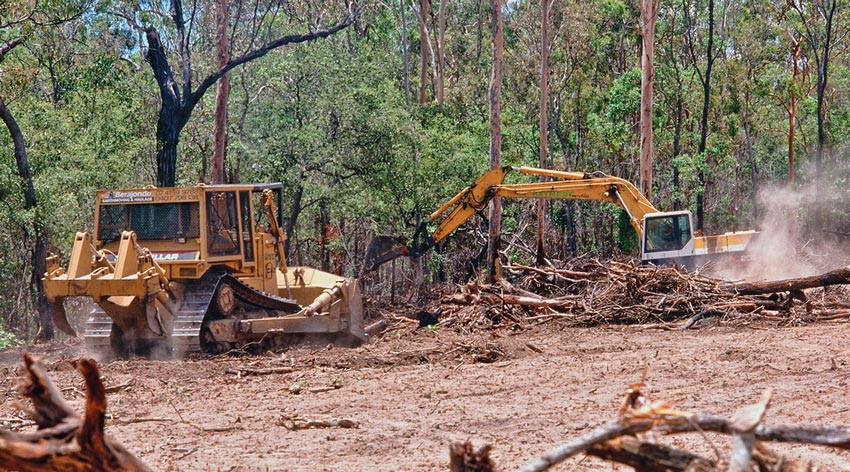
As I have discussed before, the greatest threatening process to biodiversity in South Australia today is past and ongoing clearing of native vegetation. So, arresting further vegetation clearing, and restoring previously cleared land to functional native-vegetation communities are easily the highest priorities across the entire State.

Despite some valiant attempts across South Australia to revegetate previously cleared areas1, the haphazard approach to reforestation in South Australia means that we are unlikely to be maximising ecological function and providing the best habitats for native biodiversity. Several improvements in this regard can be made:

(i) Establish a State Register of past, ongoing, and planned revegetation projects, including data on the proponents, area revegetated, species planted, number of individuals planted for each species, monitoring in place (e.g., plant survival, other species using the restored habitat, etc.), and costs (actual or projected). Such a State Register would allow for a more regional coordination of future revegetation projects to suggest potentially more ecologically useful approaches. This could include identifying the most locally suitable species to plant, maximising the area of existing native habitat or restored fragments by planting adjacent to these, joining isolated islands of habitat to increase connectivity, or even to create more efficient projects by combining otherwise independent proponents (e.g., adjacent landholders).

(ii) Establish a State Revegetation Council that uses data from the Register to prioritise projects, enhance collaboration, and suggest improvements in design and placement according to the principles mentioned above. The Council could also help to coordinate monitoring of progress and ecological outcomes at the landscape scale. A similar State Register for Wetland Restoration and a relevant Council could be established in a similar manner, emphasising the conservation and restoration of smaller wetlands with more unique, endemic plant species. Likewise, both Councils could ideally assist in coordinating non-profit and private organisations in terms of their revegetation priorities, as well as coordinate with conservation covenants(see below) for private landholders.

Read the rest of this entry »


Cartoon guide to biodiversity loss LII

2 01 2019

The first set of six biodiversity cartoons for 2019 to usher in the New Year. See full stock of previous ‘Cartoon guide to biodiversity loss’ compendia here.


Read the rest of this entry »


Influential conservation ecology papers of 2018

17 12 2018

e35f9ddeada029a053a15cd023abadf5
For the last five years I’ve published a retrospective list of the ‘top’ 20 influential papers of the year as assessed by experts in F1000 Prime — so, I’m doing so again for 2018 (interesting side note: six of the twenty papers highlighted here for 2018 appear in Science magazine). See previous years’ posts here: 2017, 20162015, 2014, and 2013.

Read the rest of this entry »


Fancy a job in biosecurity controlling pest species?

13 12 2018

Rabbits-Western-NSW

My mate Dr Brad Page — Principal Biosecurity Officer (Pest Animals) at Biosecurity SA — asked me to post the following jobs he’s advertising for pest-animal control. Now, I’m near-completely opposed to ‘wild dog’ (i.e., dingo) control in Australia, but I’ve agreed to post the third position as well, despite my ecological misgivings. Brad has a different perspective.

We have exciting opportunities for three new pest animal control coordinators, who will be working to support and reinvigorate control of deer, rabbits, and ‘wild dogs’.

All three coordinators will be part of our Biosecurity SA Division within PIRSA. These new positions will report to our Principal Biosecurity Officer, Pest Animals.

cnt-deer

Deer and Rabbit Control Coordinators (two positions)

The Deer Control Coordinator and the Rabbit Control Coordinator will provide tailored professional support to natural resource management (NRM) staff and community groups doing control programs. These coordinators will aim to increase the impact of deer and rabbit control programs to support primary producers and biodiversity managers. The position will connect and empower existing community and industry groups, maximising impacts of their efforts to control feral deer and rabbits in agricultural landscapes. Read the rest of this entry »


Perseverance eventually gets the policy makers’ attention

10 12 2018

IMG_2819

My entry badge today to the South Australian Parliament (sorry for the shitty reproduction, but it’s a shitty photo of a shitty photo)

I’ve often commented on it over the years, as well as written about it both in my latest book, as well as featured it here on CB.com, that little of the conservation science we do appears to reach the people making all the decisions. This is, of course, a massive problem because so much policy that affects biodiversity is not evidence-based, nor do we seem to be getting any better at telling them how buggered our natural world is.

Even the Extinction Rebellion, or school kids screaming in the streets about lack of climate-change policies appears unable to budge the entrenched, so what hope do we lonely little scientists have of getting in a Minister’s ear? It’s enough to make one depressed.

look-at-me-girlSo, we go through the motions; we design ideal reserves with the aid of our computers, we tell people how much to fish, we tell them why feral species are bad, etc., etc., and then we publish our findings and walk away. We might do a little more and shout our messages loudly from the media rooftops, or submit comments to proposed policies, or even draft open letters or petitions. Yet no matter how hard we seem to try, our messages of urgency and despair largely fall on deaf ears.

It’s enough to make you reconsider and not bothering at all.

But! Despite my obviously jaded perspective, two things have happened to me recently that attest to how a little perseverance, sticking to your guns, and staying on message can reach the ears of the powerful. My examples are minuscule in the grand scheme of things, nor will they necessarily translate into anything really positive on the ground; yet, they give me a modicum of hope that we can make a positive difference.

The first event happened a few weeks ago after we did a press release about our paper on co-extinction cascades published in Scientific Reports. Yes, it got into a few big newspapers and radio, but I thought it wouldn’t do much more than peak the punters’ interest for the typical 24-hour news cycle. However, after the initial media interest died down, I received an e-mail from one of my university’s media officers saying that the we had been cited in The Senate (one of the two houses in the Australian Parliament)! An excerpt of the transcript is shown below (you can read the whole thing — if you could be bothered — here): Read the rest of this entry »


Biodiversity offsetting is off-putting

5 11 2018

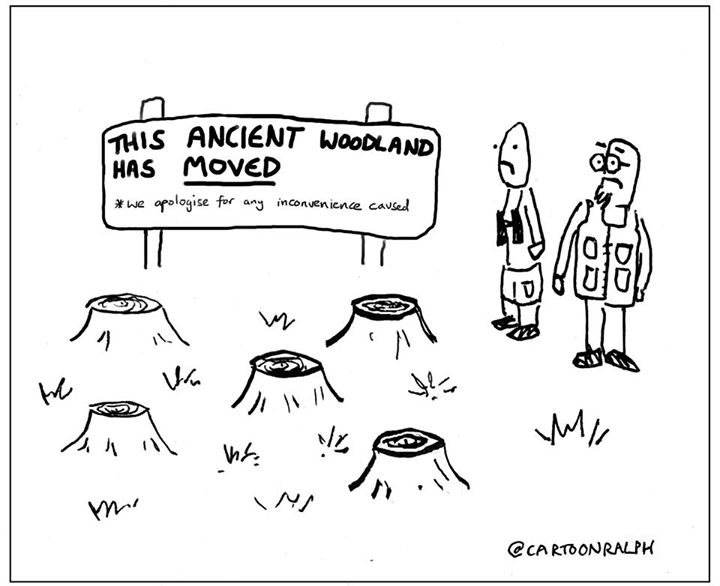
Ancient-woodland-has-movedBiodiversity offsets are becoming more popular in Australia and elsewhere as a means to raise money for conservation and restoration while simultaneously promoting economic development (1). However, there are many perverse consequences for biodiversity if they are not set up carefully (1-3).

Biodiversity ‘offsets’ are intended to work in a similar way to carbon offsets1, in that the destruction of a part of an ecosystem (e.g., a native forest or grassland, or a wetland) can be offset by paying to fund the restoration of another, similar ecosystem elsewhere. As such, approval to clear native vegetation usually comes with financial and other conditions.

But there are several problems with biodiversity offsetting, including the inconvenient fact that creating an equivalent ecosystem somewhere takes substantially longer than it does to destroy one somewhere else (e.g., 4). While carbon emitted in one place is essentially the same as that sequestered elsewhere, a forest can take hundreds of years to develop the same biodiversity values and ecological functions it had prior to destruction. Read the rest of this entry »


Ecophysiological feedbacks under climate change

29 10 2018

Variability in heat tolerance among populations modifies the climate-driven periods of diurnal activity expected for ectotherm species. We illustrate this phenomenon for Iberian lizards in a paper we have just published in the Journal of Animal Ecology (blog post reproduced with permission by the Journal; see related blog).

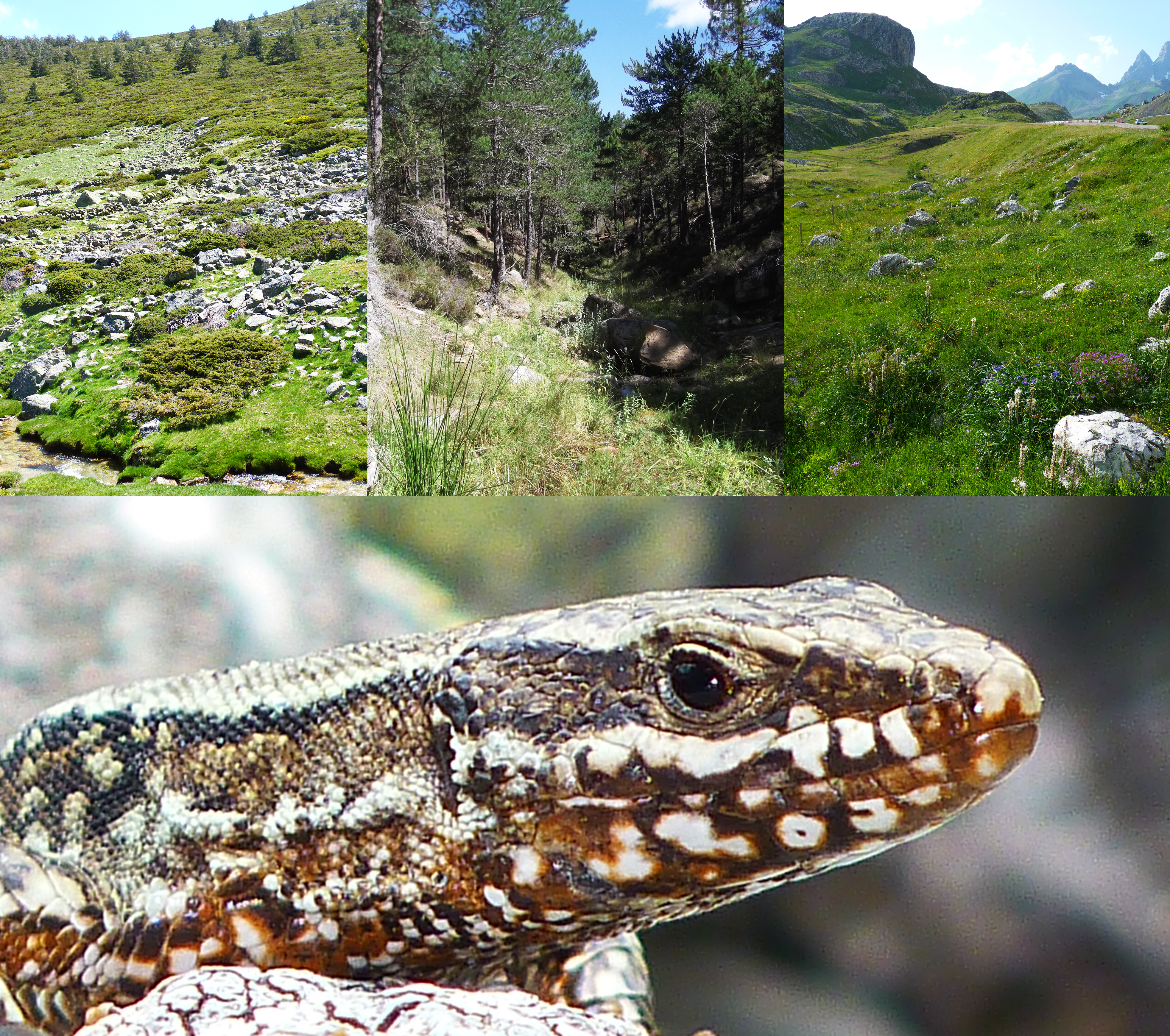
Common wall lizard (Podarcis muralis, male) and three localities where the species is abundant in Spain, left to right including Valdesquí/Madrid (Central System), Peñagolosa/Castellón (Iberian System) and El Portalet/Huesca (The Pyrenees).

Iberia is a wonderful natural laboratory, with a complex blend of flat/hilly, open/woody and coastal/continental terrain, swept by climatic gradients of temperature and moisture. In 2013, I launched a BES-supported project about the thermal ecology of Iberian lizards and managed to drive over much of the Iberian Peninsula in fairly little time. Not being a reptile specialist myself, I was confronted by the consistent observation that lizard populations occupied very different habitats across the known distribution of each of the ~ 25 known Iberian species belonging to the family Lacertidae.

For instance, the common wall lizard (Podarcis muralis) likes water, rocks and mountains, but you can find this pencil-long reptile at the top of a summit, along the slopes or riversides of shallow and deep ravines, on little stones barely surfacing above peatland grasslands, or among the bricks of buildings. These animals must experience different local climates conditional on where they live, and adapt their thermal physiology accordingly.

Having then started a postdoc in Miguel Araújo’s lab — a world-class site for global change ecology and ‘big’ biodiversity patterns — I reviewed a sizeable body of literature looking into large-scale gradients of thermal tolerance. Most of those papers had collated (mostly) one estimate of tolerance from each of tens to thousands of species, then mapped them against regional and global metrics of climate change through sophisticated mathematical frameworks. But these studies rarely accounted for population-level thermal tolerance.

Read the rest of this entry »


Cartoon guide to biodiversity loss LI

23 10 2018

The six set of six biodiversity cartoons for 2018. See full stock of previous ‘Cartoon guide to biodiversity loss’ compendia here.


Read the rest of this entry »


Save a jaguar by eating less meat

8 10 2018

Kaayana

My encounter with Kaayana in Kaa-Iya National Park in the Bolivian Chaco. Her cub was around but cannot be seen in the photo

I was trapped. Or so I thought.

The jaguar came towards me on the dirt road, calmly but attentively in the dusky light, her nearly full grown cub behind her. Nervous and with only a torch as defence, I held the light high above my head as she approached, trying to look taller. But she was merely curious; and, after 20 minutes, they left. I walked home in the thickening darkness, amazed at having come so close to South America’s top predator. We later named this mother jaguar ‘Kaayana’, because she lives inside Kaa-Iya National Park in the Bolivian Chaco. My fascination with jaguars has only grown since then, but the chances of encountering this incredible animal in the wild have shrunk even since that night.

A few years after that encounter, I’m back to study jaguars in the same forest, only now at the scale of the whole South American Gran Chaco. Jaguars are the third largest cats in the world and the top predators across Latin America. This means that they are essential for keeping ecosystems healthy. However, they are disappearing rapidly in parts of their range.

Understanding how and where the jaguar’s main threats — habitat destruction and hunting — affect them is fundamental to set appropriate strategies to save them. These threats are not only damaging on their own, but they sometimes act simultaneously in an area, potentially having impacts that are larger than their simple sum. For instance, a new road doesn’t only promote deforestation, it also increases hunters’ ability to get into previously inaccessible forests. Similarly, when the forest is cut for cattle ranching, ranchers often kill jaguars for fears of stock loss.

Kaayana & kittens

Kaayana was seen years later by Daniel Alarcón, who took much better photos of her and her new cubs

However, the interactions between these threats are still not fully understood. In our new study, just published in the journal Diversity and Distributions, we developed a new framework to quantify how and where habitat destruction and hunting risk acted together over three decades, at the expense of highly suitable jaguar habitat in the Gran Chaco. We also analyzed how well the different Chaco countries — Bolivia, Paraguay and Argentina — and their protected areas maintained key jaguar habitat. Read the rest of this entry »


South Australia’s broken biodiversity legislation

24 09 2018

It might come as a bit of shock to some who might give more than a shit about our State’s environmental integrity that there is no dedicated legislation to protect biodiversity in South Australia today.

What? Well, ok, we do have the Native Vegetation Act that is supposed to restrict the clearing of existing native vegetation (of which there is precious little left), and the National Parks and Wildlife Act 1972 to legislate protected areas and species endangerment. We also have the Wilderness Protection Act 1992 that addresses wilderness protection and land restoration, and the Natural Resource Management Act 2004 that is designed to promote sustainable and integrated management of the State’s natural resources. Finally, the South Australia Environment Protection Authority operates under various acts1 to limit environmental damage.

However, South Australia has no act specifically focussed on biodiversity conservation, and the legislation that does exist does not even consider invertebrates (like insects) as animals — because most animals are in fact invertebrates, this means that most of South Australia’s species are ineligible for official threat listing, even if they have a high risk of extinction.

If you recall, I reported in July this year that in 2017 we had a Parliamentary Inquiry into Biodiversity2, which concluded that existing environmental legislation in South Australia “… lacks cohesion and consistency, particularly regarding enforcement and compliance provisions”.

In my judgement, therefore, an entirely new, biodiversity-focussed act would add legislative teeth to biodiversity conservation in South Australia. As it turns out, that very same Parliamentary Inquiry into Biodiversity I mentioned above recommended3 the creation of a Biodiversity Expert Panel to reform the legislative framework of environmental protection. Thus, the new Government of South Australia has the perfect opportunity to do so under their proposed changes to natural resource management legislation. Following these calls for reform and the new direction of Nature of SA, there is a real opportunity here for statutory reform that includes integrated biodiversity legislation analogous to the New South Wales Biodiversity Conservation Act 2016.

Read the rest of this entry »


Minister, why is the dingo no longer ‘fauna’?

7 09 2018

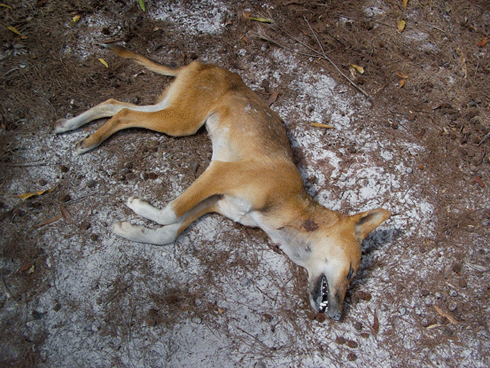
dead dingoSo, a few of us have just submitted a letter contesting the Western Australia Government’s recent decision to delist dingoes as ‘fauna’ (I know — what the hell else could they be?). The letter was organised brilliantly by Dr Kylie Cairns (University of New South Wales), and she and the rest of the signatories have agreed to reproduce the letter in full here on ConservationBytes.com. If you feel so compelled, please voice your distaste of this decision officially by contacting the Minister (details below).

CJA Bradshaw

Honourable Stephen Dawson MLC
Minister for Environment; Disability Services
Address: 12th Floor, Dumas House
2 Havelock Street, WEST PERTH WA 6005
(minister.dawson@dpc.wa.gov.au)

cc: Department of Biodiversity, Conservation and Attractions (biodiversity@dbca.wa.gov.au)
cc: Brendan Dooley (brendan.dooley@dpc.wa.gov.au)

Dear Minister,

The undersigned welcome the opportunity to comment on and recommend alteration of the proposed section (9)(2) order of the Biodiversity Conservation Act 2016 (BC Act) that changes the listing of the dingo from “fauna” to “non-fauna” in Western Australia. Removing the “fauna” status from dingoes has serious consequences for the management and conservation of this species and other native biota it benefits. Currently, dingoes are classed as A7, or fauna that requires a management policy. The proposed section (9)(2) order will move dingoes (as “non-fauna”) to the A5 class, meaning that dingoes must be (lethally) controlled and there will be no obligation for the Department of Biodiversity, Conservation and Attractions to have an appropriate management policy (or approval).

Currently, under the Wildlife Conservation Act 1950 (WC Act) the dingo is considered “unprotected” fauna allowing management under a Department of Biodiversity, Conservation and Attractions management policy. A section (9)(2) order demoting dingoes to “non-fauna” will remove the need for Department of Biodiversity, Conservation and Attractions management policy and instead mandate the lethal control of dingoes throughout Western Australia.

As prominent researchers in top predator ecology, biology, cultural value and genetics, we emphasise the importance of dingoes within Australian, and particularly Western Australia’s ecosystems. Dingoes are indisputably native based on the legislative definition of “any animal present in Australia prior to 1400 AD” from the BC Act. Dingoes have been present in Australia for at least 5000 years. On the Australian mainland they are now the sole non-human land-based top predator. Their importance to the ecological health and resilience of Australian ecosystems cannot be overstated. Read the rest of this entry »


South Australia doesn’t value its environment

5 09 2018

how we treat our environmentThe South Australian State Budget was released yesterday, and as has been the trend for the last ten years or so, the numbers are not good for the State’s environment.

While it has been reported that the budget includes the loss of 115 full-time staff from the Department of Environment and Water, the overall cuts run much deeper. They also herald a new era of not giving a tinker’s cuss for the sorry state of our environment.

I took the liberty of amassing the budget data with respect to environmental spending in this State since 2002-2003 (the earliest year I could find budget papers), and now I’ve just added the 2018-2019 data.

If I’ve selected the appropriate amounts, — side note: someone desperately needs to teach these budget bean-counters how to standardise, report, itemise, and organise data much, much better than they do (my first-year students could do a better job drunk and blindfolded) — then this is what environmental spending (including environment, biodiversity, water, and the Environment Protection Authority) has looked like since 2002: Read the rest of this entry »


The European Union just made bioenergy worse for biodiversity

21 08 2018

bioenergy2While some complain that the European Union (EU) is an enormous, cumbersome beast (just ask the self-harming Brexiteers), it generally has some rather laudable legislative checks and balances for nature conservation. While far from perfect, the rules applying to all Member States have arguably improved the state of both European environments, and those from which Europeans source their materials.

But legislation gets updated from time to time, and not always in the ways that benefit biodiversity (and therefore, us) the most. This is exactly what’s just happened with the new EU Renewable Energy Directive (RED) released in June this year.

Now, this is the point where most readers’ eyes glaze over. EU policy discussions are exceedingly dry and boring (I’ve dabbled a bit in this arena before, and struggled to stay awake myself). But I’ll try to lighten your required concentration load somewhat by being as brief and explanatory as possible, but please stay with me — this shit is important.

In fact, it’s so important that I joined forces with some German colleagues with particular expertise in greenhouse-gas accounting and EU policy — Klaus Hennenberg and Hannes Böttcher1 of Öko-Institut (Institute of Applied Ecology) in Darmstadt — to publish an article available today in Nature Ecology and Evolution.

bioenergy4So back to the RED legislation. The original ‘RED 2009‘ covered reductions of greenhouse-gas emissions and the mitigation of negative impacts on areas of high biodiversity value, such as primary forests, protected areas, and highly biodiverse grasslands, and for areas of high carbon stock like wetlands, forests, and peatlands.

But RED 2009 was far from what we might call ‘ambitious’, because globally mandatory criteria on water, soil and social aspects for agriculture and forestry production were excluded to avoid conflicts with rules of the World Trade Organization.

Nor did RED 2009 apply to all bioenergy types, and only included biofuels used in transport, including gaseous and solid fuels, and bioliquids used for electricity, heating, and cooling. But RED 2009 requirements also applied to all raw materials sourced from agriculture and forestry, especially as forest biomass is explicitly mentioned as a raw material for the production of advanced biofuels in the RED 2009 extension from 2015.

Thus, one could conceivably call RED 2009 criteria ‘minimum safeguards’.

But as of June this year, the EU accepted a 2016 proposal to recast RED 2009 into what is now called ‘RED II’. While the revisions might look good on paper by setting new incentives in transport (advanced biofuels) and in heating and cooling that will likely increase the use of biomass sourced from forests, and by extending the directive on solid and gaseous biomass, the amendments unfortunately take some huge leaps backwards in terms of sustainability requirements.

These include the following stuff-ups: Read the rest of this entry »


Primate woes where the oil palm grows

16 08 2018

gorilla

A new article just published in PNAS reveals how future expansion of the palm-oil industry could have terrible consequences for African primates.

Researchers from the European Commission’s Joint Research Centre, CIRAD, Liverpool John Moores University, and ETH Zurich searched for “areas of compromise” combining high oil palm suitability with low primate vulnerability, as possible locations where to accommodate new oil-palm plantations while reducing detrimental effects on primate populations.

Results show that there is small room for compromise. In fact, potential areas of compromise are rare across the whole African continent, covering a total extent of 0.13 Mha of land highly suited to oil palm cultivation where primate vulnerability is low, rising to just 3.3 Mha if all land with at least minimum suitability to grow oil palm is taken into account.

Palm oil production is steadily rising, and expected to accelerate in response to growing world’s population, with future demand driven not only by the food industry, but also by the biofuel market. Read the rest of this entry »


Cartoon guide to biodiversity loss L

3 08 2018

The fifth set of six biodiversity cartoons for 2018. See full stock of previous ‘Cartoon guide to biodiversity loss’ compendia here.


Read the rest of this entry »


Some scary stats about agriculture and biodiversity

20 07 2018

84438Last week we had the pleasure of welcoming the eminent sustainability scientist, Professor Andrew Balmford of the University of Cambridge, to our humble Ecology and Evolution Seminar Series here at Flinders University. While we couldn’t record the seminar he gave because of some of the unpublished and non-proprietary nature of some of his slides, I thought it would be interesting, useful, and thought-provoking to summarise some of the information he gave.

Andrew started off by telling us some of the environmental implications of farming worldwide. Today, existing agriculture covers more than half of ‘useable’ land (i.e., excluding unproductive deserts, etc.), and it has doubled nitrogen fixation rates from a pre-industrial baseline. Globally, agriculture is responsible for between 19 and 35% of all greenhouse gas emissions, and it has caused approximately 40% increase in observed sea-level rise (1961-2003). Not surprisingly, agriculture already occupies the regions of highest biodiversity globally, and is subsequently the greatest source of threat to species.

Read the rest of this entry »


Biodiversity is everyone’s responsibility

13 07 2018

Workspace: Team Of Diverse Workers Put Hands TogetherI’m not sure if many South Australians are aware of this, but the Parliamentary Inquiry into Biodiversity by the Environment, Resources and Development Committee presented a report to the 53rd Parliament of South Australia in March 2017. I thought it worthwhile reproducing their executive summary here on CB.com (I’ve highlighted the text that I deem to be rather insightful and simultaneously damning from our own elected government representatives):

This report summarises the findings and recommendations of the South Australian Parliament’s Environment, Resources and Development Committee’s inquiry into biodiversity in South Australia. Specifically, the inquiry investigated the regulatory and policy framework to determine whether it appropriately supports terrestrial and marine ecological processes, biodiversity values and abates species extinction.

The Committee found that in spite of the efforts of the State and Federal governments, industry and private landholders in South Australia, the condition of biodiversity in the State continues to decline. Species extinctions have occurred in the past and a further “extinction debt” still exists. There is no reason to believe that this trend will improve without a change to the way we approach biodiversity conservation.

A key theme to emerge from the Inquiry is that biodiversity conservation needs to be everyone’s responsibility; State and Federal government, industry, the broader community, and private landholders.

This also means that biodiversity conservation needs to occur across both public and private land, with actions coordinated at a landscape scale.

Making biodiversity conservation everyone’s responsibility requires a range of measures, including legislative reform, improved management of threats and greater involvement of the community. The provision of greater resources would yield faster results.

This report has focused on several key themes that emerged from submissions to the Inquiry.

Regulating for better biodiversity – South Australia’s legislative framework

South Australia’s current legislative framework does not provide for optimum biodiversity outcomes.

Three key issues contribute to this –

  • an out-of-date suite of environmental legislation that lacks cohesion and consistency, particularly regarding enforcement and compliance provisions;
  • inadequate and incomplete processes for identifying and protecting at-risk elements that need special measures (e.g. for protection of specific threatened species and ecological communities); and
  • inadequate consideration of biodiversity conservation in legislation that regulates human activities. In particular, there is a lack of cohesion between the environmental legislative and policy framework and land use planning, assessment and approval.
  • Statutory fragmentation of biodiversity considerations – that is, consideration of different aspects of biodiversity under different pieces of legislation – results in lack of cohesion and consistency, duplication and inefficiency, and makes it difficult to implement a landscape approach or to identify strategic opportunities and risks.

Taken as a whole, current enforcement provisions do not provide for effective and proportionate compliance action. Enforcement and compliance provisions across the relevant legislation are uneven in their approach. For example, penalties appear to be disproportionate and not risk-based (although there are some exceptions). Modern enforcement tools such as compliance orders, civil remedies and alternative penalties (such as administrative penalties, payment of damages including exemplary damages, remediation orders etc) are not included in all relevant legislation. There is some duplication in offences and inconsistency in the types of sanctions and penalty ranges.

There is an urgent need to amend the legislative framework to support any attempt to improve biodiversity outcomes.

The best approach will be based on clear, shared responsibility for biodiversity outcomes, supported by individual accountability. However, such a change will require policy development and drive.

To ensure forward momentum and improvements in the short term while developing the policy settings to support such a step-change, a staged approach could be implemented. There are various ways this could be achieved.

The Committee suggests a 3-stage approach to reforming the legislative framework. The Committee recommends the creation of a Biodiversity Expert Panel that is responsible for advancing this 3-stage approach.

  1. The first stage will involve amendments to improve operation and effectiveness of the regulatory regime within current policy settings, acknowledging that as a result of Stage 3, provisions may be altered or moved into different pieces of legislation. Amendments generally would be to the existing ‘environmental’ Acts, and primarily to the National Parks and Wildlife Act 1972 and Native Vegetation Act 1991. They would include many of the specific areas for amendment identified in EDO submissions (2011 & 2015) as well as in the SA Government submission, for example, beginning with amendments to improve current environmental legislation.
  2. Stage 2 would progress to amendments to improve integration between Acts and improve support for landholders and community participation.
  3. Stage 3 would implement a system whereby all resource use and management would be managed by one piece of legislation, with protection of biodiversity and sustainable development at its core. Provisions for protected area management, and for the scientific work involved in identifying threatened species and communities, may be contained in separate legislation.

Threats, ecological resilience and restoration

The State’s native biodiversity is facing myriad of current threats, including habitat loss and fragmentation (due to development and changing land-use), pest plants and animals, and control burn regimes. There is a need for more stringent vegetation protection, better informed and enacted control and management strategies of known pest plants and animals, and a revision of burning regimes.

Future threats to the State’s biodiversity will be largely driven by climate change impacts and the interaction with existing major threats (e.g. urbanisation and changing land use). Adequately preparing for and managing such future threats will require knowledge of projected changes and pro-active preparation for such changes.

Working with the community

Involvement of the community is an essential part of any biodiversity conservation strategy for the State. It is a foundation stone for moving to a point where biodiversity conservation is everyone’s business.

Community engagement will become increasingly important for biodiversity conservation, especially given the growing role of volunteers to support works on public land as well as the voluntary conservation efforts of private landholders. The expanding role of volunteers reenforces that biodiversity conservation is everyone’s business.

South Australia’s approach to biodiversity conversation on private land needs to be reinvigorated.

Cross cutting themes

There were several cross cutting themes identified in submissions to the Inquiry. There was broad recognition of the strong cultural and historic significance of elements of biodiversity to Aboriginal people, and that this is often poorly understood outside those communities. Continuing to identify ways for Aboriginal people to contribute to land and water management in South Australia remains a priority.

With respect to knowledge generation, critical knowledge gaps exist that need to be filled and existing knowledge is not being adequately understood, communicated or applied. From a resourcing perspective, there is concern that insufficient funds are being allocated to biodiversity conservation, which is affecting work on public and private lands.

The management of over-abundant species in South Australia remains a challenge, noting the recent impacts of long-nose fur seals in the Lower Lakes and Coorong, and ongoing concerns regarding the impact of animals such as little corellas and some species of kangaroos on negative vegetation.


Cartoon guide to biodiversity loss XLIX

2 07 2018

The fourth set of six biodiversity cartoons for 2018. See full stock of previous ‘Cartoon guide to biodiversity loss’ compendia here.


Read the rest of this entry »


Personal deterrents can reduce the risk of shark bites

19 06 2018

Shak deterrent testing

Photo: Charlie Huveneers

A little over a week ago, shark ecologist, Charlie Huveneers, and I attempted to write an article in The Conversation about a report we co-wrote regarding the effectiveness of personal shark-deterrent devices (see below for more on the report itself). It’s a great little story, with both immediate policy implications for human safety and great, big potential improvements to shark conservation in general (i.e., if sharks kill fewer people, then perhaps governments would be less inclined to invokes stupid laws to kill sharks). Indeed, sharks aren’t doing very well around the world, mainly because of over-harvest and persecution from unfounded fear.

Anyway, all was going swimmingly until our editor at The Conversation suddenly decided that they wouldn’t publish the piece based on the following funding disclaimer that we had submitted with the article:

This project was funded by the New South Wales Department of Primary Industries Shark Management Strategy Competitive Annual Grants Program, the Government of South Australia, Ocean Guardian Pty Ltd, and the Neiser Foundation. We openly and transparently declare that Ocean Guardian contributed financially to the study, but that Ocean Guardian was not involved in the study design or implementation, nor did they have access to the data post-collection. Nor did Ocean Guardian provide input into data analysis, interpretation, writing of the report, or the conclusions drawn. The study design followed a protocol developed for a previous study, which was not funded by Ocean Guardian. In summary, Ocean Guardian had no opportunity to influence any aspect of the study or its conclusions, apart from providing some financial support to realise the field project (e.g., boat hire, equipment purchase, etc.) in the same manner as the other funding agencies. The South Australian cage-diving industry provided logistical support during the testing of the deterrents.

The long and short of The Conversation‘s negative decision was that one of the companies contributed financially to project. However, as we stated above, they had absolutely no influence in the subsequent experimental design, data collection, analysis, interpretation or report writing.

While normally I’m a big fan of The Conversation, I really think they dropped the ball with this one. Their decision was illogical and unsupported for five main reasons:

  1. There were many funding partners involved, and the Ocean Freedom contribution was in no way the major or even majority share of funding.
  2. Other companies with devices tested could have contributed, but only Ocean Freedom offered.
  3. The study was commissioned by a state government agency (New South Wales Department of Primary Industries), which is not a commercial entity.
  4. As stated in our disclosure, there was no opportunity for manipulating experimental design, data ownership, or post-collection analysis or writing that could have influenced the results, by any funders or contributors.
  5. The disclosure is open, honest, comprehensive and in every way truthful.

So, I’m more than just a little disappointed — and my opinion of the organisation has dropped considerably. That, with the constant barrage of donation requests they send makes me think twice about their journalistic integrity. I challenge others to think carefully before giving them any money.

Regardless, let’s move on to the article itself (which I can publish freely here without the Draconian oversight of The Conversation):

Many things might explain why the number of shark bites appear to be increasing. However, the infrequent occurrence of such events makes it nearly impossible to determine why. Recently, an atypically high rate of shark bites occurred in Western Australia in 2010-2011 and on the north coast of New South Wales in 2015-2016. These highly publicised events — often sensationalised in both traditional and social media — have pressured governments to implement new measures to reduce the risk of shark bites.

The rising pressure to do something to reduce shark bites has prompted the recent development or commercial release of many new personal shark deterrents. Yet, most of these devices lack any rigorous scientific assessment of their effectiveness, meaning that some manufacturers have made unfounded claims about how much their devices dissuade sharks from attacking humans.

However, if a particular type of commercially available shark deterrent happens to be less effective (or completely ineffective) as advertised, it can give users a false sense of security, potentially encouraging some to put themselves at greater risk than is necessary. For example, some surfers and spearfishers probably ignore other mitigation measures, such as beach closures, because they ‘feel safe’ when wearing these products.

Read the rest of this entry »


Communicating climate change

5 06 2018

Both the uncertainty inherent in scientific data, and the honesty of those scientists who report such data to any given audience, can sow doubt about the science of climate change. The perception of this duality is engrained in how the human mind works. We illustrate this through a personal experience connecting with global environmentalism, and synthesise some guidelines to communicate the science of climate disruption by humans.

EskimoTote_English

Courtesy of Toté (www.elcomic.es)

In January 2017, the Spanish environmental magazine Quercus invited us to give a talk, at the Cabinet of Natural History in Madrid, about our article on the effects of climate change on the feeding ecology of polar bears, which made to Quercuscover in February 2017 (1) — see blog post here. During questions and debate with the audience (comprising both scientists and non-scientists), we displayed a graph illustrating combinations of seven sources of energy (coal, water, gas, nuclear, biomass, sun and wind) necessary to meet human society’s global energy needs according to Barry Brook & Corey Bradshaw (2). That paper supports the idea that nuclear energy, and to a lesser extent wind energy, offer the best cost-benefit ratios for the conservation of biodiversity after accounting for factors intimately related to energy production, such as land use, waste and climate change.

While discussing this scientific result, one member of the audience made the blunt statement that it was normal that a couple of Australian researchers supported nuclear energy since Australia hosts the largest uranium reservoirs worldwide (~1/3 of the total). The collective membership of Quercus and the Cabinet of Natural History is not suspicious of lack of awareness of environmental problems, but a different matter is that individuals can of course evaluate a piece of information through his/her own and legitimate perspective.

The stigma of hypocrisy

Indeed, when we humans receive and assimilate a piece of information, our (often not self-conscious) approach can range from focusing on the data being presented to questioning potential hidden agendas by the informer. However, the latter can lead to a psychological trap that has been assessed recently (3) — see simple-language summary of that assessment in The New York Times. In one of five experiments, a total of 451 respondents were asked to rank their opinion about four consecutive vignettes tracking the conversation between two hypothetical individuals (Becky & Amanda) who had a common friend. During this conversation, Amanda states that their friend is pirating music from the Internet, and Becky (who also illegally downloads music) can hypothetically give three alternative answers: Read the rest of this entry »