Influential conservation ecology papers of 2018

17 12 2018

e35f9ddeada029a053a15cd023abadf5
For the last five years I’ve published a retrospective list of the ‘top’ 20 influential papers of the year as assessed by experts in F1000 Prime — so, I’m doing so again for 2018 (interesting side note: six of the twenty papers highlighted here for 2018 appear in Science magazine). See previous years’ posts here: 2017, 20162015, 2014, and 2013.

Read the rest of this entry »


Biodiversity offsetting is off-putting

5 11 2018

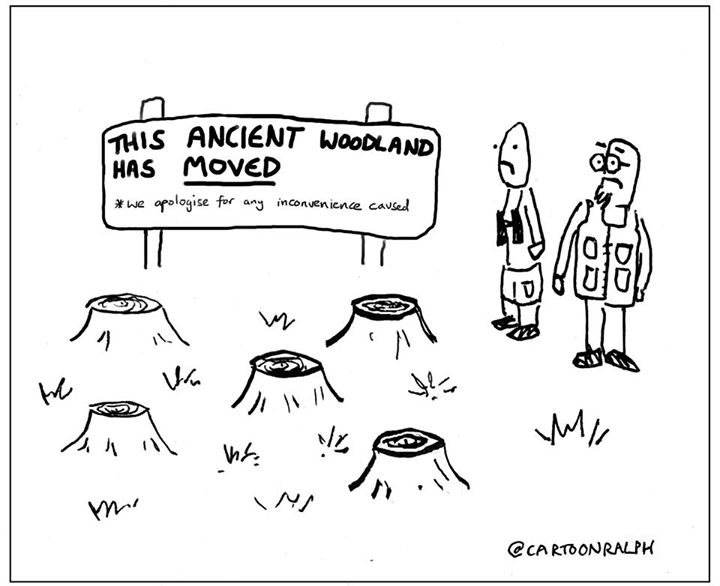
Ancient-woodland-has-movedBiodiversity offsets are becoming more popular in Australia and elsewhere as a means to raise money for conservation and restoration while simultaneously promoting economic development (1). However, there are many perverse consequences for biodiversity if they are not set up carefully (1-3).

Biodiversity ‘offsets’ are intended to work in a similar way to carbon offsets1, in that the destruction of a part of an ecosystem (e.g., a native forest or grassland, or a wetland) can be offset by paying to fund the restoration of another, similar ecosystem elsewhere. As such, approval to clear native vegetation usually comes with financial and other conditions.

But there are several problems with biodiversity offsetting, including the inconvenient fact that creating an equivalent ecosystem somewhere takes substantially longer than it does to destroy one somewhere else (e.g., 4). While carbon emitted in one place is essentially the same as that sequestered elsewhere, a forest can take hundreds of years to develop the same biodiversity values and ecological functions it had prior to destruction. Read the rest of this entry »


Greater death rates for invasive rabbits from interacting diseases

30 05 2018

When it comes to death rates for invasive European rabbits (Oryctolagus cuniculus) in Australia, it appears that 1 + 1 = 2.1.

Pt tagged rab with RHD+myxo 1 10-08

Tagged European rabbit kitten infected with myxoma virus, but that died from rabbit haemorrhagic virus disease (RHDV). Photo by David Peacock, Biosecurity South Australia.

“Canberra, we have a problem” — Sure, it’s an old problem and much less of one than it used to be back in the 1950s, but invasive rabbits are nonetheless an ecological, conservation, and financial catastrophe across Australia.

relative rabbit abundance South Australia

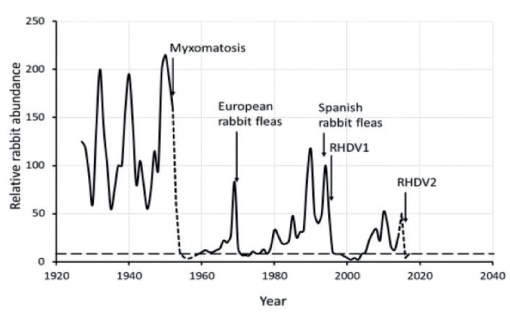
Semi-schematic diagram, redrawn using data from Saunders and others and extended to include the recent spread of RHDV2, showing changes in rabbit abundance in relation to the introduction of biological control agents into north-eastern South Australia. Dotted lines indicate uncertainty due to lack of continuous annual data. The broken line indicates a level of about 0.5 rabbits ha-1, below which rabbits must be held to ensure recovery of native pastures and shrubs (from B. Cooke 2018 Vet Rec doi:10.1136/vr.k2105)

Rabbits used to reach plague numbers in much of agricultural and outback Australia, but the introduction and clever manipulation of two rather effective rabbit-specific viruses and insect vectors — first, myxoma virus in 1950, European rabbit fleas in the 1960s to help spread the virus, then Spanish rabbit fleas in the 1990s to increase spread into arid areas, and then rabbit haemorrhagic disease virus (RHDV) in 1995 — have been effective in dropping rabbit abundances by an estimated 75-80% in South Australia alone since the 1950s.

Read the rest of this entry »


A life of fragmentation

9 05 2018

LauranceWhat do you say to a man whose list of conservation awards reads like a Star Wars film intro, who has introduced terms like the ‘hyperdynamism hypothesis’ to the field of ecology, and whose organisation reaches over one million people each week with updates of the scientific kind?

Interview with Bill Laurance by Joel Howland (originally published in Conjour)


Well, I started by asking what it is that leads him to love the natural world to the extent he does. His answer was disarmingly simple.

“I grew up in the country, on an Oregon cattle ranch, and I think my love of nature just evolved naturally from that. When I was a young kid my dad and I did some fishing and ‘rock-hounding’— searching for rare stones and fossils. As an adolescent and teen I loved heading off into a forest or wilderness, rifle in hand – back in those days you could do that – to see whatever I could find. I watched red foxes hunting, eagles mating, and even heard a mountain lion scream. I got to be a pretty good duck and game-bird hunter.”

He’s quick to point out, however, he realised his taste for guns was not so developed as his love of nature.

“I gave up my rifles for a camera, and enjoyed that even more. I really got into photography for a while. Nature has always just calmed and fascinated me —I guess that’s partly why I became a conservationist.”

Who is Bill Laurance?

William F. Laurance is one of the leading ecology and conservation scientists globally, publishing dozens of papers in journals like Nature and Science, and rewriting the way scientists in the field research the complex interactions between flora and fauna — particularly in rainforests like the Amazon.

He is a Distinguished Research Professor at James Cook University in Australia, a Fellow of the Australian Academy of Science and the American Association for the Advancement of Science, and has received an Australian Laureate Fellowship from the Australian Research Council.

All this for a man from western USA who dreamed of running a zoo. Instead, he has travelled a path of intricate and game-changing research, trailblazing awareness campaigns and inspirational writings that have driven the way many see the environment over the past few decades.

Despite this profile, Laurance gave some time to tell Conjour about his life, his passion and his aims. I asked him what — considering his impressive CV — the future holds.

His response seems a real insight to the man. Read the rest of this entry »


My interview with Conservation Careers

10 04 2018

IMage-2

The online job-search engine and careers magazine for conservation professionals — Conservation Careers — recently published an interview with me written by Mark Thomas. Mark said that he didn’t mind if I republished the article here.

As we walk through life we sometimes don’t know where our current path will take us. Will it be meaningful, and what steps could we take? Seeking out and talking to people who have walked far ahead of us in a line of work that we are interested in could help shape the next steps we take, and help us not make the same mistakes that could have cost us precious time.

A phrase that I love is “standing on the shoulders of giants” and this conversation has really inspired me — I hope it will do for you as well.

Corey Bradshaw is the Matthew Flinders Fellow in Global Ecology at Flinders University, and author to over 260 hundred peer-reviewed articles. His research is mainly in the area of global-change ecology, and his blog ConservationBytes critiques the science of conservation and has over 11,000 followers. He has written books, and his most recent one ‘The Effective Scientist’ will be published in March (more on this later).

What got you interested in ecology and conservation?

As a child I grew up in British Columbia, Canada, my father was a fur trapper, and we hunted everything we ate (we ate a lot of black bear). My father had lots of dead things around the house and he prepared the skins for the fur market. It was a very consumptive and decidedly non-conservation upbringing.

Ironically, I learnt early in life that some of the biggest impediments to deforestation through logging was the trapping industry, because when you cut down trees nothing that is furry likes to live there. In their own consumptive ways, the hunters were vocal and acted to protect more species possibly than what some dedicated NGOs were able to.

So, at the time, I never fully appreciated it, but not having much exposure to all things urban and the great wide world, and by spending a lot of time out in the bush, I ended up appreciating the conservation of wild things even within that consumptive mind-set. Read the rest of this entry »


Influential conservation ecology papers of 2017

27 12 2017

Gannet Shallow Diving 03
As I have done for the last four years (20162015, 2014, 2013), here’s another retrospective list of the top 20 influential conservation papers of 2017 as assessed by experts in F1000 Prime.

Read the rest of this entry »


Job: Research Fellow in Palaeo-Ecological Modelling

13 04 2017

© seppo.net

I have another postdoctoral fellowship to advertise! All the details you need for applying are below.

KEY PURPOSE 

Scientific data such as fossil and archaeological records used as proxy to reconstruct past environments and biological communities (including humans) are sparse, often ambiguous or contradictory when establishing any consensus on timing or routes of initial human arrival and subsequent spread, the timing or extent of major changes in climate and other environmental perturbations, or the timing or regional pattern of biological extinctions.

The Research Fellow (Palaeo-Ecological Modelling) will assist in addressing these problems by developing state-of-the-art analytical and simulation tools to infer regional pattern of both the timing of human colonisation and megafauna extinction based on incomplete and sparse dataset, and investigating past environmental changes and human responses to identify their underlying causes and consequences on Australia’s landscapes, biodiversity and cultural history.

ORGANISATIONAL ENVIRONMENT 

The position will be based in the School of Biological Sciences in the Faculty of Science & Engineering at Flinders University. Flinders University boasts a world-class Palaeontology Research Group (PRG) and the new Global Ecology Research Laboratory that have close association with the research-intensive South Australian Museum. These research groups contribute to building a dynamic research environment that explores the continuum of environmental and evolutionary research from the ancient to modern molecular ecology and phylogeography. The School of Biological Sciences is an integrated community researching and teaching biology, and has a long history of science innovation. The appointee will join an interdisciplinary school of approximately 45 academic staff. The teaching and research activities of the School are supported by a range of technical and administrative infrastructure services.

KEY RESPONSIBILITIES

The key responsibilities and selection criteria identified for this position should be read in conjunction with the Flinders University Academic Profiles for the relevant academic classification (scroll down to Academic Profiles).

The Research Fellow (Palaeo-Ecological Modelling) will work under the direction of the Project Chief Investigator, and will be required to: Read the rest of this entry »


Potential conservation nightmare unfolding in South Africa

31 10 2016

fees-must-fallLike most local tragedies, it seems to take some time before the news really grabs the overseas audience by the proverbial goolies. That said, I’m gobsmacked that the education tragedy unfolding in South Africa since late 2015 is only now starting to be appreciated by the rest of the academic world.

You might have seen the recent Nature post on the issue, and I do invite you to read that if all this comes as news to you. I suppose I had the ‘advantage’ of getting to know a little bit more about what is happening after talking to many South African academics in the Kruger in September. In a word, the situation is dire.

We’re probably witnessing a second Zimbabwe in action, with the near-complete meltdown of science capacity in South Africa as a now very real possibility. Whatever your take on the causes, justification, politics, racism, or other motivation underlying it all, the world’s conservation biologists should be very, very worried indeed.

Read the rest of this entry »


More things stay the same, more we retrogress

20 07 2016

obrazek_1idiommmmsmmWithin six months of Abbott and the Coalition seizing power in the 2013 Australian election, decades—if not centuries—of environmental damage and retrograde policies unfolded. But this was no run-of-the-mill incompetence and neglect by government—this was an all-out attack on anything with the merest whiff of environmental protection. The travesty is well-documented, from infamously axing both the carbon-pricing scheme and climate commission, eradicating Labor’s 80% emissions-reduction target by 2050, diluting the Renewable Energy Target, refusing to commit to enforcing the Illegal Logging Prohibition Act (fortunately, this is now law), defunding the only independent legal entity available to limit environmentally destructive development (Environmental Defenders Office), to even attempting to remove the rights of environmental groups to challenge development proposals (thankfully, that failed).

The Coalition’s backward and ineffectual climate change-mitigation policies alone are evidence enough for long-term damage, but their war on the environment in general means that even the future election of a more environmentally responsible government will not undo the damage quickly, if at all. As a result of these and other nearsighted policies, Australia remains one of the highest per-capita greenhouse-gas emitters on the planet, has one of the highest per-capita water uses of any nation, leads the world in mammal extinctions, continues to deforest its already forest-poor landscape, and is a society utterly unprepared to deal with the future challenges of a degraded planet.
Read the rest of this entry »


Seeing the wood for the trees

11 07 2016
The Forest Synopsis: Photo of the Anamalai Tiger Reserve, India, by Claire Wordley

The Forest Synopsis: Photo of the Anamalai Tiger Reserve, India, by Claire Wordley

From the towering kapoks of South America to the sprawling banyans of South Asia, from misty cloud forests to ice-covered pines, forests are some of the most diverse and important ecosystems on Earth. However, as conservationists and foresters try to manage, conserve and restore forests across the world, they often rely on scanty and scattered information to inform their decisions, or indeed, no information at all. This could all change.

This week sees the launch of the Forest Synopsis from Conservation Evidence, a free resource collating global scientific evidence on a wide range of conservation-related actions. These aim to include all interventions that conservationists and foresters are likely to use, such as changing fire regimes, legally protecting forests or encouraging seed-dispersing birds into degraded forests.

Making conservation work

“We hear a lot about how important it is to do evidence-based conservation”, says Professor Bill Sutherland at the University of Cambridge, UK, “but in reality getting a handle on what works is not easy. That’s why we set up Conservation Evidence, to break down the barriers between conservationists and the scientific evidence that they need to do their jobs.” Read the rest of this entry »


Shadow of ignorance veiling society despite more science communication

19 04 2016

imagesI’ve been thinking about this post for a while, but it wasn’t until having some long, deep chats today with staff and students at Simon Fraser University‘s Department of Biological Sciences (with a particular hat-tip to the lovely Nick Dulvy, Isabelle Côté & John Reynolds) that the full idea began to take shape in my brain. It seems my presentation was a two-way street: I think I taught a few people some things, and they taught me something back. Nice.

There’s no question at all that science communication has never before been so widespread and of such high quality. More and more scientists and science students are now blogging, tweeting and generally engaging the world about their science findings. There is also an increasing number of professional science communication associations out there, and a growing population of professional science communicators. It is possibly the best time in history to be involved in the generation and/or communication of scientific results.

Why then is the public appreciation, acceptance and understanding of science declining? It really doesn’t make much sense if you merely consider that there has never been more good science ‘out there’ in the media — both social and traditional. For the source literature itself, there has never before been as many scientific journals, articles and even scientists writing. Read the rest of this entry »


Bad science

10 02 2016

Head in HandsIn addition to the surpassing coolness of reconstructing long-gone ecosystems, my new-found enthusiasm for palaeo-ecology has another advantage — most of the species under investigation are already extinct.

That might not sound like an ‘advantage’, but let’s face it, modern conservation ecology can be bloody depressing, so much so that one sometimes wonders if it’s worth it. It is, of course, but there’s something marvellously relieving about studying extinct systems for the simple reason that there are no political repercussions. No self-serving, plutotheocratic politician can bugger up these systems any more. That’s a refreshing change from the doom and gloom of modern environmental science!

But it’s not all sweetness and light, of course; there are still people involved, and people sometimes make bad decisions in an attempt to modify the facts to suit their creed. The problem is when these people are the actual scientists involved in the generation of the ‘facts’.

As I alluded to a few weeks ago with the publication of our paper in Nature Communications describing the lack of evidence for a climate effect on the continental-scale extinctions of Australia’s megafauna, we have a follow-up paper that has just been published online in Proceedings of the Royal Society B — What caused extinction of the Pleistocene megafauna of Sahul? led by Chris Johnson of the University of Tasmania.

After our paper published earlier this month, this title might seem a bit rhetorical, so I want to highlight some of the reasons why we wrote the review. Read the rest of this entry »


What’s in a name? The dingo’s sorry saga

30 01 2015

bad dingoThe more I delve into the science of predator management, the more I realise that the science itself takes a distant back seat to the politics. It would be naïve to think that the management of dingoes in Australia is any more politically charged than elsewhere, but once you start scratching beneath the surface, you quickly realise that there’s something rotten in Dubbo.

My latest contribution to this saga is a co-authored paper led by Dale Nimmo of Deakin University (along with Simon Watson of La Trobe and Dave Forsyth of Arthur Rylah) that came out just the other day. It was a response to a rather dismissive paper by Matt Hayward and Nicky Marlow claiming that all the accumulated evidence demonstrating that dingoes benefit native biodiversity was somehow incorrect.

Their two arguments were that: (1) dingoes don’t eradicate the main culprits of biodiversity decline in Australia (cats & foxes), so they cannot benefit native species; (2) proxy indices of relative dingo abundance are flawed and not related to actual abundance, so all the previous experiments and surveys are wrong.

Some strong accusations, for sure. Unfortunately, they hold no water at all. Read the rest of this entry »


An Open Letter to Environmentalists on Nuclear Energy

15 12 2014

nuclear biodiversityProfessor Barry W. Brook, Chair of Environmental Sustainability, University of Tasmania, Australia. barry.brook@utas.edu.au

Professor Corey J.A. Bradshaw, Sir Hubert Wilkins Chair of Climate Change, The Environment Institute, The University of Adelaide, Australia. corey.bradshaw@adelaide.edu.au

An Open Letter to Environmentalists:

As conservation scientists concerned with global depletion of biodiversity and the degradation of the human life-support system this entails, we, the co-signed, support the broad conclusions drawn in the article Key role for nuclear energy in global biodiversity conservation published in Conservation Biology (Brook & Bradshaw 2014).

Brook and Bradshaw argue that the full gamut of electricity-generation sources—including nuclear power—must be deployed to replace the burning of fossil fuels, if we are to have any chance of mitigating severe climate change. They provide strong evidence for the need to accept a substantial role for advanced nuclear power systems with complete fuel recycling—as part of a range of sustainable energy technologies that also includes appropriate use of renewables, energy storage and energy efficiency. This multi-pronged strategy for sustainable energy could also be more cost-effective and spare more land for biodiversity, as well as reduce non-carbon pollution (aerosols, heavy metals).

Given the historical antagonism towards nuclear energy amongst the environmental community, we accept that this stands as a controversial position. However, much as leading climate scientists have recently advocated the development of safe, next-generation nuclear energy systems to combat global climate change (Caldeira et al. 2013), we entreat the conservation and environmental community to weigh up the pros and cons of different energy sources using objective evidence and pragmatic trade-offs, rather than simply relying on idealistic perceptions of what is ‘green’.

Although renewable energy sources like wind and solar will likely make increasing contributions to future energy production, these technology options face real-world problems of scalability, cost, material and land use, meaning that it is too risky to rely on them as the only alternatives to fossil fuels. Nuclear power—being by far the most compact and energy-dense of sources—could also make a major, and perhaps leading, contribution. As scientists, we declare that an evidence-based approach to future energy production is an essential component of securing biodiversity’s future and cannot be ignored. It is time that conservationists make their voices heard in this policy arena.

Signatories (in alphabetical order)

  1. Professor Andrew Balmford, Professor of Conservation Science, Department of Zoology, University of Cambridge, United Kingdom. apb12@cam.ac.uk
  2. Professor Andrew J. Beattie, Emeritus, Department of Biological Sciences, Macquarie University, Australia. abeattie@bio.mq.edu.au
  3. Assistant Professor David P. Bickford, Department of Biological Sciences, National University of Singapore, Singapore. dbsbdp@nus.edu.sg
  4. Professor Tim M. Blackburn, Professor of Invasion Biology, Department of Genetics, Evolution and Environment, Centre for Biodiversity and Environment Research, University College London, United Kingdom. t.blackburn@ucl.ac.uk
  5. Professor Daniel T. Blumstein, Chair, Department of Ecology and Evolutionary Biology, University of California Los Angeles, USA. marmots@ucla.edu
  6. Professor Luigi Boitani, Dipartimento di Biologia, e Biotecnologie Charles Darwin, Sapienza Università di Roma, Italy. luigi.boitani@uniroma1.it
  7. Professor Mark S. Boyce, Professor and Alberta Conservation Association Chair in Fisheries and Wildlife, Department of Biological Sciences, University of Alberta, Canada. boyce@ualberta.ca
  8. Professor David M.J.S. Bowman, Professor of Environmental Change Biology, School of Biological Sciences, University of Tasmania, Australia. david.bowman@utas.edu.au
  9. Professor Scott P. Carroll, Institute for Contemporary Evolution and Department of Entomology and Nematology, University of California Davis, USA. spcarroll@ucdavis.edu
  10. Associate Professor Phillip Cassey, School of Earth and Environmental Sciences, The University of Adelaide, Australia.
  11. Professor F. Stuart Chapin III, Professor Emeritus of Ecology, Department of Biology and Wildlife, Institute of Arctic Biology, University of Alaska Fairbanks, USA. terry.chapin@alaska.edu
  12. Professor David Choquenot, Director, Institute for Applied Ecology, University of Canberra, Australia. david.choquenot@canberra.edu.au
  13. Dr Ben Collen, Centre for Biodiversity and Environment Research, University College London, United Kingdom. b.collen@ucl.ac.uk
  14. Professor Richard T. Corlett, Director, Centre for Integrative Conservation, Xishuangbanna Tropical Botanical Garden, Chinese Academy of Sciences, China. corlett@xtbg.org.cn
  15. Dr Franck Courchamp, Director of Research, Laboratoire Ecologie, Systématique et Evolution – UMR CNRS, Member of the European Academy of Sciences, Université Paris-Sud, France. franck.courchamp@u-psud.fr
  16. Professor Chris B. Daniels, Director, Barbara Hardy Institute, University of South Australia, Australia. chris.daniels@unisa.edu.au
  17. Professor Chris Dickman, Professor of Ecology, School of Biological Sciences, The University of Sydney, Australia. chris.dickman@sydney.edu.au
  18. Associate Professor Don Driscoll, College of Medicine, Biology and Environment, The Australian National University, Australia. don.driscoll@anu.edu.au
  19. Professor David Dudgeon, Chair Professor of Ecology and Biodiversity, School of Biological Sciences, The University of Hong Kong, Hong Kong SAR, China. ddudgeon@hku.hk
  20. Associate Professor Erle C. Ellis, Geography and Environmental Systems, University of Maryland, USA. ece@umbc.edu
  21. Dr Damien A. Fordham, School of Earth and Environmental Sciences, The University of Adelaide, Australia. damien.fordham@adelaide.edu.au
  22. Dr Eddie Game, Senior Scientist, The Nature Conservancy Worldwide Office, Australia. egame@tnc.org
  23. Professor Kevin J. Gaston, Professor of Biodiversity and Conservation, Director, Environment and Sustainability Institute, University of Exeter, United Kingdom. k.j.gaston@exeter.ac.uk
  24. Professor Dr Jaboury Ghazoul, Professor of Ecosystem Management, ETH Zürich, Institute for Terrestrial Ecosystems, Switzerland. jaboury.ghazoul@env.ethz.ch
  25. Professor Robert G. Harcourt, Department of Biological Sciences, Macquarie University, Australia. robert.harcourt@mq.edu.au
  26. Professor Susan P. Harrison, Department of Environmental Science and Policy, University of California Davis, USA. spharrison@ucdavis.edu
  27. Professor Fangliang He, Canada Research Chair in Biodiversity and Landscape Modelling, Department of Renewable Resources, University of Alberta, Canada and State Key Laboratory of Biocontrol and School of Life Sciences, Sun-yat Sen University, Guangzhou, China. fhe@ualberta.ca
  28. Professor Mark A. Hindell, Institute for Marine and Antarctic Studies, University of Tasmania, Australia. mark.hindell@utas.edu.au
  29. Professor Richard J. Hobbs, School of Plant Biology, The University of Western Australia, Australia. richard.hobbs@uwa.edu.au
  30. Professor Ove Hoegh-Guldberg, Professor and Director, Global Change Institute, The University of Queensland, Australia. oveh@uq.edu.au
  31. Professor Marcel Holyoak, Department of Environmental Science and Policy, University of California, Davis, USA. maholyoak@ucdavis.edu
  32. Professor Lesley Hughes, Distinguished Professor, Department of Biological Sciences, Macquarie University, Australia. lesley.hughes@mq.edu.au
  33. Professor Christopher N. Johnson, Department of Zoology, University of Tasmania, Australia. c.n.johnson@utas.edu.au
  34. Dr Julia P.G. Jones, Senior Lecturer in Conservation Biology, School of Environment, Natural Resources and Geography, Bangor University, United Kingdom. julia.jones@bangor.ac.uk
  35. Professor Kate E. Jones, Biodiversity Modelling Research Group, University College London, United Kingdom. kate.e.jones@ucl.ac.uk
  36. Dr Menna E. Jones, Department of Zoology, University of Tasmania, Australia. menna.jones@utas.edu.au
  37. Dr Lucas Joppa, Conservation Biologist, United Kingdom. lujoppa@microsoft.com
  38. Associate Professor Lian Pin Koh, School of Earth and Environmental Sciences, The University of Adelaide, Australia. lianpin.koh@adelaide.edu.au
  39. Professor Charles J. Krebs, Emeritus, Department of Zoology, University of British Columbia, Canada. krebs@zoology.ubc.ca
  40. Dr Robert C. Lacy, Conservation Biologist, USA. rlacy@ix.netcom.com
  41. Associate Professor Susan Laurance, Centre for Tropical Biodiversity and Climate Change, Centre for Tropical Environmental and Sustainability Studies, James Cook University, Australia. susan.laurance@jcu.edu.au
  42. Professor William F. Laurance, Distinguished Research Professor and Australian Laureate, Prince Bernhard Chair in International Nature Conservation, Centre for Tropical Environmental and Sustainability Science and School of Marine and Tropical Biology, James Cook University, Australia. bill.laurance@jcu.edu.au
  43. Professor Peter Ng Kee Lin, Department of Biological Sciences, National University of Singapore, Singapore. dbsngkl@nus.edu.sg
  44. Professor Thomas E. Lovejoy, Senior Fellow at the United Nations Foundation and University Professor in the Environmental Science and Policy department, George Mason University, USA. tlovejoy@unfoundation.org
  45. Dr Antony J Lynam, Global Conservation Programs, Wildlife Conservation Society, USA. tlynam@wcs.org
  46. Professor Anson W. Mackay, Department of Geography, University College London, United Kingdom. ans.mackay@ucl.ac.uk
  47. Professor Helene D. Marsh, College of Marine and Environmental Sciences, Centre for Tropical Water and Aquatic Ecosystem Research, James Cook University, Australia. helene.marsh@jcu.edu.au
  48. Professor Michelle Marvier, Department of Environmental Studies and Sciences, Santa Clara University, USA. mmarvier@scu.edu
  49. Professor Lord Robert M. May of Oxford OM AC Kt FRS, Department of Zoology, University of Oxford, United Kingdom. robert.may@zoo.ox.ac.uk
  50. Dr Margaret M. Mayfield, Director, The Ecology Centre, School of Biological Sciences, The University of Queensland, Australia. m.mayfield@uq.edu.au
  51. Dr Clive R. McMahon, Sydney Institute of Marine Science and Institute for Marine and Antarctic Studies, University of Tasmania, Australia. clive.mcmahon@utas.edu.au
  52. Dr Mark Meekan, Marine Biologist, Australia. m.meekan@aims.gov.au
  53. Dr Erik Meijaard, Borneo Futures Project, People and Nature Consulting, Denpasar, Bali, Indonesia. emeijaard@gmail.com
  54. Professor L. Scott Mills, Chancellor’s Faculty Excellence Program in Global Environmental Change, North Carolina State University, USA. lsmills@ncsu.edu
  55. Professor Atte Moilanen, Research Director, Conservation Decision Analysis, University of Helsinki, Finland. atte.moilanen@helsinki.fi
  56. Professor Craig Moritz, Research School of Biology, The Australian National University, Australia. craig.moritz@anu.edu.au
  57. Dr Robin Naidoo, Adjunct Professor, Institute for Resources, Environment, and Sustainability University of British Columbia, Canada. robin.naidoo@wwfus.org
  58. Professor Reed F. Noss, Provost’s Distinguished Research Professor, University of Central Florida, USA. reed.noss@ucf.edu
  59. Associate Professor Julian D. Olden, Freshwater Ecology and Conservation Lab, School of Aquatic and Fishery Sciences, University of Washington, USA. olden@uw.edu
  60. Professor Maharaj Pandit, Professor and Head, Department of Environmental Studies, University of Delhi, India. mkpandit@cismhe.org
  61. Professor Kenneth H. Pollock, Professor of Applied Ecology, Biomathematics and Statistics, Department of Applied Ecology, North Carolina State University, USA. pollock@ncsu.edu
  62. Professor Hugh P. Possingham, School of Biological Science and School of Maths and Physics, The University of Queensland, Australia. h.possingham@uq.edu.au
  63. Professor Peter H. Raven, George Engelmann Professor of Botany Emeritus, President Emeritus, Missouri Botanical Garden, Washington University in St. Louis, USA. peter.raven@mobot.org
  64. Professor David M. Richardson, Distinguished Professor and Director of the Centre for Invasion Biology, Department of Botany and Zoology, Stellenbosch University, South Africa. rich@sun.ac.za
  65. Dr Euan G. Ritchie, Senior Lecturer, Centre for Integrative Ecology, School of Life and Environmental Sciences, Deakin University, Australia. e.ritchie@deakin.edu.au
  66. Professor Terry L. Root, Senior Fellow, Stanford Woods Institute for the Environment, Stanford University, USA. troot@stanford.edu
  67. Dr Çağan H. Şekercioğlu, Assistant Professor, Biology, University of Utah, USA and Doçent 2010, Biology/Ecology, Inter-university Council (UAK) of Turkey. c.s@utah.edu
  68. Associate Professor Douglas Sheil, Department of Ecology and Natural Resource Management, Norwegian University of Life Sciences, Norway. douglas.sheil@nmbu.no
  69. Professor Richard Shine AM FAA, Professor in Evolutionary Biology, School of Biological Sciences, The University of Sydney, Australia. rick.shine@sydney.edu.au
  70. Professor William J. Sutherland, Miriam Rothschild Professor of Conservation Biology, Department of Zoology, University of Cambridge, United Kingdom. w.sutherland@zoo.cam.ac.uk
  71. Professor Chris D. Thomas, FRS, Department of Biology, University of York, United Kingdom. chris.thomas@york.ac.uk
  72. Professor Ross M. Thompson, Chair of Water Science, Institute of Applied Ecology, University of Canberra, Australia. ross.thompson@canberra.edu.au
  73. Professor Ian G. Warkentin, Environmental Science, Memorial University of Newfoundland, Canada. ian.warkentin@grenfell.mun.ca
  74. Professor Stephen E. Williams, Centre for Tropical Biodiversity and Climate Change, School of Marine and Tropical Biology, James Cook University, Australia. stephen.williams@jcu.edu.au
  75. Professor Kirk O. Winemiller, Department of Wildlife and Fisheries Sciences and Interdisciplinary Program in Ecology and Evolutionary Biology, Texas A&M University, USA. k-winemiller@tamu.edu

Note: Affiliations of signatories are for identification purposes, and do not imply that their organizations have necessarily endorsed this letter.

References

Brook, B. W., and C. J. A. Bradshaw. 2014. Key role for nuclear energy in global biodiversity conservation. Conservation Biology doi:10.1111/cobi.12433.

Caldeira, K., K., Emmanuel, J. Hansen, and T. Wigley. 2013. An Open Letter to those influencing environmental policy but opposed to nuclear power. CNN. http://edition.cnn.com/2013/11/03/world/nuclear-energy-climate-change-scientists-letter/index.html. (Accessed 14 March 2014).



Psychological toll of being a sustainability scientist

8 12 2014

depressed scientistLike many academics, I’m more or less convinced that I am somewhere on the mild end of the autism spectrum. No, I haven’t been diagnosed and I doubt very much that my slight ‘autistic’ tendencies have altered my social capacity, despite my wife claiming that I have only two emotions – angry or happy. Nor have they engendered any sort of idiot savant mathematical capability.

But I’m reasonably comfortable with mathematics, I can do a single task for hours once it consumes my attention, and I’m excited about discovering how things work. And I love to code. Rather than academics having a higher innate likelihood of being ‘autistic’, I just think the job attracts such personalities.

In the past few years though, my psychological state is probably less dictated by the hard-wiring of my ‘autidemic’ mind and more and more influenced by the constant battery of negative information my brain receives.

Read the rest of this entry »


Using ecological theory to make more money

1 12 2014

huge.9.46974Let’s face it: Australia doesn’t have the best international reputation for good ecological management. We’ve been particularly loathsome in our protection of forests, we have an appalling record of mammal extinctions, we’re degenerate water wasters and carbon emitters, our country is overrun with feral animals and weeds, and we have a long-term love affair with archaic, deadly, cruel, counter-productive and xenophobic predator management. To top it all off, we have a government hell-bent on screwing our already screwed environment even more.

Still, we soldier on and try to fix the damages already done or convince people that archaic policies should be scrapped and redrawn. One such policy that I’ve written about extensively is the idiocy and cruelty of the dingo fence.

The ecological evidence that dingoes are good for Australian wildlife and that they pose less threat to livestock than purported by some evidence-less graziers is becoming too big to ignore any longer. Poisoning and fencing are not only counter-productive, they are cruel, ineffective and costly.

So just when ecologists thought that dingoes couldn’t get any cooler, out comes our latest paper demonstrating that letting dingoes do their thing results in a net profit for cattle graziers.

Come again? Read the rest of this entry »


It’s not all about cats

20 10 2014

Snake+OilIf you follow any of the environment news in Australia, you will most certainly have seen a lot about feral cats in the last few weeks. I’ve come across dozens of articles in the last week alone talking about the horrendous toll feral cats have had on Australian wildlife since European arrival. In principle, this is a good thing because finally Australians are groggily waking to the fact that our house moggies and their descendants have royally buggered our biodiversity. As a result, we have the highest mammal extinction rate of any country.

But I argue that the newfound enthusiasm for killing anything feline is being peddled mainly as a distraction from bigger environmental issues and to camouflage the complete incompetence of the current government and their all-out war on the environment.

Call me cynical, but when I read headlines like “Australia aims to end extinction of native wildlife by 2020” and Environment Minister Hunt’s recent speech that he has “… set a goal of ending the loss of mammal species by 2020“, I get more than just a little sick to the stomach.

What a preposterous load of shite. Moreover, what a blatant wool-pulling-over-the-eyes public stunt. Read the rest of this entry »


Australia should have a more vibrant ecological culture

13 10 2014
Another great social event bringing ecologists together

Another great social event bringing ecologists together

I’ve always had the gut feeling that Australia punched above its weight when it comes to ecology and conservation. For years I’ve been confidently bragging to whomever might listen (mostly at conference pub sessions) that Australians have a vibrant academic and professional community of ecologists who are internationally renowned and respected. However, my bragging was entirely anecdotal and I always qualified the boast with the caveat that I hadn’t actually looked at the numbers.

Well, I finally did look at the numbers – at least superficially. It seems that for the most part, my assertion was true. I will qualify the following results with another caveat – I’ve only looked at the smallest of samples to generate this rank, so take it with a few grains of salt. Looking at the 200 most-cited ecologists in Google Scholar (with some licence as to who qualifies as an ‘ecologist’ – for example, I ditched a few medicos), I calculated the number of ecologists in that range per 100,000 people for each country. Of course, even the country of designation is somewhat fluid and imprecise – I did not know where most had received the bulk of their training and in which country they had spent most of their time, so the numbers are (again) only indicative. Excluding countries with only one highly cited ecologist in the top 200, the sorted list comes out as: Read the rest of this entry »


Farewell to an environmental hero: Tony McMichael

26 09 2014

120927: ANU Reporter Magazine Portraits. PIcture by Belinda PrattenI had some sad news today – a visionary in human health and environmental integrity, Professor Tony McMichael, passed away last night from advanced influenza complications. Many people in the conservation field might not have heard of Tony, but rest assured he was one of the foremost thinkers and visionaries in the relationship between environment and human health.

I first met Tony on a World Health Organization-sponsored trip to China in 2008, where I was the ‘token’ ecologist on a panel of experts examining the nexus between environment, agriculture and the infectious diseases of poverty. Tony’s intellect and experience were daunting, to say the least, but a man who had served on several IPCC panels and countless international specialist committees was approachable and always listened. I was impressed and humbled from the outset.

A powerhouse in the general and multidisciplinary approach to the drivers of declining human health, Tony researched everything from classic human epidemiology to the sociological aspects of declining human health in the face of climate disruption. A little home-grown pride was present too in the fact that Tony did his medical degree at the University of Adelaide where I am now based.

If you are not familiar with Tony’s work and have even the slightest interest in the human-environment relationship, I encourage you to read his classic and innovative works. Read the rest of this entry »