Tiny, symbiotic organisms protect corals from predation and disease

20 12 2017
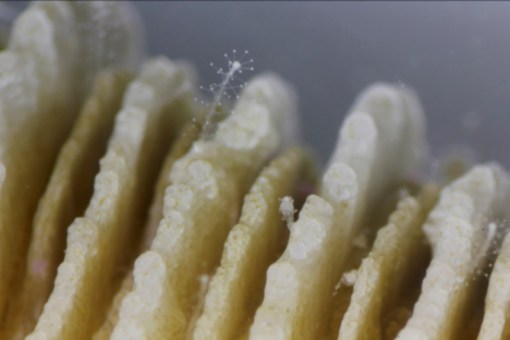
hydrozoan polyp

Hydrozoan polyps living on the surface of a coral (photo credit: S. Montano)

Corals could have some unexpected allies to cope with the multi-faceted threats posed by climate change.

In a new study published today in Proceedings of the Royal Society B, Montano and colleagues show how tiny hydrozoans smaller than 1 mm and commonly found in dense colonies on the surface of hard corals (see above photo) play an important ecological role.

Visually examining ~ 2500 coral colonies in both Maldivian and Saudi Arabian reefs, the scientists searched for signs of predation, temperature-induced stress, and disease. For each colony, they also recorded the presence of symbiotic hydrozoans. They demonstrated that corals living in association with hydrozoans are much less prone to be eaten by corallivorous (i.e., ‘coral-eating’) fish and gastropods than hydrozoan-free corals.

A likely explanation for this pattern could be the deterring action of hydrozoan nematocysts (cells capable of ejecting a venomous organelle, which are the same kinds found in jellyfish tentacles). An individual hydrozoan polyp of less than 1 mm clearly cannot cope with a corallivorous fish that is a billions of times larger, yet hydrozoans can grow at high densities on the surface of corals (sometimes > 50 individuals per cm2). This creates a sort of a continuous, ‘urticating‘ carpet that can discourage fish from foraging. Read the rest of this entry »


Giving a monkey’s about primate conservation

12 12 2017
Urban monkey living (Macaque, Gibraltar) small

Concrete jungle. A Barbary macaque sits in a human-dominated landscape in Gibraltar. Photo: Silviu Petrovan

Saving primates is a complicated business. Primates are intelligent, social animals that have complex needs. They come into conflict with humans when they raid rubbish bins and crops, chew power cables, and in some cases become aggressive towards people.

Humans, however, have the upper hand. While 60% of non-human primate species are threatened, humans grow in numbers and power, building roads through forests, hunting and trapping primates, and replacing their habitat with farms and houses.

To help primatologists choose the most effective conservation approaches to resolve these problems, researchers in the Conservation Evidence project teamed up with primate researchers to produce a global database on the effectiveness of primate conservation solutions. This free database, which can also be downloaded as a single pdf, summarizes the evidence for 162 conservation interventions — actions that conservationists might take to conserve primates. The data come from searches of over 170 conservation journals and newsletters, and each study is summarized in a single paragraph in plain English, making it possible for conservationists without access to scientific journals to read the key findings.

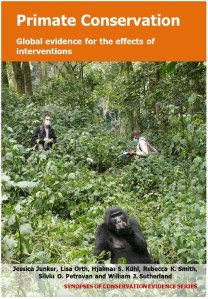
Front cover primate synopsisSo what works in primate conservation? Well, the picture is rarely straightforward — partly due to the lack of data — but there are some interesting trends. Reducing hunting is one area where there seem to be a range of potentially effective approaches. Community control of patrolling, banning hunting and removing snares was effective in the three studies in which it was tested, all in African countries.

Further emphasizing the importance of involving local communities, implementing no-hunting community policies or traditional hunting bans also appeared helpful in boosting primate numbers. In other places, a more traditional approach of using rangers to protect primates has proved a winning strategy. Training rangers, providing them with arms, and increasing ranger patrols all worked to protect primates from poachers. Identifying the circumstances in which community led approaches or ranger patrols work will be key to implementing the most appropriate response to each conservation challenge. Read the rest of this entry »


Research in Translation

11 12 2017

Do you enjoy the challenge of communicating complex scientific ideas and conservation issues to the general public? Current Conservation is looking for submissions of reader-friendly summaries of recently published research papers in conservation science!
CC

Current Conservation is a quarterly magazine that communicates conservation science in an accessible manner to a wide audience. Our magazine combines art and science to communicate the latest in research concepts and news from both the natural and social science facets of conservation, encompassing ecology, wildlife biology, conservation biology, environmental history, anthropology and sociology, ecological economics, and related fields of research.

Your summary (~ 250-300 words) should be written in a simple jargon-free way that conveys the nuances of the paper, but at the same time is easy and fun to read. You can find some examples here.
Read the rest of this entry »


Cartoon guide to biodiversity loss XLV

6 12 2017

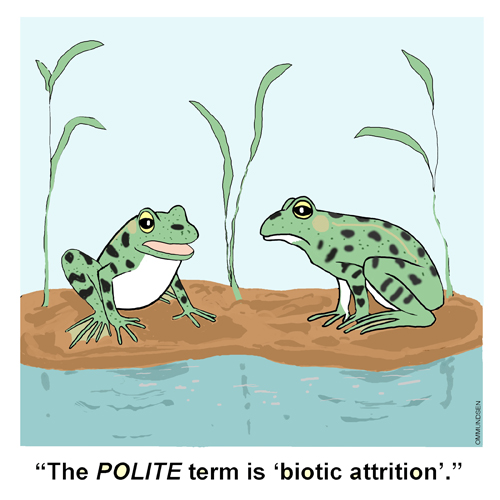
The last set of biodiversity cartoons for 2017. See full stock of previous ‘Cartoon guide to biodiversity loss’ compendia here.

Read the rest of this entry »


Microclimates: thermal shields against global warming for small herps

22 11 2017

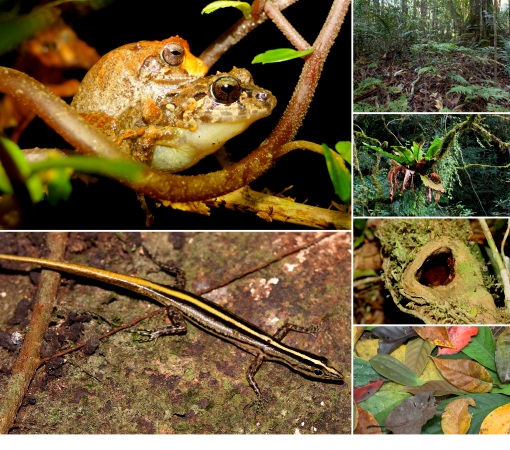
Thermal microhabitats are often uncoupled from above-ground air temperatures. A study focused on small frogs and lizards from the Philippines demonstrates that the structural complexity of tropical forests hosts a diversity of microhabitats that can reduce the exposure of many cold-blooded animals to anthropogenic climate warming.

Luzon forest frogs

Reproductive pair of the Luzon forest frogs Platymantis luzonensis (upper left), a IUCN near-threatened species restricted to < 5000 km2 of habitat. Lower left: the yellow-stripped slender tree lizard Lipinia pulchella, a IUCN least-concerned species. Both species have body lengths < 6 cm, and are native to the tropical forests of the Philippines. Right panels, top to bottom: four microhabitats monitored by Scheffers et al. (2), namely ground vegetation, bird’s nest ferns, phytotelmata, and fallen leaves above ground level. Photos courtesy of Becca Brunner (Platymantis), Gernot Kunz (Lipinia), Stephen Zozaya (ground vegetation) and Brett Scheffers (remaining habitats).

If you have ever entered a cave or an old church, you will be familiar with its coolness even in the dog days of summer. At much finer scales, from centimetres to millimetres, this ‘cooling effect’ occurs in complex ecosystems such as those embodied by tropical forests. The fact is that the life cycle of many plant and animal species depends on the network of microhabitats (e.g., small crevices, burrows, holes) interwoven by vegetation structures, such as the leaves and roots of an orchid epiphyte hanging from a tree branch or the umbrella of leaves and branches of a thick bush.

Much modern biogeographical research addressing the effects of climate change on biodiversity is based on macroclimatic data of temperature and precipitation. Such approaches mostly ignore that microhabitats can warm up or cool down in a fashion different from that of local or regional climates, and so determine how species, particularly ectotherms, thermoregulate (1). To illustrate this phenomenon, Brett Scheffers et al. (2) measured the upper thermal limits (typically known as ‘critical thermal maxima’ or CTmax) of 15 species of frogs and lizards native to the tropical forest of Mount Banahaw, an active volcano on Luzon (The Philippines). The > 7000 islands of this archipelago harbour > 300 species of amphibians and reptiles (see video here), with > 100 occurring in Luzon (3).

Read the rest of this entry »


Ecologists are gender-biased

16 11 2017
sexism-image

© xkcd.com

I normally don’t do this, but this is an extra-ordinary circumstance.

As many of you are already aware, Franck Courchamp and I published a paper in Nature Ecology and Evolution on Monday that ranked high-profile ecology papers. I won’t go into any details about the list here, because you can read the paper and the associated blog posts themselves.

The publication caused a bit of a stir among ecologists, evidenced by the rather high and rising Altmetrics score for the paper (driven mainly by a Boaty McBoatface-load of tweets). I haven’t done any social-media analysis, but it appears that most of the tweets were positive, a few were negative, and a non-trivial proportion of them were highly critical of the obvious male-biased nature of the list (in terms of article authors).

On that last point, we couldn’t agree more.

Which is why we have a follow-up analysis specifically addressing this gender bias, but that’s currently in review in Nature Ecology and Evolution.

In the meantime, however, and at the suggestion of possibly one of the coolest, nicest, and most logical editors in the world, Dr Patrick Goymer (Editor-in-Chief of Nature Ecology and Evolution), I’ve just posted a pre-print of our paper entitled “Gender-biased perceptions of important ecology articles” on bioRxiv.

Read the rest of this entry »


100 papers that every ecologist should read

14 11 2017

o-SLEEP-LIBRARY-facebook

If you’re a regular reader of CB.com, you’ll be used to my year-end summaries of the influential conservation papers of that calendar year (e.g., 2016, 2015, 2014, 2013), as somewhat subjectively assessed by F1000 Prime experts. You might also recall that I wrote a post with the slightly provocative title Essential papers you’ve probably never read back in 2015 where I talked about papers that I believe at least my own students should read and appreciate by the time they’ve finished the thesis.

But this raised a much broader question — of all the thousands of papers out there that I should have read/be reading, is there a way to limit the scope and identify the really important ones with at least a hint of objectivity? And I’m certainly not referring to the essential methods papers that you have to read and understand in order to implement their recommended analysis into your own work — these are often specific to the paper you happen to be writing at the moment.

The reason this is important is that there is absolutely no way I can keep on top of my scientific reading, and not only because there are now over 1.5 million papers published across the sciences each year. If you have even the slightest interest in working across sub-disciplines or other disciplines, the challenge becomes more insurmountable. Finding the most pertinent and relevant papers to read, especially when introducing students or young researchers to the concepts, is turning into an increasingly nightmarish task. So, how do we sift through the mountain of articles out there?

It was this question that drove the genesis of our paper that came out only today in Nature Ecology and Evolution entitled ‘100 articles every ecologist should read‘. ‘Our’ in this case means me and my very good friend and brilliant colleague, Dr Franck Courchamp of Université Paris-Sud and the CNRS, with whom I spent a 6-month sabbatical back in 2015. Read the rest of this entry »


Postdoctoral Fellowship in Ecological Networks

8 11 2017

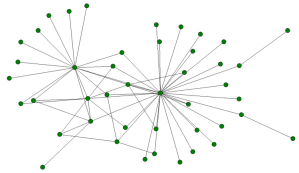
socialnetworkWell, we’ve been a bit unlucky.

We had a fantastic round of applicants for our previously advertised position in palaeo-ecological network modelling, and had offered the position to someone who had great potential.

Well, due to unforeseen circumstances (the person to whom we offered the position received another offer for a longer contract in her existing place of residence; such is life), we now have to re-advertise the position, and this one is open to both genders.

The brief overview of the position follows: Read the rest of this entry »


You know you’re screwed when the insects disappear

31 10 2017

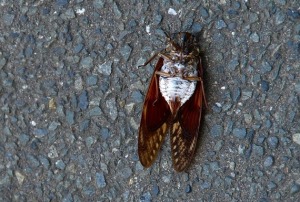
dead cicadaLast Friday, ABC 891 here in Adelaide asked me to comment on a conservation paper doing the news rounds last week. While it has been covered extensively in the media (e.g., The Guardian, CNN, and Science), I think it’s probably going to be one of those things that people unfortunately start to forget right away. But this is decidedly something that no one should be forgetting.

While you can listen to me chat about this with the lovely Sonya Feldhoff on the ABC (I start chin-wagging around the 14:30 mark), I thought it prudent to remind CB.com readers just how devastatingly important this study is.

While anyone with a modicum of conservation science under her belt will know that the Earth’s biodiversity is not doing well, the true extent of the ecological tragedy unfolding before our very eyes really came home to us back in 2014 with the publication of WWF’s Living Planet Report. According to a meta-analysis of 10,380 population trends from over 3000 species of birds, reptiles, amphibians, mammals, and fish, the report concluded that the Earth has lost over 50% of the individuals in vertebrate populations since 1970. Subsequent revisions (and more population trends from more species) place the decline at over 60% by 2020 (that’s only a little over two years away). You can also listen to me speak about this on another radio show.

If that little bit of pleasant news didn’t make the pit of your stomach gurgle and a cold sweat break out on the back of your neck, you’re probably not human. But hang on, boys and girls — it gets so much worse! The publication in PLoS One on 18 October about Germany’s insect declines might be enough to tip you over the edge and into the crevasse of mental instabilityRead the rest of this entry »


Postdoctoral position re-opened in Global Ecology

18 10 2017

women-are-better-codersI believe it is important to clarify a few things about the job advertisement that we are re-opening.

As many of you might recall, we advertised two positions in paleo-ecological modelling back in July — one in ecological networks, and the other in vegetation modelling.

We decided to do something a little unusual with the vegetation modelling position by only accepting applications from women. We did this expressly to increase the probability of attracting excellent women candidates, and to increase the number of women scientists in our lab.

I’m happy to say that we received many great applications for both positions, and whether or not it was related, most of the applicants for both positions were women (83%). As it turned out, we ended up offering the network position to a woman applicant, but we were unable to find an ideal candidate for the vegetation modelling job (i.e., the one that was originally targeting women only).

Our decision not to appoint anyone in the first round of applicants for the vegetation modelling position was clearly not related to the fact that it a woman-only position, mainly because we had so many excellent women candidates for both positions (and ended up hiring a woman for the position that was open to both genders). In other words, it seems to be a just one of those random things.

That said, we are still in need of a great vegetation modeller (or at least, someone who has the capacity to learn this knowledge), and so we have decided to re-open the announcement to both genders. However, it should go without saying that we particularly encourage women to apply.

The full details of the position, essential and desired criteria, and application process are available here (Vacancy Reference Number 17115). Note that the application closing date is 15 November 2017.

Please distribute this widely among your networks.

CJA Bradshaw


Dangers of forcing regressions through the origin

17 10 2017

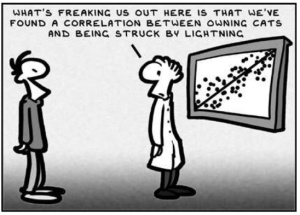
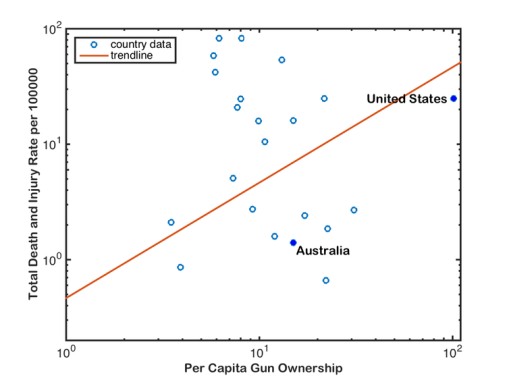
correlationsI had an interesting ‘discussion’ on Twitter yesterday that convinced me the topic would make a useful post. The specific example has nothing whatsoever to do with conservation, but it serves as a valuable statistical lesson for all concerned about demonstrating adequate evidence before jumping to conclusions.

The data in question were used in a correlation between national gun ownership (guns per capita) and gun-related deaths and injuries (total deaths and injuries from guns per 100,000 people) (the third figure in the article). As you might intuitively expect, the author concluded that there was a positive correlation between gun-related deaths and injuries, and gun ownership:

image-20160307-30436-2rzo6k

__

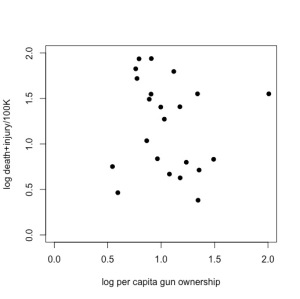
Now, if you’re an empirical skeptic like me, there was something fishy about that fitted trend line. So, I replotted the data (available here) using Plot Digitizer (if you haven’t yet discovered this wonderful tool for lifting data out of figures, you would be wise to get it now), and ran a little analysis of my own in R:

Rplot01

Just doing a little 2-parameter linear model (y ~ α + βx) in R on these log-log data (which means, it’s assumed to be a power relationship), shows that there’s no relationship at all — the intercept is 1.3565 (± 0.3814) in log space (i.e., 101.3565 = 22.72), and there’s no evidence for a non-zero slope (in fact, the estimated slope is negative at -0.1411, but it has no support). See R code here.

Now, the author pointed out what appears to be a rather intuitive requirement for this analysis — you should not have a positive number of gun-related deaths/injuries if there are no guns in the population; in other words, the relationship should be forced to go through the origin (xy = 0, 0). You can easily do this in R by using the lm function and setting the relationship to y ~ 0 + x; see code here). Read the rest of this entry »


Cartoon guide to biodiversity loss XLIV

9 10 2017

Here’s another set of biodiversity cartoons to make you giggle, groan, and contemplate the Anthropocene extinction crisis. See full stock of previous ‘Cartoon guide to biodiversity loss’ compendia here.

Read the rest of this entry »


Four decades of fragmentation

27 09 2017

fragmented

I’ve recently read perhaps the most comprehensive treatise of forest fragmentation research ever compiled, and I personally view this rather readable and succinct review by Bill Laurance and colleagues as something every ecology and conservation student should read.

The ‘Biological Dynamics of Forest Fragments Project‘ (BDFFP) is unquestionably one of the most important landscape-scale experiments ever conceived and implemented, now having run 38 years since its inception in 1979. Indeed, it was way ahead of its time.

Experimental studies in ecology are comparatively rare, namely because it is difficult, expensive, and challenging in the extreme to manipulate entire ecosystems to test specific hypotheses relating to the response of biodiversity to environmental change. Thus, we ecologists tend to rely more on mensurative designs that use existing variation in the landscape (or over time) to infer mechanisms of community change. Of course, such experiments have to be large to be meaningful, which is one reason why the 1000 km2 BDFFP has been so successful as the gold standard for determining the effects of forest fragmentation on biodiversity.

And successful it has been. A quick search for ‘BDFFP’ in the Web of Knowledge database identifies > 40 peer-reviewed articles and a slew of books and book chapters arising from the project, some of which are highly cited classics in conservation ecology (e.g., doi:10.1046/j.1523-1739.2002.01025.x cited > 900 times; doi:10.1073/pnas.2336195100 cited > 200 times; doi:10.1016/j.biocon.2010.09.021 cited > 400 times; and doi:10.1111/j.1461-0248.2009.01294.x cited nearly 600 times). In fact, if we are to claim any ecological ‘laws’ at all, our understanding of fragmentation on biodiversity could be labelled as one of the few, thanks principally to the BDFFP. Read the rest of this entry »


A gender-diverse lab is a good lab

18 09 2017

sexism

Another little expurgated teaser from my upcoming book with Cambridge University Press.

My definition of a ‘lab’ is simply a group of people who do the science in question — and people are indeed a varied mob. I’d bet that most scientists do not necessarily give much thought to the diversity of the people in their lab, and instead probably focus more on obtaining the most qualified and cleverest people for the jobs that need doing. There are probably few of us who are overtly racist, sexist, or otherwise biased against or for certain types of people.

But the problem is not that scientists tend to exclude certain types of people deliberately based on negative stereotypes; rather, it concerns more the subconscious biases that might lurk within, and about which unfortunately most of us are blissfully unaware. But a scientist should be aware of, and seek to address, these hidden biases.

I acknowledge that as a man, I am stepping onto thin ice even to dare to discuss the thorny issue of gender inequality in science today, for it is a massive topic that many, far more qualified people are tackling. But being of the male flavour means that I have to, like an alcoholic, admit that I have a problem, and then take steps to resolve that problem.

Read the rest of this entry »


Less snow from climate change pushes evolution of browner birds

7 09 2017
© Bill Doherty

© Bill Doherty

Climate changes exert selective pressures on the reproduction and survival of species. A study of tawny owls from Finland finds that the proportion of two colour morphs varies in response to the gradual decline of snowfall occurring in the boreal region.

Someone born in the tropics who travels to the Antarctic or the Himalaya can, of course, stand the cold (with a little engineering help from clothing, however). The physiology of our body is flexible enough to tolerate temperatures alien to those of our home. We can acclimate and, if we are healthy, we can virtually reside anywhere in the world.

However, modern climate change is steadily altering the thermal conditions of the native habitats of many species. Like us, some can live up to as much heat or cold as their genetic heritage permits, because each species can express a range of morphological, physiological, and behavioural variation (plasticity). Others can modify their genetic make-up, giving way to novel species-specific features or genotypes (evolution).

When genetic changes are speedy, that is, within a few generations, we are witnessing ‘microevolution’ — in contrast to ‘macroevolution’ across geological time scales as originally reported by Darwin and Wallace (1). To date, the detection of microevolution in response to modern climate change remains elusive, and many studies claiming so seem to lack the appropriate data to differentiate microevolution from phenotypic plasticity (i.e., the capacity of a single genotype to exhibit variable phenotypes in different environments) (2, 3). Read the rest of this entry »


Which countries protect the most of their land?

1 09 2017

forestOne potentially useful metric to measure how different nations value their biodiversity is just how much of a country’s land its government sets aside to protect its natural heritage and resources. While this might not necessarily cover all the aspects of ‘environment’ we need to explore, we know from previous research that the more emphasis a country places on protecting its biodiversity, the more it actually achieves this goal. This might sound intuitive, but there is no shortage of what have become known as ‘paper parks’ around the world, which are essentially only protected in principle, but not in practice.

For example, if a national park or some other type of protected area is not respected by the locals (who might rightly or wrongly perceive them as a limitation of their ‘rights’ of exploitation), or is pilfered by corrupt government officials in cahoots with extractive industries like logging or mining, then the park does not do well in protecting the species it was designed to safeguard. So, even though the proportion of area protected within a country is not a perfect reflection of its environmental performance, it tends to indicate to what extent its government, and therefore, its people, are committed to saving its natural heritage.

Read the rest of this entry »


When to appeal a rejection

26 08 2017

BegA modified excerpt from my upcoming book for you to contemplate after your next rejection letter.

This is a delicate subject that requires some reflection. Early in my career, I believed the appeal process to be a waste of time. Having made one or two of them to no avail, and then having been on the receiving end of many appeals as a journal editor myself, I thought that it would be a rare occasion indeed when an appeal actually led to a reversal of the final decision.

It turns out that I was very wrong, but not in terms of simple functional probability that you might be thinking. Ironically, the harder it is to get a paper published in a journal, the higher the likelihood that an appeal following rejection will lead to a favourable outcome for the submitting authors. Let me explain. Read the rest of this entry »


Cartoon guide to biodiversity loss XLIII

12 08 2017

I’m travelling again, so here’s another set of fishy cartoons to appeal to your sense of morbid fascination with biodiversity loss in the sea. See full stock of previous ‘Cartoon guide to biodiversity loss’ compendia here.

Read the rest of this entry »


World of urban rangers

2 08 2017

Bridging the gap between an urban population and the wildlife we love.IOE_crowdfunding1_web_16-9-with-logo-C

The world continues to urbanise. According to the Population Reference Bureau, the developed nations of the world are 74% urban, and it is expected that by 2050, 70% of the entire world will be ‘urban’. Besides all the other consequences, people’s connection to nature will become more and more distant. With more people living in concrete jungles, a faster pace of life and a barrage of things competing for their attention, we cannot expect that nature, wildlife protection, ocean sustainability, et cetera will be high on the list of their priorities. Other than when the most sensational of news stories are released, how many of them will even think about wildlife, let alone take any personal steps that would make a difference to its survival?

If these are the people who define consumer behaviour and impact policy decisions, they are the ones who will also unwittingly drive the wildlife-conservation agenda. The conservation sector must therefore make a more concerted effort to connect with city dwellers and to do so, understand the motivations and desires of the greater public.

The good news is that despite the grander evidence against it, people do love animals. As children, we are surrounded by animals. Many of our favourite books, movies, clothes, and toys are associated with animals. Even as adults, 163 million of us have watched a video of a panda clinging to its caretaker, 100 million of us went to see Jungle Book, and 700 million more of us visited zoos last year. Marketers play into our love of animals and use the sympathetic or iconic nature of animals on a massive scale in advertising and branding.

If you threw practicality out the window, the most impactful thing you could do to convert that love of animals into a love of conservation would be to airlift those hundreds of millions of people into the Amazon, Serengeti, or Alaskan wilderness for a week. While the experience wouldn’t make all of them conservationists, it would certainly change the way they thought about the importance of nature.

Given this impossibility, the next best thing is to bring nature to them and entice them to explore more within their own means. Shows like BBC Planet Earth or Wild Kratts do a fantastic job of revealing the awesomeness of nature in a way that most everyone appreciates.

But TV shows are still a passive experience where the viewer takes in what he/she is being shown.

Our work at Internet of Elephants is to supplement this type of programming with games about wildlife that can actively be played every day. Our goal is to get people to think about wildlife for five minutes every day and convert the urban world into wildlife addicts. Read the rest of this entry »


Paying to stop degrading

28 07 2017

green baby bathwaterWe conservationists don’t get a lot of good news these days, and even when we do, I am reminded of the (slightly modified) expression: one step forward, but ten steps backward. It’s enough to lead to depression.

Still, we soldier on, and now there are more and more philosophically positive events and venues for ‘optimistic’ conservation stories. Indeed, some of them have even appeared here on ConservationBytes.com (mainly from Claire Wordley‘s excellent string of posts from Conservation Evidence — see here, here, here, here), as well as the much-publicised Conservation Optimism Summit and its American version, Earth Optimism.

A decade or so ago, payment for ecosystem services was all the rage. The idea was simple — pay people to conserve forests and other intact habitats instead of cutting them down for timber or to grow food. However, as the years passed, these types of programmes — which were often funded (or intended to be funded) through carbon-sequestration schemes) — showed little capacity to prevent deforestation at a landscape scale. Many people have therefore binned the entire idea as a result. Read the rest of this entry »