Those of us living with cats share our homes with an ancestral predator, one adapted for hunting and the frequent, exclusive consumption of meat. These instincts become fully activated outside the domestic environment, where cats pose a global threat to wildlife.
Pets are family. We celebrate their arrival with the same joy as a grand homecoming, and their absence leaves a grief as deep as losing a loved one. In bonding with cats and dogs, we often attribute human abilities and emotions to them.
But beyond this affection, domestic animals still carry the instincts and genetic legacy of their wild ancestors(1, 2). My cats — Caruso, Muesli, and Plata — have been calm and loving, but they have always enjoyed a real hunt (3). When a moth comes in through a window, they seem possessed: their mouths chitter and make clicking sounds, they leap from one piece of furniture to another, and their heads snap sharply between the insect’s position and other points in the room, calculating the best spot from which to pounce on their prey. That is why when they become feral, cats and dogs integrate into food chains like any other species: they compete for ecosystem resources, hunt and are hunted, and hybridise and exchange diseases with other carnivores (4, 5).
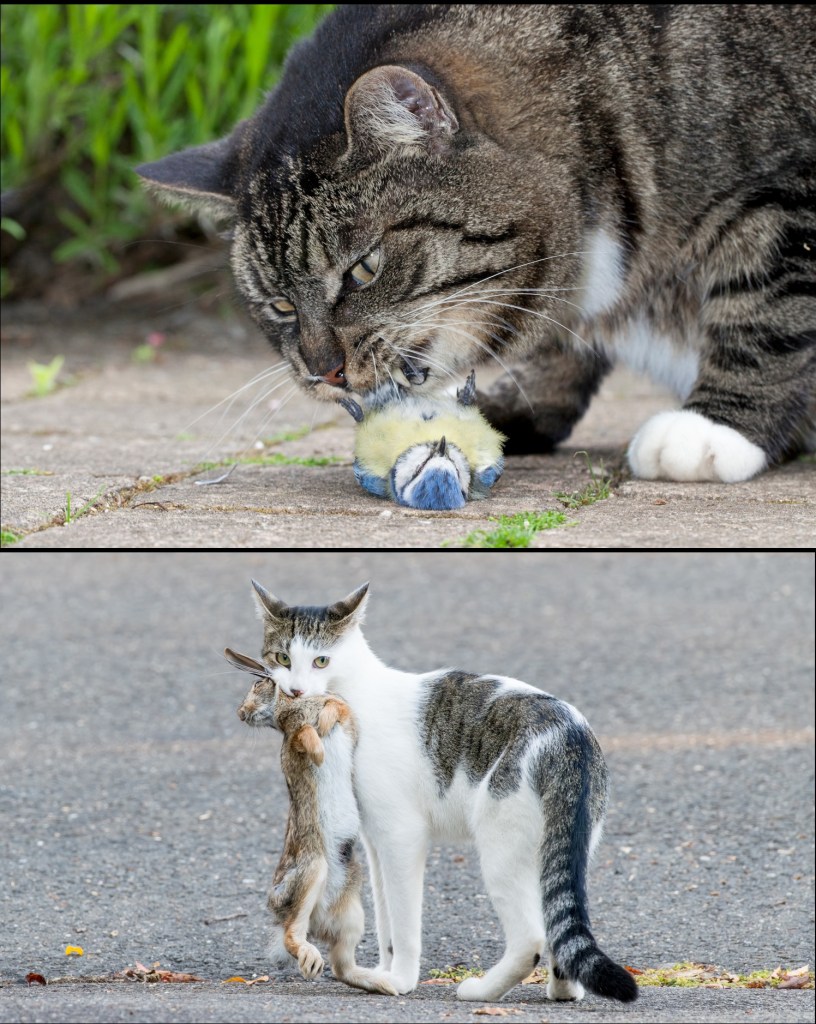
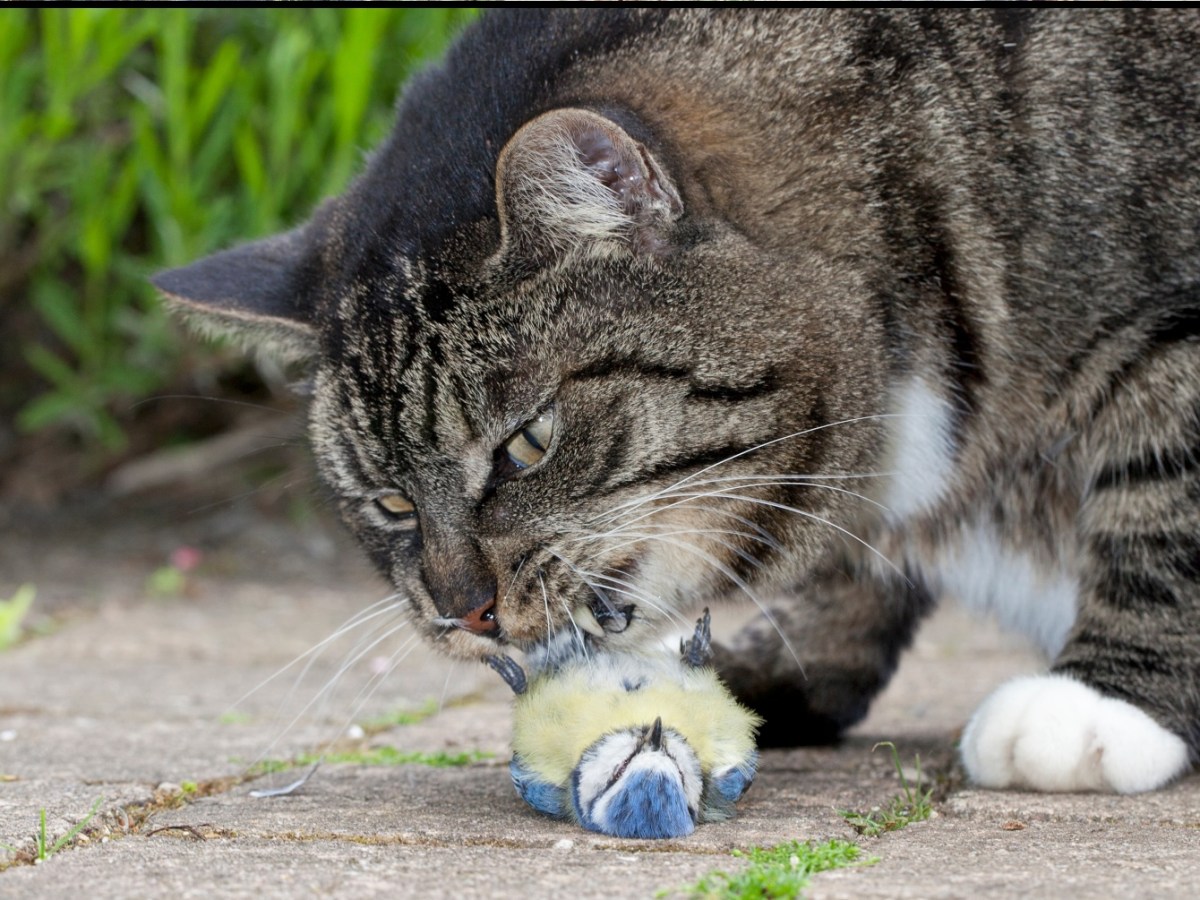
Top: cat eating an Eurasian blue tit (Cyanistes caeruleus), a common visitor to home gardens in Nijmegen (Netherlands). Bottom, domestic cat after hunting an Eastern cottontail rabbit (Sylvilagus floridanus) in a residential neighbourhood of Stratford (Connecticut, USA). Photos courtesy of Jelger Herder (Nijmegen) and Scott Kruitbosch (Stratford). Scott is a photographer and conservationist. Near sunset on 30/09/2020, while intently observing local wildlife, he witnessed a neighbourhood cat sneak up from behind on a cottontail feeding in open grass and grab it. For years, Scott has had extremely negative interactions, both in person and online, with local residents over these issues. These exchanges have revealed that many people show little concern for wildlife or for the dangers their outdoor cats face, and believe that their cats would not, or could not, harm wildlife.
Domestic cats are highly skilled hunters, and their predatory interactions with a wide range of prey are widely documented in social media and documentaries. Some examples include cats catching: bats and birds on the wing, butterflies, chipmunks, dragons, fishes, grasshoppers, frogs, lizards, mice, owls, rabbits, seagulls, snakes, squirrels, and wallabies. See an award-winning photo depicting wildlife with fatal injuries caused by cats recorded in 2019 at a single animal hospital in the USA, and a video showing domestic cats mimicking bird calls and some cat owners explaining that their pets reject commercial cat food after experiencing the thrill of hunting real prey. The documentary Secret Life of Cats contextualises the ecological challenges posed by free-roaming cats.
The way that eels migrate along rivers and seas is mesmerising. There has been scientific agreement since the turn of the 20th Century that the Sargasso Sea is the breeding home to the sole European species. But it has taken more than two centuries since Carl Linnaeus gave this snake-shaped fish its scientific name before an adult was discovered in the area where they mate and spawn.
Even among nomadic people, the average human walks no more than a few dozen kilometres in a single trip. In comparison, the animal kingdom is rife with migratory species that traverse continents, oceans, and even the entire planet (1).
The European eel (Anguilla anguilla) is an outstanding example. Adults migrate up to 5000 km from the rivers and coastal wetlands of Europe and northern Africa to reproduce, lay their eggs, and die in the Sargasso Sea — an algae-covered sea delimited by oceanic currents in the North Atlantic.
The European eel (Anguilla Anguilla) is an omnivorous fish that migrates from European and North African rivers to the Sargasso Sea to mate and die (18). Each individual experiences 4 distinct developmental phases, which look so different that they have been described as three distinct species (19): A planktonic, leaf-like larva (ilecocephalus phase) emerges from each egg and takes up to 3 years to cross the Atlantic. Off the Afro-European coasts, the larva transforms into a semi-transparent tiny eel (iiglass phase) that enters wetlands and estuaries, and travels up the rivers as it gains weight and pigment (iiiyellow phase). They remain there for up to 20 years, rarely growing larger than 1 m in length and 4 kg in weight (females are larger than males) — see underwater footage here and here. Sexual maturity ultimately begins to adjust to the migration to the sea: a darker, saltier, and deeper environment than the river. Their back and belly turn bronze and silver (ivsilver phase), respectively, the eyes increase in size and the number of photoreceptors multiplies (function = submarine vision), the stomach shrinks and loses its digestive function, the walls of the swim bladder thicken (function = floating in the water column), and the fat content of tissues increases by up to 30% of body weight (function = fuel for transoceanic travelling). And finally, the reproductive system will gradually develop while eels navigate to the Sargasso Sea — a trip during which they fast. Photos courtesy of Sune Riis Sørensen (2-day embryo raised at www.eel-hatch.dk and leptocephalus from the Sargasso Sea) and Lluís Zamora (Ter River, Girona, Spain: glass eels in Torroella de Montgrí, 70 cm yellow female in Bonmatí, and 40 cm silver male showing eye enlargement in Bescanó). Eggs and sperm are only known from in vitro fertilisation in laboratories and fish farms (20).
As larvae emerge, they drift with the prevailing marine currents over the Atlantic to the European and African coasts (2). The location of the breeding area was unveiled in the early 20th Century as a result of the observation that the size of the larvae caught in research surveys gradually decreased from Afro-European land towards the Sargasso Sea (3, 4). Adult eels had been tracked by telemetry in their migration route converging on the Azores Archipelago (5), but none had been recorded beyond until recently.
Crossing the Atlantic
To complete this piece of the puzzle, Rosalind Wright and collaborators placed transmitters in 21 silver females and released them in the Azores (6). These individuals travelled between 300 and 2300 km, averaging 7 km each day. Five arrived in the Sargasso Sea, and one of them, after a swim of 243 days (from November 2019 to July 2020), reached what for many years had been the hypothetical core of the breeding area (3, 4). It is the first direct record of a European eel ending its reproductive journey.
Eels use the magnetic fields in their way back to the Sargasso Sea and rely on an internal compass that records the route they made as larvae (7). The speed of navigation recorded by Wright is slower than in many long-distance migratory vertebrates like birds, yet it is consistent across the 16 known eel species (8).
Telemetry (6) and fisheries (14) of European eel (Anguilla anguilla). Eel silhouettes indicate the release point of 21 silver females in Azores in 2018 (orange) and 2019 (yellow), the circles show the position where their transmitters stopped sending signals, and the grey background darkens with water depth. The diagrams display the distance travelled and the speed per eel, where the circle with bold border represents the female that reached the centre of the hypothetical spawning area in the Sargasso Sea (dashed lines in the map) (3). Blue, green and pink symbols indicate the final location of eels equipped with teletransmitters in previous studies, finding no individual giving location signals beyond the Azores Archipelago (6). The barplot shows commercial catches (1978-2021) of yellow+silver eels in those European countries with historical landings exceeding 30,000 t (no data available for France prior to 1986), plus Spain (6120 t from 1951) — excluding recreational fishery and farming which, in 2020, totalled 300 and 4600 t, respectively (14). Red circles represent glass-eel catches added up for France (> 90% of all-country landings), Great Britain, Portugal, and Spain. Catches have kept declining since the 1980s. One kg of glass eels contains some 3000 individuals, so the glass-eel fishery has a far greater impact on stocks than the adult fishery.
Wright claimed that, instead of swiftly migrating for early spawning, eels engage in a protracted migration at depth. This behaviour serves to conserve their energy and minimises the risk of dying (6). The delay also allows them to reach full reproductive potential since, during migration, eels stop eating and mobilise all their resources to swim and reproduce (9).
Other studies have revealed that adults move in deep waters in daylight but in shallow waters at night, and that some individuals are faster than others (3 to 47 km per day) (5). Considering that (i) this fish departs Europe and Africa between August and December and (ii) spawning occurs in the Sargasso Sea from December to May, it is unknown whether different individuals might breed 1 or 2 years after they begin their oceanic migration.
Management as complex as life itself
The European eel started showing the first signs of decline at the end of the 19th Century (10, 11). In 2008, the species was listed as Critically Endangered by the IUCN, and its conservation status has since remained in that category — worse than that of the giant panda (Ailuropoda melanoleuca) or the Iberian lynx (Lynx pardinus).
I’d be surprised if any Australians with even a passing interest in science could claim not to have listened to the Science Show before, and I suspect a fair mob of people overseas would be in the same boat.
It was a real privilege to talk with Robyn about our work on the ghastly future, and as always, the production value is outstanding.
Shamefully, Australia has one of the highest extinction rates in the world. And the number one threat to our species is invasive or “alien” plants and animals.
But invasive species don’t just cause extinctions and biodiversity loss – they also create a serious economic burden. Our research, published today, reveals invasive species have cost the Australian economy at least A$390 billion in the last 60 years alone.
Our paper – the most detailed assessment of its type ever published in this country – also reveals feral cats are the worst invasive species in terms of total costs, followed by rabbits and fire ants.
Without urgent action, Australia will continue to lose billions of dollars every year on invasive species.
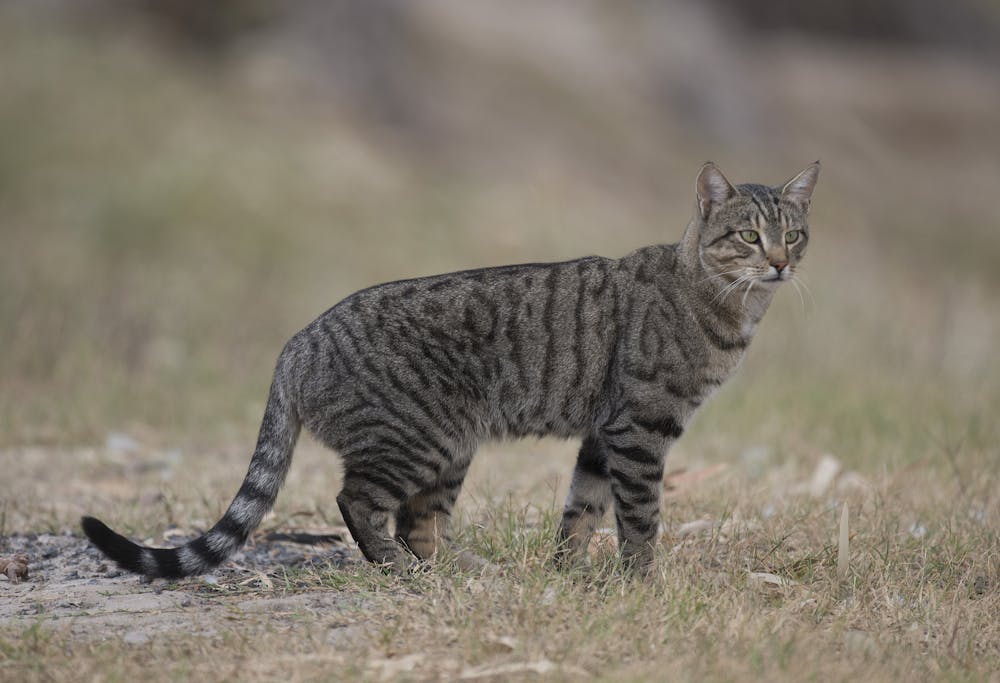
Feral cats are Australia’s costliest invasive species. Source: Adobe Stock/240188862
Huge economic burden
Invasive species are those not native to a particular ecosystem. They are introduced either by accident or on purpose and become pests.
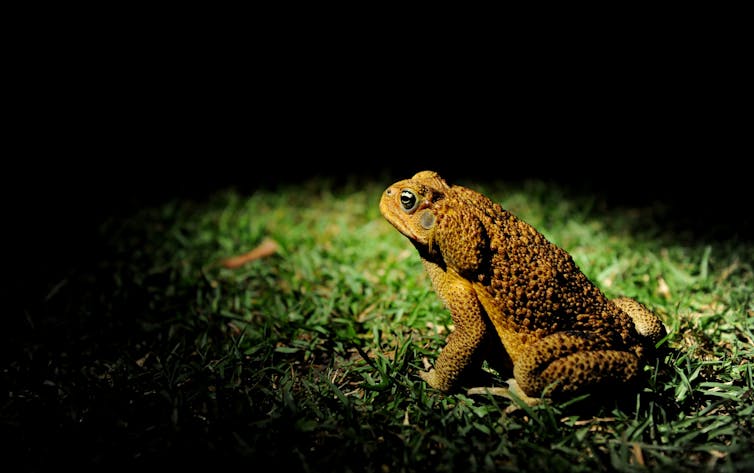
Some costs involve direct damage to agriculture, such as insects or fungi destroying fruit. Other examples include measures to control invasive species like feral cats and cane toads, such as paying field staff and buying fuel, ammunition, traps and poisons.
Our previous research put the global cost of invasive species at A$1.7 trillion. But this is most certainly a gross underestimate because so many data are missing.
As a wealthy nation, Australia has accumulated more reliable cost data than most other regions. These costs have increased exponentially over time – up to sixfold each decade since the 1970s.
“I wish it need not have happened in my time,” said Frodo. “So do I,’ said Gandalf, “and so do all who live to see such times. But that is not for them to decide. All we have to decide is what to do with the time that is given us.”
Frodo Baggins and Gandalf, The Fellowship of the Ring
Today, 16 high-profile scientists and I published what I describe as a ‘cold shower’ about society’s capacity to avoid a ghastly future of warfare, disease, inequality, persecution, extinction, and suffering.
And it goes way beyond just the plight of biodiversity.
No one who knows me well would mistake me for an optimist, try as I might to use my colleagues’ and my research for good. Instead, I like to describe myself as a ‘realist’. However, this latest paper has made even my gloomier past outputs look downright hopeful.
And before being accused of sensationalism, let me make one thing abundantly clear — I sincerely hope that what we describe in this paper does not come to pass. Not even I am that masochistic.
I am also supportive of every attempt to make the world a better place, to sing about our successes, regroup effectively from our failures, and maintain hope in spite of evidence to the contrary.
But failing to acknowledge the magnitude and the gravity of the problems facing us is not just naïve, it is positively dangerous and potentially fatal.
I’m almost slightly embarrassed to say that Shiny was so addictive that I ended up making another app.
This new app takes any list of user-supplied digital object identifiers (doi) and fetches their Altmetric data for you.
Why might you be interested in a paper’s Altmetric data? Citations are only one measure of an article’s impact on the research community, whereas Altmetrics tend to indicate the penetration of the article’s findings to a much broader audience.
Altmetric is probably the leading way to gauge the ‘impact’ (attention) an article has commanded across all online sources, including news articles, tweets, Facebook entries, blogs, Wikipedia mentions and others.
Several months ago, Daniel Blumstein of UCLA approached me with an offer — fancy leading a Special Section in a new Frontiers journal dedicated to conservation science?
I admit that my gut reaction was a visceral ‘no’, both in terms of the extra time it would require, as well as my autonomous reflex of ‘not another journal, please‘.
I had, for example, spent a good deal of blood, sweat, and tears helping to launch Conservation Letters when I acted as Senior Editor for the first 3.5 years of its existence (I can’t believe that it has been nearly a decade since I left the journal). While certainly an educational and reputational boost, I can’t claim that the experience was always a pleasant one — as has been said many times before, thefastest way to makeenemies is to become an editor.
But then Dan explained what he had in mind for Frontiers in Conservation Science, and the more I spoke with him, the more I started to think that it wasn’t a bad idea after all for me to join.
You’d think I’d get tired of this, wouldn’t you? Alas, the fight does wear me down, but I must persist.
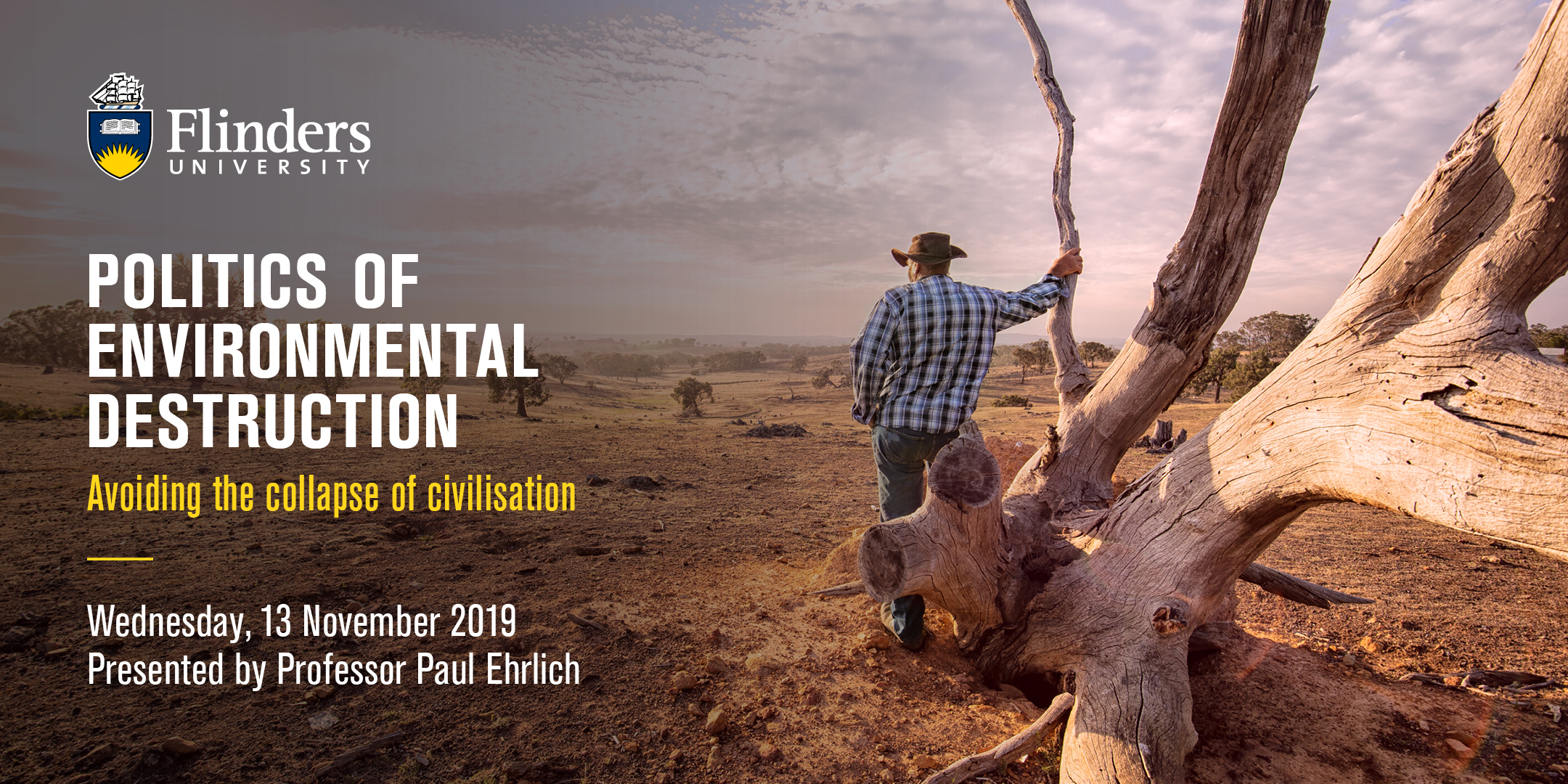
My good friend and colleague, the legendary Professor Paul Ehrlich of Stanford University, as well as his equally legendary wife, Anne, will be joining us in Adelaide for a brief visit during their annual southern migration.
Apart from just catching up over a few good bottles of wine (oh, do those two enjoy fine wines!), we have the immense privilege of having Paul appear at two events while he’s in town.
I’m really only going to be talking about the second of the two events (the first is a Science Meets Parliament gig with me and many others at the South Australia Parliament on 12 November): a grand, public lecture and Q&A session held at Flinders University on Wednesday, 13 November.
Haven’t heard of Paul? Where have you been hiding? If by some miracle you haven’t, here’s a brief bio:
Paul Ehrlich is Bing Professor of Population Studies Emeritus, President of the Center for Conservation Biology, Department of Biology, Stanford University and Adjunct Professor, University of Technology, Sydney. He does research in population biology (includes ecology, evolutionary biology, behavior, and human ecology and cultural evolution). Ehrlich has carried out field, laboratory and theoretical research on a wide array of problems ranging from the dynamics and genetics of insect populations, studies of the ecological and evolutionary interactions of plants and herbivores, and the behavioral ecology of birds and reef fishes, to experimental studies of the effects of crowding on human beings and studies of cultural evolution, especially the evolution of norms. He is President of the Millennium Alliance for Humanity and the Biosphere and is author and coauthor of more than 1100 scientific papers and articles in the popular press and over 40 books. He is best known to his efforts to alert the public to the many intertwined drivers that are pushing humanity toward a collapse of civilization – especially overpopulation, overconsumption by the rich, and lack of economic, racial, and gender equity. Ehrlich is a Fellow of the American Academy of Arts and Sciences, the American Entomological Society and the Beijer Institute of Ecological Economics, and a member of the United States National Academy of Sciences and the American Philosophical Society. He is a Foreign Member of the Royal Society, an Honorary Member of the British Ecological Society and an Honorary Fellow of the Royal Entomological Society. Among his many other honours are the Royal Swedish Academy of Sciences, Crafoord Prize in Population Biology and the Conservation of Biological Diversity (an explicit replacement for the Nobel Prize); a MacArthur Prize Fellowship; the Volvo Environment Prize; UNEP Sasakawa Environment Prize; the Heinz Award for the Environment; the Tyler Prize for Environmental Achievement; the Heineken Prize for Environmental Sciences; the Blue Planet Prize; the Eminent Ecologist award of the Ecological Society of America, the Margalef Prize in Ecology and Environmental Sciences, and the BBVA Frontiers of Knowledge Award in Ecology and Conservation Biology. Prof Ehrlich has appeared as a guest on more than 1000 TV and radio programs; he also was a correspondent for NBC News. He has given many hundreds of public lectures in the past 50 years.
Here’s a presentation I gave earlier in the year for the Flinders University BRAVE Research and Innovation series:
There is No Plan(et) B — What you can do about Earth’s extinction emergency
Earth is currently experiencing a mass extinction brought about by, … well, … us. Species are being lost at a rate similar to when the dinosaurs disappeared. But this time, it’s not due to a massive asteroid hitting the Earth; species are being removed from the planet now because of human consumption of natural resources. Is a societal collapse imminent, and do we need to prepare for a post-collapse society rather than attempt to avoid one? Or, can we limit the severity and onset of a collapse by introducing a few changes such as removing political donations, becoming vegetarians, or by reducing the number of children one has?
Late last year (10 December) I was invited to front up to the ‘Overabundant and Pest Species Inquiry’ at the South Australian Parliament to give evidence regarding so-called ‘overabundant’ and ‘pest’ species.
There were the usual five to six Ministers and various aides on the Natural Resources Committee (warning here: the SA Parliament website is one of the most confusing, archaic, badly organised, and generally shitty government sites I’ve yet to visit, so things require a bit of nuanced searching) to whom I addressed on issues ranging from kangaroos, to dingoes, to koalas, to corellas. The other submissions I listened to that day were (mostly) in favour of not taking drastic measures for most of the human-wildlife conflicts that were being investigated.
Forward seven months and the Natural Resources Committee has been reported to have requested the SA Minister for Environment to allow mass culling of any species (wildlife or feral) that they deem to be ‘overabundant’ or a ‘pest’.
So, the first problem is terminological in nature. If you try to wade through the subjectivity, bullshit, vested interests, and general ignorance, you’ll quickly realise that there is no working definition or accepted meaning for the words ‘overabundant’ or ‘pest’ in any legislation. Basically, it comes down to a handful of lobbyists and other squeaky wheels defining anything they deem to be a nuisance as ‘overabundant’, irrespective of its threat status, ecological role, or purported impacts. It is, therefore, entirely subjective, and boils down to this: “If I don’t like it, it’s an overabundant pest”. Read the rest of this entry »
This book is free to download. This book contains the evidence for the effectiveness of over 1200 things you might do for conservation. If you don’t have a copy, go and download yourself a free one here, right now, before you even finish reading this article. Seriously. Go. You’ll laugh, you’ll cry, it’ll change your life.
Why you’ll laugh
OK, I may have exaggerated the laughing part. ‘What Works in Conservation 2018’ is a serious and weighty tome, 660 pages of the evidence for 1277 conservation interventions (anything you might do to conserve a species or habitat), assessed by experts and graded into colour-coded categories of effectiveness. This is pretty nerdy stuff, and probably not something you’ll lay down with on the beach or dip into as you enjoy a large glass of scotch (although I don’t know your life, maybe it is).
But that’s not really what it’s meant for. This is intended as a reference book for conservation managers and policymakers, a way to scan through your possible solutions and get a feel for those that are most likely to be effective. Once you have a few ideas in mind, you can follow the links to see the full evidence base for each study at conservationevidence.com, where over 5000 studies have been summarised into digestible paragraphs.
The book takes the form of discrete chapters on taxa, habitats or topics (such as ‘control of freshwater invasives’). Each chapter is split into IUCN threat categories such as ‘Agriculture’ or ‘Energy production and mining’. For each threat there are a series of interventions that could be used to tackle it, and for each of these interventions the evidence has been collated. Experts have then graded the body of the evidence over three rounds of Delphi scoring, looking at the effectiveness, certainty in the evidence (i.e., the quality and quantity of evidence available), and any harms to the target taxa. These scores combine to place each intervention in a category from ‘Beneficial’ to ‘Likely to be ineffective or harmful’. Read the rest of this entry »
Jorge Drexler sings “… I was committed not to see what I saw, but sometimes life is more complex than what it looks like …”*. This excerpt by the Oscar-winning Uruguayan singer seems to foretell the theme of this blog: how the ecological complexity of marine ecosystems can elicit false signals to their predators. Indeed, the fidelity of marine predators to certain feeding areas can turn demographically detrimental to themselves when the amount of available food shrinks. A study of jackass penguins illustrates the phenomenon in a context of overfishing and ocean warming.
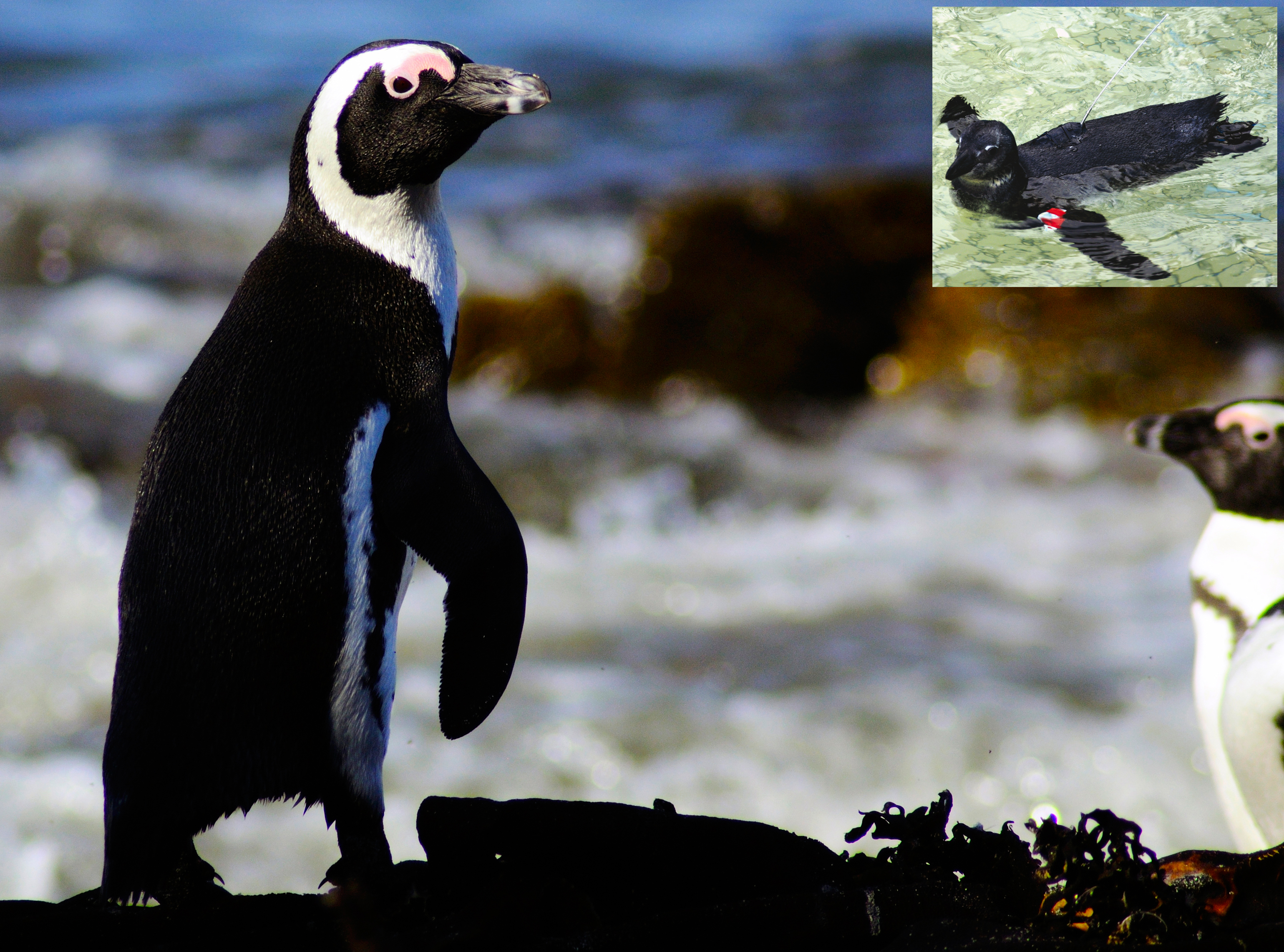
Adult of jackass penguin (Spheniscus demersus) from Robben Island (South Africa) — in the inset, one of the first juveniles released with a satellite transmitter on its back. The species is ‘Endangered’ under IUCN’s criteria (28), following a recent halving of the total population currently estimated at ~ 80,000 adults. Jackass penguins are the only penguins living in Africa, and owe their common name to their vocalisations (you can hear their braying sounds here); adults are ~ 50 cm tall and weigh ~ 3 kg. Photos courtesy of Richard Sherley.
Surface temperature, dissolved oxygen, acidity and primary productivity are, by and large, the top four environmental factors driving the functionality of marine ecosystems (1). Growing scientific evidence supports the idea that anthropogenic warming of the atmosphere and the oceans correlates with this quartet (2). For instance, marine primary productivity is enhanced by increased temperatures (3), but a warmer sea surface intensifies stratification, i.e., stacked layers of seawater with contrasting physical and chemical properties.
In coastal areas experiencing ‘upwelling’ (where winds displace surface water, allowing deep water laden with nutrients to reach the euphotic zone where plankton communities feast), stratification weakens upwelling currents and, in turn, limits the growth of plankton (4) that fuels the entire trophic web, including our fisheries. The study of these complex trophic cascades is particularly cumbersome from the perspective of large marine predators because of their capacity to move long distances, from hundreds to thousands of kilometres (5), with strong implications for their conservation (6).
With those caveats in mind, Richard Sherley and colleagues satellite-tracked the movement of 54 post-fledged, juvenile jackass penguins (Spheniscus demersus) for 2-3 years (7). All individuals had been hatched in eight colonies (accounting for 80% of the global population), and were equipped with platform terminal transmitters. Jackass penguins currently nest in 28 island and mainland locations between South Africa and Namibia. Juveniles swim up to 2000 km in search of food and, when approaching adulthood, return to their native colonies where they reproduce and reside for the remainder of their lives (watch individuals swimming here).
The natural history of this species is linked to the Southern Hemisphere’s trade winds (‘alisios’ for Spanish speakers), which blow from the southeast to the tropics. In the South Atlantic, trade winds sustain the Benguela Current, the waters of which surface from some 300 m of depth and fertilise the marine ecosystems stretching from the Western coasts of South Africa to Angola (8). Read the rest of this entry »
There’s a romantic myth surrounding Australia that is pervasive both overseas and within the national psyche: this sun-scorched continent home to stoic bushmen1 that eek out a frugal, yet satisfying existence in this harsh rural land. Unfortunately that ideal is anathema to almost every Australian alive today.
While some elements of that myth do have a basis in reality – it is indeed a hot, dry, mostly inhospitable place if you count the entire land area (all 7.69 million square kilometres of it), and it does have the dubious honour of being the driest inhabited continent on Earth – most Australians live nowhere near the dry interior or the bush.
Despite our remarkably low average population density (a mere 3.09 people per square kilometre), Australia is in fact one of the most urbanised nations on the planet, with nearly 90% of its citizenry living within a major urban centre. As a result, our largely urban/suburban, latte-sipping, supermarket-shopping population has little, if any, connection to the vast landscape that surrounds its comfortable, built-up environs. There should be little wonder then that Australians are so disconnected from their own ecology, and little surprise that our elected officials (who, after all, represent the values of the majority of the citizens they purport to represent), are doing nothing to slow the rapid flushing of our environment down the toilet. Indeed, the current government is in fact actively encouraging the pace of that destruction. Read the rest of this entry »
Unless you’ve been out bush for the last few days or completely ignored the news services, you would have heard that Western Australia has decided not to go ahead with its moronic shark-culling programme. It all came down to the Western Australia Environmental Protection Authority‘s recommendation to the state government that it should not proceed with the cull because of ‘uncertainties’ in its effectiveness and impacts. While the government could conceivably ignore this recommendation and go ahead with the cull anyway, the right-wing Premier of Western Australia, Colin ‘Captain Hook’ Barnett, stated that while he was “disappointed”, the government was unlikely to appeal the decision, at least this year.
Putting the obvious commentary on his response aside for the moment, this is a rare example where overwhelming evidence actually persuaded a semi-autonomous government agency from going ahead with clearly stupid environmental policies. I can claim a small part in this endeavour, having co-written the synopsis of the scientific consensus statement and co-signed the submission to the Environmental Protection Authority. However, it was mainly down to the hard work and dedication of Professor Jessica Meeuwig of the University of Western Australia that the Western Australia government had little choice to but to heed our condemnation. Without her, I can pretty much guarantee that the shark slaughter would be continuing this year.
Normally I just report the Thomson-Reuters ISI Web of Knowledge Impact Factors for conservation-orientated journals each year, with some commentary on the rankings of other journals that also publish conservation-related material from time to time (see my lists of the 2008, 2009, 2010, 2011 and 2012 Impact Factor rankings).
This year, however, I’m doing something different given the growing negativity towards Thomson-Reuters’ secretive behaviour (which they’ve promised this year to rectify by being more transparent) and the generally poor indication of quality that the Impact Factor represents. Although the 2013 Impact Factors have just been released (very late this year, for some reason), I’m going to compare them to the increasingly reputable Google Scholar Journal Metrics, which intuitively make more sense to me, are transparent and turn a little of the rankings dogma on its ear.
In addition to providing both the Google metric as well as the Impact Factor rankings, I’ve come up with a composite (average) rank from the two systems. I think ranks are potentially more useful than raw corrected citation metrics because you must first explicitly set your set of journals to compare. I also go one step further and modify the average ranking with a penalty term that is essentially the addition of the coefficient of variation of rank disparity between the two systems.
A major media release today coordinated by Jessica Meeuwig in Western Australia makes the (obvious) point that there’s no biological justification to cull sharks.
Coordinating scientist, Professor Jessica Meeuwig from the University of Western Australia said:
“To have over 300 researchers, including some of the world’s top shark specialists and marine ecologists, all strongly agreeing that there is no scientific basis for the lethal drum-line programme, tells you how unjustified the government’s proposal is. If the EPA and the Federal Minister for the Environment are using science for decisions, the drum-line proposal should not be approved.”
The experts agree that the proposal presents no evidence that the lethal drum-line programme, as implemented, will improve ocean safety. It ignores evidence from other hook-based programs in Hawaii and Queensland that have been shown to be ineffective in reducing shark attacks on humans.
“There is no evidence that drum lines reduce shark bites. The Western Australia EPA now faces a question of science versus politics with global implications because it is considering establishing a new international norm that would allow for the killing of protected white sharks.”
The drum lines are ineffective and indiscriminate, with 78% of the sharks captured not considered ‘threatening’ to humans. Yet, scientifically supported, non-lethal alternatives such as the South African ‘Shark Spotter’ and Brazil’s ‘Tag and Remove’ programmes are not adequately assessed as viable options for Western Australia. Read the rest of this entry »
Led by Bill Laurance, our latest opinion editorial in the Higher Education supplement. Interestingly, it has already spawned a bilious and spittle-flecked response by Queensland’s Acting National Parks Minister, Tim Mander. Given the evidence, who’s side do you take? I’m happy that at least one of the worst culprit state governments is at least now paying some attention to the issue.
Why is Australia going down this reckless path? It’s all down to the state governments – especially in Victoria, Queensland and NSW.
For the conservative politicians currently holding sway in these States, it seems it’s time to generate some quick cash while cutting park budgets – and never mind the impact on Australia’s imperilled ecosystems and biodiversity.
In Victoria, for instance, land developers are now being allowed to build hotels and other ventures in national parks. In NSW, recreational shooting and possibly logging will be allowed in parks if new legislation is passed. In NSW’s marine parks, bans on shore-based recreational fishing are being lifted [see previous post here].
Other parks in NSW and Queensland are being opened up to livestock grazing. In Morrinya National Park in Queensland, a strip of forest 20 km long was recently cleared for fencing, with new stock-watering tanks being established throughout the park. Read the rest of this entry »
It’s the time of year that scientists love to hate – the latest (2012) journal ranking have been released by ISI Web of Knowledge. Many people despise this system, despite its major role in driving publishing trends.
I’ve previously listed the 2008, 2009, 2010 and 2011 IF for major conservation and ecology journals. As before, I’ve included the previous year’s IF alongside the latest values to see how journals have improved or worsened (but take note – journals increase their IF on average anyway merely by the fact that publication frequency is increasing, so small jumps aren’t necessarily meaningful; I suspect that declines are therefore more telling).
Here we go – another year, another set of citations, and another journal ranking by ISI Web of Knowledge Journal Citation Reports. Love them or loathe them, Impact Factors (IF) are immensely important for dictating publication trends. No, a high Impact Factor doesn’t mean your paper will receive hundreds of citations, but the two are correlated.
I’ve previously listed the 2008, 2009 and 2010 IF for major conservation and ecology journals – now here are the 2011 IF fresh off the press (so to speak). I’ve included the 2010 alongside to see how journals have improved or worsened (but take note – journals increase their IF on average anyway merely by the fact that publication frequency is increasing, so small jumps aren’t necessarily meaningful).
What makes an ecologist ‘successful’? How do you measure ‘success’? We’d all like to believe that success is measured by our results’ transformation of ecological theory and practice – in a conservation sense, this would ultimately mean our work’s ability to prevent (or at least, slow down) extinctions.
Alas, we’re not that good at quantifying such successes, and if you use the global metric of species threats, deforestation, pollution, invasive species and habitat degradation, we’ve failed utterly.
So instead, we measure scientific ‘success’ via peer-reviewed publications, and the citations (essentially, scientific cross-referencing) that arise from these. These are blunt instruments, to be sure, but they are really the only real metrics we have. If you’re not being cited, no one is reading your work; and if no one is reading you’re work, your cleverness goes unnoticed and you help nothing and no one.
A paper I just read in the latest issue of Oikos goes some way to examine what makes a ‘successful’ ecologist (i.e., in terms of publications, citations and funding), and there are some very interesting results. Read the rest of this entry »
Those of us living with cats share our homes with an ancestral predator, one adapted for hunting and the frequent, exclusive consumption of meat. These instincts become fully activated outside the domestic environment, where cats pose a global threat to wildlife. Pets are family. We celebrate their arrival with the same joy as a grand…
Many animals avoid contact with people. In protected areas of the African savanna, mammals flee more intensely upon hearing human conversations than when they hear lions or sounds associated with hunting. This fear of humans affects how species use and move in their habitat. Throughout our lives, we interact with hundreds of wildlife species without…
Deep-sea sharks include some of the longest-lived vertebrates known. The record holder is the Greenland shark, with a recently estimated maximum age of nearly 400 years. Their slow life cycle makes them vulnerable to fisheries. Humans rarely live longer than 100 years. But many other animals and plants can live for several centuries or even millennia, particularly…






 Late last year (10 December) I was invited to front up to the ‘Overabundant and Pest Species Inquiry’ at the South Australian Parliament to give evidence regarding so-called ‘overabundant’ and ‘pest’ species.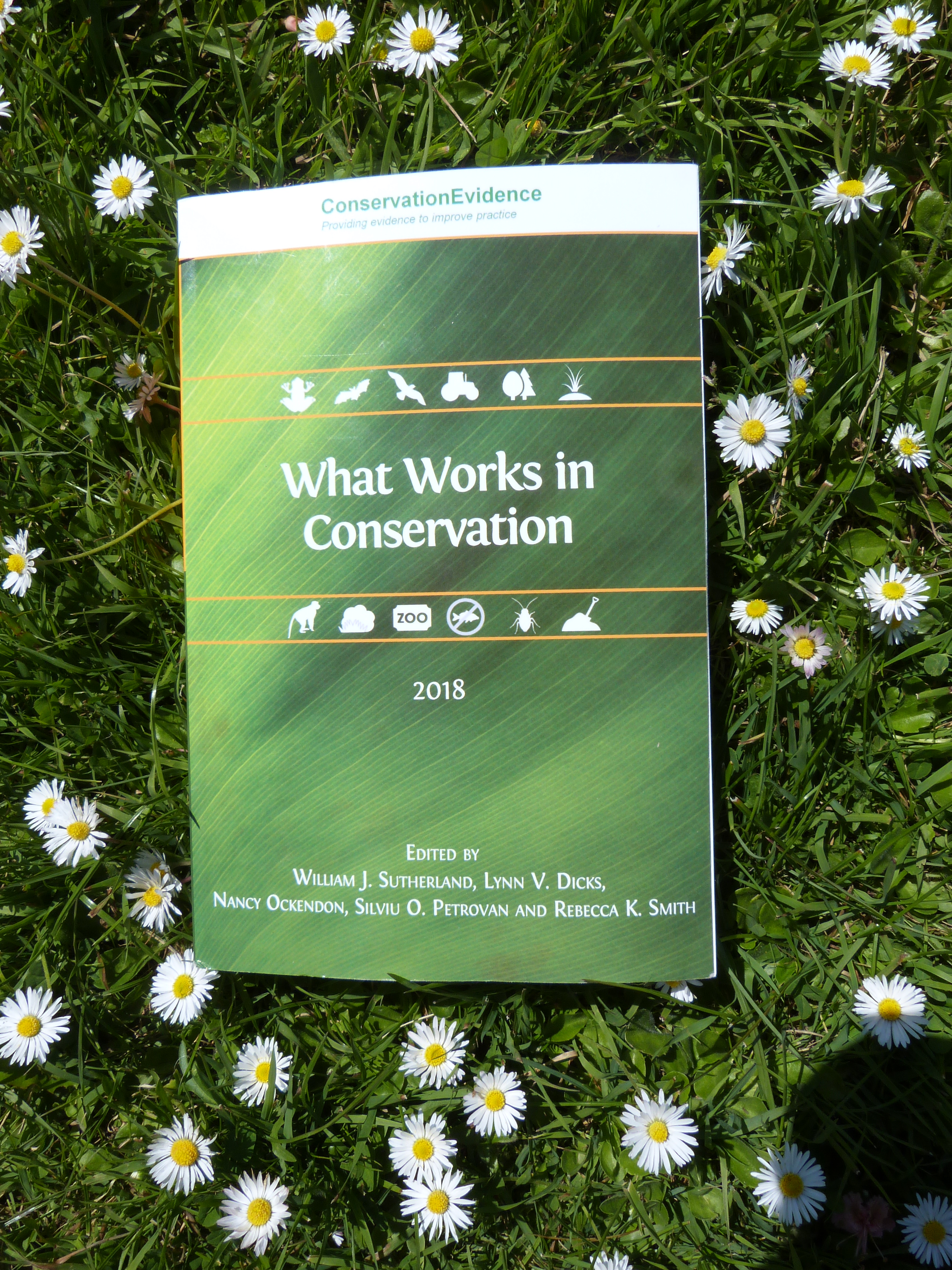









 ConservationBytes.com