Greater death rates for invasive rabbits from interacting diseases

30 05 2018

When it comes to death rates for invasive European rabbits (Oryctolagus cuniculus) in Australia, it appears that 1 + 1 = 2.1.

Pt tagged rab with RHD+myxo 1 10-08

Tagged European rabbit kitten infected with myxoma virus, but that died from rabbit haemorrhagic virus disease (RHDV). Photo by David Peacock, Biosecurity South Australia.

“Canberra, we have a problem” — Sure, it’s an old problem and much less of one than it used to be back in the 1950s, but invasive rabbits are nonetheless an ecological, conservation, and financial catastrophe across Australia.

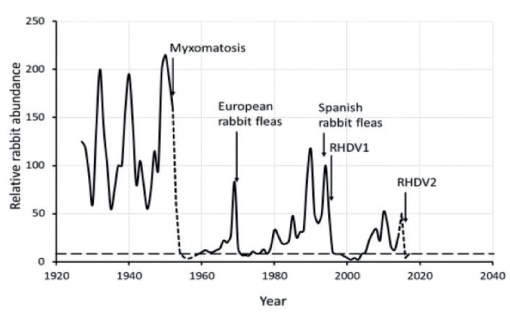
relative rabbit abundance South Australia

Semi-schematic diagram, redrawn using data from Saunders and others and extended to include the recent spread of RHDV2, showing changes in rabbit abundance in relation to the introduction of biological control agents into north-eastern South Australia. Dotted lines indicate uncertainty due to lack of continuous annual data. The broken line indicates a level of about 0.5 rabbits ha-1, below which rabbits must be held to ensure recovery of native pastures and shrubs (from B. Cooke 2018 Vet Rec doi:10.1136/vr.k2105)

Rabbits used to reach plague numbers in much of agricultural and outback Australia, but the introduction and clever manipulation of two rather effective rabbit-specific viruses and insect vectors — first, myxoma virus in 1950, European rabbit fleas in the 1960s to help spread the virus, then Spanish rabbit fleas in the 1990s to increase spread into arid areas, and then rabbit haemorrhagic disease virus (RHDV) in 1995 — have been effective in dropping rabbit abundances by an estimated 75-80% in South Australia alone since the 1950s.

Read the rest of this entry »


The Effective Scientist

22 03 2018

final coverWhat is an effective scientist?

The more I have tried to answer this question, the more it has eluded me. Before I even venture an attempt, it is necessary to distinguish the more esoteric term ‘effective’ from the more pedestrian term ‘success’. Even ‘success’ can be defined and quantified in many different ways. Is the most successful scientist the one who publishes the most papers, gains the most citations, earns the most grant money, gives the most keynote addresses, lectures the most undergraduate students, supervises the most PhD students, appears on the most television shows, or the one whose results improves the most lives? The unfortunate and wholly unsatisfying answer to each of those components is ‘yes’, but neither is the answer restricted to the superlative of any one of those. What I mean here is that you need to do reasonably well (i.e., relative to your peers, at any rate) in most of these things if you want to be considered ‘successful’. The relative contribution of your performance in these components will vary from person to person, and from discipline to discipline, but most undeniably ‘successful’ scientists do well in many or most of these areas.

That’s the opening paragraph for my new book that has finally been release for sale today in the United Kingdom and Europe (the Australasian release is scheduled for 7 April, and 30 April for North America). Published by Cambridge University Press, The Effective ScientistA Handy Guide to a Successful Academic Career is the culmination of many years of work on all the things an academic scientist today needs to know, but was never taught formally.

Several people have asked me why I decided to write this book, so a little history of its genesis is in order. I suppose my over-arching drive was to create something that I sincerely wish had existed when I was a young scientist just starting out on the academic career path. I was focussed on learning my science, and didn’t necessarily have any formal instruction in all the other varied duties I’d eventually be expected to do well, from how to write papers efficiently, to how to review properly, how to manage my grant money, how to organise and store my data, how to run a lab smoothly, how to get the most out of a conference, how to deal with the media, to how to engage in social media effectively (even though the latter didn’t really exist yet at the time) — all of these so-called ‘extra-curricular’ activities associated with an academic career were things I would eventually just have to learn as I went along. I’m sure you’ll agree, there has to be a better way than just muddling through one’s career picking up haphazard experience. Read the rest of this entry »


Offshore Energy & Marine Spatial Planning

22 02 2018

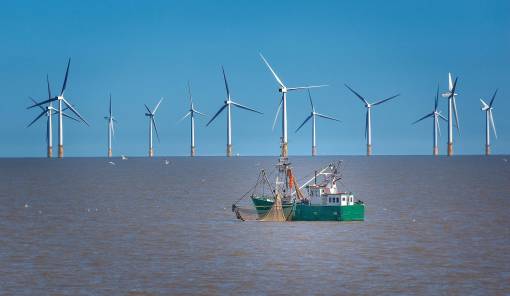
FishingOffshoreWind

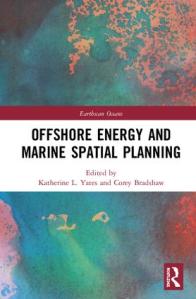
I have the pleasure (and relief) of announcing a new book that’s nearly ready to buy, and I think many readers of CB.com might be interested in what it describes. I know it might be a bit premature to announce it, but given that we’ve just finished the last few details (e.g., and index) and the book is ready to pre-order online, I don’t think it’s too precocious to advertise now.

9781138954533-2

A little history is in order. The brilliant and hard-working Katherine Yates (now at the University of Salford in Manchester, UK) approached me back in 2014 to assist her with co-editing the volume that she wanted to propose for the Routledge Earthscan Ocean series. I admit that I reluctantly agreed at the time, knowing full well what was in store (anyone who has already edited a book will know what I mean). Being an active researcher in energy and biodiversity (perhaps not so much on the ‘planning’ side per se) certainly helped in my decision.

And yes, there were ups and downs, and sometimes it was a helluva lot of work, but Katherine certainly made my life easier, and she has finally driven the whole thing to completion. She deserves most of the credit.

Read the rest of this entry »


Postdoctoral position re-opened in Global Ecology

18 10 2017

women-are-better-codersI believe it is important to clarify a few things about the job advertisement that we are re-opening.

As many of you might recall, we advertised two positions in paleo-ecological modelling back in July — one in ecological networks, and the other in vegetation modelling.

We decided to do something a little unusual with the vegetation modelling position by only accepting applications from women. We did this expressly to increase the probability of attracting excellent women candidates, and to increase the number of women scientists in our lab.

I’m happy to say that we received many great applications for both positions, and whether or not it was related, most of the applicants for both positions were women (83%). As it turned out, we ended up offering the network position to a woman applicant, but we were unable to find an ideal candidate for the vegetation modelling job (i.e., the one that was originally targeting women only).

Our decision not to appoint anyone in the first round of applicants for the vegetation modelling position was clearly not related to the fact that it a woman-only position, mainly because we had so many excellent women candidates for both positions (and ended up hiring a woman for the position that was open to both genders). In other words, it seems to be a just one of those random things.

That said, we are still in need of a great vegetation modeller (or at least, someone who has the capacity to learn this knowledge), and so we have decided to re-open the announcement to both genders. However, it should go without saying that we particularly encourage women to apply.

The full details of the position, essential and desired criteria, and application process are available here (Vacancy Reference Number 17115). Note that the application closing date is 15 November 2017.

Please distribute this widely among your networks.

CJA Bradshaw


Two new postdoctoral positions in ecological network & vegetation modelling announced

21 07 2017

19420366_123493528240028_621031473222812853_n

With the official start of the new ARC Centre of Excellence for Australian Biodiversity and Heritage (CABAH) in July, I am pleased to announce two new CABAH-funded postdoctoral positions (a.k.a. Research Associates) in my global ecology lab at Flinders University in Adelaide (Flinders Modelling Node).

One of these positions is a little different, and represents something of an experiment. The Research Associate in Palaeo-Vegetation Modelling is being restricted to women candidates; in other words, we’re only accepting applications from women for this one. In a quest to improve the gender balance in my lab and in universities in general, this is a step in the right direction.

The project itself is not overly prescribed, but we would like something along the following lines of inquiry: Read the rest of this entry »


Job: Research Fellow in Palaeo-Ecological Modelling

13 04 2017

© seppo.net

I have another postdoctoral fellowship to advertise! All the details you need for applying are below.

KEY PURPOSE 

Scientific data such as fossil and archaeological records used as proxy to reconstruct past environments and biological communities (including humans) are sparse, often ambiguous or contradictory when establishing any consensus on timing or routes of initial human arrival and subsequent spread, the timing or extent of major changes in climate and other environmental perturbations, or the timing or regional pattern of biological extinctions.

The Research Fellow (Palaeo-Ecological Modelling) will assist in addressing these problems by developing state-of-the-art analytical and simulation tools to infer regional pattern of both the timing of human colonisation and megafauna extinction based on incomplete and sparse dataset, and investigating past environmental changes and human responses to identify their underlying causes and consequences on Australia’s landscapes, biodiversity and cultural history.

ORGANISATIONAL ENVIRONMENT 

The position will be based in the School of Biological Sciences in the Faculty of Science & Engineering at Flinders University. Flinders University boasts a world-class Palaeontology Research Group (PRG) and the new Global Ecology Research Laboratory that have close association with the research-intensive South Australian Museum. These research groups contribute to building a dynamic research environment that explores the continuum of environmental and evolutionary research from the ancient to modern molecular ecology and phylogeography. The School of Biological Sciences is an integrated community researching and teaching biology, and has a long history of science innovation. The appointee will join an interdisciplinary school of approximately 45 academic staff. The teaching and research activities of the School are supported by a range of technical and administrative infrastructure services.

KEY RESPONSIBILITIES

The key responsibilities and selection criteria identified for this position should be read in conjunction with the Flinders University Academic Profiles for the relevant academic classification (scroll down to Academic Profiles).

The Research Fellow (Palaeo-Ecological Modelling) will work under the direction of the Project Chief Investigator, and will be required to: Read the rest of this entry »


Not 100% renewable, but 0% carbon

5 04 2017

635906686103388841-366754148_perfection1Anyone familiar with this blog and our work on energy issues will not be surprised by my sincere support of nuclear power as the only realistic solution to climate change in the electricity (and possibly transport and industrial heat) arena. I’ve laid my cards on the table in the peer-reviewed literature (e.g., see here, here, here, here, here & here) and the standard media, and I’ve even joined the board of a new environmental NGO that supports nuclear.

And there is hope, despite the ever-increasing human population, rising consumerism, dwindling resources, and the ubiquity of ideologically driven and ethically compromised politicians. I am hopeful for several reasons, including rising safety and reliability standards of modern nuclear technology, the continued momentum of building new fission reactors in many countries, and even the beginnings of real conversations about nuclear power (or at least, the first steps toward this) in countries where nuclear energy is currently banned (e.g., Australia). I’m also heartened by the fact that nearly every conservation scientists with whom I speak is generally supportive, or at least non-resistant, to the idea of nuclear power as part of the climate change solution. An open letter by our colleagues attests to this. In fact, every day that passes brings new evidence that we cannot ignore this solution any longer.

Even despite the evidence in support of implementing a strong nuclear component into climate change-mitigation strategies, one of the most frequent arguments for not doing so is that society can achieve all of its energy needs and simultaneously combat climate change by constructing 100% renewable-energy pathways. While it is an easy mantra to repeat because it feels right intrinsically to nearly everyone with an environmental conscience, as a scientist I also had to ask if such a monumental task is even technically feasible. Read the rest of this entry »


Job: Research Associate in Eco-epidemiological modelling

3 03 2017
myxo-rabbit

European rabbit infected with myxomatosis

Earlier this week I advertised two new PhD scholarships in palaeo-ecological modelling. Now we are pleased to advertise a six-month Research Associate position in eco-epidemiological modelling.

The position will be based in the School of Biological Sciences at Flinders University. Flinders University offers a dynamic research environment that explores the continuum of environmental and evolutionary research from the ancient to modern ecology. The School of Biological Sciences is an integrated community researching and teaching biology, and has a long history of science innovation.

Project background

Since 1996, Biosecurity South Australia has been running a capture-mark-recapture study on a European rabbit (Oryctolagus cuniculus) population located at Turretfield (~ 50 km north of Adelaide). Now into the 21st year, this is one of the world’s longest studies of its kind. Approximately every 8 weeks cage traps are reset and the population trapped over five days, with the captured rabbits weighed, sexed, tagged and blood-sampled. The study was established to investigate the epidemiology and efficacy of the two imported rabbit biocontrol agents, rabbit haemorrhagic disease virus (RHDV) and myxomatosis. To date, from 119 formal trapping events and RHDV-outbreak carcass-sampling trips, > 4500 rabbits have been monitored with > 8700 cELISA RHDV antibody tests and 7500 IgG, IgM and IgA RHDV antibody tests on sera (similarly for myxomatosis), and 111 RHDV-specific polymerase chain reaction (PCR) analyses run on tissue samples of the sampled rabbits. This represents an unparalleled dataset on rabbit survival, population fluctuations and disease dynamics. Read the rest of this entry »


One-two carbon punch of defaunation

30 04 2016

1-2 punchI’ve just read a well-planned and lateral-thinking paper in Nature Communications that I think readers of CB.com ought to appreciate. The study is a simulation of a complex ecosystem service that would be nigh impossible to examine experimentally. Being a self-diagnosed fanatic of simulation studies for just such purposes, I took particular delight in the results.

In many ways, the results of the paper by Osuri and colleagues are intuitive, but that should never be a reason to avoid empirical demonstration of a suspected phenomenon because intuition rarely equals fact. The idea itself is straightforward, but takes more than a few logical steps to describe: Read the rest of this entry »


How to find fossils

30 03 2016

Many palaeontologists and archaeologists might be a little put out by the mere suggestion that they can be told by ecologists how to do their job better. That is certainly not our intention.

Like fossil-hunting scientists, ecologists regularly search for things (individuals of species) that are rare and difficult to find, because surveying the big wide world for biodiversity is a challenge that we have faced since the dawn of our discipline. In fact, much of the mathematical development of ecology stems from this probabilistic challenge — for example, species distribution models are an increasingly important component of both observational and predictive ecology.

IMG_1277But the palaeo types generally don’t rely on mathematical models to ‘predict’ where fossils might be hiding just under the surface. Even I’ve done what most do when trying to find a fossil — go to a place where fossils have already been found and start fossicking. I’ve done this now with very experienced sedimentary geologists in the Flinders Rangers looking for 550 million year-old Ediacaran fossils, and most recently searching for Jurassic fossils (mainly ammonites) on the southern coast of England (Devon’s Jurassic Coast). My prized ammonite find is shown in the photo to the left.

If you’ve read anything on this blog before, you’ll probably know that I’m getting increasingly excited about palaeo-ecology, with particular emphasis on Australia’s late-Pleistocene and early Holocene mass-extinction of megafauna. So with a beautiful, brand-new, shiny, and quality-rated megafauna dataset1, we cheekily decided to take fossil hunting to the next level by throwing mathematics at the problem.

Just published2 in PloS One, I’m happy to announce our newest paper entitled Where to dig for fossils: combining climate-envelope, taphonomy and discovery models.

Of course, we couldn’t just treat fossil predictions like ecological ones — there are a few more steps involved because we are dealing with long-dead specimens. Our approach therefore involved three steps: Read the rest of this entry »


Sensitive numbers

22 03 2016
toondoo.com

A sensitive parameter

You couldn’t really do ecology if you didn’t know how to construct even the most basic mathematical model — even a simple regression is a model (the non-random relationship of some variable to another). The good thing about even these simple models is that it is fairly straightforward to interpret the ‘strength’ of the relationship, in other words, how much variation in one thing can be explained by variation in another. Provided the relationship is real (not random), and provided there is at least some indirect causation implied (i.e., it is not just a spurious coincidence), then there are many simple statistics that quantify this strength — in the case of our simple regression, the coefficient of determination (R2) statistic is a usually a good approximation of this.

In the case of more complex multivariate correlation models, then sometimes the coefficient of determination is insufficient, in which case you might need to rely on statistics such as the proportion of deviance explained, or the marginal and/or conditional variance explained.

When you go beyond this correlative model approach and start constructing more mechanistic models that emulate ecological phenomena from the bottom-up, things get a little more complicated when it comes to quantifying the strength of relationships. Perhaps the most well-known category of such mechanistic models is the humble population viability analysis, abbreviated to PVA§.

Let’s take the simple case of a four-parameter population model we could use to project population size over the next 10 years for an endangered species that we’re introducing to a new habitat. We’ll assume that we have the following information: the size of the founding (introduced) population (n), the juvenile survival rate (Sj, proportion juveniles surviving from birth to the first year), the adult survival rate (Sa, the annual rate of surviving adults to year 1 to maximum longevity), and the fertility rate of mature females (m, number of offspring born per female per reproductive cycle). Each one of these parameters has an associated uncertainty (ε) that combines both measurement error and environmental variation.

If we just took the mean value of each of these three demographic rates (survivals and fertility) and project a founding population of = 10 individuals for 1o years into the future, we would have a single, deterministic estimate of the average outcome of introducing 10 individuals. As we already know, however, the variability, or stochasticity, is more important than the average outcome, because uncertainty in the parameter values (ε) will mean that a non-negligible number of model iterations will result in the extinction of the introduced population. This is something that most conservationists will obviously want to minimise.

So each time we run an iteration of the model, and generally for each breeding interval (most often 1 year at a time), we choose (based on some random-sampling regime) a different value for each parameter. This will give us a distribution of outcomes after the 10-year projection. Let’s say we did 1000 iterations like this; taking the number of times that the population went extinct over these iterations would provide us with an estimate of the population’s extinction probability over that interval. Of course, we would probably also vary the size of the founding population (say, between 10 and 100), to see at what point the extinction probability became acceptably low for managers (i.e., as close to zero as possible), but not unacceptably high that it would be too laborious or expensive to introduce that many individuals. Read the rest of this entry »



No evidence climate change is to blame for Australian megafauna extinctions

29 01 2016

bw spear throwingLast July I wrote about a Science paper of ours demonstrating that there was a climate-change signal in the overall extinction pattern of megafauna across the Northern Hemisphere between about 50,000 and 10,000 years ago. In that case, it didn’t have anything to do with ice ages (sorry, Blue Sky Studios); rather, it was abrupt warming periods that exacerbated the extinction pulse instigated by human hunting.

Contrary to some appallingly researched media reports, we never claimed that these extinctions arose only from warming, because the evidence is more than clear that humans were the dominant drivers across North America, Europe and northern Asia; we simply demonstrated that warming periods had a role to play too.

A cursory glance at the title of this post without appreciating the complexity of how extinctions happen might lead you to think that we’re all over the shop with the role of climate change. Nothing could be farther from the truth.

Instead, we report what the evidence actually says, instead of making up stories to suit our preconceptions.

So it is with great pleasure that I report our new paper just out in Nature Communications, led by my affable French postdoc, Dr Frédérik SaltréClimate change not to blame for late Quaternary megafauna extinctions in Australia.

Of course, it was a huge collaborative effort by a crack team of ecologists, palaeontologists, geochronologists, paleo-climatologists, archaeologists and geneticists. Only by combining the efforts of this diverse and transdisciplinary team could we have hoped to achieve what we did. Read the rest of this entry »


Ice Age? No. Abrupt warmings and hunting together polished off Holarctic megafauna

24 07 2015
Oh shit oh shit oh shit ...

Oh shit oh shit oh shit …

Did ice ages cause the Pleistocene megafauna to go extinct? Contrary to popular opinion, no, they didn’t. But climate change did have something to do with them, only it was global warming events instead.

Just out today in Science, our long-time-coming (9 years in total if you count the time from the original idea to today) paper ‘Abrupt warmings drove Late Pleistocene Holarctic megafaunal turnover‘ demonstrates for the first time that abrupt warming periods over the last 60,000 years were at least partially responsible for the collapse of the megafauna in Eurasia and North America.

You might recall that I’ve been a bit sceptical of claims that climate changes had much to do with megafauna extinctions during the Late Pleistocene and early Holocene, mainly because of the overwhelming evidence that humans had a big part to play in their demise (surprise, surprise). What I’ve rejected though isn’t so much that climate had nothing to do with the extinctions; rather, I took issue with claims that climate change was the dominant driver. I’ve also had problems with blanket claims that it was ‘always this’ or ‘always that’, when the complexity of biogeography and community dynamics means that it was most assuredly more complicated than most people think.

I’m happy to say that our latest paper indeed demonstrates the complexity of megafauna extinctions, and that it took a heap of fairly complex datasets and analyses to demonstrate. Not only were the data varied – the combination of scientists involved was just as eclectic, with ancient DNA specialists, palaeo-climatologists and ecological modellers (including yours truly) assembled to make sense of the complicated story that the data ultimately revealed. Read the rest of this entry »


An appeal to extinction chronologists

2 06 2015

u7Pi3Extinction is forever, right? Yes, it’s true that once the last individual of a species dies (apart from insane notions that de-extinction will do anything to resurrect a species in perpetuity), the species is extinct. However, the answer can also be ‘no’ when you are limited by poor sampling. In other words, when you think something went extinct when in reality you just missed it.

Most of you are familiar with the concept of Lazarus1 species – when we’ve thought of something long extinct that suddenly gets re-discovered by a wandering naturalist or a wayward fisher. In paleontological (and modern conservation biological) terms, the problem is formally described as the ‘Signor-Lipps’ effect, named2 after two American palaeontologists, Phil Signor3 and Jere Lipps. It’s a fairly simple concept, but it’s unfortunately ignored in most palaeontological, and to a lesser extent, conservation studies.

The Signor-Lipps effect arises because the last (or first) evidence (fossil or sighting) of a species presence has a nearly zero chance of heralding its actual timing of extinction (or appearance). In paleontological terms, it’s easy to see why. Fossilisation is in fact a nearly impossible phenomenon – all the right conditions have to be in place for a once-living biological organism to be fossilised: it either has to be buried quickly, in a place where nothing can decompose it (usually, an anoxic environment), and then turned to rock by the process of mineral replacement. It then has to resist transformation by not undergoing metamorphosis (e.g., vulcanism, extensive crushing, etc.). For more recent specimens, preservation can occur without the mineralisation process itself (e.g., bones or flesh in an anoxic bog). Then the bloody things have to be found by a diligent geologist or palaeontologist! In other words, the chances that any one organism is preserved as a fossil after it dies are extremely small. In more modern terms, individuals can go undetected if they are extremely rare or remote, such that sighting records alone are usually insufficient to establish the true timing of extinction. The dodo is a great example of this problem. Remember too that all this works in reverse – the first fossil or observation is very much unlikely to be the first time that the species was there. Read the rest of this entry »


What’s in a name? The dingo’s sorry saga

30 01 2015

bad dingoThe more I delve into the science of predator management, the more I realise that the science itself takes a distant back seat to the politics. It would be naïve to think that the management of dingoes in Australia is any more politically charged than elsewhere, but once you start scratching beneath the surface, you quickly realise that there’s something rotten in Dubbo.

My latest contribution to this saga is a co-authored paper led by Dale Nimmo of Deakin University (along with Simon Watson of La Trobe and Dave Forsyth of Arthur Rylah) that came out just the other day. It was a response to a rather dismissive paper by Matt Hayward and Nicky Marlow claiming that all the accumulated evidence demonstrating that dingoes benefit native biodiversity was somehow incorrect.

Their two arguments were that: (1) dingoes don’t eradicate the main culprits of biodiversity decline in Australia (cats & foxes), so they cannot benefit native species; (2) proxy indices of relative dingo abundance are flawed and not related to actual abundance, so all the previous experiments and surveys are wrong.

Some strong accusations, for sure. Unfortunately, they hold no water at all. Read the rest of this entry »


Using ecological theory to make more money

1 12 2014

huge.9.46974Let’s face it: Australia doesn’t have the best international reputation for good ecological management. We’ve been particularly loathsome in our protection of forests, we have an appalling record of mammal extinctions, we’re degenerate water wasters and carbon emitters, our country is overrun with feral animals and weeds, and we have a long-term love affair with archaic, deadly, cruel, counter-productive and xenophobic predator management. To top it all off, we have a government hell-bent on screwing our already screwed environment even more.

Still, we soldier on and try to fix the damages already done or convince people that archaic policies should be scrapped and redrawn. One such policy that I’ve written about extensively is the idiocy and cruelty of the dingo fence.

The ecological evidence that dingoes are good for Australian wildlife and that they pose less threat to livestock than purported by some evidence-less graziers is becoming too big to ignore any longer. Poisoning and fencing are not only counter-productive, they are cruel, ineffective and costly.

So just when ecologists thought that dingoes couldn’t get any cooler, out comes our latest paper demonstrating that letting dingoes do their thing results in a net profit for cattle graziers.

Come again? Read the rest of this entry »


Human population size: speeding cars can’t stop quickly

28 10 2014

Stop breeding cartoon-Steve Bell 1994Here at ConservationBytes.com, I write about pretty much anything that has anything remotely to do with biodiversity’s prospects. Whether it is something to do with ancient processes, community dynamics or the wider effects of human endeavour, anything is fair game. It’s a little strange then that despite cutting my teeth in population biology, I have never before tackled human demography. Well as of today, I have.

The press embargo has just lifted on our (Barry Brook and my) new paper in PNAS where we examine various future scenarios of the human population trajectory over the coming century. Why is this important? Simple – I’ve argued before that we could essentially stop all conservation research tomorrow and still know enough to deal with most biodiversity problems. If we could only get a handle on the socio-economic components of the threats, then we might be able to make some real progress. In other words, we need to find out how to manage humans much more than we need to know about the particulars of subtle and complex ecological processes to do the most benefit for biodiversity. Ecologists tend to navel-gaze in this arena far too much.

So I called my own bluff and turned my attention to humans. Our question was simple – how quickly could the human population be reduced to a more ‘sustainable’ size (i.e., something substantially smaller than now)? The main reason we posed that simple, yet deceptively loaded question was that both of us have at various times been faced with the question by someone in the audience that we were “ignoring the elephant in the room” of human over-population.

Read the rest of this entry »


Western Australia’s moronic shark cull

4 07 2014

another stupid politicianA major media release today coordinated by Jessica Meeuwig in Western Australia makes the (obvious) point that there’s no biological justification to cull sharks.

301 Australian and International Scientists experts have today provided their submission to the Western Australia Environmental Protection Authority (EPA), rejecting the scientific grounds for the proposed three-year drum-line programme.

Coordinating scientist, Professor Jessica Meeuwig from the University of Western Australia said:

“To have over 300 researchers, including some of the world’s top shark specialists and marine ecologists, all strongly agreeing that there is no scientific basis for the lethal drum-line programme, tells you how unjustified the government’s proposal is. If the EPA and the Federal Minister for the Environment are using science for decisions, the drum-line proposal should not be approved.”

The experts agree that the proposal presents no evidence that the lethal drum-line programme, as implemented, will improve ocean safety. It ignores evidence from other hook-based programs in Hawaii and Queensland that have been shown to be ineffective in reducing shark attacks on humans.

Dr. Christopher Neff from the University of Sydney stated:

“There is no evidence that drum lines reduce shark bites. The Western Australia EPA now faces a question of science versus politics with global implications because it is considering establishing a new international norm that would allow for the killing of protected white sharks.”

The drum lines are ineffective and indiscriminate, with 78% of the sharks captured not considered ‘threatening’ to humans. Yet, scientifically supported, non-lethal alternatives such as the South African ‘Shark Spotter’ and Brazil’s ‘Tag and Remove’ programmes are not adequately assessed as viable options for Western Australia. Read the rest of this entry »


School finishers and undergraduates ill-prepared for research careers

22 05 2014

bad mathsHaving been for years now at the pointy end of the educational pathway training the next generation of scientists, I’d like to share some of my observations regarding how well we’re doing. At least in Australia, my realistic assessment of science education is: not well at all.

I’ve been thinking about this for some time, but only now decided to put my thoughts into words as the train wreck of our current government lurches toward a future guaranteeing an even stupider society. Charging postgraduate students to do PhDs for the first time, encouraging a US-style system of wealth-based educational privilege, slashing education budgets and de-investing in science while promoting the belief in invisible spaghetti monsters from space, are all the latest in the Fiberal future nightmare that will change our motto to “Australia – the stupid country”.

As you can appreciate, I’m not filled with a lot of hope that the worrying trends I’ve observed over the past 10 years or so are going to get any better any time soon. To be fair though, the problems go beyond the latest stupidities of the Fiberal government.

My realisation that there was a problem has crystallised only recently as I began to notice that most of my lab members were not Australian. In fact, the percentage of Australian PhD students and post-doctoral fellows in the lab usually hovers around 20%. Another sign of a problem was that even when we advertised for several well-paid postdoctoral positions, not a single Australian made the interview list (in fact, few Australians applied at all). I’ve also talked to many of my colleagues around Australia in the field of quantitative ecology, and many lament the same general trend.

Is it just poor mathematical training? Yes and no. Australian universities have generally lowered their entry-level requirements for basic maths, thereby perpetuating the already poor skill base of school leavers. Why? Bums (that pay) on seats. This means that people like me struggle to find Australian candidates that can do the quantitative research we need done. We are therefore forced to look overseas. Read the rest of this entry »


Ecological processes depend on …

14 05 2014
© Cagan Sekercioglu

© Cagan Sekercioglu

I have been known to say (ok – I say it all the time) that ecologists should never equivocate when speaking to the public. Whether it’s in a media release, blog post, television presentation or newspaper article, just stick to ‘yes’ or ‘no’. In other words, don’t qualify your answer with some horrid statistical statement (i.e., in 95% of cases …) or say something like “… but it really depends on …”. People don’t understand uncertainty – to most people, ‘uncertainty’ means “I don’t know” or worse, “I made it all up”.

But that’s only in the movies.

In real ‘ecological’ life, things are vastly different. It’s never as straightforward as ‘yes’ or ‘no’, because ecology is complex. There are times that I forget this important aspect when testing a new hypothesis with what seem like unequivocal data, but then reality always hits.

Our latest paper is the epitome of this emergent complexity from what started out as a fairly simple question using some amazing data. What makes birds change their range1? We looked at this question from a slightly different angle than had been done before because we had access to climate data, life-history data and most importantly, actual range change data. It’s that latter titbit that is typically missing from studies aiming to understand what drives species toward a particular fate; whether it’s a species distribution model predicting the future habitat suitability of some species as a function of climate change, or the past dynamics of some species related to its life history pace, most often the combined dynamics are missing. Read the rest of this entry »