Climate change is one ingredient of a cocktail of factors driving the ongoing destruction of pristine forests on Earth. We here highlight the main physiological challenges trees must face to deal with increasing drought and heat.

A common scene when we return from a long trip overseas is to find our indoor plants wilting if no one has watered them in our absence. But … what does a thirsty plant experience internally?
Like animals, plants have their own circulatory system and a kind of plant blood known as sap. Unlike the phloem (peripheral tissue underneath the bark of trunks and branches, and made up of arteries layered by live cells that transport sap laden with the products of photosynthesis, along with hormones and minerals — see videos here and here), the xylem is a network of conduits flanked by dead cells that transport water from the roots to the leaves through the core of the trunk of a tree (see animation here). They are like the pipes of a building within which small pressure differences make water move from a collective reservoir to every neighbours’ kitchen tap.
Water relations in tree physiology have been subject to a wealth of research in the last half a decade due to the ongoing die-off of trees in all continents in response to episodes of drought associated with temperature extremes, which are gradually becoming more frequent and lasting longer at a planetary scale (1).
Embolised trees
During a hot drought, trees must cope with a sequence of two major physiological challenges (2, 3, 4). More heat and less internal water increase sap tension within the xylem and force trees to close their stomata (5). Stomata are small holes scattered over the green parts of a plant through which gas and water exchanges take place. Closing stomata means that a tree is able to reduce water losses by transpiration by two to three orders of magnitude. However, this happens at the expense of halting photosynthesis, because the main photosynthetic substrate, carbon dioxide (CO2), uses the same path as water vapour to enter and leave the tissues of a tree.
If drought and heat persist, sap tension reaches a threshold leading to cavitation or formation of air bubbles (6). Those bubbles block the conduits of the xylem such that a severe cavitation will ultimately cause overall hydraulic failure. Under those conditions, the sap does not flow, many parts of the tree dry out gradually, structural tissues loose turgor and functionality, and their cells end up dying. Thus, the aerial photographs showing a leafy blanket of forest canopies profusely coloured with greys and yellows are in fact capturing a Dantesque situation: trees in photosynthetic arrest suffering from embolism (the plant counterpart of a blood clot leading to brain, heart or pulmonary infarction), which affects the peripheral parts of the trees in the first place (forest dieback).
Read the rest of this entry »


 This might seem a little left-of-centre for
 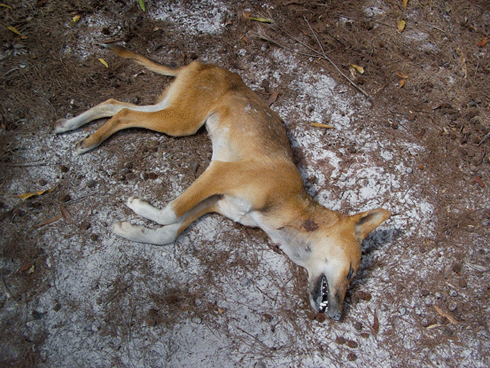 So, a few of us have just submitted a letter contesting the Western Australia Government’s recent decision to delist dingoes as ‘fauna’ (I know — what the hell else could they be?). The letter was organised brilliantly by Dr


 What do you say to a man whose list of conservation awards reads like a Star Wars film intro, who has introduced terms like the ‘hyperdynamism hypothesis’ to the field of ecology, and whose organisation reaches over one million people each week with updates of the scientific kind?








 Last year I